Aquatic Phytoremediation by Accumulator Plants
R.R. Brooks and B.H. Robinson
Department of Soil Science, Massey University, Palmerston North, New Zealand
1Introduction引言
Phytoremediation of metal-contaminated waters is readily achieved by use of aquatic and terrestrial plants because there is no problem of bioavailability of the target element. In terrestrial systems involving hyperaccumulator plants growing over polluted soils, the plant must first solubilise the target element in the rhizosphere and then have the ability to transport it to the aerial tissues. No such problem exists when the plant grows naturally, or is made to grow in, or on, an aqueous medium. It is not surprising therefore that some quite spectacular hyperaccumulations of heavy metals from aqueous systems can be achieved, and indeed this has been known for at least 50 years.
利用水生植物和陆生植物对金属污染水体进行植物修复较易实现,因为目标元素不存在生物有效性问题。在超富集植物生长于污染土壤的陆地系统中,植物必须首先在根际溶解目标元素,然后还须具备将其转运至地上组织的能力。当植物自然生长于水体介质之中或之上,或被人为置于其中或其上生长时,则不存在此类问题。因此,从水体系统中能够实现某些相当惊人的重金属超富集也就不足为奇,事实上这一现象至少在50年前即已为人所知。
In the treatment of the subject of aquatic phytoremediation systems, there are two natural divisions that involve: 1 - purely aquatic plants such as the floating water hyacinth (Eichhornia crassipes); 2 - submersion of the rhizosphere of terrestrial plants in order to remove metal pollutants (rhizofiltration). Each of these two subjects will be discussed independently below.
在论述水生植物修复系统时,可自然地划分为两类:1——纯水生植物,如漂浮的凤眼莲(Eichhornia crassipes);2——将陆生植物的根际浸没于水中以去除金属污染物(根际过滤)。下文将分别讨论这两个主题。
There is a vast literature on the subject of trace elements in marine plants (mainly seaweeds) but these are described separately in Chapter 5.
关于海洋植物(主要为海藻)中微量元素的文献极为丰富,但这些内容将在第5章中单独介绍。
Hyperaccumulation by Aquatic Plants水生植物的超富集作用
2Introduction引言
A useful review of hyperaccumulation of elements by aquatic plants (Outridge and Noller, 1991) is the basis of much of the material in this first section of this chapter. Freshwater vascular plants (FVPs) when combined with macroscopic algae are known collectively as macrophytes. Their ability to concentrate elements from the aquatic environment was first reviewed by Hutchinson (1975) who reported that levels of potentially toxic elements such as cadmium, lead and mercury were at least an order of magnitude higher than in the supporting aqueous medium.
Outridge and Noller(1991)对水生植物元素超富集作用所作的一篇有益综述,构成了本章第一节大部分内容的基础。淡水维管植物(FVPs)与大型藻类合称为大型水生植物。Hutchinson(1975)首次综述了其从水环境中富集元素的能力,报道镉、铅、汞等潜在有毒元素在其中的含量比所在水体介质至少高一个数量级。
203
Building on the review of Hutchinson (1975), Outridge and Noller (1991) sought to establish the following facts:
在Hutchinson(1975)综述的基础上,Outridge and Noller(1991)试图确定以下事实:
1 - the "normal" concentrations of selected elements in natural fresh water systems;
1——天然淡水系统中若干选定元素的“正常”浓度;
2 - "normal" levels of elements in macrophytes growing in uncontaminated ecosystems;
2——生长于未受污染生态系统中的大型水生植物体内元素的“正常”含量;
3 - the median and maximum concentrations of elements in macrophytes growing in contaminated waters;
3——生长于受污染水体中的大型水生植物体内元素的中位浓度和最高浓度;
4 - pathways and rates of elemental uptake and excretion;
4——元素吸收与排泄的途径和速率;
5 - environmental factors that control uptake of elements by these plants;
5——控制此类植物吸收元素的环境因素;
6 - the importance of these plants in terms of biogeochemistry or entry of trace elements into food chains;
6——此类植物在生物地球化学或微量元素进入食物链方面的重要性;
7 - elements that are the most toxic to FVPs and how this compares with their toxicity to algae;
7——对淡水维管植物毒性最强的元素,以及其与对藻类毒性的比较;
8 - the significance of trace element uptake for the field of wastewater treatment and biomonitoring of pollution.
8——微量元素吸收对废水处理及污染生物监测领域的意义。
In practical terms, the last topic is perhaps of greatest interest to scientists engaged in the theory and practice of bioremediation of aqueous systems and will be given some prominence in this chapter. It may be appropriate at this stage to define two of the terms used.
从实际角度看,最后一个主题或许最受从事水体系统生物修复理论与实践研究的科学家关注,本章将予以重点论述。此处宜先对所用的两个术语加以界定。
Freshwater vascular plants comprise mainly angiosperms (flowering plants) with a few fern species. They have a vascular system (xylem and phloem) as well as well defined roots. They exclude macroscopic algae.
淡水维管植物主要包括被子植物(有花植物)以及少数蕨类植物。它们具有维管系统(木质部和韧皮部)以及分化明确的根,不包括大型藻类。
Heavy metals is a term often used to describe some trace elements. It is an imprecise term that can include quite "light" elements such as copper. It has been suggested by Nieboer and Richardson (1980) that heavy metals are often associated with toxicity to biota, although some "heavy metals" such as manganese and uranium are not known to be particularly toxic to life forms. Life forms include:
“重金属”是常用于描述某些微量元素的术语。该术语并不严谨,可能包括铜等相当“轻”的元素。Nieboer and Richardson(1980)指出,重金属常与对生物的毒性相关联,但锰、铀等某些“重金属”并未被认为对生物类群具有特别的毒性。生活型包括:
1 - rooted emergents that are rooted in bottom sediments;
1——根植于底部沉积物中的有根挺水植物;
2 - free-floating emergents such as water hyacinth and duckweed that are not rooted in bottom sediments;
2——不根植于底部沉积物中的自由漂浮挺水植物,如凤眼莲和浮萍;
3 - rooted submergents with leaves and flowers under water; 4 - free-floating submergents;
3——叶和花均位于水下的有根沉水植物;4——自由漂浮沉水植物;
5 - rooted floating-leaved plants such as water lilies; 6 - free-floating floating-leaved plants.
5——有根浮叶植物,如睡莲;6——自由漂浮的浮叶植物。
Heavy metals in natural uncontaminated fresh water systems天然未受污染淡水系统中的重金属
The elemental composition of uncontaminated fresh waters has been calculated by Turekian (1969) and is shown in the second column of Table 9.1. The values are of course rather imprecise, partly because of analytical error involved in estimations in the ng/g (ppb) range and partly because of the problem of extrapolating to the entire fresh hydrosphere from a relatively small number of rivers.
Turekian(1969)计算了未受污染淡水的元素组成,结果列于表9.1第二列。这些数值当然不够精确,部分原因在于ng/g(ppb)范围内估算存在分析误差,部分原因则在于需由数量相对较少的河流外推至整个淡水水圈。
![Table 9.1. Elemental concentrations (ug/mL [waters] and ug/g dry weight for freshwater vascular plants - FVPs).](7/table-01.png)
A - uncontaminated river waters (Turekian, 1969), B - terrestrial plants (Bowen, 1966), C - median values for uncontaminated FVPs, D - median values for contaminated FVPs, E - maximum value for contaminated FVPs, C/A - accumulation factor for FVPs growing in uncontaminated waters. After: Outridge and Noller (1991).
A——未受污染的河水(Turekian, 1969),B——陆生植物(Bowen, 1966),C——未受污染淡水维管植物的中位值,D——受污染淡水维管植物的中位值,E——受污染淡水维管植物的最大值,C/A——生长于未受污染水体中的淡水维管植物的富集系数。引自:Outridge and Noller(1991)。
It will be seen from Table 9.1 that in natural uncontaminated fresh waters, elemental abundances are extremely low and in most cases are in the ng/mL (ug/L) range. Under these conditions, the FVPs appear to be invariably hyperaccumulators of the heavy metals even in the uncontaminated environment.
由表9.1可见,天然未受污染淡水中的元素丰度极低,多数处于ng/mL(μg/L)范围。在此条件下,即使在未受污染的环境中,淡水维管植物似乎也无一例外地是重金属的超富集植物。
Heavy metals in freshwater vascular plants
淡水维管植物中的重金属
Several patterns were established by Outridge and Noller (1991) using median values for the data shown in Table 9.1 and elsewhere in their paper.
Outridge and Noller(1991)利用表9.1及其论文其他部分所列数据的中位值,归纳出若干规律。
1 - manganese was the most strongly absorbed element followed in descending order by zinc, molybdenum, copper and lead;
1——锰是吸收最强的元素,其后依次为锌、钼、铜和铅;
2 - FVPs contained higher concentrations of Ag, As, Cd, Cr, Hg, Ni, Pb, Se and U than did terrestrial plants, whereas Co, Cu, Mn and V were similar in both groups.
2——淡水维管植物中Ag、As、Cd、Cr、Hg、Ni、Pb、Se和U的浓度高于陆生植物,而Co、Cu、Mn和V在两类植物中相近。
3 - concentrations of As, Cd, Co, Cr and U were generally higher in submerged plants than in other FVP life forms;
3——沉水植物中As、Cd、Co、Cr和U的浓度一般高于其他生活型的淡水维管植物;
4 - roots usually contained higher concentrations of heavy metals than above-ground plant parts;
4——根中重金属浓度通常高于地上部分;
5 - maximum elemental abundances in FVPs were usually one or two orders of magnitude higher than naturally occurring levels, though the median concentrations were not usually very different;
5——淡水维管植物中元素丰度的最大值通常比自然水平高一至两个数量级,但中位浓度通常差异不大;
A further observation needs to be made on the findings of Outridge and Noller (1991). The generally higher levels of elemental concentrations in roots would seem to indicate that these heavy metals are absorbed from the sediments rather than the waters. However, the sediments are in most cases derived from the settling of particulates from the waters and there must be some degree of constant proportionality between the two phases.
对于Outridge and Noller(1991)的研究结果,还需补充一点。根中元素浓度普遍较高,似乎表明这些重金属是从沉积物而非水体中吸收的。然而,沉积物多数由水中颗粒物沉降而来,因此两相之间必然存在一定程度的恒定比例关系。
Environmental and physiological factors affecting elemental toxicity and uptake by FVPs影响淡水维管植物元素毒性及吸收的环境与生理因素
Outridge and Noller (1991) have shown that heavy metal uptake and retention by FVPs and macrophytes in general, are controlled by four main factors:
Outridge and Noller(1991)指出,淡水维管植物以及大型水生植物总体对重金属的吸收和滞留受以下四个主要因素控制:
1 - sediment geochemistry;
2 - water physicochemistry;
3 - plant physiology;
4 - genotypic differences.
The first two control metal speciation in sediments and waters, whereas the last two control the ability of plants to accumulate plant-available forms of the metals.
前两个因素控制沉积物和水体中金属的形态,后两个因素则控制植物富集植物有效态金属的能力。
The question of speciation is very important in deciding to what extent a given elemental species will be taken up by macrophytes or be toxic to them. It is less understood that any given elemental species will have a whole range of different bioavailabilities because of physiological differences with respect to uptake sites and uptake mechanisms (Leppard, 1983).
形态问题对于判断某一元素形态在多大程度上被大型水生植物吸收或对其产生毒性至关重要。较少为人所知的是,由于吸收位点和吸收机制方面的生理差异,任一给定元素形态都会表现出一系列不同的生物有效性(Leppard, 1983)。
The bioavailability of elemental species to FVPs are less well understood than in the case of other aquatic biota such as fish. However, it is known that FVPs usually accumulate heavy metals by absorption followed by passive or active transport across membranes (Forstner and Wittman, 1981; Smies, 1983).
与鱼类等其他水生生物相比,人们对元素形态对淡水维管植物生物有效性的认识较为有限。然而已知淡水维管植物通常先吸附重金属,继而经由被动或主动跨膜运输加以富集(Forstner and Wittman, 1981; Smies, 1983)。
In their summary of their benchmark paper, Outridge and Noller (1991) showed that physicochemical factors that increase metal solubility (such as lake acidification) also increase elemental concentrations in FVPs presumably because of greater solubility of metals in the sediments.
Outridge and Noller(1991)在其具有标杆意义的论文总结中指出,提高金属溶解度的理化因素(如湖泊酸化)也会提高淡水维管植物中的元素浓度,这可能是由于沉积物中金属溶解度增大所致。
Aquo metal and soluble metal chelate complexes were the most plant-available forms, whereas metals in reducing sediments were almost completely unavailable to plants, perhaps because of the great insolubility of most metal sulphides.
水合金属离子和可溶性金属螯合物是植物最易利用的形态,而还原性沉积物中的金属几乎完全不能被植物利用,这可能是由于大多数金属硫化物溶解度极低。
Elemental levels in most macrophytes exhibited a typical seasonal pattern of a spring maximum followed by a steady decline during the summer. This was ascribed to environmentally driven physiological changes including translocation between above-ground and below-ground tissues. Iron root plaque displayed an important role in availability and uptake of elements from reduced sediments.
大多数大型水生植物中的元素含量呈现典型的季节变化规律,即春季达到最大值,随后在夏季持续下降。这被归因于环境驱动的生理变化,包括地上与地下组织之间的转运。根表铁膜对还原性沉积物中元素的有效性及吸收具有重要作用。
Macrophytes play an important role in sediment-water trace element cycling through root uptake, excretion into water and detrital absorption of metals that may be conveyed to the sediments. Elemental toxicity experiments have shown that Ag, As, Cr, Cu, Hg and Ni are about 10 times more toxic to macrophytes than are lead or zinc. Copper is one of the most toxic of these elements and its effects are visible at concentrations of 0.05-0.15 ug/mL. Compared with phytoplankton, macrophytes are 10-100 times less sensitive to most elements except copper to which they are equally sensitive.
大型水生植物通过根系吸收、向水体排泄以及碎屑对金属的吸附(这些金属可能被输送至沉积物),在沉积物—水体微量元素循环中发挥重要作用。元素毒性试验表明,Ag、As、Cr、Cu、Hg和Ni对大型水生植物的毒性约为铅或锌的10倍。铜是其中毒性最强的元素之一,在0.05–0.15 μg/mL浓度下即可观察到其效应。与浮游植物相比,大型水生植物对大多数元素的敏感性低10–100倍,但对铜的敏感性二者相当。
Practical applications of FVPs for water purity monitoring and decontamination淡水维管植物在水质监测和净化中的实际应用
Water purity monitoring水质监测
Freshwater vascular plants can be used for biomonitoring of contaminated waters and possess several innate advantages over algae:
淡水维管植物可用于受污染水体的生物监测,与藻类相比具有若干固有优势:
1 - they have longer life cycles;
1——生命周期较长;
2 - they have a higher degree of tolerance to most elements including those heavy metals largely responsible for pollution;;
2——对大多数元素(包括主要造成污染的重金属)具有较高的耐受性;
3 - their biomass is much larger than in the case of algae, so that a larger sample is available for chemical analysis.
3——生物量远大于藻类,因而可获得更多样品用于化学分析。
Phillips (1977) has proposed the following essential requirements for a suitable FVP biomonitor:
Phillips(1977)提出了合适的淡水维管植物生物监测种应满足的以下基本要求:
1 - the species must be endemic to the area;
1——该物种必须为当地特有种;
2 - it should be easily cultivated or abundant in the field;
2——应易于栽培或在野外数量丰富;
3 - it should concentrate the elements to above the threshold of the limits of detection of the analytical method that is to be employed;
3——其对元素的富集应超过拟采用分析方法的检出限阈值;
4 - there must be a statistically significant relationship between the abundance
4——植物中某一目标元素的丰度
of a given target element in the plant and its concentration level in the surrounding water.
与其在周围水体中的浓度水平之间必须存在统计学上显著的关系。
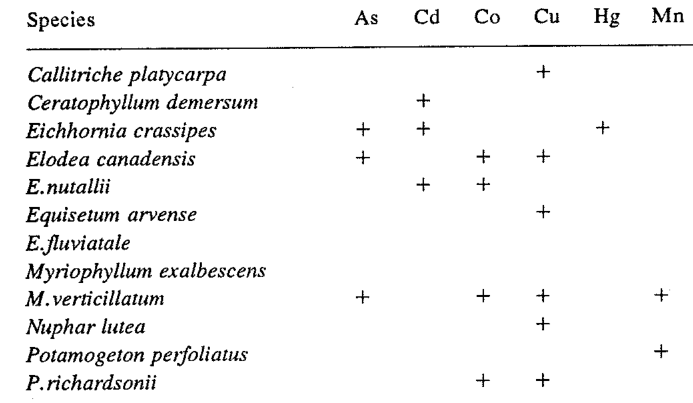
Several FVPs have been suggested as suitable for biomonitoring of trace elements in waters. These are summarised in Table 9.2 above. Some will also be discussed later in this chapter under the individual species.
已有若干淡水维管植物被认为适用于水体微量元素的生物监测,汇总于上文表9.2。其中部分物种还将在本章后文按物种分别讨论。
As pointed out by Outridge and Noller (1991), the species in Table 9.2 were sometimes selected on the basis of their very high accumulation of trace elements from the surrounding waters. This criterion is not necessarily valid as it is far more important that there be a statistically significant relationship between the plant-water system of elemental abundances.
正如Outridge and Noller(1991)所指出,表9.2中的物种有时是依据其从周围水体中大量富集微量元素而选定的。这一标准未必成立,因为更为重要的是植物—水体系统中元素丰度之间须存在统计学上显著的关系。
There is not usually a good correlation between elemental abundances in sediments and those in rooted aquatic plants. Indeed Campbell et al. (1985) found fewer than 30 significant correlations in the 100 cases that they investigated.
沉积物中的元素丰度与有根水生植物中的元素丰度之间通常不存在良好的相关性。事实上,Campbell et al.(1985)在其研究的100个案例中发现显著相关的不足30个。
For monitoring purposes, it seems logical that free-floating plants should be used in place of rooted species since such plants derive their nutrients solely from the water column. Sprenger and McIntosh (1989) found a significant relationship for the free-floating Utricularia purpurea.
就监测目的而言,以自由漂浮植物代替有根物种似乎更合乎逻辑,因为此类植物仅从水柱中获取养分。Sprenger and McIntosh(1989)发现自由漂浮的Utricularia purpurea存在显著相关关系。
Decontamination of polluted waters
污染水体的净化
The use of FVPs for removal of pollutants has been established for over 20 years following the pioneering work of Wolverton (1975), Wolverton and McDonald (1975a, 1975b) and Wolverton et al. (1975), several species, notably the water hyacinth (Eichhornia crassipes), have been proposed for this purpose and will be discussed further below.
自Wolverton(1975)、Wolverton and McDonald(1975a, 1975b)以及Wolverton et al.(1975)的开创性工作以来,利用淡水维管植物去除污染物的做法已确立20余年,已有若干物种被提议用于此目的,其中尤以凤眼莲(Eichhornia crassipes)为代表,下文将作进一步讨论。
There are two main ways in which FVPs may be used for remediation of polluted waters. The first of these involves monospecific pond cultures of free-floating plants such as water hyacinth. The plants accumulate the pollutants until a steady state of equilibrium is achieved. They are then harvested by removal from the pond.
利用淡水维管植物修复污染水体主要有两种方式。第一种是在池塘中单种培养自由漂浮植物,如凤眼莲。植物不断富集污染物直至达到稳态平衡,随后将其从池塘中移出收获。
There are various problems inherent in the above method. The first is associated with how to dispose of the waste matter. One solution was achieved at a sewage treatment plant where the toxic waste was used to generate methane gas. Further problems associated with the "free floating" procedures include the presence of unwanted pathogens that may destroy the whole of a monospecific culture and there is also the problem of continual harvesting that requires specialised equipment.
上述方法存在若干固有问题。首先是废弃物的处置问题。某污水处理厂的一种解决办法是利用这些有毒废弃物产生甲烷气体。“自由漂浮”方法的其他问题还包括:有害病原体可能毁灭整个单种培养群体;此外,持续收获需要专门设备。
The second methodology employing FVPs for pollutant removal involves growing rooted emergents in trickling bed filters. Uptake of trace elements in these systems is usually caused by rhizosphere microbes with relatively little uptake caused by the plants themselves. The rhizosphere methods do not necessarily have to employ FVPs and are discussed below in a separate section. There will now be a discussion of selected FVP species that have significant promise for phytoremediation of polluted waters.
利用淡水维管植物去除污染物的第二种方法是在滴滤床中种植有根挺水植物。在此类系统中,微量元素的去除通常由根际微生物引起,植物本身的吸收相对较少。根际方法不一定需要采用淡水维管植物,将在下文另节讨论。以下将讨论若干在污染水体植物修复方面具有显著潜力的淡水维管植物物种。
The water hyacinth (Eichhornia crassipes)凤眼莲(Eichhornia crassipes)
The water hyacinth is perhaps one of the most commonly cited species for phytoremediation of polluted waters (Gupta, 1980; McDonald and Wolverton, 1980). The plant has a rapid growth rate and can hyperaccumulate nutrients (Cornwell et al., 1977) as well as heavy metals (Wolverton, 1975; Wolverton et al., 1975).
凤眼莲或许是污染水体植物修复中最常被引用的物种之一(Gupta, 1980; McDonald and Wolverton, 1980)。该植物生长迅速,能够超富集营养元素(Cornwell et al., 1977)以及重金属(Wolverton, 1975; Wolverton et al., 1975)。
The water hyacinth has a number of problems that tend to hinder its commercial use. The first of these is that in many countries it is a noxious weed that has choked large areas of waterways. For example in Sudan it has completely covered a large area of the Nile River with a dense mat known as the sudd. A further disadvantage of this plant is that it will only grow in tropical or warm-temperate parts of the world that are frost-free in winter.
凤眼莲存在若干妨碍其商业应用的问题。首先,在许多国家它是一种有害杂草,已堵塞大面积水道。例如在苏丹,它以一种称为“sudd”的致密草垫完全覆盖了尼罗河的大片区域。该植物的另一缺点是仅能生长于冬季无霜冻的热带或暖温带地区。
As pointed out by Kay et al. (1984), much of the research on the water hyacinth has been faulty insofar as estimates of biomass production have been carried out in the field in unpolluted waters, whereas uptake experiments are usually carried out in the laboratory where there is concomitant, but unmeasured, reduction in biomass.
正如Kay et al.(1984)所指出,许多有关凤眼莲的研究存在缺陷:生物量产量的估算是在野外未受污染的水体中进行的,而吸收试验通常在实验室中开展,其间生物量会随之下降,但并未加以测定。
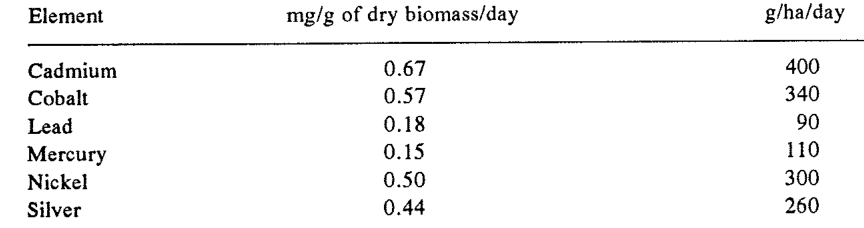
There is little doubt that there is a rapid rate of removal of heavy metals following absorption by the water hyacinth. This is demonstrated in Table 9.3 that shows the rate of removal of six heavy metals from a system in which the biomass production was 600 kg/ha/day.
毫无疑问,凤眼莲吸收重金属后可实现较高的去除速率。表9.3对此进行了说明,该表列出了生物量产量为600 kg/ha/day的系统中6种重金属的去除速率。
After: Outridge and Noller (1991).
引自:Outridge and Noller(1991)。
The effect of lead, copper and cadmium on metal uptake and growth of the water hyacinth was studied by Kay et al. (1984). Although lead had no effect on plant growth, they found that cadmium and copper were toxic to this plant and that the thresholds were respectively 0.5 and 1.0-2.0 ug/mL in the ambient water. Beyond the threshold concentrations the effects were chlorosis, suppressed development of new roots, and greatly reduced growth rates.
Kay et al.(1984)研究了铅、铜和镉对凤眼莲金属吸收及生长的影响。他们发现,铅对植物生长无影响,而镉和铜对该植物有毒,其阈值在环境水体中分别为0.5和1.0–2.0 μg/mL。超过阈值浓度后,表现为失绿、新根发育受抑以及生长速率大幅下降。
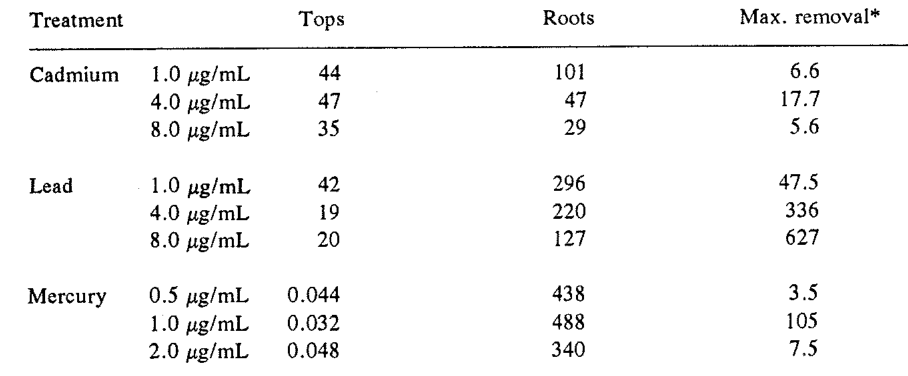
Muramoto and Oki (1983) studied the uptake of cadmium, lead and mercury by the water hyacinth. Their data are summarised in Table 9.4. The absorption factors appear to be quite low compared with the average of several thousand shown in Table 9.1. However, it must be remembered that the data were on a fresh-weight basis and that dry weights of aquatic plants are usually about 5% of the fresh weight. This would give concentration factors of the order of 1000 for the tops of plants growing in cadmium and lead, and about 5000 for the roots.
Muramoto and Oki(1983)研究了凤眼莲对镉、铅和汞的吸收,其数据汇总于表9.4。与表9.1所示数千的平均值相比,吸收系数似乎相当低。然而须注意,这些数据以鲜重计,而水生植物干重通常约为鲜重的5%。据此换算,生长于镉和铅溶液中的植物地上部富集系数约为1000量级,根部约为5000。
It can also be seen that increasing the heavy metal content of the aqueous medium actually has the effect of significant reduction of concentration factors owing to the toxicity of the metals concerned.
还可以看出,由于相关金属的毒性,提高水体介质中的重金属含量实际上会显著降低富集系数。
When the laboratory data were extrapolated to field conditions in Japan, Muramoto and Oki (1983) calculated (Table 9.4) the maximum removal of heavy metals from heavily contaminated waters. The findings are perhaps somewhat overoptimistic because we are again confronted here with the problems of extrapolating from the laboratory to the field where the biomass reported, was based on cultivation under metal-free conditions.
Muramoto and Oki(1983)将实验室数据外推至日本的野外条件,计算了从重度污染水体中去除重金属的最大量(表9.4)。这些结果可能略显乐观,因为此处再次面临由实验室外推至野外的问题,而所报道的生物量是基于无金属条件下的栽培得出的。
*These values are in g/m? of whole plants under field conditions assuming a biomass yield of 45 kg (fresh weight)/m?. After: Muramoto and Oki (1983).
*这些数值为野外条件下整株植物的g/m²,假定生物量产量为45 kg(鲜重)/m²。引自:Muramoto and Oki(1983)。
Before leaving the discussion of water hyacinth, some mention should be made of a proposal to use this plant to recover gold from tailings (Anon, 1976). The Gold Hill Mesa Corp. of Colorado Springs undertook a survey in which gold tailings were to be washed free of cyanide and stored in settling ponds to which the Eichhornia was to be added. The initial vat leaching procedure removes only 60% of the gold and it was hoped that some of the remainder could be removed by the water hyacinth and later recovered by burning the plant material. No information is currently available about the success or otherwise of the operation.
在结束凤眼莲的讨论之前,应提及一项利用该植物从尾矿中回收金的提议(Anon, 1976)。科罗拉多斯普林斯的Gold Hill Mesa Corp.开展了一项调查,拟将金尾矿中的氰化物洗除后储存于沉淀池中,再向池中投放Eichhornia。最初的槽浸工艺仅能回收60%的金,人们希望剩余部分中的一些可被凤眼莲吸收,随后通过焚烧植物材料加以回收。目前尚无关于该项目成败的资料。
Ceratophyllum demersum, Egeria densa and Lagarosiphon majorCeratophyllum demersum、Egeria densa和Lagarosiphon major
The above plants are extremely common in temperate waterways and are mentioned here because of their extraordinary accumulation of arsenic derived from geothermal activity in New Zealand. The unusual accumulation of arsenic by FVPs in this area was first reported by Reay (1972) who found 650 ug/g (dry weight) in C.demersum. Later, Liddle (1982) reported arsenic concentrations of 265-1121 ug/g (dry weight) for the same species collected from this area.
上述植物在温带水道中极为常见,此处提及是因为它们在新西兰对源自地热活动的砷具有非同寻常的富集能力。Reay(1972)首次报道了该地区淡水维管植物对砷的异常富集,他在C. demersum中测得650 μg/g(干重)的砷。其后,Liddle(1982)报道了采自该地区同一物种的砷浓度为265–1121 μg/g(干重)。
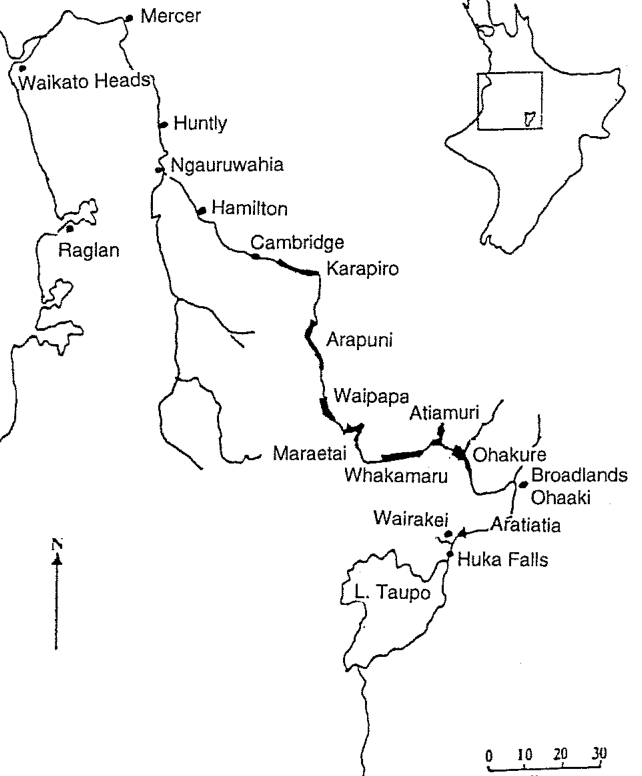
A more recent survey by Robinson et al. (1995) involved a study of Egeria densa, Ceratophyllum demersum and Lagarosiphon major taken from the Waikato River (Fig.9.1). Means and ranges (ug/g dry weight) were as follows: Ceratophyllum demersum 378 and 44-1160; and Egeria densa 488 and 94-1120. Lagarosiphon major from the Huka Falls upstream from the geothermal area contained 11 ug/g arsenic, whereas the same species from Lake Aratiatia below the geothermal activity, had 300 ug/g of this element. Ceratophyllum demersum occurred from Lake Aratiatia northwards. Lagarosiphon major occurred between Lake Taupo and Broadlands where it was replaced by E. densa. All species had arsenic concentrations of up to 1200 ug/g (0.12%) dry weight. Egeria densa and C. demersum had arsenic concentrations that had a highly significant inverse correlation (r=-0.86[S**] and r=-0.76[S**] respectively) with the distance of the plant downstream (Fig.9.2). These results show that the above aquatic macrophytes actively extract arsenic from the water in which they grow.
Robinson et al.(1995)较近期的一项调查研究了采自怀卡托河(图9.1)的Egeria densa、Ceratophyllum demersum和Lagarosiphon major。其均值和范围(μg/g干重)如下:Ceratophyllum demersum为378和44–1160;Egeria densa为488和94–1120。采自地热区上游Huka Falls的Lagarosiphon major含砷11 μg/g,而采自地热活动区下游Lake Aratiatia的同一物种含砷300 μg/g。Ceratophyllum demersum分布于Lake Aratiatia以北。Lagarosiphon major分布于陶波湖至Broadlands之间,在此以下被E. densa取代。所有物种的砷浓度均可达1200 μg/g(0.12%)干重。Egeria densa和C. demersum的砷浓度与植物所处位置的下游距离呈极显著负相关(分别为r=-0.86[S**]和r=-0.76[S**])(图9.2)。上述结果表明,这些大型水生植物能够从其生长的水体中主动提取砷。
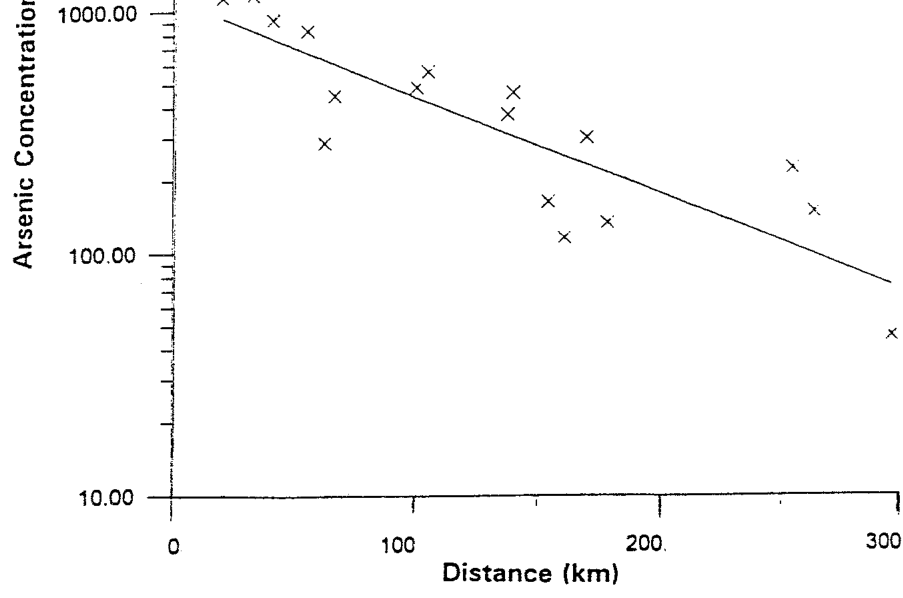
The arsenic concentration of C.demersum showed a highly significant (r=0.65[S*]) positive correlation with the arsenic content of the water from which the plant was taken. The arsenic concentration in this plant was about 10,000 times the arsenic concentration in the surrounding water. The arsenic concentration in E. densa showed no significant correlation (r=0.41[NS]) with that of the water from which it was taken. These results indicate that C. demersum can also be used as a biomonitor of arsenic levels in waters.
C. demersum的砷浓度与其采集水体的砷含量呈显著正相关(r=0.65[S*])。该植物中的砷浓度约为周围水体砷浓度的10,000倍。E. densa的砷浓度与其采集水体的砷浓度无显著相关性(r=0.41[NS])。这些结果表明,C. demersum还可用作水体砷水平的生物监测物种。
The high concentrations of arsenic in the weeds may be the result of the element being taken up by the same process as the uptake of an essential element. Arsenic has some chemical similarities with phosphorus, which is an essential plant macro nutrient. Accumulation of arsenic may be incidental to phosphorus uptake. This possibility is supported by the observation that nearly all the plants tested that grow in waters with elevated arsenic levels, accumulate arsenic to some degree.
水草中砷浓度较高,可能是由于该元素通过与某种必需元素相同的吸收过程被吸收。砷与磷具有某些化学相似性,而磷是植物必需的大量营养元素。砷的富集可能是磷吸收的附带结果。这一可能性得到如下观察结果的支持:几乎所有受试的、生长于砷含量升高水体中的植物都在一定程度上富集了砷。
The concentration of phosphorus in the water may affect the amount of arsenic accumulated by the plant. This may in turn affect the amount of arsenic in the river water. Benson (1953) showed that increasing levels of phosphorus decreased the toxicity of arsenic to barley plants by possibly competing for the binding sites that would otherwise have been occupied by this phytotoxic element.
水中磷的浓度可能影响植物对砷的富集量,进而可能影响河水中的砷含量。Benson(1953)表明,提高磷水平可降低砷对大麦的毒性,其原因可能是磷与这种植物毒性元素竞争原本会被其占据的结合位点。
It is normal farming practice to apply 400 kg/ha phosphate fertiliser to pumice soils (Hill, 1975) and some of the phosphorus leaches into the waterways of the area. The amount of phosphorus applied to farms around the Waikato River system may directly affect the amount of arsenic accumulated by plants, which will affect the arsenic concentration in the waters of this waterway.
在浮石土上施用400 kg/ha磷肥是常规农业做法(Hill, 1975),部分磷会淋溶进入该地区的水道。怀卡托河水系周边农场的施磷量可能直接影响植物对砷的富集量,进而影响该水道水体中的砷浓度。
Weed eradication programmes that involve the use of herbicides need to take into account the amount of arsenic released into the water as the weeds decay. The performance of carp and other herbivorous fish introduced in an attempt to control the weeds will be affected by the arsenic concentration of weeds in the Taupo Volcanic Zone. Arsenic in weeds may be toxic and/or unpalatable to the fish.
采用除草剂的杂草清除计划需考虑水草腐烂时释放到水中的砷量。为控制水草而引入的鲤鱼及其他草食性鱼类的表现,将受到陶波火山带水草中砷浓度的影响。水草中的砷可能对鱼类有毒和/或使其不愿取食。
The weeds may also have a use as detoxification agents in waterways with high levels of arsenic. Arsenic may be removed from a body of water by growing, and periodically removing, the macrophytes in a particular area. Lakes such as Lake Rotoroa, which still contains large amounts of arsenic from a weed eradication programme 25 years ago, may be detoxified in this manner.
在砷含量高的水道中,这些水草还可用作解毒剂。通过在特定区域种植并定期移除大型水生植物,可将砷从水体中去除。诸如Lake Rotoroa等湖泊至今仍含有25年前一项除草计划遗留的大量砷,可采用这种方式进行解毒。
Water cress豆瓣菜
Robinson et al. (1995) have found that New Zealand water cress Rorippa naturtium subsp. aquaticum collected from the Waikato River near the Ohaaki (Broadlands) power station (Fig.9.1) contained >400 ug/g (dry weight) of arsenic. Laboratory trials with water cress grown in tanks containing added arsenic confirmed the ability of this species to accumulate arsenic to a degree at least an order of magnitude higher than the ambient water.
Robinson et al.(1995)发现,采自怀卡托河Ohaaki(Broadlands)电站附近(图9.1)的新西兰豆瓣菜Rorippa naturtium subsp. aquaticum含砷>400 μg/g(干重)。在添加砷的水箱中栽培豆瓣菜的实验室试验证实,该物种富集砷的程度至少比环境水体高一个数量级。
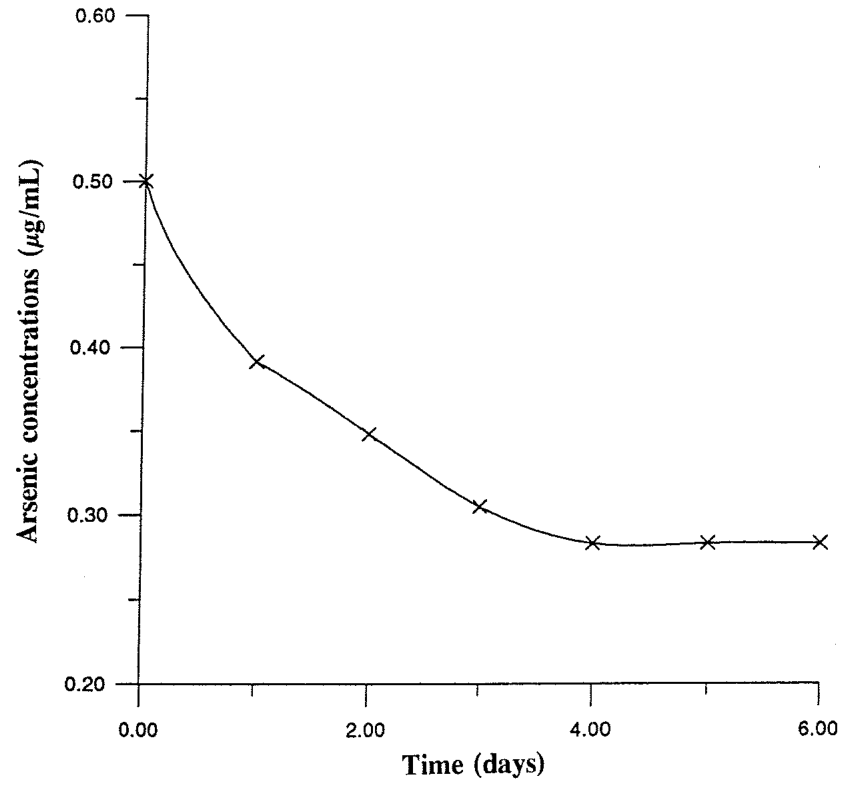
Fig.9.3 shows the relationship between arsenic in the plants and in the surrounding waters. The correlation is extremely good and shows that water cress might also be used for biomonitoring of arsenic pollution in waters.图9.3显示了植物中砷与周围水体中砷之间的关系。二者相关性极好,表明豆瓣菜也可用于水体砷污染的生物监测。
Arsenic levels in plants grown under laboratory conditions were neverthless about five-fold lower than in plants growing in the Waikato River. This was attributed to a number of factors including the likelihood that the laboratory plants were surrounded by reduced arsenic (As+) instead of the more strongly absorbed As+ encountered under natural conditions. Another factor is that in the field, the water cress is rooted in sediment containing on average about 95 ug/g arsenic. It was recommended that water cress not be consumed in waters containing >0.05 ug/mL arsenic (essentially the Waikato River between Wairakei and Atiamuri). These studies carry an important message for health authorities.
然而,实验室条件下栽培的植物中砷含量比生长于怀卡托河中的植物低约5倍。这归因于多种因素,其中包括实验室植物周围可能是还原态砷(As³⁺),而非自然条件下所遇到的更易被吸收的As⁵⁺。另一因素是,在野外豆瓣菜根植于平均含砷约95 μg/g的沉积物中。研究建议,不应食用生长于砷含量>0.05 μg/mL水体中的豆瓣菜(基本上即Wairakei至Atiamuri之间的怀卡托河段)。这些研究为卫生部门提供了重要警示。
Other floating PVPS其他漂浮淡水维管植物
Before leaving the subject of metal uptake by specific plants, brief mention should be made of use of duckweed (Lemna minor) and water velvet (Azolla pinnata).
在结束特定植物金属吸收的讨论之前,应简要提及浮萍(Lemna minor)和满江红(Azolla pinnata)的利用。
Wahaab et al. (1995) studied copper and chromium (III) uptake by duckweed. They found that the light incidence was a major factor in growth, with the plants doubling in size every 3 days under the most favourable conditions. When grown in water containing 0.25 and 1.0 ug/mL of copper and chromium (II1) respectively, uptake rates were 80-333 and 250-667 mg/day/m' of water surface. Maximum levels of uptake were 1-2 g of metal/kg of dry matter.
Wahaab et al.(1995)研究了浮萍对铜和铬(III)的吸收。他们发现光照是影响生长的主要因素,在最适条件下植物每3天体积增加一倍。在分别含0.25和1.0 μg/mL铜和铬(III)的水中生长时,吸收速率分别为每平方米水面80–333和250–667 mg/day。最大吸收量为每kg干物质1–2 g金属。
A somewhat analogous series of experiments were carried out by Jain et al. (1989) using duckweed and water velvet in which laboratory trials studied uptake of iron and copper from solutions containing 1.0, 2.0, 4.0 and 8.0 ug/mL of these two elements. Growth rates decreased slightly with increasing concentrations of either element for both species. After 14 days, bioaccumulation coefficients (plant/water) approached about 1000 for both elements in both species for waters containing 8 ug/mL of the element concerned.
Jain et al.(1989)利用浮萍和满江红开展了一系列类似试验,在实验室试验中研究了其从含铁和铜各1.0、2.0、4.0和8.0 μg/mL的溶液中对这两种元素的吸收。随任一元素浓度升高,两个物种的生长速率均略有下降。14天后,在相应元素浓度为8 μg/mL的水体中,两个物种对两种元素的生物富集系数(植物/水)均接近1000。
The authors suggested that both species would be useful for bioremediation of polluted waters and might be employed by passing effluent over a bed of these plants contained in ponds.
作者认为,这两个物种均可用于污染水体的生物修复,可将废水流经池塘中由这些植物构成的植床加以处理。
Rhizofiltration根际过滤
3Introduction引言
The discussion so far has been centred around freshwater vascular plants (FVPs) that are able to take up significant amounts of heavy metal pollutants from the aqueous medium. Although quite high concentration factors are achieved so that these species can be considered as hyperaccumulators, their biomass is usually very small so that the actual mass of pollutant removed is not large. In addition, these plants are often slow-growing.
迄今的讨论主要围绕能够从水体介质中吸收大量重金属污染物的淡水维管植物(FVPs)。尽管这些物种能达到相当高的富集系数,可视为超富集植物,但其生物量通常很小,因而实际去除的污染物总量并不大。此外,这些植物往往生长缓慢。
Terrestrial plants usually have much larger root systems than FVPS. These roots are often fibrous and are covered with a multitude of root hairs that present a large surface area to the medium in which they grow. A new and burgeoning field has been described as rhizofiltration and is currently being studied at various institutions such as at Rutgers University, New Jersey, where I.Raskin is very active in this field. Much of this work at the university, and in their associated commercial enterprise (Phytotech Inc.), has been concerned with the possibility of extracting lead commercially from polluted waters using the root systems of terrestrial plants.
陆生植物的根系通常比淡水维管植物大得多。这些根往往为须根,并覆盖着大量根毛,与其生长介质之间具有很大的接触表面积。一个新兴且迅速发展的领域被称为根际过滤,目前正在多个机构开展研究,例如新泽西州的Rutgers University,I. Raskin在该领域非常活跃。该大学及其关联商业企业(Phytotech Inc.)的大部分工作涉及利用陆生植物根系从污染水体中商业化提取铅的可能性。
Rhizofiltration usually involves the hydroponic culture of plants in a stationary or moving aqueous environment wherein the plant roots absorb pollutants from the water. The principles of the technique have been described by Dushenkov et al. (1995) and by Salt et al. (1995).
根际过滤通常是在静止或流动的水环境中水培植物,由植物根系从水中吸收污染物。Dushenkov et al.(1995)和Salt et al.(1995)阐述了该技术的原理。
Ideal plants for rhizofiltration should have extensive root systems and be able to remove metal pollutants over an extended period. Such plants should be capable of producing up to 1.5 kg (dry weight) of roots per month per m? of water surface.
理想的根际过滤植物应具有发达的根系,并能在较长时期内去除金属污染物。此类植物每月每平方米水面应能产生高达1.5 kg(干重)的根。
Suitable candidates for rhizofiltration have included the Indian mustard (Brassica juncea) and sunflower (Helianthus annuus). Both of these species tend to concentrate heavy metals in the root systems and translocate only a small part of the metal burden to the shoots. If extensive translocation does occur, this has the effect of making the system less efficient.
适用于根际过滤的候选物种包括印度芥菜(Brassica juncea)和向日葵(Helianthus annuus)。这两个物种均倾向于将重金属富集于根系,仅将少部分金属负荷转运至地上部。若发生大量转运,则会降低系统效率。
Apart from physical absorption of heavy metals at root systems, plants are also able to precipitate metals such as lead at the root systems by exuding phosphate that can form the highly insoluble lead phosphate. Concentration factors (bioaccumulation coefficients) defined as elemental content of roots divided by that of the water, are as high as 60,000 for some elements (Salt et al., 1995).
除根系对重金属的物理吸附外,植物还能通过分泌磷酸盐,使铅等金属在根系处形成极难溶的磷酸铅而沉淀。富集系数(生物富集系数)定义为根中元素含量与水中元素含量之比,对某些元素可高达60,000(Salt et al., 1995)。
Although the emphasis in this chapter is on bioremediation by metal uptake, a great deal of work has been carried out on removal of organic compounds and nutrient elements by rhizofiltration (Schnoor et al.,1995), often by the use of large trees such as willow and poplar. The same large trees can however also remove metals and will be discussed further below.
尽管本章侧重于通过金属吸收进行生物修复,但已有大量工作研究了利用根际过滤去除有机化合物和营养元素(Schnoor et al., 1995),常采用柳树和杨树等大型树木。然而,这些大型树木同样能够去除金属,下文将作进一步讨论。
The field of rhizofiltration can be divided into three main divisions:
根际过滤领域可分为三个主要类别:
1 - the use of large annual or perennial herbs or grasses;
1——利用大型一年生或多年生草本植物或禾草;
2 - the use of trees;
2——利用树木;
3 - the use of trees, large herbs, reeds or grasses to remove contaminated water whereby the water is recycled into the atmosphere and the metals retained within the plant.
3——利用树木、大型草本植物、芦苇或禾草去除污染水体,使水分返回大气,而金属滞留于植物体内。
Rhizofiltration with large annual or perennial herbs or grasses
利用大型一年生或多年生草本植物或禾草进行根际过滤
Brassica juncea (Indian mustard)
Brassica juncea(印度芥菜)
Lead
Some of the earliest experiments on the use of Brassica juncea for rhizofiltration of lead were carried out by Dushenkov et al. (1995). They report the study of 24 different herbs, grasses and crop plants in order to discover which absorbed the greatest amount of lead in their root systems. Values ranged from 60 mg Pb/g of dry biomass to 136, 140 and 169 mg/g for Brassica juncea, Helianthus annuus and Agrostis tenuis respectively. The much smaller total biomass of the grass Agrostis precluded its potential use for rhizofiltration, though other grasses of greater biomass might be useful for this purpose.
Dushenkov et al.(1995)开展了利用Brassica juncea根际过滤铅的最早期试验之一。他们研究了24种不同的草本植物、禾草和作物,以确定哪种植物根系吸收的铅最多。数值范围为60 mg Pb/g干生物量至136、140和169 mg/g,后三者分别对应Brassica juncea、Helianthus annuus和Agrostis tenuis。禾草Agrostis的总生物量小得多,因而不具备用于根际过滤的潜力,但其他生物量较大的禾草可能适用于此目的。
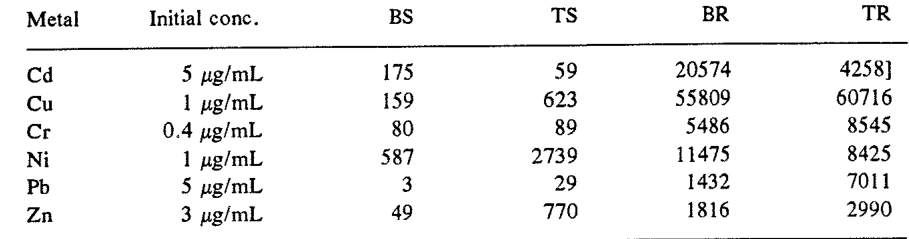
BS-Brassica shoots, TS-Thlaspi shoots, BR-Brassica roots, TR-Thlaspi roots. After: Salt et al. (1995).
BS——Brassica地上部,TS——Thlaspi地上部,BR——Brassica根,TR——Thlaspi根。引自:Salt et al.(1995)。
The uptake of lead and five other elements in roots and shoots of Brassica juncea was compared with corresponding values for Thlaspi caerulescens, a well known hyperaccumulator of cadmium and zinc. The results are shown above in Table 9.5 where it can be seen that differences in metal uptake are much greater for the shoots than the roots and that the latter have comparable uptakes for both species. The root biomass of Brassica is however, far greater than for Thlaspi and this is the greatest factor in its favour.
将Brassica juncea根和地上部对铅及其他5种元素的吸收与Thlaspi caerulescens(一种著名的镉、锌超富集植物)的相应数值进行了比较。结果列于上文表9.5,可见地上部的金属吸收差异远大于根部,两个物种根部的吸收量相当。然而,Brassica的根生物量远大于Thlaspi,这是其最大的优势。
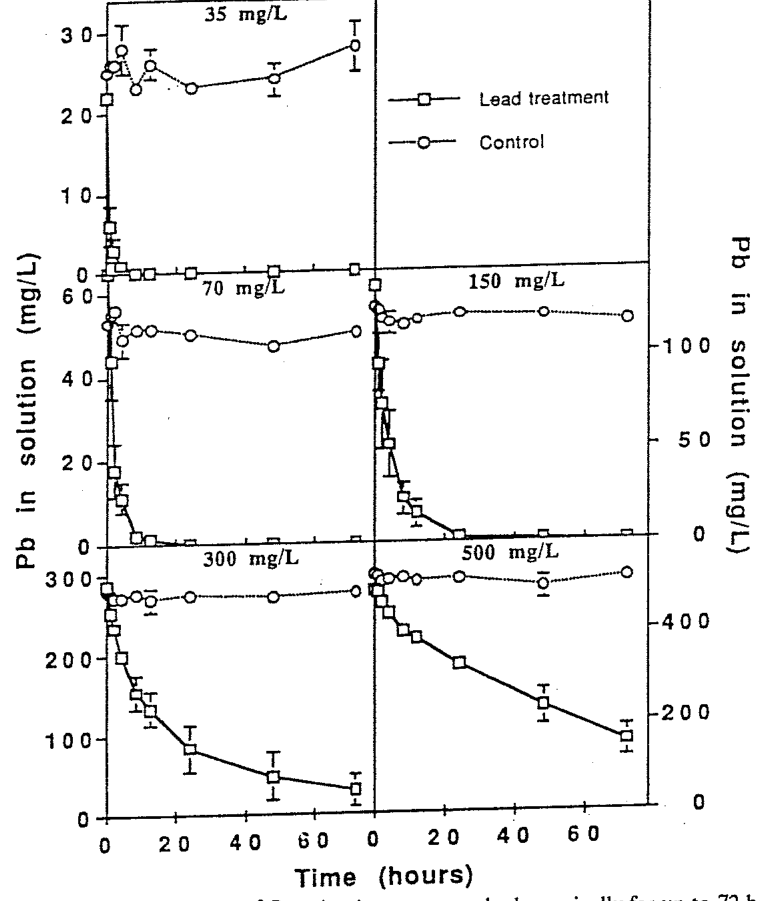
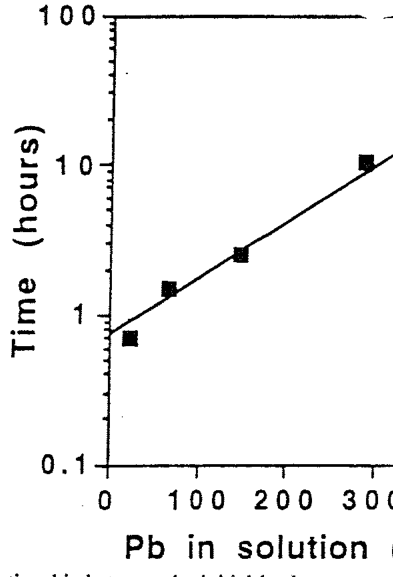
Experiments described by Dushenkov et al. (1995) have demonstrated the rapid removal of lead from solutions containing 0-500 ug/mL (ppm) lead in which Brassica juncea was grown hydroponically (Fig.9.4). The roots were able to remove most of the lead in 24 hours for concentrations of lead up to 150 ug/mL. At higher concentrations, extraction was slower and less complete. There was a linear relationship between the initial lead concentration and the time needed for the Brassica roots to remove half of the initial lead content of the water. This is shown in Fig. 9.5.
Dushenkov et al.(1995)所述试验表明,在含铅0–500 μg/mL(ppm)的溶液中水培Brassica juncea可快速去除铅(图9.4)。对于铅浓度不超过150 μg/mL的溶液,根系能在24小时内去除大部分铅。浓度更高时,提取较慢且较不完全。初始铅浓度与Brassica根系去除水中一半初始铅含量所需时间之间呈线性关系,如图9.5所示。
Other elements其他元素
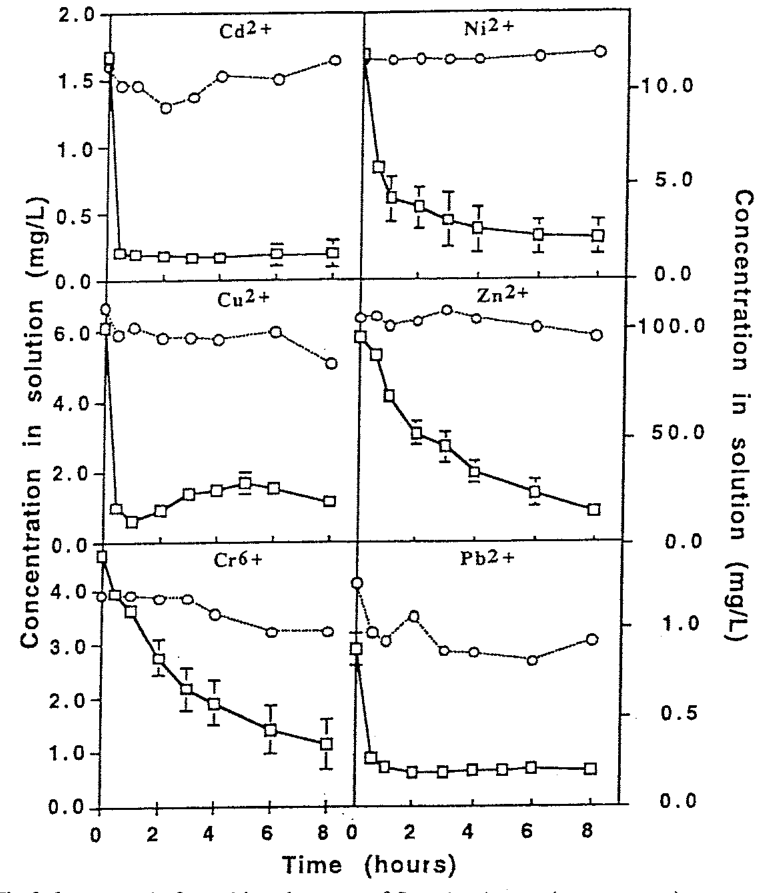
Although most of the work described by Dushenkov et al. (1995) was devoted to lead uptake, they also described analogous experiments in which rhizofiltration of cadmium, nickel, copper, zinc and chromium, as well as lead was described. These experiments are shown in Fig.9.6. The initial elemental concentrations (mg/L [ug/mL]) in the aqueous media were: Cd'+ (2), Ni?+ (10), Cu?+ (6), Zn?+ (100), Cr+ (4) and Pb+ (2).
尽管Dushenkov et al.(1995)所述工作大多针对铅的吸收,他们也介绍了镉、镍、铜、锌、铬以及铅根际过滤的类似试验,结果见图9.6。水体介质中各元素的初始浓度(mg/L [μg/mL])为:Cd²⁺(2)、Ni²⁺(10)、Cu²⁺(6)、Zn²⁺(100)、Cr⁶⁺(4)和Pb²⁺(2)。
There were no visible signs of toxicity in the plants. After 8 hours there was a drastic reduction in concentration levels of all of the test metals. The bioaccumulation coefficients were as follows: Pb (563), Cu (490), Ni (208), Cr (179), Cd (134), Zn (131). When a mass balance was carried out, it was found that significantly less metal was found in the plant material than had disappeared from the solutions. This could be explained by precipitation of some of the ions by plant exudates such as phosphate (see also above).
植物未表现出可见的毒害症状。8小时后,所有受试金属的浓度均大幅下降。生物富集系数如下:Pb(563)、Cu(490)、Ni(208)、Cr(179)、Cd(134)、Zn(131)。进行质量平衡计算时发现,植物材料中的金属量显著少于溶液中消失的金属量。这可解释为部分离子被磷酸盐等植物分泌物沉淀(另见上文)。
It should be further mentioned that chromium extracted into plant roots was found to be present as the Crt ion, thus indicating that the plant reduces chromium during the process of absorption.
还应指出,被提取进入植物根中的铬以Cr³⁺离子形式存在,表明植物在吸收过程中将铬还原。
Washed dried roots of Brassica juncea were much less effective at removing heavy metals from solution. For example, a solution initially containing 300 ug/mL lead decreased immediately to 250 ug/mL (due to precipitation) in all experiments and then decreased to about 20 ug/mL after 10 hours when live roots were used, and still had 200 ug/mL after dried roots had been employed.
经洗涤干燥的Brassica juncea根从溶液中去除重金属的效果要差得多。例如,初始含铅300 μg/mL的溶液在所有试验中均立即降至250 μg/mL(由于沉淀作用);使用活根时,10小时后降至约20 μg/mL,而使用干根时仍有200 μg/mL。
Helianthus annuus (sunflower)
Helianthus annuus(向日葵)
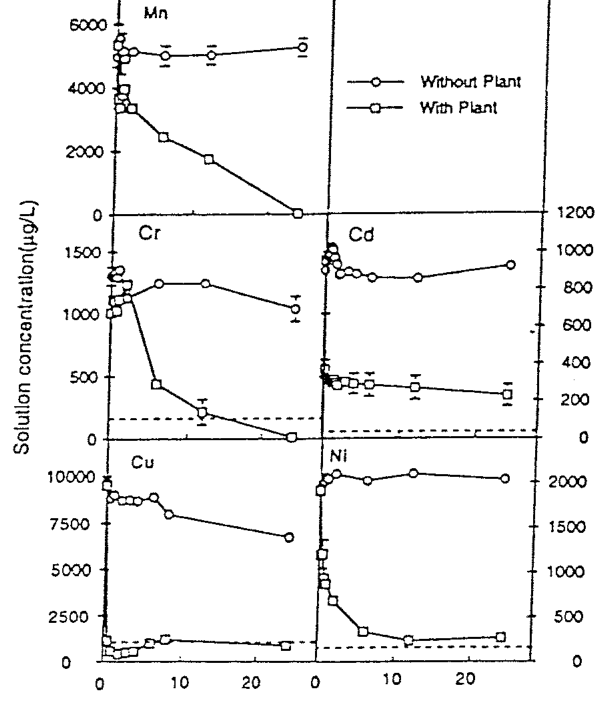
Extensive experiments have been carried out with the sunflower (Helianthus annuus). This large annual herb has about the same biomass as Brassica juncea and will readily absorb trace metals in its rhizosphere. Salt et al. (1995) have described experiments in which this plant was able to remove five elements from the solutions in which they were grown hydroponically (Fig.9.7).
已利用向日葵(Helianthus annuus)开展了大量试验。这种大型一年生草本植物的生物量与Brassica juncea大致相当,并能在其根际中迅速吸收痕量金属。Salt et al.(1995)描述了该植物能从其水培溶液中去除5种元素的试验(图9.7)。
As can be seen from Fig.9.7, the sunflower was able to drastically reduce elemental concentrations of manganese, chromium, cadmium, copper and nickel to extremely low levels after only 24 hours. Similar results were obtained for uranium (VI), lead, zinc and lead.
由图9.7可见,仅24小时后,向日葵即可将锰、铬、镉、铜和镍的浓度大幅降至极低水平。对铀(VI)、铅、锌和铅也获得了类似结果。
Because rhizofiltration can be employed most economically in situations involving large volumes of water and relatively low levels of contaminants, it would seem to be a possible method of removing radioactive nuclides from polluted waters such as at Chernobyl. Cooney (1996) has reported on field tests carried out near Chernobyl by B.D.Ensley (Phytotech Inc.) and I.Raskin and others from Rutgers University. In these tests, a pond contaminated with radioactive strontium and caesium was covered with 1 m? styrofoam rafts in which seedlings of Helianthus annuus were inserted. After 4-8 weeks the plants were harvested, dried and analysed for both radioisotopes. The highest bioconcentration coefficient for caesium was found in sunflower roots and the highest for strontium was in the shoots.
由于根际过滤在水量大、污染物含量相对较低的情况下最为经济,它似乎可作为从切尔诺贝利等地污染水体中去除放射性核素的一种方法。Cooney(1996)报道了B. D. Ensley(Phytotech Inc.)与Rutgers University的I. Raskin等人在切尔诺贝利附近开展的田间试验。在这些试验中,受放射性锶和铯污染的池塘上覆盖了1 m²的泡沫塑料浮筏,其中插植Helianthus annuus幼苗。4–8周后收获植物,干燥后分析两种放射性同位素。铯的最高生物富集系数见于向日葵根部,锶的最高值则见于地上部。
In tests carried out in Ashtabula, Ohio, sunflower plants had their roots submerged in waters contaminated with 100-400 ng/mL (ppb) uranium (Cooney, 1996). Within the first 24 hours, the uranium content decreased by 95% to below the EPA standard of 20 ng/mL.
在俄亥俄州Ashtabula开展的试验中,将向日葵根系浸没于含铀100–400 ng/mL(ppb)的污染水体中(Cooney, 1996)。在最初24小时内,铀含量降低了95%,低于EPA标准20 ng/mL。
Practical proposals for rhizofiltration using large herbs利用大型草本植物进行根际过滤的实用方案
An advertising leaflet issued by Phytotech Inc. proposes a commercial rhizofiltration system in which polluted water runs through a series of cells in which plants are grown hydroponically and spray fertilised from above. The cleaned water then passes out of the system or can be recycled if not sufficiently pure. The benefits of the system according to the company's claims are that it allows in situ treatment minimising environmental disturbance. Further claimed benefits are that the procedure is inexpensive yet more effective than comparable technology, and that the system is suitable for removal of low-level radioactive contamination.
Phytotech Inc.发布的一份广告宣传单提出了一种商业化根际过滤系统:污水流经一系列单元,单元中水培植物并从上方喷施肥料。净化后的水随后排出系统,若纯度不足则可循环处理。据该公司称,该系统的优点在于可进行原位处理,将环境扰动降至最低。其宣称的其他优点还包括:该方法成本低廉但比同类技术更有效,且适用于去除低水平放射性污染。
It is not clear from the advertising brochure to what degree this system has been proven by commercial applications, but the concept is impressive in its design and obvious future potential.
从该广告手册中尚不清楚这一系统在多大程度上已通过商业应用得到验证,但其设计理念令人印象深刻,未来潜力显而易见。
Rhizofiltration by use of large trees利用大型树木进行根际过滤
Rhizofiltration by use of large trees is also a viable, and better proven, emerging technology. The technique is already well established for remediation of organic contaminants such as TNT (Schnoor et al., 1995). There are certain essential differences between the use of large trees and large herbs for rhizofiltration. The trees are usually in situ so that the '¿mountain comes to Mohammed rather than Mohammed to the mountaini insofar as circulating ground waters seek out the rhizosphere of the plant rather than vice versa. Furthermore, the tree, unlike the annual herbs described above, is not usually removed after rhizofiltration.
利用大型树木进行根际过滤同样是一项可行且更为成熟的新兴技术。该技术已广泛用于TNT等有机污染物的修复(Schnoor et al., 1995)。利用大型树木与利用大型草本植物进行根际过滤存在某些本质差异。树木通常为原位生长,因此是“山就穆罕默德,而非穆罕默德就山”,即流动的地下水主动流向植物根际,而非相反。此外,与上述一年生草本植物不同,树木在根际过滤后通常不被移除。
Nyer and Gatliff (1996) have reported work carried out by Negri et al. (1996) in which zinc uptake by a hybrid poplar (Populus sp.) was investigated. Laboratory experiments involved growing the plants in quartz sand to which nutrients and varying amounts of zinc solutions circulated through the rhizospheres. A single pass of a solution containing 800 ug/mL zinc showed almost complete removal of the zinc in a period of 4 hours. For solutions containing > 1000 ug/mL of the metal, the leachates always had < 100 ug/mL zinc.
Nyer and Gatliff(1996)报道了Negri et al.(1996)开展的杂交杨树(Populus sp.)锌吸收研究。实验室试验将植物栽种于石英砂中,使含养分及不同量锌的溶液循环流经根际。含锌800 μg/mL的溶液单次通过后,4小时内锌几乎被完全去除。对于含该金属> 1000 μg/mL的溶液,淋出液中的锌始终< 100 μg/mL。
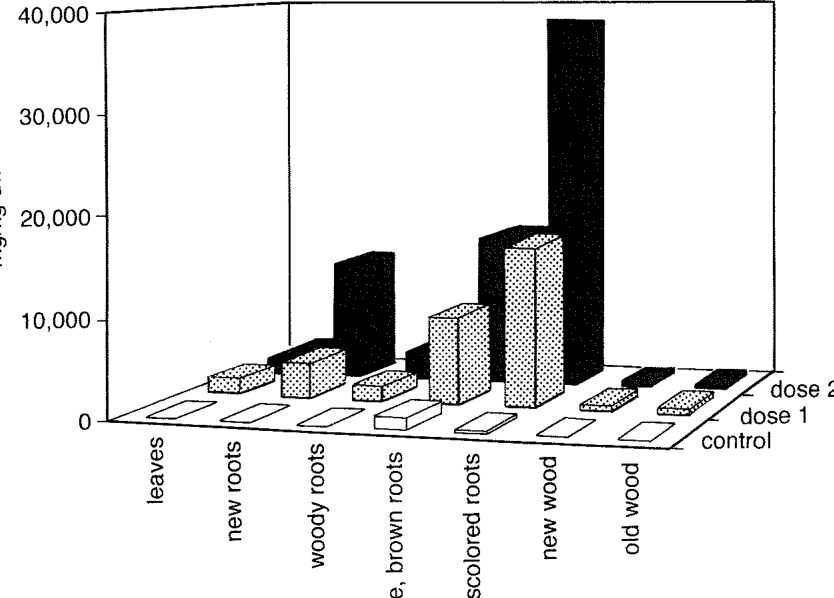
At the end of the experiment, the poplars were harvested and various plant organs analysed for zinc. The results are shown in Fig.9.8 from which it will be seen that by far the greatest concentration of zinc (38,055 ug/g) was to be found in the roots. In the aerial parts of the plants, the metal concentrations did not exceed 2250 ug/g in dry leaf tissue and 900 ug/g in the woody branches.
试验结束时收获杨树,并分析各器官中的锌含量。结果见图9.8,可见锌浓度最高者远为根部(38,055 μg/g)。在植物地上部分,干叶组织中金属浓度不超过2250 μg/g,木质枝条中不超过900 μg/g。
Rhizofiltration using plants to remove and purify contaminated waste waters利用植物去除和净化受污染废水的根际过滤
There are situations in which it is desired not only to purify waste water but also to reduce its volume. Phreatophytic trees such as poplar, willow and cottonwood are very efficient natural pumps that remove subterranean water and return it to the atmosphere by transpiration. Nyer and Gatliff (1996) have reported that a single willow tree uses and transpires as much as 22,500 litres (5000 gallons) of water in a single day.
在某些情况下,不仅需要净化废水,还需要减少其体积。杨树、柳树和三角叶杨等潜水植物型树木是非常高效的天然水泵,能汲取地下水并通过蒸腾作用将其返回大气。Nyer and Gatliff(1996)报道,一株柳树一天内可利用并蒸腾多达22,500升(5000加仑)的水。
Negri and Hinchman (1996a) have introduced the interesting concept of a plant-based system of water treatment that includes a bioreactor in which selected plants are grown hydroponically. The process was designed originally to deal with the large volume of salt-rich water emerging from drilling natural gas wells.
Negri and Hinchman(1996a)提出了一个颇具意义的植物水处理系统概念,其中包括一个水培选定植物的生物反应器。该工艺最初是为处理天然气钻井产生的大量富盐水而设计的。
The water evaporates through plant transpiration and rapidly reduces the volume of water. At the same time the heavy metals and other salts are absorbed in the fine root system. The generated plant biomass is harvested periodically, dried, and composted or burnt to produce a small amount of ash that can be buried or even sold in some cases.
水分通过植物蒸腾而蒸发,迅速减少水体体积。与此同时,重金属及其他盐分被吸收于细根系中。所产生的植物生物量定期收获、干燥后堆肥或焚烧,生成少量灰分,可予以填埋,某些情况下甚至可以出售。
It is well known that fresh and saltwater marshes can act as efficient bioremediators of contaminated waters (Kirschner, 1995). One of the commonest plants in these marshes is the bulrush (Scirpus validus). This was one of the species selected by Negri and Hinchman (1996a) for their experiments.
众所周知,淡水和咸水沼泽可作为受污染水体的高效生物修复系统(Kirschner, 1995)。这些沼泽中最常见的植物之一是水葱(Scirpus validus),它是Negri and Hinchman(1996a)试验所选物种之一。
Water passes through two cells in parallel containing hydroponically grown bulrush. The water enters with about 1.5% solutes (calculated as the sodium chloride equivalent) and on leaving has a salt content doubled to 3%. At this stage the water enters the final treatment cell containing the highly tolerant saltwater cordgrass (Spartina alterniflora). It leaves the unit with 6% salt content and a total volume reduction of 75% carried out in only 7.6 days.
水流平行通过两个种植水培藨草(bulrush)的处理池。进水溶质含量约为1.5%(以氯化钠当量计),出水时盐分含量倍增至3%。此后,水进入最后一个处理池,池中种植耐盐性极强的互花米草(Spartina alterniflora)。水离开该装置时盐分含量为6%,总体积减少75%,整个过程仅需7.6天。
A final assessment of rhizofiltration根际过滤的总体评价
Rhizofiltration, like the more general field of phytoremediation, is a new and burgeoning concept that is exciting worldwide interest because it is not only "green", but it appears to be far cheaper than many other alternatives, and in some cases there can even be a financial return if the final product is saleable. The initial euphoria of describing a new technique must be tempered by the realisation of the disadvantages as well as advantages of the new technology. These have been outlined by Black (1995) for phytoremediation in general rather than specifically for rhizofiltration. Nevertheless, the general picture is the same for both.
与更广泛的植物修复领域一样,根际过滤是一个新兴且蓬勃发展的概念,正引起全世界的浓厚兴趣,这不仅因为它是一种“绿色”技术,还因为它似乎远比许多其他替代方法便宜,在某些情况下,若最终产物可以出售,甚至还能获得经济回报。在介绍一项新技术时的最初热情,必须因认识到该新技术的缺点和优点而有所节制。Black(1995)针对一般意义上的植物修复(而非专门针对根际过滤)概述了这些优缺点。尽管如此,两者的总体情况是相同的。
Advantages优点
1 - B.Ensley of Phytotech Inc. has estimated that the cost of remediating a cubic metre of contaminated soil would be about $US80 compared with $250 for conventional methods. No figure is given for contaminated waters but we could assume that rhizofiltration would cost about 25% of that of other methods as was the case for soils;
1 - Phytotech公司的B.Ensley估计,修复每立方米污染土壤的成本约为80美元,而常规方法为250美元。对于污染水体尚无相关数据,但可以假设,与土壤的情况一样,根际过滤的成本约为其他方法的25%;
2 - the basic simplicity and cheapness of phytoremediation might well speed up the current rate of hazardous waste remediation;
2 - 植物修复本质上简便且廉价,很可能加快目前危险废物修复的速度;
3 - the volume of biomass that has to be removed and stored or sold is several orders of magnitude less than the original volume of water;
3 - 需要移除并储存或出售的生物量体积比原始水体积小几个数量级;
4 - phytoremediation by rhizofiltration, particularly of water contaminated by toxic metals such as lead will do much to improve public health;
4 - 通过根际过滤进行植物修复,特别是修复受铅等有毒金属污染的水体,将极大地改善公共健康;
5 - rhizofiltration is a much more rapid method of bioremediation than techniques that involve growing and harvesting crops grown over contaminated soils where several years might be required.
5 - 与在污染土壤上种植并收获作物的技术相比,根际过滤是一种快得多的生物修复方法,后者可能需要数年时间。
Disadvantages缺点
1 - Rhizofiltration is temperature-dependent. The plants will probably grow the whole year in tropical and warm-temperate regions, but in cool-temperate climates may well grow only half the year unless heating is installed;
1 - 根际过滤受温度影响。在热带和暖温带地区,植物可能全年生长,但在冷温带气候下,除非安装加热设施,植物很可能只能生长半年;
2 - The right plants have to be discovered that will be suitable for the climate and tolerant to the heavy metals that are to removed;
2 - 必须找到适合当地气候且能耐受待去除重金属的合适植物;
3 - The method is still in its infancy and will need to be proven by extensive testing under field conditions rather than in the laboratory.
3 - 该方法仍处于起步阶段,需要通过田间条件下(而非实验室中)的大量试验加以验证。
The future展望
It would seem that the future is bright for rhizofiltration though care must be taken not to overstate its potential at this early stage in case it suffers the fate of other new techniques that have initially been greeted with euphoria and then discarded after disillusionment. A new idea that has recently surfaced (Negri and Hinchman, 1996b) is the use of chelating agents to increase uptake of heavy metals by plants grown as crops over polluted soils. There is no reason why the same procedure might not be applied to rhizofiltration system with perhaps a dripfeed of chelators to the filtration unit.
根际过滤的前景似乎十分光明,但在这一早期阶段须注意不要夸大其潜力,以免重蹈其他新技术的覆辙——这些技术最初受到热烈追捧,随后因幻想破灭而遭摒弃。最近出现的一个新思路(Negri and Hinchman, 1996b)是利用螯合剂提高在污染土壤上作为作物种植的植物对重金属的吸收。没有理由认为同样的方法不能应用于根际过滤系统,例如可向过滤装置滴加螯合剂。
We should look forward to other new ideas in the next few years that may serve to give rhizofiltration a due place in the armoury of those engaged in phytoremediation of the environment.
我们期待未来几年出现更多新思路,使根际过滤在环境植物修复工作者的技术手段中占据应有的地位。
4References参考文献
Anon. (1976) Hyacinths may help recover gold from tailings. Engineering and Mining Journal February, 32.
Benson, N.R.(1953) Effect of season, phosphate and acidity on plant growth in arsenic toxic soils. Soil Science 76, 215-224.
Black, H.(1995) Phytoremediation. Innovations 103, 1-6.
Bowen, H.J.M. (1966) Trace Elements in Biochemistry. Academic Press, London, 241 pp.
Campbell, P,G.C.,Tessier, A.,Bisson, M. and Bougie, R. (1985) Accumulation of copper and zinc in the yellow water lily Nuphar variegatum: relationships to metal partitioning in the adjacent lake sediments. Canadian Journal of Fisheries and Aquatic Science 42, 23-32.
Cooney, C.M. (1996) Sunflowers remove radionuclides from water on ongoing phytoremediation field tests. Environmental Science and Technology News 20, 194A.
Cornwell,D.A.,Zoltek,J.Jr.,Patrinely, C.D., Furman, T.S. and Kim,J.I. (1977) Nutrient removal by water hyacinths. Journal of the Water Control Federation 70, 57-65.
Dushenkov, V.,Kumar, N.P.B.A., Motto, H. and Raskin, I. (1995) Rhizofiltration: the use of plants to remove heavy metals from aqueous streams. Environmental Science and Technology 29, 1239-1245.
Forstner,U. and Wittman, G.T.W. (1981) Metal Pollution in the Aquatic Environment 2nd Edition. Springer, Berlin.
Gupta, G.C.(1980) Use of water hyacinths in wastewater treatment. Journal of Environmental Health 43, 80-82.
Hill, C.F.(1975) Impounded lakes of the Waikato River. In: Jolly, V.H. and Brown,J.M.A. (eds), New Zealand Lakes. Auckland University Press, Auckland, New Zealand.
Hutchinson, G.E. (1975) A Treatise on Limnology Vol.3. Wiley, London, pp.264- 348.
Jain, S.K., Vasudevan, P. and Jha, N.K. (1989) Removal of some heavy metals from polluted waters by aquatic plants: studies on duckweed and water velvet. Biological Wastes 28, 115-126.
Kay, S.H.,Hailer, W.T. and Garrard, L.A. (1984) Effects of heavy metals on water hyacinths (Eichhornia crassipes (Mart.) Solms.). Aquatic Toxicology 5, 117- 128.
Kirschner, E.M. (1995) Botanical plants prove useful in cleaning up industrial sites. Chemical and Engineering News December 11, 22.
Leppard, G.G. (1983) Trace element speciation and the quality of surface waters: an introduction to the scope for research. In: Leppard, G.G.(ed.), Trace Element Speciation in Surface Waters and its Ecological Implications. Plenum Press, New York, pp. 1-15.
Liddle,J.R. (1982) Arsenic and other Elements of Geothermal Origin in the Taupo Volcanic Zone. PhD Thesis, Massey University, New Zealand, 309 pp.
McDonald,R.C. and Wolverton, B.C.(1980) Comparative study of wastewater lagoon with and without water hyacinth. Economic Botany 34, 101-110.
Muramoto,S. and Oki, Y. (1983) Removal of some heavy metals from polluted water by water hyacinth (Eichhornia crassipes). Bulletin of Environmental Contamination and Toxicology 30, 170-177.
Negri, M.C. and Hinchman, R.R. (1996a) Plants that remove contaminants from the environment. Laboratory Medicine 27, 36-40.
Negri, M.C. and Hinchman, R.R. (1996b) Bioremediation of contaminated soils by enhanced plant accumulation chelation-assisted accumulation experiments. Report of the Argonne National Laboratory. 3 pp.
Negri, M.C.,Hinchman, R.R. and Gatliff, E.G. (1996) Phytoremediation: using green plants to clean up contaminated soil, groundwater and wastewater. Proceedings of an International Topical Meeting on Nuclear and Hazardous Waste Management Spectrum 96 Seattle. American Nuclear Society, pp. 1-5.
Nieboer, E. and Richardson, D.H.S.(1980) The replacement of the non-descript term "heavy metals" by a biologically and chemically significant classification of metal ions. Environmental Pollution B 1, 3-26.
Nyer, E.K. and Gatliff, E.G.(1996) Phytoremediation. Ground Water Monitoring and Remediation. 16, 58-62.
Outridge,P.M. and Noller, B.N. (1991) Accumulation of toxic trace elements by freshwater vascular plants. Reviews of Environmental Contamination and Toxicology 121, 1-63.
Phillips, D.J.H. (1977) The use of biological indicator organisms to monitor trace metal pollution in marine and estuarine environments-a review. Environmental Pollution 13, 281-317.
Reay, P.F. (1972) The accumulation of arsenic from arsenic-rich natural waters by aquatic plants. Journal of Applied Ecology 9, 557-565.
Robinson, B.H.(1994) Pollution of the Aquatic Biosphere by Arsenic and other Elements in the Taupo Volcanic Zone. MSc Thesis, Massey University, New Zealand, 127 pp.
Robinson, B., Outred, H.,Brooks, R. and Kirkman,J. (1995) The distribution and fate of arsenic in the Waikato River system, North Island, New Zealand. Chemical Speciation and Bioavailability 7, 89-96.
Salt, D.E., Blaylock, M., Kumar, N.P.B.A., Dushenkov, V., Ensley, B.D., Chet,I. and Raskin, I. (1995) Phytoremediation: a novel strategy for the removal of toxic metals from the environment using plants. Bio/Technology 13, 468-474. Schnoor,J.L., Licht, L.L., McCutcheon, S.C., Wolfe, N.L.and Carreira, L.H. (1995) Phytoremediation of organic and nutrient contaminants. Environmental Science
and Technology 29, 318A-323A.
Smies,J. (1983) Biological aspects of trace element speciation in the aquatic environment. In: Leppard, G.G. (ed.), Trace Element Speciation in Surface Waters and its Ecological Implications. Plenum Press, New York, pp. 177- 193.
Sprenger, M. and McIntosh, A. (1989) Relationship between concentrations of aluminum, cadmium, lead and zinc in water, sediments and aquatic macrophytes in six acidic lakes. Archives of Environmental Contamination and Toxicology 18, 225-231.
Turekian, K.K. (1969) Distribution of elements in the hydrosphere. In: 1969 Yearbook of Science and Technology. McGraw Hill, New York.
Wahaab, R.A., Lubberding, H.J. and Alaerts, G.J. (1995) Copper and chromium (III) uptake by duckweed. Water Science and Technology 32, 105-110.
Wolverton, B.C. (1975) Water hyacinths for removal of cadmium and nickel from polluted waters. NASA Technical Memorandum TM-X-72721.
Wolverton, B.C. and McDonald, R.C. (1975a) Water hyacinths and alligator weeds for removal of lead and mercury from polluted waters. NASA Technical Memorandum TM-X-72723.
Wolverton, B.C. and McDonald, R.C. (1975b) Water hyacinths and alligator weeds for removal of silver, cobalt and strontium from polluted waters. NASA Technical Memorandum TM-X-72727.
Wolverton,B.C.,McDonald, R.C. and Gordon,J.(1975) Water hyacinths and alligator weeds for final filtration of sewage. NASA Technical Memorandum 1X-X-72724.