Available online at www.sciencedirect.com
Environmental Pollution 153 (2008) 668e676
www.elsevier.com/locate/envpol
Brett H. Robinson*, Simone Bischofberger, Andreas Stoll, Dirk Schroer, Gerhard Furrer, Ste´phanie Roulier, Anna Gruenwald, Werner Attinger, Rainer Schulin
Swiss Federal Institute of Technology (ETH), Universita¨tstrasse 16, CH-8092 Zu¨rich, Switzerland
Received 6 June 2007; received in revised form 24 August 2007; accepted 31 August 2007
Establishment of a complete vegetation cover on shooting ranges would reduce the contamination of plant leaves by toxic trace elements.
Abstract摘要
Over 400 tons of Pb enters Swiss soils annually at some 2000 military shooting ranges (MSRs). We measured elements in the leaves of 10 plant species and associated rhizospheric soil on the stop butt of a disused MSR. The geometric mean concentrations of Pb, Sb, Cu, Ni in rhizospheric soils were 10,171 mg/kg, 5067 mg/kg, 4125 mg/kg and 917 mg/kg. Some species contained Pb, Cu and Ni, above concentrations (30 mg/kg, 25 mg/kg and 50 mg/kg) shown to be toxic to livestock. Most contaminants in leaves resulted from surface deposition. However, at soil Pb concentrations >60,000 mg/kg, Equisetum arvense and Tussilago farfara took up >1000 mg/kg Pb into the leaves. These plants are not hyperaccumulators, having <100 mg/kg Pb in leaves at lower soil concentrations. Removal of soil with more than 30,000 Pb, from which one could smelt this metal to offset remediation costs, followed by revegetation, would minimise dust and hence leaf-borne contaminants. � 2007 Elsevier Ltd. All rights reserved.
瑞士约2000个军事射击场(MSRs)每年向土壤输入逾400吨Pb。本研究测定了一处废弃军事射击场挡弹堤上10种植物叶片及其根际土壤中的元素含量。根际土壤中Pb、Sb、Cu、Ni的几何平均浓度分别为10,171 mg/kg、5067 mg/kg、4125 mg/kg和917 mg/kg。部分物种叶片中Pb、Cu和Ni的含量超过了已知对家畜有毒的浓度(分别为30 mg/kg、25 mg/kg和50 mg/kg)。叶片中的大部分污染物来源于表面沉降。然而,当土壤Pb浓度 >60,000 mg/kg时,Equisetum arvense和Tussilago farfara叶片吸收的Pb超过1000 mg/kg。这两种植物并非超富集植物,在较低土壤浓度下其叶片Pb含量 <100 mg/kg。移除Pb含量超过30,000 mg/kg的土壤(可从中冶炼该金属以抵消修复成本),随后进行植被重建,可最大限度地减少扬尘,从而减少叶片携带的污染物。© 2007 Elsevier Ltd. 版权所有。
Keywords: Lead; Antimony; Surface deposition; Phytoremediation; Phytomanagement
关键词:铅;锑;表面沉降;植物修复;植物管理
1Introduction引言
1.1. Trace elements in military shooting ranges1.1. 军事射击场中的微量元素
Lead (Pb) and to a lesser extent antimony (Sb) are common contaminants in areas adjacent to the stop butts of military shooting ranges (MSRs). On an average, new bullets and pellets consist of over 90% Pb, 1e7% Sb, <2% arsenic (As) and <0.5% nickel (Ni) (Rooney et al., 1999). Low-quality Pb, from which bullets are made, may also contain bismuth (Bi) and silver (Ag) (Johnson et al., 2005). Zinc (Zn) and copper (Cu) covers improve the ballistic properties of high velocity rounds. Tracer and incendiary bullets contain strontium (Sr), barium (Ba) and Zn (Batelle Corporation, 1997).
铅(Pb)以及在较小程度上的锑(Sb)是军事射击场(MSRs)挡弹堤邻近区域常见的污染物。平均而言,新子弹和弹丸含Pb逾90%、Sb 1–7%、砷(As)<2%、镍(Ni)<0.5%(Rooney et al., 1999)。用于制造子弹的低品质Pb还可能含有铋(Bi)和银(Ag)(Johnson et al., 2005)。锌(Zn)和铜(Cu)弹壳可改善高速弹的弹道性能。曳光弹和燃烧弹含有锶(Sr)、钡(Ba)和Zn(Batelle Corporation, 1997)。
Once in the soil, the bullets and the bullet fragments gradually oxidise through the weathering actions of air, water, organic acids and microbial activity (Lin et al., 1995; Johnson et al., 2005). The most important factor governing the rate of bullet oxidation is the soil’s pH (Labare et al., 2004).
子弹及其碎片进入土壤后,在空气、水、有机酸和微生物活动的风化作用下逐渐氧化(Lin et al., 1995; Johnson et al., 2005)。决定子弹氧化速率的最重要因素是土壤pH(Labare et al., 2004)。
Switzerland is a highly militarised nation with an annual defence budget of US$ 2.5 billion (CIA, 2006). Military training, combined with recreational shooting, result in the annual deposition of >400 t of Pb into Swiss soils at some 2000 MSRs scattered throughout the country (Johnson et al., 2005).
瑞士是一个高度军事化的国家,年度国防预算达25亿美元(CIA, 2006)。军事训练与娱乐性射击相结合,导致每年有 >400 t Pb沉积于分布在全国各地的约2000个军事射击场的土壤中(Johnson et al., 2005)。
1.2. Environmental risks of trace elements in MSRs1.2. 军事射击场中微量元素的环境风险
* Corresponding author. Tel.: +41 44 633 6073; fax: +41 44 633 1123. E-mail address: brett.robinson@env.ethz.ch (B.H. Robinson).
Lee et al. (2002) reported a reduction in the enzymatic activity in shooting range soils. Tuomela et al. (2005) and
Lee et al. (2002) 报道了射击场土壤中酶活性的降低。Tuomela et al. (2005) 和
0269-7491/$ - see front matter � 2007 Elsevier Ltd. All rights reserved. doi:10.1016/j.envpol.2007.08.034
0269-7491/$ - 见前页 © 2007 Elsevier Ltd. 版权所有。doi:10.1016/j.envpol.2007.08.034
Rantalainen et al. (2006) demonstrated the negative effect of Pb on litter decomposers in Finnish forests.
Rantalainen et al. (2006) 证明了Pb对芬兰森林凋落物分解者的负面影响。
The migration of toxic trace elements to the food chain or to the drinking water can reduce ecosystem functioning on a large scale and may present a human health risk. Craig et al. (1999) and Sorvari et al. (2006) reported that Pb from shooting range stop butts might leach and contaminate receiving waters (ground- and surface-waters). Wersin et al. (2002) measured elevated Sb concentrations in receiving waters near a Swiss MSR. Migliorini et al. (2003) reported the bioaccumulation of Pb by invertebrates on shooting ranges.
有毒微量元素向食物链或饮用水的迁移可在大尺度上削弱生态系统功能,并可能对人体健康构成风险。Craig et al. (1999) 和Sorvari et al. (2006) 报道,射击场挡弹堤中的Pb可能发生淋溶并污染受纳水体(地下水和地表水)。Wersin et al. (2002) 在瑞士某军事射击场附近的受纳水体中测得较高的Sb浓度。Migliorini et al. (2003) 报道了射击场中无脊椎动物对Pb的生物累积。
Although trace element phases with a low solubility may migrate from shooting ranges with surface runoff and erosion (Craig et al., 1999), soluble phases have the greatest mobility and present the largest environmental risk.
尽管低溶解度的微量元素相态可随地表径流和侵蚀从射击场迁出(Craig et al., 1999),但可溶性相态迁移性最强,环境风险也最大。
1.3. Plant interactions with trace elements on shooting ranges1.3. 射击场中植物与微量元素的相互作用
Most studies investigating plants on shooting ranges have dealt with Pb, because this trace element occurs at the highest concentration in the soil. Rooney et al. (1999) clearly demonstrated the poor translocation of Pb from plant roots into the shoots. They showed that in a lead-shot contaminated soil containing nearly 6000 mg/kg of EDTA extractable Pb, the root concentrations of Barley, Lettuce, Ryegrass, Radish and Clover were about 60 times higher that the shoot Pb concentrations, which were, in all cases, less than 100 mg/kg.
由于Pb是土壤中浓度最高的微量元素,大多数关于射击场植物的研究都以Pb为对象。Rooney et al. (1999) 明确证明了Pb从植物根部向地上部的转运能力较差。他们发现,在EDTA可提取态Pb含量近6000 mg/kg的铅弹污染土壤中,大麦、莴苣、黑麦草、萝卜和三叶草的根部Pb浓度约为地上部的60倍,而地上部Pb浓度在所有情况下均低于100 mg/kg。
Zellmer and Schneider (1993) measured some metal concentrations in leaves from assorted species on shooting ranges from Grafenwo¨hr, Germany. They found that the concentrations of most metals fell within the normal range for plants (Baker and Chesnin, 1975). They attributed the occasional high Pb concentration to surface contamination. Ma et al. (2002) measured Pb in Bermuda grass (Cynodon dactylon). They found up to 806 mg/kg Pb in the shoot tissue. Labare et al. (2004) found shoot concentrations up to 152 mg/kg Pb for various species growing at an active shooting range at West Point, New York. The Pb in plant tissue may have arisen from air-borne Pb generated by shooting as well as soil-bound Pb. Mozafar et al. (2002) reported that, when grown in shooting range soils under greenhouse conditions, Leeks (Allium porrum L.) accumulated Pb to over 1000 mg/kg in the aboveground portions.
Zellmer and Schneider (1993) 测定了德国Grafenwöhr射击场多种植物叶片中部分金属的浓度。他们发现,大多数金属的浓度处于植物的正常范围内(Baker and Chesnin, 1975),并将偶见的高Pb浓度归因于表面污染。Ma et al. (2002) 测定了狗牙根(Cynodon dactylon)中的Pb,发现其地上部组织Pb含量高达806 mg/kg。Labare et al. (2004) 发现,在纽约西点一处在用射击场生长的多种植物地上部Pb浓度高达152 mg/kg。植物组织中的Pb可能既来源于射击产生的大气传播Pb,也来源于土壤结合态Pb。Mozafar et al. (2002) 报道,在温室条件下以射击场土壤种植时,韭葱(Allium porrum L.)地上部Pb累积量超过1000 mg/kg。
Antimony has only recently become the focus of environmental concerns about trace element inputs into shooting range soils. Johnson et al. (2005) reported that Sb was the most soluble and mobile of all the trace element contaminants in Swiss MSRs.
锑直到最近才成为射击场土壤微量元素输入相关环境问题的关注焦点。Johnson et al. (2005) 报道,在瑞士军事射击场的所有微量元素污染物中,Sb的溶解性和迁移性最强。
1.4. Vegetation and the management of disused MSRs1.4. 植被与废弃军事射击场的管理
There are limited remediation options for disused MSRs. One can remove the stop butts and reprocess the soil to recover the valuable Pb. However, it is impractical to remove all the contaminated soil, or cap entire MSRs with non-contaminated material. Nor is there any technology that would permit the safe in situ decontamination of such sites (Sorvari et al., 2006).
废弃军事射击场的修复选择有限。可以移除挡弹堤并对土壤进行再处理,以回收有价值的Pb。然而,移除全部污染土壤或用未污染材料覆盖整个射击场并不现实,目前也没有任何技术能够对此类场地进行安全的原位去污(Sorvari et al., 2006)。
Vegetation and soil conditioners may reduce the mobility of the contaminating trace elements, thereby reducing the exposure pathways to humans and ecosystems. Since vegetation will eventually cover most disused MSRs, land managers could select plants that do not accumulate toxic metals in their aboveground portions, yet have a high transpiration rate, thus reducing the leaching of these metals into receiving waters (Robinson et al., 2003).
植被和土壤改良剂可降低污染性微量元素的迁移性,从而减少其对人类和生态系统的暴露途径。由于植被最终将覆盖大多数废弃军事射击场,土地管理者可选择地上部不累积有毒金属但蒸腾速率高的植物,从而减少这些金属向受纳水体的淋溶(Robinson et al., 2003)。
It is important to distinguish between trace elements in the aerial portions of plants that have arisen from surface deposition and those taken up by the roots and subsequently translocated to the shoots. When the site is entirely vegetated, the stabilising effect of plant roots will mitigate the generation of wind-borne dust and rain-induced redistribution of contaminated solid material from soil. Thus, uptake from the soil will play an overriding role in controlling the total aboveground trace element concentration, and hence the potential exposure to herbivores. Conversely, in a sparsely vegetated site, a large proportion of the trace elements in the aerial tissues may come from surface deposition. These trace elements, may nevertheless present an ecological or human health risk if consumed.
区分植物地上部中来源于表面沉降的微量元素与经根系吸收后转运至地上部的微量元素十分重要。当场地完全被植被覆盖时,植物根系的稳定作用将减少风蚀扬尘的产生以及降雨引起的土壤污染固体物质的再分布。因此,从土壤中的吸收将在控制地上部微量元素总浓度方面起主导作用,进而决定食草动物的潜在暴露。相反,在植被稀疏的场地,地上组织中很大一部分微量元素可能来自表面沉降。尽管如此,这些微量元素一旦被摄食,仍可能构成生态或人体健康风险。
1.5. Aims1.5. 研究目的
We aimed to determine the accumulation of trace elements by vegetation growing on the stop butt of a disused MSR in Switzerland, with a view to identifying plant species that may be useful for trace element immobilisation. In particular, we sought to distinguish between physiological trace element uptake by plants and trace elements in the shoots arising from aerial surface deposition.
本研究旨在测定瑞士一处废弃军事射击场挡弹堤上生长的植被对微量元素的累积,以筛选可用于微量元素固定的植物物种。特别是,我们试图区分植物对微量元素的生理吸收与地上部中来源于大气表面沉降的微量元素。
2Materials and methods材料与方法
Sampling occurred on the stop butt (15 m � 100 m) of a 300 m military shooting range (MSR) at the Allmend (47�01042.8500 N, 8�18036.800 E), near the city of Lucerne, Switzerland. The MSR has been disused for five years. The concentration of Pb in the soil of the stop butt ranged from 0.7% to 15%, while the soil Pb burden in the remainder of the MSR ranged from 0.01% to 1%. The average annual rainfall is 1171 mm, with an average annual temperature of 8.8 �C, as measured at a nearby meteorological station in Luzern. The soil pH was 6.9. The median sand, silt, and clay fractions were 59%, 26% and 15%, and the median organic carbon content was 7.3%.
采样在瑞士卢塞恩市附近Allmend(47°01′42.85″ N, 8°18′36.8″ E)一处300 m军事射击场(MSR)的挡弹堤(15 m × 100 m)上进行。该射击场已废弃五年。挡弹堤土壤中Pb浓度为0.7%–15%,而射击场其余区域土壤Pb含量为0.01%–1%。据卢塞恩附近气象站测定,年均降水量为1171 mm,年均气温为8.8 °C。土壤pH为6.9,砂粒、粉粒和黏粒含量的中位数分别为59%、26%和15%,有机碳含量中位数为7.3%。
On the 2nd of September 2005 (sunny, dry weather), we sampled leaves from 10 of the most commonly occurring plant species. For each plant sample, we took ca. 150 g of fresh shoot material at least 50 mm above the soil. We did not sample roots due to the impossibility of adequately removing the surrounding soil, which contained up to 15% Pb. For each plant, we also sampled soil from the root zone. After removing any surface litter, approximately 500 g of soil was sampled from a depth of 20e100 mm. In total, we sampled 70 individual plants and soils. Table 1 lists the plant species that were sampled, along with the number of samples taken.
2005年9月2日(晴朗干燥天气),我们采集了10种最常见植物的叶片。每个植物样品采集距地面至少50 mm以上的新鲜地上部材料约150 g。由于无法充分去除根部周围含Pb高达15%的土壤,未采集根系样品。对于每株植物,同时采集其根区土壤:去除地表凋落物后,在20–100 mm深度采集约500 g土壤。共采集70个植株及对应土壤样品。表1列出了所采集的植物物种及其样品数量。
Vegetative material was thoroughly washed for 18 h after sampling with distilled water, and then dried at 40 �C until a constant weight was obtained. Soils were similarly dried and then sieved to <2 mm using a nylon sieve. We found no bullet fragments in the soil, either in the <2 mm fraction or in the �2 mm fraction.
植物样品采集后用蒸馏水彻底清洗18 h,然后于40 °C烘干至恒重。土壤样品同样烘干后用尼龙筛过 <2 mm筛。在 <2 mm和 ≥2 mm组分的土壤中均未发现子弹碎片。
Plant species sampled from a military shooting range, Luzern Allmend, Switzerland the plant leaves. Titanium, Ba, and Cr make good indicator elements, since the plants do not take up significant concentrations of these elements (Brooks, 1998). Therefore, the measured concentrations are directly proportional to surface-deposited dust. Unfortunately, these elements were unsuitable as indicator elements in this study. The plant mill contained Ti, thus leading to elevated Ti concentrations in the plant samples. Barium and Cr occurred at relatively low concentrations in the soil (277 mg/kg and 126 mg/kg) and in any case were not positively correlated with Pb (r = �0.46 and r = 0.10), the principle element of interest. By contrast, Fe occurred at 65,766 mg/kg in the soil, and was strongly correlated with Pb (r = 0.85). However, Fe is an essential nutrient that plants take up to concentrations of around 112 mg/kg (Marschner, 1995). Therefore, when using Fe to calculate surface deposition, one must first subtract a baseline value, i.e. the Fe that the plants have accumulated through root uptake. The mass fraction of soil on the plant sample, Msoil (kg/kg) is therefore:
瑞士卢塞恩Allmend军事射击场采集的植物物种 植物叶片上。钛、Ba和Cr是良好的指示元素,因为植物对这些元素的吸收量不显著(Brooks, 1998),因此其测定浓度与表面沉降的尘土量成正比。遗憾的是,这些元素不适合作为本研究的指示元素:植物粉碎机含Ti,导致植物样品Ti浓度偏高;Ba和Cr在土壤中的浓度相对较低(277 mg/kg和126 mg/kg),且与主要关注元素Pb均不呈正相关(r = −0.46和r = 0.10)。相比之下,土壤中Fe含量为65,766 mg/kg,且与Pb呈强相关(r = 0.85)。然而,Fe是植物必需营养元素,植物吸收浓度约为112 mg/kg(Marschner, 1995)。因此,以Fe计算表面沉降时,须先扣除基线值,即植物经根系吸收累积的Fe。植物样品上土壤的质量分数Msoil(kg/kg)计算如下:
| Species物种 | Botanical reference植物学 参考文献 | Family科 | Number of samples样品 数量 |
|---|---|---|---|
| Equisetum arvense | L. | Equisetaceae | 21 |
| Dryopteris affinis | Lowe | Dryopteridaceae | 5 |
| Salix purpuria | L. | Salicaceae | 5 |
| Salix cinerea | L. | Salicaceae | 5 |
| Salix alba | L. | Salicaceae | 5 |
| Populus alba | L. | Salicaceae | 3 |
| Tussilago farfara | L. | Asteraceae | 10 |
| Silene vulgaris | Moench | Caryophyllaceae | 5 |
| Arrhenatherum elatius | L. | Poaceae | 5 |
| Molinia arundinacea | Schrank | Poaceae | 5 |
Tplant � Rplant Msoil = Tsoil
Msoil = (Tplant − Rplant) / Tsoil
2.1. Elemental determination2.1. 元素测定
Soil samples were ground using a Retsch RS1 grinder with a tungsten carbide ball and ring. Plant samples were ground using a Retsch ZM200 titanium mill. Ground material (4 g) was mixed with 0.9 g of wax and pressed into tablets under a pressure of 15 t. The total element concentrations (Na, Mg, Al, Si, P, S, Cl, K, Ca, Ti, V, Cr, Mn, Fe, Co, Ni, Cu, Zn, Ga, Ge, As, Se, Br, Rb, Sr, Y, Zr, Nb, Mo, Ag, Cd, In, Sn, Sb, Te, I, Cs, Ba, La, Ce, Pr, Nd, Sm, Hf, Ta, W, Hg, Tl, Pb, Bi, Th, U) of the tablets were determined using a Spectro X-lab 2000 X-Ray Fluorescence (XRF) spectrometer. Here, we only report elements that were above detection limits (0.1e5 mg/kg for all elements except Na (100 mg/kg) and Al (20 mg/kg) in both plant and soil samples) in >50% of the samples.
土壤样品使用配有碳化钨球和环的Retsch RS1粉碎机研磨,植物样品使用Retsch ZM200钛磨研磨。取研磨后样品4 g与0.9 g蜡混合,在15 t压力下压制成片。采用Spectro X-lab 2000 X射线荧光(XRF)光谱仪测定压片中元素全量(Na、Mg、Al、Si、P、S、Cl、K、Ca、Ti、V、Cr、Mn、Fe、Co、Ni、Cu、Zn、Ga、Ge、As、Se、Br、Rb、Sr、Y、Zr、Nb、Mo、Ag、Cd、In、Sn、Sb、Te、I、Cs、Ba、La、Ce、Pr、Nd、Sm、Hf、Ta、W、Hg、Tl、Pb、Bi、Th、U)。本文仅报告在 >50%的样品中高于检出限的元素(植物和土壤样品中,除Na(100 mg/kg)和Al(20 mg/kg)外,所有元素检出限为0.1–5 mg/kg)。
For quality assurance, we analysed 4 Wageningen soil standards, 958, 998, 989, and 951 (Wageningen, 2006) as well as a certified plant reference material (poplar leaves NCS DC73350, China National Analysis Center for Iron and Steel, Beijing, China). The average recoveries for soils were: Ca 113%, Cu 117%, Fe 106%, Pb 115%, K 100%, Mg 89%, Mn 112%, Ni 125%, Sb 121%, and Zn 101%. For the plant standard, the recoveries were: Ca 96%, Cu 101%, Fe 98%, K 97%, Mg 67%, Mn 126%, Ni 89%, and Zn 99%. In the plant reference, Pb and Sb were below the detection limits of our method for plant samples (<2 mg/kg).
为保证质量,我们分析了4个Wageningen土壤标准物质958、998、989和951(Wageningen, 2006)以及一个植物有证标准物质(杨树叶NCS DC73350,中国钢铁研究总院国家钢铁材料测试中心,中国北京)。土壤的平均回收率为:Ca 113%、Cu 117%、Fe 106%、Pb 115%、K 100%、Mg 89%、Mn 112%、Ni 125%、Sb 121%、Zn 101%。植物标准物质的回收率为:Ca 96%、Cu 101%、Fe 98%、K 97%、Mg 67%、Mn 126%、Ni 89%、Zn 99%。植物标准物质中Pb和Sb低于本方法对植物样品的检出限(<2 mg/kg)。
In a second test of analytical quality, we sent 10 soil samples and 10 plant samples to an external laboratory (Niutec AG, Winterthur) for acid digestion and analyses with ICP-MS for Pb, Sb, Bi, Tl, Ga, and Hg. The recoveries of Pb and Sb, in this case the Inductively Coupled Plasma Mass Spectroscopy (ICP-MS) results as a percentage of the XRF results, were 114% and 127%. The correlation coefficients (r) between our XRF analyses and those of the external laboratory were 0.98 for both Pb and Sb. The recoveries (ICP-MS/XRF) were <3% for Bi, Tl and Hg, and <10% for Ga. Therefore, we do not report data for these elements. The high concentrations measured on the XRF were probably the result of interference from inordinately high Pb concentrations with Bi, Tl and Hg.
作为第二项分析质量检验,我们将10个土壤样品和10个植物样品送至外部实验室(Niutec AG,Winterthur),经酸消解后用ICP-MS测定Pb、Sb、Bi、Tl、Ga和Hg。Pb和Sb的回收率(此处为电感耦合等离子体质谱(ICP-MS)结果占XRF结果的百分比)分别为114%和127%。本实验室XRF分析结果与外部实验室结果之间的相关系数(r)对Pb和Sb均为0.98。Bi、Tl和Hg的回收率(ICP-MS/XRF)<3%,Ga <10%,因此本文不报告这些元素的数据。XRF测得的高浓度可能是由于极高的Pb浓度对Bi、Tl和Hg产生干扰所致。
where Tplant is the measured indicator element concentration in the plant tissue (mg/kg), Rplant is the baseline concentration of the indicator element that the plant has accumulated through the roots and translocated to the shoots (mg/kg), and Tsoil is the concentration of the indicator element in the soil (mg/kg). The corrected plant concentration of the target element, Cplant* (mg/kg), is:
式中,Tplant为植物组织中指示元素的实测浓度(mg/kg),Rplant为植物经根系累积并转运至地上部的指示元素基线浓度(mg/kg),Tsoil为土壤中指示元素的浓度(mg/kg)。目标元素校正后的植物浓度Cplant*(mg/kg)为:
C�plant = Cplant � MsoilCsoilC*plant = Cplant − MsoilCsoil
where Cplant and Csoil are the measured concentrations (mg/kg) of the target element in the plant and soil.
式中,Cplant和Csoil分别为植物和土壤中目标元素的实测浓度(mg/kg)。
For each target element, we separated plant uptake from surface deposition using Fe as an indicator element. We took the baseline concentration of Fe in the plant, i.e. Rplant for Fe, of 27.3 mg/kg, the lowest measured Fe concentration in any of our plant samples. To validate the amount of surface-deposited dust calculated with Fe, we repeated the calculation using Cu (baseline value = 2.3 mg/kg) and Al (baseline value = 22 mg/kg). The mass of surface-deposited material that we calculated with Cu and Al were in reasonable agreement (r = 0.96 and r = 0.92) with the values calculated using Fe.
对于每种目标元素,我们以Fe为指示元素区分植物吸收与表面沉降。取所有植物样品中Fe的最低实测浓度27.3 mg/kg作为植物中Fe的基线浓度,即Fe的Rplant。为验证以Fe计算的表面沉降尘土量,我们以Cu(基线值 = 2.3 mg/kg)和Al(基线值 = 22 mg/kg)重复计算。以Cu和Al计算的表面沉降物质量与以Fe计算的结果具有较好的一致性(r = 0.96和r = 0.92)。
Errors will arise in the corrected values calculated using Fe as an indicator element when the amount of Fe that the plant has taken up through the roots differs from the baseline value used in the calculation. Similarly, surface-deposited dust from soil that is chemically distinct from the plant’s rhizospheric soil will result in errors.
当植物经根系吸收的Fe量与计算中所用基线值不同时,以Fe为指示元素计算的校正值将产生误差。同样,若表面沉降尘土来源于与植物根际土壤化学组成不同的土壤,也会导致误差。
2.3. Statistical treatment of data2.3. 数据统计处理
Data that were log-normally distributed were log-transformed for statistical analyses. Data were considered lognormal when the geometric mean was closer to the median than the arithmetic mean. For lognormal data, we report geometric means and standard deviation ranges rather than means and standard deviations. With lognormal data, the geometric mean is a better measure of central tendency than the arithmetic mean. Use of geometric means reduces distortions caused by a few anomalous values and produces a value of better centrality.
对呈对数正态分布的数据进行对数转换后再作统计分析。当几何均值比算术均值更接近中位数时,认为数据呈对数正态分布。对于对数正态数据,报告几何均值及标准差范围,而非均值和标准差。对于对数正态数据,几何均值比算术均值更能反映集中趋势。采用几何均值可减少少数异常值造成的偏差,获得中心性更好的数值。
2.2. Calculating the fraction of trace elements in2.2. 计算叶片中微量元素
the leaves originating from surface deposition来源于表面沉降的比例
Even careful washing does not remove all surface-deposited dust, which may incorporate particles into the waxy layers or entrap them in leaf hairs. Therefore, some fraction of a plant sample may actually consist of soil particles. To determine the mass of soil contamination on leaf samples, one can measure an indicator element that is indicative of the level of soil contamination on the leaves (Hinton et al., 1995). The indicator element should not be of interest in the study and should occur at high concentrations in the soil. Its physiological uptake by the plant should be either low or maintained at a constant tissue concentration over a wide range of soil concentrations. It is advantageous if it correlates with the elements of interest. This is because the calculation uses the indicator element concentration in the soil where the plant is growing; however, wind may have deposited soil from some distance onto
即使仔细清洗也无法去除全部表面沉降尘土,因为颗粒可能嵌入蜡质层或被叶毛截留。因此,植物样品中可能有一部分实际上是土壤颗粒。为确定叶片样品上土壤污染的质量,可测定一种能指示叶片土壤污染程度的指示元素(Hinton et al., 1995)。该指示元素不应是研究关注的元素,且在土壤中浓度较高;植物对其生理吸收应较低,或在较宽的土壤浓度范围内保持恒定的组织浓度。若其与关注元素相关则更为有利,这是因为计算采用的是植物生长处土壤中的指示元素浓度,而风可能将一定距离外的土壤沉降到
3Results结果
3.1. Elemental composition of soils3.1. 土壤元素组成
Fig. 1a shows the concentrations of selected elements in the soil samples taken from the plant rhizospheres. Lead, after Si, occurred at the highest concentration in the soil, some 160 times higher than the Dutch Intervention Value (DIV) of 530 mg/kg. Antimony, Cu and Ni concentrations also exceeded the DIVs, which are 15 mg/kg, 190 mg/kg, and 210 mg/kg (Heinrich, 2006). Lead was significantly ( p < 0.05) and positively correlated with (in increasing order of p) Sb, Ni, Cu, Rb, Fe, Sm,图1a显示了从植物根际采集的土壤样品中部分元素的浓度。Pb在土壤中的浓度仅次于Si,约为荷兰干预值(DIV,530 mg/kg)的160倍。Sb、Cu和Ni的浓度也超过了各自的DIV(分别为15 mg/kg、190 mg/kg和210 mg/kg)(Heinrich, 2006)。Pb与以下元素(按p值递增顺序)呈显著(p < 0.05)正相关:Sb、Ni、Cu、Rb、Fe、Sm、
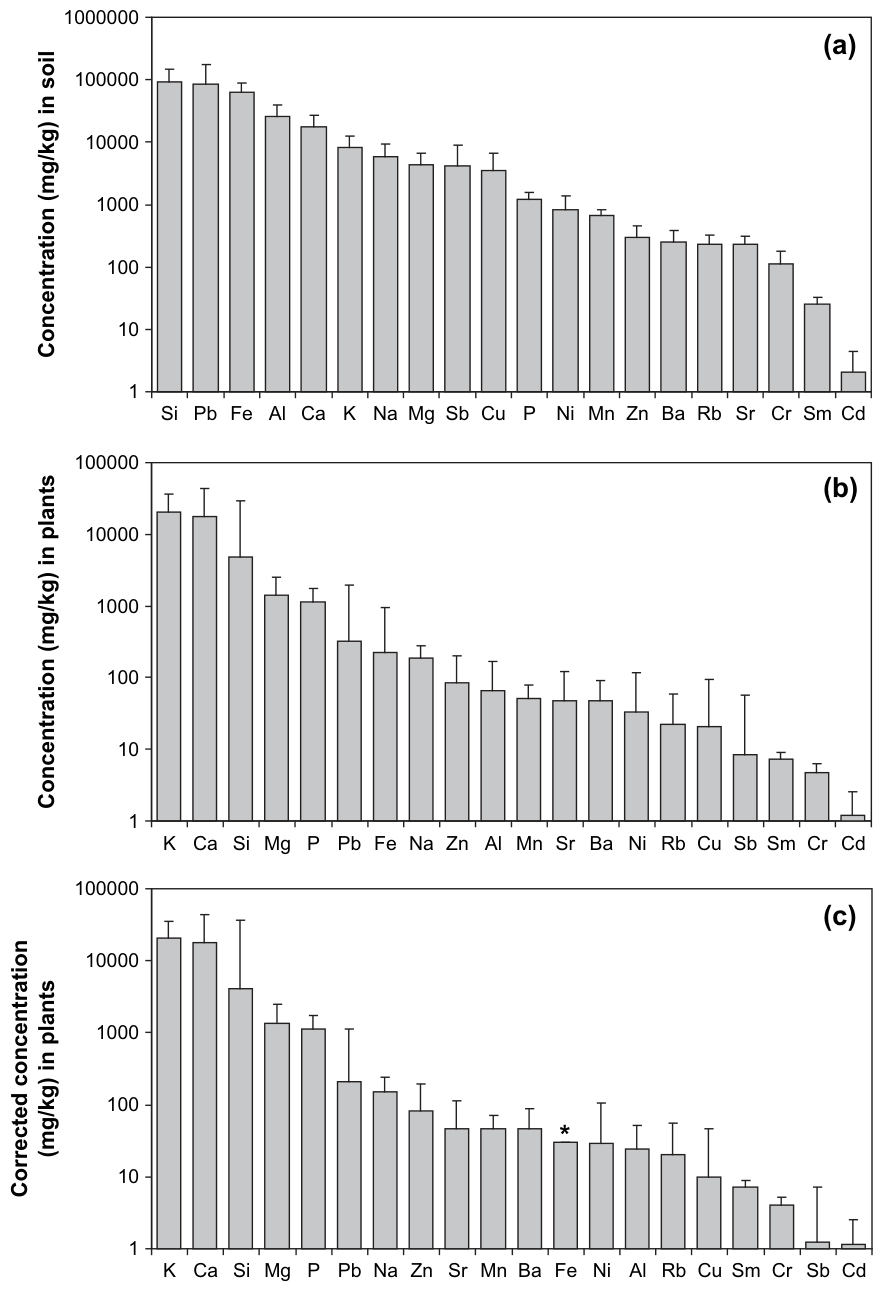
Na, Cd, Sr and P, and significantly and negatively correlated with Ca, Al, K, Si, Ba, and Mg. Elements that are positively correlated with Pb are probably constituents of the bullets, while the remainder are probably the major components of the native soil.
Na、Cd、Sr和P,而与Ca、Al、K、Si、Ba和Mg呈显著负相关。与Pb呈正相关的元素可能为子弹成分,其余元素则可能是原生土壤的主要组分。
3.2. Elemental composition of plants3.2. 植物元素组成
Fig. 1b shows the geometric means of the uncorrected trace element concentrations in all 70 plant samples. As expected, theessentialplantmacronutrients occur atthe highestconcentrations. The geometric mean concentrations of Pb, Ni and Cu were manifold higher than the values (2e5 mg/kg, 0.1e5 mg/kg, and 3e20 mg/kg) that Chaney (1989) considered ‘‘normal图1b显示了全部70个植物样品中未校正微量元素浓度的几何均值。正如预期,植物必需大量营养元素的浓度最高。Pb、Ni和Cu的几何平均浓度比Chaney (1989) 认为的非污染土壤中生长植物地上部“正常
levels’’ in the shoots of plant species growing in non-contaminated soil. The geometric mean Pb concentration was above 30 mg/kg, a threshold concentration in fodder (Chaney, 1989), above which livestock (cattle, sheep, swine, poultry) may show toxicity symptoms. Leaf Cu concentrations exceeded threshold levels for sheep (25 mg/kg) but not for other livestock. The geometric mean Ni concentration in leaves was below the threshold for livestock (50 mg/kg) given by Chaney (1989).
水平”(分别为2–5 mg/kg、0.1–5 mg/kg和3–20 mg/kg)高出数倍。Pb的几何平均浓度超过了饲料中的阈值浓度30 mg/kg(Chaney, 1989),高于该浓度时家畜(牛、羊、猪、家禽)可能出现中毒症状。叶片Cu浓度超过了绵羊的阈值(25 mg/kg),但未超过其他家畜的阈值。叶片中Ni的几何平均浓度低于Chaney (1989) 给出的家畜阈值(50 mg/kg)。
Upon correction of the plant concentrations using Fe as an indicator element, the concentrations of the plant macronutrients, namely K, Ca, Mg and P, stayed within 98% of their original value (Fig. 1c). However, the concentrations of Pb, Sb, and Cu, the major soil contaminants, dropped to 45%, <20% and 50% of their original values. The corrected Ni concentration was still 95% of its original value. These results indicate that, with the exception of Ni, surface deposition, rather than plant uptake, is responsible for most of the contaminants present in the plant leaves. Nevertheless, the levels of Pb remain far above levels that Chaney (1989) reported as normal for plant tissue.
以Fe为指示元素对植物浓度进行校正后,植物大量营养元素K、Ca、Mg和P的浓度仍保持在其原始值的98%以内(图1c)。然而,主要土壤污染物Pb、Sb和Cu的浓度分别降至原始值的45%、<20%和50%。校正后的Ni浓度仍为原始值的95%。这些结果表明,除Ni外,植物叶片中的大部分污染物来源于表面沉降而非植物吸收。尽管如此,Pb含量仍远高于Chaney (1989) 报道的植物组织正常水平。
Table 2 shows the Pb, Sb, Cu and Ni concentrations in the leaves of 10 sampled plant species, along with their concentrations in the rhizospheric soil and bioaccumulation coefficients表2列出了10种植物叶片中Pb、Sb、Cu和Ni的浓度,以及其在根际土壤中的浓度和生物累积系数
(plant/soil concentration quotient). For Dryopteris affinis, Salix spp., and Populis alba the corrected leaf Pb concentrations were within the normal range for plants. Silene vulgaris, Arrhenatherum elatius, and Molina arundinacea contained elevated concentrations (20e70 mg/kg), while E. arvense and T. farfara contained Pb at concentrations (both corrected and uncorrected) 10 to 50 times higher than those shown to be toxic to livestock (30 mg/kg).
(植物/土壤浓度比)。Dryopteris affinis、Salix spp.和Populis alba校正后的叶片Pb浓度处于植物正常范围内。Silene vulgaris、Arrhenatherum elatius和Molina arundinacea的Pb浓度偏高(20–70 mg/kg),而E. arvense和T. farfara的Pb浓度(无论校正与否)比对家畜有毒的浓度(30 mg/kg)高10至50倍。
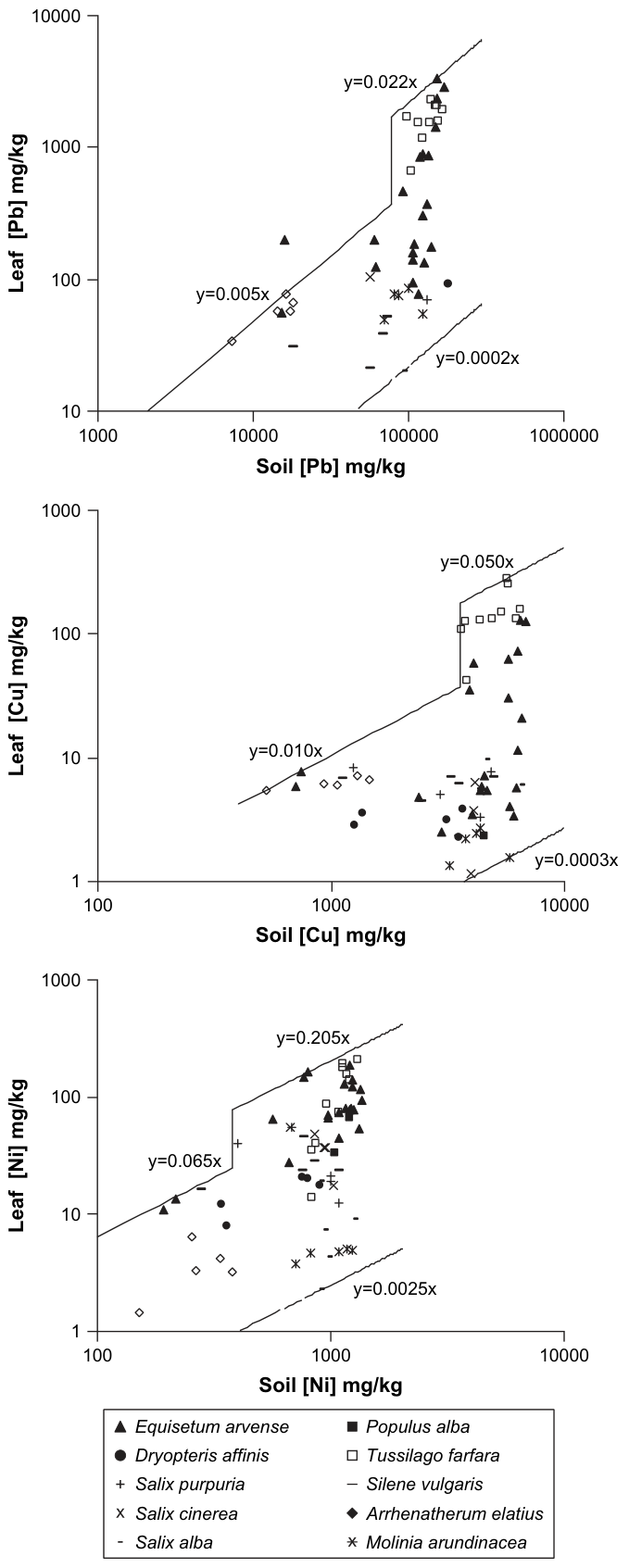
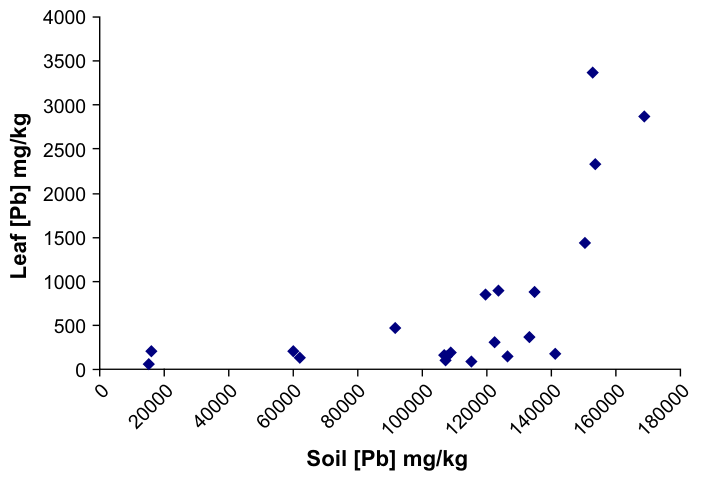
Across all species, the leaf concentrations of Pb, Cu, Ni, Sr and Sm were significantly and positively correlated with the concentrations of these elements in the soil. Fig. 2 shows these relationships for Pb, Cu and Ni along with the minimum and maximum bioaccumulation coefficients (plant/soil concentration quotient). The maximum bioaccumulation coefficient for these elements increased at higher soil metal concentrations, represented in Fig. 2 in a two-step equation. The threshold soil concentrations, above which plant metal concentrations sharply increased, were 60,000 mg/kg for Pb, 3600 mg/kg for Cu, and 400 mg/kg for Ni. These results show that the risk of these metals entering the food chain via plant uptake is disproportionately higher above these threshold concentrations. In a single species, E. arvense, for which we had 21 samples, Pb uptake followed a similar trend ofincreased bioaccumulation at higher soil Pb concentrations (Fig. 3). This species follows an accumulation pattern similar to that proposed by Baker (1981) for a metalexcluder species.
在所有物种中,叶片Pb、Cu、Ni、Sr和Sm浓度均与土壤中相应元素浓度呈显著正相关。图2显示了Pb、Cu和Ni的上述关系以及最小和最大生物累积系数(植物/土壤浓度比)。这些元素的最大生物累积系数随土壤金属浓度升高而增大,图2中以两段式方程表示。植物金属浓度急剧上升的土壤阈值浓度分别为:Pb 60,000 mg/kg、Cu 3600 mg/kg、Ni 400 mg/kg。结果表明,在高于这些阈值浓度时,这些金属经植物吸收进入食物链的风险不成比例地升高。就单一物种E. arvense(共21个样品)而言,其Pb吸收同样呈现出在较高土壤Pb浓度下生物累积增强的趋势(图3)。该物种的累积模式与Baker (1981) 提出的金属排斥型物种相似。
Geometric mean Pb, Sb, Cu and Ni concentrations (mg/kg), along with standard deviation ranges, in leaves and rhizospheric soil of plants sampled from the stop butt of a military shooting range near the city of Lucerne, Switzerland
瑞士卢塞恩市附近军事射击场挡弹堤上所采集植物的叶片及根际土壤中Pb、Sb、Cu和Ni的几何平均浓度(mg/kg)及标准差范围
| Soil土壤 | Plant植物 | Plant (corrected)植物(校正后) | BAF | |
|---|---|---|---|---|
| Pb | ||||
| Equisetum arvense | 96,100 (49,700e185,900) | 855 (194e3760) | 346 (102e1180) | 0.004 |
| Dryopteris affinis | 95,700 (52,200e175,000) | 113 (75e171) | 4 (1e24) | 0.001 |
| Salix purpuria | 85,700 (44,800e164,000) | 145 (40e523) | 5 (1e29) | 0.001 |
| Salix cinerea | 87,800 (67,200e115,000) | 169 (57e497) | 4 (1e26) | 0.002 |
| Salix alba | 100,000 (81,800e128,000) | 50 (20e133) | 3 (<1e9) | <0.001 |
| Populus alba | 156,000 (64,900e250,000) | 92 (41e208) | <2 | <0.001 |
| Tussilago farfara | 132,000 (111,000e158,000) | 4640 (3130e6880) | 1580 (1100e2280) | 0.012 |
| Silene vulgaris | 56,000 (25,000e109,000) | 86 (46e142) | 24 (8e56) | <0.001 |
| Arrhenatherum elatius | 14,000 (9590e20,400) | 69 (50e97) | 56 (41e77) | 0.004 |
| Molinia arundinacea | 90,600 (72,900e113,000) | 87 (73e104) | 67 (52e85) | 0.001 |
| Sb | ||||
| Equisetum arvense | 4760 (2470e9160) | 20 (3e116) | <2 | <0.001 |
| Dryopteris affinis | 4580 (2590e8100) | 1 (1e2) | <2 | <0.001 |
| Salix purpuria | 4550 (2540e8140) | 4 (2e11) | <2 | <0.001 |
| Salix cinerea | 4420 (3310e5900) | 4 (1e12) | <2 | <0.001 |
| Salix alba | 4920 (4140e6100) | 2 (1e3) | <2 | <0.001 |
| Populus alba | 8230 (3300e13500) | 4 (2e5) | <2 | <0.001 |
| Tussilago farfara | 6420 (5550e7440) | 143 (92e222) | 10 (4e25) | 0.002 |
| Silene vulgaris | 2930 (1280e5830) | 2 (1e4) | <2 | <0.001 |
| Arrhenatherum elatius | 629 (395e1000) | 2 (1e2) | <2 | <0.001 |
| Molinia arundinacea | 4750 (3870e5830) | 2 (1e2) | <2 | <0.001 |
| Cu | ||||
| Equisetum arvense | 4120 (2170e7810) | 34 (8e150) | 13 (4e46) | 0.003 |
| Dryopteris affinis | 2340 (1380e3970) | 7 (5e9) | 3 (3e4) | 0.001 |
| Salix purpuria | 3250 (1830e5790) | 13 (8e21) | 4 (2e10) | 0.001 |
| Salix cinerea | 4030 (3880e4190) | 13 (7e22) | 3 (1e7) | 0.001 |
| Salix alba | 4300 (3300e5590) | 11 (8e16) | 4 (1e10) | 0.001 |
| Populus alba | 6200 (3090e10500) | 10 (7e15) | 2 (1e3) | <0.001 |
| Tussilago farfara | 4890 (3940e6080) | 249 (155e402) | 136 (82e228) | 0.028 |
| Silene vulgaris | 2750 (1370e4830) | 9 (6e13) | 6 (5e7) | 0.002 |
| Arrhenatherum elatius | 996 (670e1480) | 7 (6e8) | 6 (6e7) | 0.006 |
| Molinia arundinacea | 4180 (3360e5200) | 3 (2e4) | 2 (1e3) | 0.001 |
| Ni | ||||
| Equisetum arvense | 902 (521e1560) | 79 (36e175) | 72 (34e151) | 0.080 |
| Dryopteris affinis | 581 (364e928) | 16 (11e23) | 15 (10e22) | 0.025 |
| Salix purpuria | 783 (515e1190) | 29 (17e47) | 26 (14e47) | 0.033 |
| Salix cinerea | 879 (745e1040) | 39 (25e61) | 36 (23e57) | 0.042 |
| Salix alba | 985 (880e1140) | 9 (4e16) | 7 (3e15) | 0.007 |
| Populus alba | 1490 (733e2440) | 57 (25e88) | 55 (25e85) | 0.037 |
| Tussilago farfara | 1040 (881e1230) | 111 (52e239) | 85 (34e208) | 0.081 |
| Silene vulgaris | 685 (360e1150) | 27 (17e39) | 26 (16e38) | 0.038 |
| Arrhenatherum elatius | 265 (186e378) | 4 (2e6) | 3 (2e6) | 0.013 |
| Molinia arundinacea | 979 (767e1250) | 5 (4e5) | 5 (4e5) | 0.005 |
The corrected plant values were calculated using Fe as an indicator element to determine surface deposition. BAF is the bioaccumulation coefficient, defined here as the plant (corrected)/soil concentration quotient.
校正后的植物值以Fe为指示元素确定表面沉降后计算得出。BAF为生物累积系数,此处定义为植物(校正后)/土壤浓度比。
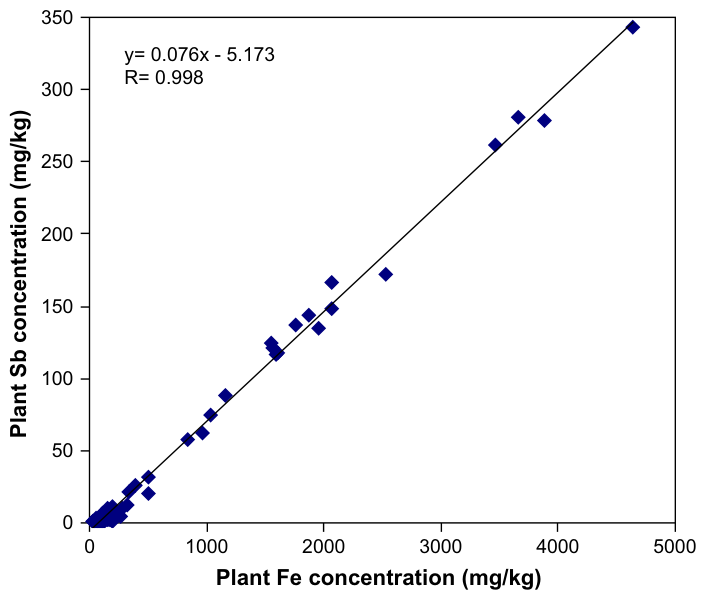
The corrected Sb concentrations in the leaves of all species except T. farfara were below detection limits (2 mg/kg). The bioaccumulation coefficients of all species were below 0.002. In leaf tissue, Sb was significantly and positively correlated with Fe (r = 0.97, p < 0.001), which we used as an indicator element (Fig. 4). This indicates that virtually all measured Sb in the plants arose from surface deposition, and little was translocated from the roots to the shoots.
除T. farfara外,所有物种叶片校正后的Sb浓度均低于检出限(2 mg/kg)。所有物种的生物累积系数均低于0.002。叶片组织中Sb与用作指示元素的Fe呈显著正相关(r = 0.97, p < 0.001)(图4)。这表明植物中实测的Sb几乎全部来源于表面沉降,从根部转运至地上部的Sb极少。
The corrected Cu concentrations in the leaves of all species except T. farfara were in the range 3e20 mg/kg that Chaney (1989) considered normal for plant tissue. T. farfara had leaf concentrations above those reported to be phytotoxic (10e70 mg/kg) by Gupta and Gupta (1998). There was no significant correlation between the leaf and rhizospheric soil Cu concentration in E. arvense.
除T. farfara外,所有物种叶片校正后的Cu浓度均处于Chaney (1989) 认为的植物组织正常范围3–20 mg/kg内。T. farfara叶片Cu浓度高于Gupta and Gupta (1998) 报道的植物毒性浓度(10–70 mg/kg)。E. arvense叶片与根际土壤Cu浓度之间无显著相关性。
Except for A. elatius, the corrected Ni concentrations in all plants were above the normal range (0.1e5 mg/kg) in plants given by Chaney (1989). Nickel had the highest bioaccumulation factor of the 4 major contaminants. There was little difference between the uncorrected and corrected values, indicating that most of the Ni present in the leaves was taken up by the plant through the roots, and not surface-deposited. Nevertheless, the concentrations in the sampled plants were within the range found within non-hyperaccumulator plants growing on Ni-rich ultramafic (serpentine) soils (Brooks, 1987). There was a highly significant and positive correlation between the Ni concentration in the shoots of E. arvense and the soil Ni concentration.
除A. elatius外,所有植物校正后的Ni浓度均高于Chaney (1989) 给出的植物正常范围(0.1–5 mg/kg)。在4种主要污染物中,Ni的生物累积系数最高。未校正值与校正值差异很小,表明叶片中的Ni大部分由植物经根系吸收,而非表面沉降。尽管如此,所采集植物中的Ni浓度仍处于富Ni超基性(蛇纹岩)土壤上生长的非超富集植物的浓度范围内(Brooks, 1987)。E. arvense地上部Ni浓度与土壤Ni浓度呈极显著正相关。
4Discussion讨论
The high metal burden in the stop butt of the MSR may explain the sparse vegetation, even though more than five years have elapsed since the last shot was fired. The high pH (6.9) and high organic matter contents in the stop butt no doubt reduce the phytotoxicity of metals that may otherwise inhibit the establishment of vegetation. Unlike cationic elements, Sb is more soluble at high soil pH (Nakamaru et al., 2006) and thus more available to interact with plant roots. We did not quantify the trace element concentrations in soil solution.
尽管最后一次射击已过去五年多,军事射击场挡弹堤中的高金属负荷或可解释其植被稀疏的现象。挡弹堤较高的pH(6.9)和较高的有机质含量无疑降低了金属的植物毒性,否则这些金属可能会抑制植被的定植。与阳离子元素不同,Sb在较高土壤pH下溶解度更高(Nakamaru et al., 2006),因而更易与植物根系发生作用。本研究未测定土壤溶液中的微量元素浓度。
After washing, the leaf Pb, Sb, Cu, and Ni concentrations of all species were above the normal range for plants and in the range reported by Chaney (1989) to be toxic to livestock. Presumably, unwashed plant material, which herbivores would consume, would have even higher concentrations of these toxic elements. Separating the trace elements that were deposited on the leaf surface from those that the plant has taken up from through the roots revealed that for most species, the metal uptake fell into the normal range for plants. The exceptions were E. arvense and T. farfara. Both these species were found on the most highly contaminated soil, which was devoid of other species. The physiological metal uptake in these plants may have been higher, because they were growing in soil with a relatively high trace element burden. High soluble trace element concentrations (which we did not quantify) can damage plant roots, allowing the direct entry of soil solution into the xylem, thus enhancing plant metal uptake. These phenomena may explain the sharp increase in Pb uptake by E. arvense at high soil Pb concentrations (Fig. 3).
清洗后,所有物种叶片中Pb、Sb、Cu和Ni浓度均高于植物正常范围,并处于Chaney (1989) 报道的对家畜有毒的范围内。可以推测,食草动物所摄食的未清洗植物材料中这些有毒元素的浓度会更高。将沉降于叶片表面的微量元素与植物经根系吸收的微量元素区分后发现,大多数物种的金属吸收处于植物正常范围内,例外的是E. arvense和T. farfara。这两个物种均生长在污染最严重、无其他物种分布的土壤上。由于生长在微量元素负荷相对较高的土壤中,这些植物的生理金属吸收可能更高。高浓度的可溶性微量元素(本研究未定量)可损伤植物根系,使土壤溶液直接进入木质部,从而增强植物对金属的吸收。上述现象或可解释在高土壤Pb浓度下E. arvense对Pb吸收的急剧增加(图3)。
The low physiological plant uptake of Sb found in this study is surprising, since Johnson et al. (2005) reported that Sb is the most soluble element in shooting range soils. Although we did not quantify soluble Sb in this study, one would expect Sb to be relatively soluble at the neutral pH in our soils. The large size of the Sb(OH)�6 anion, the predominant form in well aerated soils (Scheinost et al., 2006), may prohibit its passage through the root endodermis into the xylem, thus limiting its translocation to the aerial portions of the plant.
本研究发现植物对Sb的生理吸收很低,这一结果出人意料,因为Johnson et al. (2005) 报道Sb是射击场土壤中溶解性最强的元素。虽然本研究未测定可溶性Sb,但在本研究土壤的中性pH条件下,Sb预计具有相对较高的溶解性。Sb(OH)−6阴离子是通气良好土壤中的主要存在形态(Scheinost et al., 2006),其较大的离子尺寸可能阻碍其穿过根内皮层进入木质部,从而限制其向植物地上部的转运。
The plants in this study, which were all sampled in late summer, represent a snapshot of leaf trace element concentrations at only one time. Poplars and willows have the highest foliar concentrations of many trace elements at this time (Robinson et al., 2005). By contrast, Deram et al. (2006) found that Pb, Cd, and Zn concentrations in the leaves of A. elatius were highest at the beginning of the growing season.
本研究中的植物均于夏末采集,仅代表某一时间点叶片微量元素浓度的瞬时状况。杨树和柳树在此时期叶片中多种微量元素浓度最高(Robinson et al., 2005)。相比之下,Deram et al. (2006) 发现A. elatius叶片中Pb、Cd和Zn浓度在生长季初期最高。
4.1. Management implications4.1. 管理启示
Unless the most highly contaminated soils were removed, Pb uptake by species such as E. arvense and T. farfara may still be above 30 mg/kg, a concentration that is toxic to livestock (Chaney, 1989). Lead immobilisation agents, such as hydroxyapatite or Zeolite minerals may also reduce plant Pb uptake (Chen et al., 2007).
除非移除污染最严重的土壤,否则E. arvense和T. farfara等物种的Pb吸收仍可能超过30 mg/kg这一对家畜有毒的浓度(Chaney, 1989)。羟基磷灰石或沸石矿物等铅固定剂也可降低植物对Pb的吸收(Chen et al., 2007)。
Given that the Pb concentration in most rhizospheric soils of the stop butt are above those of many Pb ores (Mucha and Szuwarzynski, 2004), this soil could be removed, and the Pb extracted to recover the cost of the operation. The establishment of vegetation, using soil conditioners and metaltolerant species, on the remainder of the MSR would greatly reduce the concentrations of toxic elements associated with plant leaves, because this would eliminate wind-borne and rain-splash soil particles, the main contributor to the plant’s trace element burden. In the case of Sb, the most abundant contaminant after Pb, plant tissue concentrations could be reduced to <1 mg/kg. Without surface deposition, the reduced concentrations of Cu and Ni would be unlikely to present a risk to terrestrial ecosystems.
鉴于挡弹堤大部分根际土壤中的Pb浓度高于许多铅矿石(Mucha and Szuwarzynski, 2004),可将这些土壤移除并提取其中的Pb,以回收作业成本。在射击场其余区域利用土壤改良剂和耐金属物种建立植被,将大幅降低植物叶片所附着的有毒元素浓度,因为这将消除风蚀和雨滴溅蚀产生的土壤颗粒,而后者是植物微量元素负荷的主要来源。对于仅次于Pb的最主要污染物Sb,植物组织浓度可降至 <1 mg/kg。若无表面沉降,降低后的Cu和Ni浓度不大可能对陆地生态系统构成风险。
Intuitively, planting deep-rooted tree species to reduce leaching may seem like a logical choice, since they would maximise evapotranspiration from the site, thus minimising drainage. However, the roots of such trees may create preferential flow pathways that actually exacerbate contaminant leaching. Knechtenhofer et al. (2003) showed that preferential flow was the main mechanism for the downward mobility of otherwise immobile elements in another Swiss MSR. Vegetation with a high biomass production may also enhance trace element mobility through the generation of organic compounds, which Wang and Benoit (1996) demonstrated as important factors in the Pb flux in a contaminated forest.
直观上看,种植深根性树种以减少淋溶似乎是合理的选择,因为它们可最大化场地的蒸散量,从而最大限度地减少排水。然而,这类树木的根系可能形成优先流通道,反而加剧污染物淋溶。Knechtenhofer et al. (2003) 表明,在瑞士另一处军事射击场,优先流是原本不易迁移元素向下迁移的主要机制。高生物量植被还可能通过产生有机化合物而增强微量元素的迁移性,Wang and Benoit (1996) 已证明这些有机化合物是污染森林中Pb通量的重要影响因素。
Similar to other polluted sites, contaminants in MSRs occur heterogeneously. The interactions of roots with hotspots are of overriding importance on the contaminant fate. Root avoidance of hotspots will reduce contaminant mobility because of reduced plant uptake. Conversely, when roots penetrate a hotspot, the plant may accumulate higher amounts of the contaminant and the contaminants may have a preferential flow conduit into receiving waters (Roulier et al., in press).
与其他污染场地类似,军事射击场中污染物的分布具有异质性。根系与污染热点区的相互作用对污染物归趋具有决定性影响。根系避开热点区会因植物吸收减少而降低污染物迁移性。相反,当根系穿透热点区时,植物可能累积更多污染物,且污染物可能获得进入受纳水体的优先流通道(Roulier et al., in press)。
The remediation of disused MSRs would be most effective by combining soil removal, soil conditioners, revegetation and perhaps reactive barriers to capture Pb, Sb, Cu and Ni that leach beyond the root zone. Since any remediation-technology is sensitive to climatic and edaphic conditions, the design of such systems requires mechanistic modelling. These models should incorporate variation in microtopography that may cause crusting (Roulier et al., 2002). This could increase runoff and erosion from Swiss MSRs, many of which are on steep slopes in the Alps.
废弃军事射击场的修复最有效的方式是将土壤移除、土壤改良剂、植被重建以及可能的反应屏障相结合,以截获淋溶至根区以下的Pb、Sb、Cu和Ni。由于任何修复技术都对气候和土壤条件敏感,此类系统的设计需要机理模型。这些模型应纳入可能导致土壤结皮的微地形变化(Roulier et al., 2002),因为结皮可能增加瑞士军事射击场的径流和侵蚀,而其中许多射击场位于阿尔卑斯山的陡坡上。
5Conclusions结论
The major soil contaminants Pb, Sb, Cu, and Ni occurred at high concentrations in the aerial portions of the sampled plants, primarily because of the surface deposition of wind-borne dust from the sparsely vegetated soil. At high soil Pb concentrations (>60,000 mg/kg) the physiological uptake of Pb by plant may present an exposure pathway for this toxic element to enter food chains. Revegetating the site, using metaltolerant species, soil conditioners and possibly capping with uncontaminated topsoil, would reduce the upward mobility of these contaminants into plant tissues. Vegetation would also reduce, via evapotranspiration, the downward mobility of these contaminants into receiving waters. An important and as-yet unanswered question is whether deep-rooted tree species generate macropores that enhance contaminant leaching via preferential flow.
主要土壤污染物Pb、Sb、Cu和Ni在所采集植物的地上部中浓度较高,这主要是由于植被稀疏的土壤产生的风蚀扬尘在表面沉降所致。在高土壤Pb浓度(>60,000 mg/kg)下,植物对Pb的生理吸收可能成为该有毒元素进入食物链的暴露途径。利用耐金属物种、土壤改良剂进行植被重建,并可能覆盖未污染表土,可减少这些污染物向植物组织的向上迁移。植被还可通过蒸散作用减少这些污染物向受纳水体的向下迁移。一个重要且尚未解答的问题是:深根性树种是否会形成大孔隙,从而通过优先流加剧污染物淋溶。
Acknowledgements致谢
We gratefully acknowledge Niutec Laboratories AG, who conducted the independent analyses. We would like to thank Stefan Herfort at Umwelt und Energie Luzern for help with the plant identification.
感谢Niutec Laboratories AG进行独立分析。感谢Umwelt und Energie Luzern的Stefan Herfort协助鉴定植物。
References参考文献
Baker, A.J.M., 1981. Accumulators and excluders e strategies in the response of plants to heavy metals. Journal of Plant Nutrition 3, 643e654.
Baker, D.E., Chesnin, L., 1975. Chemical monitoring for environmental qual-
ity and animal and human health. Advances in Agronomy 27, 305e374. Batelle Corporation, 1997. Implementation Guidance Handbook: Physical Separation and Acid Leaching to Process Small-arms Range Soils. Naval Facilities Engineering Service Center. Available from: http://enviro.nfesc.navy.mil/erb/ erb_a/restoration/technologies/remed/uxo_remed/rpt-sar-imple.pdf (accessed 03.08.06).
Brooks, R.R., 1987. Serpentine and Its Vegetation. Discorides Press, Portland. Brooks, R.R., 1998. Plants That Hyperaccumulate Heavy Metals: Their Role in Archaeology, Microbiology, Mineral Exploration, Phytomining and Phytoremediation. CAB International, Wallingford.
Chaney, R.L., 1989. Toxic element accumulation in soils and crops: protecting soil fertility and agricultural food chains. In: Bar-Yosef, B., Barrow, N.J., Goldshmid, J. (Eds.), Inorganic Contaminants in the Vadose Zone. Springer, Berlin, pp. 140e158.
Chen, S.B., Xu, M.G., Ma, Y.B., Yang, J.C., 2007. Evaluation of different phosphate amendments on availability of metals in contaminated soil. Ecotoxicology and Environmental Safety 67 (2), 278e285.
CIA, 2006. The CIA World Fact Book. Available from: https://www.cia.gov/ cia/publications/factbook/geos/sz.html (accessed 04.08.06).
Craig, J.R., Rimstidt, J.D., Bonnaffon, C.A., Collins, T.K., Scanlon, P.F., 1999. Surface water transport of lead at a shooting range. Bulletin of Environmental Contamination and Toxicology 63, 312e319.
Deram, A., Denayer, F., Petit, D., Van Haluwyn, C., 2006. Seasonal variations of cadmium and zinc in Arrhenatherum elatius, a perennial grass species from highly contaminated soils. Environmental Pollution 140, 62e70.
Gupta, U.C., Gupta, S.C., 1998. Trace element toxicity relationships to crop production and livestock and human health: implications for management. Communications in Soil Science and Plant Analysis 29 (11e14), 1491e1522.
Heinrich, A., 2006. Comparison of soil clean-up standards for trace elements between countries: why do they differ? Journal of Soils and Sediments 6 (3), 173e181.
Hinton, T.G., Kopp, P., Ibrahim, S., Bubryak, I., Syomov, A., Tobler, L., Bell, C., 1995. A comparison of techniques used to estimate the amount of resuspended soil on plant surfaces. Health Physics 68, 523e531.
Johnson, C.A., Moench, H., Wersin, P., Kugler, P., Wenger, P., 2005. Solubility of antimony and other elements in samples taken from shooting ranges. Journal of Environmental Quality 34, 248e254.
Knechtenhofer, L.A., Xifra, I.O., Scheinost, A.C., Flu¨hler, H., Kretzschmar, R., 2003. Fate of heavy metals in a strongly acidic shooting-range soil: small-scale metal distribution and its relation to preferential flow. Journal of Plant Nutrition and Soil Science 166, 84e92.
Labare, M.P., Butkus, M.A., Riegner, D., Schommer, N., Atkinson, J., 2004. Evaluation of lead movement from the abiotic to the biotic at a small-arms firing range. Environmental Geology 46, 750e754.
Lee, I.S., Kim, O.K., Chang, Y.Y., Bae, B., Kim, H.H., Baek, K.H., 2002. Heavy metal concentrations and enzyme activities in soil from a contaminated Korean shooting range. Journal of Bioscience and Bioengineering 94 (5), 406e411.
Lin, Z., Comet, B., Qvarfort, U., Herbert, R., 1995. The chemical and mineralogical behaviour of Pb in shooting range soils from central Sweden. Environmental Pollution 89 (3), 303e309.
Ma, L.Q., Cao, R.X., Hardison, D., Chen, M., Harris, W.G., Sartain, J., 2002. Environmental Impacts of Lead Pellets at Shooting Ranges and Arsenical Herbicides on Golf Courses in Florida. Report No. 02-01. Florida Center for Solid and Hazardous Waste Management. Available from: http:// lqma.ifas.ufl.edu/Publication/MA-00-R.pdf (accessed 03.08.06).
Marschner, H., 1995. Mineral Nutrition of Higher Plants. Academic Press, London, UK, p. 65.
Migliorini, M., Pigino, G., Bianchi, N., Bernini, F., Leonzio, C., 2003. The effects of metal contamination on the soil arthropod community of a shooting range. Environmental Pollution 129 (2), 331e340.
Mozafar, A., Ruh, R., Klingel, P., Gamper, H., Egli, S., Frossard, E., 2002. Effect of heavy metal contaminated shooting range soils on mycorrhizal colonization of roots and metal uptake by leek. Environmental Monitoring and Assessment 79, 177e191.
Mucha, J., Szuwarzynski, M., 2004. Sampling errors and their influence on accuracy of zinc and lead content evaluation in ore from the Trzebionka mine (SilesianeCracow ZnePb ore district, Poland). Chemometrics and Intelligent Laboratory Systems 74 (1), 165e170.
Nakamaru, Y., Tagami, K., Uchida, S., 2006. Antimony mobility in Japanese agricultural soils and the factors affecting antimony sorption behavior. Environmental Pollution 141, 321e326.
Rantalainen, M.L., Torkkeli, M., Stro¨mmer, R., Seta¨la¨, H., 2006. Lead contamination of an old shooting range affecting the local ecosystem e a case study with a holistic approach. Science of the Total Environment 369, 99e108.
Robinson, B.H., Green, S.R., Mills, T.M., Clothier, B.E., van der Velde, M., Laplane, R., Fung, L., Deurer, M., Hurst, S., Thayalakumaran, T., van den Dijssel, C., 2003. Phytoremediation: using plants as biopumps to improve degraded environments. Australian Journal of Soil Research 41 (3), 599e611.
Robinson, B.H., Mills, T.M., Green, S.R., Chancerel, B., Clothier, B.E., Fung, L., Hurst, S., McIvor, I., 2005. Trace element accumulation by pop-
lars and willows used for stock fodder. New Zealand Journal of Agricultural Research 48, 489e497.
Rooney, C.P., McLaren, R.G., Cresswell, R.J., 1999. Distribution and phytoavailability of lead in a soil contaminated with lead shot. Water, Air and Soil Pollution 116, 535e548.
Roulier, S., Angulo-Jaramillo, R., Bresson, L.M., Auzet, A.V., Gaudet, J.P., Bariac, T., 2002. Water transfer and mobile water content measurement in a cultivated crusted soil. Soil Science 167 (3), 201e210.
Roulier, S., Robinson, B., Kuster, E., Schulin, R. Analysing the preferential transport of lead in a road-side soil under vegetation. European Journal of Soil Science, in press. doi:10.1111/j.1365-2389.2007.00954.x.
Scheinost, A.C., Rossberg, A., Vantelon, D., Xifra, I., Kretzschmar, R., Leuz, A.K., Funke, H., Johnson, C.A., 2006. Quantitative antimony speciation in shooting-range soils by EXAFS spectroscopy. Geochimica et Cosmochimica Acta 70, 3299e3312.
Sorvari, J., Antikainen, R., Pyy, O., 2006. Environmental contamination at Finnish shooting ranges e the scope of the problem and management options. Science of the Total Environment 366, 21e31.
Tuomela, M., Steffen, K.T., Kerko, E., Hartikainen, H., Hofrichter, M., Hatakka, A., 2005. Influence of Pb contamination in boreal forest soil on the growth and ligninolytic activity of litter-decomposing fungi. FEMS Microbiology Ecology 53, 179e186.
Wageningen, 2006. International Soil-analytical Exchange. Quarterly report 2006.1. WEPAL, Wageningen, Netherlands.
Wang, E.X., Benoit, G., 1996. Mechanisms controlling the mobility of lead in the spodosols of a northern hardward forest ecosystem. Environmental Science and Technology 30, 2211e2219.
Wersin, P., Johnson, C.A., Furrer, G., 2002. Antimony contamination in soil and groundwater by shooting range activities. Geochimica et Cosmochimica Acta 66, A829.
Zellmer, S.D., Schneider, J.F., 1993. Heavy-metal Contamination on Training Ranges at the Grafenwo¨hr Training Area, Germany. Prepared by Argonne National Laboratory, Argonne, IL, for the Department of the Army, U.S. Army Seventh Army Training Center, Grafenwo¨hr, Germany. ANL/ESD/ TM-59. Available from: http://www.osti.gov/energycitations/servlets/purl/ 10132677-qRHg8M/native/ (accessed 02.08.06).