M. Tschan et al., Environ. Chem. 2009, 6, 144–152. doi:10.1071/EN08103 www.publish.csiro.au/journals/env
Martin Tschan,A,D Brett H. Robinson,B Matteo NodariC and Rainer SchulinA
AEidgenössische Technische Hochschule (ETH) Zurich, Institute of Terrestrial Ecosystems ITES, Universitaetstrasse 16, CH-8092 Zurich, Switzerland.
BAgricultural and Life Sciences Division, Lincoln University, PO Box 84, Canterbury, New Zealand.
CUniversity of Zurich, Zoologisches Institut, Winterthurerstrasse 190, Zurich, CH-8057, Switzerland. DCorresponding author. Email: martin.tschan@env.ethz.ch
Environmental context. Because of its many industrial and other uses, antimony (Sb) is increasingly emitted into the environment through human activities. We studied the uptake of Sb by crop plants from three different substrates: hydroponic nutrient solutions, agar medium, and potting soil. The uptake of Sb increased linearly with Sb in solution or soluble Sb in soil over a wide range of concentrations until it was limited by toxicity. Antimony was much less toxic than its sister element arsenic compared on a molar basis. The results suggest that Sb may be accumulated by some crop plants on heavily contaminated soils at concentrations that may pose a health risk to humans and animals.
环境背景。由于锑(Sb)具有广泛的工业及其他用途,人类活动向环境中排放的锑日益增多。本研究考察了作物从三种不同基质(水培营养液、琼脂培养基和盆栽土壤)中对Sb的吸收。在较宽的浓度范围内,Sb吸收量随溶液中Sb或土壤中可溶性Sb浓度的升高而线性增加,直至受到毒性的限制。以摩尔浓度计,锑的毒性远低于其同族元素砷。结果表明,在重度污染土壤上,某些作物可能累积Sb,其浓度可能对人类和动物健康构成风险。
Abstract. We investigated the uptake of antimonate from nutrient solutions, agar and soil by various cultivated plants, including Indian mustard (Brassica juncea (L.) Czern), sunflower (Helianthus annuus L.), perennial ryegrass (Lolium perenne L.), clover (Trifolium pratense L.), wheat (Triticum aestivum L.) and maize (Zea mays L.).Antimony uptake did not differ between the three growth media. In all tested plants, the shoot Sb concentration was proportional to Sb in solution or soluble Sb in soil, until toxicity eventually limited growth. At a given Sb concentration in the growth medium, Sb accumulation differed between plant species by up to an order of magnitude. Clover grown in agar containing 160 mg L−1 Sb in solution accumulated 2151 mg kg−1 Sb (dry weight) in the shoots. Maize had the lowest accumulation. In maize and sunflower, most Sb accumulated in the leaves. The results indicate that antimony may accumulate in the edible parts of crop plants grown on heavily contaminated soils at concentrations that may pose a health risk to humans and animals.
摘要。本研究考察了多种栽培植物从营养液、琼脂和土壤中对锑酸盐的吸收,包括印度芥菜(Brassica juncea (L.) Czern)、向日葵(Helianthus annuus L.)、多年生黑麦草(Lolium perenne L.)、三叶草(Trifolium pratense L.)、小麦(Triticum aestivum L.)和玉米(Zea mays L.)。三种生长介质之间锑的吸收无差异。在所有供试植物中,地上部Sb浓度与溶液中Sb或土壤中可溶性Sb成正比,直至毒性最终限制生长。在生长介质中Sb浓度相同的条件下,不同植物物种间Sb累积量的差异可达一个数量级。在溶液Sb浓度为160 mg L−1的琼脂中生长的三叶草,其地上部Sb累积量达2151 mg kg−1(干重)。玉米的累积量最低。在玉米和向日葵中,Sb主要累积于叶片。结果表明,在重度污染土壤上生长的作物,其可食部分可能累积锑,其浓度可能对人类和动物健康构成风险。
Additional keywords: allocation, arsenic, hydroponics, plant uptake, toxicity.
1Introduction引言
With an average concentration between 0.2 and 0.3 mg kg−1, antimony (Sb) is a rare element in the earth’s crust.[1] Natural Sb background concentrations in soil were found to vary between 0.3 and 8.6 mg kg−1.[2,3] However, as a component of many industrial products, e.g. in fire retardants, brakes, semiconductors, and metal alloys,[4,5] it has become increasingly emitted through human activities into the environment. One major pathway of Sb entry into soils by human activities is shooting; bullets and pellets contain between 1 and 7% Sb.[6] Switzerland, for example, has more than 2000 shooting ranges. Depending on the duration and intensity of shooting activities, not only soil lead (Pb) but also soil Sb concentrations are generally highly elevated on these sites.[7] As they are often used for grazing sheep and cattle when they are not used for shooting, there is a potential risk that Sb enter the food chain through uptake into plants growing on such Sb-contaminated sites.
锑(Sb)在地壳中的平均含量为0.2~0.3 mg kg−1,属于稀有元素。[1]土壤中Sb的自然背景浓度在0.3~8.6 mg kg−1之间。[2,3]然而,由于锑是阻燃剂、刹车片、半导体和金属合金等许多工业产品的组分,[4,5]人类活动向环境中排放的锑日益增多。射击是人类活动导致Sb进入土壤的主要途径之一;子弹和弹丸含有1%~7%的Sb。[6]例如,瑞士有2000多个射击场。根据射击活动的持续时间和强度,这些场地土壤中不仅铅(Pb)浓度,而且Sb浓度通常也显著升高。[7]由于这些场地在不用于射击时常被用于放牧羊和牛,Sb存在通过此类污染场地上生长的植物吸收而进入食物链的潜在风险。
Previous studies have shown that plants can accumulate Sb at high concentrations on Sb-contaminated soil. Foliar Sb concentrations of up to 1100 mg kg−1 were measured in vegetation growing in a soil polluted with up to 400 mg Sb kg−1 dry weight (DW) in the vicinity of an Sb smelter in northeast England.[8] Another study reported foliar Sb concentrations greater than 100 mg kg−1 in plants growing on a mine tailing soil with 9000 mg Sb kg−1 DW. In the basal leaves of Achillea ageratum, more than 1000 mg Sb kg−1 DW was found on that site.[9] There are also studies that reported only small Sb concentrations in plants grown on heavily Sb-contaminated soils. Pratas et al. reported maximum stem concentrations of less than 5 mg Sb kg−1 DW in various tree and herb species growing on a Portuguese mine spoil with an average total Sb concentration of 663 mg kg−1.[10]
已有研究表明,植物可在Sb污染土壤上累积高浓度的Sb。在英格兰东北部一座锑冶炼厂附近,土壤Sb污染高达400 mg Sb kg−1干重(DW),其上生长的植被叶片Sb浓度高达1100 mg kg−1。[8]另一项研究报道,在含9000 mg Sb kg−1 DW的尾矿土壤上生长的植物,叶片Sb浓度超过100 mg kg−1。在该场地,Achillea ageratum的基生叶中Sb含量超过1000 mg Sb kg−1 DW。[9]也有研究报道,在重度Sb污染土壤上生长的植物中Sb浓度很低。Pratas et al.报道,在平均总Sb浓度为663 mg kg−1的葡萄牙矿山废弃地上生长的多种乔木和草本植物,其茎中最高Sb浓度低于5 mg Sb kg−1 DW。[10]
Deposition of Sb-containing dust particles on leaf surfaces may be one reason for the high plant Sb concentrations on contaminated field sites,[8] and thus to some extent may explain the diversity of results reported in the literature, given that most studies did not discriminate between Sb coming from dust deposition or through root uptake. However, very different accumulation rates have also been reported from two pot experiments performed under greenhouse conditions. In one of these studies, barley (Hordeum vulgare L.) grown in sand contaminated with 100 mg kg−1 soluble Sb was not found to take up more than 2 mg Sb kg−1 DW, which was the detection limit in that study, although yields were reduced.[11] In the other study, 19 species of garden and crop plants were grown on potted soil that had been spiked with Sb to give a dissolved Sb concentration of
含Sb粉尘颗粒在叶片表面的沉降可能是污染场地植物Sb浓度较高的原因之一,[8]鉴于多数研究并未区分来源于粉尘沉降和根系吸收的Sb,这在一定程度上可以解释文献报道结果的差异。然而,在温室条件下进行的两项盆栽试验也报道了截然不同的累积速率。其中一项研究中,在含100 mg kg−1可溶性Sb的污染砂中生长的大麦(Hordeum vulgare L.),虽然产量下降,但其Sb吸收量未超过2 mg Sb kg−1 DW(即该研究的检出限)。[11]另一项研究中,19种园艺植物和作物生长在添加Sb的盆栽土壤上,土壤溶解态Sb浓度为
Antimony uptake by plants植物对锑的吸收
45 mg L−1. The plants accumulated up to 399 mg Sb kg−1 DW in the shoots without showing toxicity symptoms.[12]
45 mg L−1。植物地上部Sb累积量高达399 mg Sb kg−1 DW,但未表现出毒害症状。[12]
Given the large variation observed in plant Sb concentrations and the uncertain role of roots in Sb uptake by plants, the goal of the present study was to study plant Sb uptake through roots under controlled conditions and to relate the uptake to the Sb concentration in the soil or solution to which the roots were exposed. For this purpose, we performed experiments with six plant species that are cultivated in practice for various purposes, using three systems: nutrient solution (hydroponics), agar medium and potted soil. We also compared the toxicity of AsV and SbV in hydroponic solutions and agar cultures.
鉴于所观察到的植物Sb浓度差异很大,且根系在植物吸收Sb中的作用尚不明确,本研究旨在受控条件下研究植物经根系对Sb的吸收,并将吸收量与根系所接触的土壤或溶液中的Sb浓度相关联。为此,我们以六种在实践中用于不同目的的栽培植物为材料,采用三种体系开展试验:营养液(水培)、琼脂培养基和盆栽土壤。我们还比较了AsV和SbV在水培溶液和琼脂培养中的毒性。
Each of the three different substrates we used has distinct advantages and disadvantages. The agar system was used in addition to the hydroponics system to control for root damage that may arise from seedling manipulation in hydroponics experiments; as seeds cannot be germinated in solution, the hydroponics system requires that seeds are germinated first and then the seedlings are transferred to the nutrient solution. This may cause damage to the roots by which pathways are created bypassing the endodermis barrier and thus allowing excessive uptake of solutes that would otherwise be prevented by this barrier. Although no transplantation is necessary in agar and soil systems, as seeds can be directly germinated in these media, hydroponics have the important advantage that it is much easier to control – and also change if desired – the composition of the solution to which the roots are exposed. Heterogeneity of the rhizosphere is on one hand a problem in experiments with soil; however, this reflects natural conditions, and providing a more natural environment for plant growth than hydroponics means that such experiments are more representative of growing conditions in field situations.To some extent, the agar system provides conditionsinbetweenthehydroponicsandthesoilsystem.Itprovides much less natural growth conditions than soil, but allows better control of rhizosphere conditions. Nodari et al. found that Sb is 98% available in agar.[13] Care has to be taken that the slow diffusion of gases does not lead to stresses such as shortage in oxygen and accumulation of carbonic acid, as encountered by roots growing in waterlogged soils.[14,15]
本研究所用的三种基质各有其优缺点。在水培体系之外另采用琼脂体系,是为了控制水培试验中幼苗操作可能造成的根系损伤;由于种子无法在溶液中萌发,水培体系需先使种子萌发,再将幼苗移入营养液。这可能损伤根系,形成绕过内皮层屏障的通道,从而使原本受该屏障阻挡的溶质被过量吸收。虽然琼脂和土壤体系中种子可直接萌发、无需移栽,但水培的重要优势在于更易于控制(并可按需改变)根系所接触溶液的组成。根际的异质性一方面是土壤试验中的问题;但另一方面,这反映了自然条件,并且与水培相比,土壤为植物生长提供了更为自然的环境,意味着此类试验更能代表田间生长条件。在一定程度上,琼脂体系提供的条件介于水培与土壤体系之间。其生长条件远不如土壤自然,但可更好地控制根际条件。Nodari et al.发现Sb在琼脂中的有效性为98%。[13]需注意避免气体扩散缓慢导致的胁迫,例如缺氧和碳酸积累,类似于根系在渍水土壤中所遭遇的情况。[14,15]
In the current study, we focussed on the uptake of SbV provided in the form of antimonate, as this is the dominant Sb species in the solution of aerated soils. Moreover, as antimonate is very soluble, it was also possible to apply very high concentrations and, thus, to test for toxicity limits of growth.
本研究重点关注以锑酸盐形式提供的SbV的吸收,因为这是通气土壤溶液中的优势Sb形态。此外,由于锑酸盐溶解度很高,因而可以施加非常高的浓度,从而检验生长的毒性限度。
2Material and methods材料与方法
Plant cultivation and application of Sb treatments植物培养与Sb处理
The plants used in the present study were Indian mustard (Brassica juncea (L.) Czern, obtained from TRS, Middlesex, UK), sunflower (Helianthus annuus L. cv. Iregi), ryegrass (Lolium perenne L. cv. Arvicola), clover (Trifolium pratense L. cv. Milvus), wheat (Triticum aestivum L. cv. Galaxie) and maize (Zea mays L. cv. Magister). All experiments were performed in a climate chamber with a daily photoperiod of 16 h at a light intensity of 11 000 lx, and a day–night temperature rhythm of 22–14◦C.
本研究所用植物为印度芥菜(Brassica juncea (L.) Czern,购自英国Middlesex的TRS)、向日葵(Helianthus annuus L.,品种Iregi)、黑麦草(Lolium perenne L.,品种Arvicola)、三叶草(Trifolium pratense L.,品种Milvus)、小麦(Triticum aestivum L.,品种Galaxie)和玉米(Zea mays L.,品种Magister)。所有试验均在人工气候室中进行,每日光照16 h,光照强度11 000 lx,昼夜温度22~14◦C。
For the hydroponic experiments, plants were germinated in quartz sand. After 2 weeks, the seedlings were transferred to 30-L plastic boxes containing a modified Hoagland nutrient solution.[16] The nutrient solution consisted of 0.4 mmol L−1 Ca(NO3)2, 0.2 mmol L−1 MgSO4, 0.1 mmol L−1 KH2PO4, 0.5 mmol L−1 KNO3, 0.01 mmol L−1
水培试验中,植物先在石英砂中萌发。2周后,将幼苗移入装有改良Hoagland营养液的30 L塑料箱中。[16]营养液组成为:0.4 mmol L−1 Ca(NO3)2、0.2 mmol L−1 MgSO4、0.1 mmol L−1 KH2PO4、0.5 mmol L−1 KNO3、0.01 mmol L−1
NaFeIIIEDTA, 0.01 mmol L−1 H3BO3, 2 µmol L−1 MnSO4, 0.2 µmol L−1 ZnSO4, 0.2 µmol L−1 CuSO4, 0.1 µmol L−1 Na2MoO4, 0.02 mmol L−1 NaCl and 2 mmol L−1 MES (2-(Nmorpholino)ethanesulfonic acid as a buffer).[17] For the treatments, the seedlings were transferred to 1-L bottles containing the same nutrient solution to which Sb orAs were added according to the desired treatment level. The treatment solutions were adjusted to pH 6 by addition of NaOH, continually aerated, and replaced weekly.Antimony was added as KSb(OH)6 and arsenic as KH2AsO4.
NaFeIIIEDTA、0.01 mmol L−1 H3BO3、2 µmol L−1 MnSO4、0.2 µmol L−1 ZnSO4、0.2 µmol L−1 CuSO4、0.1 µmol L−1 Na2MoO4、0.02 mmol L−1 NaCl和2 mmol L−1 MES(2-(N-吗啉代)乙磺酸,作为缓冲剂)。[17]处理时,将幼苗移入装有相同营养液的1 L瓶中,并按所需处理水平添加Sb或As。处理溶液用NaOH调节至pH 6,持续通气,每周更换一次。锑以KSb(OH)6形式添加,砷以KH2AsO4形式添加。
For the agar cultures, we used either Petri dishes or 300-mL polyethylene boxes filled with 80 mL of a 10% w/v agar medium. The same modified Hoagland solution was used to prepare the agar medium as in the hydroponics system, except that no MES buffer was added. Antimony and arsenic were added as KSb(OH)6 and Na2HAsO4, respectively, according to the desired treatment level to the agar before it solidified. After autoclaving the agar for 21 min at 121◦C and 961 hPa, seedlings were grown singly per Petri dish or box in three replicates per treatment.
琼脂培养采用培养皿或300 mL聚乙烯盒,内装80 mL 10%(w/v)琼脂培养基。琼脂培养基采用与水培体系相同的改良Hoagland溶液配制,但不添加MES缓冲剂。锑和砷分别以KSb(OH)6和Na2HAsO4形式,按所需处理水平在琼脂凝固前加入。琼脂在121◦C、961 hPa条件下高压灭菌21 min后,每个培养皿或盒中单株培养幼苗,每个处理3次重复。
For the pot experiments, we used a standard potting mix consisting of a garden soil enriched with compost. The organic carbon content was 22.9 ± 2.7% and the pH (in 0.1 mmol L−1 CaCl2) 7.0 ± 0.1. Antimony was added according to the desired treatment by mixing granular KSb(OH)6 with the dry potting mix. The mixtures were left to equilibrate for 2 weeks, with regular watering, before they were used for planting.
盆栽试验采用由堆肥改良的园土构成的标准盆栽基质。其有机碳含量为22.9 ± 2.7%,pH(0.1 mmol L−1 CaCl2浸提)为7.0 ± 0.1。按所需处理水平将颗粒状KSb(OH)6与干燥的盆栽基质混合以添加锑。混合物在定期浇水条件下平衡2周后用于种植。
Experiments试验
The following experiments were performed using the three experimental systems:
利用三种试验体系开展了以下试验:
(i) In a first experiment, we compared the uptake of Sb and As from nutrient solution and their phytotoxicity to maize, sunflower, ryegrass and wheat. After 4 weeks of growth in uncontaminated nutrient solution, treated plants were exposed for 1 week to either 25 µmol L−1 Sb or 25 µmol L−1 As added to the nutrient solutions, while neither of the two elements was added to the controls. Four replicates were set up for each treatment.
(i)第一项试验比较了玉米、向日葵、黑麦草和小麦从营养液中对Sb和As的吸收及其植物毒性。植物在未污染营养液中生长4周后,处理组植物在添加了25 µmol L−1 Sb或25 µmol L−1 As的营养液中暴露1周,对照组则不添加这两种元素。每个处理设4次重复。
(ii) Second, we performed a set of experiments in which we compared the dependence of Sb uptake and aboveground growth of Indian mustard, sunflower, clover, wheat and maize grown in hydroponics, agar and soil on the Sb concentration in solution of the hydroponics or agar system and on the KNO3-extractable Sb concentration in the potted soil system, respectively.Treatment concentrations were 0, 3.0, 6.1, 12.2, 18.3, 24.4 mg L−1 Sb in the hydroponics and 0, 10, 20, 40, 80 and 160 mg L−1 Sb in the agar system, whereas 0, 12.9, 61.3, 294, 563 and 1240 mg Sb kg−1 DW were applied in the experiment with potted soil. The ratio between KNO3-extractable Sb per litre of soil solution and total Sb per kg of dry soil was 0.031 ± 0.001 kg L−1 for all treatments. In the hydroponics system, 4-week old plants were exposed for 1 week to the treatment solutions as in the previous experiment. In the agar experiments, plants were grown for 4 weeks in 300-mL boxes, prepared as described above. In the potted soil system, plants were grown for 5 weeks in 250-mL pots.
(ii)第二,我们开展了一组试验,比较在水培、琼脂和土壤中生长的印度芥菜、向日葵、三叶草、小麦和玉米的Sb吸收及地上部生长分别对水培或琼脂体系溶液中Sb浓度以及盆栽土壤体系中KNO3可提取态Sb浓度的依赖关系。水培中的处理浓度为0、3.0、6.1、12.2、18.3、24.4 mg L−1 Sb,琼脂体系中为0、10、20、40、80和160 mg L−1 Sb,而盆栽土壤试验中的施加量为0、12.9、61.3、294、563和1240 mg Sb kg−1 DW。所有处理中,每升土壤溶液中KNO3可提取态Sb与每千克干土中总Sb之比为0.031 ± 0.001 kg L−1。水培体系中,4周龄植物与前一试验一样在处理溶液中暴露1周。琼脂试验中,植物在按上述方法制备的300 mL盒中生长4周。盆栽土壤体系中,植物在250 mL盆中生长5周。
(iii) In a third experiment, we investigated the toxicity effect of Sb on root growth of the five plant species using agar cultures in Petri dishes. The treatment concentrations were 0, 10, 30, 100 and 300 mg L−1 Sb as in the previous agar
(iii)第三项试验采用培养皿琼脂培养,研究了Sb对五种植物根系生长的毒性效应。与前述琼脂试验一样,处理浓度为0、10、30、100和300 mg L−1 Sb
experiment. Root length was measured after 14 days of growth.
生长14天后测定根长。
(iv) Finally, we also studied the allocation of Sb in maize and sunflower grown in Sb-spiked potted soil. For this experiment, we used 5-L pots and applied a KNO3-extractable Sb concentration of 1.03 mg L−1 (mass per volume unit of soil solution). Plants were harvested after 4 months of growth by cutting off the shoots ∼1 cm above the soil surface, and separated into stems, leaves and seeds. Leaves were further grouped by position along the stem into three age categories: ‘old’, ‘medium’ and ‘young’. These groups were analysed separately, as were the stem and seeds.
(iv)最后,我们还研究了在添加Sb的盆栽土壤中生长的玉米和向日葵体内Sb的分配。该试验采用5 L盆,施加的KNO3可提取态Sb浓度为1.03 mg L−1(以单位体积土壤溶液中的质量计)。植物生长4个月后收获,在距土壤表面约1 cm处剪取地上部,并分为茎、叶和种子。叶片按其在茎上的位置进一步分为三个叶龄组:“老叶”、“中叶”和“幼叶”。这些组别与茎和种子分别进行分析。
Sample analysis样品分析
Soil samples were taken from each treatment batch after preparation and before the soil was put into the pots. The soil samples were oven-dried at 65◦C for 1 week, weighed and stored at 4◦C until they were analysed. Soluble Sb in the soil samples was extracted using potassium nitrate as described by Massard et al.[18] For this purpose, 5-g soil samples were mixed with 12.5-mL aliquots of a 0.1 mol L−1 potassium nitrate solution in polypropylene bottles. The bottles were tightly closed and longitudinally shaken for 2 h at a frequency of 120 min−1 and with an amplitude of 55 mm. The resulting slurries were left for 10 min to settle; then the supernatants were collected using 60-mL single-use syringes and filtered through 45-µm membrane filters. The filtrates were collected in 20-mL volumetric flasks, which contained 0.8 mL of 65% nitric acid.
每批处理土壤在制备后、装盆前取样。土壤样品在65◦C下烘干1周,称重后于4◦C保存直至分析。按Massard et al.所述方法,用硝酸钾提取土壤样品中的可溶性Sb。[18]为此,将5 g土壤样品与12.5 mL 0.1 mol L−1硝酸钾溶液在聚丙烯瓶中混合。将瓶子密封,以120 min−1的频率和55 mm的振幅纵向振荡2 h。所得泥浆静置10 min沉降后,用60 mL一次性注射器收集上清液,并经45 µm滤膜过滤。滤液收集于预先加入0.8 mL 65%硝酸的20 mL容量瓶中。
The plant samples were oven-dried at 65◦C for 48 h and weighed, the dried samples were digested for chemical analysis using aqua regia in closed Teflon vessels, at first for 2 h at room temperature and then for 30 min in a microwave oven (MLS) at 100◦C.
植物样品在65◦C下烘干48 h并称重,干燥样品在密闭聚四氟乙烯消解罐中用王水消解以进行化学分析,先在室温下消解2 h,再在微波炉(MLS)中于100◦C消解30 min。
Soil solution samples and plant extracts from the agar experiments were analysed by inductively coupled plasma mass spectrometry (ICP-MS) (Varian). The extracts and solution samples from the other experiments were analysed for Sb by means of hydride generation atomic fluorescence spectroscopy (HG-AFS, PSAnalytical) and for As by means of inductively coupled plasma optical emission spectrometry (ICP- OES, Varian). For quality assurance, we used Virginia Tobacco leaves (CTA-VTL-2) as reference material obtained from LGC Standards for all plant sample analyses using AFS. The mean ± standard error of our measurements was 0.306 ± 0.023 mg kg−1, which agreed well with the certified values (0.312 ± 0.025 mg kg−1) of these standards. For the ICP-MS measurements, we employed standard addition, using a series of CTA-VTL-2 standards; the measured values exceeded the expected values on average by 14.4%.All sample measurements were corrected for this deviation.
琼脂试验的土壤溶液样品和植物提取液采用电感耦合等离子体质谱(ICP-MS)(Varian)分析。其他试验的提取液和溶液样品中Sb采用氢化物发生原子荧光光谱法(HG-AFS,PSAnalytical)测定,As采用电感耦合等离子体发射光谱法(ICP-OES,Varian)测定。质量保证方面,所有采用AFS分析的植物样品均以购自LGC Standards的弗吉尼亚烟草叶(CTA-VTL-2)作为标准参考物质。测定值的平均值 ± 标准误为0.306 ± 0.023 mg kg−1,与该标准物质的认证值(0.312 ± 0.025 mg kg−1)吻合良好。ICP-MS测定采用标准加入法,使用一系列CTA-VTL-2标准;测定值平均比预期值高14.4%。所有样品测定结果均按此偏差进行了校正。
Statistical analysis统计分析
Statistical analyses (ANOVA and regression) were performed usingSPSS13.0 (SPSSInc.,Chicago,MA).Differencesbetween estimated parameters were tested using the t-test proposed by Sachs.[19]
统计分析(ANOVA和回归分析)使用SPSS13.0(SPSS Inc., Chicago, MA)进行。估计参数之间的差异采用Sachs提出的t检验进行检验。[19]
3Results结果
Plant uptake and phytotoxicity of Sb in comparison with As Exposed to the same molar concentration of 25 µmol L−1 antimonate or arsenate in hydroponic solution, sunflower, wheat and ryegrass seedlings accumulated between ∼1.5 (sunflower) and 3 (ryegrass) times higher concentrations (by mass) of As than Sb in their shoots (Fig. 1). Plant Sb concentrations are given on the basis of mass in Fig. 1 for reasons of easier comparability with literature data. Expressed on a molar basis, the differences would increase by a factor of 1.63 owing to the correspondingly higher atomic weight of Sb. Maize accumulated an order of magnitude less of both elements than the other three plant species. On the basis of mass, there was no difference, but on the basis of molar concentrations, more As than Sb was also taken up by this crop.
Sb与As的植物吸收及植物毒性比较 在水培溶液中暴露于相同摩尔浓度(25 µmol L−1)的锑酸盐或砷酸盐时,向日葵、小麦和黑麦草幼苗地上部累积的As浓度(按质量计)比Sb高约1.5倍(向日葵)至3倍(黑麦草)(图1)。为便于与文献数据比较,图1中植物Sb浓度以质量为基础给出。若以摩尔为基础表示,由于Sb的原子量相应较高,差异将增大1.63倍。玉米对两种元素的累积量均比其他三种植物低一个数量级。以质量计两者无差异,但以摩尔浓度计,该作物吸收的As也多于Sb。
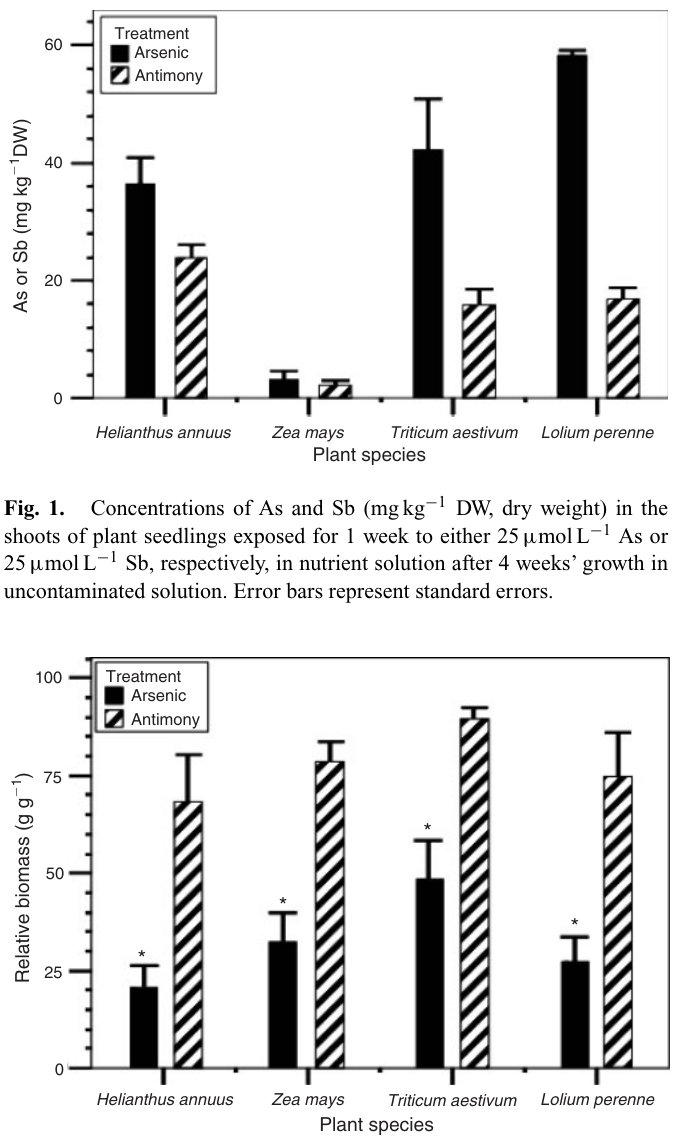
Fig. 1. Concentrations of As and Sb (mg kg−11 DW, dry weight) in the shoots of plant seedlings exposed for 1 week to either 25 µmol L µmol Lmol L−11 As or 25 µmol L µmol Lmol L−11 Sb, respectively, in nutrient solution after 4 weeks’ growth in uncontaminated solution. Error bars represent standard errors.图1. 植物幼苗在未污染溶液中生长4周后,分别在含25 µmol L−1 As或25 µmol L−1 Sb的营养液中暴露1周后,其地上部As和Sb浓度(mg kg−1 DW,干重)。误差线表示标准误。
Fig. 2 shows that at the applied concentration of 25 µmol L−1, SbwasalsolesstoxicthanAstotheshootgrowthofallfourtested plant species. In theAs treatment, the plants produced on average only between 20% (sunflower) and 50% (wheat) of the biomass in the control treatment. Growth was also slightly reduced in the Sb treatment, but this effect was not significant at the P < 0.05 level. In the As treatments, we observed chlorosis and wilting图2表明,在25 µmol L−1的施加浓度下,Sb对所有四种供试植物地上部生长的毒性也低于As。在As处理中,植物生物量平均仅为对照处理的20%(向日葵)至50%(小麦)。Sb处理中生长也略有下降,但在P < 0.05水平上不显著。在As处理中,我们观察到叶片失绿和萎蔫
of leaves, whereas in the Sb treatments, no such symptoms were observed. The results suggest that in all four plants, the toxicity threshold was below 25 µmol L−1 forAs and approximately that level for Sb. Comparison of Fig. 2 with Fig. 1 suggests that the lower toxicity of Sb in this experiment may be closely related to the lower accumulation of this element, whereas the toxicity of the two elements may actually not be so different if their concentrations in the tissues are considered.
现象,而在Sb处理中未观察到此类症状。结果表明,四种植物对As的毒性阈值均低于25 µmol L−1,对Sb的毒性阈值则约为该水平。比较图2与图1可知,本试验中Sb毒性较低可能与该元素累积量较低密切相关,而若考虑其在组织中的浓度,两种元素的毒性实际上可能相差不大。

Dependence of Sb accumulation in plants on Sb in the growth medium
植物Sb累积量与生长介质中Sb的关系
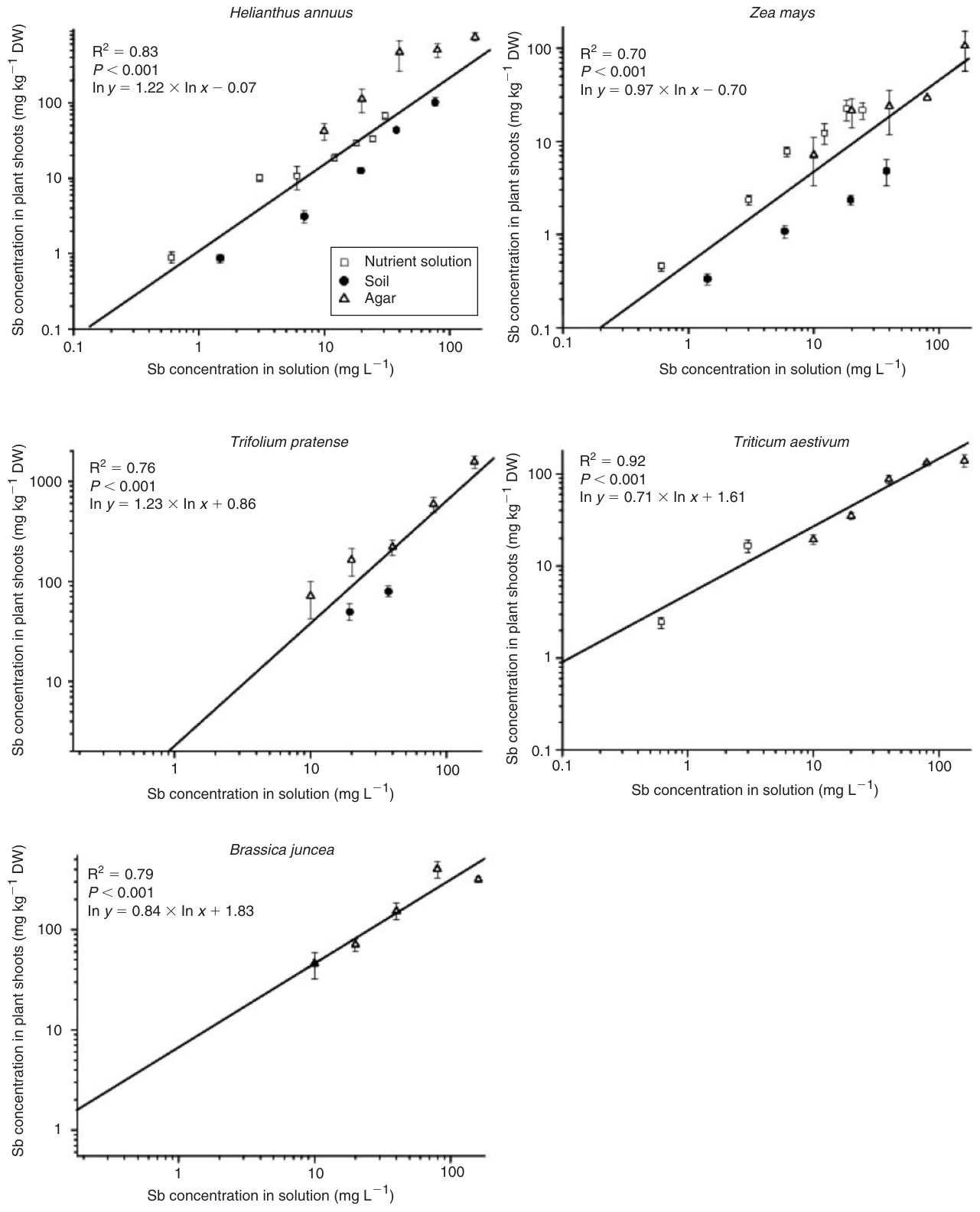
As Fig. 3 shows, there was an approximately linear relationship in all plant species tested between the concentrations of Sb in the shoot biomass and the available Sb concentration in the growth medium (i.e. dissolved Sb concentration in the case of the hydroponics and agar system and the KNO3-soluble Sb concentration in the potted soil system) if both were plotted on a log scale. Linear regression on the logarithms of the concentrations did not only show that these relationships were highly significant, with R2 values between 0.70 and 0.92, but also revealed that the slope of the regression lines, denoted as A, varied closely around 1. (Note that for Brassica juncea, Trifolium pratense and Triticum aestivum, this statement is subject to a rather large uncertainty though, owing to the relatively small number of data points.) This means that in all plants, the accumulation of Sb was approximately proportional to the available Sb in the growth medium. However, the ratio B between Sb concentration in plant and growth medium, which was determined from the offset log(B) of the log-log regression lines, varied by an order of magnitude among the different plant species (Table 1). This ratio, which represents an averaged bioconcentration factor over the investigated range of Sb concentrations, was highest in Indian mustard, followed by clover, sunflower and wheat, and lowest in maize. The bioconcentration factor was approximately three times higher in the hydroponics system than in the soil system in those cases where sufficient data were available for both media, i.e. for sunflower and maize. This reflects a lower mobility of Sb in the soil solution compared with hydroponics. In the case of maize, the same bioconcentration was found in the agar as in the hydroponics system, whereas Sb accumulation by sunflower was three times higher in agar than in hydroponics. The latter difference can be attributed to the fact that seedlings were exposed to the Sb treatments over the entire period of their growth in the agar system, whereas exposure lasted only 1 week in the hydroponics system after 4 weeks of unexposed growth. In maize, where accumulation was very low over the entire period of seedling growth, uptake probably was negligible at the early stages of growth, so that the difference in exposure during this period did not matter.The fact that Sb accumulation by the plants was similar or even higher in agar than in nutrient solution also demonstrates that root damage due to seedling transfer at the beginningoftheexperimentdidnotplayaroleinthehydroponics system.
如图3所示,若将地上部生物量中的Sb浓度与生长介质中有效态Sb浓度(即水培和琼脂体系中的溶解态Sb浓度以及盆栽土壤体系中的KNO3可溶态Sb浓度)均以对数尺度作图,则所有供试植物中两者均呈近似线性关系。对浓度对数的线性回归不仅表明这些关系高度显著,R2值介于0.70与0.92之间,还显示回归线斜率(记为A)在1附近小幅波动。(需要指出的是,对于Brassica juncea、Trifolium pratense和Triticum aestivum,由于数据点相对较少,这一结论存在较大的不确定性。)这意味着在所有植物中,Sb累积量与生长介质中的有效态Sb近似成正比。然而,由双对数回归线截距log(B)求得的植物与生长介质中Sb浓度之比B,在不同植物物种间相差一个数量级(表1)。该比值代表所研究Sb浓度范围内的平均生物富集系数,以印度芥菜最高,其次为三叶草、向日葵和小麦,玉米最低。在两种介质数据均充足的情况下(即向日葵和玉米),水培体系中的生物富集系数约为土壤体系的三倍。这反映出与水培相比,Sb在土壤溶液中的迁移性较低。玉米在琼脂和水培体系中的生物富集程度相同,而向日葵在琼脂中的Sb累积量是水培中的三倍。后一差异可归因于:在琼脂体系中,幼苗在整个生长期间均暴露于Sb处理,而在水培体系中,幼苗在未暴露条件下生长4周后仅暴露1周。玉米在整个幼苗生长期间累积量均很低,其在生长早期的吸收可能可以忽略,因此该阶段暴露的差异并无影响。植物在琼脂中的Sb累积量与营养液中相近甚至更高,这也表明试验开始时幼苗移栽造成的根系损伤在水培体系中并未产生影响。
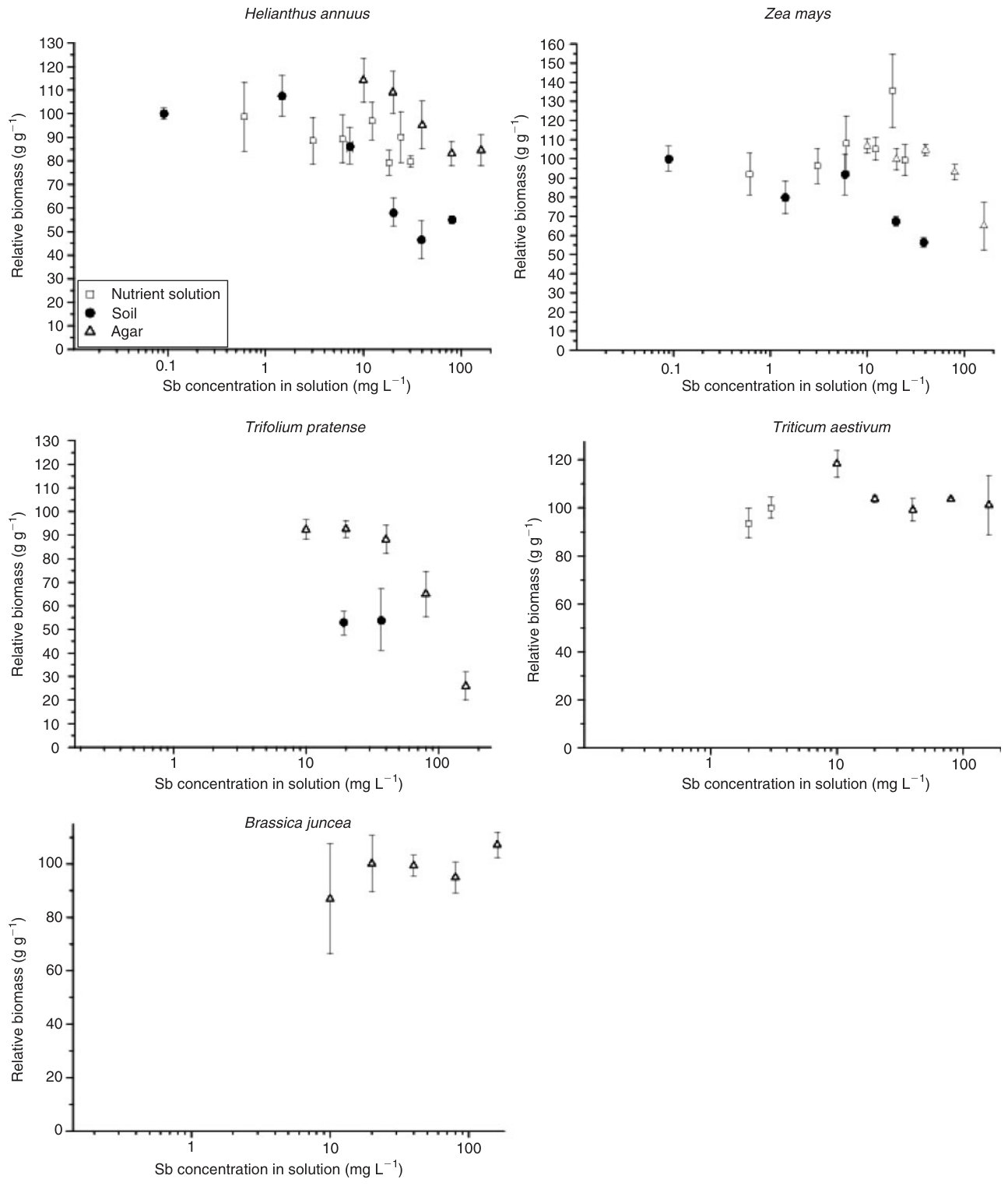
Fig. 4 shows the dependence of shoot biomass on the available Sb concentration in the growth medium for the different experiment systems. No shoot growth reduction was observed in图4显示了不同试验体系中地上部生物量与生长介质中有效态Sb浓度的关系。即使在最高Sb施加浓度下,
wheat and Indian mustard even at the highest Sb concentrations applied. No significant decrease in growth was also found in sunflowers grown in agar and nutrient solution. However, sunflower showed reduced shoot growth at soluble Sb concentrations above 6 mg L−1 in the potted soil system. A similar difference in toxicity between Sb treatments in agar and soil was also found in maize and clover.These two species showed increasing reduction of shoot growth only at the two highest levels applied in the agar system, i.e. at 80 and 160 mg L−1 Sb, but no sign of toxicity up to the level of 40 mg L−1 Sb. In contrast, shoot growth of maize and clover was reduced to a similar degree as that of sunflower already at soluble Sb concentrations above 6 mg L−1 in the potted soil system.Also, many leaves were necrotic and chlorotic in the latter treatments. We have no explanation for this difference, but it appears as if there was an additional stress factor in the soil system.
小麦和印度芥菜的地上部生长也未见降低。在琼脂和营养液中生长的向日葵生长也未显著下降。然而,在盆栽土壤体系中,当可溶性Sb浓度高于6 mg L−1时,向日葵地上部生长降低。玉米和三叶草在琼脂与土壤中的Sb处理之间也存在类似的毒性差异。这两个物种仅在琼脂体系的两个最高处理水平(即80和160 mg L−1 Sb)下地上部生长降低程度逐渐加大,而在40 mg L−1 Sb及以下未见毒性迹象。相反,在盆栽土壤体系中,当可溶性Sb浓度高于6 mg L−1时,玉米和三叶草的地上部生长即已降低至与向日葵相近的程度。此外,在后述处理中许多叶片出现坏死和失绿。我们对这一差异尚无解释,但土壤体系中似乎存在额外的胁迫因素。
Toxicity of Sb to root growthSb对根系生长的毒性
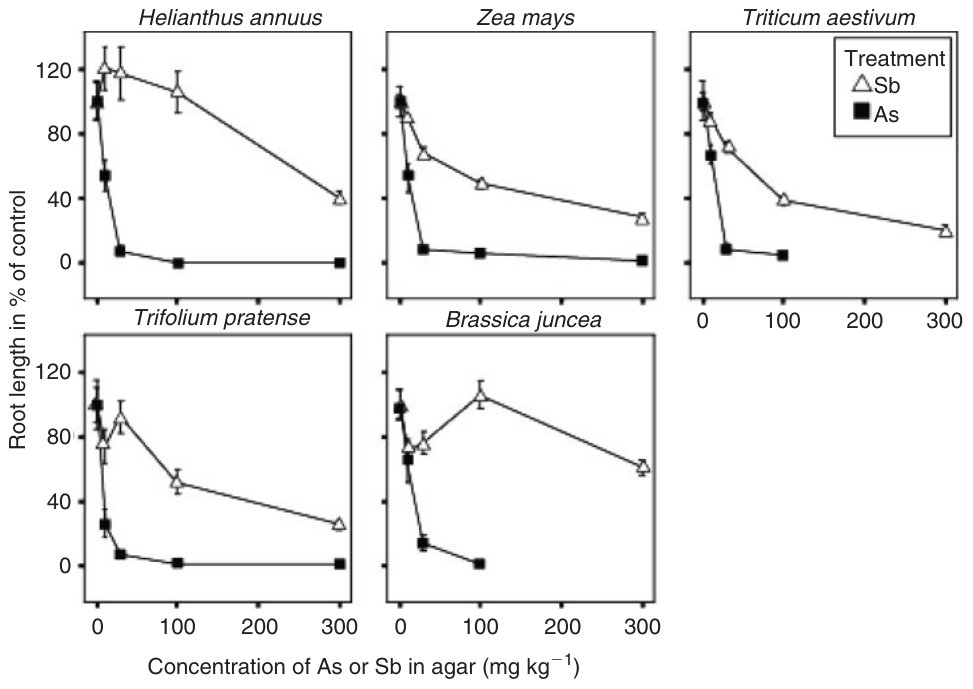
Also, the 2-week root growth tests performed with agar as growth medium revealed a high Sb tolerance of Indian mustard (Fig. 5). Even an Sb concentration of 300 mg L−1 was tolerated without reduction in root length. Sunflower was second in this test, showing little effect up to 100 mg L−1 (= 821 µmol L−1), but a clear toxicity effect at 300 mg L−1 (= 2464 µmol L−1) Sb. Clover was similar, with a clearer reduction in root growth already at 100 mg L−1 Sb, whereas the root growth of the two monocotyledons wheat and maize was inhibited already at Sb concentrations of 30 mg L−1 (= 246 µmol L−1) or less.
此外,以琼脂为生长介质进行的2周根系生长试验也表明印度芥菜对Sb具有较高耐性(图5)。即使Sb浓度达300 mg L−1,其根长也未降低。向日葵在该试验中位居第二,在100 mg L−1(= 821 µmol L−1)以下影响很小,但在300 mg L−1(= 2464 µmol L−1)Sb时表现出明显毒性效应。三叶草与之相似,但在100 mg L−1 Sb时根系生长即已明显降低,而两种单子叶植物小麦和玉米的根系生长在Sb浓度为30 mg L−1(= 246 µmol L−1)或更低时即受到抑制。
In all five species investigated here, As was much more toxic to root growth than Sb (Fig. 5). The large difference in rhizotoxicity of the two elements visible in Fig. 5 is partially due the fact that concentrations are given on a mass basis, for reasons of easier comparability with the literature. However, if the effects of the two elements on root growth are also compared on the basis of molar concentrations, there is still a clear difference. Already at As concentrations of 10 mg L−1 (= 133 µmol L−1), root growth was clearly reduced, least in Indian mustard and most strongly in clover; at an As concentration of 30 mg L−1 (= 400 µmol L−1), it was reduced to less than 15% of the controls in all plants and close to zero in some like clover, maize and wheat; and at 100 mg L−1 (= 1335 µmol L−1), the next highest treatment level, virtually none of the seedlings showed significant root growth any more. In contrast, even at the highest Sb treatment level (= 2464 µmol L−1), there was still more than 21% root growth in comparison with the controls, even in wheat and maize.
在本研究的全部五个物种中,As对根系生长的毒性均远高于Sb(图5)。图5中两种元素根系毒性的巨大差异部分是由于浓度以质量为基础给出,以便于与文献比较。然而,即使以摩尔浓度为基础比较两种元素对根系生长的影响,差异仍然明显。As浓度为10 mg L−1(= 133 µmol L−1)时,根系生长即已明显降低,印度芥菜降幅最小,三叶草降幅最大;As浓度为30 mg L−1(= 400 µmol L−1)时,所有植物根系生长均降至对照的15%以下,三叶草、玉米和小麦等接近于零;而在其次一级的处理水平100 mg L−1(= 1335 µmol L−1)下,几乎所有幼苗均不再有明显的根系生长。相反,即使在最高Sb处理水平(= 2464 µmol L−1)下,即便是小麦和玉米,其根系生长仍达对照的21%以上。
Allocation of accumulated Sb in sunflower and maize
向日葵和玉米体内累积Sb的分配
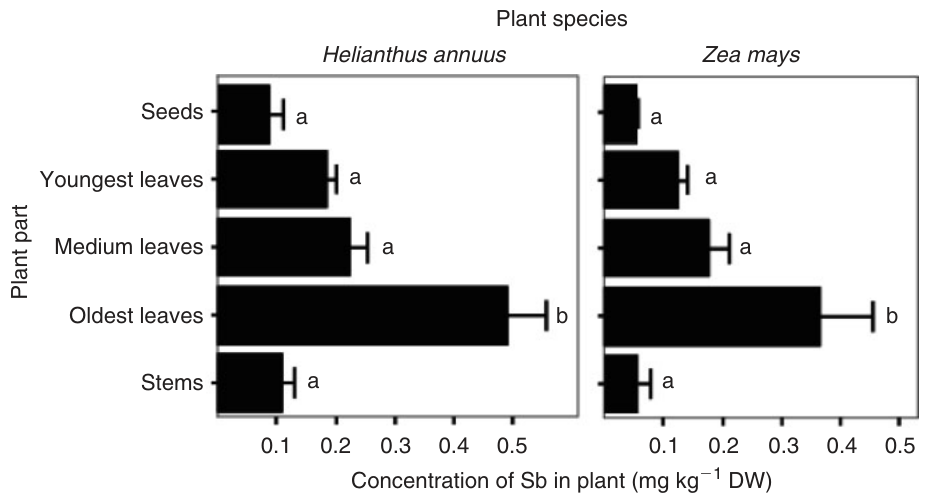
Both plant species tested, i.e. maize and sunflower, showed similar patterns of Sb allocation in the aboveground parts at harvest after 4 months of growth.Antimony concentrations were highest in the oldest (i.e. bottom) leaves, decreased with the age of the leaves (i.e. towards the top), and were lowest in the seeds and stems (Fig. 6). Compared with average leaf Sb concentrations, the concentration ratio between Sb in stems and Sb in leaves was 0.34 in sunflower and 0.28 in maize, whereas the concentration ratiobetweenSbinseedsandSbinleaveswas0.25inbothplants.
两种供试植物(即玉米和向日葵)在生长4个月收获时,地上部各部位的Sb分配格局相似。Sb浓度以最老(即底部)叶片最高,随叶龄减小(即向顶部)而降低,在种子和茎中最低(图6)。与叶片平均Sb浓度相比,茎与叶中Sb浓度之比在向日葵中为0.34,在玉米中为0.28,而种子与叶中Sb浓度之比在两种植物中均为0.25。
4Discussion and conclusions讨论与结论
The approximate proportionality between available Sb concentration in the growth medium and accumulation of Sb in the shoots of all plants investigated in the present study is in agreement with a similar proportionality found by Hammel et al. in a pot experiment with spinach.[12] In the latter study, three different soils were spiked with up to 1000 mg Sb kg−1 DW and then left to age for 6 months before the plants were grown. This treatment resulted in NH4NO3-extractable Sb concentrations of up to 90 mg kg−1 dry soil and an Sb accumulation in the spinach leaves of up to 399 mg kg−1 dry mass.The observed proportionalities between soil and plant Sb suggest that Sb uptake by these plants is not controlled and mediated by membrane-bound transporters. In the latter case, saturation of the transporter binding sites would be expected at high Sb concentrations, leading to a levelling of the uptake rate. The existence of a mechanism for the specific uptake of Sb also is not likely because it is not an essential element.
本研究中所有植物的生长介质有效态Sb浓度与地上部Sb累积量之间近似成正比,这与Hammel et al.在菠菜盆栽试验中发现的类似比例关系一致。[12]在该研究中,三种不同土壤添加了高达1000 mg Sb kg−1 DW的Sb,并老化6个月后种植植物。该处理使NH4NO3可提取态Sb浓度高达90 mg kg−1干土,菠菜叶片中Sb累积量高达399 mg kg−1干物质。所观察到的土壤与植物Sb之间的比例关系表明,这些植物对Sb的吸收并非由膜结合转运蛋白控制和介导。若为后者,则在高Sb浓度下转运蛋白结合位点将趋于饱和,导致吸收速率趋于平稳。由于Sb并非必需元素,存在特异性吸收Sb的机制也不太可能。
Antimony was supplied in our experiments as antimonate. Antimonate speciates as a monovalent anion (Sb(OH)−6 ) between pH 2 and pH 10, i.e. over the entire range of pH occurring in soils. As an anion, antimonate entering a cell has to overcome an electrical potential difference across the membrane in the range of −100 to −200 mV, which would require an outer concentration two to three orders of magnitude higher than internally to drive passive uptake.[20] Thus, at least at low external concentrations, uptake of antimonate into the root symplast would require anion transporters of low selectivity, in which antimonate anions could substitute for essential nutrient anions such as Cl− or NO−3 . An alternative uptake route would be via the apoplastic pathway as in the case of negatively charged metal chelates.[21,22] As the Casparian strip does not completely seal the intercellular space of the root cortex from the inner root cylinder, in particular at the root tips and at branching-points of lateral roots, transport to the xylem can partly bypass the endodermis barrier without transfer through a cell membrane. Purely apoplastic transport would mean that Sb is simply taken up with the transpiration water stream, in proportion to the concentration of Sb in solution, and accumulated where the water evaporates.Also, the very similar ratios between Sb concentrations in various plant parts for maize and sunflower are in line with the hypothesis that Sb is primarily translocated with the transpiration stream and thus accumulated in the leaves, where the water is transpired and evaporated into the atmosphere, leaving behind solutes that are not volatilised.
本试验中锑以锑酸盐形式供给。在pH 2至pH 10之间,即在土壤中出现的整个pH范围内,锑酸盐以一价阴离子(Sb(OH)−6)形态存在。作为阴离子,锑酸盐进入细胞须克服跨膜−100至−200 mV的电位差,这需要胞外浓度比胞内高两到三个数量级才能驱动被动吸收。[20]因此,至少在外部浓度较低时,锑酸盐进入根共质体需要低选择性的阴离子转运蛋白,锑酸根阴离子可在其中替代Cl−或NO−3等必需营养阴离子。另一种吸收途径可能是质外体途径,类似于带负电荷的金属螯合物。[21,22]由于凯氏带并不能将根皮层细胞间隙与根内部中柱完全隔离,特别是在根尖和侧根分枝点处,向木质部的运输可部分绕过内皮层屏障而无需穿过细胞膜。纯质外体运输意味着Sb仅随蒸腾水流被吸收,其吸收量与溶液中Sb浓度成正比,并在水分蒸发处累积。此外,玉米和向日葵各器官间Sb浓度比值非常相似,这也支持以下假设:Sb主要随蒸腾流转运,因而累积于叶片,水分在叶片中蒸腾并蒸发至大气,留下不挥发的溶质。
In the form of non-ionic antimonite (Sb(OH)3), passive uptake of Sb with the transpiration stream could theoretically also occur through aquaporins. Passage of Sb(OH)3 into cells via aquaglyceroporins was found in microorganisms, i.e. in Escherichia coli, Saccharomyces cerevisiae, Leishmania major and L. tarentolae.[23] This pathway is not open to ions, however, apart from the thermodynamic problem of overcoming the electrochemical gradient. Antimonite very likely did not play a role in the uptake of Sb in our experiments though. In addition to supplying Sb only in the form of antimonate, we took care that all the experimental systems were well aerated. With the agar system, we performed preliminary tests with a dye tracer showing that there was sufficient air-filled pore space around the roots to allow rapid infiltration. The fact that the growth medium had little or no influence on the uptake rate provides additional evidence that reduction of antimonate to antimonite, which should have differed in degree between the three systems, was negligible, if it occurred at all.
以非离子态亚锑酸盐(Sb(OH)3)形式存在时,Sb理论上也可随蒸腾流经水通道蛋白被动吸收。在微生物(即Escherichia coli、Saccharomyces cerevisiae、Leishmania major和L. tarentolae)中已发现Sb(OH)3经水甘油通道蛋白进入细胞。[23]然而,除需克服电化学梯度这一热力学问题外,该途径对离子并不开放。不过,亚锑酸盐很可能未在本试验的Sb吸收中发挥作用。除仅以锑酸盐形式供给Sb外,我们还确保所有试验体系通气良好。对于琼脂体系,我们用染料示踪剂进行了预试验,结果表明根系周围有足够的充气孔隙以允许快速渗入。生长介质对吸收速率几乎没有影响,这进一步证明锑酸盐还原为亚锑酸盐(其程度在三种体系间理应不同)即便发生也可以忽略。
It is not clear why maize and wheat showed a much higher tolerance to external Sb in shoot growth than in root growth. In the case of maize, it could be hypothesised that the aboveground parts were protected by a low degree of Sb translocation from roots to shoots in these two species. But in wheat shoots, Sb accumulation and toxicity was similar to that in the dicotyledons that were tested here, where toxicity effects emerged in shoots and roots at similar levels of external Sb exposure. The magnitude of Sb concentrations at which toxicity effects were manifested here agrees well with findings by Oorts et al., who found a 50% reduction of root elongation in barley and a 50% shoot biomass reduction in lettuce at concentrations of 39 and 41 mg L−1 Sb in soil solution (collected by centrifugation), respectively.[24]
尚不清楚为何玉米和小麦地上部生长对外部Sb的耐性远高于根系生长。就玉米而言,可以推测这两个物种中Sb由根向地上部转运程度较低,从而保护了地上部。但在小麦地上部,Sb累积和毒性与本研究所测双子叶植物相似,后者在相近的外部Sb暴露水平下地上部和根系均出现毒性效应。本研究中出现毒性效应的Sb浓度量级与Oorts et al.的发现高度一致,他们发现土壤溶液(离心收集)中Sb浓度分别为39和41 mg L−1时,大麦根伸长降低50%,莴苣地上部生物量降低50%。[24]
Antimony was accumulated less from solution or soil than arsenic in our experiments. Being also less phytotoxic, Sb contamination of soil could still be a problem for human or animal health, because this means that plants can survive much higher soluble Sb than As concentrations. Johnson et al. found concentrations of up to 6 mg L−1 Sb in deionised water leachates from shooting-range soils where total Sb concentrations reached values up to 10 g kg−1.[3] Using these data and the average bioaccumulation coefficients found in our study here, the predicted shoot Sb accumulation would be 45.7 mg kg−1 in clover, 4.4 mg kg−1 in maize and 23.6 mg kg−1 in sunflower. We did not find any tolerance or critical values for Sb consumption by animals. But taking as a surrogate a chronic toxicity threshold of 1.4 mg kg−1 day−1, which has been proposed for Sb ingestion by humans,[25] cattleconsumingmorethan15.4 kgofclover,160 kg ofmaizeor29.4 kgofsunflowergrownonsuchasiteperdayover a longer period to exceed the threshold of 1.4 mg kg−1 day−1 may be at risk of adverse health effects.[25] Although such situations are probably rare, there may be other plants accumulating even more Sb. Leaf vegetables grown on soils with high soluble
本试验中,锑从溶液或土壤中的累积量低于砷。由于Sb的植物毒性也较低,土壤Sb污染仍可能对人类或动物健康构成问题,因为这意味着植物可在比As高得多的可溶性Sb浓度下存活。Johnson et al.发现,在总Sb浓度高达10 g kg−1的射击场土壤中,去离子水淋溶液中Sb浓度高达6 mg L−1。[3]利用这些数据和本研究得到的平均生物累积系数,预测地上部Sb累积量在三叶草中为45.7 mg kg−1,在玉米中为4.4 mg kg−1,在向日葵中为23.6 mg kg−1。我们未找到动物摄入Sb的耐受值或临界值。但若以已提出的人类摄入Sb的慢性毒性阈值1.4 mg kg−1 day−1作为替代,[25]牛若长期每天采食在此类场地上生长的三叶草超过15.4 kg、玉米超过160 kg或向日葵超过29.4 kg,将超过1.4 mg kg−1 day−1的阈值,可能面临不良健康效应的风险。[25]尽管此类情况可能很少见,但可能存在累积Sb更多的其他植物。在可溶性Sb浓度较高的土壤上种植的叶菜类蔬菜
Sb concentrations might even present some chronic health risk for human self-suppliers. Thus, in addition to the influence of soil factors such as redox conditions on Sb uptake by plants, a wider variety of plants should also be tested for their capability to accumulate Sb.
甚至可能对自给自足的人群构成一定的慢性健康风险。因此,除了氧化还原条件等土壤因素对植物吸收Sb的影响外,还应测试更多种类植物累积Sb的能力。
5Acknowledgements致谢
We gratefully acknowledgeAnna Grünwald, René Saladin andViktor Stadelmann for their generous help and support in the laboratory. The current project was financially supported by the Swiss National Science Foundation (Grants No. 200021–103768).
衷心感谢Anna Grünwald、René Saladin和Viktor Stadelmann在实验室中给予的慷慨帮助与支持。本项目由瑞士国家科学基金会资助(资助号200021–103768)。
6References参考文献
[1] M. A. Rish, Antimony, in Elements and their Compounds in the Environment (Eds E. Merian, M. Anke, M. Ihnat, M. Stoeppler) 2004, pp. 659–670 (Wiley-VHC: Weinheim).
[2] A. Kabata-Pendias, H. Pendias, Trace Elements in Soils and Plants 1984 (CRC Press: Boca Raton, FL).
[3] C. A. Johnson, H. Moench, P. Wersin, P. Kugler, C. Wenger, Solubility of antimony and other elements in samples taken from shooting ranges. J. Environ. Qual. 2005, 34, 248.
[4] M. Filella, N. Belzile, Y. W. Chen, Antimony in the environment: a review focused on natural waters I. Occurence. Earth Sci. Rev. 2002, 57, 125. doi:10.1016/S0012-8252(01)00070-8
[5] R. Mathys, J. Dittmar, C. A. Johnson, Antimony in Switzerland – a Substance Flow Analysis 2007 (Swiss Federal Office for the Environment: Berne).
[6] C. P. Rooney, R. G. McLaren, R. J. Cresswell, Distribution and phytoavailability of lead in a soil contaminated with lead shot. Water Air Soil Pollut. 1999, 116, 535. doi:10.1023/A:1005181303843
[7] M. Gresch, B. Wettstein, Antimon- und Bleibelastung bei Schiessanlagen, Fallbeispiel Eschenbach (SG) 2002, B.Sc. semester thesis, ETH Zurich.
[8] N. Ainsworth, J. A. Cooke, M. S. Johnson, Distribution of antimony in contaminated grassland. 1. Vegetation and soils. Environ. Pollut. 1990, 65, 65. doi:10.1016/0269-7491(90)90165-9
[9] F. Baroni, A. Boscagli, G. Protano, F. Riccobono, Antimony accumulation in Achillea ageratum, Plantago lanceolata and Silene vulgaris growing in an old Sb-mining area. Environ. Pollut. 2000, 109, 347. doi:10.1016/S0269-7491(99)00240-7
[10] J. Pratas, M. N. V. Prasad, H. Freitas, L. Conde, Plants growing in abandoned mines of Portugal are useful for biogeochemical exploration of arsenic, antimony, tungsten and mine reclamation. J. Geochem. Explor. 2005, 85, 99. doi:10.1016/ J.GEXPLO.2004.11.003
[11] R. D. Davis, P. H. T. Beckett, E. Wollan, Critical levels of 20 potentially toxic elements in young spring barley. Plant Soil 1978, 49, 395. doi:10.1007/BF02149747
[12] W. Hammel, R. Debus, L. Steubing, Mobility of antimony in soil and its availability to plants. Chemosphere 2000, 41, 1791. doi:10.1016/S0045-6535(00)00037-0
[13] M. Nodari, R. Schulin, H. U. Reyer, B. H. Robinson, Investigating plant–antimony interactions: method development, plant tolerance, and plant uptake 2007, M.Sc. thesis, Universität Zürich.
[14] M. C. Drew, Plant injury and adaptation to oxygen deficiency in the root environment: a review. Plant Soil 1983, 75, 179. doi:10.1007/BF02375564
[15] M. B. Jackson, M. C. Drew, Effects of flooding on growth and metabolism of herbaceous plants, in Flooding and Plant Growth (Ed. T. T. Kozlowski) 1984, pp. 47–128 (Academic Press: Orlando, FL).
[16] D. R. Hoagland, D. I. Arnon, The water-culture method for growing plants without soil, in Circular of the Agricultural Experiment Station Berkeley, California 1938,Vol. 347 (University of California: Berkeley, CA).
[17] U. Krämer, J. D. Cotter-Howells, J. M. Charnock, A. J. M. Baker, J. A. C. Smith, Free histidine as a metal chelator in plants that accumulate nickel. Nature 1996, 379, 635. doi:10.1038/379635A0
[18] G. Massard, R. Reiser, V. Stadelmann, S. K. Gupta, Antimony- Contaminated Soils on Shooting Ranges 2006 (Swiss Federal Department of Economic Affairs: Zurich).
[19] L. Sachs, Angewandte Statistik 2004 (Springer: Heidelberg, Germany).
[20] R. Reid, J. Hayes, Mechanisms and control of nutrient uptake in plants, in International Review of Cytology – a Survey of Cell Biology 2003, Vol. 229, pp. 73–114 (Academic Press Inc.: San Diego, CA).
[21] P. F. Bell, M. J. McLaughlin, G. Cozens, D. P. Stevens, G. Owens, H. South, Plant uptake of 14C-EDTA, 14C-citrate, and 14C-histidine from chelator-buffered and conventional hydroponic solutions. Plant Soil 2003, 253, 311. doi:10.1023/A:1024836032584
[22] K. Wenger, S. Tandy, B. Nowack, Effect of chelating agents on trace metal speciation and bioavailability, in Biogeochemistry of Chelating Agents (Eds J. Vanbriesen, B. Nowack) 2005, pp. 204–224 (American Chemical Society: Oxford, UK).
[23] M. Filella, N. Belzile, M. C. Lett, Antimony in the environment: a review focused on natural waters. III. Microbiota relevant interactions. Earth Sci. Rev. 2007, 80, 195. doi:10.1016/ J.EARSCIREV.2006.09.003
[24] K. Oorts, E. Smolders, F. Degryse, J. Buekers, G. Gasco, G. Cornelis, J. Mertens, Solubility and toxicity of antimony trioxide (Sb2O3) in soil. Environ. Sci. Technol. 2008, 42, 4378. doi:10.1021/ES703061T
[25] H. J. M. Bowen, Environmental Chemistry of the Elements 1979 (Academic Press: London).
Manuscript received 10 December 2008, accepted 30 March 2009