Review
Martin Tschan,A,C Brett H. RobinsonB and Rainer SchulinA
AEidgenössische Technische Hochschule (ETH) Zurich, Institute of Terrestrial Ecosystems ITES, Universitaetstrasse 16, CH-8092 Zurich, Switzerland.
A苏黎世联邦理工学院(ETH Zurich),陆地生态系统研究所(ITES),Universitaetstrasse 16, CH-8092 Zurich,瑞士。
BAgricultural and Life Sciences Division, Lincoln University, PO Box 84, Canterbury, New Zealand.
B林肯大学农业与生命科学学部,PO Box 84,坎特伯雷,新西兰。
CCorresponding author. Email: martin.tschan@env.ethz.ch
Environmental context. Soil contamination by antimony (Sb) has become an environmental problem of much concern in recent years, because increasing mining and industrial use has led to widespread soil contamination by this biologically unessential, but potentially carcinogenic element. We reviewed the available literature and found that Sb is generally taken up by terrestrial plants in proportion to the concentration of soluble Sb in soil over a concentration range covering five or more orders of magnitude, a finding that is relevant in particular for the assessment of environmental and health risks arising from Sb-contaminated soils. But very little is known about the mechanisms of Sb uptake by plants.
环境背景。近年来,土壤锑(Sb)污染已成为备受关注的环境问题:采矿和工业用途的日益增加,导致这种非生物必需但具有潜在致癌性的元素广泛污染土壤。我们综述了现有文献,发现在跨越五个或更多数量级的浓度范围内,陆生植物对Sb的吸收通常与土壤中可溶性Sb的浓度成正比,这一发现对于评估Sb污染土壤所带来的环境与健康风险尤为重要。然而,目前对植物吸收Sb的机制仍知之甚少。
Abstract. Soil contamination by antimony (Sb) due to human activities has considerably increased in the recent past. We reviewed the available literature on Sb uptake by plants and toxicity risks arising from soil contamination by Sb and found that Sb is generally taken up by terrestrial plants in proportion to the concentration of soluble Sb in soil over a concentration range covering five or more orders of magnitude. However, very little is known about the mechanisms of Sb uptake by plants.Also the deposition of resuspended soil particles on the surfaces of aerial plant surfaces can result in high plant Sb concentration in the vicinity of Sb-contaminated sites. Although soil pollution by Sb may be rarely so severe as to cause toxicity problems to humans or animals consuming plants or food derived from plants grown on Sb-contaminated sites, such risks may arise under worst-case conditions.
摘要。近年来,人类活动导致的土壤锑(Sb)污染显著加剧。我们综述了有关植物吸收Sb以及土壤Sb污染所致毒性风险的现有文献,发现在跨越五个或更多数量级的浓度范围内,陆生植物对Sb的吸收通常与土壤中可溶性Sb的浓度成正比。然而,目前对植物吸收Sb的机制仍知之甚少。此外,再悬浮土壤颗粒在植物地上部表面的沉降,也可导致Sb污染场地附近植物Sb浓度较高。尽管土壤Sb污染很少严重到使食用污染场地所生长植物或其制成食品的人类或动物出现毒性问题,但在最不利条件下仍可能产生此类风险。
1Introduction引言
Natural concentrations of antimony (Sb) in the environment are low. Its abundance in the earth’s crust is in the order of 0.2–0.3 mg kg−1.[1] In topsoils, Sb tends to be slightly enriched. Background concentrations of antimony in soils range between 0.3 and 8.6 mg kg−1 (Table 1).[2,3] In general, they are below 1 mg kg−1.[4] Higher concentrations are usually related to anthropogenic sources. Antimony has many uses, and these are still increasing.[5,6] In its metallic form, its major use is as a hardener for lead, e.g. in lead–acid batteries, cable sheathings and ammunition, and it is also an important component in semiconductors. Antimony trioxide (Sb2O3) is widely used as a flame-retardant, e.g. in textiles, papers, plastics and adhesives. Therefore, textiles and plastics are major sources of Sb in municipal waste.[7] Furthermore, antimony trioxide is used as a paint pigment, ceramic opacifier, catalyst, mordant and glass decolouriser. Antimony tetroxide (Sb4O8) is used as an oxidation catalyst, particularly for the oxidative dehydrogenation of olefins. The wide use of Sb has led to considerable inputs of this element into the environment (Fig. 1). Important anthropogenic sources of antimony in the environment are emissions from vehicles (where it is used as a fire-retardant in brake linings), waste disposal and incineration, fuel combustion, metal smelters, and shooting activities.[8,9]
环境中锑(Sb)的天然浓度较低,其在地壳中的丰度约为0.2–0.3 mg kg−1。[1]表层土壤中Sb往往略有富集。土壤中锑的背景浓度介于0.3至8.6 mg kg−1之间(表1),[2,3]一般低于1 mg kg−1。[4]较高的浓度通常与人为来源有关。锑用途广泛,且仍在不断增加。[5,6]金属锑的主要用途是作为铅的硬化剂,例如用于铅酸蓄电池、电缆护套和弹药,同时也是半导体的重要组分。三氧化二锑(Sb2O3)被广泛用作阻燃剂,例如用于纺织品、纸张、塑料和胶黏剂,因此纺织品和塑料是城市垃圾中Sb的主要来源。[7]此外,三氧化二锑还用作涂料颜料、陶瓷乳浊剂、催化剂、媒染剂和玻璃脱色剂。四氧化锑(Sb4O8)用作氧化催化剂,特别是用于烯烃的氧化脱氢。Sb的广泛使用导致该元素大量输入环境(图1)。环境中锑的重要人为来源包括机动车排放(Sb在刹车片中用作阻燃剂)、废物处置与焚烧、燃料燃烧、金属冶炼厂以及射击活动。[8,9]
ParticularlyhighSbconcentrationsinsoilshaveresultedfrom mining and shooting activities. For example, Sb concentrations up to 15 g kg−1 were found in an area in southernTuscany where Sb ores have been mined and smelted until recently.[10] Reuse of material from mining dumps has also been identified as a cause of severe Sb contamination of agricultural land and residential areas.[11,12] Recently, shooting ranges were also found to not only be hotspots of soil pollution by lead (Pb), but also by Sb.[3] Antimony is used in bullets to harden them. Next to Pb, Sb generally is their second-most important component, with a content ranging between 1 and 7% by mass.[13] Johnson et al. found up to 13.8 g kg−1 Sb in the topsoils of Swiss shooting ranges.[3] Although such pollution is usually restricted to very small areas, it constitutes a major environmental problem because of the abundance of shooting ranges. Switzerland alone has more than 2000 shooting ranges that are still in use.
采矿和射击活动导致土壤Sb浓度尤其高。例如,在意大利托斯卡纳南部一处直至不久前仍在开采和冶炼锑矿的地区,土壤Sb浓度高达15 g kg−1。[10]采矿废石堆物料的再利用也被确认为农田和居住区严重Sb污染的原因之一。[11,12]最近还发现,射击场不仅是土壤铅(Pb)污染的热点,也是Sb污染的热点。[3]锑被添加到子弹中以提高其硬度,通常是仅次于Pb的第二大组分,质量含量为1%–7%。[13]Johnson等在瑞士射击场表层土壤中测得高达13.8 g kg−1的Sb。[3]尽管此类污染通常局限于很小的区域,但由于射击场数量众多,仍构成重大环境问题。仅瑞士就有2000多个仍在使用的射击场。
Antimony has no known essential biological function. Similar to other trace elements, it can be toxic at elevated concentrations, and some Sb compounds are even considered potentially carcinogenic.[14] A potentially important Sb exposure pathway of humans and animals to antimony in areas with contaminated soils is through food and feed plants.[11,15] However, owing to the fact that Sb mostly occurs as a co-contaminant of more toxic elements such as Pb or As, research into its biogeochemistry and ecotoxicity has been neglected in the past. Thus, little is still known also about the factors determining the phytoavailability of Sb in soils and its uptake by crop plants. The objective of the present study was to review the available literature on the transfer of Sb from soil into plants and on the toxicity risks associated with soil pollution by this element.
锑尚无已知的生物必需功能。与其他微量元素类似,锑在浓度升高时可能具有毒性,部分Sb化合物甚至被认为具有潜在致癌性。[14]在土壤受污染地区,人类和动物暴露于锑的一个潜在重要途径是食用作物和饲料植物。[11,15]然而,由于Sb大多作为Pb或As等毒性更强元素的伴生污染物出现,过去对其生物地球化学和生态毒性的研究一直受到忽视。因此,目前对决定土壤中Sb植物有效性及作物吸收Sb的因素仍了解甚少。本研究旨在综述有关Sb从土壤向植物迁移以及该元素土壤污染相关毒性风险的现有文献。
2Toxicity of antimony to plants and soil organisms锑对植物和土壤生物的毒性
In general, inorganic Sb compounds were found to be more toxic than organic ones, and SbIII more than SbV species.[5]
总体而言,无机Sb化合物的毒性高于有机Sb化合物,SbIII形态的毒性高于SbV形态。[5]
| Medium介质 | Source of pollution污染来源 | Concentration (mg kg−1, unless given otherwise)浓度(mg kg−1, 另有说明者除外) | Reference参考文献 |
|---|---|---|---|
| Igneous rocks | – | 0.1–1 | [57] |
| Sedimentary rocks | – | 0.05–1.5 | [55] |
| Soil background | – | 0.3–2.3 | [2] |
| Seawater | – | 0.0002 | [5] |
| Water near mine | Mercury mine | 418 | [58] |
| Soils near mine | Mercury mine | 0.5–52 | [58] |
| Emissions waste deposit | Waste deposit | 10µg m−3 | [59] |
| Roadside highway (100 m distance) | Traffic pollution | 0.53 | [8] |
| Needles of trees | Residential area | 2.4 | [27] |
| Orchard soil | Pesticide | 0.4–1.5 | [60] |
| Grass | Antimony smelter | 400 | [48] |
| Garden soil near disused mine | Past mining activities | 500 | [11] |
| Detritivore invertebrates | Smelter | 290 | [15] |
| Ectomycorrhizal fungi | Lead smelter | 100–1400 | [43] |
| Aquatic plants | Mine tailing pond | 19 | [51] |
| Garden and crop plants | Spiked pots | 399 | [11] |
| Shooting range | Bullets | 13 800 | [3] |
![Fig. 1. Fate of Sb consumed in Switzerland. Adapted from Mathys et al.[6]](76/figure-01.jpg)
In its trivalent form, Sb may have a level of genotoxicity similar to trivalentAs.[16] Flynn et al. found that the bioluminescence of As and Sb-specific biosensors (Escherichia coli strain CM1166 pC200) was suppressed at SbIII concentrations in solution exceeding 1 mg L−1.[12] Although sodium stibogluconate has been used for more than 75 years to treat leishmaniasis, a disease caused by the protozoan parasite Leishmania sp. and affecting 12 million people in 88 countries (in 2007),[17] little is known about the toxicity of elemental and methylated Sb.
三价Sb的遗传毒性可能与三价As相当。[16]Flynn等发现,当溶液中SbIII浓度超过1 mg L−1时,As和Sb特异性生物传感器(Escherichia coli菌株CM1166 pC200)的生物发光受到抑制。[12]尽管葡萄糖酸锑钠用于治疗利什曼病已有75年以上的历史(该病由原生动物寄生虫Leishmania sp.引起,2007年影响88个国家的1200万人),[17]但人们对元素态和甲基化Sb的毒性仍知之甚少。
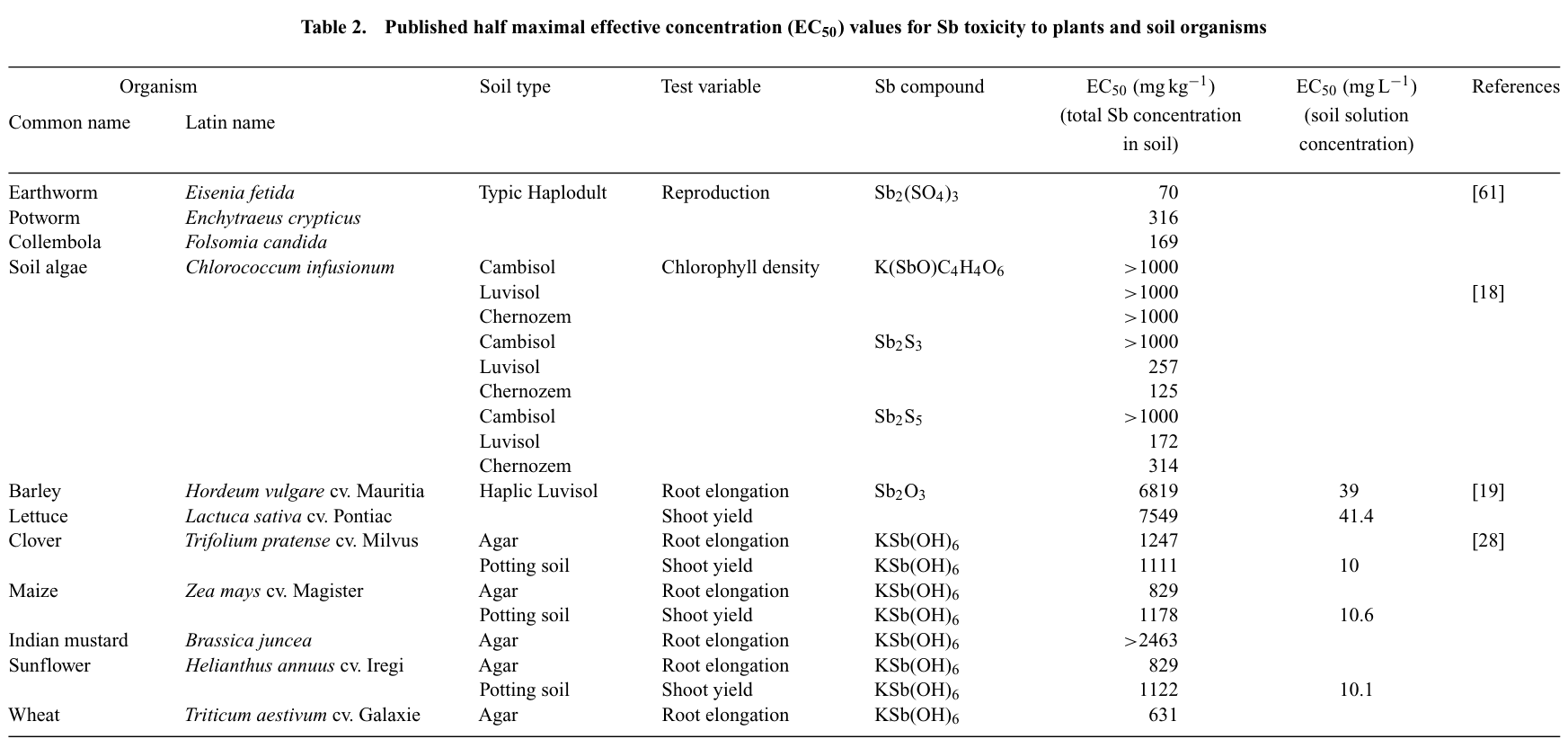
Only a few toxicity tests have been performed with plants or other organisms exposed to Sb-contaminated soil. Table 2 summarises half maximal effective concentration (EC50) values for various soil organisms and terrestrial plants. According to the data given in Table 2, plants were generally found to be more tolerant to soil Sb than soil fauna.
针对暴露于Sb污染土壤的植物或其他生物开展的毒性试验很少。表2汇总了多种土壤生物和陆生植物的半数最大效应浓度(EC50)值。根据表2的数据,植物对土壤Sb的耐受性总体上高于土壤动物。
Hammel et al. found that aqueous extracts of a Luvisol and a Chernozem that had been spiked with 1000 mg kg−1 dry weight (DW) Sb2S3 and Sb2S5 and aged for 6 months were more toxic to the soil alga Chlorococcum infusionum than similar extracts from a Cambisol.[18] Oorts et al. found a 50% reduction of root elongation in barley and a 50% reduction of shoot growth in lettuce at ∼40 mg L−1 Sb in centrifuged soil solution after spiking the soil used in their study with ∼7 g kg−1 Sb in the form of Sb2O3.[19] At the time of sampling, ∼70% of the Sb in solution was present as SbV. He andYang found no significant difference in the toxicity of SbIII and SbV on root and shoot growth of rice grown in pots.[20]
Hammel等发现,添加1000 mg kg−1干重(DW)Sb2S3和Sb2S5并老化6个月的淋溶土(Luvisol)和黑钙土(Chernozem)的水提取液,对土壤藻类Chlorococcum infusionum的毒性高于雪穴土(Cambisol)的类似提取液。[18]Oorts等在其研究所用土壤中以Sb2O3形式添加约7 g kg−1 Sb后发现,当离心所得土壤溶液中Sb浓度约为40 mg L−1时,大麦根伸长和莴苣地上部生长均降低50%。[19]采样时,溶液中约70%的Sb以SbV形式存在。He和Yang发现,在盆栽水稻中,SbIII和SbV对根和地上部生长的毒性无显著差异。[20]
Davis et al. showed that phytotoxicity of Sb does not necessarily require Sb accumulation in the shoots. Growth of barley (Hordeum vulgare) was depressed in sand cultures at concentrations of 50–100 mg L−1 Sb in solution, although Sb was below the detection limit in the shoots (<2 mg kg−1).[21]
Davis等表明,Sb的植物毒性并不一定需要Sb在地上部积累。在砂培条件下,溶液Sb浓度为50–100 mg L−1时大麦(Hordeum vulgare)生长受到抑制,而地上部Sb低于检出限(<2 mg kg−1)。[21]
3Uptake of antimony by plants植物对锑的吸收
Relationship between plant and soil Sb concentrations植物与土壤Sb浓度之间的关系
Antimony uptake by plants has been found to vary widely among plant species and study sites (see Table A1 in the Accessory publication). Particularly high plant Sb concentrations occur in Sb mining areas. Baroni et al. found up to 1367 mg kg−1 Sb in the basal leaves of Achillea ageratum growing in southern Tuscany at a tailing pond in an abandoned Sb mining area where the soil contained ∼9000 mg kg−1 Sb with an extractable concentration of 793 mg kg−1. Foliar Sb concentrations exceeded 100 mg kg−1 also in other plant species on this site.[10]
植物对锑的吸收因植物种类和研究地点不同而差异很大(见附录材料表A1)。Sb矿区植物Sb浓度尤其高。Baroni等在托斯卡纳南部一处废弃Sb矿区的尾矿库发现,生长于此的Achillea ageratum基生叶中Sb含量高达1367 mg kg−1,该处土壤含Sb约9000 mg kg−1,可提取态浓度为793 mg kg−1。该场地其他植物种类的叶片Sb浓度也超过100 mg kg−1。[10]
Antimony in the soil–plant system – a review土壤–植物系统中的锑:综述
In contrast to these high concentrations, there are also reports of low Sb uptake from plants growing on heavily contaminated soils. Pratas et al. reported maximum Sb concentrations of less than 5 mg kg−1 Sb in tree stems and herbaceous plants growing on mine spoils of abandoned mines in Portugal with an average soil Sb concentration of 663 mg kg−1.[22] In comparison with the study of Baroni et al., Sb uptake was not only much less in absolute terms, but also relative to the soil Sb concentration in the Portuguese study. Relatively low soil-to-plant transfer or bioaccumulation coefficients were also reported by Dominguez et al.[23] from the Guadiamar valley of southern Spain, where soils had been covered by mine tailing sludges after a dam break at Aznalcóllar. Antimony concentrations of woody plant leaves ranged between 0.03 and 0.07 mg kg−1 on soil that contained between 4.5 and 37.7 mg kg−1 Sb, which corresponds to bioaccumulation coefficients of less than 0.03. Similar bioaccumuation rates were also obtained by Leduc and Gardou, who analysed plants growing on Sb-rich ore deposits near Brouzils in the Vendée department, France.[24] The Sb concentration of the sampled soil averaged 38 mg kg−1. On soil with the maximum Sb concentration of 105 mg kg−1, oak branches accumulated 0.23 mg kg−1 Sb in their tips and hawthorn branches 0.19 mg kg−1 Sb.
与上述高浓度相反,也有报道称生长在重度污染土壤上的植物对Sb吸收较低。Pratas等报道,在葡萄牙废弃矿山的矿渣上生长的树木茎干和草本植物中,Sb最高浓度低于5 mg kg−1,而土壤Sb平均浓度为663 mg kg−1。[22]与Baroni等的研究相比,该葡萄牙研究中的Sb吸收不仅绝对量低得多,相对于土壤Sb浓度也低得多。Dominguez等[23]在西班牙南部Guadiamar河谷也报道了相对较低的土壤–植物转移系数或生物富集系数,该地区土壤在Aznalcóllar溃坝后被尾矿泥浆覆盖。在含Sb 4.5至37.7 mg kg−1的土壤上,木本植物叶片的锑浓度为0.03至0.07 mg kg−1,对应的生物富集系数低于0.03。Leduc和Gardou分析了法国旺代省Brouzils附近富Sb矿床上生长的植物,也得到了类似的生物富集率。[24]所采土壤的Sb浓度平均为38 mg kg−1。在Sb最高浓度为105 mg kg−1的土壤上,栎树枝梢积累了0.23 mg kg−1 Sb,山楂枝梢积累了0.19 mg kg−1 Sb。
Rather low plant Sb concentrations were also reported in studies of roadside soils and residential areas where soil Sb concentrations were elevated to some, but not a high degree, presumably owing to atmospheric deposition. Lehndorff and Schwark measured Sb concentrations of ∼0.5 mg kg−1 dry weight in the needles of pines (Pinus nigra) growing in a heavy traffic area in Cologne, Germany.[25] Krachler et al. found concentrations up to 0.15 mg kg−1 Sb dry weight in leaves of elder bushes in a residentialarea.[26] Alsoinaresidentialarea,Pohletal.measured up to 2.4 mg kg−1 Sb in the dry mass of thuja needles.[27]
在道路旁土壤和居住区的研究中,土壤Sb浓度有一定程度但不高的升高(可能源于大气沉降),报道的植物Sb浓度也相当低。Lehndorff和Schwark在德国科隆交通繁忙地区生长的松树(Pinus nigra)针叶中测得Sb浓度约为0.5 mg kg−1干重。[25]Krachler等在某居住区接骨木灌丛叶片中测得Sb浓度最高为0.15 mg kg−1干重。[26]同样在居住区,Pohl等在侧柏(thuja)针叶干物质中测得最高2.4 mg kg−1 Sb。[27]
These results indicate that plant Sb accumulation increases with the Sb concentration of soil over a very wide range of concentrations. In fact, combining available published data from field studies in which Sb concentrations have been analysed in plants as well as in the soils on which the sampled plants were growing produced a relationship with a significant correlation between plant and total soil Sb (Fig. 2). Despite considerable scatter, this relationship is described well by a linear log-log regression model. The fact that the slope of the regression line approximately equals 1 means that the two variables are on average almost proportional to each other. A large part of the scatter is due to the variation in Sb solubility among the soils included in the studies. Performing the same analysis with soluble instead of total soil Sb concentrations, a similar but much closer relationship was obtained, although a variety of different analytical methods were used and very different plants examined in the studies on which this analysis is based (Fig. 3).Again the slope of the log-log line was almost exactly equal to 1, indicating proportionality. The average proportionality factor (i.e. ratio between plant and soil concentration or bioaccumulation coefficient) was 0.02 (kg soil per kg plant dry matter) for total soil Sb and 2.57 for soluble soil Sb. Similar linear relationships were also found within individual studies,[11,20,24,28] indicating that proportionality between plant and soluble soil Sb indeed represents a common pattern. That fact that this proportionality is found to extend over at least five orders of magnitude of Sb concentrations suggests a very general and rather simple mechanism. A mechanism easily explaining it would be passive transport by convection with the stream of transpirational water into and through the plants. However, this hypothesis has to be reconciled with the existence of selective barriers in plant roots controlling the root-to-shoot transfer of water and solutes.
上述结果表明,在非常宽的浓度范围内,植物Sb积累量随土壤Sb浓度的增加而增加。事实上,汇总已发表的、同时分析了植物及其生长土壤中Sb浓度的田间研究数据,可得到植物Sb与土壤全量Sb之间具有显著相关性的关系(图2)。尽管数据较为离散,但该关系可用线性双对数回归模型较好地描述。回归线斜率约等于1,意味着这两个变量平均而言几乎成正比。离散的很大一部分源于所纳入研究中土壤Sb溶解度的差异。以土壤可溶性Sb浓度代替全量Sb进行同样的分析,得到了类似但更为紧密的关系,尽管该分析所依据的研究采用了多种不同的分析方法,且所研究的植物差异很大(图3)。双对数直线的斜率同样几乎恰好等于1,表明两者成正比。平均比例系数(即植物与土壤浓度之比,或生物富集系数)对土壤全量Sb为0.02(kg土壤/kg植物干物质),对土壤可溶性Sb为2.57。在单项研究中也发现了类似的线性关系,[11,20,24,28]表明植物Sb与土壤可溶性Sb之间的正比关系确实是一种普遍规律。这种正比关系至少可跨越Sb浓度的五个数量级,这提示存在一种非常普遍且相当简单的机制。能够轻易解释这一现象的机制是:Sb随蒸腾水流以对流方式被动进入并通过植物体。然而,这一假设须与植物根系中控制水分和溶质由根向地上部转移的选择性屏障的存在相协调。
Mechanisms of Sb uptake and root-to-shoot transfer
Sb吸收及由根向地上部转移的机制
Little is known about the mechanisms of Sb uptake by plants. In microorganisms, Sb(OH)3 was found to be taken up through aquaglyceroporins like As(OH)3, which can be attributed to the small size of these two neutral molecules and their similarity in conformation and charge distribution with glycerol.[29,30] Also, active membrane transport of arsenite and antimonite is known in microorganisms. This transport is mediated by ArsB proteins, which are ATP-dependent efflux transporters for arsenite. Cai et al. found that the same genes coding for the ArsB protein in Pseudomonas aeruginosa also contributed to Sb resistance when they were cloned and inserted into E. coli.[31]
目前对植物吸收Sb的机制知之甚少。在微生物中,发现Sb(OH)3与As(OH)3一样通过水甘油通道蛋白被吸收,这可归因于这两种中性分子体积小,且在构象和电荷分布上与甘油相似。[29,30]此外,已知微生物中存在亚砷酸盐和亚锑酸盐的主动跨膜转运,该转运由ArsB蛋白介导,ArsB是依赖ATP的亚砷酸盐外排转运蛋白。Cai等发现,Pseudomonas aeruginosa中编码ArsB蛋白的同一基因在被克隆并导入E. coli后,同样有助于提高其对Sb的抗性。[31]
No such analogy has been found between Sb and its sister elementAs with respect to their uptake in oxidation stateV.Whereas arsenateistransferredthroughcellmembranesbythesametransporters as phosphate, resulting in mutual inhibition of uptake due to competition between these two anions for transporter binding sites,[32] plant uptake of antimonate was not found to be affected by phosphate, suggesting that it does not occur by the same pathway.[33] This difference may be due to structural factors. The structure of antimonate is octahedral, whereas that of phosphate and arsenate is tetrahedral, and together with the larger size and lower charge density set antimonate clearly apart from other oxyanions (Table 3).[33]
然而,就V价氧化态下的吸收而言,Sb与其同族元素As之间并未发现此类相似性。砷酸盐通过与磷酸盐相同的转运蛋白跨越细胞膜,这两种阴离子竞争转运蛋白结合位点,导致吸收相互抑制;[32]而植物对锑酸盐的吸收并不受磷酸盐影响,表明两者并非经由同一途径。[33]这种差异可能源于结构因素。锑酸盐为八面体结构,而磷酸盐和砷酸盐为四面体结构,再加上锑酸盐体积较大、电荷密度较低,使其明显区别于其他含氧阴离子(表3)。[33]
Also, antimonite and arsenite do not always show similar effects. The deletion of genes responsible for the production of phytochelatins in Schizosaccharomyces pombe reduced the tolerance to arsenite and arsenate, but not to antimonite.[34]
此外,亚锑酸盐与亚砷酸盐的作用也并不总是相似。在Schizosaccharomyces pombe中敲除负责合成植物螯合肽的基因,降低了其对亚砷酸盐和砷酸盐的耐受性,但并未降低对亚锑酸盐的耐受性。[34]
The presented evidence suggests that the mechanisms of cellular uptake and transport in plants are also probably not the same for antimonate and antimonite. Antimonite may cross cell membranes passively with water through aquaporins. Such transport would be consistent with the observed proportionality between plant and soluble soil Sb concentrations. Aquaporins, however, are not open for anions like antimonate, and cellular uptake of antimonate would require mediation by transporters. A linear rate law extending over a concentration range of several orders of magnitudes may be produced by a cascade of transporters with different kinetics, but is highly unlikely in the case of Sb, given that this element is not essential for organisms. However, as antimonate usually is the dominating Sb species in soil solution, a mechanism with a linear rate-dependence on concentration is also needed for this species in order to explain the observed linearity in the Sb uptake characteristics of plants. To understand how this may work, we have to consider the pathways along which solutes are transported from the soil solution into plant roots and shoots.
上述证据表明,植物对锑酸盐和亚锑酸盐的细胞吸收及转运机制很可能也不相同。亚锑酸盐可能随水经水通道蛋白被动跨越细胞膜,这种转运与所观察到的植物Sb与土壤可溶性Sb浓度之间的正比关系相一致。然而,水通道蛋白对锑酸盐等阴离子并不开放,锑酸盐的细胞吸收需要转运蛋白介导。一系列动力学特征不同的转运蛋白协同作用,或可产生跨越数个数量级浓度范围的线性速率规律,但鉴于Sb并非生物必需元素,这在Sb的情形下极不可能。然而,由于锑酸盐通常是土壤溶液中占主导地位的Sb形态,要解释所观察到的植物吸收Sb特征的线性关系,该形态同样需要一种速率与浓度呈线性关系的机制。为理解其作用方式,须考察溶质从土壤溶液进入植物根系和地上部的运输途径。
There are two parallel transport pathways for water and solutes through plant tissues: the apoplastic pathway through intercellular spaces including pores in the cell walls and the symplastic pathway from cell to cell (selective transport across membranes).Thesymplasticpathwayisonlyaccessiblebycrossing a cell membrane. The apoplast of the root cortex is directly accessible to solutes from the external solution, whereas the apoplast of the root stele is separated from the cortex by the Casparian bands, thickenings impregnated with hydrophobic materials, in particular suberin, in the radial and transverse walls of the endodermis.[35] The function of the Casparian bands is to force water and solutes to enter the symplastic pathway and pass through the endodermis cells in order to reach the inner cylinder oftheroot,whichallowstheplanttoexertcontrolontheuptakeof solutes. The Casparian bands, however, are not a perfect barrier for apoplastic transport. Apart from ‘leaks’ at branching points where lateral roots emerge, they are not fully developed at the root tips,[36] and the endodermis may also be damaged by chemical or biological agents, such as herbicides, toxic metals or root pathogens.[37] Using this bypass, even big molecules such as ethylenediamine-N,N′-disuccinic acid (EDDS) can be taken up along the apoplastic pathway and translocated from the roots into the shoots without any membrane passage.[38] Transport along this pathway would plausibly explain why Sb accumulation by plants was found to be proportional to the concentration of Sb in the soil solution.
水分和溶质在植物组织中存在两条并行的运输途径:一是经由细胞间隙(包括细胞壁孔隙)的质外体途径,二是细胞间的共质体途径(跨膜选择性运输)。共质体途径只有跨越细胞膜才能进入。根皮层的质外体可被外部溶液中的溶质直接进入,而根中柱的质外体则被凯氏带与皮层隔开;凯氏带是内皮层径向壁和横向壁上浸渍有疏水物质(尤其是木栓质)的加厚结构。[35]凯氏带的作用是迫使水分和溶质进入共质体途径,穿过内皮层细胞才能到达根的内部柱体,从而使植物能够控制溶质的吸收。然而,凯氏带并非质外体运输的完美屏障。除侧根发生处分枝点的“渗漏”外,凯氏带在根尖处尚未完全发育,[36]而且内皮层也可能被化学或生物因子(如除草剂、有毒金属或根系病原菌)破坏。[37]借助这一旁路,即使是乙二胺-N,N′-二琥珀酸(EDDS)这样的大分子,也能沿质外体途径被吸收,并在不经任何跨膜过程的情况下由根部转运至地上部。[38]沿这一途径的运输可合理解释为何植物Sb积累量与土壤溶液中Sb浓度成正比。
![Fig. 2. Relationship between total Sb concentrations of field-contaminated soils and Sb in plants grown on thesesoils,basedonpublisheddata.[10,11,22–24,39,41,53,56,70–74] Thepointsrepresentaveragesofreplicatesamples or p](76/figure-02.jpg)
| Molecular formula分子式 | Radius (Å)半径(Å) | Structure结构 | Predominant species at pH 7pH 7时的主要形态 | Volume (Å3)体积(Å3) | Charge density (e Å−3)电荷密度(e Å−3) | Reference for bond length键长参考文献 |
|---|---|---|---|---|---|---|
| Sb(OH)− 6 | 3.68 | Octahedral | Sb(OH)− 6 | 209.2 | −0.0048 | [62] |
| B(OH)− 4 | 3.13 | Tetrahedral | B(OH)− 4 | 129.0 | −0.0078 | [63] |
| PO3− 4 | 3.12 | Tetrahedral | H2PO− 4 | 127.5 | −0.0078 | [64] |
| AsO3− 4 | 3.36 | Tetrahedral | HAsO2− 4 | 158.3 | −0.0126 | [65] |
| MoO2− 4 | 3.29 | Tetrahedral | MoO2− 4 | 149.3 | −0.0134 | [66] |
| SeO2− 4 | 3.16 | Tetrahedral | SeO2− 4 | 132.0 | −0.0151 | [67] |
| CrO2− 4 | 3.14 | Tetrahedral | CrO2− 4 | 129.7 | −0.0154 | [68] |
| SO2− 4 | 2.99 | Tetrahedral | SO2− 4 | 112.0 | −0.0179 | [69] |
![Fig. 3. Relationship between soluble Sb concentrations of field-contaminated soils and Sb in plants grown on these soils, based on published data.[10,11,22,23,41,56,71,73,74] The points represent averages of replicate sa](76/figure-03.jpg)
Passive apoplastic transport also explains the pattern of Sb allocation within plants. Jung et al., who investigated Sb accumulation and allocation in crop plants on soil polluted with Sb, As and Bi around a mining area in Korea, found the highest Sb concentrations in plant leaves and the lowest in grains and fruits.[39] Baroni et al. found that Sb was not deposited in the roots, but in the epigeal parts of Achillea ageratum and Silene vulgaris that died at the end of the growing season.[10]
被动质外体运输也可解释Sb在植物体内的分配模式。Jung等研究了韩国某矿区周边受Sb、As和Bi污染土壤上作物对Sb的积累与分配,发现叶片中Sb浓度最高,籽粒和果实中最低。[39]Baroni等发现,Sb并不沉积在根部,而是沉积在Achillea ageratum和Silene vulgaris于生长季末枯死的地上部分。[10]
Although most of the available evidence suggests that Sb is translocated within plants primarily along the apoplastic pathway through the xylem, this does not exclude that some symplastic transport may also occur. Studying the environmental distribution of the radioisotope 125Sb emitted from a nuclear fuel processing plant, Ghuman et al. found that Sb deposited onto the leaves ofAgropyron dasystachyum,Artemisia tridentata and Chrysothamnus viscidiflorus was transferred into the roots of these plants, indicating Sb transport through the phloem.[40]
尽管现有证据大多表明Sb在植物体内主要沿质外体途径经木质部转运,但这并不排除也可能存在一定的共质体运输。Ghuman等在研究某核燃料处理厂排放的放射性同位素125Sb的环境分布时发现,沉积在Agropyron dasystachyum、Artemisia tridentata和Chrysothamnus viscidiflorus叶片上的Sb被转移至这些植物的根部,表明Sb可经韧皮部运输。[40]
Influence of other factors than soil Sb concentration on plant Sb uptake土壤Sb浓度以外的其他因素对植物吸收Sb的影响
If Sb uptake by plant roots were primarily a passive process of convection with root water uptake, a close relationship with the rate of transpiration would be expected. No studies on such a relationship have been published so far, however. Also, it has not been investigated to what extent water consumption may explain differences in Sb uptake or accumulation observed among different plants. Such differences can be large as shown by studies of plants growing under the same conditions. Rached- Mosbah et al.[41] found that some plant species in the area of the Djebel Hamimat, Algeria, seemed to exclude Sb, while others apparently accumulated it. An example for exclusion was Lygeum spartum L. Plants of this species growing on soil with 168 mg kg−1 Sb only had 17.5 mg kg−1 Sb in the leaves. Conversely, Carduncellus pinnatus (Desf.) DC accumulated up to 61 mg kg−1 Sb on a soil with only 17.5 mg kg−1 Sb.[41]
若植物根系对Sb的吸收主要是随根系吸水而发生的被动对流过程,则应与蒸腾速率密切相关。然而,迄今尚无关于这一关系的研究发表。此外,也未研究过耗水量能在多大程度上解释不同植物间Sb吸收或积累的差异。对相同条件下生长植物的研究表明,这种差异可能很大。Rached-Mosbah等[41]发现,在阿尔及利亚Djebel Hamimat地区,一些植物种类似乎排斥Sb,而另一些则明显积累Sb。排斥型的例子是Lygeum spartum L.,该种植物生长在含Sb 168 mg kg−1的土壤上,叶片中Sb仅为17.5 mg kg−1。相反,Carduncellus pinnatus (Desf.) DC在仅含Sb 17.5 mg kg−1的土壤上积累了高达61 mg kg−1的Sb。[41]
Temperature is another factor that has been found to influence Sb accumulation in plants. Baghour et al. investigated the effect of root-zone temperature on the accumulation of As, Ag, Cr and Sb in different organs of potato plants under field conditions by applying mulches. The soil was an alkaline 21 µg kg−1 extractable Sb, associated with As, Ag, and Cr. The temperature range tested was 16 to 30◦C. The highest accumulation of Sb was 0.85 mg kg−1 in roots, 0.14 mg kg−1 in tubers and 1.64 mg kg−1 in stems at 30◦C, and 2.70 mg kg−1 in leaves at 20◦C.[42] Although the growth was maximal, the Sb concentration of tubers and leaves was minimal at 23◦C, indicating that Sb was more ‘diluted’ in the larger biomass produced at this temperature. Also, at higher temperatures, increased diffusion and desorption rates of soil Sb may have contributed to enhanced Sb uptake.
温度是已发现的影响植物Sb积累的另一因素。Baghour等在田间条件下通过覆盖地膜,研究了根区温度对马铃薯植株不同器官中As、Ag、Cr和Sb积累的影响。供试土壤为碱性土壤,可提取态Sb为21 µg kg−1,并伴有As、Ag和Cr。试验温度范围为16至30◦C。Sb的最高积累量在30◦C时出现于根(0.85 mg kg−1)、块茎(0.14 mg kg−1)和茎(1.64 mg kg−1),而叶片在20◦C时最高(2.70 mg kg−1)。[42]在23◦C时,尽管生长量最大,块茎和叶片的Sb浓度却最低,表明在该温度下产生的较大生物量对Sb起到了“稀释”作用。此外,在较高温度下,土壤Sb扩散和解吸速率的增加也可能促进了Sb的吸收。
The study performed by Hammel et al.[11] indicates that rates of short-range transport and phase transfer processes may be an important factor in limiting the transfer of Sb from soil into plants. These authors conducted a pot experiment with spinach using contaminated garden and agricultural soils, soils from a mining area and artificially Sb-contaminated arable soils (aged for 6 months after spiking) and compared the uptake of Sb from the potted soils with the Sb concentrations of plant samples collected at the field sites. Approximately linear relationships between soil and plant Sb concentrations were found in the pot experiment, with soil-to-plant transfer factors ranging between 4.5 and 12.9 for NH4NO3-extractable soil Sb and 0.17 and 0.54 for total soil Sb (depending primarily on the soil type), whereas the uptake under field conditions was two to three orders of magnitude lower (ranging from <0.02 to 2.2 mg Sb per kg dry weight) and did not show a significant dependence on the NH4NO3-extractable soil Sb concentration (ranging from <0.02 to 0.29 mg Sb per kg soil) owing to the relatively large scatter in the measurements in this concentration range.[11] These results suggest that the availability of Sb for plant uptake was highly increased by the structural disruption and physical homogenisation of the soils for the pot experiment.
Hammel等[11]的研究表明,短程运移和相间转移过程的速率可能是限制Sb从土壤向植物迁移的重要因素。他们以菠菜进行盆栽试验,所用土壤包括受污染的园地和农业土壤、矿区土壤以及人工添加Sb的耕作土壤(添加后老化6个月),并将盆栽土壤中Sb的吸收与田间采集植物样品的Sb浓度进行比较。盆栽试验中土壤与植物Sb浓度之间呈近似线性关系,以NH4NO3可提取态土壤Sb计的土壤–植物转移系数为4.5至12.9,以土壤全量Sb计为0.17至0.54(主要取决于土壤类型);而田间条件下的吸收量低两到三个数量级(<0.02至2.2 mg Sb/kg干重),且由于该浓度范围内测定值离散较大,未表现出对NH4NO3可提取态土壤Sb浓度(<0.02至0.29 mg Sb/kg土壤)的显著依赖。[11]这些结果表明,盆栽试验中土壤结构的破坏和物理均质化大大提高了Sb对植物吸收的有效性。
In the context of bioaccessibility and bioavailability of Sb to uptake by plant roots, mycorrhyzal fungi may also play an important role. Borovicka et al.[43] analysed more than a hundredspeciesofmacrofungi,ectomycorrhizalfungiandterrestrial saprobes in the vicinity of a lead smelter. Several of the tested ectomycorrhizal species were found to have accumulated more than 100 mg kg−1 Sb, and specimens of Chalciperus piperatus were found with up to 1400 mg kg−1 Sb. However, whether Sb is transferred from mycorrhizal fungi to host plants is not known.
就Sb对植物根系吸收的生物可及性和生物有效性而言,菌根真菌也可能发挥重要作用。Borovicka等[43]分析了某铅冶炼厂附近一百多种大型真菌、外生菌根真菌和陆生腐生菌。结果发现,所测的若干外生菌根真菌种类积累的Sb超过100 mg kg−1,Chalciperus piperatus标本中Sb高达1400 mg kg−1。然而,Sb是否会从菌根真菌转移至宿主植物尚不清楚。
Antimony uptake by plants via surface deposition植物经表面沉降吸收锑
Plantsmaytakeupcontaminantsintotheirabovegroundpartsnot only through the roots, but also through deposition of aerosols from the atmosphere onto the surfaces or aerial plant parts, where part of the contamination then can become so tightly bound or incorporated that they cannot be removed even by vigorous washing.[44] Like lead and mercury, antimony can also be transported over long distances through the atmosphere, before it is deposited on plant, soil or water surfaces. Analysing samples of the two moss species Hylocomium splendens and Pleurozium schreberi, Berg and Steinnes showed that Sb is among the elements that are transported over long distances even to the remotest parts of northern Norway.[45] Cloy et al.[46] and Shotyk et al.[47] found that patterns of Sb and Pb concentrations in peat cores from remote areas of Switzerland and Scotland reflected the history of anthropogenic air pollution over the past two millennia. Sb was found to be immobile in peat like Pb and also similarly distributed. Current anthropogenic Sb fluxes in the atmosphere are ∼10 times greater than natural fluxes. Short-range atmospheric transport may be even more important, at least locally, than long-distance transport. In particular, on highly contaminated sites with reduced ground vegetation cover, resuspension of soil particles by wind erosion or rain splash can be an important pathway of contaminant transfer from soil to plants.
植物地上部分不仅可通过根系吸收污染物,还可通过大气气溶胶在植物地上部表面的沉降获取污染物,其中部分污染物随后可能被紧密结合或包埋,即使剧烈清洗也无法去除。[44]与铅和汞一样,锑也可通过大气进行长距离传输,然后沉降到植物、土壤或水体表面。Berg和Steinnes分析了Hylocomium splendens和Pleurozium schreberi两种苔藓样品,表明Sb属于可长距离传输、甚至可到达挪威北部最偏远地区的元素之一。[45]Cloy等[46]和Shotyk等[47]发现,瑞士和苏格兰偏远地区泥炭柱中Sb和Pb的浓度分布反映了过去两千年人为大气污染的历史。Sb在泥炭中与Pb一样不迁移,且分布相似。目前大气中人为Sb通量约为自然通量的10倍。至少在局地范围内,短程大气传输可能比长距离传输更为重要。尤其是在地面植被覆盖减少的重度污染场地,风蚀或雨滴溅射引起的土壤颗粒再悬浮,可能是污染物从土壤向植物迁移的重要途径。
As the following evidence demonstrates, atmospheric deposition of Sb onto plant surfaces may in fact be a dominating pathway in the soil-to-plant transfer of Sb under field conditions. It may explain part of the variability in plant Sb concentrations shown in Figs 2 and 3 in addition to the factors discussed before. Ainsworth et al. measured ∼300 mg kg−1 Sb in leaf samples of various grasses near an Sb smelter in north-east England, where soil Sb concentrations reached 400 mg kg−1.[48] A control experiment in which plants were grown under open-air conditions in pots with uncontaminated soil revealed that almost all this Sb uptake could be attributed to dust deposition onto the plant leaves. Robinson et al. obtained similar results at a highly polluted shooting range in Switzerland.[49] Using iron as a reference element to determine the rate of resuspended soil deposition, they concluded that almost all Sb found in leaf and shoot samples from the study site was attributable to this pathway.
如以下证据所示,在田间条件下,大气Sb在植物表面的沉降实际上可能是Sb由土壤向植物迁移的主导途径。除前述因素外,这可以解释图2和图3所示植物Sb浓度变异的一部分。Ainsworth等在英格兰东北部某Sb冶炼厂附近测得多种禾草叶片样品中Sb约为300 mg kg−1,该处土壤Sb浓度达400 mg kg−1。[48]在露天条件下以未污染土壤盆栽植物的对照试验表明,几乎所有这些Sb吸收均可归因于植物叶片上的粉尘沉降。Robinson等在瑞士一处严重污染的射击场得到了类似结果。[49]他们以铁作为参比元素测定再悬浮土壤的沉降速率,得出结论:研究场地叶片和枝条样品中检出的Sb几乎全部源于这一途径。
Short-range transfer of resuspended soil particles from contaminated soil to aerial plant parts would not invalidate the general relationship between total concentrations of Sb in soil and Sb in the aboveground parts of plants shown in Fig. 2. However, it cannot be expected to produce a close relationship between plant Sb and soluble Sb in soil. In fact, it may be one of the major reasons for the scatter in this relationship shown in Fig. 3.
再悬浮土壤颗粒由污染土壤向植物地上部的短程转移,不会否定图2所示土壤Sb全量浓度与植物地上部Sb浓度之间的总体关系。然而,这种转移不会使植物Sb与土壤可溶性Sb之间形成紧密关系。实际上,它可能是图3所示关系中数据离散的主要原因之一。
Direct transfer of contaminants to the aerial parts of plants by dust deposition and rain splash can be avoided under greenhouse conditions. Unfortunately, only few experiments have been performed on Sb uptake by plants under such controlled conditions so far. These experiments, however, show the same type of linear relationships between plant and soil Sb concentrations as those shown in Figs 2 and 3 with comparable bioaccumulation coefficients, showing that high uptake of Sb is possible via the root–shoot pathway and does not necessarily imply atmospheric deposition of resuspended contaminated soil particles.[11,28]
在温室条件下,可以避免污染物经粉尘沉降和雨滴溅射直接转移至植物地上部。遗憾的是,迄今在此类受控条件下开展的植物吸收Sb试验很少。然而,这些试验显示出与图2和图3所示相同类型的植物与土壤Sb浓度线性关系,且生物富集系数相当,表明经由根–地上部途径可实现较高的Sb吸收,并不一定意味着存在再悬浮污染土壤颗粒的大气沉降。[11,28]
In aquatic environments, Sb may also be directly transferred to submerged shoot and leaf surfaces through the water phase. This phenomenon has been shown for arsenic in aquatic vegetation and may also be involved in the uptake of Sb by aquatic plants reported in some studies.[50] Hozhina et al. found that Typha latifolia and Scirpus sylvaticus growing around a mine tailing pond that contained up to 3.6 mg L−1 Sb, accumulated up to 19 mg kg−1 Sb.[51] Similarly, Kawamoto and Morisawa reported Sb concentrations of up to 7 mg kg−1 not only in green algae, but also in the roots and leaves of higher plants growing along a river in which the water contained 3.4 to 4.0 mg L−1 Sb due to discharges from a dye factory.[52]
在水生环境中,Sb也可能经水相直接转移至沉水茎叶表面。砷在水生植被中已证实存在这一现象,该现象也可能参与了一些研究所报道的水生植物对Sb的吸收。[50]Hozhina等发现,生长在Sb含量高达3.6 mg L−1的尾矿池周围的Typha latifolia和Scirpus sylvaticus积累了高达19 mg kg−1的Sb。[51]同样,Kawamoto和Morisawa报道,某河流因染料厂排污导致水中Sb含量为3.4至4.0 mg L−1,沿河生长的绿藻以及高等植物的根和叶中Sb浓度高达7 mg kg−1。[52]
4Toxicity risks posed by consumption of plants grown on Sb-contaminated soil食用Sb污染土壤上生长的植物所带来的毒性风险
If Sb is taken up by crop plants, it may enter the food chain and present a health risk for animals and humans, even if the plants themselves remain unaffected.
如果Sb被作物吸收,即使植物本身不受影响,Sb也可能进入食物链,对动物和人类构成健康风险。
Li and Thornton investigated soil and pasture herbage contaminated by As, Sb and Bi. They came to the conclusion that very little of these elements is usually absorbed by grazing animals from the soil or herbage and that health problems in grazing livestock therefore are uncommon.[53] The chemical forms of these elements and other related metals in soil and herbage, and possible subclinical effects of long-term, low-level exposure require further study.
Li和Thornton研究了受As、Sb和Bi污染的土壤和牧草,得出结论:放牧动物通常从土壤或牧草中吸收的这些元素极少,因此放牧家畜出现健康问题的情况并不常见。[53]这些元素及其他相关金属在土壤和牧草中的化学形态,以及长期低水平暴露可能产生的亚临床效应,仍有待进一步研究。
A possible danger is the low Sb toxicity to plants. As has been mentioned before, plants can take up high amounts of Sb while still being and looking healthy. Humans as well as animals consuming such plants over longer periods of time may thus become poisoned.
一个潜在的危险在于Sb对植物的毒性较低。如前所述,植物可以吸收大量Sb而仍然健康且外观正常。人类和动物若长期食用此类植物,便可能发生中毒。
Gebel et al. studied Sb exposure by taking urine, blood and scalp hair sample from a population living in a contaminated area in northern Palatinate, Germany. No significant differences in Sb concentrations compared with the control group were found. Also, risk factors like consuming seafood or home-grown produce apparently did not affect Sb concentrations in urine, blood or scalp hair.[54]
Gebel等通过采集德国普法尔茨北部某污染地区居民的尿液、血液和头发样品,研究了Sb暴露情况。与对照组相比,Sb浓度无显著差异。此外,食用海产品或自产农产品等风险因素显然也未影响尿液、血液或头发中的Sb浓度。[54]
Owing to the limited knowledge about Sb toxicity, it is difficult to assess the health risks of exposure to elevated concentrations of Sb. Acute Sb poisoning of humans or animals via ingestion of Sb-contaminated soil or consumption of plants grown on Sb-contaminated soil is extremely unlikely. Also, chronic effects are to be expected only under rare circumstances. Assuming an average Sb concentration in vegetables grown in a contaminated garden of 100 mg kg−1 dry weight (a value that has rarely been found exceeded under field conditions), then a person hypothetically would have to consume in average 1 kg dry matter of these plants per day in order to reach a dose of 100 mg day−1 Sb, i.e. the threshold of Sb intake considered to be critical.[55]
由于对Sb毒性的了解有限,难以评估暴露于高浓度Sb的健康风险。人类或动物因摄入Sb污染土壤或食用Sb污染土壤上生长的植物而发生急性Sb中毒的可能性极低,慢性效应也仅在少数情况下才会出现。假设污染菜园中所种蔬菜的平均Sb浓度为100 mg kg−1干重(在田间条件下很少发现超过该值),则一个人假设每天平均须食用1 kg此类植物干物质,才能达到100 mg day−1 Sb的剂量,即被视为临界值的Sb摄入阈值。[55]
| Site样点 | Initial soil Sb concentration (mg kg−1)初始土壤Sb浓度 (mg kg−1) | Time necessary to halve concentration in soil (years)土壤浓度 减半所需时间 (年) | Target concentration (mg kg−1)目标浓度 (mg kg−1) | Time required to reach a certain Sb concentration in the topsoil (years)表层土壤Sb浓度 降至特定水平 所需时间(年) |
|---|---|---|---|---|
| Mine spoil | 26.3 | 4096 | 1 | 19 307 |
| Shooting range | 13 800 | 4096 | 100 | 29 113 |
| Roadside along highway | 0.53 | 4096 | 0.5 | 344 |
| Garden soil near mine | 500 | 4096 | 100 | 9510 |
| Orchard | 0.95 | 4096 | 0.5 | 3792 |
5Treatment of Sb-contaminated soilSb污染土壤的治理
In principle at least, phytoextraction would be the method of choice to remove Sb from a polluted soil without destroying it. Murciego Murciego et al. proposed to use Dittrichia viscosa for phytoextraction of Sb from mine waste.[56] The practical feasibility of this approach has not been demonstrated yet, however, and simple spreadsheet calculations reveal that this will not be easy. With a constant bioaccumulation coefficient of 0.022 (the average ratio between plant and total soil concentrations derived from the data presented in Fig. 2), an annual yield of 10 t plant dry mass per ha, a soil bulk density of 1.3 kg L−1, and a contamination depth of 0.1 m, the time required to halve the Sb concentration of the soil by phytoextraction would be more than 4000 years. This value is independent of the initial Sb concentration because the assumption of a constant bioaccumulation coefficient means that the rate of Sb extraction decreases in proportion to the concentration of Sb in the soil. For other scenarios, estimates of the time required to reduce a given initial Sb contamination to a specified target concentration by phytoextraction are presented in Table 4. These example calculations demonstrate that phytoextraction is generally not a realistic option, unless high-biomass Sb hyperaccumulator plants are found that are much more efficient for this purpose.
至少在原理上,植物提取是在不破坏土壤的前提下去除污染土壤中Sb的首选方法。Murciego Murciego等提出利用Dittrichia viscosa对矿山废弃物中的Sb进行植物提取。[56]然而,该方法的实际可行性尚未得到证实,简单的电子表格计算表明这并非易事。若生物富集系数恒定为0.022(由图2数据得出的植物与土壤全量浓度平均比值),年产量为每ha 10 t植物干物质,土壤容重为1.3 kg L−1,污染深度为0.1 m,则通过植物提取使土壤Sb浓度减半所需时间将超过4000年。该值与初始Sb浓度无关,因为生物富集系数恒定的假设意味着Sb提取速率随土壤Sb浓度成比例下降。表4给出了其他情景下通过植物提取将给定初始Sb污染降至指定目标浓度所需时间的估算。这些示例计算表明,除非发现效率更高的高生物量Sb超富集植物,否则植物提取总体上并非现实可行的选择。
6Conclusions结论
The main findings of the present literature review are that Sb is generally taken up in proportion to the concentration of soluble Sb in the soil and that this proportionality holds over a concentration range of five or more orders of magnitude. Almost nothing is known about the mechanisms of Sb uptake by plants, but the general occurrence of proportionality suggests passive uptake by convection along the apoplastic pathway with the stream of transpiration water. Crossing of the endodermis could occur through leaks in the Casparian bands or, in the case of antimonite, also through aquaporins.Although soil pollution by Sb may be rarely so severe as to cause toxicity problems to humans or animals consuming plants or food derived from plants grown on Sb-contaminated sites, such risks also cannot be excluded in all cases.There is a general need for more controlled laboratory and greenhouse experiments to elucidate the mechanisms and processes that govern the fate of Sb in soil–plant systems, including the ecotoxicity of Sb and its transfer through the food chain.
本文献综述的主要发现是:植物对Sb的吸收通常与土壤可溶性Sb浓度成正比,且这种正比关系在五个或更多数量级的浓度范围内均成立。关于植物吸收Sb的机制几乎一无所知,但正比关系的普遍存在提示Sb随蒸腾水流沿质外体途径以对流方式被动吸收。穿越内皮层可能通过凯氏带的渗漏处实现,对于亚锑酸盐,也可能经由水通道蛋白。尽管土壤Sb污染很少严重到使食用污染场地所生长植物或其制成食品的人类或动物出现毒性问题,但也不能在所有情况下排除此类风险。总体而言,需要开展更多受控的实验室和温室试验,以阐明控制Sb在土壤–植物系统中归趋的机制与过程,包括Sb的生态毒性及其在食物链中的传递。
7References参考文献
[1] B. A. Fowler, P. L. Goering, Antimony, in Metals and their Compounds in the Environment: Occurrence, Analysis and Biological Relevance (Ed. M. Ernest) 1997, pp. 743–750 (VCH: Weinheim).
[2] A. Kabata-Pendias, H. Pendias, Trace Elements in Soils and Plants 1984 (CRC Press: Boca Raton, FL).
[3] C. A. Johnson, H. Moench, P. Wersin, P. Kugler, C. Wenger, Solubility of antimony and other elements in samples taken from shooting ranges. J. Environ. Qual. 2005, 34, 248.
[4] J. Lintschinger, B. Michalke, S. Schulte-Hostede, P. Schramel, Studies on speciation of antimony in soil contaminated by industrial activity. Int. J. Environ. Anal. Chem. 1998, 72, 11. doi:10.1080/03067319808032641
[5] M. Filella, N. Belzile, Y. W. Chen, Antimony in the environment: a review focused on natural waters I. Occurence. Earth Sci. Rev. 2002, 57, 125. doi:10.1016/S0012-8252(01)00070-8
[6] R. Mathys, J. Dittmar, C. A. Johnson, Antimony in Switzerland – a Substance Flow Analysis 2007 (Swiss Federal Office for the Environment: Berne).
[7] F. Paoletti, P. Sirini, H. Seifert, J.Vehlow, Fate of Sb in municipal solid waste incineration. Chemosphere 2001, 42, 533. doi:10.1016/S0045- 6535(00)00225-3
[8] M. J. Cal-Prieto, A. Carlosena, J. M. Andrade, M. L. Martínez, S. Muniategui, P. López-Mahía, D. Prada, Antimony as a tracer of the anthropogenic influence on soils and estuarine sediments. Water Air Soil Pollut. 2001, 129, 333. doi:10.1023/A:1010360518054
[9] S. Amereih, T. Meisel, R. Scholger, W. Wegscheider, Antimony speciation in soil samples along two Austrian motorways by HPLC-ID-ICP-MS. J. Environ. Monit. 2005, 7, 1200. doi:10.1039/ B510321E
[10] F. Baroni, A. Boscagli, G. Protano, F. Riccobono, Antimony accumulation in Achillea ageratum, Plantago lanceolata and Silene vulgaris growing in an old Sb-mining area. Environ. Pollut. 2000, 109, 347. doi:10.1016/S0269-7491(99)00240-7
[11] W. Hammel, R. Debus, L. Steubing, Mobility of antimony in soil and its availability to plants. Chemosphere 2000, 41, 1791. doi:10.1016/S0045-6535(00)00037-0
[12] H. C. Flynn, A. A. Meharg, P. K. Bowyer, G. I. Paton, Antimony bioavailability in mine soils. Environ. Pollut. 2003, 124, 93. doi:10.1016/S0269-7491(02)00411-6
[13] C. P. Rooney, R. G. McLaren, R. J. Cresswell, Distribution and phytoavailability of lead in a soil contaminated with lead shot. Water Air Soil Pollut. 1999, 116, 535. doi:10.1023/A:1005181303843
[14] A. Leonard, G. B. Gerber, Mutagenicity, carcinogenicity and teratogenicity of antimony compounds. Mutat. Res. Rev. Genet. Toxicol. 1996, 366, 1. doi:10.1016/S0165-1110(96)90003-2
[15] N. Ainsworth, J. A. Cooke, M. S. Johnson, Distribution of antimony in contaminated grassland. 2. Small mammals and invertebrates. Environ. Pollut. 1990, 65, 79. doi:10.1016/0269-7491(90)90166-A
[16] T. Gebel, Arsenic and antimony: comparative approach on mechanistic toxicology. Chem. Biol. Interact. 1997, 107, 131. doi:10.1016/S0009-2797(97)00087-2
[17] J. Mishra, A. Saxena, S. Singh, Chemotherapy of leishmaniasis: past, present and future. Curr. Med. Chem. 2007, 14, 1153. doi:10.2174/092986707780362862
[18] W. Hammel, L. Steubing, R. Debus, Assessment of the ecotoxic potential of soil contaminants by using a soil-algae test. Ecotoxicol. Environ. Saf. 1998, 40, 173. doi:10.1006/EESA.1998.1659
[19] K. Oorts, E. Smolders, F. Degryse, J. Buekers, G. Gasco, G. Cornelis, J. Mertens, Solubility and toxicity of antimony trioxide (Sb2O3) in soil. Environ. Sci. Technol. 2008, 42, 4378. doi:10.1021/ ES703061T
[20] M. C. He, J. R. Yang, Effects of different forms of antimony on rice during the period of germination and growth and antimony concentration in rice tissue. Sci. Total Environ. 1999, 243–244, 149. doi:10.1016/S0048-9697(99)00370-8
[21] R. D. Davis, P. H. T. Beckett, E. Wollan, Critical levels of 20 potentially toxic elements in young spring barley. Plant Soil 1978, 49, 395. doi:10.1007/BF02149747
[22] J. Pratas, M. N. V. Prasad, H. Freitas, L. Conde, Plants growing in abandoned mines of Portugal are useful for biogeochemical exploration of arsenic, antimony, tungsten and mine reclamation. J. Geochem. Explor. 2005, 85, 99. doi:10.1016/J.GEXPLO.2004.11.003
[23] M. T. Dominguez, T. Maranon, J. M. Murillo, R. Schulin, B. H. Robinson, Trace element accumulation in woody plants of the Guadiamar Valley, SW Spain: a large-scale phytomanagement case study. Environ. Pollut. 2008, 152, 50. doi:10.1016/J.ENVPOL.2007.05.021
[24] C. Leduc, C. Gardou, Biochemical prospecting for antimony – results of an orientation study on the Brouzils deposit (Vendée, France). Bulletin de la société botanique de France – Actualités botaniques 1992, 139, 123.
[25] E. Lehndorff, L. Schwark, Accumulation histories of major and trace elements on pine needles in the Cologne conurbation as function of air quality. Atmos. Environ. 2008, 42, 833. doi:10.1016/ J.ATMOSENV.2007.10.025
[26] M. Krachler, M. Burow, H. Emons, Development and evaluation of an analytical procedure for the determination of antimony in plant materials by hydride generation atomic absorption spectrometry. Analyst 1999, 124, 777. doi:10.1039/A900437H
[27] P. Pohl, A. Lesniewicz, W. Zyrnicki, Determination of As, Bi, Sb and Sn in conifer needles from various locations in Poland and Norway by hydride generation inductively coupled plasma atomic emission spectrometry. Int. J. Environ. Anal. Chem. 2003, 83, 963. doi:10.1080/03067310310001608731
[28] M. Tschan, B. H. Robinson, M. Nodari, R. Schulin, Antimony uptake by different plant species from nutrient solution, agar and soil. Environ. Chem. 2008, 6, 144. doi:10.1071/EN08103
[29] M. Filella, N. Belzile, M. C. Lett, Antimony in the environment: a review focused on natural waters. III. Microbiota relevant interactions. Earth Sci. Rev. 2007, 80, 195. doi:10.1016/ J.EARSCIREV.2006.09.003
[30] A. Porquet, M. Filella, Structural evidence of the similarity of Sb(OH)3 and As(OH)3 with glycerol: implications for their uptake. Chem. Res. Toxicol. 2007, 20, 1269. doi:10.1021/TX700110M
[31] J. Cai, K. Salmon, M. S. DuBow, A chromosomal ars operon homologue of Pseudomonas aeruginosa confers increased resistance to arsenic and antimony in Escherichia coli. Microbiology 1998, 144, 2705.
[32] C. J. Asher, P. F. Reay, Arsenic uptake by barley seedlings. Aust. J. Plant Physiol. 1979, 6, 459.
[33] M. Tschan, B. Robinson, R. Schulin, Antimony uptake by Zea mays (L.) and Helianthus annuus (L.) from nutrient solution. Environ. Geochem. Health 2008, 30, 187. doi:10.1007/S10653-008-9142-4
[34] R. Wysocki, S. Clemens, D. Augustyniak, P. Golik, E. Maciaszczyk, M. J. Tamas, D. Dziadkowiec, Metalloid tolerance based on phytochelatins is not functionally equivalent to the arsenite transporter Acr3p. Biochem. Biophys. Res. Commun. 2003, 304, 293. doi:10.1016/S0006-291X(03)00584-9
[35] Y. Waisel, A. Eshel, U. Kafkafi (Eds), Plant Roots – the Hidden Half, 2nd edn 1996 (Marcel Dekker, Inc.: New York).
[36] C. X. Huang, R. F. M. Van Steveninck, The role of particular pericycle cells in the apoplastic transport in root meristems of barley. J. Plant Physiol. 1989, 135, 554.
[37] K. Wenger, S. Tandy, B. Nowack, Effect of chelating agents on trace metal speciation and bioavailability, in Biogeochemistry of Chelating Agents (Eds J. Vanbriesen, B. Nowack) 2005, pp. 204–224 (American Chemical Society).
[38] S. Tandy, R. Schulin, B. Nowack, The influence of EDDS on the uptake of heavy metals in hydroponically grown sunflowers. Chemosphere 2006, 62, 1454. doi:10.1016/J.CHEMOSPHERE.2005.06.005 [39] M. C. Jung, I. Thornton, H. T. Chon, Arsenic, Sb and Bi contamination of soils, plants, waters and sediments in the vicinity of the Dalsung Cu-W mine in Korea. Sci. Total Environ. 2002, 295, 81. doi:10.1016/S0048-9697(02)00042-6
[40] G. S. Ghuman, B. G. Motes, S. J. Fernandez, K. W. Guardipee, G. W. McManus, C. M. Wilcox, F. J. Weesner, Distribution of antimony-125, cesium-137, and iodine-129 in the soil–plant system around a nuclear-fuel reprocessing plant. J. Environ. Radioact. 1993, 21, 161. doi:10.1016/0265-931X(93)90039-A
[41] O. Rached-Mosbah, C. Gardou, J. M. Pauwels, Accumulator plants in a steppe upon an antimonious contaminated soil. Bulletin de la société botanique de France – Actualités botaniques 1992, 139, 133.
[42] M. Baghour, D. A. Moreno, J. Hernandez, N. Castilla, L. Romero, Influence of root temperature on phytoaccumulation of As, Ag, Cr, and Sb in potato plants (Solanum tuberosum L. var. Spunta). J. Environ. Sci. Heal. A 2001, 36, 1389. doi:10.1081/ESE-100104886
[43] J. Borovicka, Z. Randa, E. Jelinek, Antimony content of macrofungi from clean and polluted areas. Chemosphere 2006, 64, 1837. doi:10.1016/J.CHEMOSPHERE.2006.01.060
[44] T. G. Hinton, P. Kopp, S. Ibrahim, I. Bubryak, A. Syomov, L. Tobler, C. Bell, A comparison of techniques used to estimate the amount of resuspended soil on plant surfaces. Health Phys. 1995, 68, 523. doi:10.1097/00004032-199504000-00009
[45] T. Berg, E. Steinnes, Use of mosses (Hylocomium splendens and Pleurozium schreberi) as biomonitors of heavy metal deposition: from relative to absolute deposition values. Environ. Pollut. 1997, 98, 61. doi:10.1016/S0269-7491(97)00103-6
[46] J. M. Cloy, J. G. Farmer, M. C. Graham, A. B. MacKenzie, G. T. Cook, A comparison of antimony and lead profiles over the past 2500 years in Flanders Moss ombrotrophic peat bog, Scotland. J. Environ. Monit. 2005, 7, 1137. doi:10.1039/B510987F
[47] W. Shotyk, M. Krachler, B. Chen, Antimony in recent, ombrotrophic peat from Switzerland and Scotland: comparison with natural background values (5320 to 8020 14C yr BP) and implications for the global atmospheric Sb cycle. Global Biogeochem. Cy. 2004, 18, GB1016. doi:10.1029/2003GB002113
[48] N. Ainsworth, J. A. Cooke, M. S. Johnson, Distribution of antimony in contaminated grassland.1. Vegetation and soils. Environ. Pollut. 1990, 65, 65. doi:10.1016/0269-7491(90)90165-9
[49] B. H. Robinson, S. Bischofberger, A. Stoll, D. Schroer, G. Furrer, S. Roulier, A. Gruenwald, W. Attinger, R. Schulin, Plant uptake of trace elements on a Swiss military shooting range: uptake pathways and land management implications. Environ. Pollut. 2008, 153, 668. doi:10.1016/J.ENVPOL.2007.08.034
[50] B. H. Robinson, M. Greven, S. Green, S. Sivakumaran, P. Davidson, B. Clothier, Leaching of copper, chromium and arsenic from treated vineyard posts in Marlborough, New Zealand. Sci. Total Environ. 2006, 364, 113. doi:10.1016/J.SCITOTENV.2005.07.012
[51] E. I. Hozhina, A. A. Khramov, P. A. Gerasimov, A. A. Kumarkov, Uptake of heavy metals, arsenic, and antimony by aquatic plants in the vicinity of ore mining and processing industries. J. Geochem. Explor. 2001, 74, 153. doi:10.1016/S0375-6742(01) 00181-9
[52] Y. Kawamoto, S. Morisawa, The distribution and speciation of antimony in river water, sediment and biota in Yodo River, Japan. Environ. Technol. 2003, 24, 1349. doi:10.1080/09593330309385679
Antimony in the soil–plant system – a review
[53] X. D. Li, I. Thornton, Arsenic, antimony and bismuth in soil and pasture herbage in some old metalliferous mining areas in England. Environ. Geochem. Health 1993, 15, 135. doi:10.1007/ BF02627831
[54] T. Gebel, K. Claussen, H. Dunkelberg, Human biomonitoring of antimony. Int. Arch. Occup. Environ. Health 1998, 71, 221. doi:10.1007/S004200050273
[55] H. J. M. Bowen, Environmental Chemistry of the Elements 1979 (Academic Press: London).
[56] A. Murciego Murciego, A. García Sánchez, M. A. Rodríguez González, E. Pinilla Gil, C. Toro Gordillo, J. Cabezas Fernández, T. Buyolo Triguero, Antimony distribution and mobility in topsoils and plants (Cytisus striatus, Cistus ladanifer and Dittrichia viscosa) from polluted Sb-mining areas in Extremadura (Spain). Environ. Pollut. 2007, 145, 15. doi:10.1016/J.ENVPOL.2006.04.004
[57] W. C. Butterman, J. F. J. Carlin, Antimony, Mineral Commodity Profiles, Open file Report 03–019 2004 (US Department of the Interior: Washington, DC).
[58] U. Gemici, G. Tarcan, Assessment of the pollutants in farming soils and waters around untreated abandoned Turkonu mercury mine (Turkey). Bull. Environ. Contam. Toxicol. 2007, 79, 20. doi:10.1007/ S00128-007-9087-9
[59] A. V. Hirner, U. M. Gruter, J. Kresimon, Metal(loid)organic compounds in contaminated soil. Fresenius J. Anal. Chem. 2000, 368, 263. doi:10.1007/S002160000451
[60] S. E. Wagner, F. J. Peryea, R. A. Filby, Antimony impurity in lead arsenate insecticide enhances the antimony content of old orchard soils. J. Environ. Qual. 2003, 32, 736.
[61] R. G. Kuperman, R. T. Checkai, M. Simini, C. I. Phillips, J. A. Speicher, D. J. Barclift, Toxicity benchmarks for antimony, barium, and beryllium determined using reproduction endpoints for Folsomia candida, Eisenia fetida, and Enchytraeus crypticus. Environ. Toxicol. Chem. 2006, 25, 754. doi:10.1897/04-545R.1
[62] R. C. Palenik, K. A. Abboud, G. J. Palenik, Bond valence sums and structural studies of antimony complexes containing Sb bonded only to O ligands. Inorg. Chim. Acta 2005, 358, 1034. doi:10.1016/J.ICA.2004.11.013
[63] G. Z. Liu, S. T. Zheng, G. Y. Yang, B3O4(OH)·0.5(C4H10N2): first organic–inorganic hybrid borate with a neutral layered framework. Inorg. Chem. Commun. 2007, 10, 84. doi:10.1016/ J.INOCHE.2006.09.021
[64] U. Hoppe, G. Walter, A. Barz, D. Stachel, A. C. Hannon, The P–O bond lengths in vitreous P2O5 probed by neutron diffraction with
high real-space resolution. J. Phys. Condens. Matter 1998, 10, 261. doi:10.1088/0953-8984/10/2/004
[65] W. Hilmer, K. Dornberger-Schiff, Die Kristallstruktur von Lithiumpolyarsenat (LiAsO3)X. Acta Crystallogr. 1956, 9, 87. doi:10.1107/S0365110X56000176
[66] U. Kolitsch, E. Tillmanns, Li3Sc(MoO4)3: substitutional disorder on three (Li,Sc) sites. Acta Crystallogr. Sect. E Struct. Rep. Online 2003, 59, i55. doi:10.1107/S1600536803004872
[67] C. Stålhandske, Structure of cadmium selenate monohydrate. Acta Crystallogr. B 1981, 37, 2055. doi:10.1107/S0567740881007942
[68] H. Montgomery, Tuttons salts. 9. Nickel ammonium chromate hexahydrate. Acta Crystallogr. B 1979, 35, 155.
[69] R. Zahrobsky, W. H. Baur, Crystal structure of copper(II) sulfate trihydrate. Naturwissenschaften 1965, 52, 389. doi:10.1007/ BF00621416
[70] M. Tighe, P. Ashley, P. Lockwood, S. Wilson, Soil, water, and pasture enrichment of antimony and arsenic within a coastal floodplain system. Sci. Total Environ. 2005, 347, 175. doi:10.1016/ J.SCITOTENV.2004.12.008
[71] I. De Gregori, H. Pinochet, E. Fuentes, M. Potin-Gautier, Determination of antimony in soils and vegetables by hydride generation atomic fluorescence spectrometry and electrothermal atomic absorption spectrometry. Optimization and comparison of both analytical techniques. J. Anal. At. Spectrom. 2001, 16, 172. doi:10.1039/B008568P
[72] R. Affolter, A. Enggist, Schadstoffbelastung des Bodens und der Vegetation im Bereich von Schiessanlagen, Folgeuntersuchungen an drei Schiessanlagen im Kanton Solothurn 1995 (Volkswirtschaftsdepartement des Kantons Solothurn: Solothurn, Switzerland).
[73] I. De Gregori, E. Fuentes, D. Olivares, H. Pinochet, Extractable copper, arsenic and antimony by EDTA solution from agricultural Chilean soils and its transfer to alfalfa plants (Medicago sativa L.). J. Environ. Monit. 2004, 6, 38. doi:10.1039/B304840C
[74] I. De Gregori, E. Fuentes, M. Rojas, H. Pinochet, M. Potin- Gautier, Monitoring of copper, arsenic and antimony levels in agricultural soils impacted and non-impacted by mining activities, from three regions in Chile. J. Environ. Monit. 2003, 5, 287. doi:10.1039/B211469K
Manuscript received 24 December 2008, accepted 24 March 2009