The Potential Use of Hyperaccumulators and Other Plants for Phytomining
R.R. Brooks and B.H. Robinson
Department of Soil Science, Massey University, Palmerston North, New Zealand
Introduction引言
The first suggestion that hyperaccumulator plants could be used forimetal mining was made by Baker and Brooks (1989), but another eight years were to pass until Nicks and Chambers (1995 - see also Chapter 14) demonstrated the economic feasibility of growing a crop of nickel by use of the nickel hyperaccumulator Streptanthus polygaloides in California. They showed that the potential value of a crop of nickel was about the same as that of a crop of wheat provided that use could be made of some of the energy used in combustion of the dry material to produce the bio-ore containing about 15% nickel metal.
利用超富集植物进行金属开采的设想最早由Baker and Brooks (1989)提出,但此后又过了八年,Nicks and Chambers (1995;另见第14章)才在美国加利福尼亚州利用镍超富集植物Streptanthus polygaloides证明了种植“镍作物”的经济可行性。他们指出,只要能够利用干物质燃烧过程中释放的部分能量,并生产出含镍金属约15%的生物矿石,一季镍作物的潜在价值便与一季小麦大致相当。
The benchmark paper by Nicks and Chambers (1995) was followed two years later by a study by Robinson et al. (1997) in Italy using the well known hyperaccumulator Alyssum bertolonii, the first plant of this type to be identified (Minguzzi and Vergnano, 1948). Salient details of this latter research are given below.
继Nicks and Chambers (1995)这一开创性论文之后,两年后Robinson et al. (1997)在意大利利用著名的超富集植物Alyssum bertolonii开展了研究,该植物是最早被发现的此类植物(Minguzzi and Vergnano, 1948)。后一项研究的要点见下文。
The term phytomining has been used to describe this emerging technology which at present is very far from being established commercially. Nevertheless, some new developments described below, may well serve to make the technique a viable proposition in the next decade. These include the following:
“植物采矿”一词被用来描述这项新兴技术,目前该技术距离实现商业化仍相去甚远。然而,下文所述的一些新进展很可能使该技术在未来十年内成为切实可行的方案,主要包括:
1 - discovery of hyperaccumulators with a large biomass;
1 - 发现具有高生物量的超富集植物;
2 - discovery of fertiliser amendments that can increase the biomass of hyperaccumulators without affecting metal uptake to any significant degree;
2 - 发现能够提高超富集植物生物量而又不显著影响其金属吸收的施肥改良措施;
3 - utilisation of chelates that would permit higher metal uptake by hyperaccumulators or by plants of high biomass that do not usually hyperaccumulate the target metals;
3 - 利用螯合剂提高超富集植物或通常不超富集目标金属的高生物量植物对金属的吸收;
individual wild huneraccumulators with greater than average metal contents or biomass;
筛选金属含量或生物量高于平均水平的野生超富集植物个体;
5 - use of biotechnology to introduce hyperaccumulation genes into non-accumulators of high biomass.
5 - 利用生物技术将超富集基因导入高生物量的非富集植物。
It should be emphasized that all of the above strategies are equally applicable to phytoextraction for remediation of polluted sites and that current research is mainly directed to this latter purpose. The essential difference between phytoremediation and phytomining is that economic considerations are paramount for the latter procedure, whereas they are of lesser importance phytoremediation.
需要强调的是,上述所有策略同样适用于污染场地修复中的植物提取,而目前的研究主要针对后一目的。植物修复与植物采矿的本质区别在于:对后者而言,经济因素是首要考虑,而对植物修复而言则相对次要。
Potential Strategies for Enhanced Phytomining强化植物采矿的潜在策略
Use of hyperaccumulators of high biomass
利用高生物量超富集植物
It is obvious that it is preferable to use hyperaccumulators with high biomass rather than those of lower biomass, provided that there is not the trade-off of a lower metal content. Unfortunately, most of the well known hyper-accumulators of heavy metals have a low biomass. This is especially true of plants such as Thlaspi caerulescens, that can contain over 3% zinc. Field trials with this plant over a soil containing 381 ug/g zinc showed that it contained about 6000 ug/g dry weight of this element (McGrath et al., 1993). In these trials, the fertilised plant biomass was around 5.1 t/ha. Several of our field trials have shown that fertilising crops of many hyperaccumulators with NPK amendments usually increases the biomass by 300%.
显然,在不以降低金属含量为代价的前提下,使用高生物量超富集植物优于使用低生物量超富集植物。遗憾的是,大多数著名的重金属超富集植物生物量都较低,锌含量可超过3%的Thlaspi caerulescens等植物尤其如此。在锌含量为381 ug/g的土壤上对该植物进行的田间试验表明,其干重锌含量约为6000 ug/g(McGrath et al., 1993)。在这些试验中,施肥后植物生物量约为5.1 t/ha。我们的多项田间试验表明,对多种超富集植物施用NPK肥料通常可使其生物量提高300%。
Table 15.1 is a rough estimate of expected biomasses and potential metal yield of fertilised and unfertilised crops of selected hyperaccumulators of various metals. Though not an accumulator, Zea mays has been included for comparison since it affords one of the highest biomasses of any annual plant species.表15.1粗略估算了若干不同金属超富集植物在施肥和不施肥条件下的预期生物量及潜在金属产量。Zea mays虽不是富集植物,但因其生物量在一年生植物中位居前列,故列入表中以作比较。
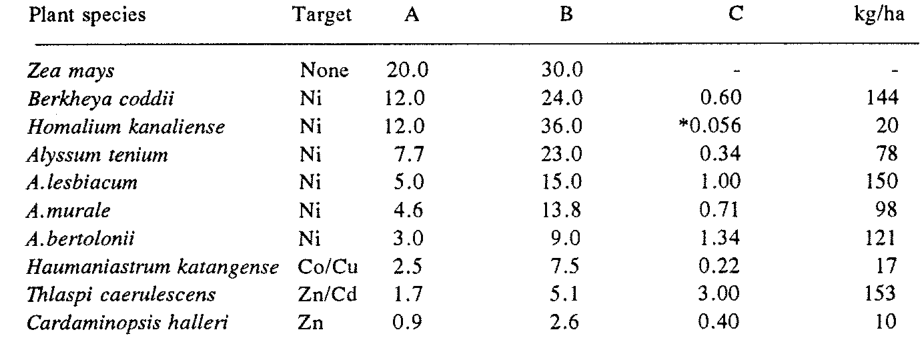
*Though leaves contain typically 0.6% nickel, the whole plant contains far less. Data based on own studies, McGrath et al. (1993), and Brooks et al. (1979).
*叶片镍含量通常为0.6%,但整株植物的镍含量要低得多。数据来源于本研究组的研究、McGrath et al. (1993)及Brooks et al. (1979)。
The biomass of the plant must be related to its metal content in assessing its suitability for phytoremediation or phytomining. The final column of Table 15.1 shows (in kg/ha) the product of the biomass (t/ha) and the metal content (%) of the plant. This highest expected metal yield is more important than the actual biomass. It would appear from the table that the plants with the highest biomass are in descending order: Homalium kanaliense, Zea mays, Berkheya coddii, Alyssum tenium, A.lesbiacum, A.murale, A.bertolonii, Haumaniastrum katangense, Thlaspi caerulescens and Cardaminopsis halleri. In terms of expected metal yield (kg/ha) the order is somewhat different and, again in descending order, follows the sequence: Thlaspi caerulescens, Alyssum lesbiacum, Berkheya coddii, A.bertolonii, A.murale, A.tenium, Homalium katangense, Haumaniastrum katangense and Cardaminopsis halleri. It must be remembered that the essential difference between phytoremediation and phytomining is that in the latter technology, the value of the metal crop is of paramount importance. Whereas Thlaspi caerulescens would appear to extract the greatest mass of metal among the plants listed in Table 1.2 (Chapter 1), the commercial value of this metal (zinc) is so low that the plant could never be used for biomining. On the other hand, the Zaïrean copper/cobalt accumulator, Haumaniastrum katangense with a yield of only 17 kg/ha of each of copper and cobalt might well be able to provide an economic crop because of the current high price of cobalt ($48,000/t). This question will be addressed in a later subsection of this chapter.
在评估某种植物是否适用于植物修复或植物采矿时,必须将其生物量与金属含量结合考虑。表15.1最后一列给出了植物生物量(t/ha)与金属含量(%)的乘积(kg/ha)。这一最高预期金属产量比实际生物量更为重要。由表可见,生物量由高到低依次为:Homalium kanaliense、Zea mays、Berkheya coddii、Alyssum tenium、A.lesbiacum、A.murale、A.bertolonii、Haumaniastrum katangense、Thlaspi caerulescens和Cardaminopsis halleri。按预期金属产量(kg/ha)排序则略有不同,由高到低依次为:Thlaspi caerulescens、Alyssum lesbiacum、Berkheya coddii、A.bertolonii、A.murale、A.tenium、Homalium katangense、Haumaniastrum katangense和Cardaminopsis halleri。必须牢记,植物修复与植物采矿的本质区别在于,对后者而言金属作物的价值至关重要。尽管在表1.2(第1章)所列植物中Thlaspi caerulescens似乎提取的金属量最大,但该金属(锌)的商业价值极低,因此该植物永远不可能用于生物采矿。另一方面,扎伊尔的铜/钴富集植物Haumaniastrum katangense虽然铜和钴的产量各仅为17 kg/ha,但由于目前钴价较高(48,000美元/t),它很可能提供具有经济效益的作物。这一问题将在本章后面的小节中讨论。
Fertiliser amendments as a means of increasing biomass and metal yields
以施肥改良提高生物量和金属产量
There has already been some discussion in Chapters 10 and 11 of the use of fertilisers to increase the biomass of selected hyperaccumulator plants. There will therefore be only limited discussion of the subject in this chapter. Table 15.2 summarises the increases of biomass achieved in various experiments with hyperaccumulator plants.
第10章和第11章已对利用肥料提高部分超富集植物生物量的问题进行了一定讨论,因此本章仅作简要论述。表15.2汇总了各项超富集植物试验中所获得的生物量增幅。
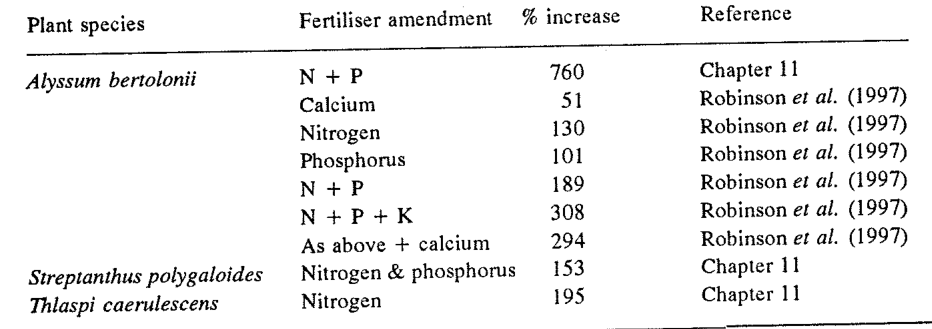
be achieved by fertilisation of the substrate. The experiments carried out by Robinson et al. (1997) were performed on naturally occurring populations of Alyssum bertolonii in Italy, whereas the other experiments were carried out as pot trials.
可通过对基质施肥来实现。Robinson et al. (1997)的试验是在意大利天然生长的Alyssum bertolonii种群上进行的,而其他试验均为盆栽试验。
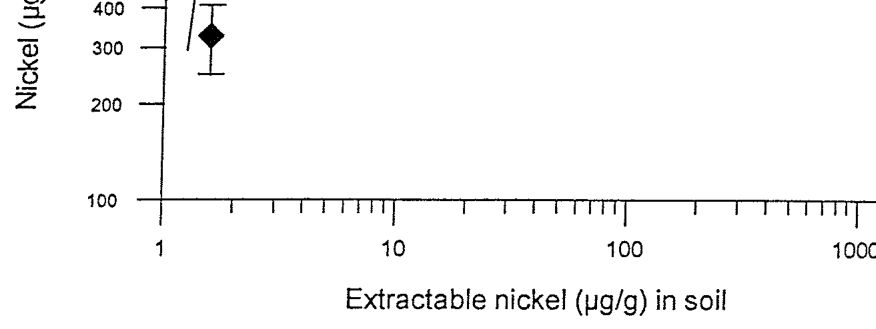
In the Italian work there was a highly significant positive correlation (0.01>P>0.001) between nickel uptake in the reproductive structures of A. bertolonii and the extractable nickel content of the associated soils (Fig. 15.1). This indicates that addition of fertilisers that increase this available nickel content should increase the nickel content of ihe plants.
在意大利的研究中,A. bertolonii繁殖器官对镍的吸收量与相应土壤的可提取镍含量之间存在极显著正相关(0.01>P>0.001)(图15.1)。这表明施用能够提高土壤有效镍含量的肥料应可提高植物的镍含量。
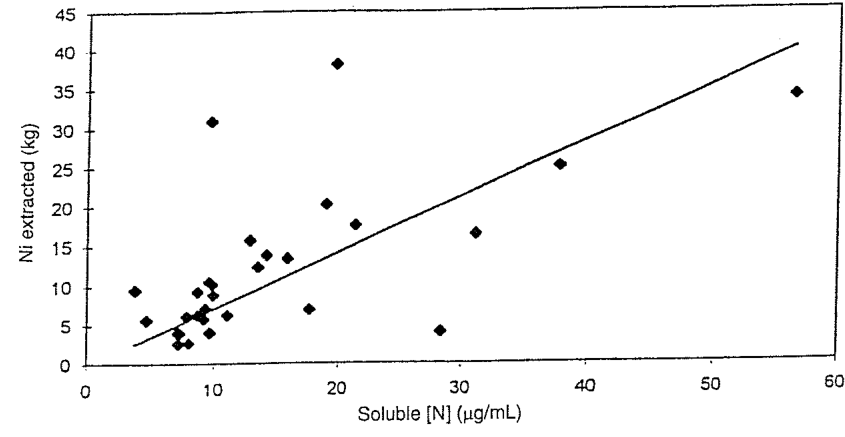
Table 15.2 shows that extractability of nickel was virtually unaffected by the nature of the treatment except in the case of CaCO, where the extractability of the former was halved. A similar result was obtained with the N+K+P+ Ca fertiliser. Robinson et al. (1996) have shown that the availability of trace elements in serpentine soils decreases exponentially as the pH is raised. This highlights the importance of avoiding CaCO, if a nickel "crop" is desired. There was a similar reduction in magnesium availability when calcium was used in fertilisers. Paradoxically, addition of CaCO,, though reducing nickel and magnesium availability, has the effect of rendering the soil more fertile for nonserpentinic plants by increasing the Ca/Mg quotient from ca. 0.5 to 3.0. This increase would clearly improve a crop such as wheat or barley but reduce a "crop" of nickel.由表15.2可知,除CaCO3处理使镍的可提取性降低一半外,镍的可提取性几乎不受处理类型的影响。N+K+P+Ca肥料处理也得到了类似结果。Robinson et al. (1996)已证明,蛇纹岩土壤中微量元素的有效性随pH升高呈指数下降。这突出表明,若希望获得镍“作物”,就必须避免施用CaCO3。在肥料中施用钙时,镁的有效性也出现了类似下降。矛盾的是,施用CaCO3虽然降低了镍和镁的有效性,却可将Ca/Mg比值由约0.5提高至3.0,从而使土壤对非蛇纹岩植物更为肥沃。这一提高显然有利于小麦或大麦等作物,但会降低镍“作物”的产量。
With the addition of fertilisers, the maximum annual biomass increase (ABI) in this Italian study, was about 300% (Table 15.2). The highest individual increase (130%) was with nitrogen alone, and the highest combined increase (308%) was with N+P+K.
在这项意大利研究中,施肥后年最大生物量增幅(ABI)约为300%(表15.2)。单一养分处理中增幅最高的是单施氮肥(130%),复合处理中增幅最高的是N+P+K(308%)。
The nickel content of the Italian field specimens of Alyssum bertolonii remained fairly constant in the range 0.54-0.77% for all fertiliser amendments except in the treatment with four fertiliser elements including calcium. It therefore appears that there is no appreciable decrease of nickel concentration with increase in biomass except when the pH is increased by addition of calcium. In other words there is no trade-off in reduced nickel concentration to offset the gain in biomass. Similar findings were made in work described in Chapter 11 (Figs 11.5 and 11.6).
除含钙的四元素施肥处理外,意大利田间Alyssum bertolonii样品的镍含量在所有施肥处理下均相当稳定,介于0.54%~0.77%之间。由此可见,除施钙导致pH升高的情况外,镍浓度并不会随生物量的增加而明显降低。换言之,生物量的增加不会以镍浓度的降低为代价。第11章所述研究也得到了类似结果(图11.5和图11.6)。
The use of chelates in soils to increase elemental uptake by plants
在土壤中施用螯合剂以提高植物对元素的吸收
The use of chelates in soils to increase metal uptake by plants represents perhaps the greatest step forward in the technology of phytoremediation. Early experiments by Norvell (1972), Wallace et al. (1977), Checkai et al. (1987) and Sadiq and Hussain (1993) showed that synthetic chelating agents could be used to increase uptake of various cations by plants. More recently, Huang and Cunningham (1996) and Huang et al. (1997) have shown that complexing of lead with EDTA renders this element much more available to large-biomass non-accumulators such as Zea mays so that a metal content of 1% (dry weight) can be obtained in the plant material. Harvesting of these plants permits a reduction of the lead content of the contaminated soil so that a satisfactory level can be reached in a small number of sequential crops. tala concerns the accumulation of anthropogenic lead in soils throughout the world. Lead is normally very immobile to plants as it can precipitate at roots systems as the highly insoluble phosphate or sulphate and does not readily penetrate from roots to the stems.
在土壤中施用螯合剂以提高植物对金属的吸收,或许是植物修复技术最重大的进展。Norvell (1972)、Wallace et al. (1977)、Checkai et al. (1987)以及Sadiq and Hussain (1993)的早期试验表明,合成螯合剂可用于提高植物对多种阳离子的吸收。近年来,Huang and Cunningham (1996)和Huang et al. (1997)证明,铅与EDTA络合后,其对Zea mays等高生物量非富集植物的有效性大大提高,使植物材料中的金属含量可达1%(干重)。收获这些植物可降低污染土壤的铅含量,只需少数几茬连续种植即可达到满意水平。tala涉及全球土壤中人为来源铅的积累问题。铅对植物而言通常极难移动,因为它可在根系以高度难溶的磷酸盐或硫酸盐形式沉淀,且不易从根部向茎部转运。
However, Marten and Hammond (1966) found that ethylenediaminetetraacetic acid (EDTA) applied to lead-contaminated soils, increased the lead content of bromegrass from 5 to 35 ug/g.
然而,Marten and Hammond (1966)发现,向铅污染土壤施用乙二胺四乙酸(EDTA)后,雀麦草的铅含量由5 ug/g增加至35 ug/g。
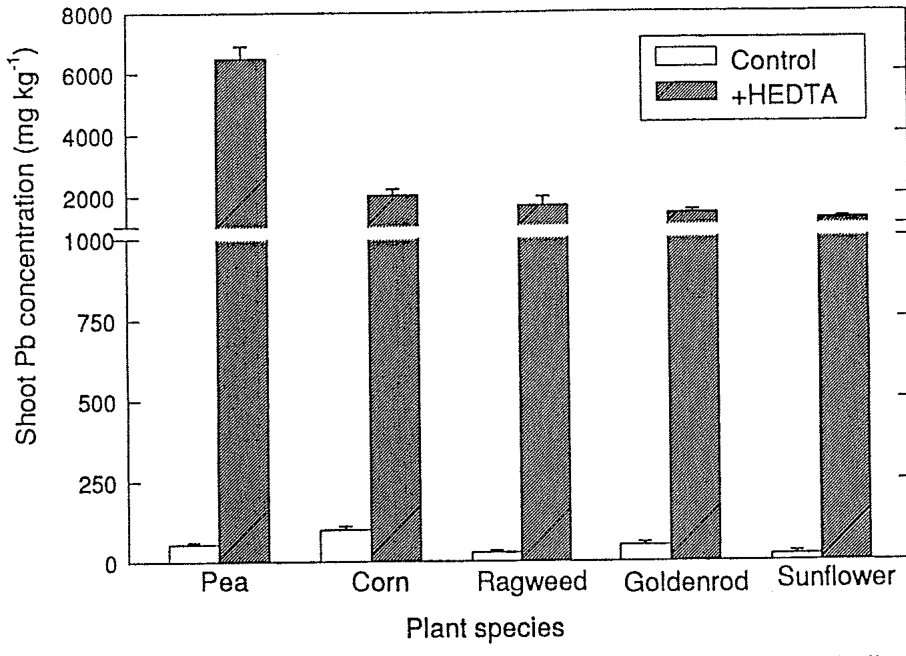
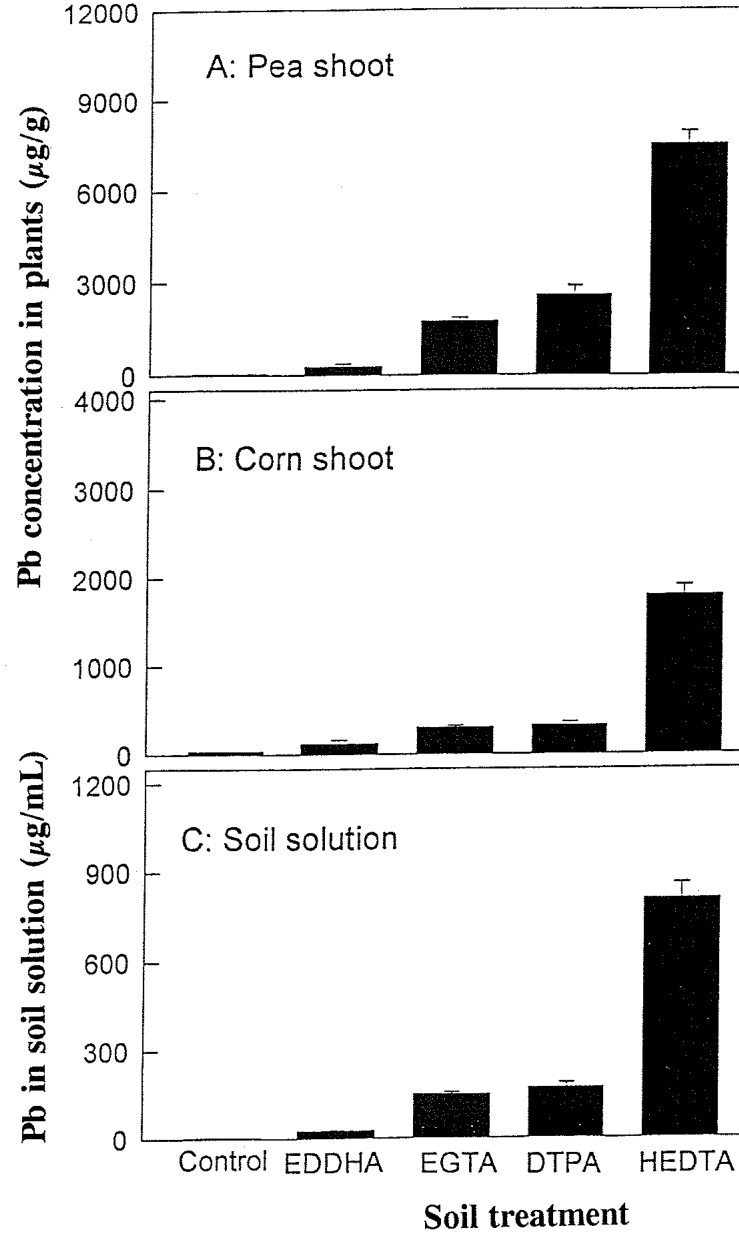
Huang et al. (1997) have reported experiments in which EDTA (as the trisodium salt Na,HEDTA) was added to lead-contaminated soils (2500 jug/g) at the rate of 0, 0.5, 1.0 and 2.0 g/kg. Within 24 hours the soluble lead content of the soil solution increased from almost zero to about 4000 ug/mL. Lead accumulation in shoots of five plant species grown in the same soil and with the addition of 0.5 g/kg of EDTA, is shown in Fig. 15.2. It will be observed that the lead content of pea (Pisum sativum) reached over 6000 ug/g lead whereas that of corn (Zea mays) was only 2000 ug/g. However, the biomass of corn being at least ten times that of pea, shows that the former would be much more effective in removing lead from the soil. The same is true for the high-biomass sunflower (Helianthus annuus) with well over 1000 ug/g of the same element.
Huang et al. (1997)报道了向铅污染土壤(2500 ug/g)中分别以0、0.5、1.0和2.0 g/kg的用量添加EDTA(以三钠盐Na3HEDTA形式)的试验。24小时内,土壤溶液中的可溶性铅含量由接近零增加至约4000 ug/mL。在同一土壤中添加0.5 g/kg EDTA后,5种植物地上部的铅积累量见图15.2。可以看出,豌豆(Pisum sativum)的铅含量超过6000 ug/g,而玉米(Zea mays)仅为2000 ug/g。然而,玉米的生物量至少是豌豆的十倍,这表明玉米去除土壤铅的效果要好得多。高生物量的向日葵(Helianthus annuus)也是如此,其铅含量远超1000 ug/g。
The effect of different complexing agents on the uptake of lead by pea and corn shoots is shown in Fig. 15.3. It is clear that EDTA (trisodium salt) is by far the most efficient of the five chelates used, followed by HEDTA (N-(2-hydroxyethyl)ethylenediaminetetraacetic acid, DTPA (diethylenetriaminepentaacetic acid), EGTA (ethylenebis(oxyethylenenitrilo)tetraacetic acid), and EDDHA. EDTA has the further advantage of being the least expensive of the chelating agents (about $40/kg).
不同络合剂对豌豆和玉米地上部铅吸收的影响见图15.3。显然,在所用的5种螯合剂中,EDTA(三钠盐)的效率远高于其他螯合剂,其次依次为HEDTA(N-(2-羟乙基)乙二胺三乙酸)、DTPA(二乙烯三胺五乙酸)、EGTA(乙二醇双(2-氨基乙基醚)四乙酸)和EDDHA。EDTA的另一优势是其价格在各螯合剂中最低(约40美元/kg)。
The above discussion has centred around complexing of lead in contaminated soils since this element is one of the most ubiquitous in sites polluted with heavy metals. The beneficial application of the technique to phytoremediation cannot be doubted, whereas for phytomining, the thrust of this chapter, the benefits are negligible because the low world price of lead (ca. $800/t) would militate against its economic recovery by growing plants. Nevertheless, the principles of chelateassisted metal uptake by plants are equally applicable to other more valuable elements such as nickel, cobalt, or even gold. As far as we know, no other studies have yet been published in which chelates have been used to increase metal uptake by hyperaccumulators of these more expensive metals. Details of our experiments with chelating agents are given below.
上述讨论集中于污染土壤中铅的络合,因为铅是重金属污染场地中最普遍存在的元素之一。该技术对植物修复的益处毋庸置疑;而对于本章的重点——植物采矿而言,其益处则微乎其微,因为铅的世界价格较低(约800美元/t),不利于通过种植植物对其进行经济回收。尽管如此,螯合剂辅助植物吸收金属的原理同样适用于镍、钴乃至金等更有价值的元素。据我们所知,目前尚未有其他研究发表过利用螯合剂提高这些较昂贵金属的超富集植物对金属吸收的报道。我们利用螯合剂开展的试验详见下文。
Selection by plant breeding of specific cultivars and wild strains of hyperaccumulators
通过植物育种筛选超富集植物的特定品种和野生株系
Among small-biomass hyperaccumulating plants such as Streptanthus polygaloides (Ni) and Thlaspi caerulescens (Zn/Cd) there is often a large difference of biomass and metal uptake among individual plants. In Chapter 14, field observations of Streptanthus polygaloides showed that it was not uncommon to find two plants growing less than 20 cm apart to differ in biomass by a factor of two to three. These variations made estimates of potential crop yields difficult but it is important to note that they also indicated a rich variety of genotypes in the wild application of selective breeding techniques to develop a high-yielding strain.
在Streptanthus polygaloides(Ni)和Thlaspi caerulescens(Zn/Cd)等低生物量超富集植物中,不同个体之间的生物量和金属吸收量往往差异很大。第14章中对Streptanthus polygaloides的野外观察表明,相距不足20 cm的两株植物生物量相差2~3倍的情况并不少见。这些差异使潜在作物产量的估算变得困难,但值得注意的是,它们也表明野外存在丰富多样的基因型,可以应用选择育种技术培育高产株系。
In our studies on Thlaspi caerulescens growing over zinc/lead mine wastes at Les Avinières near Montpellier in southern France, we have observed a very wide range of biomass ranging from 1 to 64 g. This extremely variable species is also a good candidate for selection of high-biomass strains by plant breeding.
我们在法国南部蒙彼利埃附近Les Avinières对生长于锌/铅矿废弃物上的Thlaspi caerulescens进行研究时,观察到其生物量变幅很大,从1 g到64 g不等。这一变异极大的物种也是通过植物育种筛选高生物量株系的良好候选对象。
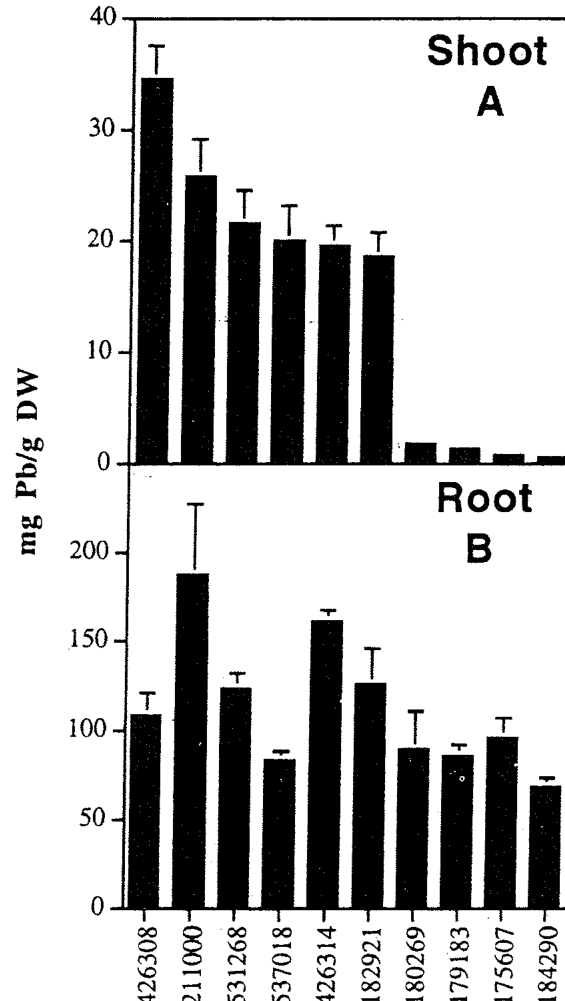
Kumar et al. (1995) have reported studies in which they tested 106 different cultivars of Indian mustard (Brassica juncea) for their ability to accumulate lead in roots and transport this element to the shoots. Some of their data are shown in
Kumar et al. (1995)报道了一项研究,他们测试了106个印度芥菜(Brassica juncea)品种在根部积累铅并将其转运至地上部的能力。部分数据见
B. juncea cultivarsB. juncea品种
14 days in a sand/Perlite mixture containing 625 ug/g lead. Source: Kumar et al. (1995).
含铅625 ug/g的砂/珍珠岩混合基质中生长14天后地上部(a)和根部(B)的铅含量。来源:Kumar et al. (1995)。
Fig. 15.4. The most efficient cultivar (No.426308) contained 35 ug/g lead in the dry shoots compared with only 0.4 ug/g for the least efficient (No. 184290).图15.4。效率最高的品种(No.426308)干地上部铅含量为35 ug/g,而效率最低的品种(No. 184290)仅为0.4 ug/g。
The above observations clearly show the wide range of biomass and metal uptake that can be expected in wild strains and cultivars of many plant species, both hyperaccumulators and non-accumulators.
上述观察清楚地表明,在许多植物种类(包括超富集植物和非富集植物)的野生株系和栽培品种中,生物量和金属吸收量均可能存在很大差异。
Use of biotechnology to introduce "hyperaccumulation" genes into plants of high biomass
利用生物技术将“超富集”基因导入高生物量植物
The main problem in phytomining and phytoremediation technologies is that there are few plants that combine high biomass with a high degree of accumulation of the target heavy metals. In some cases, notably in Cuba and New Caledonia, there are indeed plants of high biomass such as the New Caledonian Hybanthus austrocaledonicus and Sebertia acuminata. These trees are however difficult to grow and have a slow rate of growth.
植物采矿和植物修复技术的主要问题在于,兼具高生物量和对目标重金属高度富集能力的植物很少。在某些地区,特别是古巴和新喀里多尼亚,确实存在高生物量的植物,如新喀里多尼亚的Hybanthus austrocaledonicus和Sebertia acuminata。然而,这些树木难以栽培且生长缓慢。
There is clearly a need for species that combine the extraordinarily high uptake of metals by low-biomass plants such as Thlaspi caerulescens with high-biomass fast-growing plants such as Brassica juncea. This problem has been discussed by Kumar et al. (1995) and by Cunningham and Ow (1996) who have suggested that the answer to the problem lies in genetic engineering to transfer the "hyperaccumulation genes" from plants of low biomass to fast-growing high-biomass plants such as Brassica juncea or Helianthus annuus. Such experiments are still in their infancy but encouraging results have been obtained by experiments in which scientists have cloned the gene for a vacuolar membrane transport pump that facilitates sequestering of the peptide-Cd complex (Ortiz et al., 1995). Hyperproduction of this protein in the fission yeast Schizosaccharomyces pombe enhances tolerance to, and accumulation of, cadmium. Ow (1993) has suggested that hyperexpression of this yeast protein may yield similar results in a higher plan.
显然,需要培育既具有Thlaspi caerulescens等低生物量植物超强的金属吸收能力、又具有Brassica juncea等高生物量速生植物特性的物种。Kumar et al. (1995)以及Cunningham and Ow (1996)讨论了这一问题,他们认为解决途径在于通过基因工程将“超富集基因”从低生物量植物转入Brassica juncea或Helianthus annuus等速生高生物量植物。此类试验仍处于起步阶段,但已取得了令人鼓舞的结果:科学家克隆了一种液泡膜转运泵的基因,该转运泵可促进肽-Cd复合物的区隔化(Ortiz et al., 1995)。在裂殖酵母Schizosaccharomyces pombe中过量表达该蛋白可增强其对镉的耐受性和积累。Ow (1993)认为,在高等植物中过量表达这种酵母蛋白可能产生类似的效果。
Cropping Sustainability of Phytomining Operations植物采矿作业的种植可持续性
Robinson et al. (1997) have examined the question of whether growing a crop of nickel will entail quick removal of the soluble fraction of this element from the soil in the way that a conventional crop will quickly remove plant nutrients. It would be scarcely feasible to grow a crop on an annual basis for a decade in order to answer this question. An alternative approach is the method of sequential extraction that we have developed in our laboratories. Using cumulative extraction of nickel by KH phthalate at pH 2, 4 and 6 shows that:
Robinson et al. (1997)研究了这样一个问题:种植镍作物是否会像常规作物迅速耗竭土壤养分那样,迅速耗尽土壤中可溶态的镍。为回答这一问题而连续十年每年种植一茬作物几乎是不可行的。另一种方法是采用我们实验室建立的连续提取法。利用pH 2、4和6的邻苯二甲酸氢钾对镍进行累积提取,结果表明:
te = 1- tc/(x+ C)
Where: te = cumulative extracted concentration of nickel, t = concentration of potentially available nickel, x = number of extractions, and c = a constant extraction. The cumulative extractions approach a limiting value where fewer extractions are needed at lower pH values.
式中:te为镍的累积提取浓度,t为潜在有效镍浓度,x为提取次数,c为提取常数。累积提取量趋近于一个极限值,pH越低,达到该值所需的提取次数越少。
In experiments carried out on ultramafic rocks of the Murlo area of Tuscany Italy (Fig. 15.5), the limiting value was found to be 768 ug/g nickel in the soil (approximately the amount of nickel removed in a single extraction with 0.1M HCI). If we assume that removal of up to 30% of this limiting value would be acceptable economically, a simple calculation shows how many crops could be sustained by the site. Assuming that the soil is being phytomined to a depth of 0.15 m, the volume of a hectare of soil to this depth would be 1500 m?. For a density of 1.3, the mass would be 1950 t. For a crop producing 72 kg nickel/ha, the concentration of removable nickel would be 72,000/1950 g/t = 40 ug/g for a single crop. The number of potential croppings before the soil was exhausted would therefore be 30% of 768 divided by 40: i.e. 230/40 = 5.8 croppings.
在意大利托斯卡纳Murlo地区超基性岩上开展的试验(图15.5)中,土壤镍的极限值为768 ug/g(大致相当于用0.1M HCl单次提取所去除的镍量)。假设去除该极限值的30%以内在经济上是可接受的,通过简单计算即可得出该场地可维持的种植茬数。假设植物采矿的土壤深度为0.15 m,则每公顷该深度土壤的体积为1500 m3;按容重1.3计算,其质量为1950 t。对于镍产量为72 kg/ha的作物,单茬可去除的镍浓度为72,000/1950 g/t = 40 ug/g。因此,土壤耗竭前可种植的茬数为768的30%除以40,即230/40 = 5.8茬。
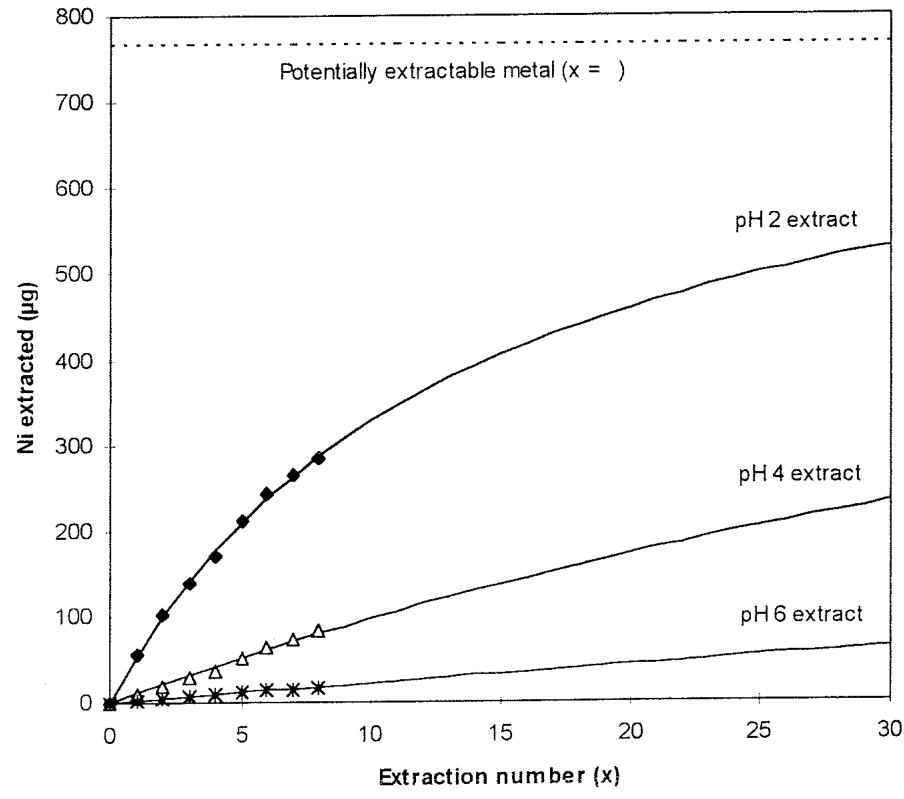
After each of the sequential extracts, the equilibrium of soluble to total nickel restores the soluble fraction to almost its original value otherwise it would be quickly depleted. The procedure obviously cannot reproduce the exact field conditions but will certainly err on the conservative side since, in the laboratory, we are looking at an equilibrium recovery time of only as long as it takes to replace the extractant with a fresh supply compared with a period of 12 months under field conditions.
每次连续提取后,可溶态镍与全镍之间的平衡会使可溶态组分几乎恢复到其初始值,否则其将很快耗竭。该方法显然无法完全再现田间条件,但其结果必然偏于保守,因为在实验室中,平衡恢复时间仅为更换新鲜提取剂所需的时间,而在田间条件下则为12个月。
The reality is therefore that under field conditions, nearly 6 croppings would keep within the guidelines of 30% removal of available nickel. An undeniable advantage of using a perennial with a life of about 10 years is that resowing would not be needed. After harvesting, the plant would regenerate and would be reinforced by seedlings from the crop itself.
因此,实际情况是,在田间条件下种植近6茬仍可满足有效镍去除量不超过30%的准则。使用寿命约为10年的多年生植物的一个明显优势是无需重新播种。收获后,植物会再生,并得到作物自身所产幼苗的补充。
When the pool of available nickel is reduced by 30%, ploughing to bring fresh soil to the surface would be followed by resowing. The latter might even not be necessary if sufficient seed from the current crop were already distributed in the soil.
当有效镍库减少30%时,可通过翻耕将新鲜土壤翻至表层,然后重新播种。如果当前作物已有足够的种子散落于土壤中,甚至可能无需重新播种。
The Economic Limits of Phytomining植物采矿的经济极限
Although there are clearly economic limits in terms of biomass production and metal content in respect of the potential use of any plant for phytomining, the same is not true for the wider subject of phytoremediation. Whereas phytomining is limited by the need to produce a commercially viable metal crop, this is not the case for phytoremediation.
尽管任何植物用于植物采矿时,在生物量和金属含量方面显然都存在经济极限,但对于范围更广的植物修复而言则并非如此。植物采矿受限于必须生产具有商业可行性的金属作物,而植物修复则不受此限制。
*Excluding any profit from sale of the energy of biomass incineration.
*不包括出售生物质焚烧能量所得的任何利润。
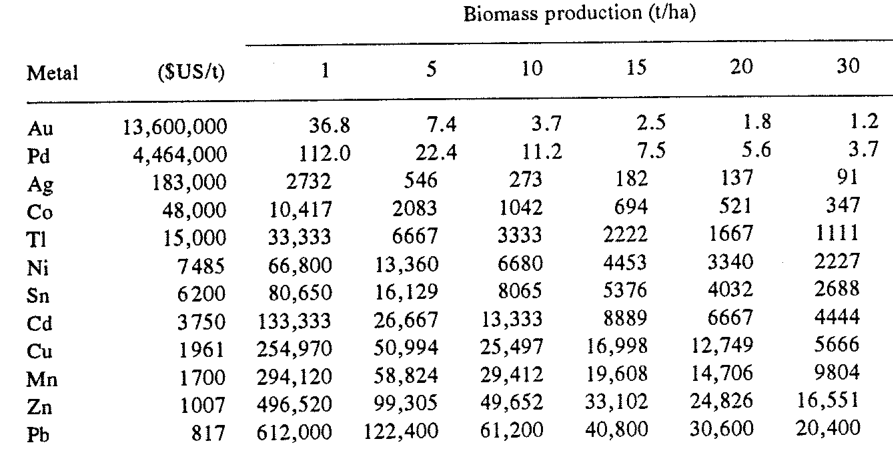
for phytomining with plants of a 10 t/ha biomass. Hyperaccumulators with 1% (10,000 ug/g) cobalt are known from Zaïre (Brooks and Malaisse, 1985) and many Alyssum species can have nickel contents well in excess of 1% (Brooks et al., 1979). There are no records of high-biomass plants (i.e. around 30 t/ha) whose noble metal contents exceed the values shown in Table 15.3 and neither are there any for cadmium, copper, lead, tin or zinc. It must be emphasized however, that many hyperaccumulators of nickel will also accumulate the much more valuable cobalt. Similarly, cobalt hyperaccumulators often hyperaccumulate copper as well. Though copper is not valuable enough for phytomining in its own right, it can add value to a crop of cobalt. Consider the copper/cobalt hyperaccumulator Haumaniastrum katangense from Zaïre. It typically contains 0.2% (dry weight) of both elements. Assuming a fertilised biomass of 7.5 t/ha, a hectare of mineralised soil could provide 0.015 tonne of cobalt worth $720 plus the same weight of copper worth $29. The total of $749/ha would be easily economic.
适用于生物量为10 t/ha的植物进行植物采矿。已知扎伊尔有钴含量达1%(10,000 ug/g)的超富集植物(Brooks and Malaisse, 1985),许多Alyssum属植物的镍含量也远超1%(Brooks et al., 1979)。目前尚无贵金属含量超过表15.3所列数值的高生物量植物(即约30 t/ha)的记录,镉、铜、铅、锡或锌也没有此类记录。但必须强调的是,许多镍超富集植物同时也会富集价值高得多的钴。同样,钴超富集植物往往也超富集铜。铜的价值虽不足以单独用于植物采矿,但可提高钴作物的附加值。以扎伊尔的铜/钴超富集植物Haumaniastrum katangense为例,其两种元素的含量通常均为0.2%(干重)。假设施肥后生物量为7.5 t/ha,则每公顷矿化土壤可产出0.015 t钴(价值720美元)以及等量的铜(价值29美元)。合计749美元/ha,显然具有经济效益。
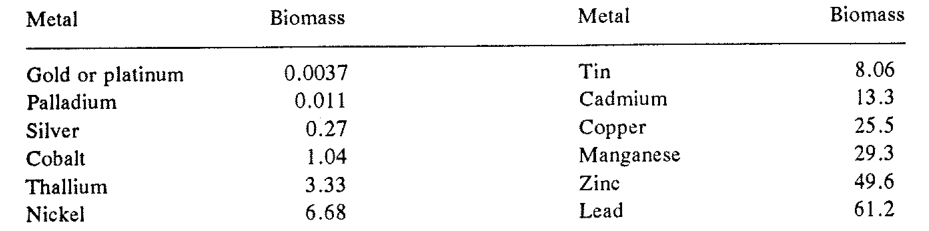
The above problem can be addressed to some extent by use of hyperaccumulators of higher biomass combined with a sufficiently high metal content. Table 15.4 shows the biomass needed to give a gross return of $500/ha assuming that the plant contains 1% (dry weight) of the target metal. The table shows that values range from 0.0037 t/ha for gold and platinum to 61 t/ha for lead. For annual crops the biomass range is up to about 30 t/ha (maize) with a value of about 5 t/ha for hay. It is not likely that an unfertilised hyperaccumulator annual crop will be found with a biomass exceeding that of maize although there are several large trees that can hyperaccumulate metals. For example, using the data of Jaffré et al. (1976), it can be calculated that a mature specimen of the New Caledonian tree Sebertia acuminata (see Fig.3.6) contains a total of about 40 kg of nickel. A crop of these trees planted at the rate of 2000/ha would produce 8 tonnes of nickel worth about $60,000 at today's prices. Assuming that this tree would have taken 40 years to mature, the annual yield is then only $7500 after 40 years and much less in a shorter time frame when the tree was initially only a sapling.
上述问题在一定程度上可通过使用兼具较高生物量和足够高金属含量的超富集植物来解决。表15.4列出了假设植物含目标金属1%(干重)时获得500美元/ha总收益所需的生物量。由表可见,所需生物量从金和铂的0.0037 t/ha到铅的61 t/ha不等。一年生作物的生物量最高约为30 t/ha(玉米),干草约为5 t/ha。尽管有若干大型树木能够超富集金属,但不太可能找到生物量超过玉米的未施肥一年生超富集作物。例如,根据Jaffré et al. (1976)的数据可以计算出,一株成熟的新喀里多尼亚树种Sebertia acuminata(见图3.6)共含镍约40 kg。以2000株/ha的密度种植这种树木,可产出8 t镍,按现价计约值60,000美元。假设该树需要40年才能成熟,则40年后的年收益仅为7500美元;若时间更短、树木最初仅为幼树,则收益要低得多。
The reproductive matter of Alyssum bertolonii after fertilising, has a biomass of about 13.5 t/ha. This value is in the middle to low part of the potential economic range. The South African Berkheya coddii (Morrey et al., 1992) has an unfertilised biomass of about 12 t/ha but our field trials in New Zealand have shown that a fertilised biomass of 22 t/ha can be achieved (Robinson et al., 1998). Together with its high nickel content of over 1%, it is probably one of the best candidates to extend the outermost limits of phytomining for nickel. Experiments with both of these hyperaccumulators are described below.
施肥后Alyssum bertolonii繁殖器官的生物量约为13.5 t/ha,处于潜在经济范围的中低部分。南非的Berkheya coddii(Morrey et al., 1992)未施肥时生物量约为12 t/ha,但我们在新西兰的田间试验表明,施肥后生物量可达22 t/ha(Robinson et al., 1998)。加之其镍含量超过1%,该植物可能是将镍植物采矿推向极限的最佳候选植物之一。下文介绍对这两种超富集植物开展的试验。
Phytomining potential of hyperaccumulators
超富集植物的植物采矿潜力
Examination of the Potential of Phytomining by Pot Trials and Field Tests通过盆栽试验和田间试验考察植物采矿的潜力
Experiments with Alyssum bertolonii
Alyssum bertolonii试验
Introduction引言
The work described in this subsection has already been reported by Robinson et al. (1997). Therefore, only the salient details will be reported here. The study was based on the principles established by Nicks and Chambers (1995 - see also Chapter 14) and as far as we know, represents only the second report ever published on the potential of phytomining based on field work under natural conditions and using native plant species rather than exotic taxa. The work was carried out in Tuscany, Italy, using populations of Alyssum bertolonii growing under natural conditions over the ultramafic (serpentine) soils of the region. The aims of the experiments were to assess: the approximate yield of nickel per hectare; the relation between the nickel content of the plant and the available nickel status of the soil; the effect of plant age and size on the nickel content of the plant; the effect of fertilisers on biomass and nickel content of the plants; the reduction of nickel availability in the soil after successive croppings.
本小节所述工作已由Robinson et al. (1997)报道,因此此处仅介绍其要点。该研究基于Nicks and Chambers (1995;另见第14章)确立的原则,据我们所知,这是迄今为止第二篇基于自然条件下田间工作、利用本土植物而非外来类群探讨植物采矿潜力的报道。研究在意大利托斯卡纳进行,所用材料为在该地区超基性(蛇纹岩)土壤上自然生长的Alyssum bertolonii种群。试验目的是评估:每公顷的大致镍产量;植物镍含量与土壤有效镍状况的关系;植株年龄和大小对植物镍含量的影响;肥料对植物生物量和镍含量的影响;连续种植后土壤镍有效性的降低。
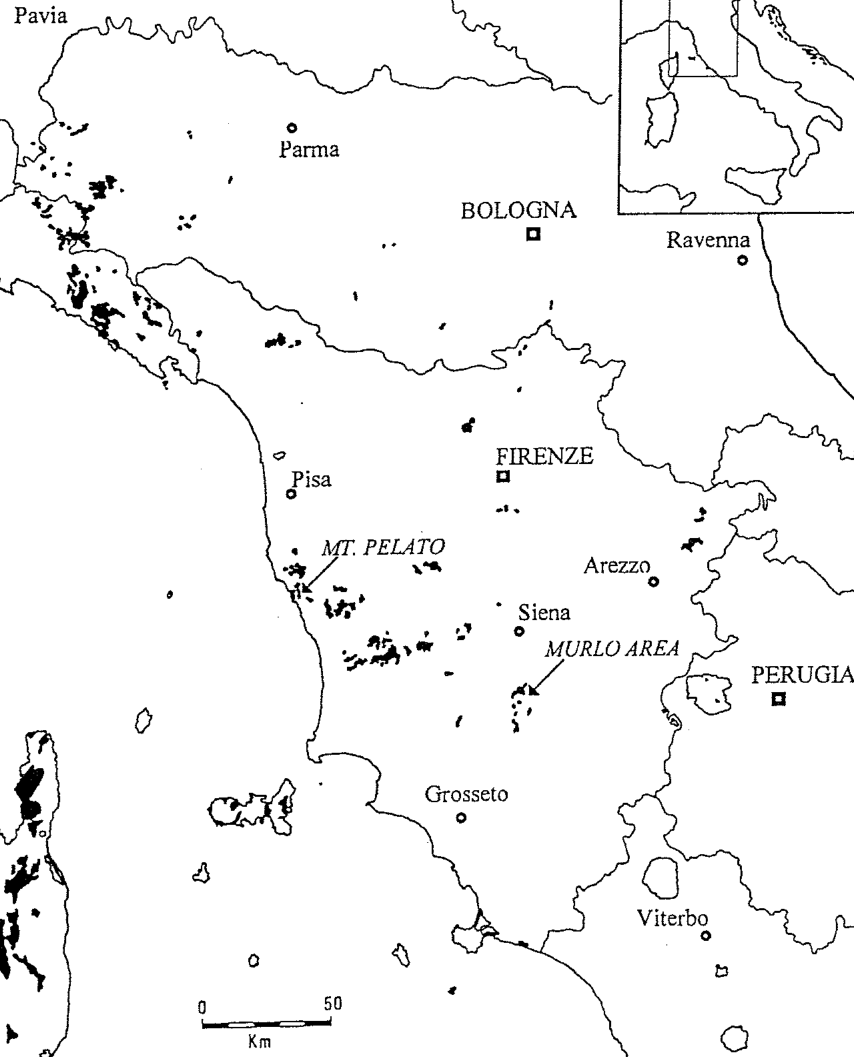
The test areas were located on Monte Pelato (350 m) in Livorno Province and near the village of Murlo (350 m) south of Siena, Italy (Fig. 15.6). The rocks are composed of herzolitic serpentinites emplaced in gabbro and basalt. The soils are often skeletal with a low water-holding capacity (Vergnano Gambi, 1992). The pH ranges from 6.6 to 7.4 on serpentinite and 6.8 to 7.0 on gabbro.
试验区位于意大利利沃诺省的Monte Pelato(海拔350 m)和锡耶纳以南Murlo村附近(海拔350 m)(图15.6)。岩石为侵位于辉长岩和玄武岩中的二辉橄榄岩质蛇纹岩。土壤多为粗骨土,持水能力低(Vergnano Gambi, 1992)。蛇纹岩上土壤pH为6.6~7.4,辉长岩上为6.8~7.0。
Arrigoni et al. (1983) distinguished a specific vegetation community on the screes and debris. It is known as the Armerio-Alyssetum bertolonii vegetation type and is spread over all the Tuscan ultramafic outcrops. It encompasses all the serpentine-endemic plants including of course, Alyssum bertolonii itself (Chiarucci et al., 1995). This species and its community are absent over the gabbro and basalt.
Arrigoni et al. (1983)在岩屑坡和碎石上划分出一个特定的植被群落,称为Armerio-Alyssetum bertolonii植被类型,广泛分布于托斯卡纳所有超基性岩露头。该群落包含所有蛇纹岩特有植物,当然也包括Alyssum bertolonii本身(Chiarucci et al., 1995)。该物种及其群落在辉长岩和玄武岩上均不存在。
Climatic data are available for both Monte Pelato and Murlo. Both sites can be classified bioclimatically as Mediterranean pluvio-seasonal oceanic. For Murlo the mean annual temperature is 13.8°C ranging from 5.8° in 37 mm in July to 129 mm in November.
Monte Pelato和Murlo均有气候资料。从生物气候学角度,两地均可归为地中海雨季性海洋型气候。Murlo年平均气温为13.8°C,变幅从5.8°……7月的37 mm至11月的129 mm。
For Monte Pelato the mean annual temperature is 12.6°C ranging from 4.3° in January to 21.7° in July/August. The total annual rainfall is 978 mm ranging from 21 mm in July to 137 mm in November.
Monte Pelato年平均气温为12.6°C,从1月的4.3°到7/8月的21.7°。年总降水量为978 mm,从7月的21 mm到11月的137 mm。
Brief description of experiments试验概述
At Monte Murlo, 35 random quadrats (1 m × 1 m) were selected in Spring 1994 on a gently sloping hillside. In each plot the presence of all vascular plants was recorded and their coverage estimated by the points-quadrat method which estimates the ground cover of a given plant by the relative interceptions of the plant canopy with regularly spaced point observations which, in this case, were made on a square grid with 5 cm spacing of each point. These quadrats encompassed natural populations of Alyssum bertolonii that were treated with the following fertiliser regimes in Autumn (October) of the same year: 1 - calcium carbonate at 100 g/m', 2 - sodium dihydrogen phosphate at 10 g/m?, 3 - ammonium nitrate at 10 g/m', 4 - sodium dihydrogen phosphate + ammonium nitrate each at 10 g/m?, 5 - sodium dihydrogen phosphate + ammonium nitrate + potassium chloride each at 10 g/m', and 6 - calcium carbonate + sodium dihydrogen phosphate + ammonium nitrate + potassium chloride each at the loadings shown above. There were five replicates of each treatment including five controls. The fertiliser treatment was repeated one year later in October 1995. The increase in biomass of Alyssum bertolonii was noted by measuring the increase in cover (the relationship between cover and biomass having been previously established by experiments in which plants were harvested, dried and weighed at the end of each year for a period of two years). The plants were harvested from each quadrat at the end of the two-year period and a soil sample (0-15 cm depth and weighing 100 g) was also taken.
1994年春季,在Monte Murlo一处缓坡上随机选取了35个样方(1 m × 1 m)。在每个样方中记录所有维管植物的出现情况,并采用点样方法估算其盖度。该方法通过植物冠层与规则分布观测点的相对截取率来估算某一植物的地面盖度,本研究中观测点设在间距为5 cm的方格网上。这些样方包含Alyssum bertolonii的天然种群,于同年秋季(10月)进行以下施肥处理:1 - 碳酸钙100 g/m2;2 - 磷酸二氢钠10 g/m2;3 - 硝酸铵10 g/m2;4 - 磷酸二氢钠 + 硝酸铵,各10 g/m2;5 - 磷酸二氢钠 + 硝酸铵 + 氯化钾,各10 g/m2;6 - 碳酸钙 + 磷酸二氢钠 + 硝酸铵 + 氯化钾,用量同上。每个处理设5次重复,另设5个对照。一年后(1995年10月)重复施肥处理。通过测定盖度的增加来记录Alyssum bertolonii生物量的增加(盖度与生物量的关系已通过事先试验确定,即连续两年在每年年末收获植物、烘干并称重)。两年期结束时收获各样方的植物,并采集土壤样品(0~15 cm深度,重100 g)。
Subsamples (0.5 g) of the vegetative and reproductive parts of the plants were removed and placed in small borosilicate test tubes. These were ashed overnight at 500°C and 10 mL of hot 2M HCI added to each tube to dissolve the ash. The solutions were analysed for trace elements using flame atomic absorption spectrometry.
取植物营养器官和繁殖器官的子样品(0.5 g),置于小型硼硅酸盐试管中,于500°C灰化过夜,然后向每支试管中加入10 mL热的2M HCl溶解灰分。采用火焰原子吸收光谱法测定溶液中的微量元素。
In statistical tests on the biomass of Alyssum, the total biomass was transformed logarithmically and submitted to analysis of variance (ANOVA). Statistically significant differences at the 5% level (P <0.05) were determined by the LSD test.
对Alyssum生物量进行统计检验时,将总生物量进行对数转换后进行方差分析(ANOVA),采用LSD检验确定5%水平(P <0.05)上的显著性差异。
Results and discussion of a proposed pilot project for biomining
生物采矿中试项目方案的结果与讨论
Earlier in this chapter, it has been shown that fertilisation of the natural populations of Alyssum bertolonii was able to increase the biomass of this plant by a factor of three (Table 15.2) without concomitant reduction in the nickel concentration in the fertilised plant.
本章前文已表明,对Alyssum bertolonii天然种群施肥可使其生物量提高至3倍(表15.2),而施肥植物的镍浓度并未随之降低。
We have calculated the biomass of a fertilised crop of Alyssum bertolonii by multiplying the unfertilised yield (4.5 t/ha) by a factor of two rather than three in order to err on the conservative side. This gives a fertilised biomass of about 9.0 t/ha. It appears that this factor was indeed too conservative because in of 3.4 and 13.0 t/ha for unfertilised and fertilised plots respectively. This is in very good agreement with the Italian findings on natural populations of Alyssum and suggests that our estimate of 9 t/ha for the biomass is on the conservative side.
为稳妥起见,我们将未施肥产量(4.5 t/ha)乘以2而非3来计算施肥Alyssum bertolonii作物的生物量,由此得出施肥后生物量约为9.0 t/ha。看来这一系数确实过于保守,因为在……未施肥和施肥小区分别为3.4和13.0 t/ha。这与意大利Alyssum天然种群的研究结果非常吻合,表明我们对生物量9 t/ha的估计偏于保守。
From our experience in the field at Murlo, we envisage that a pilot project might involve the following programme:
根据我们在Murlo的野外经验,设想中试项目可包括以下方案:
1 - select a suitable site where the topography would permit harvesting of the crop, ploughing, and fertiliser addition to the serpentine soil;
1 - 选择合适的场地,其地形应便于作物收获、翻耕以及向蛇纹岩土壤施肥;
2 - seed the site directly or plant out seedlings at a rate of approximately 16 plants per m' (160,000 per ha);
2 - 在场地直接播种,或按约16株/m2(160,000株/ha)的密度移栽幼苗;
3 - after a period of 12 months, harvest the reproductive structures with a harvester set to collect all vegetation above 10 cm from the ground;
3 - 12个月后,用收割机收获繁殖器官,收割机设定为收集离地面10 cm以上的全部植被;
4 - burn the crop in some type of incinerator and collect the bio-ore which will have a nickel content of about 11%. With application of N+ K+P fertiliser, the yield of upper reproductive tissue should be at least 9.0 t/ha. There would be no problem in producing the seedlings as Alyssum bertolonii grows very quickly and produces a large quantity of viable seed that germinates in a few days. It must be emphasized that the first crop could not be taken during the first season in order to allow the plants to grow large enough in the second season for sustainable cropping
4 - 将作物在某种焚烧炉中焚烧,收集镍含量约为11%的生物矿石。施用N+K+P肥料后,上部繁殖组织的产量应至少达到9.0 t/ha。幼苗生产不存在问题,因为Alyssum bertolonii生长非常迅速,并能产生大量在数天内即可萌发的有活力种子。必须强调的是,第一季不能收获,以便植物在第二季长得足够大,从而实现可持续收获。
Nicks and Chambers (1995) have proposed that commercial exploitation of the annual Californian hyperaccumulator Streptanthus polygaloides would produce about 100 kg/ha of nickel after moderate application of fertilisers. Our own calculation with Alyssum bertolonii have arrived at a conservative value of 72 (more probably 108) kg of nickel/ha containing 0.08% nickel worth $539 at the present world price. The value of the accompanying cobalt from the 80 ug/g of this element in dry plant tissue (0.72 kg/ha) is about $35, making a total of $574 for the entire crop.
Nicks and Chambers (1995)提出,对加利福尼亚一年生超富集植物Streptanthus polygaloides进行商业开发,在适度施肥后可产镍约100 kg/ha。我们对Alyssum bertolonii的计算得出保守值为72(更可能为108)kg镍/ha,含镍0.08%,按目前世界价格计值539美元。干植物组织中伴生钴含量为80 ug/g(0.72 kg/ha),价值约35美元,整季作物合计574美元。
However, this Italian plant is a perennial with a life of about 10 years that might be extended with annual removal of the crowns. If only half of this sum represented a net return to the "phytominer", the value of the crop would be $287, a little lower than the net return of a hectare of wheat ($309). This of course presupposes that the costs associated with farming a crop of nickel would be the same as for wheat. It must be remembered however, that native plants growing in their own natural environment should require less fertiliser and irrigation than a crop of wheat. There is also the fact that the Alyssum bertolonii crop is perennial and will not require resowing the following year.
然而,这种意大利植物为多年生,寿命约10年,每年去除冠部可能还可延长其寿命。若该金额只有一半为“植物采矿者”的净收益,则作物价值为287美元,略低于每公顷小麦的净收益(309美元)。当然,这是以种植镍作物的相关成本与小麦相同为前提的。但必须记住,在其自然环境中生长的本土植物所需的肥料和灌溉应少于小麦。此外,Alyssum bertolonii作物为多年生,次年无需重新播种。
The yield of nickel could be increased by removing some of the vegetative tissue of the plant along with the reproductive material. Another approach might be to add a complexing agent to the soil in order to increase the availability of nickel (see above). Such a procedure would not be without risk. In experiments carried out in the United States, a crop of Brassica juncea has been grown in lead-contaminated soil and EDTA added to the soil once the plants became well established (Huang and Cunningham, 1996; Blaylock et al., 1997; Huang et al., 1997). At this stage the formerly immobile lead is complexed and taken up by the plant which then starts to die because of the phytotoxic nature of this element. The plants were harvested at this stage to phytoremediate the polluted soil.
在收获繁殖器官的同时收获部分营养组织,可以提高镍产量。另一种方法是向土壤中添加络合剂以提高镍的有效性(见上文)。这种做法并非没有风险。在美国开展的试验中,在铅污染土壤中种植Brassica juncea,待植物生长稳定后向土壤添加EDTA(Huang and Cunningham, 1996; Blaylock et al., 1997; Huang et al., 1997)。此时原本不移动的铅被络合并被植物吸收,植物随后因该元素的植物毒性而开始死亡。在此阶段收获植物,以对污染土壤进行植物修复。
Our chelation experiments with Alyssum bertolonii are only at an early stage, but there is no evidence of plant death after adding EDTA. It may well be that plants already adapted to high metal uptake (unlike Brassica) will tolerate both EDTA and the increase in yield of the target metal to which it is already adapted. We do not believe that EDTA in itself is phytotoxic. It is only the phytotoxic metals that cause plant death. Residual EDTA in the soil might also be a problem. There is nevertheless scope for controlled trials with EDTA or other complexing agents.
我们对Alyssum bertolonii的螯合试验尚处于早期阶段,但添加EDTA后未见植物死亡的迹象。或许已适应高金属吸收的植物(与Brassica不同)能够同时耐受EDTA以及其已适应的目标金属吸收量的增加。我们认为EDTA本身并无植物毒性,导致植物死亡的只是具有植物毒性的金属。土壤中残留的EDTA也可能是一个问题。尽管如此,利用EDTA或其他络合剂开展对照试验仍有一定空间。
From our own experiments with Alyssum, a second crop seems to be quite feasible. We obtained 13.0 t/ha of biomass for plants harvested in December 1996 (Southern Hemisphere early summer). Three months later (early autumn) a second crop estimated at 5 t/ha emerged from the stubble.
根据我们自己的Alyssum试验,第二茬收获似乎完全可行。1996年12月(南半球初夏)收获的植物生物量为13.0 t/ha。三个月后(初秋),残茬上又长出了估计为5 t/ha的第二茬作物。
Another cost-effective strategy that might be adopted would be to recover some of the energy released during incineration of the biomass (17,500 kJ/kg for cellulose material). To quote Nicks and Chambers (1995), if only 25% of this energy were recovered, an additional $219/ha could be recovered making a gross return of $793 t/ha. If half of this sum were recovered by the company after making allowance for capital costs, fertilisers etc, the net return of $396 would be well above the net return of $309 from a crop of wheat obtained by American farmers in the period 1993/1994.
另一种可采用的具有成本效益的策略是回收生物质焚烧过程中释放的部分能量(纤维素材料为17,500 kJ/kg)。引用Nicks and Chambers (1995)的说法,即使只回收25%的能量,也可额外获得219美元/ha,使总收益达到793美元/ha。若公司在扣除资本成本、肥料等费用后能回收该金额的一半,则396美元的净收益将远高于1993/1994年间美国农民种植小麦所获得的309美元净收益。
An obvious problem with the use of an incinerator to produce steam for power generation is that the crop harvesting would occur over a fairly short space of time and therefore the power plant should be situated near an urban area where domestic waste might be used as a feedstock to keep the plant going the rest of the year. There is also the possibility of two crops a year as mentioned above. This would not only increase nickel yield but would give more work to a nearby incineration plant.
利用焚烧炉产生蒸汽发电的一个明显问题是,作物收获集中在较短的时间内,因此发电厂应位于城市附近,以便在一年中的其余时间利用生活垃圾作为原料维持运行。此外,如上所述,还有一年两茬的可能性。这不仅可以提高镍产量,还能为附近的焚烧厂提供更多原料。
Although it must be clearly stated that the economics of A. bertolonii for phytomining are at the lower range of economic viability, the same is not true if instead this plant is used for phytoremediation of soils polluted with nickel. The costs of conventional methods of remediation such as removal and replacement of polluted soil and storage of the toxic material ($1,000,000/ha according to Salt et al., 1995), are so great, that a "green" method that would also permit recouping some of the costs by sale of an environmentally friendly "bio-ore" will clearly be of economic benefit.
必须明确指出,A. bertolonii用于植物采矿的经济性处于经济可行性的下限;但如果将该植物用于镍污染土壤的植物修复,情况则并非如此。常规修复方法(如移除和替换污染土壤并贮存有毒物质)的成本极高(据Salt et al., 1995,为1,000,000美元/ha),因此一种能够通过出售环境友好型“生物矿石”收回部分成本的“绿色”方法显然具有经济效益。
Experiments with Berkheya coddii a height of about 2 m. In its natural state it is confined to ultramafic outcrops in the Eastern Transvaal, near Barberton. The nickel content of B. coddii has been investigated by various workers (Morrey et al., 1989,1992; Howes 1991) who have shown that it is a hyperaccumulator of nickel containing up to 1.7% of this element in the dry mass.
Berkheya coddii试验 ……高约2 m。在自然状态下,该植物仅分布于Barberton附近东德兰士瓦的超基性岩露头。多位研究者(Morrey et al., 1989,1992; Howes 1991)对B. coddii的镍含量进行了研究,表明它是一种镍超富集植物,干物质中镍含量可高达1.7%。
Berkheya coddii begins to grow at the onset of the rainy season in late winter and finishes its cycle at the end of March. It is a perennial that dies back after flowering and re-emerges at the start of the next rainy season.
Berkheya coddii在冬末雨季开始时开始生长,至3月底完成其生长周期。它是一种多年生植物,开花后地上部枯萎,并在下一个雨季开始时重新萌发。
Fig. 15.7. Stand of Berkheya coddii growing in late summer (March) in an artificial serpentine soil (550 ug/g nickel) in experimental plots in New Zealand.图15.7 新西兰试验小区中在人工蛇纹岩土壤(镍550 ug/g)上生长的Berkheya coddii夏末(3月)群丛。
Experiments were carried out at this university with both pot trials and growth in outside plots (Robinson et al., 1998). The aims of the experiments were to determine the following:
本校开展了盆栽试验和室外小区种植试验(Robinson et al., 1998),试验目的是确定:
1 - the biomass achievable in outside plots using an artificial "serpentine soil";
1 - 在室外小区中使用人工“蛇纹岩土壤”可达到的生物量;
2 - effect of fertiliser addition on nickel uptake;
2 - 施肥对镍吸收的影响;
3 - the effect of excision on the nickel content of new growth;
3 - 切除对新生组织镍含量的影响;
4 - the limiting nickel content that could be achieved under controlled conditions;
4 - 受控条件下可达到的镍含量极限;
5 - calculation of the probable nickel yield of plants grown over serpentine soils in various parts of the world;
5 - 计算世界各地蛇纹岩土壤上种植该植物的可能镍产量;
6 - the potential of the species for phytoremediation as well as phytomining.
6 - 该物种在植物修复及植物采矿方面的潜力。
The achievable biomass of Berkheya coddii under controlled outside conditions
受控室外条件下Berkheya coddii可达到的生物量
After one year's growth from seed, the total above-ground dry biomass of plants in two 1 m × 1 m plots were 2.08 and 2.20 kg respectively. This translates to a mean biomass production of 21.4 t/ha/annum. Plants were on average 180 cm tall and are shown in Fig. 15.7. This biomass was achieved with moderate addition of Osmocote slow-release fertilisers. However field observations indicate that the plant attains this height in its natural habitat. Poorer soils may however need fertiliser addition for optimal production. The value of 21.4 t/ha is among the highest reported for any natural hyperaccumulator species, and over twice as high as the biomass production of Alyssum bertolonii (9 t/ha/yr) that has been shown by Robinson et al. (1997) to have the potential of being able to provide an economic crop of nickel.
从种子开始生长一年后,两个1 m × 1 m小区中植物地上部总干生物量分别为2.08和2.20 kg,相当于平均生物量产量21.4 t/ha/年。植株平均高180 cm,见图15.7。该生物量是在适量施用Osmocote缓释肥的条件下获得的。不过,野外观察表明该植物在其自然生境中也能达到这一高度。较贫瘠的土壤可能需要施肥才能达到最佳产量。21.4 t/ha这一数值在已报道的天然超富集植物中名列前茅,是Alyssum bertolonii生物量产量(9 t/ha/yr)的两倍以上,而Robinson et al. (1997)已证明后者具有提供经济性镍作物的潜力。
The effect of fertiliser on nickel uptake by Berkheya coddii
施肥对Berkheya coddii镍吸收的影响
Chemical analysis of leaves collected in from plants subjected to various fertiliser amendments (N and P) showed no statistically significant relationship between the nickel content and phosphorus amendment when the nitrogen content was constant. If however the experimental samples were considered as three separate populations with treatments of 0, 100 and 200 ug/g N added to a 3:1 bark:crushed serpentine mixture, the mean nickel content rose from 2300 ug/g d.w. for zero addition of N, to 3250 for the 100 ug/g N treatment and to 4200 ug/g for the 200 ug/g N amendments.
对经不同施肥处理(N和P)植物所采集叶片的化学分析表明,在氮含量不变的情况下,镍含量与磷施用量之间无统计学显著关系。但若将试验样品视为三个独立群体,即在3:1树皮:碎蛇纹岩混合基质中分别添加0、100和200 ug/g N,则平均镍含量由不施N时的2300 ug/g干重上升至100 ug/g N处理的3250 ug/g,以及200 ug/g N处理的4200 ug/g。
The effect of leaf excision on the nickel content of fresh Berkheya shoots
切叶对Berkheya新生枝条镍含量的影响
Plants that were excised at ground level rapidly grew new foliage. This new growth had a much higher nickel concentration than the original plant (Fig. 15.8). The difference is on average over three times greater in the optimum range of (1996) for the nickel hyperaccumulator Alyssum pintodasilvae.
在地面处被剪除的植株迅速长出新叶。这些新生组织的镍浓度远高于原始植株(图15.8)。二者差异平均超过三倍,处于(1996)对镍超富集植物Alyssum pintodasilvae所报道的最佳范围内。
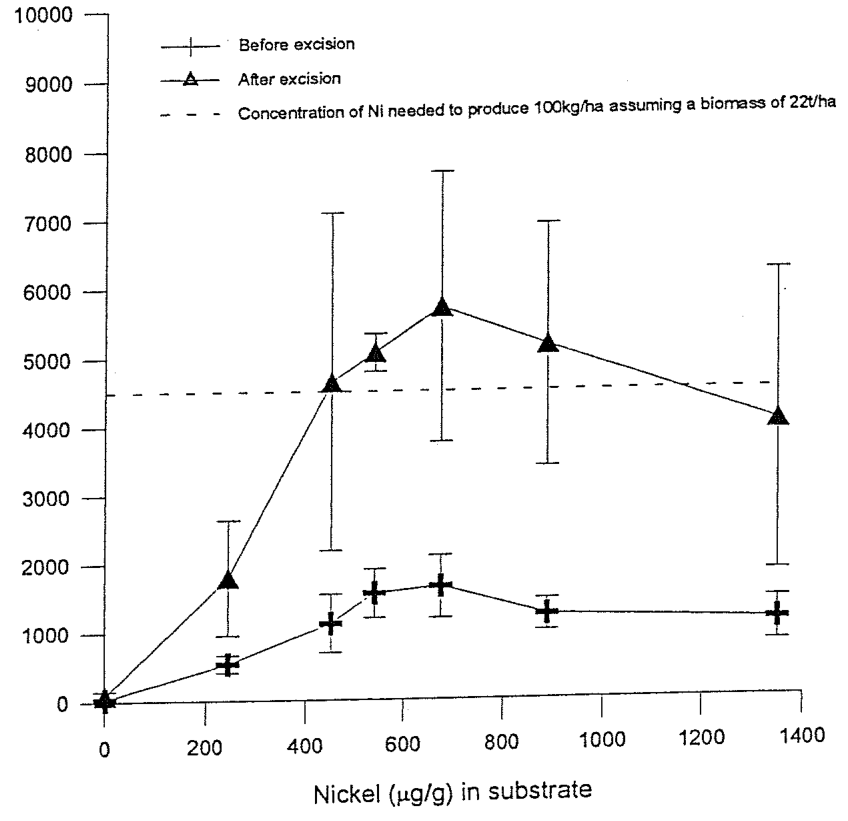
Enhanced nickel uptake after excision could be due to two factors. The plant may be removing more nickel from the soil, or it may simply be translocating existing nickel in the plant to the new growth structures. The higher nickel in the new growth would be advantageous to the plant if it inhibited its predation by folivores (Boyd and Martens, 1992). Were the plant to be extracting more nickel from the soil, it may be possible to induce increased nickel uptake by removal of the apical meristem. The new growth could be harvested as another high nickel crop a few months after the original cropping, or the plant may be cropped once a year, removing the need to resow the plants.
剪除后镍吸收增强可能由两方面因素造成:植物可能从土壤中吸收了更多的镍,也可能仅仅是将植物体内已有的镍转运至新生组织中。若新生组织中较高的镍含量能够抑制食叶动物的取食,则对植物有利(Boyd and Martens, 1992)。若植物确实从土壤中提取了更多的镍,则可通过去除顶端分生组织来诱导镍吸收的增加。新生组织可在首次收获数月后作为另一茬高镍作物收获,或者每年收割一次,从而无需重新播种。
Nickel in plants as a function of the total available nickel in the substrate
植物中镍含量与基质中总有效镍的关系
The results of experiments in which three-month-old whole plants of B.coddii were grown in standard seed mix containing incremental concentrations of available nickel (0-10,000 ug/g) are shown in Fig. 15.9.
将三月龄的B.coddii整株种植于含不同梯度有效镍浓度(0-10,000 ug/g)的标准育苗基质中,试验结果见图15.9。
The plants would not grow in substrates containing more than 3333 ug/g available nickel and the highest level of just over 10,000 ug/g nickel in the plants grown in pot trials is probably a limiting value. Although under natural conditions the plant can have up to 17,000 ug/g (1.7 %) of this element in its dry leaves, the whole plant has a nickel content around 0.8% and this is of the same order as our experimental value of 1% in pot trials.
在有效镍含量超过3333 ug/g的基质中植物无法生长,盆栽试验中植物镍含量的最高值(略高于10,000 ug/g)可能是一个极限值。虽然在自然条件下该植物干叶中该元素含量可高达17,000 ug/g(1.7 %),但整株植物的镍含量约为0.8%,这与我们盆栽试验中1%的实验值处于同一数量级。
Prediction of the probable nickel yield of Berkheya coddii grown over serpentine souls throughout the world
全球超基性(蛇纹岩)土壤上种植Berkheya coddii的可能镍产量预测
From Fig. 15.9 and analogous experiments in which the ammonium acetate worldwide, it was observed that there was a linear relationship between the nickel content of Berkheya coddii and the extractable fraction of this element in the soil. The nickel content of B. coddii growing on a nickeliferous soil can therefore be predicted by the extractable nickel as determined by use of ammonium acetate solutions. Obviously there are other factors involved in nickel uptake such as the pH of the soil, nutrient availability, and the concentration of other heavy metals, however the predictions should give a rough guide to a soil's suitability for phytomining or phytoremediation. Predictions of crop yields for nickel are shown in Table 15.5.
根据图15.9以及采用乙酸铵对全球各地土壤进行提取的类似试验,观察到Berkheya coddii的镍含量与土壤中该元素的可提取态之间存在线性关系。因此,生长在富镍土壤上的B. coddii的镍含量可通过乙酸铵溶液测定的可提取镍来预测。显然,镍吸收还涉及其他因素,如土壤pH、养分有效性以及其他重金属的浓度,但这些预测应能为评估土壤是否适合植物采矿或植物修复提供粗略参考。镍的作物产量预测见表15.5。
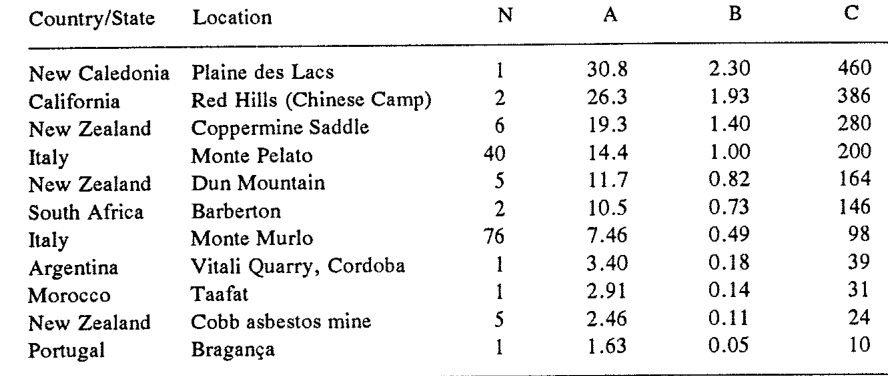
A - extractable soil nickel (ug/g), B - estimated nickel content of plant (%), C - estimated nickel yield (kg/ha).
A - 土壤可提取镍(ug/g),B - 植物镍含量估算值(%),C - 镍产量估算值(kg/ha)。
Assumptions: 1 - biomass of 22 t/ha, 2 - nickel yield of the plant, and hence its extractive power, is a function of the extractable nickel content of the soil as determined from Fig. 15.9 and other experiments.
假设条件:1 - 生物量为22 t/ha;2 - 植物的镍产量及其提取能力是土壤可提取镍含量的函数,该函数由图15.9及其他试验确定。
Phytomining by use of Berkheya coddii
利用Berkheya coddii进行植物采矿
It is possible that economic crops of nickel could be phytomined from sites (Table 15.5) with > 98 kg Ni/ha projected yields from B. coddii provided of course that other factors were favourable, not the least of which would be a sufficiently large area for economic metal farming.
在B. coddii预计镍产量 > 98 kg Ni/ha的地点(表15.5),有可能通过植物采矿获得具有经济价值的镍收成,当然前提是其他因素也较为有利,其中尤为重要的是要有足够大的面积以实现经济可行的金属农业。
The most obvious regions on earth where metal farming with Berkheya might be possible are the ultramafics of California/Oregon, Central Brazil in Goiás State, New Caledonia, Anatolia, and Western Australia. The next step in the development process would be the establishment of a pilot scheme in one of these or other suitable territories.
地球上最有可能利用Berkheya开展金属农业的地区包括美国加利福尼亚州/俄勒冈州、巴西中部戈亚斯州、新喀里多尼亚、安纳托利亚以及西澳大利亚的超基性岩区。开发进程的下一步将是在上述地区或其他适宜地区建立试点项目。
It is important to mention, however, other considerations that would need to be addressed before B. coddii were to be introduced to an area intended for phytomining (or phytoremediation). All the plants in our experiments, as well as plants growing naturally in South Africa were not under water stress. It has yet to be determined how B. coddii would tolerate xeric conditions. The plants in our outside plots in New Zealand withstood ground frosts of up to -5°C, though growth will undoubtedly suffer in very cold climates.
然而需要指出的是,在将B. coddii引入拟用于植物采矿(或植物修复)的地区之前,还有其他问题需要解决。我们试验中的所有植株以及南非自然生长的植株均未处于水分胁迫之下。B. coddii对干旱条件的耐受能力尚待确定。我们在新西兰室外样地中的植株经受住了低至-5°C的地面霜冻,但在极寒气候下其生长无疑会受到影响。
The question arises as to whether B. coddii could potentially become a weed. The rapid growth rate, and the production of large quantities of wind-borne seeds could in theory make the species invasive of surrounding areas, thus outcompeting native vegetation. Even though this plant is entirely confined to ultramafic environments in South Africa where the limiting factor may indeed be lack of competition from non-serpentine plants, it should not be assumed that there is no risk of its becoming a weed in other environments and this question should therefore be addressed in future field trials in other countries.
由此产生的问题是,B. coddii是否可能成为杂草。其快速生长速率以及大量产生借风传播的种子,理论上可能使该物种入侵周边地区,从而在竞争中胜过本土植被。尽管该植物在南非完全局限于超基性环境,其限制因素可能正是缺乏来自非蛇纹岩植物的竞争,但不应假定它在其他环境中不存在成为杂草的风险,因此今后在其他国家开展田间试验时应对这一问题加以研究。
Phytoremediation of nickel-contaminated soils by use of Berkheya coddii
利用Berkheya coddii对镍污染土壤进行植物修复
The combination of high biomass and high nickel content of Berkheya coddii, together with its ease of propagation and culture as well as its tolerance of cool climatic conditions, should render this species a suitable agent for phytoremediation. Sites highly polluted with nickel are less numerous than those contaminated with lead and zinc. There is however a need for some degree of remediation of several sites throughout the world where pollution from nickel is a problem. McGrath and Smith (1990) have reviewed the problem of nickel pollution of the environment. Apart from the obvious local pollution from smelters, a significant problem arises from addition of nickel to pastures via sewage sludges. At Beaumont Leys (UK) for example, the nickel content of surface soils at a sewage farm was found to be as high as 385 ug/g.
Berkheya coddii兼具高生物量和高镍含量,且易于繁殖和栽培,并能耐受冷凉气候条件,因此应是一种适宜的植物修复物种。受镍严重污染的场地数量少于受铅和锌污染的场地,但世界各地仍有若干受镍污染困扰的场地需要一定程度的修复。McGrath and Smith (1990)综述了环境中的镍污染问题。除冶炼厂造成的明显局部污染外,通过施用污水污泥向牧场输入镍也是一个重要问题。例如,在英国Beaumont Leys,一处污水处理农场表层土壤的镍含量高达385 ug/g。
European Community guidelines for nickel in pastures receiving sewage sludge have been set at a maximum level of 75 ug/g where background levels are around 25 ug/g for UK (McGrath and Smith, 1990). Assuming a biomass of 22 t/ha for Berkheya coddii and a soil depth of 15 cm and density of 1.3, it is possible to calculate the amount of nickel that could potentially be removed annually from contaminated pastures using a crop of this species. Using the data in Fig. 15.9, an estimate can be made for the probable nickel content of a Berkheya crop growing over polluted soils. It must be remembered, however, that the experiments portrayed in Fig. 15.9 were carried out with substrates containing nickel as the totally soluble nitrate, though a high proportion of this element would have been absorbed by complexing with the organic matter of the substrate. In applying these data to a hypothetical situation involving a contaminated soil in which the availability of the nickel might not be known in advance, we have adopted a conservative approach that assumes that only half of the metal burden of the soil would be available to the plants.
欧洲共同体对施用污水污泥的牧场中镍的限值规定为最高75 ug/g,而英国的背景值约为25 ug/g(McGrath and Smith, 1990)。假设Berkheya coddii的生物量为22 t/ha,土层深度为15 cm,土壤容重为1.3,即可计算利用该物种每年可从受污染牧场中去除的镍量。利用图15.9中的数据,可估算生长在污染土壤上的Berkheya作物的可能镍含量。但必须注意,图15.9所示试验中所用基质的镍以完全可溶的硝酸盐形式加入,尽管其中很大一部分会通过与基质有机质络合而被吸附。在将这些数据应用于镍有效性事先未知的污染土壤这一假设情形时,我们采用了保守的方法,即假定土壤中只有一半的金属负荷可被植物利用。
The number of annual crops of Berkheya coddii that would be required to reduce the nickel burden of soils down to the EU level of 75 ug/g is summarised in Table 15.6. For moderate nickel contamination (100 ug/g) two crops would be guidelines. Even at 250 ug/g (few polluted sites would exceed this value) only 4 crops of Berkheya coddii would be needed.
将土壤镍负荷降低至欧盟限值75 ug/g所需的Berkheya coddii年度收获次数汇总于表15.6。对于中度镍污染(100 ug/g),需要两茬作物即可达到该限值。即使在250 ug/g(很少有污染场地会超过此值)的情况下,也仅需4茬Berkheya coddii。
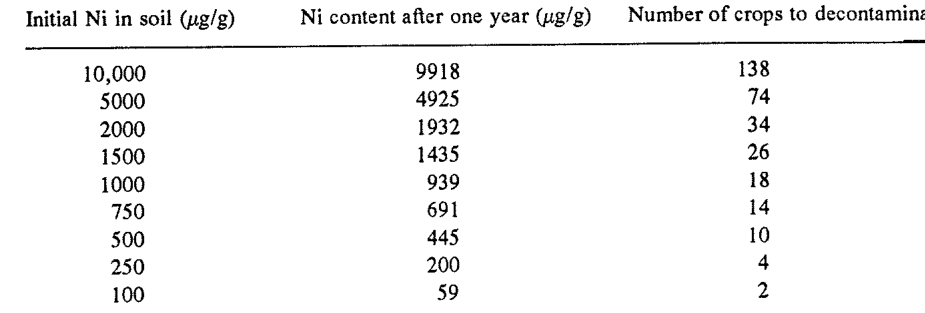
Assumptions: 1 - biomass of 22 t/ha, 2 - only half the nickel is extractable, 3 - nickel content of the plant, and hence its extractive power, is a function of the nickel content of the soil.
假设条件:1 - 生物量为22 t/ha;2 - 仅一半的镍可被提取;3 - 植物的镍含量及其提取能力是土壤镍含量的函数。
Current EU guidelines (CEC, 1986) permit an annual addition of only 3 kg/ha nickel when sewage sludge is used as fertiliser for pastures and cropping. One crop of Berkheya would remove the equivalent of 24 years of annual fertiliser additions assuming that only half of the nickel is extractable.
现行欧盟准则(CEC, 1986)规定,将污水污泥用作牧场和农作物肥料时,每年镍的输入量仅允许3 kg/ha。在假定仅一半的镍可被提取的情况下,一茬Berkheya即可去除相当于24年施肥输入的镍量。
Some Philosophical Observations on the Feasibility or Desirability of Phytomining
关于植物采矿可行性与可取性的若干哲学思考
In contemplating the possibility of phytomining in the future, a number of questions need to addressed:
在展望未来开展植物采矿的可能性时,需要回答以下几个问题:
1. In the case of phytomining for nickel, would conservationists allow a large area of serpentine soil to be colonised by commercial crops of an exotic or native hyperaccumulator?
1. 就镍的植物采矿而言,自然保护人士是否会允许大面积的蛇纹岩土壤被外来或本土超富集植物的商业作物所占据?
To answer this question, it must be appreciated that there is a difference in the acceptability of exotics compared with local hyperaccumulators. To take the example of Italy, it would be technically feasible to carry out phytomining by use of the serpentine-endemic Alyssum bertolonii. The species is endemic to serpentine soils and there would be no question of introducing an exotic species. In the worst case scenario the Alyssum would merely be replacing other serpentine-tolerant plants.
要回答这一问题,必须认识到外来超富集植物与本地超富集植物在可接受程度上存在差异。以意大利为例,利用蛇纹岩特有种Alyssum bertolonii开展植物采矿在技术上是可行的。该物种为蛇纹岩土壤特有种,因此不存在引入外来物种的问题。在最坏的情况下,Alyssum也只是取代其他耐蛇纹岩植物而已。
Nevertheless, it would be unreasonable to expect Italian conservationists to allow unrestricted use of serpentine environments for phytomining unless such use were confined to degraded land such as in the vicinity of former mines. The most likely sites where phytomining could be allowed, either in Italy or elsewhere, would be as a "green" alternative to opencast mining. If Alyssum bertolonii were to be used for phytoremediation of soils polluted by nickel as a result of industrial
然而,期望意大利的自然保护人士允许不受限制地将蛇纹岩环境用于植物采矿是不合理的,除非此类利用仅限于退化土地,如废弃矿山附近区域。无论在意大利还是其他地方,最有可能允许开展植物采矿的场地,是将其作为露天采矿的“绿色”替代方案。如果将Alyssum bertolonii用于修复因工业
activity, a very different situation would arise, a situation where the blessing of conservationists might be expected.
活动而受镍污染的土壤,情况将截然不同,届时可望获得自然保护人士的认可。
2. Would phytomining involve using land that might have been used for agriculture?
2. 植物采矿是否会占用原本可用于农业的土地?
The answer here is very clear. By their very nature, mineralised soils are extremely hostile for unadapted plant life and are almost never used for food production.
答案非常明确。就其本质而言,矿化土壤对未经适应的植物极为不利,几乎从未用于粮食生产。
3What will happen to the price of metals in the future?未来金属价格将如何变化?
This question is hard to answer. Some metals such as nickel have been constantly rising in price for the past few years, but there is no guarantee that their price will not one day collapse. Nickel is a metal whose price is relatively stable unlike metals such as tin. In any case, phytomining will be just another mining technique no more susceptible than others to fluctuating world prices.
这一问题难以回答。镍等一些金属的价格在过去几年中持续上涨,但无法保证其价格不会在某一天崩盘。与锡等金属不同,镍的价格相对稳定。无论如何,植物采矿只是另一种采矿技术,其受世界价格波动的影响不会比其他技术更大。
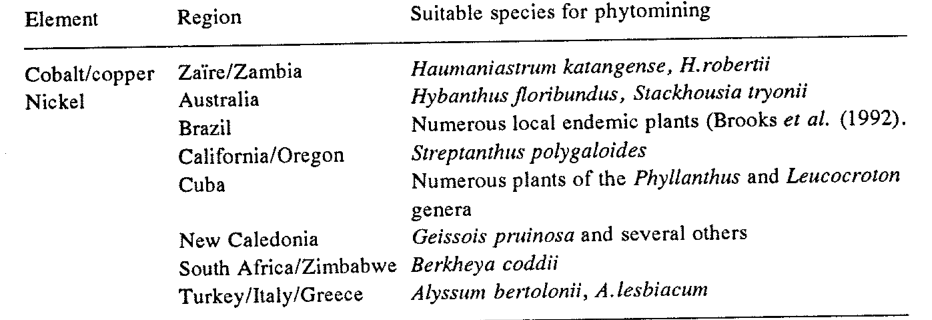
4. Where are the most likely sites where phytomining might one day be used? The technique would be most applicable in areas where there are large areas of subeconomic metal reserves. Unless some way can be found to discover plants that hyperaccumulate the noble metals, we are essentially looking at nickel and cobalt as potential targets for phytomining. Only in central Africa (Zaïre and Zambia) as well as possibly Canada and Russia are there significant areas of low-grade cobalt ores. Nickel is an entirely different matter because of the widespread occurrence of ultramafic soils throughout the world. Table 15.7 lists some areas of the world where major subeconomic deposits of nickel or cobalt are to be found and suggests potential hyperaccumulators that could be used for phytomining. Forest species are not included in the listing as they would not lend themselves to cultivation in unshaded areas.
4. 植物采矿未来最有可能在哪些地点应用?该技术最适用于拥有大面积次经济性金属储量的地区。除非能够找到超富集贵金属的植物,否则植物采矿的潜在目标基本上只有镍和钴。只有中非(扎伊尔和赞比亚)以及可能的加拿大和俄罗斯拥有大面积的低品位钴矿。镍的情况则完全不同,因为超基性土壤在全世界广泛分布。表15.7列出了世界上存在大型次经济性镍或钴矿床的部分地区,并提出了可用于植物采矿的潜在超富集植物。森林物种未列入其中,因为它们不适合在无遮荫地区栽培。
5. How hardy are hyperaccumulators and how resistant to insect attack or disease, i.e. could a crop be wiped out in a single year by such agencies? Hyperaccumulators of nickel and other elements have a strong protection against predator attack because of their high nickel content. Boyd and Martens /100911. i~d ant curarimante on nickel huneraccumulators to illustrate this bertolonii and Berkheya coddii we have not observed any tendency to disease in either plant. A. bertolonii is an exceptionally hardy plant that will withstand extremes of temperature. Our tests in New Zealand have shown that it will even grow over asbestos tailings where no other dicotyledonous plant will survive. Although Berkeya coddii grows in a warm part of South Africa, it will readily overwinter in New Zealand where ground frosts occur in winter.
5. 超富集植物的抗逆性如何?对虫害或病害的抵抗力如何?即作物是否可能在一年之内因上述因素而全部毁灭?镍及其他元素的超富集植物因其高镍含量而对捕食者的侵害具有很强的防御能力。Boyd and Martens (1991)对镍超富集植物开展了试验来说明这一点。就Alyssum bertolonii和Berkheya coddii而言,我们未观察到任何一种植物有发病倾向。A. bertolonii是一种极其耐逆的植物,能够耐受极端温度。我们在新西兰的试验表明,它甚至能在其他双子叶植物均无法存活的石棉尾矿上生长。尽管Berkeya coddii生长于南非的温暖地区,但它在冬季出现地面霜冻的新西兰也能顺利越冬。
6How environmentally acceptable would phytomining be?植物采矿在环境上的可接受程度如何?
By its very nature phytomining will be seen as "green" by many critics of the mining industry. There will be others however who will decry the suggestion of bulldozing away other native plants to make way for large crops of a phytomining plant. This question is a moral one and hopefully some solution will be found to satisfy all interested parties.
就其本质而言,许多采矿业的批评者会将植物采矿视为“绿色”技术。但也会有人谴责为大面积种植植物采矿作物而用推土机清除其他本土植物的提议。这是一个道德问题,希望能找到令各利益相关方都满意的解决方案。
7What is the potential of obtaining dual crops of two different metals?同时获得两种不同金属收成的潜力如何?
There is clearly a possibility of obtaining crops of two different elements whenever a given species of hyperaccumulator has the ability to accumulate two elements. The most obvious possibilities (see also above) are nickel and cobalt from "nickel plants" growing over ultramafic soils that usually contain around 100 ug/g cobalt. Initial experiments with EDTA chelation indicate that there might be a dramatic increase of the cobalt content of some plants after such treatment even if there is no great increase in the nickel content. The other obvious possibility is concomitant uptake of copper when growing a crop of cobalt using some of the Zaïrean dual hyperaccumulators such as Haumaniastrum katangense. The copper is far less valuable than the cobalt, but might just tip the scales to make a subeconomic crop viable.
只要某一超富集植物物种具有累积两种元素的能力,就显然有可能获得两种不同元素的收成。最明显的可能性(另见上文)是从生长在超基性土壤(通常含钴约100 ug/g)上的“镍植物”中同时获得镍和钴。EDTA螯合的初步试验表明,经此处理后,即使镍含量没有大幅增加,某些植物的钴含量也可能显著提高。另一个明显的可能性是,利用Haumaniastrum katangense等扎伊尔双元素超富集植物种植钴作物时同时吸收铜。铜的价值远低于钴,但或许恰好足以使一种原本不具经济性的作物变得可行。
A Model of a Possible Economic Phytomining System一种可能具有经济性的植物采矿系统模型
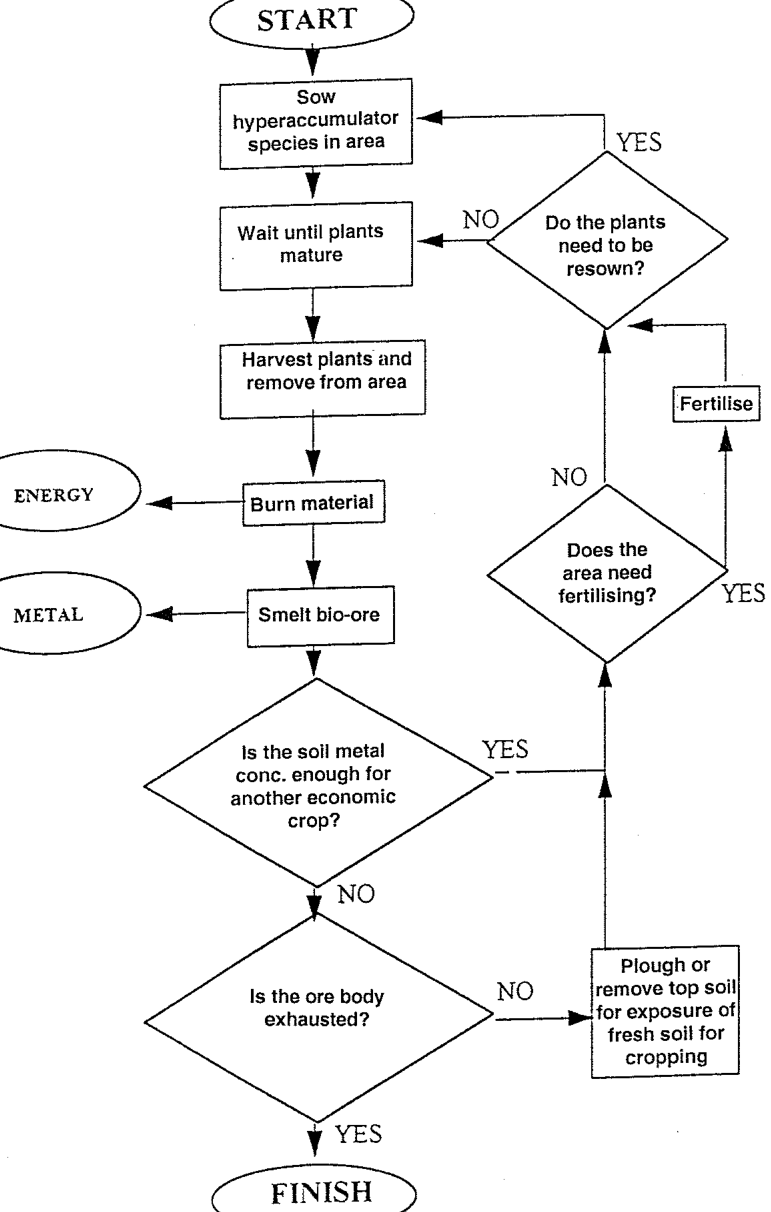
A model of a possible economic phytomining system is shown in Fig. 15.10. The system differentiates between annual and perennial crops and encompasses the questions of fertilising and soil exhaustion. Probably the success or failure of a project will depend on whether or not some of the energy of combustion of raw material can be recovered. In tropical regions of the earth, it should be possible to have crops maturing in each month of the year so that the incineration plant could be kept busy yearlong.
一种可能具有经济性的植物采矿系统模型如图15.10所示。该系统区分了一年生和多年生作物,并涵盖了施肥和土壤耗竭等问题。项目的成败很可能取决于能否回收原料燃烧所产生的部分能量。在地球的热带地区,应能做到每个月都有作物成熟,从而使焚烧厂全年保持运转。
If phytomining proceeds beyond the theoretical and pilot plant stages there are two possible scenarios that might be envisaged. The first of these presupposes a commercial project on a very large scale involving a few square kilometres of ultramafic soils or low-grade nickel mineralization.
如果植物采矿能够超越理论和中试阶段,可以设想两种可能的情景。第一种情景是在超基性土壤或低品位镍矿化区开展涉及数平方公里的超大规模商业项目。
The second scenario, perhaps the more likely, could involve phytomining being farmed out to smallholders throughout the region in which a peasant farmer might grow a few hectares of plant material and have it collected for processing at a nearby facility preferably close to a large city where industrial waste could also be used as feedstock for the incineration plant which in turn could supply steam for producing local supplies of electricity. A country such as Brazil that has large areas of sub-economic nickel mineralisation and ultramafic soils might be an obvious site of the small-farmer scenario.
第二种情景或许更有可能实现,即将植物采矿分包给整个区域内的小农户:农民可种植数公顷的植物材料,收获后运至附近的设施进行加工。该设施最好靠近大城市,以便工业废弃物也可作为焚烧厂的原料,而焚烧厂又可提供蒸汽,为当地发电。像巴西这样拥有大面积次经济性镍矿化区和超基性土壤的国家,可能是小农户情景的理想地点。
I have myself seen in Brazil (Goias State) several fields of failed soyabean crops where peasant farmers had sought to grow these crops over ultramafic soils. The surrounding natural vegetation was in contrast quite luxuriant and included several nickel hyperaccumulators (Brooks et al. 1992) that would have grown quite well as an alternative to failed soyabean crops.
我本人曾在巴西(戈亚斯州)看到过数块大豆种植失败的田地,当地农民曾试图在超基性土壤上种植大豆。与之形成对比的是,周边的天然植被相当繁茂,其中包括若干镍超富集植物(Brooks et al. 1992),这些植物本可作为失败大豆作物的替代品而生长良好。
The future of phytomining remains unknown at present, but who would have thought 20 years ago that the Brazilians could have grown their own motor fuel (alcohol) from sugar cane. To grow a crop of a metal such as nickel is only an extension of that idea. Only time will tell whether it is merely a flight of fancy or an idea whose time has come.
植物采矿的前景目前尚不明朗,但20年前谁又能想到巴西人能用甘蔗生产自己的机动车燃料(酒精)呢?种植镍等金属作物只不过是这一理念的延伸。它究竟只是一种空想,还是一个时机已经成熟的构想,唯有时间能够证明。
References参考文献
Arrigoni, P.V., Ricceri, C. and Mazzanti, A. (1983) La vegetazione serpentincola del Monte Ferrato di Prato in Toscana. Centro di Scienze Naturale Prato Cat. Quarr., Pistoia, 27 p.
Baker, A.J.M. and Brooks,R.R.(1989) Terrestrial higher plants which hyperaccumulate chemical elements - a review of their distribution, ecology and phytochemistry. Biorecovery 1, 81-126.
Blaylock, M.J.,Salt, D.E.,Dushenkov,S., Zakharova, O., Gussman, C., Kapulnik, Y., Ensley,B.D. and Raskin,I. (1997) Enhanced accumulation of Pb in Indian mustard by soil-applied chelating agents. Environmental Science and Technology 31, 860-865.
Boyd,R.S. and Martens,S.N.(1992) The raison d'être for metal hyperaccumulation by plants. In: Baker, A.J.M,Proctor,J. and Reeves, R.D. (eds), The Vegetation of Ultramafic (Serpentine) Soils. Intercept, Andover, 279-289. Brooks,R.R. and Malaisse,F. (1985) The Heavy-Metal Tolerant Flora of Southcentral Africa. Balkema, Rotterdam, 199 pp.
Brooks, R.R., Morrison, R.S.M.,Reeves, R.D., Dudley, T.R. and Akman, Y. (1979) Hyperaccumulation of nickel by Alyssum Linnaeus (Cruciferae). Proceedings of the Royal Society (London) Section B 203, 387-403.
Brooks, R.R., Reeves, R.D. and Baker, A.J.M.(1992) The serpentine vegetation of Goiás State, Brazil. In: Baker, A.J.M.,Proctor,J. and Reeves, R.D. (eds), The Vegetation of Ultramafic (Serpentine) Soils. Intercept, Andover, pp.67-81.
CEC (Commission of the European Community) Council Directive of 12 June 1986 on protection of the environment, and in particular of the soil, when sewage sludge is used in agriculture. Official Journal of the European Communities L181 (86/278/EEC), 6-12.
Checkai, R.T., Corey, R.B. and Helmke, P.A. (1987) Effects of ionic and complexed metal concentrations in plant uptake of cadmium and micronutrient metals. Plant and Soil 99, 335-345.
Chiarucci,A.,Foggi,B. and Selvi,F.(1995) Garigue plant communities of ultramafic outcrops of Tuscany, Italy. Webbia 49, 179-192.
Cunningham, S.D. and Ow,D.W.(1996) Promises and prospects of phytoremediation. Plant Physiology 110, 715-719.
Howes, A. (1991) Investigations into Nickel Hyperaccumulation in the Plant Berkheya coddii. MSc Thesis, University of Natal, Pietermaritzburg, South Africa.
Huang,J.W. and Cunningham, S.D. (1996) Lead phytoextraction: species variation in lead uptake and translocation. New Phytologist 134, 75-84.
Huang,J.W., Chen,J., Berti, W.R. and Cunningham, S.D. (1997) Phytoremediation of lead-contaminated soils: role of synthetic chelates in lead phytoextraction. Environmental Science and Technology 31, 80-805.
Jaffré, T.,Brooks, R.R.,Lee,J. and Reeves, R.D. (1976) Sebertia acuminata: a nickel-accumulating plant from New Caledonia. Science 193, 579-580.
Kumar, N.P.B.A., Dushenkov, V. Motto, H. and Raskin, I. (1995) Phytoextraction: the use of plants to remove heavy metals from soils. Environmental Science and Technology 29, 1232-1238.
McGrath,S.P.,Sidoli, C.M.D.,Baker, A.J.M. and Reeves, R.D.(1993) The potential for the use of metal-accumulating plants for the in situ decontamination of metal-polluted soils. In: Eijsackers, H.J.P. and Hamers, T. (eds), Integrated Soil and Sediment Research: a Basis for Proper Protection. Kluwer Academic Publishers, Dordrecht, pp.673-676.
McGrath,S.P. and Smith,S. (1990) Chromium and nickel. In: Alloway, B.J. (ed.). Heavy Metals in Soils. Blackie, Glasgow, 125-150.
Marten, G.C. and Hammond,P.B.(1966) Lead uptake by bromegrass from contaminated soils. Agronomy Journal 58, 553-555.
Minguzzi, C. and Vergnano, O.(1948) Il contenuto di nichel nelle ceneri di Alyssum bertolonii. Atti della Società Toscana di Scienze Naturale 55: 49-74.
Morrey, D.R.,Balkwill,K. and Balkwill, M.-J. (1989) Studies on serpentine flora: preliminary analyses of soils and vegetation associated with serpentinite rock formations in the south-eastern Transvaal. South African Journal of Botany 55, 171-177.
Morrey, D.R.,Balkwill,K.,Balkwill, M.-J. and Williamson, S. (1992) A review of some studies of the serpentine flora of South Africa. In: Baker, A.J.M., Proctor, J. and Reeves, R.D. (eds), The Vegetation of Ultramafic (Serpentine) Soils. Intercept, Andover, pp. 147-157.
Nicks, L. and Chambers, M.F. (1995) Farming for metals. Mining Environmental Management. Mgt. September 15-18.
Norvell, W.A.(1972) Equilibria of metal chelates in soil solution. In: Mortvedt, J.J., Cox, F.R.,Shuman, L.M. and Welch, R.M. (eds), Micronutrients in Agriculture. American Society of Agronomy, Madison, pp. 115-138.
Ortiz,D.F.,Ruscitti, T.,McCue,K. and Ow,D.W.(1995) Transport of metalbinding peptides by HMT1, a fission yeast ABC-type vacuolar membrane protein. Journal of Biological Chemistry 270, 4721-4728.
Ow, D.W. (1993) Phytochelatin-mediated cadmium tolerance in Schizosaccharomyces pombe. In Vitro Cell Development Biology 29P, 213-219. Robinson, B.H.,Brooks, R.R.,Howes, A.W.,Kirkman,J.H. and Gregg,P.E.H.
coddii for phytoremediation and phytomining. Journal of Geochemical Exploration (in press).
Robinson, B.H., Brooks, R.R.,Kirkman, J.H.,Gregg, P.E.H. and Gremigni,P. (1996) Plant-available elements in soils and their influence on the vegetation over ultramafic (serpentine) rocks in New Zealand. Journal of the Royal Society of New Zealand 26, 455-466.
Robinson, B.H., Chiarucci, A., Brooks, R.R.,Petit, D.,Kirkman, J.H., Gregg, P.E.H., and De Dominicis, V.(1997) The nickel hyperaccumulator plant Alyssum bertolonii as a potential agent for phytoremediation and phytomining of nickel. Journal of Geochemical Exploration 59, 75-86.
Sadiq,M. and Hussain,G. (1993) Effect of chelate fertilizers on metal concentrations and growth of corn in a pot experiment. Journal of Plant Nutrition 16, 699-711.
Salt, D.E., Blaylock, M.,Kumar, N.P.B.A., Dushenkov, V.,Ensley, B., Chet, I. and Raskin, I. (1995) Phytoremediation: a novel strategy for the removal of toxic metals from the environment using plants. Bio/Technology, 13, 468-474.
Varennes, A.de, Torres, M.O., Coutinho,J.F.,Rocha, M.M.F.S. and Neto, M.M.P.M. (1996) Effects of heavy metals on growth and mineral composition of a nickel hyperaccumulator. Journal of Plant Nutrition 19, 669-678.
Vergnano Gambi, O. (1992) The distribution and ecology of the vegetation of ultramafic soils in Italy. In: Roberts, B.A. and Proctor,J. (eds), The Ecology of Areas with Serpentinized Rocks; a World View. Kluwer Academic Publishers, Dordrecht, pp.217-247.
Wallace, A.,Rommey, E.M.,Alexander, G.V.,Soufi,S.M. and Patel,P.M. (1977) Some interactions in plants among cadmium and other heavy metals and chelating agents. Agronomy Journal 69, 18-20.