Contents lists available at ScienceDirect journal homepage: www.elsevier.com/locate/scitotenv
Review
Brett H. Robinson ⁎
Department of Soil and Physical Sciences, Lincoln University, Lincoln 7647, Canterbury, New Zealand
a r t i c l e i n f o
| ConteConte | nts | ||
|---|---|---|---|
| 1. | Intro | duction . . . . . . . . . . . . . . . . . . . . . . . . . . . . . . . . . . . . . . . . . . . . . . . . . | . . . . . . . . . . . . . 184 |
| 2. | The | current and future global production of E-waste . . . . . . . . . . . . . . . . . . . . . . . . . . . . . . | . . . . . . . . . . . . . 184 |
| 2.1. | An estimation of global E-waste production . . . . . . . . . . . . . . . . . . . . . . . . . . . . . . | . . . . . . . . . . . . . 184 | |
| 2.2. | Future trends in E-waste production . . . . . . . . . . . . . . . . . . . . . . . . . . . . . . . . . . | . . . . . . . . . . . . . 185 | |
| 3. | Pote | ntial environmental contaminants associated with E-waste . . . . . . . . . . . . . . . . . . . . . . . . | . . . . . . . . . . . . . 185 |
| 3.1. | Unusual contaminants in E-waste . . . . . . . . . . . . . . . . . . . . . . . . . . . . . . . . . . . | . . . . . . . . . . . . . 186 | |
| 3.2. | Changing nature of E-waste . . . . . . . . . . . . . . . . . . . . . . . . . . . . . . . . . . . . . . | . . . . . . . . . . . . . 186 | |
| 4. | The l | flux of these contaminants on a global scale: the fate of E-waste . . . . . . . . . . . . . . . . . . . . . . | . . . . . . . . . . . . . 187 |
| 5. | Disp | osal and recycling of E-waste and associated environmental contamination . . . . . . . . . . . . . . . . . | . . . . . . . . . . . . . 187 |
| 5.1. | Recycling . . . . . . . . . . . . . . . . . . . . . . . . . . . . . . . . . . . . . . . . . . . . . . . | . . . . . . . . . . . . . 187 | |
| 6. | Envir | onments contaminated by E-waste . . . . . . . . . . . . . . . . . . . . . . . . . . . . . . . . . . . . | . . . . . . . . . . . . . 187 |
| 6.1. | Case study: Guiyu and some other E-waste recycling centres . . . . . . . . . . . . . . . . . . . . . . | . . . . . . . . . . . . . 187 | |
| 6.2. | Waters and aquatic systems . . . . . . . . . . . . . . . . . . . . . . . . . . . . . . . . . . . . . . | . . . . . . . . . . . . . 188 | |
| 6.3. | Air . . . . . . . . . . . . . . . . . . . . . . . . . . . . . . . . . . . . . . . . . . . . . . . . . . | . . . . . . . . . . . . . 188 | |
| 6.4. | Soils and terrestrial environments . . . . . . . . . . . . . . . . . . . . . . . . . . . . . . . . . . . | . . . . . . . . . . . . . 188 | |
| 6.5. | Humans . . . . . . . . . . . . . . . . . . . . . . . . . . . . . . . . . . . . . . . . . . . . . . . | . . . . . . . . . . . . . 188 | |
| 7. | The r | e-exportation of contaminants associated with E-waste: the other hidden flow . . . . . . . . . . . . . . . | . . . . . . . . . . . . . 189 |
⁎ Tel.: +64 3 3218471.
E-mail address: brett.robinson@lincoln.ac.nz.
0048-9697/$ – see front matter © 2009 Elsevier B.V. All rights reserved. doi:10.1016/j.scitotenv.2009.09.044 8. Conclusions . . . . . . . . . . . . . . . . . . . . . . . . . . . . . . . . . . . . . . . . . . . . . . . . . . . . . . . . . . . . . . 189 Acknowledgements . . . . . . . . . . . . . . . . . . . . . . . . . . . . . . . . . . . . . . . . . . . . . . . . . . . . . . . . . . . . . 189 References . . . . . . . . . . . . . . . . . . . . . . . . . . . . . . . . . . . . . . . . . . . . . . . . . . . . . . . . . . . . . . . . . 189
0048-9697/$ – see front matter © 2009 Elsevier B.V. All rights reserved. doi:10.1016/j.scitotenv.2009.09.044 8. 结论 . . . . . . . . . . . . . . . . . . . . . . . . . . . . . . . . . . . . . . . . . . . . . . . . . . . . . . . . . . . . . . 189 致谢 . . . . . . . . . . . . . . . . . . . . . . . . . . . . . . . . . . . . . . . . . . . . . . . . . . . . . . . . . . . . . 189 参考文献 . . . . . . . . . . . . . . . . . . . . . . . . . . . . . . . . . . . . . . . . . . . . . . . . . . . . . . . . . . . . . . . . . 189
1Introduction引言
E-waste and Waste Electrical and Electronic Equipment (WEEE) describe discarded appliances that use electricity. E-waste describes waste electronic goods, such as computers, televisions and cell phones, while WEEE also includes traditionally non-electronic goods such as refrigerators and ovens. Table 1 lists some common WEEE items.
电子垃圾(E-waste)和废弃电器电子设备(WEEE)均指使用电力的废弃器具。电子垃圾指废弃的电子产品,如计算机、电视机和手机;而WEEE还包括冰箱和烤箱等传统上不属于电子产品的物品。表1列出了一些常见的WEEE物品。
The distinction between E-waste and WEEE is becoming less sharp due to the advent of pervasive computing (Kohler and Erdmann, 2004), where programmable microprocessors are incorporated into electrical equipment, such as refrigerators, which are not normally considered electronic items (Hilty, 2005). However, it is the rapid growth of computing that is driving E-waste production. In the next five years, one billion computers will be retired (Ladou and Lovegrove, 2008).
随着普适计算的出现(Kohler and Erdmann, 2004),可编程微处理器被集成到冰箱等通常不被视为电子产品的电气设备中(Hilty, 2005),电子垃圾与WEEE之间的界限正变得日益模糊。然而,推动电子垃圾产生的主要是计算机的快速增长。未来五年内,将有10亿台计算机被淘汰(Ladou and Lovegrove, 2008)。
E-Waste is chemically and physically distinct from other forms of municipal or industrial waste; it contains both valuable and hazardous materials that require special handling and recycling methods to avoid environmental contamination and detrimental effects on human health. Recycling can recover reusable components and base materials, especially Cu and precious metals. However, due to lack of facilities, high labour costs, and tough environmental regulations, rich countries tend not to recycle E-waste. Instead, it is either landfilled, or exported from rich countries to poor countries, where it may be recycled using primitive techniques and little regard for worker safety of environmental protection (Cobbing, 2008). Although illegal under the Basel Convention of 1992 (UNEP, 2009), E-waste exportation continues through clandestine operations, legal loopholes, and by countries that have not ratified the convention.
电子垃圾在化学和物理性质上均不同于其他形式的城市垃圾或工业废物;它既含有有价值的材料,也含有有害物质,需要采用专门的处理和回收方法,以避免环境污染及对人体健康的不利影响。回收可以回收可再利用的部件和基础材料,尤其是Cu和贵金属。然而,由于缺乏设施、劳动力成本高以及环境法规严格,富裕国家往往不回收电子垃圾,而是将其填埋,或从富裕国家出口至贫穷国家;在这些国家,电子垃圾可能采用原始技术进行回收,几乎不顾及工人安全或环境保护(Cobbing, 2008)。尽管根据1992年《巴塞尔公约》(UNEP, 2009),此类出口属于违法行为,但通过秘密运作、法律漏洞以及未批准该公约的国家,电子垃圾出口仍在继续。
The environmental effects of E-waste disposal are drawing increasing attention from politicians, Non Governmental Organisations (NGOs) such as Greenpeace (www.greenpeace.org), the Basel Action Network (www.ban.org), the Silicon Valley Toxics Coalition (www.svtc.org), as well as the scientific community. As of June 2006, there were more than 500 scientific articles dealing with E-waste and its environmental effects.
电子垃圾处置的环境影响日益受到政界人士、非政府组织(NGO)如绿色和平组织(www.greenpeace.org)、巴塞尔行动网络(www.ban.org)、硅谷毒物联盟(www.svtc.org)以及科学界的关注。截至2006年6月,涉及电子垃圾及其环境影响的科学论文已超过500篇。
This review aims to assess the global production of E-waste, the contaminants and contaminant fluxes associated with E-waste, and the likely environmental impact of E-waste associated contaminants. This paper focuses on the physical, chemical and environmental effects of E-waste, rather than E-waste associated politics, which are discussed extensively in publications from the aforementioned NGOs.
本综述旨在评估全球电子垃圾的产生量、与电子垃圾相关的污染物及其通量,以及电子垃圾相关污染物可能造成的环境影响。本文侧重于电子垃圾的物理、化学和环境效应,而非与电子垃圾相关的政治问题,后者已在上述非政府组织的出版物中有广泛讨论。
2The current and future global production of E-waste全球电子垃圾的当前及未来产生量
In 2006, the world's production of E-waste was estimated at 20–50 million tonnes per year (UNEP, 2006), representing 1–3% of the global municipal waste production of 1636 million tonnes per year (OECD, 2008). Cobbing (2008) calculated that computers, mobile telephones and television sets would contribute 5.5 million tonnes to the E-waste stream in 2010, rising to 9.8 million tonnes in 2015. In rich countries, E-waste may constitute some 8% by volume of municipal waste (Widmer et al., 2005).
2006年,全球电子垃圾产生量估计为每年2000万~5000万吨(UNEP, 2006),占全球城市垃圾年产生量16.36亿吨的1%~3%(OECD, 2008)。Cobbing(2008)计算得出,计算机、移动电话和电视机在2010年将为电子垃圾流贡献550万吨,2015年将增至980万吨。在富裕国家,电子垃圾可能占城市垃圾体积的约8%(Widmer et al., 2005)。
The contribution of an item to the annual E-waste production, E (kg/year) depends on the mass of the item, M (kg), the number of units in service, N, and its average lifespan, L (years) [1].
某一物品对年电子垃圾产生量E(kg/year)的贡献取决于该物品的质量M(kg)、在用数量N及其平均使用寿命L(years)[1]。
MN E = (1) L
List of common Waste Electrical and Electronic Equipment (WEEE) items, including those normally considered as E-waste.
常见废弃电器电子设备(WEEE)物品清单,包括通常被视为电子垃圾的物品。
| Item物品 | Wt of Item (kg)物品重量(kg) | Typical life (year)典型使用寿命(年) |
|---|---|---|
| WEEE normally considered E-waste | ||
| Computera | 25 | 3 |
| Facsimile machine | 3 | 5 |
| High-fidelity systemb | 10 | 10 |
| Mobile telephoneb | 0.1 | 2 |
| Electronic gamesb | 3 | 5 |
| Photocopier | 60 | 8 |
| Radiob | 2 | 10 |
| Televisionc | 30 | 5 |
| Video recorder and DVD playerb | 5 | 5 |
| WEEE not normally considered E-waste | ||
| Air conditioning unit | 55 | 12 |
| Dish washerb | 50 | 10 |
| Electric cookerb | 60 | 10 |
| Electric heatersb | 5 | 20 |
| Food mixerb | 1 | 5 |
| Freezerb | 35 | 10 |
| Hair dryerb | 1 | 10 |
| Ironb | 1 | 10 |
| Kettleb | 1 | 3 |
| Microwaveb | 15 | 7 |
| Refrigeratorb | 35 | 10 |
| Telephoneb | 1 | 5 |
| Toasterb | 1 | 5 |
| Tumble dryerb | 35 | 10 |
| Vacuum cleanerb | 10 | 10 |
| Washing machineb | 65 | 8 |
a (Betts, 2008a). b (Cobbing, 2008). c (Li et al., 2009).
a (Betts, 2008a)。b (Cobbing, 2008)。c (Li et al., 2009)。
Computers, which have an average lifespan of three years (Betts, 2008a), comprise a greater proportion of WEEE than refrigerators and ovens, which have lifespans of 10–12 years. Table 1 provides a list of some WEEE items along with their mass and expected lifetimes.
计算机的平均使用寿命为三年(Betts, 2008a),其在WEEE中所占比例高于使用寿命为10~12年的冰箱和烤箱。表1列出了部分WEEE物品及其质量和预期使用寿命。
2.1. An estimation of global E-waste production2.1. 全球电子垃圾产生量的估算
Calculating global E-waste production requires information on the number of items in service. These data are generally available in rich countries so E-waste production can be calculated using Eq. (1). Switzerland produces 9 kg per person per year (Sinha-Khetriwal et al., 2005). Europeans produce E-waste at a rate of 14 kg per person per year (Goosey, 2004), making a total annual E-waste production for the 15-member-state European Union (EU-15) of 5.5 million tonnes per year, and the EU-27 of 8.3–9.1 million tonnes per year (Huisman and Magalini, 2007). The United States produced some 2.63 million tonnes in 2005 (Cobbing, 2008), while China produced 2.5 million tonnes (Liu et al., 2006). E-waste production data for poorer countries are less readily available. India and Thailand are estimated to have, respectively, produced just 0.33 and 0.1 million tonnes of E-waste in 2007 (Cobbing, 2008).
计算全球电子垃圾产生量需要掌握在用物品数量的信息。富裕国家通常具备这些数据,因此可利用式(1)计算电子垃圾产生量。瑞士人均每年产生9 kg电子垃圾(Sinha-Khetriwal et al., 2005)。欧洲人均每年产生电子垃圾14 kg(Goosey, 2004),由此欧盟15个成员国(EU-15)的电子垃圾年总产生量为550万吨,欧盟27国(EU-27)为830万~910万吨(Huisman and Magalini, 2007)。美国2005年产生约263万吨(Cobbing, 2008),中国产生250万吨(Liu et al., 2006)。较贫穷国家的电子垃圾产生量数据较难获得。据估计,印度和泰国2007年的电子垃圾产生量分别仅为33万吨和10万吨(Cobbing, 2008)。
Summing the available data indicates that the global production of E-waste was at least 13.9 million tonnes per year in the middle of this decade. This figure does not include Latin America, Africa, Canada or Russia and does not account for the growth in the last four years.
对现有数据进行加总表明,本十年中期全球电子垃圾产生量至少为每年1390万吨。该数字未包括拉丁美洲、非洲、加拿大和俄罗斯,也未计入过去四年的增长。
An independent estimation was obtained using Eq. (1) using data from Table 1 and data for the total number of computers (0.78 bn [2004]), mobile telephones (3.4 bn [2007]), fixed-line telephones (1.2 bn [2005]), televisions (1.4 bn [2003]), and radios (2.5 bn [2003]) (Nationmaster, 2009). The total E-waste production, 11.7 million tonnes per year, is similar to the above calculation of the E-waste produced in rich countries. Again, the total global E-waste production will be considerably higher because some of the data are six years old. Similarly, the mass of WEEE produced will be higher because it includes heavy electrical items, such as refrigerators and air conditioning units.
利用表1中的数据以及计算机(7.8亿台[2004])、移动电话(34亿部[2007])、固定电话(12亿部[2005])、电视机(14亿台[2003])和收音机(25亿台[2003])的总数数据(Nationmaster, 2009),通过式(1)进行了独立估算。所得电子垃圾年总产生量为1170万吨,与上文对富裕国家电子垃圾产生量的计算结果相近。同样,由于部分数据已有六年之久,全球电子垃圾实际总产生量将显著更高。类似地,WEEE的产生量会更高,因为其包括冰箱和空调等大型电器。
Adjusting the calculated figure of 13.9 million tonnes per year for the 20% growth in the World's Gross Domestic Product (GDP) over the last five years, gives 16.8 million tonnes. Given that computers form the bulk of E-waste and that most E-waste is produced in rich countries (Cobbing, 2008), it is probable that the actual global E-waste production is 20–25 million tonnes per year, at the lower end of the United Nations Environment Programme's (UNEP's) estimation of 20– 50 million tonnes per year (UNEP, 2006).
按照过去五年全球国内生产总值(GDP)20%的增长对计算所得的每年1390万吨进行调整,得到1680万吨。鉴于计算机构成电子垃圾的主体,且大部分电子垃圾产生于富裕国家(Cobbing, 2008),全球电子垃圾的实际产生量很可能为每年2000万~2500万吨,处于联合国环境规划署(UNEP)估计值每年2000万~5000万吨的下限(UNEP, 2006)。
2.2. Future trends in E-waste production2.2. 电子垃圾产生量的未来趋势
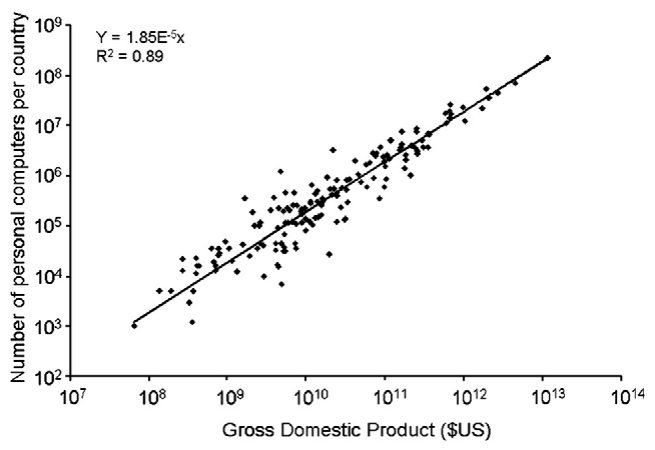
The global production of E-waste will change as economies grow and new technologies are developed. For any given country, the total number of computers and other potential E-waste items is strongly correlated with the country's GDP, because electrical and electronic items are essential for the functioning of all but the most primitive economies. Fig. 1 shows the total number of computers per country as a function of that country's GDP. Fig. 1 supports the supposition that economic growth will result in more E-waste production. However, assessing the effect of economic growth on the total E-waste production from Fig. 1 is difficult because there is considerable scatter and no weighting according to the country's population. A better measure of the distribution of computers, and by implication E-waste production, is their distribution amongst the Earth's population as a function of wealth (Fig. 2), defined here as GDP per person weighted for Purchasing Power Parity (PPP). Fig. 2 shows that there is an exponential relationship between wealth and number of computers and that the richest billion people have 75% of all computers. Fig. 2 indicates that the number of computers per 100 people, and hence the total number of computers, will increase faster in richer countries than in poor countries for any given increase in GDP. This is in agreement with the predictions of Hischier et al. (2005), who reported that the annual growth of E-waste in Europe is increasing at a rate of 3–5%, compared to an average (2005–2008) increase in GDP of 2.6%. If the number of computers is indicative of total E-waste production, then Eastern Europe, Latin America and China will become major E-waste producers in the next 10 years.
随着经济增长和新技术的发展,全球电子垃圾产生量将发生变化。对任一国家而言,计算机及其他潜在电子垃圾物品的总数与该国GDP密切相关,因为除最原始的经济体外,电气和电子产品对所有经济体的运行都必不可少。图1显示了各国计算机总数与该国GDP的关系。图1支持了经济增长将导致更多电子垃圾产生的假设。然而,由于数据离散程度较大且未按国家人口加权,难以根据图1评估经济增长对电子垃圾总产生量的影响。衡量计算机分布(并由此推及电子垃圾产生量)的更好指标,是其在全球人口中随财富水平的分布(图2),此处财富定义为经购买力平价(PPP)加权的人均GDP。图2表明,财富与计算机数量之间呈指数关系,最富有的10亿人拥有全部计算机的75%。图2表明,在GDP增幅相同的情况下,富裕国家每百人计算机拥有量(进而计算机总数)的增长速度将快于贫穷国家。这与Hischier et al.(2005)的预测一致,他们报道欧洲电子垃圾年增长率为3%~5%,而同期(2005—2008年)GDP平均增长率为2.6%。如果计算机数量能够指示电子垃圾总产生量,那么东欧、拉丁美洲和中国将在未来10年内成为主要的电子垃圾产生地区。
Changes in technology will also affect the global mass of E-waste produced. Short innovation cycles of hardware have led to a high turnover of devices. The lifespan of central processing units in computers dropped from 4–6 years in 1997 to 2 years in 2005 (Babu et al., 2007).
技术变革也将影响全球电子垃圾的产生量。硬件的创新周期短,导致设备更新换代频繁。计算机中央处理器的使用寿命从1997年的4~6年缩短至2005年的2年(Babu et al., 2007)。
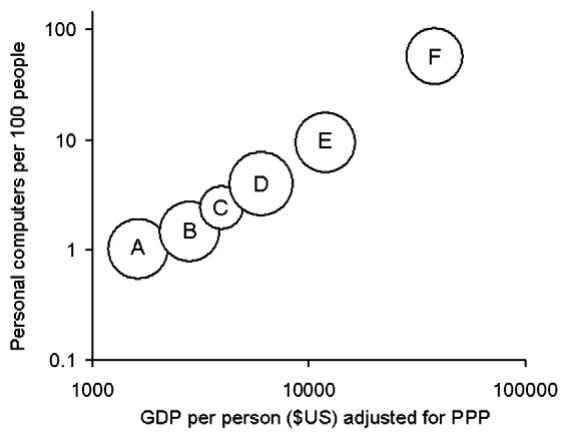
| Population (bn)人口(十亿) | Dominant geographic regions主要地理区域 | |
|---|---|---|
| A | 1.30 | Sub-Saharan Africa, Bangladesh, Pakistan |
| B | 1.17 | India |
| C | 0.66 | South East Asia |
| D | 1.33 | China |
| E | 0.98 | Eastern Europe, Latin America |
| F | 1.27 | Western Europe, United States, Australasia |
The average mass of 25 kg for a personal computer (Table 1) is indicative of a desktop computer with a Cathode Ray Tube (CRT) monitor, which represents most of thepast andpresent computers in the E-waste stream. However, the advent of Liquid Crystal Displays (LCD) will reduce the average weight of a desktop. More significantly, the increasing prevalence of laptop and netbook computers (Micklethwait, 2009a), which weigh just 1–3 kg, will significantly reduce the average mass of a discarded computer. In the case of netbooks, computing power and associated potential E-waste production has been shifted from the end user to remote computing “clouds”, supported by warehouses of shared machines, which may be located in another country (Micklethwait, 2009b). There is a lacuna of information on E-waste generation from these computing warehouses. E-waste growth from increasing wealth and shorter innovation cycles may be offset by miniaturisation and outsourcing of computing power.
个人计算机平均质量为25 kg(表1),这代表配有阴极射线管(CRT)显示器的台式计算机,而此类计算机构成了过去及当前电子垃圾流中的大部分计算机。然而,液晶显示器(LCD)的出现将降低台式计算机的平均重量。更为重要的是,重量仅1~3 kg的笔记本电脑和上网本日益普及(Micklethwait, 2009a),将显著降低废弃计算机的平均质量。就上网本而言,计算能力及相应的潜在电子垃圾产生已从终端用户转移至远程计算“云”,后者由可能位于其他国家的共享机器仓库提供支撑(Micklethwait, 2009b)。关于这些计算仓库产生电子垃圾的信息目前尚属空白。财富增长和创新周期缩短所带来的电子垃圾增长,可能会被计算能力的小型化和外包所抵消。
3Potential environmental contaminants associated with E-waste与电子垃圾相关的潜在环境污染物
The chemical composition of E-waste varies depending on the age and type of the discarded item. However, most E-waste is composed of a mixture of metals, particularly Cu, Al, and Fe, attached to, covered with, or mixed with various types of plastics and ceramics (Hoffmann, 1992). A discarded personal computer with a CRT monitor typically weighs 25 kg and consists of metal (43.7%), plastics (23.3%), electronic components (17.3%) and glass (15%) (Berkhout and Hertin, 2004). Heavy WEEE items, such as washing machines and refrigerators, which are mostly composed of steel, may contain fewer potential environmental contaminants than lighter E-waste items, such as laptop computers, which may contain high concentrations of flame retardants and heavy metals.
电子垃圾的化学组成因废弃物品的年代和类型而异。然而,大多数电子垃圾由金属(尤其是Cu、Al和Fe)的混合物构成,这些金属附着于、覆盖有或混杂于各类塑料和陶瓷中(Hoffmann, 1992)。一台配有CRT显示器的废弃个人计算机通常重25 kg,由金属(43.7%)、塑料(23.3%)、电子元件(17.3%)和玻璃(15%)组成(Berkhout and Hertin, 2004)。洗衣机和冰箱等大型WEEE物品主要由钢材构成,其所含潜在环境污染物可能少于笔记本电脑等较轻的电子垃圾物品,后者可能含有高浓度的阻燃剂和重金属。
Virtually all E-waste contains some valuable components or base materials, especially Cu. These are environmentally important, because they provide an incentive for recycling, which occurs predominantly in poor countries, and may result in a human health risk or environmental pollution. Platinum group metals are included in electrical contact materials due to their high chemical stability and conductance of electricity. The precious metal concentrations in printed circuit boards is more than tenfold higher than commerciallymined minerals (Betts, 2008a).
几乎所有电子垃圾都含有一些有价值的部件或基础材料,尤其是Cu。这些物质在环境方面具有重要意义,因为它们为回收提供了动力,而回收主要在贫穷国家进行,并可能导致人体健康风险或环境污染。铂族金属因其化学稳定性高、导电性好而被用于电接触材料。印刷电路板中贵金属的浓度比商业开采矿石高出十倍以上(Betts, 2008a)。
Table 2 lists the potential environmental contaminants associated with E-waste. Some contaminants, such as heavy metals, are used in the manufacture of electronic goods, while others, such as polycyclic aromatic hydrocarbons (PAHs) are generated by the low-temperature combustion of E-waste. The burning of insulated wire, which typically occurs in open iron barrels, generates 100 times more dioxins than burning domestic waste (Gullett et al., 2007).表2列出了与电子垃圾相关的潜在环境污染物。其中一些污染物(如重金属)用于电子产品的制造,而另一些(如多环芳烃,PAHs)则产生于电子垃圾的低温燃烧。焚烧绝缘电线(通常在露天铁桶中进行)所产生的二噁英是焚烧生活垃圾的100倍(Gullett et al., 2007)。
The concentrations of environmental contaminants found in E-waste depend on the type of item that is discarded and the time when that item was produced. E-waste composition is spatially and temporally heterogeneous. Table 2 gives the concentrations of some components in Swiss E-waste (Morf et al., 2007). Concentrations of Cd, Cu, Ni, Pb and Zn are such that were these elements released into the environment they would pose a risk to ecosystems and human health (Wilmoth et al., 1991). Using the estimation that 20 million tonnes of E-waste are produced annually, combined with the data of Morf et al. (2007), the amounts of some potential contaminants that are contained in the annual E-waste stream have been calculated (Table 2). Although recycling may remove some contaminants, large amounts may still end up concentrated in landfills or E-waste recycling centres, where they may adversely affect human health or the environment. Some 820,000 t of Cu are included in the annual flow of E-waste. Despite recycling, it would seem E-waste is a major contributor to the some 5000 t of Cu emitted into the environment annually (Bertram et al., 2002).
电子垃圾中环境污染物的浓度取决于废弃物品的类型及其生产时间。电子垃圾的组成在空间和时间上均具有异质性。表2给出了瑞士电子垃圾中部分组分的浓度(Morf et al., 2007)。Cd、Cu、Ni、Pb和Zn的浓度之高,一旦这些元素释放到环境中,将对生态系统和人体健康构成风险(Wilmoth et al., 1991)。以每年产生2000万吨电子垃圾的估计值,结合Morf et al.(2007)的数据,计算了年电子垃圾流中所含部分潜在污染物的数量(表2)。尽管回收可以去除部分污染物,但仍可能有大量污染物最终富集于填埋场或电子垃圾回收中心,从而可能对人体健康或环境产生不利影响。年电子垃圾流中含有约820,000 t Cu。尽管存在回收,电子垃圾似乎仍是每年约5000 t Cu排放到环境中的主要来源之一(Bertram et al., 2002)。
Polybrominated diphenyl ethers (PBDEs) are flame retardants that are mixed into plastics and components. There are no chemical bonds between the PBDEs and the plastics and therefore they may leach from the surface of E-waste components into the environment (Deng et al., 2007). PBDEs are lipophilic, resulting in their bioaccumulation in organisms and biomagnification in food chains (Deng et al., 2007). PBDEs have endocrine disrupting properties (Tseng et al., 2008).
多溴二苯醚(PBDEs)是一类混入塑料和部件中的阻燃剂。PBDEs与塑料之间不存在化学键,因此可能从电子垃圾部件表面淋溶进入环境(Deng et al., 2007)。PBDEs具有亲脂性,导致其在生物体内生物积累并在食物链中生物放大(Deng et al., 2007)。PBDEs具有内分泌干扰特性(Tseng et al., 2008)。
Obsolete refrigerators, freezers and air conditioning units contain ozone-depleting Chlorofluorocarbons (CFCs). These gases may escape from items disposed in landfills (Scheutz et al., 2004).
废旧冰箱、冷冻柜和空调设备含有消耗臭氧层的氯氟烃(CFCs)。这些气体可能从填埋处置的物品中逸出(Scheutz et al., 2004)。
3.1. Unusual contaminants in E-waste3.1. 电子垃圾中的特殊污染物
E-waste may contain complex mixtures of potential environmental contaminants that are distinct from other forms of waste. Some potential contaminants in E-waste are uncommon, even in other contaminated sites. Consequently, there has been little work on their environmental effects. Examples include Li (batteries), Be (contact material), Sb (flame retardant) (Ernst et al., 2003), and Ga and In (used in Si chips and LCD monitors) (Ladou and Lovegrove, 2008).
电子垃圾可能含有有别于其他形式废物的潜在环境污染物复杂混合物。电子垃圾中的一些潜在污染物即使在其他污染场地中也不常见,因此有关其环境效应的研究很少。例如Li(电池)、Be(接触材料)、Sb(阻燃剂)(Ernst et al., 2003)以及Ga和In(用于Si芯片和LCD显示器)(Ladou and Lovegrove, 2008)。
3.2. Changing nature of E-waste3.2. 电子垃圾性质的变化
E-waste composition is changing with technological development and pressure on manufacturers from regulators and NGOs. The replacement of CRT monitors with LCD displays will reduce the concentration of Pb in E-waste, as each CRT tube contains some 2 kg Pb (Puckett et al., 2005). However, LCD displays contain Hg (Mester et al., 2005), In, Sn and Zn (Li et al., 2009). Similarly, fibre optics, which may replace some Cu wires (Berkhout and Hertin, 2004), can contain F, Pb, Y and Zr (Kogo et al., 1995). Rechargeable battery composition has also changed dramatically, from old Ni–Cd, to Ni metal hydrides, to Li ion batteries.
随着技术发展以及监管机构和非政府组织对制造商施加的压力,电子垃圾的组成正在发生变化。由于每个CRT显像管含有约2 kg Pb(Puckett et al., 2005),以LCD显示器取代CRT显示器将降低电子垃圾中Pb的浓度。然而,LCD显示器含有Hg(Mester et al., 2005)、In、Sn和Zn(Li et al., 2009)。同样,可能取代部分Cu导线的光纤(Berkhout and Hertin, 2004)可含有F、Pb、Y和Zr(Kogo et al., 1995)。可充电电池的组成也发生了巨大变化,从早期的Ni–Cd电池到镍氢电池,再到锂离子电池。
NGOs have placed pressure on manufacturers to reduce or eliminate the content of potential environmental contaminants in their products. Manufacturers are competing to be seen as “green” and want to remove as many toxic chemicals from products as possible (Betts, 2008b). Many producers of electronic and electrical goods have responded to pressure from NGOs and the public and are investigating innovative ways to enhance safe disposal and recycling. For example, radio frequency identification tags cost 10–20 cents and provide information about the condition and composition of computer systems and other electronics products (Betts, 2008a). Such tags can alert waste managers and recyclers to valuable components and potential environmental contaminants contained within the end-oflife product (Binder et al., 2008).
非政府组织已向制造商施压,要求其减少或消除产品中潜在环境污染物的含量。制造商竞相树立“绿色”形象,希望尽可能从产品中去除有毒化学物质(Betts, 2008b)。许多电子电气产品生产商已对来自非政府组织和公众的压力作出回应,正在探索提高安全处置和回收水平的创新途径。例如,射频识别标签的成本为10~20美分,可提供计算机系统及其他电子产品的状况和组成信息(Betts, 2008a)。此类标签可提醒废物管理者和回收商注意报废产品中所含的有价值部件和潜在环境污染物(Binder et al., 2008)。
Potential environmental contaminants arising from E-waste disposal or recycling.
电子垃圾处置或回收过程中产生的潜在环境污染物。
| Contaminant污染物 | Relationship with E-waste与电子垃圾的关系 | Typical E-waste concentration (mg/kg)a电子垃圾中典型 浓度(mg/kg)a | Annual global emission in E-waste (tons)b电子垃圾中全球年排放量 (吨)b |
|---|---|---|---|
| Polybrominated diphenyl ethers (PBDEs) polybrominated biphenyls (PBBs) tetrabromobisphenol-A (TBBPA) | Flame retardants | ||
| Polychlorinated biphenyls (PCB) | Condensers, transformers | 14 | 280 |
| Chlorofluorocarbon (CFC) | Cooling units, insulation foam | ||
| Polycyclic aromatic hydrocarbons (PAHs) | Product of combustion | ||
| Polyhalogenated aromatic hydrocarbons (PHAHs) | Product of low-temperature combustion | ||
| Polychlronated dibenzo-p-dioxins (PCDDs), polychlorinated dibenzofurans (PCDFs) | Product of low-temperature combustion of PVCs and other plastics | ||
| Americium (Am) | Smoke detectors | ||
| Antimony | Flame retardants, plastics (Ernst et al., (2003)) | 1700 | 34,000 |
| Arsenic (As) | Doping material for Si | ||
| Barium (Ba) | Getters in cathode ray tubes (CRTs) | ||
| Beryllium (Be) | Silicon-controlled rectifiers | ||
| Cadmium (Cd) | Batteries, toners, plastics | 180 | 3600 |
Chromium (Cr) | Data tapes and floppy disks | 9900 | 198,000 |
| Copper (Cu) | Wiring | 41,000 | 820,000 |
| Gallium (Ga) | Semiconductors | ||
| Indium (In) | LCD displays | ||
| Lead (Pb) | Solder (Kang and Schoenung, (2005)), CRTs, batteries | 2900 | 58,000 |
| Lithium (Li) | Batteries | ||
| Mercury (Hg) | Fluorescent lamps, batteries, switches | 0.68 | 13.6 |
| Nickel (Ni) | Batteries | 10,300 | 206,000 |
| Selenium (Se) | Rectifiers | ||
| Silver (Ag) | i Wiring, switches | ||
| Tin (Sn) | Solder (Kang and Schoenung, (2005)), LCD screens | 2400 | 48,000 |
| Zinc (Zn) | 5100 | 102,000 | |
| Rare earth elements | CRT screens |
Adapted from (e-waste, 2009). a (Morf et al., 2007). b Assuming a global e-waste production of 20 million tonnes per year.
改编自(e-waste, 2009)。a (Morf et al., 2007)。b 假设全球电子垃圾产生量为每年2000万吨。
Producing halogen-free components would reduce polychlorinated biphenyls (PCBs) and dioxin loadings in E-waste; however, their production is more environmentally costly (Bergendahl et al., 2004). Brominated flame retardants can be replaced with more environmentally friendly phosphorus-based retardants (Dietz et al., 2004) such as aminophenyl phosphate (Mauerer, 2005). Lead-free solder could significantly reduce the environmental burden of this toxic heavy metal (Bradley, 2003); this may be enshrined in law (Herat, 2008) in many countries. In 2003, the European Union enacted the Restriction on Hazardous Substances Directive (RoHS), limiting the concentrations in homogeneous electronic materials of Pb, Hg, Cr (IV), polybrominated biphenyls (PBBs) and PBDEs to 1000 mg/kg, and Cd to 100 mg/kg (LaDou, 2006). RoHS was met with some resistance by manufacturers due to compliance costs and technical problems, such as the use of low-Pb solders that are prone to “tin whisker” growth (Puttlitz and Galyon, 2007).
生产无卤部件可降低电子垃圾中多氯联苯(PCBs)和二噁英的负荷,但其生产的环境代价更高(Bergendahl et al., 2004)。溴化阻燃剂可以用更为环境友好的磷系阻燃剂替代(Dietz et al., 2004),如磷酸氨基苯酯(Mauerer, 2005)。无铅焊料可显著减轻这种有毒重金属的环境负担(Bradley, 2003);许多国家可能会将其写入法律(Herat, 2008)。2003年,欧盟颁布了《关于限制在电子电气设备中使用某些有害物质的指令》(RoHS),将均质电子材料中Pb、Hg、Cr(IV)、多溴联苯(PBBs)和PBDEs的浓度限制在1000 mg/kg,Cd限制在100 mg/kg(LaDou, 2006)。由于合规成本和技术问题(如使用易产生“锡须”生长的低Pb焊料),RoHS遭到了制造商的一定抵制(Puttlitz and Galyon, 2007)。
4The flux of these contaminants on a global scale: the fate of E-waste这些污染物在全球尺度上的通量:电子垃圾的去向
Most E-waste is not recycled, because E-waste items tend to go out with household waste and receive no special treatment (Ladou and Lovegrove, 2008). Of that which is collected, some 80% is exported to poor countries (Schmidt, 2006).
大多数电子垃圾未被回收,因为电子垃圾物品往往随生活垃圾一同丢弃,未经任何特殊处理(Ladou and Lovegrove, 2008)。在被收集的电子垃圾中,约80%出口至贫穷国家(Schmidt, 2006)。
Electronic equipment that is no longer of use to the original purchaser may be reused, effectively extending its lifespan. Reuse is ultimately the source of some E-waste in many poor countries (Puckett et al., 2005) that accept donations of equipment considered obsolete in rich countries. Old yet functional electronic equipment is often shipped to developing countries by well-meaning donors in the West. Unscrupulous organisations in rich countries use donations of obsolete electronic equipment as a loop-hole in the Basel Convention to export both functioning and non-functioning electronic equipment (Ladou and Lovegrove, 2008). Brokers who arrange the export of functioning products often pad shipping containers with irreparable waste, which may account for up to 75% of deliveries. Most of this ends up in landfills and informal dumps (Schmidt, 2006).
对原购买者不再有用的电子设备可以被再利用,从而有效延长其使用寿命。在许多接受富裕国家视为过时设备捐赠的贫穷国家,再利用最终成为部分电子垃圾的来源(Puckett et al., 2005)。西方善意的捐赠者常将陈旧但仍可使用的电子设备运往发展中国家。富裕国家一些不法组织则利用捐赠过时电子设备作为《巴塞尔公约》的漏洞,出口可用和不可用的电子设备(Ladou and Lovegrove, 2008)。安排出口可用产品的中间商常在集装箱中塞入无法修复的废物,其比例可高达交付量的75%。其中大部分最终进入填埋场和非正规垃圾场(Schmidt, 2006)。
China receives some 70% of all exported E-waste (Liu et al., 2006), while significant quantities are also exported to India, Pakistan, Vietnam, the Philippines, Malaysia, Nigeria and Ghana (Puckett et al., 2005), and possibly to Brazil and Mexico. Due to the semi-clandestine nature of these operations, the actual mass of E-waste being exported is impossible to quantify. Some 500 shipping containers filled with electronic items pass through Lagos each month (Schmidt, 2006). NGOs such as Greenpeace campaign against this “hidden flow” of E-waste (Cobbing, 2008).
中国接收了全部出口电子垃圾的约70%(Liu et al., 2006),另有大量电子垃圾出口至印度、巴基斯坦、越南、菲律宾、马来西亚、尼日利亚和加纳(Puckett et al., 2005),可能还出口至巴西和墨西哥。由于这些活动具有半隐蔽性质,出口电子垃圾的实际数量无法量化。每月约有500个装满电子产品的集装箱经过拉各斯(Schmidt, 2006)。绿色和平组织等非政府组织开展运动,反对电子垃圾的这种“隐性流动”(Cobbing, 2008)。
5Disposal and recycling of E-waste and associated environmental contamination电子垃圾的处置与回收及相关环境污染
Most E-waste is currently landfilled (Barba-Gutierrez et al., 2008). Using the Toxicity Characteristic Leaching Procedure (TCLP) (USEPA, 2000), Spalvins et al. (2008) concluded that E-waste disposal in modern-municipal solid waste landfills is unlikely to result in lead leachate concentrations of regulatory concern. However, Dagan et al. (2007) demonstrated that the chemical cocktail that leached from a variety of consumer electronics using TCLP was toxic to aquatic organisms. Incineration prior to landfilling may increase the mobility of heavy metals, particularly Pb (Gullett et al., 2007). On average the plastic fraction of E-waste has Sn, Pb, Ni, Zn and Sb concentrations >1000 mg/kg as well as >100 mg/kg Cd (Morf et al., 2007). While contained in a plastic matrix, these elements do not leach and are not bioavailable. However, combustion or dissolution will liberate these elements. As with other materials, leaching of many heavy metals such as Pb from E-waste is increased at low pH and in the presence of organic ligands (Jang and Townsend, 2003).
目前大多数电子垃圾被填埋处置(Barba-Gutierrez et al., 2008)。Spalvins et al.(2008)采用毒性特征浸出程序(TCLP)(USEPA, 2000)得出结论:在现代城市固体废物填埋场中处置电子垃圾,不太可能导致渗滤液中铅浓度达到需监管关注的水平。然而,Dagan et al.(2007)证明,采用TCLP从多种消费电子产品中浸出的化学混合物对水生生物具有毒性。填埋前焚烧可能提高重金属(尤其是Pb)的迁移性(Gullett et al., 2007)。电子垃圾塑料组分中Sn、Pb、Ni、Zn和Sb的平均浓度>1000 mg/kg,Cd浓度>100 mg/kg(Morf et al., 2007)。这些元素在被塑料基质包裹时不会淋溶,也不具有生物有效性。然而,燃烧或溶解会使这些元素释放出来。与其他材料一样,低pH条件和有机配体的存在会增强电子垃圾中Pb等许多重金属的淋溶(Jang and Townsend, 2003)。
Most studies investigating leaching from landfilled E-waste have investigated just a few key contaminants, especially Pb. However, there is a lacuna of information on the behaviour of oxyanion forming contaminants such as Sb, which can occur at concentrations >1000 mg/kg in some E-waste components (Morf et al., 2007). Antimonate (Sb(OH)6−) has been shown to be more mobile and more toxic in soil than Pb, and is more soluble at higher pH values and readily taken up by plants (Tschan et al., 2009).
大多数关于填埋电子垃圾淋溶的研究仅考察了少数关键污染物,尤其是Pb。然而,关于Sb等形成含氧阴离子的污染物的行为,目前信息仍属空白,而在某些电子垃圾部件中Sb的浓度可>1000 mg/kg(Morf et al., 2007)。研究表明,锑酸根(Sb(OH)6−)在土壤中比Pb更易迁移、毒性更强,在较高pH值下溶解度更大,且易被植物吸收(Tschan et al., 2009)。
Niu and Li (2007) showed that compaction of E-waste, prior or during landfilling, can increase leaching through the disruption of circuit board components. The same authors showed that cement solidification, which imparts impact resistance, raises pH and reduces water flux through the waste, reduced Pb leaching from E-waste to below regulatory levels.
Niu and Li(2007)表明,在填埋前或填埋过程中压实电子垃圾,会破坏电路板部件,从而增加淋溶。上述作者还表明,水泥固化可赋予抗冲击性、提高pH并减少穿过废物的水通量,使电子垃圾的Pb淋溶量降至监管限值以下。
5.1. Recycling5.1. 回收
E-waste recycling involves the disassembly and destruction of the equipment to recover new materials (Cui and Zhang, 2008). Recycling can recover 95% of the useful materials from a computer and 45% of materials from cathode ray tube monitors (Ladou and Lovegrove, 2008). In rich countries, such as Japan, high tech recycling operations function well with little environmental impact (Aizawa et al., 2008). Modern techniques can recover high-Pb glass from discarded CRT with minimal environmental impact (Andreola et al., 2007). Any ecological benefits of recycling are more than offset if the waste has to be transported long distances due to the negative environmental effects of fossil fuel combustion (Barba-Gutierrez et al., 2008). However, recycling always has a lower ecological impact than landfilling of incinerated E-waste (Hischier et al., 2005).
电子垃圾回收包括拆解和破碎设备以回收新材料(Cui and Zhang, 2008)。回收可以从计算机中回收95%的有用材料,从阴极射线管显示器中回收45%的材料(Ladou and Lovegrove, 2008)。在日本等富裕国家,高技术回收作业运行良好,对环境影响很小(Aizawa et al., 2008)。现代技术能够以最小的环境影响从废弃CRT中回收高铅玻璃(Andreola et al., 2007)。如果废物需要长距离运输,由于化石燃料燃烧的负面环境效应,回收的任何生态效益都会被完全抵消(Barba-Gutierrez et al., 2008)。然而,回收的生态影响始终低于焚烧后电子垃圾的填埋(Hischier et al., 2005)。
Mechanical separation of components is the first step in E-waste recycling. Components may be separated for reuse or metallurgical processing (He et al., 2006). This process can be automated or carried out by hand. In poor countries, there is a risk that children may be employed to separate E-waste components (Ladou and Lovegrove, 2008). An open flame is often used to free components (Manomaivibool, 2009), which may result in exposure to volatilised contaminants.
部件的机械分离是电子垃圾回收的第一步。部件经分离后可用于再利用或冶金处理(He et al., 2006)。该过程可自动化进行,也可人工完成。在贫穷国家,存在雇用儿童分离电子垃圾部件的风险(Ladou and Lovegrove, 2008)。人们常用明火拆取部件(Manomaivibool, 2009),这可能导致暴露于挥发性污染物。
Valuable metals may be recovered from E-waste by pyro- hydro- and bio-metallurgical processes (Cui and Zhang, 2008). Pyrometallurgical processing includes incineration of the matrix and smelting of the target metals. The efficacy of this process depends on investment. Shoddy operations have the potential to emit dangerous compounds into the environment. Copper is a catalyst for dioxin formation when flame retardants are incinerated, in particular the low-temperature incineration of brominated flame retardants (Cui and Zhang, 2008). Hydrometallurgical processes involve the dissolution and recovery of the target metals with acids, cyanide, halides, thiourea or thiosulphate.
有价金属可通过火法冶金、湿法冶金和生物冶金工艺从电子垃圾中回收(Cui and Zhang, 2008)。火法冶金处理包括基质的焚烧和目标金属的熔炼。该工艺的效果取决于投资。粗劣的作业有可能向环境中排放危险化合物。在焚烧阻燃剂时,特别是低温焚烧溴化阻燃剂时,铜是二噁英形成的催化剂(Cui and Zhang, 2008)。湿法冶金工艺是利用酸、氰化物、卤化物、硫脲或硫代硫酸盐溶解并回收目标金属。
Presently limited to rich countries, bio-metallurgical processing is attractive due to its low-cost and high specificity for the target elements (Cui and Zhang, 2008). Brandl et al. (2001) showed how Thiobacilus bacteria and fungi (Aspergillus niger, Penicillium simplicissimum) could facilitate metal leaching from electronic scrap. Creamer et al. (2006) employed Desulfovibrio desulfuricans to recover Au, Pt and Cu from E-waste.
生物冶金处理目前仅限于富裕国家,因其成本低且对目标元素具有高度专一性而颇具吸引力(Cui and Zhang, 2008)。Brandl et al.(2001)展示了Thiobacilus细菌和真菌(Aspergillus niger、Penicillium simplicissimum)如何促进电子废料中金属的浸出。Creamer et al.(2006)利用Desulfovibrio desulfuricans从电子垃圾中回收Au、Pt和Cu。
6Environments contaminated by E-waste受电子垃圾污染的环境
6.1. Case study: Guiyu and some other E-waste recycling centres6.1. 案例研究:贵屿及其他一些电子垃圾回收中心
The city of Guiyu with its surrounding towns in the Guangdong region of China is the largest E-waste recycling site in the world.
位于中国广东地区的贵屿镇及其周边城镇是世界上最大的电子垃圾回收地。
Recycling has been occurring since 1995 (Wong et al., 2007). Guiyu has a population of 150,000, most of which are immigrants. Nearly 80% of families have members who have engaged in E-waste recycling operations (Li et al., 2008a). Wind carries particulate matter from Guiyu to the Pearl River Delta Region, which has a population of some 45 million people (Deng et al., 2007). Villagers and migrant workers use environmentally unsound techniques to recycle E-waste. These include the heating and manual removal of components from printed circuit boards, open burning to reduce volumes and recover metals, and open acid digestion of E-waste to recover precious metals. The waste-acid, rich in heavy metals, is then discarded onto the soil or into waterways. Solder is melted from printed circuit boards over makeshift coal grills. Portable household fans are the only precautionary measures taken to reduce worker exposure to toxic solder fumes (Leung et al., 2008). Workers toil without goggles, masks or gloves (Li et al., 2008a). These crude recycling techniques have resulted in widespread environmental contamination with some of the components listed in Table 2.
当地自1995年起开始从事回收活动(Wong et al., 2007)。贵屿人口为150,000人,其中大部分为外来移民。近80%的家庭有成员从事电子垃圾回收作业(Li et al., 2008a)。风将颗粒物从贵屿带至人口约4500万的珠江三角洲地区(Deng et al., 2007)。村民和外来务工人员采用不利于环境的技术回收电子垃圾,包括加热并手工从印刷电路板上拆卸元件、露天焚烧以减少体积并回收金属,以及露天酸溶电子垃圾以回收贵金属。富含重金属的废酸随后被倾倒在土壤上或排入水体。焊料在简易的燃煤烤架上从印刷电路板上熔化下来。家用便携式风扇是减少工人暴露于有毒焊料烟雾的唯一防护措施(Leung et al., 2008)。工人在没有护目镜、口罩或手套的情况下劳作(Li et al., 2008a)。这些粗放的回收技术已造成表2所列部分组分的大范围环境污染。
6.2. Waters and aquatic systems6.2. 水体与水生系统
E-waste contaminants can enter aquatic systems via leaching from dumpsites where processed or unprocessed E-waste may have been deposited. Similarly, the disposal of acid following hydrometallurgical processes into waters or onto soils, as well as the dissolution or settling of airborne contaminants, can also result in the contamination of aquatic systems. Luo et al. (2007b) reported that carp from the Nanyang river, near Guiyu, were bioaccumulating PBDEs to concentrations of up to 766 ng/g (fresh weight). Unsurprisingly, the same authors (Luo et al., 2007a) reported elevated PBDE concentrations in the sediments (up to 16,000 ng/g) of the same river. In an aquatic ecosystem near an E-waste recycling plant, Wu et al. (2008) reported that the water snake, the top predator, had on average 16,512 ng/g PCBs and 1091 ng/g PBDEs on a wet weight basis. Mud carp, crucian carp and prawns from the same area also had elevated concentrations of these contaminants. The ambient water contained just 204 ng/L PCBs. Waterfowl from downstream areas in the Pearl River Delta also contained elevated PCB and PBDEs (Luo et al., 2009a). Brominated flame retardants other than PBDE, namely 1,2-bis(2,4,6-tribromophenoxy)ethane, decabromodiphenyl ethane and tetrabromobisphenol A bis (2,3-dibromopropyl) ether, are widespread in various biota of the Pearl River Delta, downstream from E-waste recycling towns (Shi et al., 2009).
电子垃圾污染物可经由堆放过已处理或未处理电子垃圾的垃圾场的淋溶进入水生系统。同样,湿法冶金工艺后将废酸排入水体或倾倒于土壤,以及空气中污染物的溶解或沉降,也会导致水生系统受到污染。Luo et al.(2007b)报道,贵屿附近南阳河中的鲤鱼对PBDEs的生物积累浓度高达766 ng/g(鲜重)。不出所料,同一作者(Luo et al., 2007a)报道该河沉积物中PBDE浓度也较高(最高达16,000 ng/g)。Wu et al.(2008)报道,在某电子垃圾回收厂附近的水生生态系统中,作为顶级捕食者的水蛇体内PCBs和PBDEs的平均含量(以湿重计)分别为16,512 ng/g和1091 ng/g。同一区域的鲮鱼、鲫鱼和虾体内这些污染物的浓度也较高,而环境水体中PCBs浓度仅为204 ng/L。珠江三角洲下游地区的水禽体内PCB和PBDEs含量同样较高(Luo et al., 2009a)。除PBDE以外的溴化阻燃剂,即1,2-双(2,4,6-三溴苯氧基)乙烷、十溴二苯乙烷和四溴双酚A双(2,3-二溴丙基)醚,广泛存在于电子垃圾回收城镇下游珠江三角洲的各类生物体中(Shi et al., 2009)。
Wang and Guo (2006) found up to 0.4 mg/L Pb in river water downstream of a recycling plant in Guiyu, some 8 times higher than the local drinking water standard (0.05 mg/L). Similarly, Wong et al. (2007) reported elevated concentrations of Ag, Cr, Li, Mo, Sb and Se in the nearby Lianjiang river.
Wang and Guo(2006)在贵屿一回收厂下游河水中检出高达0.4 mg/L的Pb,约为当地饮用水标准(0.05 mg/L)的8倍。同样,Wong et al.(2007)报道附近练江中Ag、Cr、Li、Mo、Sb和Se的浓度升高。
6.3. Air6.3. 大气
Many E-waste contaminants are spread into the air via dust. This is a major exposure pathway for humans through ingestion, inhalation and skin absorption (Mielke and Reagan, 1998). Air samples taken near Guiyu contained polychlorodibenzo-p-dioxins between 65 and 2765 pg/m3, the highest level of atmospheric dioxins ever reported (Li et al., 2007).
许多电子垃圾污染物通过粉尘扩散到空气中。这是人体经摄入、吸入和皮肤吸收的主要暴露途径(Mielke and Reagan, 1998)。在贵屿附近采集的空气样品中,多氯代二苯并对二噁英含量为65~2765 pg/m3,是迄今报道的最高大气二噁英水平(Li et al., 2007)。
Combustion of E-waste containing flame retardants has resulted in concentrations of total PBDEs of up to 16,575 pg/m3 in aerial samples near Guiyu, some 300 times higher than in nearby Hong Kong (Deng et al., 2007). Aerial contamination of PBDEs in the city of Guiyu exceeds 11,000 pg/m3 during the daytime, dropping to under 5000 pg/m3 at night (Chen et al., 2009a). Similarly, high aerial concentrations of particulate PAHs, Cr, Cu and Zn have also been reported (Deng et al., 2006). Leung et al. (2008) reported concentrations of over 2% Pb and several thousand mg/kg Cu and Zn in dust the roads in Guiyu. Dust collected from E-waste recycling workshops had Pb, Cu and Zn concentrations some fivefold higher than road dust. Ha et al. (2009) showed that E-waste workers in Bangalore breathe dustladen air containing Cd, In, Sn, Sb, Pb and Bi at concentrations of 1.5, 1.3, 91, 13, 89 and 1.0 ng/m3 respectively.
含阻燃剂电子垃圾的燃烧导致贵屿附近空气样品中总PBDEs浓度高达16,575 pg/m3,约为附近香港的300倍(Deng et al., 2007)。贵屿市区大气中PBDEs污染白天超过11,000 pg/m3,夜间降至5000 pg/m3以下(Chen et al., 2009a)。同样,也有报道指出大气中颗粒态PAHs、Cr、Cu和Zn的浓度较高(Deng et al., 2006)。Leung et al.(2008)报道,贵屿道路粉尘中Pb浓度超过2%,Cu和Zn浓度达数千mg/kg。从电子垃圾回收作坊收集的粉尘中Pb、Cu和Zn浓度约为道路粉尘的五倍。Ha et al.(2009)表明,班加罗尔的电子垃圾工人呼吸的含尘空气中Cd、In、Sn、Sb、Pb和Bi的浓度分别为1.5、1.3、91、13、89和1.0 ng/m3。
6.4. Soils and terrestrial environments6.4. 土壤与陆地环境
Soils from a site where acid leaching was used to recover valuable metals, contained up to 4250 ng/g PBDEs (Leung et al., 2007). There are elevated concentrations of PCBs, PAHs (Shen et al., 2009a) and PBDEs (Cai and Jiang, 2006) in Chinese agricultural soils proximal to E-waste reprocessing sites. Luo et al. (2009b) reported PBDE concentrations of 191 to 9156 ng/g (dry weight) in farmland soils 2 km from an E-waste recycling workshop. Soils from this region also contain polychlronated dibenzo-p-dioxins and dibenzofurans (PCDD/Fs), PCBs and PAHs at concentrations up to 100, 330 and 20,000 ng/g, respectively (Shen et al., 2009b).
在一处采用酸浸回收有价金属的场地,土壤中PBDEs含量高达4250 ng/g(Leung et al., 2007)。中国电子垃圾再处理场地附近的农业土壤中PCBs、PAHs(Shen et al., 2009a)和PBDEs(Cai and Jiang, 2006)浓度升高。Luo et al.(2009b)报道,距某电子垃圾回收作坊2 km处的农田土壤中PBDE浓度为191~9156 ng/g(干重)。该地区土壤中还含有多氯代二苯并对二噁英和二苯并呋喃(PCDD/Fs)、PCBs和PAHs,浓度分别高达100、330和20,000 ng/g(Shen et al., 2009b)。
Liu et al. (2008) reported elevated concentrations of PBDEs and PCBs in soils, plants and snails from the town of Guiyu and the surrounding areas. PBDEs are translocated from soils to plants. Leaves of bracken fern (Pteridium aquilinum L.), spider fern (Pteris multifida Poir.), sorghum (Sorghum bicolour L.), Japanese dock (Rumex japonicus Houtt.) and Eastern daisy fleabane (Erigeron annuus L.) contained PBDEs at concentrations of 144, 116, 162, 278 and 326 ng/g (dry matter), respectively, when growing in soil containing 25,479 ng/g PBDE (Yang et al., 2008). Although the bioaccumulation coefficients are small (<0.01) plant uptake may facilitate the entry of these contaminants into food chains.
Liu et al.(2008)报道,贵屿镇及周边地区的土壤、植物和蜗牛中PBDEs和PCBs浓度升高。PBDEs可从土壤转运至植物。在PBDE含量为25,479 ng/g的土壤中生长时,欧洲蕨(Pteridium aquilinum L.)、井栏边草(Pteris multifida Poir.)、高粱(Sorghum bicolour L.)、羊蹄(Rumex japonicus Houtt.)和一年蓬(Erigeron annuus L.)叶片中的PBDEs浓度分别为144、116、162、278和326 ng/g(干物质)(Yang et al., 2008)。尽管生物积累系数较小(<0.01),植物吸收仍可能促使这些污染物进入食物链。
Soils at an E-waste recycling slum in Bangalore contained up to 39 mg/kg Cd, 4.6 mg/kg In, 957 mg/kg Sn, 180 mg/kg Sb 49 mg/kg Hg, 2850 mg/kg Pb, and 2.7 mg/kg Bi (Ha et al., 2009). These concentrations are some one-hundredfold higher than those found at a nearby control site in the same city.
班加罗尔一个电子垃圾回收贫民窟的土壤中含有高达39 mg/kg Cd、4.6 mg/kg In、957 mg/kg Sn、180 mg/kg Sb、49 mg/kg Hg、2850 mg/kg Pb和2.7 mg/kg Bi(Ha et al., 2009)。这些浓度约为同一城市附近对照点的一百倍。
Analysis of rice samples from another E-waste processing town in Eastern China, Taizhou (Zhejiang province) revealed concentrations of Pb and Cd in polished rice to be 2–4 times in excess of 0.2 mg/kg, the maximum allowable concentrations of these elements in foodstuffs in China (Fu et al., 2008). In the same town, Liang et al. (2008) measured elevated levels (up to 18 ng/g) of PBDEs in chicken tissues and concluded that these toxins may pose a threat to humans and ecosystems. Rice paddy soils adjacent to E-waste recycling areas in the Zhejiang province were shown to reduce the germination rate of rice (Zhang and Min, 2009). A micronuclei assay using Vicia fabia indicated that the contaminants in these soils also promote DNA damage.
对中国东部另一个电子垃圾处理城镇台州(浙江省)的稻米样品分析显示,精米中Pb和Cd的浓度超出中国食品中这些元素最大允许浓度0.2 mg/kg的2~4倍(Fu et al., 2008)。在同一城镇,Liang et al.(2008)测得鸡组织中PBDEs含量升高(最高18 ng/g),并得出结论:这些毒物可能对人类和生态系统构成威胁。研究表明,浙江省电子垃圾回收区附近的稻田土壤会降低水稻发芽率(Zhang and Min, 2009)。利用Vicia fabia进行的微核试验表明,这些土壤中的污染物还会促进DNA损伤。
6.5. Humans6.5. 人体
Aerial contamination with dioxins at Guiyu has resulted in levels of human exposure some 15–56 times the WHO recommended maximum intake (Chatterjee, 2007). Elevated levels of dioxins were found in human milk, placentas and hair, indicating that dioxins are being taken up by humans, from the air, water, or foodstuffs, at sufficient levels to pose a serious health risk (Chan et al., 2007).
贵屿的大气二噁英污染已导致人体暴露水平达到WHO推荐最大摄入量的15~56倍(Chatterjee, 2007)。在人乳、胎盘和头发中发现了较高水平的二噁英,表明人体正从空气、水或食物中摄取二噁英,其水平足以构成严重的健康风险(Chan et al., 2007)。
The transfer of E-waste derived PCBs to ground and surfacewaters, agricultural soils, rice, eggs, fish and ultimately humans has been demonstrated (Zhao et al., 2006). E-waste workers and other residents from Guiyu had median blood serum BPDE concentrations of 126 ng/L and 35 ng/L, respectively, compared to referents from a nearby town who had just 10 ng/L (Qu et al., 2007). Samples of human hair from towns near Taizhou contained PBBs, PBDEs and PCBs at concentrations up to 58 ng/g, 30 ng/g and 182 ng/g, respectively (Zhao et al., 2008).
已有研究证实,源自电子垃圾的PCBs可转移至地下水和地表水、农业土壤、稻米、鸡蛋、鱼类,并最终进入人体(Zhao et al., 2006)。贵屿电子垃圾工人和其他居民的血清BPDE浓度中位数分别为126 ng/L和35 ng/L,而附近城镇对照人群仅为10 ng/L(Qu et al., 2007)。台州附近城镇的人发样品中PBBs、PBDEs和PCBs的浓度分别高达58 ng/g、30 ng/g和182 ng/g(Zhao et al., 2008)。
Children in Guiyu had significantly higher blood Pb (Huo et al., 2007; Li et al., 2008b) and Cd (Zheng et al., 2008) levels and lower cognitive abilities than children from a nearby control town (Li et al., 2008b). Similarly, lactating residents of Guiyu had elevated concentrations of PCBs in their breast milk (Xing et al., 2009). This could not be attributed to a single exposure pathway, since people are exposed PCBs through many enriched foodstuffs, drinking water sources and occasional air contamination.
与附近对照镇的儿童相比,贵屿儿童的血铅(Huo et al., 2007; Li et al., 2008b)和血镉(Zheng et al., 2008)水平显著更高,认知能力更低(Li et al., 2008b)。同样,贵屿哺乳期居民母乳中PCBs浓度升高(Xing et al., 2009)。这无法归因于单一暴露途径,因为人们通过多种富集污染物的食物、饮用水源以及间歇性的空气污染暴露于PCBs。
Li et al. (2008a) reported elevated levels of Cr (median 0.094 mg/L) in umbilical cord blood from infants in Guiyu. Umbilical cord Cr concentrations were correlated with DNA damage and were correlated as well with the mother's exposure to E-waste recycling. However, it was unclear whether Cr or some other toxic agent associated with E-waste resulted in DNA damage. Liu et al. (2009) reported that E-waste recycling workers from villages in the Jinghai county had chromosomal aberrations at a rate some 20-fold higher than villagers not exposed to E-waste. The authors conclude that E-waste is a potential source of genetic mutation and may induce cytogenetic damage within the general population exposed to E-waste pollution.
Li et al.(2008a)报道,贵屿新生儿脐带血中Cr含量升高(中位数0.094 mg/L)。脐带血Cr浓度与DNA损伤相关,也与母亲的电子垃圾回收暴露相关。然而,尚不清楚DNA损伤是由Cr还是与电子垃圾相关的其他有毒物质所致。Liu et al.(2009)报道,静海县村庄的电子垃圾回收工人染色体畸变率约为未暴露于电子垃圾村民的20倍。作者得出结论:电子垃圾是基因突变的潜在来源,可能在暴露于电子垃圾污染的普通人群中诱发细胞遗传学损伤。
7The re-exportation of contaminants associated with E-waste: the other hidden flow电子垃圾相关污染物的再出口:另一种隐性流动
E-waste recycling as conducted in Guiyu results in the contamination of the entire region, pervading the water, air, soil and biota contained therein. Although exports to poor countries are impossible to quantify, even a small fraction of the global E-waste stream would contribute hundreds of tonnes of Pb and several tonnes of Cd, Hg and PCBs. Therefore, other products that are manufactured in E-waste processing regions may contain elevated levels of E-waste associated contaminants. Some of these products may be consumed locally. However, others may be exported to national or international markets. Weidenhamer and Clement (2007a) found evidence that Pb from E-waste was being incorporated into Chinese-manufactured jewellery for export to the United States. Wipe tests showed that this lead was potentially available for human absorption (Weidenhamer and Clement, 2007b).
贵屿式的电子垃圾回收导致整个区域受到污染,污染遍及该区域的水体、空气、土壤和生物群。尽管向贫穷国家的出口量无法量化,但即使是全球电子垃圾流中的一小部分,也会带来数百吨Pb以及数吨Cd、Hg和PCBs。因此,在电子垃圾处理地区制造的其他产品可能含有较高水平的电子垃圾相关污染物。其中一些产品可能在当地消费,而另一些则可能出口至国内或国际市场。Weidenhamer and Clement(2007a)发现证据表明,来自电子垃圾的Pb被掺入出口美国的中国制造首饰中。擦拭试验表明,这些铅有可能被人体吸收(Weidenhamer and Clement, 2007b)。
Reports abound of children's toys, imported from China, which contain elevated levels of lead or brominated flame retardants (Chen et al., 2009b). Although the authors did not link the source of the contaminants to E-waste, it is conceivable that recycled materials from E-waste, which may contain PBDEs or PCBs, are used in the manufacture of products for export.
从中国进口的儿童玩具中含有较高水平铅或溴化阻燃剂的报道屡见不鲜(Chen et al., 2009b)。尽管作者并未将污染物来源与电子垃圾联系起来,但可以设想,可能含有PBDEs或PCBs的电子垃圾回收材料被用于制造出口产品。
Zhao et al. (2009) found that polyhalogenated aromatic hydrocarbons (PHAHs) occurred in elevated concentrations in the foodstuffs produced in an E-waste processing region in the Zhejiang province of China. Ultimately, some of these food products may be exported, posing an international health risk. Regular screening tests may not detect some of the unusual contaminants associated with E-waste. The risk of re-exportation of E-waste contaminants warrants further investigation.
Zhao et al.(2009)发现,中国浙江省某电子垃圾处理地区生产的食品中多卤代芳烃(PHAHs)浓度升高。最终,其中部分食品可能被出口,从而构成国际性的健康风险。常规筛查检测可能无法检出与电子垃圾相关的某些特殊污染物。电子垃圾污染物再出口的风险值得进一步研究。
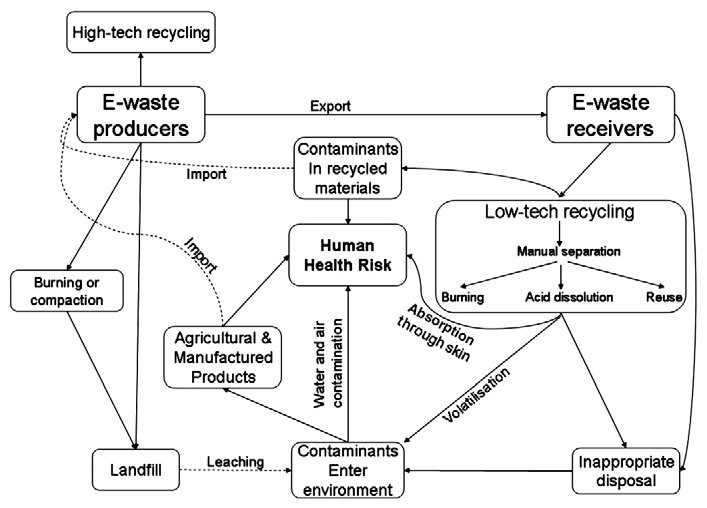
Fig. 3 shows the fluxes of contaminants associated with E-wastes from producers to receivers and ultimately to humans. The fluxes shown in Fig. 3 are relevant at a range of scales, both national and international. Fig. 3 shows that, potentially, E-waste may affect the whole of humanity.图3显示了与电子垃圾相关的污染物从产生者到接收者并最终到达人体的通量。图3所示的通量适用于国家和国际等多种尺度。图3表明,电子垃圾有可能影响全人类。
8Conclusions结论
E-waste is omnipresent. It is characterised by its unusual chemical composition and the difficulties associated with determining its mass and flux at both local and global scales. Contamination associated with E-waste has already caused considerable environmental degradation in poor countries and negatively affected the health of the people who live there. Cleansing of such large contaminated sites is probably unfeasible, since they have been heavily contaminated with numerous contaminants, many of which are poorly studied. However, the negative effects of the contaminants at these sites may be reduced using standard remediation technologies. There is limited knowledge on the ecological effects, human health risks and remediation options for some E-waste contaminants, such as Li and Sb, since they are not normally environmental pollutants. Rich countries have self-interest in mitigating the negative environmental effects of E-waste because it will negatively affect the quality and quantity of food and manufactured goods that are imported from poor countries.
电子垃圾无处不在。其特点在于化学组成特殊,且难以在局地和全球尺度上确定其数量和通量。与电子垃圾相关的污染已在贫穷国家造成了严重的环境退化,并对当地居民的健康产生了负面影响。清理如此大面积的污染场地可能并不可行,因为这些场地已受到多种污染物的严重污染,其中许多污染物的研究尚不充分。然而,可采用标准修复技术减轻这些场地污染物的负面影响。对于Li和Sb等部分电子垃圾污染物,由于它们通常不是环境污染物,有关其生态效应、人体健康风险和修复方案的知识十分有限。富裕国家减轻电子垃圾负面环境影响符合其自身利益,因为电子垃圾将对从贫穷国家进口的食品和制成品的质量和数量产生不利影响。
List of abbreviations缩略语表
| CFC | Chlorofluorocarbon氯氟烃 |
|---|---|
| CRT | Cathode Ray Tube |
| GDP | Gross Domestic Product |
| LCD | Liquid Crystal Display |
| NGO | Non Governmental Organisation |
| PAH | polycyclic aromatic hydrocarbon |
| PBB | polybrominated biphenyl |
| PBDE | polybrominated diphenyl ether |
| PCB | polychlorinated biphenyl |
| PCDD | polychlronated dibenzo-p-dioxin |
| PCDF | polychlronated dibenzofuran |
| PHAH | polyhalogenated aromatic hydrocarbon |
| PPP | Purchasing Power Parity |
| RoHS | Restriction on Hazardous Substances Directive |
| TCLP | Toxicity Characteristic Leaching Procedure |
| UNEP | United Nations Environment Programme |
| WEEE | Waste Electrical and Electronic Equipment |
Acknowledgements致谢
The author would like to thank Professor Mary Beth Kirkham, Assoc. Professor Yadong Li and an anonymous reviewer for their constructive and detailed reviews of this manuscript.
作者感谢Mary Beth Kirkham教授、Yadong Li副教授以及一位匿名审稿人对本文稿提出的建设性详细审阅意见。
References参考文献
Aizawa H, Yoshida H, Sakai SI. Current results and future perspectives for Japanese recycling of home electrical appliances. Res Conserv Recycl 2008;52:1399–410.
Andreola F, Barbieri L, Corradi A, Ferrari AM, Lancellotti I, Neri P. Recycling of EOL CRT glass into ceramic glaze formulations and its environmental impact by LCA approach. Int J Life Cycle Assess 2007;12:448–54.
Babu BR, Parande AK, Basha CA. Electrical and electronic waste: a global environmental problem. Waste Manag Res 2007;25:307–18.
Barba-Gutierrez Y, Adenso-Diaz B, Hopp M. An analysis of some environmental consequences of European electrical and electronic waste regulation. Res Conserv Recycl 2008;52:481–95.
Bergendahl CG, Lichtenvort K, Johansson G, Zackrisson M, Nyyssonen J. Environmental and economic implications of a shift to halogen-free printed wiring boards. Electronics Goes Green 2004 (Plus): Driving Forces for Future Electronics Proceedings; 2004. p. 783–8.
Berkhout F, Hertin J. De-materialising and re-materialising: digital technologies and the environment. Futures 2004;36:903–20.
Bertram M, Graedel TE, Rechberger H, Spatari S. The contemporary European copper cycle: waste management subsystem. Ecol Econ 2002;42:43–57.
Betts K. Producing usable materials from e-waste. Environ Sci Technol 2008a;42:6782–3. Betts K. Reducing the global impact of e-waste. Environ Sci Technol 2008b;42: 1393-1393.
Binder CR, Quirici R, Domnitcheva S, Staubli B. Smart labels for waste and resource management — an integrated assessment. J Ind Ecol 2008;12:207–28. Bradley E. Lead-free solder assembly: impact and opportunity. 53rd Electronic Components & Technology Conference, 2003 Proceedings; 2003. p. 41–6.
Brandl H, Bosshard R, Wegmann M. Computer-munching microbes: metal leaching from electronic scrap by bacteria and fungi. Hydrometallurgy 2001;59:319–26.
Cai ZW, Jiang GB. Determination of polybrominated diphenyl ethers in soil from e-waste recycling site. Talanta 2006;70:88–90.
Chan JKY, Xing GH, Xu Y, Liang Y, Chen LX, Wu SC, et al. Body loadings and health risk assessment of polychlorinated dibenzo-p-dioxins and dibenzofurans at an intensive electronic waste recycling site in China. Environ Sci Technol 2007;41:7668–74.
Chatterjee R. E-waste recycling spews dioxins into the air. Environ Sci Technol 2007;41: 5577-5577.
Chen DH, Bi XH, Zhao JP, Chen LG, Tan JH, Mai BX, et al. Pollution characterization and diurnal variation of PBDEs in the atmosphere of an E-waste dismantling region. Environ Pollut 2009a;157:1051–7.
Chen SJ, Ma YJ, Wang J, Chen D, Luo XJ, Mai BX. Brominated flame retardants in children's toys: concentration, composition, and children's exposure and risk assessment. Environ Sci Technol 2009b;43:4200–6.
CIA. Country Comparison: GDP — per capita (PPP). Cent Intel Agency 2009a.
CIA. Country Comparison: GDP (purchasing power parity). Cent Intel Agency 2009b. Cobbing M. Toxic Tech: Not in Our Backyard. Uncovering the Hidden Flows of e-waste. Report from Greenpeace International. http://www.greenpeace.org/raw/content/ belgium/fr/press/reports/toxic-tech.pdf, Amsterdam, 2008.
Creamer NJ, Baxter-Plant VS, Henderson J, Potter M, Macaskie LE. Palladium and gold removal and recovery from precious metal solutions and electronic scrap leachates by Desulfovibrio desulfuricans. Biotechnol Lett 2006;28:1475–84.
Cui JR, Zhang LF. Metallurgical recovery of metals from electronic waste: a review. J Hazard Mater 2008;158:228–56.
Dagan R, Dubey B, Bitton G, Townsend T. Aquatic toxicity of leachates generated from electronic devices. Arch Environ Contam Toxicol 2007;53:168–73.
Deng WJ, Louie PKK, Liu WK, Bi XH, Fu JM, Wong MH. Atmospheric levels and cytotoxicity of PAHs and heavy metals in TSP and PM2.5 at an electronic waste recycling site in southeast China. Atmos Environ 2006;40:6945–55.
Deng WJ, Zheng JS, Bi XH, Fu JM, Wong MH. Distribution of PBDEs in air particles from an electronic waste recycling site compared with Guangzhou and Hong Kong, South China. Environ Int 2007;33:1063–9.
Dietz M, Horold S, Nass B, Schacker O, Schmitt E, Wanzke W. New environmentally friendly phosphorus based flame retardants for printed circuit boards as well as polyamides and polyesters in E&E applications. Electronics Goes Green 2004 (Plus): Driving Forces for Future Electronics Proceedings; 2004. p. 771–6.
e-waste. Hazardous Substances in e-Waste. A Knowledge Base for the Sustainable Recycling of E-Waste. E-Waste: A Swiss E-Waste Guide; 2009.
Ernst T, Popp R, Wolf M, van Eldik R. Analysis of eco-relevant elements and noble metals in printed wiring boards using AAS, ICP-AES and EDXRF. Anal Bioanal Chem 2003;375:805–14.
Fu JJ, Zhou QF, Liu JM, Liu W, Wang T, Zhang QH, et al. High levels of heavy metals in rice (Oryza sativa L.) from a typical E-waste recycling area in southeast China and its potential risk to human health. Chemosphere 2008;71:1269–75.
Goosey M. End-of-life electronics legislation — an industry perspective. Circuit World 2004;30:41–5.
Gullett BK, Linak WP, Touati A, Wasson SJ, Gatica S, King CJ. Characterization of air emissions and residual ash from open burning of electronic wastes during simulated rudimentary recycling operations. J Mater Cycl Waste Manag 2007;9:69–79.
Ha NN, Agusa T, Ramu K, Tu NPC, Murata S, Bulbule KA, et al. Contamination by trace elements at e-waste recycling sites in Bangalore, India. Chemosphere 2009;76: 9-15.
He WZ, Li GM, Ma XF, Wang H, Huang JW, Xu M, et al. WEEE recovery strategies and the WEEE treatment status in China. J Hazard Mater 2006;136:502–12. Herat S. Green electronics through legislation and lead free soldering. Clean-Soil Air Water 2008;36:145–51.
Hilty LM. Electronic waste — an emerging risk? Environ Impact Assess Rev 2005;25:431–5. Hischier R, Wager P, Gauglhofer J. Does WEEE recycling make sense from an environmental perspective? The environmental impacts of the Swiss take-back and recycling systems for waste electrical and electronic equipment (WEEE). Environ Impact Assess Rev 2005;25:525–39.
Hoffmann JE. Recovering precious metals from electronic scrap. J-J Mines Met Mater Soc 1992;44:43–8.
Huisman J, Magalini F. Where are WEEE now? Lessons from WEEE: Will EPR work for the US? Proceedings of the 2007 IEEE International Symposium on Electronics & the Environment, Conference Record; 2007. p. 149–54.
Huo X, Peng L, Xu XJ, Zheng LK, Qiu B, Qi ZL, et al. Elevated blood lead levels of children in Guiyu, an electronic waste recycling town in China. Environ Health Perspect 2007;115:1113–7.
Jang YC, Townsend TG. Leaching of lead from computer printed wire boards and cathode ray tubes by municipal solid waste landfill leachates. Environ Sci Technol 2003;37:4778–84.
Kang HY, Schoenung JM. Electronic waste recycling: a review of US infrastructure and technology options. Res Conserv Recycl 2005;45:368–400.
Kogo T, Kanamori H, Onishi M, Miyajima Y, Nakazawa M. Lead-containing fluoride glass, optical fiber and process for producing it. United States Patent office 1995; Patent Number 5432131.
Kohler A, Erdmann L. Expected environmental impacts of pervasive computing. Hu Ecol Risk Assess 2004;10:831–52.
LaDou J. Printed circuit board industry. Int J Hyg Environ Health 2006;209:211–9.
Ladou J, Lovegrove S. Export of electronics equipment waste. Int J Occup Environ Health 2008;14:1-10.
Leung AOW, Duzgoren-Aydin NS, Cheung KC, Wong MH. Heavy metals concentrations of surface dust from e-waste recycling and its human health implications in southeast China. Environ Sci Technol 2008;42:2674–80.
Leung AOW, Luksemburg WJ, Wong AS, Wong MH. Spatial distribution of polybrominated diphenyl ethers and polychlorinated dibenzo-p-dioxins and dibenzofurans in soil and combusted residue at Guiyu, an electronic waste recycling site in southeast China. Environ Sci Technol 2007;41:2730–7.
Li HR, Yu LP, Sheng GY, Fu JM, Peng PA. Severe PCDD/F and PBDQ/F pollution in air around an electronic waste dismantling area in China. Environ Sci Technol 2007;41: 5641–6.
Li JH, Gao S, Duan HB, Liu LL. Recovery of valuable materials from waste liquid crystal display panel. Waste Manag 2009;29:2033–9.
Li Y, Xu XJ, Liu JX, Wu KS, Gu CW, Shao G, et al. The hazard of chromium exposure to neonates in Guiyu of China. Sci Total Environ 2008a;403:99-104. Li Y, Xu XJ, Wu KS, Chen GJ, Liu JX, Chen SJ, et al. Monitoring of lead load and its effect on neonatal behavioral neurological assessment scores in Guiyu, an electronic waste recycling town in China. J Environ Monitor 2008b;10:1233–8. Liang SX, Zhao Q, Qin ZF, Zhao XR, Yang ZZ, Xu XB. Levels and distribution of polybrominated diphenyl ethers in various tissues of foraging hens from an electronic waste recycling area in South China. Environ Toxicol Chem 2008;27:1279–83.
Liu HX, Zhou QF, Wang YW, Zhang QH, Cai ZW, Jiang GB. E-waste recycling induced polybrominated diphenyl ethers, polychlorinated biphenyls, polychlorinated dibenzo-p-dioxins and dibenzo-furans pollution in the ambient environment. Environ Int 2008;34:67–72.
Liu Q, Cao J, Li KQ, Miao XH, Li G, Fan FY, et al. Chromosomal aberrations and DNA damage in human populations exposed to the processing of electronics waste. Environ Sci Pollut Res Int 2009;16:329–38.
Liu XB, Tanaka M, Matsui Y. Generation amount prediction and material flow analysis of electronic waste: a case study in Beijing, China. Waste Manag Res 2006;24:434–45. Luo Q, Cai ZW, Wong MH. Polybrominated diphenyl ethers in fish and sediment from river polluted by electronic waste. Sci Total Environ 2007a;383:115–27. Luo Q, Wong MH, Cai ZW. Determination of polybrominated diphenyl ethers in freshwater fishes from a river polluted by e-wastes. Talanta 2007b;72:1644–9. Luo XJ, Zhang XL, Liu J, Wu JP, Luo Y, Chen SJ, et al. Persistent halogenated compounds in waterbirds from an e-waste recycling region in South China. Environ Sci Technol 2009a;43:306–11.
Luo Y, Luo XJ, Lin Z, Chen SJ, Liu J, Mai BX, et al. Polybrominated diphenyl ethers in road and farmland soils from an e-waste recycling region in Southern China: Concentrations, source profiles, and potential dispersion and deposition. Sci Total Environ 2009b;407:1105–13.
Manomaivibool P. Extended producer responsibility in a non-OECD context: the management of waste electrical and electronic equipment in India. Res Conserv Recycl 2009;53:136–44. Mauerer O. New reactive, halogen-free flame retardant system for epoxy resins. Polym Degrad Stab 2005;88:70–3. Mester A, Fraunholcz N, van Schaik A, Reuter MA. Characterization of the hazardous components in end-of-life notebook display. Light Met 2005;2005:1213–6. Micklethwait J. Small but disruptive. The Economist; 2009a. Micklethwait J. Unlocking the cloud. The Economist; 2009b. Mielke HW, Reagan PL. Soil is an important pathway of human lead exposure. Environ Health Perspect 1998;106:217–29. Morf LS, Tremp J, Gloor R, Schuppisser F, Stengele M, Taverna R. Metals, non-metals and PCB in electrical and electronic waste — actual levels in Switzerland. Waste Manag 2007;27:1306–16. Nationmaster. Media Statistics. www.nationmaster.com accessed June 2009., 2009. Niu XJ, Li YD. Treatment of waste printed wire boards in electronic waste for safe disposal. J Hazard Mater 2007;145:410–6. OECD. OECD Environmental Outlook to 2030. 2009. Organisation for Economic Cooperation and Development http://213.253.134.43/oecd/pdfs/browseit/9708011E. PDF, 2008.
Puckett J, Westervelt S, Gutierrez R, Takamiya Y. The digital dump. Exporting re-use and abuse to Africa. Report from the Basel Action Network, Seattle, 2005. Puttlitz KJ, Galyon GT. Impact of the ROHS Directive on high-performance electronic systems — Part II: key reliability issues preventing the implementation of lead-free solders. J Mater Sci: Mater Electron 2007;18:347–65.
Qu WY, Bi XH, Sheng GY, Lu SY, Fu H, Yuan J, et al. Exposure to polybrominated diphenyl ethers among workers at an electronic waste dismantling region in Guangdong, China. Environ Int 2007;33:1029–34.
Scheutz C, Mosbaek H, Kjeldsen P. Attenuation of methane and volatile organic compounds in landfill soil covers. J Environ Qual 2004;33:61–71. Schmidt CW. Unfair trade — E-waste in Africa. Environ Health Perspect 2006;114: A232–5. Shen C, Chen Y, Huang S, Wang Z, Yu C, Qiao M, et al. Dioxin-like compounds in agricultural soils near e-waste recycling sites from Taizhou area, China: Chemical and bioanalytical characterization. Environ Int 2009a;35:50–5.
Shen CF, Chen YX, Huang SB, Wang ZJ, Yu CN, Qiao M, et al. Dioxin-like compounds in agricultural soils near e-waste recycling sites from Taizhou area, China: chemical and bioanalytical characterization. Environ Int 2009b;35:50–5.
Shi T, Chen SJ, Luo XJ, Zhang XL, Tang CM, Luo Y, et al. Occurrence of brominated flame retardants other than polybrominated diphenyl ethers in environmental and biota samples from southern China. Chemosphere 2009;74:910–6.
Sinha-Khetriwal D, Kraeuchi P, Schwaninger M. A comparison of electronic waste
recycling in Switzerland and in India. Environ Impact Assess Rev 2005;25:492–504.
Spalvins E, Dubey B, Townsend T. Impact of electronic waste disposal on lead concentrations in landfill leachate. Environ Sci Technol 2008;42:7452–8.
Tschan M, Robinson BH, Schulin R. Antimony in the soil-plant system — a review. Environ Chem 2009;6:106–15.
Tseng LH, Li MH, Tsai SS, Lee CW, Pan MH, Yao WJ, et al. Developmental exposure to decabromodiphenyl ether (PBDE 209): Effects on thyroid hormone and hepatic enzyme activity in male mouse offspring. Chemosphere 2008;70:640–7.
UNEP. Call for Global Action on E-waste. United Nations Environment Programme; 2006.
UNEP. Basel Convention on the Control of Transboundary Movements of Hazardous Wastes and their Disposal. United Nations Environment Programme. http://www. basel.int/, 2009.
USEPA. United States Environmental Protection Agency. Test Methods for Evaluating Solid Waste Method 1311SW-846, Washington, DC; 2000.
Wang JP, Guo XK. Impact of electronic wastes recycling on environmental quality. Biomed Environ Sci 2006;19:137–42.
Weidenhamer JD, Clement ML. Leaded electronic waste is a possible source material for lead-contaminated jewelry. Chemosphere 2007a;69:1111–5.
Weidenhamer JD, Clement ML. Widespread lead contamination of imported low-cost jewelry in the US. Chemosphere 2007b:67.
Widmer R, Oswald-Krapf H, Sinha-Khetriwal D, Schnellmann M, Boni H. Global perspectives on e-waste. Environ Impact Assess Rev 2005;25:436–58.
Wilmoth RC, Hubbard SJ, Bruckle JO, Martin JF. Production and processing of metals: their disposal and future risks. In: Merian E, editor. Metals and their compounds in
the environment. Occurrence, analysis and biological relevance. VCH: Weinheim; 1991. p. 19–65.
Wong CSC, Duzgoren-Aydin NS, Aydin A, Wong MH. Evidence of excessive releases of metals from primitive e-waste processing in Guiyu, China. Environ Pollut 2007;148:62–72.
Wu JP, Luo XJ, Zhang Y, Luo Y, Chen SJ, Mai BX, et al. Bioaccumulation of polybrominated diphenyl ethers (PBDEs) and polychlorinated biphenyls (PCBs) in wild aquatic species from an electronic waste (e-waste) recycling site in South China. Environ Int 2008;34:1109–13.
Xing GH, Chan JKY, Leung AOW, Wu SC, Wong MH. Environmental impact and human exposure to PCBs in Guiyu, an electronic waste recycling site in China. Environ Int 2009;35:76–82.
Yang ZZ, Zhao XR, Zhao Q, Qin ZF, Qin XF, Xu XB, et al. Polybrominated diphenyl ethers in leaves and soil from typical electronic waste polluted area in South China. Bull Environ Contam Toxicol 2008;80:340–4.
Zhang J, Min H. Eco-toxicity and metal contamination of paddy soil in an e-wastes recycling area. J Hazard Mater 2009;165:744–50.
Zhao G, Zhou H, Wang D, Zha J, Xu Y, Rao K, et al. PBBs, PBDEs, and PCBs in foods collected from e-waste disassembly sites and daily intake by local residents. Sci Total Environ 2009;407:2565–75.
Zhao GF, Wang ZJ, Dong MH, Rao KF, Luo JP, Wang DH, et al. PBBs, PBDEs, and PCBs levels in hair of residents around e-waste disassembly sites in Zhejiang Province, China, and their potential sources. Sci Total Environ 2008;397:46–57.
Zhao GF, Xu Y, Han GG, Ling B. Biotransfer of persistent organic pollutants from a large site in China used for the disassembly of electronic and electrical waste. Environ Geochem Health 2006;28:341–51.
Zheng LK, Wu KS, Li Y, Qi ZL, Han D, Zhang B, et al. Blood lead and cadmium levels and relevant factors among children from an e-waste recycling town in China. Environ Res 2008;108:15–20.