María T. Domínguez & Teodoro Marañón & José M. Murillo & Rainer Schulin & Brett H. Robinson
Received: 19 November 2008 /Accepted: 8 April 2009 /Published online: 6 May 2009 # Springer Science + Business Media B.V. 2009
Abstract Soil contamination may contribute to forest decline, by altering nutrient cycling and acquisition by plants. This may hamper the establishment of a woody plant cover in contaminated areas, thus limiting the success of a restoration program. We studied the nutritional status of planted saplings of Holm oak (Quercus ilex subsp. ballota (Desf.) Samp.), white poplar (Populus alba L.), and wild olive tree (Olea europaea var. sylvestris Brot.) in the Guadiamar Green Corridor (SW Spain) and compared it with established adult trees. Soils in this area were affected by a mine-spill in 1998 and a subsequent restoration program. The spill resulted in soil acidification, due to pyrite oxidation, and deposited high concentrations of some trace elements. In some sites, we detected a phosphorus deficiency in the leaves of Q. ilex and O. europaea saplings, as indicated by a high N:P ratio (>16). For O. europaea, soil contamination explained 40% of the variability in leaf P and was negatively related to chlorophyll content. Soil pH was a significant factor predicting the variability of several nutrients, including Mg, P, and S. The uptake of Mg and S by P. alba was greater in acidic soils. The monitoring of soil pH is recommended since long-term effects of soil acidification may negatively affect the nutritional status of the trees.
摘要 土壤污染可能通过改变养分循环及植物对养分的获取而导致森林衰退。这可能阻碍污染区域木本植被的建立,从而限制修复计划的成效。本研究调查了西班牙西南部Guadiamar绿色走廊中栽植的冬青栎(Quercus ilex subsp. ballota (Desf.) Samp.)、银白杨(Populus alba L.)和野生油橄榄(Olea europaea var. sylvestris Brot.)幼树的营养状况,并与已定植的成年树进行比较。该区域土壤于1998年受到矿山尾矿泄漏的影响,随后实施了修复计划。泄漏事故因黄铁矿氧化导致土壤酸化,并沉积了高浓度的某些微量元素。在部分样点,Q. ilex和O. europaea幼树叶片呈现磷缺乏,表现为较高的N:P比(>16)。对于O. europaea,土壤污染解释了叶片P变异的40%,且与叶绿素含量呈负相关。土壤pH是预测Mg、P和S等多种养分变异的显著因子。P. alba在酸性土壤中对Mg和S的吸收更多。由于土壤酸化的长期效应可能对树木营养状况产生不利影响,建议对土壤pH进行监测。
M. T. Domínguez (*) : T. Marañón : J. M. Murillo Instituto de Recursos Naturales y Agrobiología, CSIC, P.O. Box 1052, E-41080 Seville, Spain e-mail: maitedn@irnase.csic.es
R. Schulin Institute of Terrestrial Ecosystems, ETH Zürich, Universitätstrasse 16, CH-8092 Zurich, Switzerland
B. H. Robinson Department of Agriculture and Life Sciences, Lincoln University, P.O. Box 84, Lincoln 7647, Canterbury, New Zealand
Keywords Heavy metal . Tree nutrition . Phosphorus . Quercus ilex . Olea europaea . Populus alba . Soil remediation
关键词 重金属;树木营养;磷;Quercus ilex;Olea europaea;Populus alba;土壤修复
1Introduction引言
Soil contamination can affect nutrient cycling and acquisition by trees leading to nutrient disorders in forests sites. Competitive interactions between pollutants, such as trace elements, and nutrients in the soils and in the roots may alter the availability or uptake of essential elements. For example, these interactions have been described for As and P (Lambkin and Alloway 2003), Tl and K (Kwan and Smith 1991), or Cd and Ca (Perfus-Barbeoch et al. 2002). Root growth and morphology can also be altered by trace elements (Arduini et al. 1994; Reichman et al. 2001; Domínguez et al. 2009), reducing root ability to absorb essential nutrients. Elevated trace element concentrations can alter microbial activity and composition in soils (Pennanen et al. 1998; Tuomela et al. 2005), affecting plant–microorganism interactions that are essential for plant nutrition such as mycorrhizae (Kieliszewska-Rokicka et al. 1997; Hartley- Whitaker et al. 2000).
土壤污染可影响树木的养分循环与养分获取,进而导致林地养分失调。土壤和根系中污染物(如微量元素)与养分之间的竞争性相互作用可能改变必需元素的有效性或吸收。例如,已有研究报道了As与P(Lambkin and Alloway 2003)、Tl与K(Kwan and Smith 1991)以及Cd与Ca(Perfus-Barbeoch et al. 2002)之间的此类相互作用。微量元素还可改变根系生长和形态(Arduini et al. 1994; Reichman et al. 2001; Domínguez et al. 2009),降低根系吸收必需养分的能力。微量元素浓度升高可改变土壤微生物活性和群落组成(Pennanen et al. 1998; Tuomela et al. 2005),从而影响对植物营养至关重要的植物–微生物相互作用,如菌根(Kieliszewska-Rokicka et al. 1997; Hartley- Whitaker et al. 2000)。
Mediterranean environments are frequently deficient in N and P (Henkin et al. 1998; Rodà et al. 1999). Nutrient limitations may affect the growth of afforested woody plants in Mediterranean areas (Romanyà and Vallejo, 2004; Villar-Salvador et al. 2004). Therefore, fertilization often improves the performance of planted seedlings (Querejeta et al. 1998; Vallejo et al. 2000; Fuentes et al. 2007a). The management of contaminated sites should address possible tree nutrient deficiencies associated with the contamination event or its subsequent remediation. However, little is known about the effects of soil trace elements on the nutrition of Mediterranean trees, despite the increasing use of metal-rich amendments in the afforestation of Mediterranean sites. On one hand, soil contamination may exacerbate nutrient deficiencies in plants. On the other hand, many semi-arid areas in the Mediterranean region are characterized by a relatively high pH and carbonate content, which may result in a low availability of some micronutrients such as Cu or Zn for plants (Adriano 2001). The application of metalenriched material such as sewage-sludge to semi-arid calcareous soils may improve the seedling performance, by releasing micronutrient limitations (Fuentes et al. 2007a). Thus, the influence of soil contamination on plant nutrition depends on the type of contaminant (essential vs. non-essential trace element), the dose, the type of soil and the soil organic matter content. The latter two factors determine the background availability of essential trace elements, the capacity for the retention of the added contaminants, and, therefore, the possible phytotoxic effects (Illera et al. 2000; Oudeh et al. 2002; Toribio and Romanyà 2006).
地中海环境中N和P常常缺乏(Henkin et al. 1998; Rodà et al. 1999)。养分限制可能影响地中海地区造林木本植物的生长(Romanyà and Vallejo, 2004; Villar-Salvador et al. 2004)。因此,施肥通常可改善栽植幼苗的表现(Querejeta et al. 1998; Vallejo et al. 2000; Fuentes et al. 2007a)。污染场地的管理应关注与污染事件或其后续修复相关的树木养分缺乏问题。然而,尽管富含金属的改良剂在地中海地区造林中的使用日益增多,有关土壤微量元素对地中海树木营养影响的认识仍十分有限。一方面,土壤污染可能加剧植物的养分缺乏;另一方面,地中海地区许多半干旱区域土壤pH和碳酸盐含量相对较高,可能导致Cu或Zn等某些微量营养元素对植物的有效性较低(Adriano 2001)。向半干旱石灰性土壤施用富含金属的材料(如污水污泥)可通过解除微量营养元素限制而改善幼苗表现(Fuentes et al. 2007a)。因此,土壤污染对植物营养的影响取决于污染物类型(必需与非必需微量元素)、剂量、土壤类型及土壤有机质含量。后两个因素决定了必需微量元素的本底有效性、对外源污染物的固持能力,进而决定可能的植物毒性效应(Illera et al. 2000; Oudeh et al. 2002; Toribio and Romanyà 2006)。
The Guadiamar Green Corridor (SW Spain) is one of the largest cases of soil remediation in Europe in the last decade. This area was contaminated by a mine-spill in 1998 and a large-scale restoration program was implemented, which included the addition of soil amendments and the afforestation with native Mediterranean woody plants. Soil types in the area range from sandy-loam to calcareous clay-loam. Therefore, this wide variability allows exploring the influence on soil type on the dynamics and effects of contamination. Several recent studies have shown the dynamics of trace elements in soils and plants from the Guadiamar Green Corridor following remediation (Madejón et al. 2004; Cabrera et al. 2008; Domínguez et al. 2008). However, there is a lacuna of information on the ecophysiological responses of the trees growing in this area. Given the high trace element concentrations in soils, the pollutants may detrimentally affect plant processes at the root level, and hence affect plant nutrition.
Guadiamar绿色走廊(西班牙西南部)是过去十年欧洲规模最大的土壤修复案例之一。该区域于1998年受到矿山尾矿泄漏污染,随后实施了大规模修复计划,包括施用土壤改良剂以及以地中海本土木本植物造林。该区域土壤类型从砂壤土到石灰性黏壤土不等,这种广泛的变异性使得探讨土壤类型对污染动态及效应的影响成为可能。近期多项研究揭示了修复后Guadiamar绿色走廊土壤和植物中微量元素的动态变化(Madejón et al. 2004; Cabrera et al. 2008; Domínguez et al. 2008)。然而,关于该区域树木生理生态响应的信息仍属空白。鉴于土壤中微量元素浓度较高,污染物可能在根系水平对植物生理过程产生不利影响,进而影响植物营养。
In this work, we studied the chlorophyll content and nutritional status, as plant-health indicators of trees in the Guadiamar Green Corridor. We assessed the influence of soil conditions on these plant variables. We selected three tree species (Olea europaea var. sylvestris, Populus alba, and Quercus ilex subsp. ballota), which are the most abundant in the Guadiamar Green Corridor. We aimed to determine: (1) whether there was any disorder in nutritional status or chlorophyll content of trees growing under these altered soil conditions and (2) the relative influence of soil contamination on plant nutrient status over a range of soil properties, including different pH, texture, organic matter content, and nutrient availability. As a secondary objective, we sought to elucidate relationships (synergistic, antagonistic, or neutral) that exist between essential and non-essential trace element concentrations at the leaf level, since these relationships could help to explain any nutritional changes induced by soil contamination.
本研究以叶绿素含量和营养状况作为植物健康指标,研究了Guadiamar绿色走廊的树木,并评估了土壤条件对上述植物指标的影响。选取Guadiamar绿色走廊中数量最多的三个树种(Olea europaea var. sylvestris、Populus alba和Quercus ilex subsp. ballota)。研究目的为:(1)确定在这些改变后的土壤条件下生长的树木在营养状况或叶绿素含量方面是否存在失调;(2)在不同pH、质地、有机质含量和养分有效性等一系列土壤性质范围内,明确土壤污染对植物养分状况的相对影响。次要目的是阐明叶片水平上必需与非必需微量元素浓度之间存在的关系(协同、拮抗或中性),因为这些关系有助于解释土壤污染引起的营养变化。
2Materials and Methods材料与方法
2.1 Study Area and Studied Species2.1 研究区域与研究树种
The Guadiamar River Green Corridor (SW Spain) has a semi-arid Mediterranean climate with mild rainy winters and warm dry summers. The average annual temperature is 19°C (monthly mean minimum of 9°C in January and maximum of 27°C in July). The average annual rainfall is 484 mm and potential evapotranspiration is 1,139 mm (period 1971–2004). Soils of the area are mostly neutral or slightly alkaline, with the exception of some terraces on the Northern bank, which are acidic.
Guadiamar河绿色走廊(西班牙西南部)属半干旱地中海气候,冬季温和多雨,夏季温暖干燥。年平均气温为19°C(1月月平均最低气温9°C,7月月平均最高气温27°C)。年平均降水量为484 mm,潜在蒸散量为1,139 mm(1971–2004年)。除北岸部分阶地土壤呈酸性外,该区域土壤大多为中性或弱碱性。
In 1998, a mine-spill affected some 4,286 ha of the river basin. The sludge that covered the soils was composed by polymetalic sulfides (mainly pyrite), with average concentrations of 380 g kg−1 of Fe, 9.3 g kg−1 of Zn, 8.6 g kg−1 of Pb, 5.7 g kg−1 of As, 1.5 g kg−1 of Cu, 40 mg kg−1 of Cd, and 43 mg kg−1 of Tl, as main contaminants (ITGE 1999).
1998年,一起矿山尾矿泄漏事故影响了该流域约4,286 ha的土地。覆盖土壤的尾矿泥由多金属硫化物(主要为黄铁矿)组成,主要污染物的平均浓度为:Fe 380 g kg−1、Zn 9.3 g kg−1、Pb 8.6 g kg−1、As 5.7 g kg−1、Cu 1.5 g kg−1、Cd 40 mg kg−1和Tl 43 mg kg−1(ITGE 1999)。
After the accident, an emergency cleanup removed sludge and contaminated topsoil. Organic matter and calcium-rich amendments were added with the aim of immobilizing trace elements and improving soil fertility. Sugar beet lime was the most used amendment, which had 70–80% of CaCO3 (pH 9) and N, P, and K concentrations up to 9.8, 5.1, and 5.3 g kg−1, respectively (Madejón et al. 2006). Application rates ranged from 3 to 50 t ha−1, depending of the degree of contamination of the site (Arenas et al. 2008).
事故发生后,紧急清理工作清除了尾矿泥和受污染表土。为固定微量元素并提高土壤肥力,施用了有机质和富钙改良剂。使用最多的改良剂是甜菜制糖石灰渣,其CaCO3含量为70–80%(pH 9),N、P和K含量分别高达9.8、5.1和5.3 g kg−1(Madejón et al. 2006)。根据场地污染程度,施用量为3至50 t ha−1(Arenas et al. 2008)。
The revegetation of around 2,700 ha with native Mediterranean tree and shrub species started in 1999. One of the goals of this program was the long-term establishment of a continuous vegetation belt for wildlife to migrate along the Guadiamar River between the Doñana National Park in the South (where the river flows into) and the Sierra Morena Mountains in the North. Depending on the local conditions, the target tree and shrub species used for afforestation were those typical of riparian forests, such as P. alba, Fraxinus angustifolia, and Salix atrocinerea or those typical of drier upland forests, such as Q. ilex subsp. ballota, O. europaea var. sylvestris, Ceratonia siliqua, Phillyrea angustifolia, Pistacia lentiscus, Rosmarinus officinalis, and Retama sphaerocarpa. Seedlings were grown in a local nursery and then planted out after 1 year. The planting density ranged from 480 to 980 plants per hectare.
1999年起,以地中海本土乔木和灌木物种对约2,700 ha土地进行植被重建。该计划的目标之一是长期建立一条连续的植被带,使野生动物能够沿Guadiamar河在南部的Doñana国家公园(河流注入处)与北部的Sierra Morena山脉之间迁徙。根据当地条件,造林所用的目标乔灌木物种为河岸林典型物种,如P. alba、Fraxinus angustifolia和Salix atrocinerea,或较干旱山地森林典型物种,如Q. ilex subsp. ballota、O. europaea var. sylvestris、Ceratonia siliqua、Phillyrea angustifolia、Pistacia lentiscus、Rosmarinus officinalis和Retama sphaerocarpa。幼苗在当地苗圃培育1年后出圃栽植,栽植密度为每公顷480至980株。
For this study we selected the most abundant tree species used in this restoration program: Holm oak (Q. ilex subsp. ballota (Desf.) Samp.), wild olive tree (O. europaea var. sylvestris Brot.), and white poplar (P. alba L.).
本研究选取该修复计划中使用最多的树种:冬青栎(Q. ilex subsp. ballota (Desf.) Samp.)、野生油橄榄(O. europaea var. sylvestris Brot.)和银白杨(P. alba L.)。
2.2 Plant and Soil Sampling2.2 植物与土壤采样
Sampling was carried out during autumn of 2005, 7 years after the remediation works. Nineteen sites along the Green Corridor were selected (Fig. 1), from the unaffected areas upstream of the tailings dam (37°30′, 6°13′ W), 38 km down to the Southern limit of the Doñana saltmarshes (37°13′ N, 6°14′ W). Three of these sites were unaffected by the spill, but also were afforested and included within the Corridor; they will serve as "blank" references for this study. Several soil types are present along the sampled area. Bedrocks in the North of the basin (including the unaffected sites 1 and 2) are mostly slate and schist, and soils are mostly acidic sandy loams. In the Central part of the basin, predominant bedrocks are lime and calcarenite, and soils are neutral and basic loams (including the unaffected site 13). Soils in the South of the basin are mostly clay loams, due to the vicinity of the saltmarshes in the South of the basin.
采样于2005年秋季进行,即修复工程完成7年后。沿绿色走廊共选取19个样点(图1),范围从尾矿坝上游未受影响区域(37°30′, 6°13′ W)向下游延伸38 km至Doñana盐沼南界(37°13′ N, 6°14′ W)。其中3个样点未受泄漏影响,但同样进行了造林并纳入走廊范围,作为本研究的“空白”对照。采样区域内存在多种土壤类型。流域北部(包括未受影响的样点1和2)基岩主要为板岩和片岩,土壤多为酸性砂壤土;流域中部主要基岩为石灰岩和钙质砂屑岩,土壤为中性和碱性壤土(包括未受影响的样点13);流域南部由于邻近盐沼,土壤多为黏壤土。
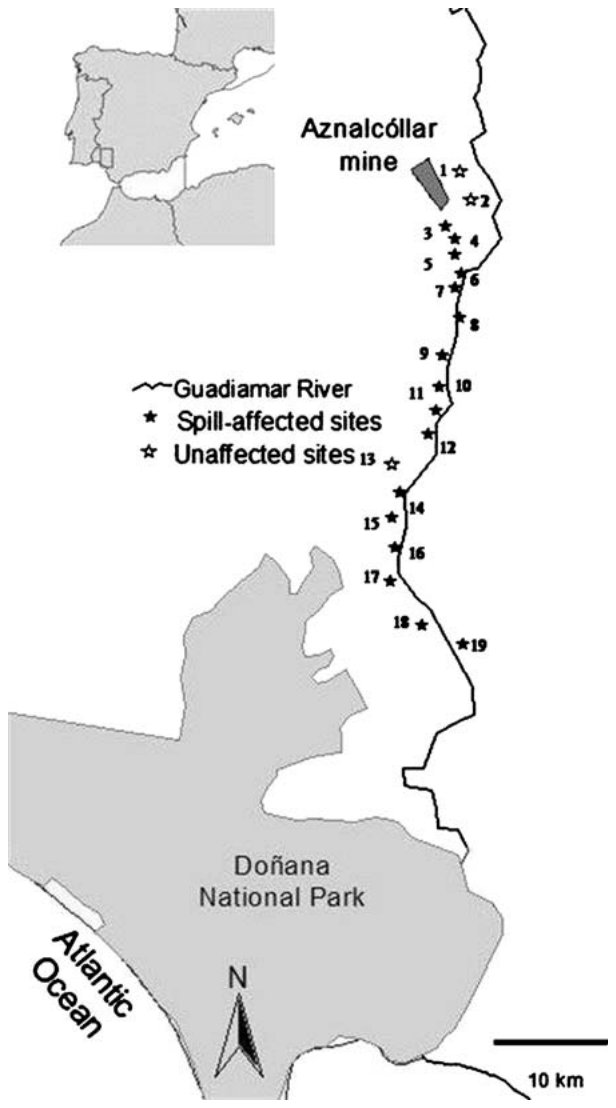
Samples of P. alba and Q. ilex were collected from ten sites and O. europaea from 11 sites. Where possible, at each site we also sampled adult trees that survived the spill, for comparison with planted saplings. There were no individuals of P. alba nor adult trees of the other two species at the non-affected sites.
在10个样点采集了P. alba和Q. ilex样品,在11个样点采集了O. europaea样品。在可能的情况下,还在各样点采集了泄漏事故后存活的成年树,以与栽植幼树进行比较。未受影响样点既无P. alba个体,也无其他两个树种的成年树。
At each site, we selected three to ten individual trees of each species, depending on their abundance. Around each tree, the leaf litter was removed and soil samples were taken from the root-zone at 0–25 cm, using a spiral auger with a diameter of 2.5 cm. Two cores were taken at opposite sides of the trunks to make a composite soil sample for each tree. A composite leaf sample was taken for each selected tree, by randomly collecting four to eight leaf subsamples around the crown. We collected fully expanded leaves from the outer canopy, avoiding shaded leaves from the inner parts of the crown. For adult trees, we used a pole to reach the leaves of the medium and upper parts of the crown. Leaves were placed in a chilled, dark storage container for transportation to the laboratory. Between 15 and 25 plant samples per species and life-stage (adults and saplings) were collected. The total number of plant (and correspondent soil) samples was 116 (52 adults and 64 saplings).
在每个样点,根据各树种的丰度选取3至10株单株。在每株树周围清除凋落物后,使用直径2.5 cm的螺旋土钻采集根区0–25 cm的土壤样品。在树干相对两侧各取1个土芯,组成每株树的混合土样。对每株选定的树,在树冠周围随机采集4至8个叶片子样品,组成混合叶样。采集树冠外层完全展开的叶片,避免采集树冠内部的遮阴叶。对于成年树,借助长杆采集树冠中上部叶片。叶片置于冷藏避光容器中运回实验室。每个树种和生活阶段(成年树和幼树)采集15至25个植物样品,植物样品(及相应土壤样品)总数为116个(成年树52个,幼树64个)。
2.3 Sample Preparation and Chemical Analyses2.3 样品制备与化学分析
Immediately upon returning from the field, we selected ten leaves from each plant sample and carefully washed them with deionized water. In these leaves we used a SPAD-502 chlorophyll meter (Minolta Camera Co. Ltd. Osaka, Japan) to determine the Chlorophyll Content Index (CCI) of each leaf, by taking three measurements per leaf. The CCI is a non-destructive, dimensionless variable, which is linearly related to the total chlorophyll concentration per unit of area. This relationship differs for leaves of different species, so we did not compare across species. The rest of each plant sample was washed thoroughly with deionised water, dried at 70°C for at least 48 h and ground using a stainless-steel mill.
野外采样返回后,立即从每个植物样品中选取10片叶片,用去离子水仔细清洗。采用SPAD-502叶绿素仪(Minolta Camera Co. Ltd. Osaka, Japan)测定每片叶的叶绿素含量指数(CCI),每片叶测定3次。CCI是一种无损、无量纲的指标,与单位面积总叶绿素浓度呈线性关系。由于不同树种叶片的这一关系存在差异,因此未进行种间比较。每个植物样品的其余部分用去离子水彻底清洗,于70°C烘干至少48 h,并用不锈钢粉碎机磨碎。
Plant material was analyzed for N using a Kjeldahl digestion. The rest of macronutrients (Ca, K, Mg, P, and S) and trace elements (As, Bi, Cd, Cu, Pb, Tl, and Zn) were extracted by wet oxidation with concentrated HNO3 under pressure in a microwave digester. Macronutrients (except N) were analyzed by inductively coupled plasma optical emission spectrophotometry (ICP-OES; Thermo Jarrel Ash Corporation). Trace elements were analyzed by inductively coupled plasma mass spectroscopy (ICP-MS; Perkin Elmer, Sciex-Elan 5000).
植物样品中N采用凯氏消解法测定。其余大量元素(Ca、K、Mg、P和S)及微量元素(As、Bi、Cd、Cu、Pb、Tl和Zn)在微波消解仪中用浓HNO3加压湿法氧化提取。大量元素(N除外)采用电感耦合等离子体发射光谱法(ICP-OES;Thermo Jarrel Ash Corporation)测定,微量元素采用电感耦合等离子体质谱法(ICP-MS;Perkin Elmer, Sciex-Elan 5000)测定。
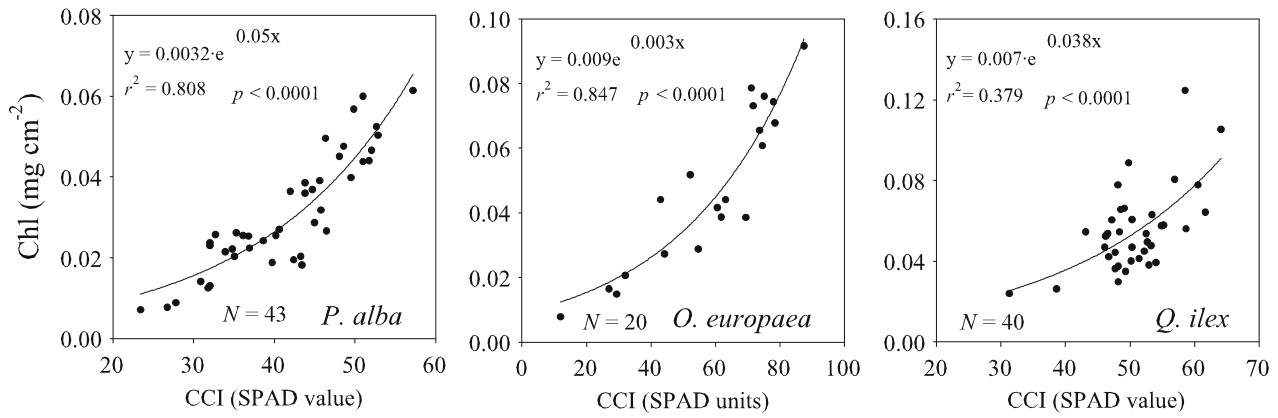
To ensure that the CCI was a reliable measurement of the total leaf chlorophyll of the studied species, a calibration was conducted in the autumn 2007. Ten trees per species and life-stage were selected in four of the sampling sites; in each of them two to three leaves were collected and treated as described above. The chemical analysis of the chlorophyll concentration was performed in two disks of 5 mm diameter of each leaf; for P. alba and Q. ilex chlorophyll was extracted with N,N-dimethylformamide and determined by spectrophotometry according to Moran (1982). For O. europaea, the extraction with N,N-dimethylformamide was not complete and methanol was used as extractant in a subsample of leaves; chlorophyll was then determined by spectrophotometry according to Wellburn (1994). The best fits between CCI and chlorophyll concentrations were obtained by exponential regressions (Fig. 2).
为确保CCI能可靠反映研究树种叶片总叶绿素含量,于2007年秋季进行了校准。在4个采样点中每个树种和生活阶段选取10株树,每株采集2至3片叶,并按上述方法处理。在每片叶上取2个直径5 mm的叶圆片进行叶绿素浓度的化学分析:对于P. alba和Q. ilex,用N,N-二甲基甲酰胺提取叶绿素,并按Moran(1982)的方法用分光光度法测定;对于O. europaea,N,N-二甲基甲酰胺提取不完全,故对部分叶片子样品采用甲醇作为提取剂,并按Wellburn(1994)的方法用分光光度法测定叶绿素。CCI与叶绿素浓度之间以指数回归拟合效果最佳(图2)。
All soil samples were oven-dried at 40°C until a constant weight was obtained, then sieved to <2 mm, for the analysis of general properties. A fraction of each sample was then ground in an agate mortar to <1 mm for trace element analysis.
所有土壤样品于40°C烘干至恒重,过<2 mm筛,用于常规性质分析。取每个样品的一部分在玛瑙研钵中研磨至<1 mm,用于微量元素分析。
Soil texture was determined by the hydrometer method (Gee and Bauder 1979). The pH was determined potentiometrically in a 1:2.5 soil–water suspension. Organic matter content was analyzed by dichromate oxidation and titration with ferrous ammonium sulfate (Walkley and Black 1934). Available P was determined by sodium bicarbonate extraction (Olsen et al. 1954) and available K was analyzed by extraction with ammonium acetate (Bower et al. 1952). Total organic N was analyzed by the Kjeldahl method (Kammerer et al. 1967). For total trace element concentrations (As, Bi, Cd, Cu, Pb, Tl, and Zn), the <1 mm soil fraction was digested using concentrated HNO3 and HCL (1:3 v/v, aqua regia) and analyzed by ICP-MS.
土壤质地采用比重计法测定(Gee and Bauder 1979)。pH在土水比1:2.5的悬液中用电位法测定。有机质含量采用重铬酸盐氧化–硫酸亚铁铵滴定法测定(Walkley and Black 1934)。有效磷采用碳酸氢钠浸提法测定(Olsen et al. 1954),速效钾采用乙酸铵浸提法测定(Bower et al. 1952)。全有机氮采用凯氏法测定(Kammerer et al. 1967)。对于微量元素(As、Bi、Cd、Cu、Pb、Tl和Zn)全量,<1 mm土壤组分用浓HNO3和HCL(1:3 v/v,王水)消解,并用ICP-MS测定。
The quality of the analyses was assessed by analyzing different reference materials: NCS DC 73350 (white poplar leaves, China National Analysis Center for Iron and Steel) for macronutrients and trace elements; BCR-62 (olive tree leaves, European Community Bureau of Reference) only for plant trace elements and CRM 141R (calcareous loam soil, European Community Bureau of Reference) for soil trace elements. Our experimental values showed recoveries from the certified values of 86% to 96% (plant macronutrients), 81% to 105% (plant trace elements), and 83% to 91% (soil trace elements).
采用多种标准参考物质评估分析质量:NCS DC 73350(银白杨叶片,中国钢铁分析测试中心)用于大量元素和微量元素;BCR-62(油橄榄叶片,欧洲共同体参考物质局)仅用于植物微量元素;CRM 141R(石灰性壤土,欧洲共同体参考物质局)用于土壤微量元素。实测值相对于认证值的回收率分别为86%至96%(植物大量元素)、81%至105%(植物微量元素)和83%至91%(土壤微量元素)。
2.4 Data Analyses2.4 数据分析
Principal component analyses (PCAs) were performed to explore the relationships between soil factors. Factor– variable correlations were considered as relevant when factor loadings were ≥0.60. Significant differences in the concentrations of plant nutrients and the chlorophyll content between saplings and adult trees of each species were analyzed using the t-test. Linear correlation analyses were performed within the concentrations of elements and the chlorophyll content in the leaves to investigate possible interferences of trace element accumulation on the leaf nutrient content. With the mean values of nutrient and chlorophyll concentrations in each sampling site, we performed univariate linear regressions with some of the soil properties of the corresponding sites (pH and an index of soil contamination, see below). Weighted regressions were used because the variances were highly different among sites. The inverse of the variance of the studied concentrations was used as the weight variable.
采用主成分分析(PCA)探讨土壤因子之间的关系,因子载荷≥0.60时认为因子–变量相关性具有意义。采用t检验分析各树种幼树与成年树之间植物养分浓度和叶绿素含量的显著差异。对叶片中各元素浓度与叶绿素含量进行线性相关分析,以探讨微量元素积累对叶片养分含量的可能干扰。以各采样点养分和叶绿素浓度的平均值,与相应样点的部分土壤性质(pH及土壤污染指数,见下文)进行一元线性回归。由于各样点间方差差异很大,采用加权回归,以所研究浓度方差的倒数作为权重变量。
On an individual tree basis, multiple regression models were used to investigate the variation of nutrient concentrations and the chlorophyll content in leaves in relation to various soil predictors. We used the Mallow’s Cp coefficient for the selection of the best subset of the models. Mallow’s Cp is a special case of the Akaike Information Criterion and is less dependent than R-square on the number of predictors in the model. We selected models with minimum Cp coefficients values (Mallow 1973). The soil variables used as predictors were pH, clay content, N, P, K concentrations, and a Contamination Index (CI). The CI incorporates all the major soil contaminants, since all contaminants were mutually correlated and were therefore unsuitable individually as predictors. CI is the first component of a PCA of the total elemental concentrations in the soil, with the soil contaminants (As, Bi, Cd, Cu, Pb, Tl, and Zn) having factor loadings >0.75 (Domínguez et al. 2008). The more contaminated the soil is, the more positive the CI is. In each model, we checked that the tolerance of the selected soil predictors was ≥0.40, to avoid error inflation due to possible collinearity of the predictors.
在单株树水平上,采用多元回归模型研究叶片养分浓度和叶绿素含量随各土壤预测变量的变化。采用Mallow’s Cp系数选择最优子集模型。Mallow’s Cp是赤池信息准则(Akaike Information Criterion)的一种特例,与R平方相比,对模型中预测变量数目的依赖性较小。选取Cp系数值最小的模型(Mallow 1973)。作为预测变量的土壤指标包括pH、黏粒含量、N、P、K浓度以及污染指数(CI)。由于各污染物之间相互关联,不适合单独作为预测变量,因此CI综合了所有主要土壤污染物。CI为土壤元素全量PCA的第一主成分,其中土壤污染物(As、Bi、Cd、Cu、Pb、Tl和Zn)的因子载荷>0.75(Domínguez et al. 2008)。土壤污染越严重,CI越大(正值越高)。在每个模型中,均检验所选土壤预测变量的容差≥0.40,以避免预测变量可能的共线性导致误差膨胀。
The significance level was fixed at the 0.05. To avoid the increase of type I error derived from multiple testing, we controlled the ‘false discovery rate’, (FDR) at the 5% level, as suggested by García (2004). We used an adapted FDR procedure (Hochberg and Benjamini 2000) to calculate a threshold value (pt≤ 0.05) for each test, to which individual p-values were compared. Therefore, only p-values not exceeding a threshold (pt) value were considered as significant. The pt values for each test are reported in the “Results” section.
显著性水平设为0.05。为避免多重检验导致的I类错误增加,按照García(2004)的建议,将“错误发现率”(FDR)控制在5%水平。采用改进的FDR程序(Hochberg and Benjamini 2000)为每项检验计算阈值(pt≤ 0.05),并将各p值与之比较。因此,仅不超过阈值(pt)的p值被视为显著。各检验的pt值在“结果”部分给出。
Data that were log-normally distributed were logtransformed for all these statistical analyses. All analyses were performed with STATISTICA v. 6.0. (StatSoft Inc., Tulsa, USA).
对于呈对数正态分布的数据,在上述所有统计分析中均进行对数转换。所有分析均使用STATISTICA v. 6.0.(StatSoft Inc., Tulsa, USA)完成。
3Results结果
3.1 Soil Conditions3.1 土壤条件
Soil properties were heterogeneous in the afforested Guadiamar Green Corridor (Table 1). Soils at the
Guadiamar绿色走廊造林区的土壤性质具有异质性(表1)。
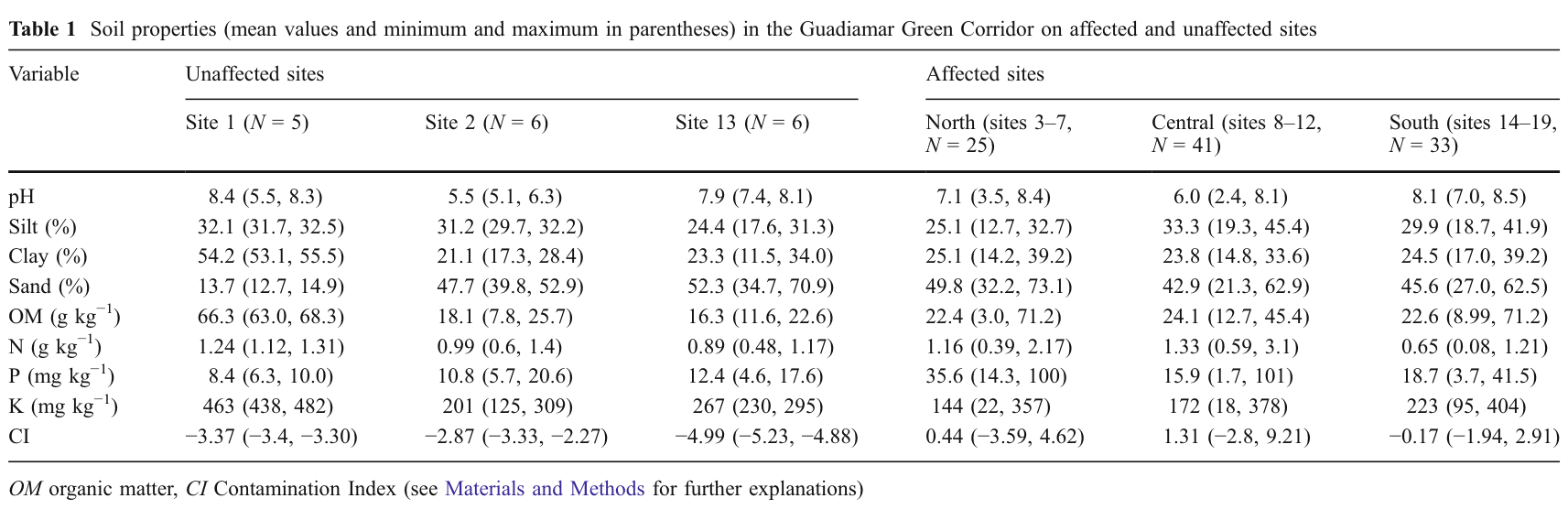
Northern areas were mostly sandy-loam and loam; while most frequent soils at Central and Southern areas were loam and clay-loam. The pH values were highly variable within the affected sites and included extremely acid soils (pH<4). Many soils (45%) had N-concentrations <1 g kg−1, a value considered low for Southern Spanish loamy soils (CAC 1992). Similarly, 50% of the sampled soils had low organic matter content of <20 g kg−1. The availability of P was highly variable, especially within the affected area, ranging from 1.7 to 101 mg kg−1. Nearly 40% of the soils had a comparatively low P availability (<13 mg kg−1). However, 40% of soils had a high Olsen-P concentration (>20 mg kg−1). Most of the soils had normal to low levels of available K (<200 mg kg−1). Trace element concentrations (As, Bi, Cd, Cu, Pb, and Zn) were relatively high in the spill-affected sites (Appendix (Table 6)). Arsenic was the most important contaminant, with an average concentration of 129 mg kg−1 in affected sites; it is remarkable that this average value is much higher than the upper limit of the range of normal values for agricultural soils (40 mg kg−1, Bowen 1979). The most contaminated sites (as indicated by the Contamination Index) were located at the Northern and Central areas of the Guadiamar Green Corridor.
北部区域土壤主要为砂壤土和壤土,而中部和南部区域最常见的土壤为壤土和黏壤土。受影响样点内pH值变化很大,包括极酸性土壤(pH<4)。许多土壤(45%)N浓度<1 g kg−1,该值对于西班牙南部壤质土壤而言属偏低水平(CAC 1992)。同样,50%的土壤样品有机质含量偏低,<20 g kg−1。P有效性变化很大,尤其在受影响区域内,范围为1.7至101 mg kg−1。近40%的土壤P有效性相对较低(<13 mg kg−1),但也有40%的土壤Olsen-P浓度较高(>20 mg kg−1)。大多数土壤速效K处于正常至偏低水平(<200 mg kg−1)。受泄漏影响样点的微量元素(As、Bi、Cd、Cu、Pb和Zn)浓度相对较高(附录(表6))。As是最主要的污染物,受影响样点平均浓度为129 mg kg−1;值得注意的是,该平均值远高于农业土壤正常值范围的上限(40 mg kg−1,Bowen 1979)。污染最严重的样点(以污染指数表征)位于Guadiamar绿色走廊的北部和中部区域。
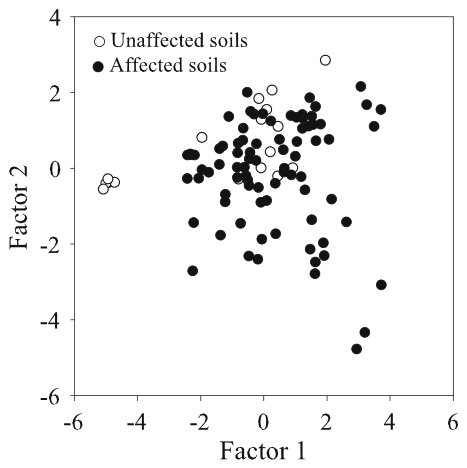
The PCA of the soil data revealed three factors with eigenvalues >1, explaining 73% of the variance (Table 2). Factor 1 had high weightings for soil texture, organic matter, and available K, the latter two were negatively correlated with sand content. Factor 2 was defined by soil pH, negatively correlated with total N and contamination (CI). Factor 3 was associated with Olsen-P. The negative correlation between CI and pH was especially high in the Central areas (r = −0.50, p = 0.001). The distribution of the soil samples in the PCA diagram (Fig. 3) illustrates the high variability of the soil properties. Even the unaffected soils had distinct textures and organic matter contents, as indicated by their positions along the Factor 1 axis. The range of coordinates in the Factor 2 axis indicates the variability in pH values and the trend of lower pH in the contaminated soils.
土壤数据的PCA提取出3个特征值>1的因子,共解释73%的方差(表2)。因子1在土壤质地、有机质和速效K上具有较高载荷,后两者与砂粒含量呈负相关。因子2由土壤pH界定,pH与全N及污染程度(CI)呈负相关。因子3与Olsen-P相关。CI与pH之间的负相关在中部区域尤为明显(r = −0.50, p = 0.001)。土壤样品在PCA图中的分布(图3)表明土壤性质具有高度变异性。即使是未受影响的土壤,其质地和有机质含量也各不相同,这体现在它们沿因子1轴的位置上。因子2轴上坐标的变化范围反映了pH值的变异性以及污染土壤pH偏低的趋势。
| Variable变量 | Factor 1 (38.7%)因子1(38.7%) | Factor 2 (22%)因子2(22%) | Factor 3 (12.3%)因子3(12.3%) |
|---|---|---|---|
| pH | −0.40 | 0.79 | 0.11 |
| Silt | −0.68 | −0.31 | −0.21 |
| Clay | −0.87 | −0.16 | 0.03 |
| Sand | 0.92 | 0.20 | 0.09 |
| OM | −0.66 | −0.34 | 0.25 |
| N | −0.23 | −0.65 | 0.47 |
| P | 0.14 | 0.29 | 0.86 |
| K | −0.73 | 0.48 | 0.09 |
| CI | 0.47 | −0.59 | 0.12 |
The percentage of variance explained by each factor is also indicated OM organic matter, CI Contamination Index
同时给出了各因子解释的方差百分比。OM:有机质;CI:污染指数
3.2 Leaf Chlorophyll and Nutrients in Trees3.2 树木叶片叶绿素与养分
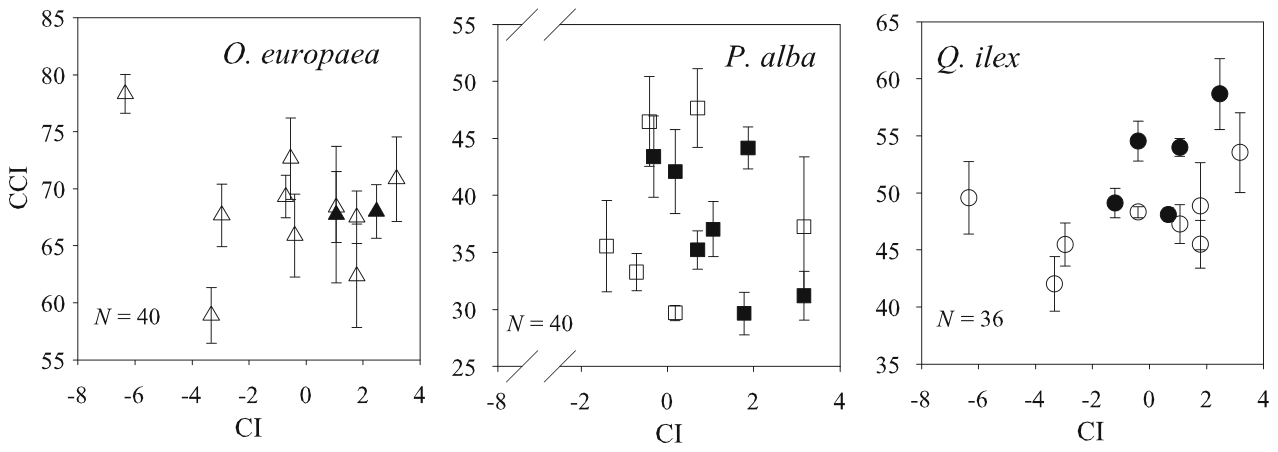
The average Chlorophyll Content Index values (CCI, hereafter referred as "chlorophyll" for simplicity) were 67, 37, and 50 for the leaves of O. europaea, P. alba, and Q. ilex, respectively. The afforested Q. ilex saplings had lower leaf chlorophyll than adult trees (Table 3). For the other two species, there were no differences between life-stages. Considering the average chlorophyll content in the leaves of each site individually and for each species, there was no significant relationship with soil contamination (Fig. 4).
O. europaea、P. alba和Q. ilex叶片的叶绿素含量指数(CCI,为简便起见下文称“叶绿素”)平均值分别为67、37和50。造林的Q. ilex幼树叶片叶绿素低于成年树(表3),其他两个树种不同生活阶段之间无差异。按样点和树种分别计算叶片平均叶绿素含量,其与土壤污染之间无显著关系(图4)。
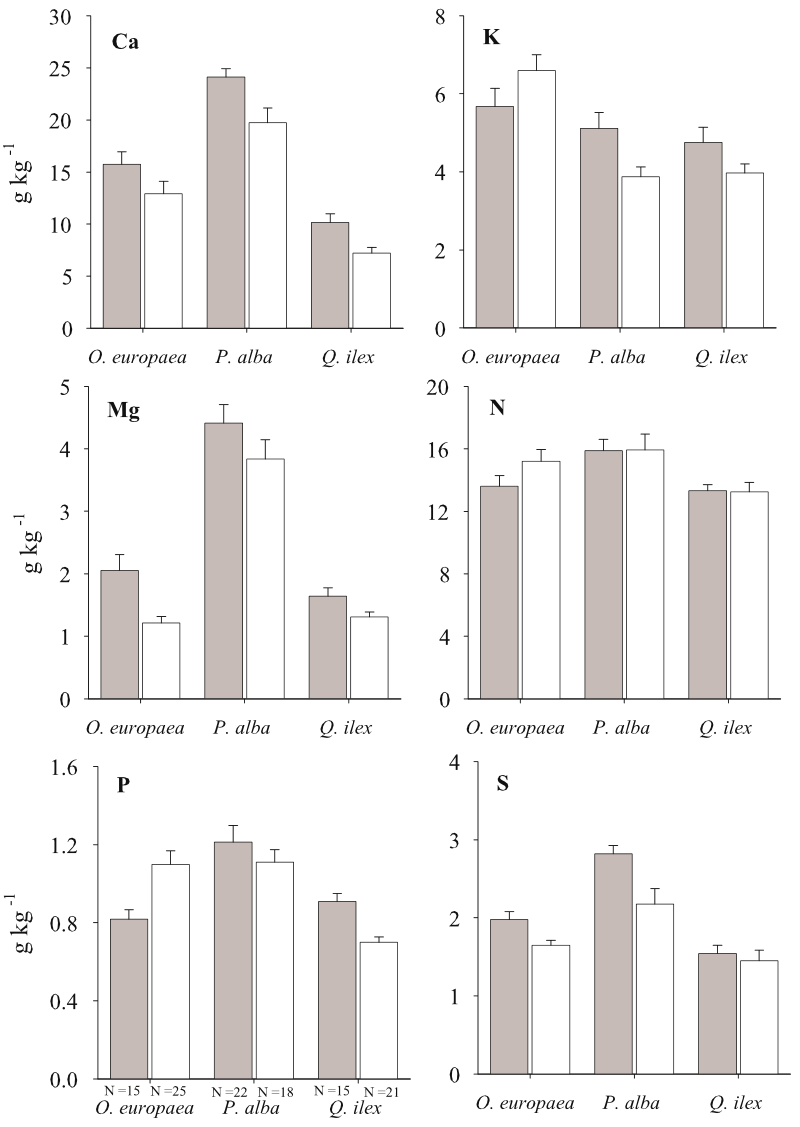
Leaf nitrogen levels were similar for the three species, ranging between 12 and 16 g kg−1. Phosphorus concentrations varied from 0.70 g kg−1 (Q. ilex saplings) up to 1.25 g kg−1 (P. alba adults). P. alba had the highest concentrations for Ca, Mg, and S (Fig. 5). For each species, there were some differences between adult trees and the afforested saplings (Table 3). In most cases, these differences indicated a higher leaf concentration of nutrients in adult trees, with the exception of P concentrations for O. europaea, which were lower in the adult trees. The ratios between N and S, P, K, and Mg (respectively) also varied between life-stages (Table 4). In particular, there was a significant difference in the ratio N:P between Q. ilex saplings (mean value of 19) and adults (mean value of 15) which indicates a relative deficiency in P content of the afforested oak saplings.
三个树种叶片氮含量相近,为12至16 g kg−1。磷浓度从0.70 g kg−1(Q. ilex幼树)至1.25 g kg−1(P. alba成年树)不等。P. alba的Ca、Mg和S浓度最高(图5)。各树种成年树与造林幼树之间均存在一定差异(表3)。多数情况下,这些差异表现为成年树叶片养分浓度较高,但O. europaea的P浓度例外,成年树较低。N与S、P、K和Mg的比值(分别)在不同生活阶段间也存在差异(表4)。特别是,Q. ilex幼树(平均值19)与成年树(平均值15)的N:P比差异显著,表明造林栎树幼树P含量相对缺乏。
Significance levels after controlling the FDR at the 5% level was pt=0.0316. Significant values are indicated in italics A adult trees, S saplings
将FDR控制在5%水平后的显著性水平为pt=0.0316。显著值以斜体表示。A:成年树;S:幼树
| O. europaeO. europae | a | P. albaP. alba | Q. ilexQ. ilex | |||
|---|---|---|---|---|---|---|
| N = 15 (A) | , 25 (S) | N = 22(A), | 18 (S) | N = 15 (A) | , 21 (S) | |
| t-value | p | t-value | p | t-value | p | |
| CCI | 0.65 | 0.5201 | −0.06 | 0.9493 | −3.86 | 0.0006 |
| Ca | −1.82 | 0.0761 | −3.00 | 0.0048 | −3.05 | 0.0044 |
| K | 1.42 | 0.1630 | −2.52 | 0.0159 | −1.78 | 0.0846 |
| Mg | −3.68 | 0.0007 | −1.34 | 0.1890 | −0.21 | 0.8350 |
| N | 1.25 | 0.2176 | −0.04 | 0.9706 | −2.24 | 0.0316 |
| P | 2.95 | 0.0054 | −0.92 | 0.3610 | −4.30 | 0.0001 |
| S | −2.97 | 0.0051 | −3.20 | 0.0028 | −0.56 | 0.5796 |
| N:K | −0.53 | 0.5994 | 2.62 | 0.0126 | 1.36 | 0.1826 |
| N:Mg | 3.53 | 0.0011 | 0.81 | 0.4248 | 1.73 | 0.0935 |
| N:P | −1.66 | 0.1049 | 0.91 | 0.3681 | 3.95 | 0.0004 |
| N:S | 2.92 | 0.0058 | 2.61 | 0.0130 | 0.83 | 0.4151 |
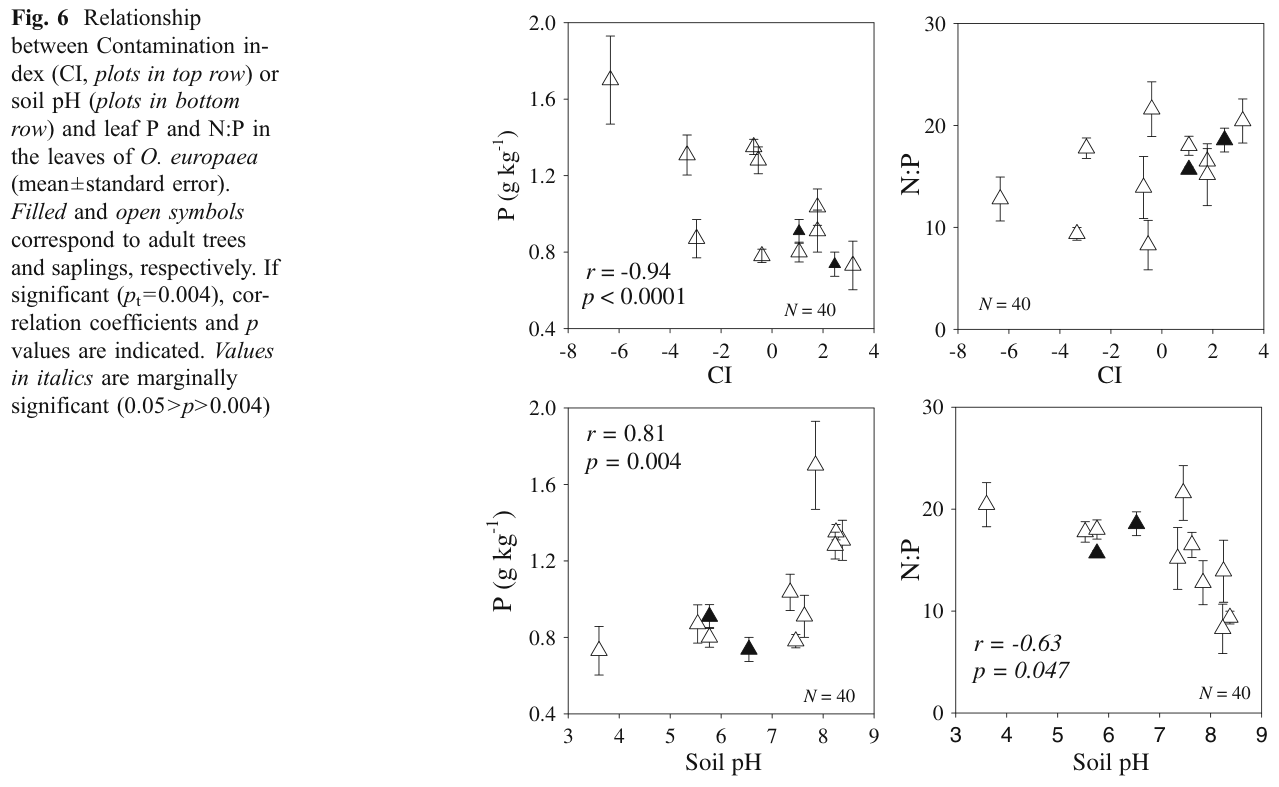
An analysis at the site level revealed a negative relationship between soil contamination and the P concentrations in the leaves of O. europaea (Fig. 6). For this species, soil pH was positively correlated with P concentrations and negatively correlated with the N: P ratio (Fig. 6). Consequently, in the most contaminated sites, the P concentrations were much lower than in the unaffected sites. For example, the wild olive saplings growing on sites 4 and 10 (affected) had some 33% less P than those on unaffected sites.
样点水平的分析表明,土壤污染与O. europaea叶片P浓度呈负相关(图6)。对该树种而言,土壤pH与P浓度呈正相关,与N: P比呈负相关(图6)。因此,在污染最严重的样点,P浓度远低于未受影响样点。例如,生长在样点4和10(受影响)的野生油橄榄幼树,其P含量比未受影响样点的幼树低约33%。
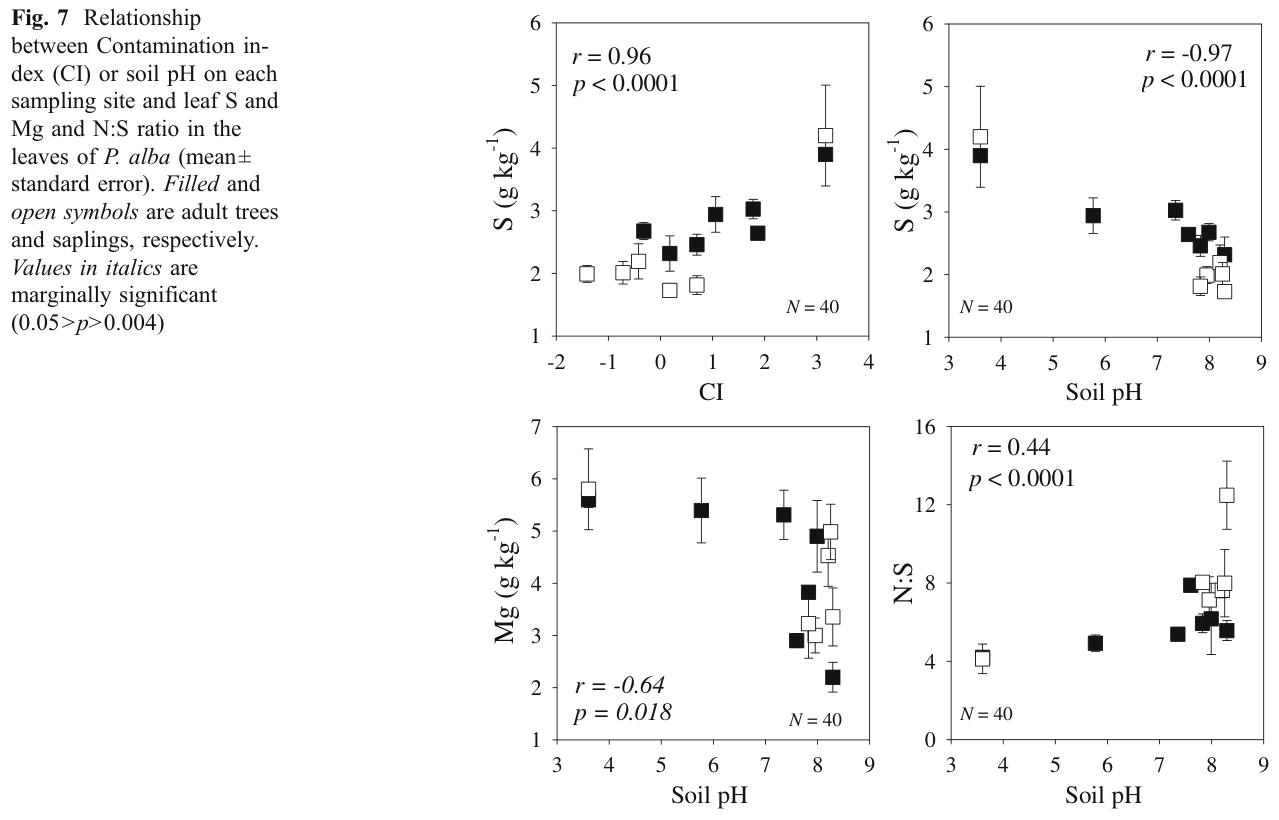
For P. alba, there was an increase in leaf S with higher soil contamination levels (Fig. 7). Soil pH was highly correlated with the average leaf S at each site (Fig. 7) and showed marginally significant correlations (0.05>p>0.004) with leaf Mg (negative) and N: S (positive). For Q. ilex, we did not find any similar relationship between the soil contamination level and the leaf concentration of any nutrient.
对于P. alba,叶片S随土壤污染程度升高而增加(图7)。土壤pH与各样点叶片S平均值高度相关(图7),并与叶片Mg(负相关)和N: S(正相关)呈边缘显著相关(0.05>p>0.004)。对于Q. ilex,未发现土壤污染程度与任何养分叶片浓度之间存在类似关系。
3.3 Soil Factors Influencing Leaf Chlorophyll and Nutrient Concentrations3.3 影响叶片叶绿素和养分浓度的土壤因子
The models obtained by multiple regressions, considering each tree and its surrounding soil individually, reflect the influences of soil conditions on leaf chlorophyll and nutrients. In the case of P concentrations in the leaves of O. europaea adults, soil contamination was the only significant predictor in the model and explained a 40% of the variance of leaf P (Table 5). In these trees, contamination was also negatively related to the N:S ratio, although soil texture had a higher relative importance in the variance of this variable (indicated by the β coefficient of the model). In the O. europaea saplings, soil contamination negatively influenced the plants’ chlorophyll content and the N:Mg ratio. For chlorophyll, the model was highly significant and explained a high percentage of the variance (r2=0.72, p<0.001). For N:Mg ratio, soil pH was also a significant predictor and its influence was higher than that corresponding to contamination. In these saplings, soil pH positively influenced leaf Mg; thus, under acidic conditions the N:Mg increased, due to a probable decrease in Mg uptake. Likewise, there was a negative correlation between soil pH and the N:P ratio (Table 5).
以单株树及其周围土壤为单位建立的多元回归模型反映了土壤条件对叶片叶绿素和养分的影响。对于O. europaea成年树叶片P浓度,土壤污染是模型中唯一的显著预测变量,解释了叶片P方差的40%(表5)。在这些树中,污染与N:S比也呈负相关,但土壤质地对该变量方差的相对重要性更高(以模型β系数表示)。在O. europaea幼树中,土壤污染对叶绿素含量和N:Mg比产生负面影响。对于叶绿素,模型高度显著且解释了较高比例的方差(r2=0.72, p<0.001)。对于N:Mg比,土壤pH也是显著预测变量,且其影响大于污染的影响。在这些幼树中,土壤pH对叶片Mg有正向影响;因此,在酸性条件下N:Mg升高,可能是由于Mg吸收减少所致。同样,土壤pH与N:P比呈负相关(表5)。
In contrast to O. europaea, the uptake of some nutrients by P. alba responded positively to soil contamination or acidification. For example, soil contamination was a positive predictor for leaf K in adult trees; decreasing pH increased the leaf S and, marginally (p>0.025), the leaf Mg in the saplings. The exception was the N to P ratio: for this variable soil pH was a negative predictor, explaining a 30% of the variance; this indicates that, under acidic conditions, the trees showed a relative P deficiency.
与O. europaea相反,P. alba对某些养分的吸收对土壤污染或酸化呈正向响应。例如,土壤污染是成年树叶片K的正向预测变量;pH降低使幼树叶片S增加,并边缘显著地(p>0.025)使叶片Mg增加。例外的是N与P的比值:对该变量而言,土壤pH为负向预测变量,解释了30%的方差;这表明在酸性条件下,树木表现出相对的P缺乏。
Similarly to P. alba trends, contamination was positively correlated with leaf S in Q. ilex saplings and negatively with the N:S ratio.
与P. alba的趋势类似,Q. ilex幼树中污染与叶片S呈正相关,与N:S比呈负相关。
3.4 Interactions Between Leaf Trace Elements and Chlorophyll and Nutrients
3.4 叶片微量元素与叶绿素及养分之间的相互作用
Some of the above-mentioned patterns were related with the interactions between non-essential elements (such as As, Pb, and Cd) and nutrients in the leaves of the trees. For example, in O. europaea saplings chlorophyll and
上述部分规律与树木叶片中非必需元素(如As、Pb和Cd)与养分之间的相互作用有关。例如,在O. europaea幼树中,叶绿素与
| Ratio比值 | Olea europaeaOlea europaea | Populus albaPopulus alba | Quercus ilexQuercus ilex | |||
|---|---|---|---|---|---|---|
| Adult (N = 15) | Sapling (N = 25) | Adult (N = 22) | Sapling (N = 18) | Adult (N = 15) | Sapling (N = 21) | |
| N:K | 2.70 ± 0.35 | 2.52 ± 0.23 | 3.45 ± 0.30 | 4.36 ± 0.24 | 3.02 ± 0.20 | 3.59 ± 0.29 |
| N:Mg | 7.85 ± 0.86 | 14.8 ± 1.4 | 4.03 ± 0.38 | 4.5 ± 0 .49 | 8.93 ± 0.79 | 10.9 ± 0.9 |
| N:P | 16.9 ± 0.6 | 15.0 ± 1.1 | 14.1 ± 1.0 | 14.9 ± 0.7 | 15.0 ± 0.6 | 19.2 ± 0.8 |
| N:S | 7.15 ± 0.50 | 9.34 ± 0.43 | 5.78 ± 0.32 | 7.78 ± 0.68 | 9.08 ± 0.56 | 10.2 ± 0.7 |
Significance levels in the comparison between adult trees and saplings are indicated in Table 3
成年树与幼树比较的显著性水平见表3
Pb showed a negative relationship (r=−0.73, p<0.001). Likewise, P was negatively correlated with As in the adult olive trees (r=−0.68, p=0.005), and, marginally, in the saplings (r=−0.436, p=0.037). A marginal influence of Bi on P levels was also observed for the saplings (r=−0.439, p=0.036). The K concentration showed a highly significant relationship with As in the leaves of the adult olive trees (r=−0.81, p<0.001).
Pb呈负相关(r=−0.73, p<0.001)。同样,在成年油橄榄树中P与As呈负相关(r=−0.68, p=0.005),在幼树中亦呈边缘显著负相关(r=−0.436, p=0.037)。在幼树中还观察到Bi对P水平的边缘显著影响(r=−0.439, p=0.036)。成年油橄榄树叶片中K浓度与As呈极显著相关(r=−0.81, p<0.001)。
In contrast, for the other two species there were some positive interactions between trace elements and some nutrients, especially for P. alba. For example, between K and Cu (r=0.62, p=0.002) and Tl and Mg (r=0.711, p=0.001) in adult trees. Again, the exception was related to leaf P, having a marginal and negative interaction between As and P in P. alba saplings (r=−0.57, p=0.016).
相比之下,其他两个树种的微量元素与部分养分之间存在一些正向相互作用,P. alba尤为明显。例如,成年树中K与Cu(r=0.62, p=0.002)以及Tl与Mg(r=0.711, p=0.001)之间。同样,例外仍与叶片P有关,P. alba幼树中As与P之间存在边缘显著的负向相互作用(r=−0.57, p=0.016)。
4Discussion讨论
4.1 Nutritional Status of the Trees4.1 树木营养状况
Soil contamination frequently leads to nutrient disorders in plants. Thus, the monitoring of the nutritional status of trees should be addressed in polluted areas, since the enhanced nutrient deficiencies could limit the success of a restoration program. Tree nutritional and health status depends on many soil factors, which determine the availability of nutrients, as well as the bioavailability of potentially toxic elements. In this study, we assessed the nutritional status of three different tree species, growing in afforested sites with different degree of soil degradation (elevated trace element concentrations and acidification).
土壤污染常导致植物养分失调。因此,在污染区域应开展树木营养状况监测,因为加剧的养分缺乏可能限制修复计划的成效。树木的营养和健康状况取决于诸多土壤因子,这些因子决定了养分的有效性以及潜在有毒元素的生物有效性。本研究评估了生长在不同土壤退化程度(微量元素浓度升高和酸化)造林样点上的三个不同树种的营养状况。
We found some evidences of nutrient deficiencies in the studied species. In general, the afforested saplings had lower nutrient concentrations than the adult trees. For adult O. europaea, N and K leaf concentrations were lower than the values reported for trees growing on uncontaminated sites (Madejón 2004); and were below the optimal thresholds for cultivated olive (according to Fernández-Escobar 1997). At some affected sites, the N:P ratio in both adult and sapling trees of O. europaea was above 16, indicating a P limitation (Koerselman and Meuleman 1996).
研究发现所研究树种存在一定的养分缺乏迹象。总体而言,造林幼树的养分浓度低于成年树。O. europaea成年树叶片N和K浓度低于生长在未污染样点树木的报道值(Madejón 2004),并低于栽培油橄榄的最适阈值(依据Fernández-Escobar 1997)。在部分受影响样点,O. europaea成年树和幼树的N:P比均高于16,表明存在P限制(Koerselman and Meuleman 1996)。
The concentrations of all macronutrients in P. alba (in both adult trees and saplings) were suboptimal (according to Kopinga and van den Burg 1995). However, the nutrient levels were similar to those reported for adult trees growing in a nearby uncontaminated riparian forest (Madejón et al. 2004).
P. alba(成年树和幼树)所有大量元素浓度均低于最适水平(依据Kopinga and van den Burg 1995)。然而,其养分水平与附近未污染河岸林中成年树的报道值相近(Madejón et al. 2004)。
The leaf concentrations of N and P in Q. ilex saplings were below the levels reported for seedlings of the same species, but growing under optimal conditions (Cornelissen et al. 1997). Mean N:P ratios in saplings over the whole study area were much higher than 16 (Table 3), indicating a strong P limitation (Koerselman and Meuleman 1996).
Q. ilex幼树叶片N和P浓度低于同种幼苗在最适条件下生长时的报道水平(Cornelissen et al. 1997)。整个研究区域幼树的平均N:P比远高于16(表3),表明存在强烈的P限制(Koerselman and Meuleman 1996)。
4.2 Influence of Soil Conditions on Leaf Nutrients and Chlorophyll4.2 土壤条件对叶片养分和叶绿素的影响
In the Guadiamar Green Corridor we found a high level of heterogeneity in soil properties, 7 years after the soil remediation works, which partly explained the differences in the concentrations of some nutrients in the trees growing there.
在土壤修复工程完成7年后,Guadiamar绿色走廊土壤性质仍具有高度异质性,这在一定程度上解释了该区域树木某些养分浓度的差异。
The soils in the affected area still presented high concentrations of trace elements, with a high variability even within each site, due to the irregular sludge deposition and the irregular cleanup of the soils. For example, in a same site soils beneath adult individuals were more contaminated and had lower pH than those beneath afforested saplings, due to the difficulty of removing the sludge and topsoil from forested areas (data not shown). The bioavailability of the cationic trace elements in the Guadiamar area is primarily determined by soil pH, with soil organic matter content or soil texture having little influence (Domínguez et al. 2009). Thus, in the acidic sites the interactions between soil contaminants and plant nutrition may be greater. Soil pH was one of the most important soil factors explaining nutrient variability in the leaves of trees.
由于尾矿泥沉积不均和土壤清理不彻底,受影响区域土壤仍含有高浓度微量元素,且即使在同一样点内变异也很大。例如,在同一样点,由于难以从林地清除尾矿泥和表土,成年树下的土壤比造林幼树下的土壤污染更重、pH更低(数据未列出)。Guadiamar地区阳离子型微量元素的生物有效性主要由土壤pH决定,土壤有机质含量或质地的影响很小(Domínguez et al. 2009)。因此,在酸性样点,土壤污染物与植物营养之间的相互作用可能更强。土壤pH是解释树木叶片养分变异最重要的土壤因子之一。
A decrease in soil pH was associated with contamination, due to the leaching of acids generated by the oxidation of sulfides in the remnant of sludge in the soils (Kraus and Wiegand 2006). Sugar beet lime, which had 70–80% CaCO3, was the most used amendment. The application rates during the remediation work were higher in the most contaminated sites (Arenas et al. 2008). Nevertheless, the most contaminated sites were highly acidified and carbonate content was lower than 1% (Domínguez et al. 2008). Therefore, the carbonates supplied in the amendments may have already been attenuated by acid generation from the contaminating sludge. In contrast, the nutrient concentrations, particularly P, in the soils still reflected the application of the amendments. On average, the spill-affected sites had significantly higher Olsen-P than non-affected sites (data not shown). Some 40% of the soils had P concentrations higher than 20 mg kg−1, which is significantly higher than the background values for this region. Contaminated soils in central areas had P concentrations up to 100 mg kg−1 (Table 1). This reflects the high P content of the sugar beet lime (up to 5.1 g kg−1, Madejón et al. 2006). Under experimental conditions, the addition of sugar beet lime to soils from the
土壤pH降低与污染相关,这是由于土壤中残留尾矿泥的硫化物氧化产生的酸发生淋溶所致(Kraus and Wiegand 2006)。使用最多的改良剂是CaCO3含量为70–80%的甜菜制糖石灰渣。修复工程中污染最严重样点的施用量更高(Arenas et al. 2008)。然而,污染最严重的样点酸化严重,碳酸盐含量低于1%(Domínguez et al. 2008)。因此,改良剂提供的碳酸盐可能已被污染尾矿泥产酸所消耗。相反,土壤养分浓度,特别是P,仍反映出改良剂施用的影响。平均而言,受泄漏影响样点的Olsen-P显著高于未受影响样点(数据未列出)。约40%的土壤P浓度高于20 mg kg−1,显著高于该地区的本底值。中部区域污染土壤P浓度高达100 mg kg−1(表1),这反映了甜菜制糖石灰渣的高P含量(高达5.1 g kg−1,Madejón et al. 2006)。在试验条件下,向来自
| Species物种 | Leaf variable叶片变量 | Soil predictor土壤预测变量 | β | p | Model adjusted r2模型调整r2 | Model p模型p |
|---|---|---|---|---|---|---|
| O. europaea adults | P | CI | −0.53 | 0.032 | 0.39 | 0.025 |
| N = 15 | N | CI | −0.49 | 0.049 | 0.43 | 0.033 |
| Clay | 0.70 | 0.010 | ||||
| S | CI | 0.53 | 0.048 | 0.23 | 0.048 | |
| N:S | CI | −0.67 | 0.002 | 0.65 | 0.003 | |
| Clay | 0.70 | 0.002 | ||||
| O. europaea saplings | CCI | CI | −0.47 | 0.007 | 0.72 | <0.001 |
| N = 25 | Clay | −0.61 | 0.003 | |||
| OM | −0.46 | 0.002 | ||||
| K | Clay | −0.52 | 0.008 | 0.66 | <0.001 | |
| pH | −0.89 | <0.001 | ||||
| P | 0.34 | 0.021 | ||||
| K | 1.21 | <0.001 | ||||
| Mg | pH | 0.73 | 0.006 | 0.32 | 0.022 | |
| P | −0.55 | 0.014 | ||||
| K | −0.64 | 0.012 | ||||
| N:P | pH | −0.61 | <0.001 | 0.62 | <0.001 | |
| P | 0.68 | <0.001 | ||||
| N:Mg | CI | −0.39 | 0.047 | 0.50 | 0.003 | |
| pH | −0.74 | 0.002 | ||||
| P | 0.71 | <0.001 | ||||
| K | 0.86 | 0.003 | ||||
| P. alba adults | K | CI | 0.97 | 0.013 | 0.37 | 0.009 |
| N = 22 | pH | 0.53 | 0.047 | |||
| S | pH | −0.46 | 0.014 | 0.70 | <0.001 | |
| N | 0.28 | 0.046 | ||||
| N:K | CI | −0.79 | 0.012 | 0.24 | 0.047 | |
| N:P | pH | −0.57 | 0.010 | 0.25 | 0.024 | |
| P. alba saplings | Mg | pH | −0.56 | 0.030 | 0.26 | 0.030 |
| N = 18 | S | pH | −0.81 | <0.001 | 0.87 | <0.001 |
| OM | 0.31 | 0.030 | ||||
| N:P | pH | −0.61 | 0.020 | 0.32 | 0.020 | |
| Q. ilex saplings | S | CI | 0.73 | <0.001 | 0.65 | <0.001 |
| N = 21 | N:S | CI | −0.68 | <0.001 | 0.43 | <0.001 |
Significance level (after controlling the FDR at the 5% level) was pt=0.025. Values in italics are marginally significant (0.05>p<0.025)
显著性水平(将FDR控制在5%水平后)为pt=0.025。斜体数值为边缘显著(0.05>p<0.025)
Guadiamar Green Corridor resulted in the enrichment in P to levels up to three times higher than P levels in the unamended soils, 30 months after application. The relative increase of nutrient concentrations after application was higher for P than for other nutrients (Pérez-de-Mora et al., 2007).
Guadiamar绿色走廊的土壤中添加甜菜制糖石灰渣后,施用30个月后P富集至未改良土壤P水平的3倍。施用后P浓度的相对增幅高于其他养分(Pérez-de-Mora et al., 2007)。
Some of the detected nutrient deficiencies, particularly P, in the afforested trees were significantly related to either the level of soil contamination or to soil acidification. For example, there was a strong negative interaction between the index of soil contamination and the P uptake for O. europaea.
所检测到的造林树木部分养分缺乏,特别是P缺乏,与土壤污染程度或土壤酸化显著相关。例如,O. europaea的土壤污染指数与P吸收之间存在强烈的负向相互作用。
There are several possible explanations for these negative interactions among trace elements and nutrients. Arsenic may interfere with plant P uptake, since arsenate and phosphate are analog ions; they compete in the soil matrix and As is transported across the plasma membrane through phosphate transport systems (Meharg and Hartley-Whitaker 2002). Arsenic was one of the most important soil contaminants in the Guadiamar Green Corridor; the mean As concentration of 130 mg kg−1 and maximum of 340 mg kg−1 (Appendix 1) were high in comparison with P concentrations (mean of 23 mg kg−1 and maximum of 100 mg kg−1, Table 1). In fact, for O. europaea we found negative correlations at the leaf level between As and P; therefore, some competitive interaction may be taking place at the root level. However, this effect would be greater on basic soils, since anionic trace elements such as arsenate are more mobile at higher pH (Adriano 2001). In contrast, we found that trees growing in acidic sites showed the highest P deficiencies.
微量元素与养分之间的这些负向相互作用有几种可能的解释。As可能干扰植物对P的吸收,因为砷酸根与磷酸根为类似离子;二者在土壤基质中相互竞争,且As通过磷酸盐转运系统跨质膜转运(Meharg and Hartley-Whitaker 2002)。As是Guadiamar绿色走廊最主要的土壤污染物之一,其平均浓度130 mg kg−1和最大值340 mg kg−1(附录1)相对于P浓度(平均23 mg kg−1,最大100 mg kg−1,表1)较高。事实上,对于O. europaea,我们在叶片水平发现As与P呈负相关;因此,根系水平可能存在某种竞争性相互作用。然而,由于砷酸根等阴离子型微量元素在较高pH下迁移性更强(Adriano 2001),这种效应在碱性土壤中应更为明显。相反,我们发现生长在酸性样点的树木P缺乏最为严重。
This could be explained by a decrease in P availability in acid soils, due to increases in P sorption capacity and decreases in the rate of organic phosphorus mineralization (Paré and Bernier 1989; Carreira et al. 1997). Oxides of Al, Fe, and Mn dominate P sorption in acid soils. Under acidic conditions, P sorption by Fe oxides could thus reduce the P availability. However, acidity and contamination were not related to P availability in the studied soils. Therefore, the decrease in the P concentrations in the leaves of some plants (mainly O. europaea) in the most degraded sites cannot be atributable to a limited availability of soil P, but to some interaction between soil degradation and P uptake by roots or P translocation to the leaves.
这可能是由于酸性土壤中P吸附容量增加、有机磷矿化速率降低,导致P有效性下降(Paré and Bernier 1989; Carreira et al. 1997)。酸性土壤中P的吸附主要由Al、Fe和Mn氧化物主导。因此,在酸性条件下,Fe氧化物对P的吸附可能降低P有效性。然而,在所研究的土壤中,酸度和污染与P有效性并无关联。因此,在退化最严重的样点,部分植物(主要为O. europaea)叶片P浓度的下降不能归因于土壤P有效性受限,而应归因于土壤退化与根系P吸收或P向叶片转运之间的某种相互作用。
The toxicity at the root level may be hampering the nutrient acquisition in the most contaminated and acidic soils, since there the solubility of toxic trace elements is higher at low pH (Greger 1999). Several studies with woody species have reported root damage by trace elements, but low contaminant transport from roots to shoots (Arduini et al. 1996; Wisniewski and Dickinson 2003; Fuentes et al. 2007b). However, non-specific morphological damage at the root level may hamper the uptake of several nutrients, and we have found that P uptake was reduced, while the uptake of other nutrients was enhanced in the most acidic and contaminated sites.
在污染最严重的酸性土壤中,由于低pH下有毒微量元素溶解度更高(Greger 1999),根系水平的毒性可能阻碍养分获取。多项针对木本植物的研究报道了微量元素对根系的损伤,但污染物从根向地上部的转运较少(Arduini et al. 1996; Wisniewski and Dickinson 2003; Fuentes et al. 2007b)。然而,根系水平的非特异性形态损伤可能阻碍多种养分的吸收;而我们发现,在酸性最强和污染最严重的样点,P吸收减少,而其他养分的吸收却有所增强。
That P is the most affected nutrient may be due to the precipitation of phosphates with soluble cationic trace elements in the rhizosphere (Rolfe 1973; Ruby et al. 1994), which might be enhanced in the most contaminated and acidic sites. The precipitation of cationic elements with phosphate can reduce the bioavailability of these elements in soils, ameliorating their toxicity and reducing the accumulation of trace elements in the leaves (Brown et al. 2004; Bosso et al. 2008). This mechanism of trace element-phosphate interaction could contribute to keep the low trace element accumulation in the leaves of O. europaea, even in highly contaminated and acidic sites.
P成为受影响最大的养分,可能是由于根际中磷酸盐与可溶性阳离子型微量元素发生沉淀(Rolfe 1973; Ruby et al. 1994),而这一过程在污染最严重的酸性样点可能更为强烈。阳离子型元素与磷酸盐的沉淀可降低这些元素在土壤中的生物有效性,从而减轻其毒性并减少微量元素在叶片中的积累(Brown et al. 2004; Bosso et al. 2008)。这种微量元素–磷酸盐相互作用机制可能有助于使O. europaea叶片即使在高污染酸性样点也保持较低的微量元素积累。
For the other two species, Q. ilex and P. alba, the interactions between soil degradation and P uptake were less clear. Nevertheless, there were also some effects of soil contamination on the N:P ratios of the leaves. The reason why O. europaea is the most sensitive species, in terms of P nutrition, to soil contamination is unclear and deserves further research. Different plant species can have different mechanisms for P uptake and O. europaea may be less efficient in accessing P from metal–phosphate complexes than the other two studied species. In general, phosphorus is a frequent limiting nutrient in Mediterranean ecosystems and can limit the growth of Mediterranean woody plant seedlings (Sardans et al. 2004; Villar-Salvador et al. 2004). Thus, the inhibition of P uptake by soil degradation could hamper the development of a woody plant cover on this remediated and afforested area.
对于另外两个树种Q. ilex和P. alba,土壤退化与P吸收之间的相互作用不太明显。尽管如此,土壤污染对叶片N:P比也存在一定影响。就P营养而言,O. europaea为何对土壤污染最敏感尚不清楚,值得进一步研究。不同植物物种可能具有不同的P吸收机制,O. europaea从金属–磷酸盐复合物中获取P的效率可能低于其他两个研究树种。总体而言,磷是地中海生态系统中常见的限制性养分,可限制地中海木本植物幼苗的生长(Sardans et al. 2004; Villar-Salvador et al. 2004)。因此,土壤退化对P吸收的抑制可能阻碍该修复造林区域木本植被的形成。
In contrast to the negative effects on phosphorus nutrition, for P. alba (and to a lesser extent also for Q. ilex) the altered soil conditions (with high level of trace elements and low pH) enhanced the uptake of several nutrients. This unexpected result may be a short-term result of soil acidification. In forest soils with a pH<4, Ca2+, Mg2+, and K+ are released to the soil solution (Rehfuess 1989; Foster et al. 1989). In the short-term, this may enhance the nutrient uptake and tree growth (Likens et al. 1996; Tomlinson 2003). P. alba (a fastgrowing deciduous tree) may respond faster to this release of cationic nutrients than O. europaea and Q. ilex (slow-growing evergreen trees). However, if cation inputs to the soil are low, a possible long-term loss of cationic bases due to soil acidification may negatively influence the uptake of cationic nutrients by the trees in the future (Likens et al. 1996; Tomlinson 2003).
与对磷营养的负面影响相反,对于P. alba(Q. ilex程度较轻),改变后的土壤条件(高微量元素水平和低pH)增强了多种养分的吸收。这一意外结果可能是土壤酸化的短期效应。在pH<4的森林土壤中,Ca2+、Mg2+和K+会释放到土壤溶液中(Rehfuess 1989; Foster et al. 1989)。短期内,这可能促进养分吸收和树木生长(Likens et al. 1996; Tomlinson 2003)。P. alba(速生落叶树种)对阳离子养分释放的响应可能快于O. europaea和Q. ilex(慢生常绿树种)。然而,若土壤阳离子输入较少,土壤酸化可能导致盐基阳离子长期流失,进而在未来对树木吸收阳离子养分产生不利影响(Likens et al. 1996; Tomlinson 2003)。
In general, the chlorophyll content was not sensitive to the nutritional changes induced by soil degradation. In particular, chlorophyll content did not reflect the P deficiencies, which were the main detrimental effect of soil degradation on tree nutrition. The only significant interaction between chlorophyll and soil contamination occurred for O. europaea, coinciding with a decrease in leaf Mg, and therefore with an alteration in the N:Mg ratio. Leaf N and Mg are mostly contained in chlorophyll, so changes in chlorophyll content may be more related to N or Mg limitations. The use of the chlorophyll estimates (CCI) as a rapid and non-destructive measurement of tree health may become more important if some Mg deficiencies appear in the future, as a possible long-term effect of soil degradation.
总体而言,叶绿素含量对土壤退化所引起的养分变化并不敏感。尤其是,叶绿素含量未能反映P缺乏,而P缺乏正是土壤退化对树木营养的主要不利影响。叶绿素与土壤污染之间唯一显著的交互作用出现在O. europaea中,这与叶片Mg含量的下降相一致,因而也与N:Mg比值的改变相一致。叶片中的N和Mg主要存在于叶绿素中,因此叶绿素含量的变化可能更多地与N或Mg的限制有关。如果未来作为土壤退化的一种可能的长期效应而出现Mg缺乏,那么将叶绿素估测值(CCI)作为一种快速、无损的树木健康测定手段可能会变得更加重要。
Guadiamar Green Corridor. Soil contamination and subsequent soil acidification contribute to these P deficiencies, especially for O. europaea. High levels of available P were found on affected soils. Since there were no important soil nutrient limitations in these afforested lands, the benefits of soil fertilization are likely to be small. Soil pH was found to be the most important factor affecting the nutritional status of the trees. In contrast to P, the uptake of some cationic nutrients was enhanced by soil acidification, especially in P. alba. Soil pH monitoring in the area is advisable, since acidification may led to nutrient disorders in the trees, influencing the long-term growth and ecosystem functioning in the Guadiamar Green Corridor.
Guadiamar Green Corridor。土壤污染及随后的土壤酸化加剧了这些P缺乏,对O. europaea尤为如此。在受影响土壤中发现了较高水平的有效P。由于这些造林地并不存在重要的土壤养分限制,土壤施肥的效益可能较小。土壤pH是影响树木营养状况的最重要因素。与P相反,土壤酸化促进了某些阳离子养分的吸收,在P. alba中尤为明显。建议在该地区开展土壤pH监测,因为酸化可能导致树木养分失调,进而影响Guadiamar Green Corridor的长期生长和生态系统功能。
Acknowledgements We acknowledge the Regional Ministry of Environment (Junta de Andalucía) for supporting this study within the SECOVER research program and the Spanish Ministry of Education for a PFU grant awarded to M.T. Domínguez. We thank Dr. Luis V. García for his statistical advice and Olga Cazalla (Centre for Scientific Instrumentation, University of Granada) for the ICP-MS measurements. We are grateful to José María Alegre and Isabel Ibáñez for their help in different stages of the study and to an anonymous reviewer for the comments on a previous version of the manuscript.
致谢 感谢安达卢西亚自治区环境部(Junta de Andalucía)在SECOVER研究计划框架内对本研究的支持,以及西班牙教育部授予M.T. Domínguez的PFU奖学金。感谢Dr. Luis V. García提供的统计学建议,以及Olga Cazalla(格拉纳达大学科学仪器中心)完成的ICP-MS测定。感谢José María Alegre和Isabel Ibáñez在研究各阶段给予的帮助,并感谢一位匿名审稿人对本文先前版本提出的意见。
5Conclusions结论
Appendix附录
There are nutrient deficiencies, particularly of phosphorus, in the trees growing in many sites of the
在以下地区的许多样点中,生长的树木存在养分缺乏,尤其是磷缺乏:
Concentration of trace elements in soil and leaves (adapted from Domínguez et al. 2008).
土壤和叶片中微量元素的浓度(改编自Domínguez et al. 2008)。
| Surface soils (0–25 cm)表层土壤(0–25 cm) | Deep soils (25–40 cm)深层土壤(25–40 cm) | |||
|---|---|---|---|---|
| Affected (N=100) | Unaffected (N=17) | Affected (N=100) | Unaffected (N=17) | |
| As | 129 (49–339) | 17 (13–20) | 95 (18–438) | 16 (14–17) |
| Bi | 1.64 (0.57–5.40) | 0.30 (0.15–0.40) | 1.35 (0.33–4.29) | 0.25 (0.18–0.35) |
| Cd | 1.44 (0.44–3.05) | 0.23 (0.07–0.37) | 1.27 (0.22–3.28) | 0.17 (0.10–0.25) |
| Cu | 115 (66–198) | 32 (13–43) | 110 (30–238) | 24 (14–31) |
| Pb | 210 (73–607) | 47 (15–65) | 179 (38–519) | 31 (18–38) |
| Tl | 1.17 (0.55–4.02) | 0.29 (0.16–0.43) | 0.82 (0.20–3.15) | 0.27 (0.23–0.33) |
| Zn | 457 (183–768) | 109 (47–149) | 376 (103–954) | 82 (53–99) |
| O. europaeaO. europaea | P. albaP. alba | Q. ilexQ. ilex | ||||
|---|---|---|---|---|---|---|
| Adult (N = 15) | Sapling (N = 16) | Adult (N = 22) | Sapling (N = 18) | Adult (N = 15) | Sapling (N = 14) | |
| As | 0.42 ± 0.07 | 0.22 ± 0.03 | 0.63 ± 0.06 | 0.34 ± 0.05 | 0.59 ± 0.07 | 0.54 ± 0.14 |
| Bi | 0.016 ± 0.03 | 0.034 ± 0.010 | 0.018 ± 0.005 | 0.010 ± 0.03 | 0.036 ± 0.004 | 0.016 ± 0.001 |
| Cd | 0.06 ± 0.01 | 0.08 ± 0.02 | 4.90 ± 0.58 | 0.96 ± 0.13 | 0.14 ± 0.02 | 0.29 ± 0.09 |
| Cu | 6.55 ± 0.55 | 7.32 ± 0.80 | 8.16 ± 0.47 | 8.07 ± 0.54 | 13.1 ± 0.9 | 7.18 ± 0.31 |
| Pb | 1.02 ± 0.09 | 0.77 ± 0.07 | 1.28 ± 0.06 | 1.12 ± 0.08 | 3.18 ± 0.40 | 1.72 ± 0.21 |
| Tl | 0.014 ± 0.003 | 0.013 ± 0.003 | 0.053 ± 0.012 | 0.007 ± 0.002 | 0.029 ± 0.009 | 0.013 ± 0.003 |
| Zn | 57.0 ± 5.2 | 28.2 ± 2.5 | 605 ± 45 | 176 ± 22 | 83.5 ± 8.4 | 76.2 ± 16.4 |
References参考文献
Adriano, D. C. (2001). Trace elements in terrestrial environments: Biochemistry, bioavailability and risks of metals. New York: Springer.
Arduini, I., Godbold, D. L., & Onnis, A. (1994). Cadmium and copper change root growth and morphology of Pinus pinea and Pinus pinaster seedlings. Physiologia Plantarum, 92, 675–680. doi:10.1111/j.1399-3054.1994. tb03039.x.
Arduini, I., Godbold, D. L., & Onnis, A. (1996). Cadmium and copper uptake and distribution in Mediterranean tree seedlings. Physiologia Plantarum, 97, 111–117. doi:10.1111/j.1399-3054.1996.tb00486.x.
Arenas, J. M., Carrascal, F., & Montes, C. (2008). Breve historia de la construcción del Corredor Verde del Guadiamar. In C. Montes & F. Carrascal (Eds.), La restauración ecológica del río Guadiamar y el proyecto del Corredor Verde. La historia de un paisaje emergente, pp. 29–64. Sevilla: Consejería de Medio Ambiente, Junta de Andalucía.
Bosso, S. T., Enzweiler, J., & Angélica, R. S. (2008). Lead bioaccessibility in soil and mine wastes after immobilization with phosphate. Water, Air, and Soil Pollution, 195, 257–273.
Bowen, H. J. M. (1979). Environmental chemistry of the elements. London: Academic Press.
Bower, C. A., Reitemeier, R. F., & Fireman, M. (1952). Exchangeable cation analysis of saline and alkali soils. Soil Science, 3, 251–261. doi:10.1111/j.1365-2389.1952. tb00646.x.
Brown, S., Chaney, R., Hallfrisch, J., Ryan, J. A., & Berti, W. R. (2004). In situ soil treatments to reduce the phyto- and bioavailability of lead, zinc, and cadmium. Journal of Environmental Quality, 33, 522–531.
Cabrera, F., Ariza, J., Madejón, P., Madejón, E., & Murillo, J. M. (2008). Mercury and other trace elements in soils affected by the mine tailing spill in Aznalcollar (SW Spain). Science of the Total Environment, 390, 311–322. doi:10.1016/j.scitotenv.2007.10.002.
CAC. (1992). Análisis de suelo, foliar y de aguas de riego. Consejería de Agricultura y Comercio, Junta de Extremadura. Madrid: Mundi Prensa.
Carreira, J. A., Harrison, A. F., Sheppard, L. J., & Woods, C. (1997). Reduced soil P availability in a Sitka spruce (Picea sitchensis (Bong.) Carr) plantation induced by applied acid-mist: significance in forest decline. Forest Ecology and Management, 92, 153–166. doi:10.1016/S0378-1127(96)03914-X.
Cornelissen, J. H. C., Werger, M. J. A., Castro-Díez, P., van Rheenen, J. W. A., & Rowland, A. P. (1997). Foliar nutrients in relation to growth, allocation and leaf traits in seedlings of a wide range of woody plant species and types. Oecologia, 111, 460–469. doi:10.1007/s004420050259.
Domínguez, M. T., Marañón, T., Murillo, J. M., Schulin, R., & Robinson, B. H. (2008). Trace element accumulation in woody plants of the Guadiamar valley, SW Spain: a large scale phytomanagement case study. Environmental Pollution, 152, 50–59. doi:10.1016/j.envpol.2007.05.021.
Domínguez, M. T., Madrid, F., Marañón, T., & Murillo, J. M. (2009). Cadmium availability in soil and retention in oak roots: potential for phytostabilization. Chemosphere, doi:10.1016/j.chemosphere.2009.03.026.
Fernández-Escobar, R. (1997). Fertilización. In D. Barranco, R. Fernández-Escobar & L. Rallo (Eds.), El cultivo del olivo, pp. 229–249. Madrid: Mundi-Prensa.
Foster, N. W., Hazlett, P. W., Nicolson, J. A., & Morrison, I. K. (1989). Ion leaching from a sugar maple forest in response to acidic deposition and nitrification. Water, Air, and Soil Pollution, 48, 251–261.
Fuentes, D., Disante, K. B., Valdecantos, A., Cortina, J., & Vallejo, V. R. (2007a). Response of Pinus halepensis Mill. seedlings to biosolids enriched with Cu, Ni and Zn in three Mediterranean forest soils. Environmental Pollution, 145, 316–323. doi:10.1016/j.envpol.2006.03.005.
Fuentes, D., Disante, K., Valdecantos, A., Cortina, J., & Vallejo, V. R. (2007b). Sensitivity of Mediterranean woody seedlings to copper, nickel and zinc. Chemosphere, 66, 412–420. doi:10.1016/j.chemosphere.2006.06.027.
García, L. V. (2004). Escaping the Bonferroni iron claw in ecological studies. Oikos, 105, 657–663. doi:10.1111/ j.0030-1299.2004.13046.x.
Gee, G. W., & Bauder, J. W. (1979). Particle-size analysis hydrometer: a simplified method for routine textural analysis and a sensitive test of measurement parameters. Soil Science Society of America Journal, 43, 1004–1007.
Greger, M. (1999). Metal availability and bioconcentration in plants. In M. N. V. Prasad & J. Hagemeyer (Eds.), Heavy metals stress in plants—from molecules to ecosystems, pp. 1–27. Berlin: Springer.
Hartley-Whitaker, J., Cairney, J. W., & Mehar, A. A. (2000). Sensivity to Cd or Zn of host and symbiont of ectomycorrhizal Pinus sylvestris L. (scots pine) seedlings. Plant and Soil, 218, 31–42. doi:10.1023/A:1014989422241.
Henkin, Z., Seligman, N. G., Kafkafi, U., & Noy-Meir, I. (1998). Effective growing days: a simple predictive model of response of herbaceous plant growth in a Mediterranean ecosystem to variation in rainfall and phosphorus availability. Journal of Ecology, 86, 137–148. doi:10.1046/ j.1365-2745.1998.00243.x.
Hochberg, Y., & Benjamini, Y. (2000). On the adaptive control of the false discovery rate in multiple testing with independent statistics. Journal of Educational and Behavioral Statistics, 25, 60–83.
Illera, V., Walter, I., Souza, P., & Cala, V. (2000). Short-term effects of biosolid and municipal solid waste applications on heavy metals distribution in a degraded soil under a semi-arid environment. Science of the Total Environment, 255, 29–44. doi:10.1016/S0048-9697(00)00444-7.
ITGE. (1999). Contribución del ITGE a la valoración de los efectos del accidente de Aznalcóllar y la recuperación del río Guadiamar. Madrid: Instituto Tecnológico Geominero de España, Ministerio de Medio Ambiente.
Kammerer, P. A., Rodel, M. G., Hughes, R. A., & Lee, G. F. (1967). Low level Kjeldahl Nitrogen determination on the Technicon autoanalyzer. Environmental Science & Technology, 1, 340–342. doi:10.1021/es60004a003.
Kieliszewska-Rokicka, B., Rudawska, M., & Leski, T. (1997). Ectomycorrhizae of young and mature scots pine trees in industrial regions in Poland. Environmental Pollution, 98, 315–324. doi:10.1016/S0269-7491(97)00150-4.
Koerselman, W., & Meuleman, A. F. M. (1996). The Vegetation N:P ratio: a new tool to detect the nature of nutrient limitation. Journal of Applied Ecology, 33, 1441–1450. doi:10.2307/2404783.
Kopinga, J., & van den Burg, J. (1995). Using soil and foliar analysis to diagnose the nutritional status of urban trees. Journal of Arboriculture, 21, 17–24.
Kraus, U., & Wiegand, J. (2006). Long-term effects of the Aznalcóllar mine spill-heavy metal content and mobility in soils and sediments of the Guadiamar river valley. Science of the Total Environment, 367, 855–871. doi:10.1016/j. scitotenv.2005.12.027.
Kwan, K. H. M., & Smith, S. (1991). Some aspects of the kinetics of cadmium and thallium uptake by fronds of Lemna minor L. New Phytologist, 117, 91–102. doi:10.1111/j.1469-8137.1991.tb00948.x.
Lambkin, D. C., & Alloway, B. J. (2003). Arsenate-induced phosphate release from soils and its effect on plant phosphorus. Water, Air, and Soil Pollution, 144, 41–56. doi:10.1023/A:1022949015848.
Likens, G. E., Driscoll, C. T., & Buso, D. C. (1996). Long-term effects of acid rain: response and recovery of a forest
ecosystem. Science, 272, 244–246. doi:10.1126/science. 272.5259.244.
Madejón, E., Pérez de Mora, A., Felipe, E., Burgos, P., & Cabrera, F. (2006). Soil amendments reduce trace element solubility in a contaminated soil and allow regrowth of natural vegetation. Environmental Pollution, 139, 40–52. doi:10.1016/j.envpol.2005.04.034.
Madejón, P. (2004). Elementos traza y nutrientes en plantas y suelos afectados por el vertido minero de Aznalcóllar. PhD dissertation, University of Seville, Seville.
Madejón, P., Marañón, T., Murillo, J. M., & Robinson, B. (2004). White poplar (Populus alba) as a biomonitor of trace elements in contaminated riparian forest. Environmental Pollution, 132, 145–155. doi:10.1016/j.envpol.2004.03.015.
Mallow, C. L. (1973). Some comments on Cp. Technometrics, 15, 661–675. doi:10.2307/1267380.
Meharg, A. A., & Hartley-Whitaker, J. (2002). Tansley Review No. 133. Arsenic Uptake and Metabolism in Arsenic Resistant and Nonresistant Plant Species. The New Phytologist, 154, 29–43. doi:10.1046/j.1469- 8137.2002.00363.x.
Moran, R. (1982). Formulae for determination of chlorophyllous pigments extracted with N, N-dimethylformamide. Plant Physiology, 69, 1376–1381. doi:10.1104/ pp.69.6.1376.
Olsen, S. R., Cole, C. V., Watanabe, F. S., & Dean, L. A. (1954). Estimation of available phosphorus in soils by extraction with sodium bicarbonate. In USDA (Ed.), USDA Circular No.939. Oce, Washington DC: US Gov. Print.
Oudeh, M., Khan, M., & Scullion, J. (2002). Plant accumulation of potentially toxic elements in sewage sludge as affected by soil organic matter level and mycorrhizal fungi. Environmental Pollution, 116, 293–300. doi:10.1016/S0269-7491(01)00128-2.
Paré, D., & Bernier, B. (1989). Origin of the phosphorus deficiency observed in declining sugar maple stands in the Quebec Appalachians. Canadian Journal of Forest Research, 19, 24–34. doi:10.1139/x89-004.
Pennanen, T., Perkioëmaëki, J., Kiikkilaë, O., Vanhala, P., Neuvonen, S., & Fritze, H. (1998). Prolonged, simulated acid rain and heavy metal deposition: separated and combined effects on forest soil microbial community structure. FEMS Microbiology Ecology, 53, 291–300. doi:10.1111/j.1574-6941.1998.tb00545.x.
Pérez-de-Mora, A., Madrid, F., Cabrera, F., & Madejón, E. (2007). Amendments and plant cover influence on trace element pools in a contaminated soil. Geoderma, 139, 1– 10. doi:10.1016/j.geoderma.2006.12.001.
Perfus-Barbeoch, L., Leonhardt, N., Vavasseur, A., & Forestier, C. (2002). Heavy metal toxicity: cadmium permeates trough calcium channels and disturbs the plant water status. Plant Journal, 32, 539–548. doi:10.1046/j.1365- 313X.2002.01442.x.
Querejeta, J. I., Roldán, A., Albaladejo, J., & Castillo, V. (1998). The role of mycorrhizae, site preparation, and organic amendment in the afforestation of a semi-arid Mediterranean site with Pinus halepensis. Forest Science, 43, 203–211.
Rehfuess, K. E. (1989). Acidic deposition-Extent and impact on forest soils, nutrition, growth and disease phenomena in
Central Europe: a review. Water, Air, and Soil Pollution, 48, 1–20. doi:10.1007/BF00282367.
Reichman, S. M., Asher, C. J., Mulligan, D. R., & Menzies, N. W. (2001). Seedling responses to three Australian tree species to toxic concentration of zinc solution culture. Plant and Soil, 235, 151–158. doi:10.1023/A:1011903430385.
Rodà, F., Mayor, X., Sabaté, S., & Diego, V. (1999). Water and nutrient limitations to primary production. In F. Rodà, J. Retana, C. Gracia & J. Bellot (Eds.), Ecology of Mediterranean evergreen oak forests, pp. 183–194. Berlin: Springer.
Rolfe, G. L. (1973). Lead uptake by selected tree seedlings. Journal of Environmental Quality, 2, 153–157.
Romanyà, J., & Vallejo, V. R. (2004). Productivity of Pinus radiata plantations in Spain in response to climate and soil. Forest Ecology and Management, 195, 177–189. doi:10.1016/j.foreco.2004.02.045.
Ruby, M. V., Davis, A., & Nicholson, A. (1994). In situ formation of lead phosphates in soils as a method to immobilize lead. Environmental Science & Technology, 28, 646–654. doi:10.1021/es00053a018.
Sardans, J., Roda, F., & Peñuelas, J. (2004). Phosphorus limitation and competitive capacities of Pinus halepensis and Quercus ilex subsp rotundifolia on different soils. Plant Ecology, 174, 305–317. doi:10.1023/B:VEGE.0000049110.88127.a0.
Tomlinson, G. H. (2003). Acidic deposition, nutrient leaching and forest growth. Biogeochemistry, 65, 51–81. doi:10.1023/A:1026069927380.
Toribio, M., & Romanyà, J. (2006). Leaching of heavy metals (Cu, Ni and Zn) and organic matter after sewage sludge application
to Mediterranean forest soils. Science of the Total Environment, 363, 11–21. doi:10.1016/j.scitotenv.2005.10.004.
Tuomela, M., Steffen, K. T., Kerko, E., Hartikainen, H., Hofrichter, M., & Hatakka, A. (2005). Influence of Pb contamination in boreal forest soil on the growth and ligninolytic activity of litter-decomposing fungi. FEMS Microbiology Ecology, 53, 79–186. doi:10.1016/j.femsec. 2004.11.008.
Vallejo, V. R., Bautista, S., & Cortina, J. (2000). Restoration for soil protection after disturbance. In L. Trabaud (Ed.), Life and Environment in the Mediterranean, pp. 301–343. Southampton: WIT Press.
Villar-Salvador, P., Planelles, R., Enriquez, E., & Peñuelas Rubira, J. (2004). Nursery cultivation regimes, plant functional attributes, and field performance relationships in the Mediterranean oak Quercus ilex L. Forest Ecology and Management, 196, 257–266. doi:10.1016/j. foreco.2004.02.061.
Walkley, A., & Black, I. A. (1934). An examination of the Degtjareff method for determining soil organic matter and a proposed determination of the chromic acid tritation method. Soil Science, 37, 29–38. doi:10.1097/00010694- 193401000-00003.
Wellburn, A. R. (1994). The spectral determination of chlorophylls a and b, as well as total carotenoids, using various solvents with spectrophotometers of different resolution. Journal of Plant Physiology, 144, 307–313.
Wisniewski, L., & Dickinson, N. M. (2003). Toxicity of copper to Quercus robur (English Oak) seedlings from a copper-rich soil. Environmental and Experimental Botany, 50, 99–107.