Contents lists available at ScienceDirect journal homepage: www.elsevier.com/locate/agee
Erika Fa¨ssler a,b,*, Brett H. Robinson c, Werner Stauffer b, Satish K. Gupta b, Andreas Papritz a, Rainer Schulin a
a Institute of Terrestrial Ecosystems, ETH Zurich, Universitaetstr. 16, 8092 Zurich, Switzerland b Agroscope Reckenholz-Ta¨nikon Research Station (ART), Reckenholzsstrasse 191, 8046 Zurich, Switzerland c Agriculture and Life Sciences Division, Lincoln University, Lincoln 7647, Canterbury, New Zealand
a 瑞士苏黎世联邦理工学院(ETH Zurich)陆地生态系统研究所,Universitaetstr. 16, 8092 Zurich, Switzerland b Agroscope Reckenholz-Tänikon研究站(ART),Reckenholzsstrasse 191, 8046 Zurich, Switzerland c 林肯大学农业与生命科学学部,Lincoln 7647,坎特伯雷,新西兰
A R T I C L E I N F O A B S T R A C T Article history: We investigated the long-term effectiveness of phytomanagement (the combination of profitable crop Received 16 September 2009 production with the gradual reduction of soil contamination by phytoextraction) to deal with Received in revised form 30 October 2009 moderately metal-contaminated agricultural land. In a 6-year field experiment, we grew maize (Zea Accepted 3 November 2009 mays L.), sunflower (Helianthus annuus L.) and tobacco (Nicotiana tabacum L.) in crop rotation. The Available online 6 December 2009 addition of elemental sulphur (2136 kg ha�1 yr�1) decreased the soil pH from 7.4 to 6.7, increased the Zn accumulation by maize, sunflower and tobacco by factors of 1.3, 1.4 and 1.2, respectively, and increased Keywords: the Cd accumulation by tobacco 1.3-fold. Neither the addition of ammonium sulphate (129 kg ha�1 yr�1) Long-term field experiment nor nitrilotriacetic acid (NTA, 430 kg ha�1 yr�1) significantly increased phytoextraction. The results Elemental sulphur NTA show that phytoextraction for soil cleansing would require centuries. However, this land could be used Phytoextraction to generate profitable crops, including the production of safe (low Cd) stock fodder fortified with Zn, Phytomanagement green manure for micronutrient-deficient soils, or bioenergy. � 2009 Elsevier B.V. All rights reserved.
文章信息 摘要 文章历史:收稿日期2009年9月16日;修回日期2009年10月30日;接受日期2009年11月3日;在线发表2009年12月6日。本研究考察了植物管理(即将有经济效益的作物生产与通过植物提取逐步降低土壤污染相结合)用于处理中度金属污染农田的长期有效性。在为期6年的田间试验中,我们以轮作方式种植了玉米(Zea mays L.)、向日葵(Helianthus annuus L.)和烟草(Nicotiana tabacum L.)。施用单质硫(2136 kg ha−1 yr−1)使土壤pH从7.4降至6.7,使玉米、向日葵和烟草对Zn的累积量分别提高至1.3、1.4和1.2倍,并使烟草对Cd的累积量提高至1.3倍。施用硫酸铵(129 kg ha−1 yr−1)和次氮基三乙酸(NTA,430 kg ha−1 yr−1)均未显著提高植物提取效率。结果表明,依靠植物提取实现土壤净化需要数百年时间。然而,该土地可用于生产有经济效益的作物,包括生产富锌且安全(低Cd)的牲畜饲料、用于微量营养元素缺乏土壤的绿肥或生物能源。关键词:长期田间试验;单质硫;NTA;植物提取;植物管理。© 2009 Elsevier B.V. 版权所有。
1Introduction引言
Excessive application of low-quality fertilizers, pesticides, sewage sludge and other bio wastes has increased the concentrations of heavy metals in many agricultural soils worldwide above levels considered safe for food production. Metal leaching from contaminated soil into waters and transfer into food chains can endanger human health as well as ecosystem quality. Phytoextraction, i.e. the use of plants to extract contaminants from soils (Salt et al., 1995), is often touted as a gentle, environmentally friendly cleanup method. Theoretically, it should be suited for the treatment of large areas of agricultural land that are contaminated at low to medium levels (McGrath et al., 2002). Repeated cropping of plants that take up contaminants from soil should lower the soil’s contaminant concentrations to acceptable levels, provided the harvested amounts of contaminants exceed further inputs. Each cropping would remove contaminants from the area. The metal-rich biomass would be burned, fermented or used in gasification to reduce its volume. Residual material that is rich in the contaminating heavy metals could be reprocessed to recover the metals or stored in an appropriate area, such as a contained landfill, that does not pose a risk to the environment.
过量施用劣质化肥、农药、污水污泥及其他生物废弃物,已使全球许多农业土壤中的重金属浓度超过了被认为可安全进行粮食生产的水平。金属从污染土壤淋溶进入水体并向食物链迁移,可能危害人类健康和生态系统质量。植物提取,即利用植物从土壤中提取污染物(Salt et al., 1995),常被誉为一种温和、环境友好的修复方法。从理论上讲,该方法应适用于处理大面积中低程度污染的农田(McGrath et al., 2002)。只要收获带走的污染物量超过后续输入量,反复种植从土壤中吸收污染物的植物即可将土壤污染物浓度降低至可接受水平。每一茬作物都会将污染物从该区域移出。富含金属的生物质可通过焚烧、发酵或气化处理以减小体积。富含污染重金属的残余物可再加工以回收金属,或储存于对环境无风险的适当场所,如封闭式填埋场。
* Corresponding author at: Institute of Terrestrial Ecosystems, ETH Zurich, Universitaetstr. 16, 8092 Zurich, Switzerland. Tel.: +41 44 633 61 43; fax: +41 44 633 11 23.
* 通讯作者地址:瑞士苏黎世联邦理工学院(ETH Zurich)陆地生态系统研究所,Universitaetstr. 16, 8092 Zurich, Switzerland。电话:+41 44 633 61 43;传真:+41 44 633 11 23。
E-mail addresses: erika.faessler@env.ethz.ch (E. Fa¨ssler), brett.robinson@lincoln.ac.nz (B.H. Robinson), satish.gupta@gmx.net (S.K. Gupta), andreas.papritz@env.ethz.ch (A. Papritz), rainer.schulin@env.ethz.ch (R. Schulin).
Phytoextraction requires that plants accumulate large amounts of contaminants into the above-ground biomass. Hyperaccumulator plants do have this property (Brooks et al., 1977), but most of them produce little biomass so that their extraction efficiency is usually limited. In addition, agronomic cultivation techniques would still need to be developed for these plants. As an alternative strategy it has been proposed to use high biomass crop plants for which agricultural techniques exist and increase the accumulation of the contaminating metals by the application of amendments that increase their bioavailability. The addition of chelants such as EDTA can dramatically increase plant metal uptake (Huang and Cunningham, 1996; Blaylock et al., 1997). However, the formation of soluble metal–organic chelates also increases the risk of metal leaching to groundwater, in particular if the chelant is resistant to biodegradation (Nowack et al., 2006). The targeted application (e.g. the injection into the root zone) of low amounts of biodegradable compounds such as NTA or EDDS (Kulli et al., 1999; Tandy et al., 2006) may reduce risks to acceptable levels. Another possibility to solubilise metals such as Cd and Zn in soil is artificial soil acidification. In practice this can be achieved by the addition of elemental sulphur (S8). The oxidation of elemental sulphur to sulphuric acid, which is catalyzed spontaneously through the activity of autochthonous bacteria such as Thiobacillus, generates acidity, resulting in a decrease in soil pH (Nor and Tabatabai, 1977). Decreasing soil pH increases the solubility of metal cations and thus also their bioavailability for plant uptake. The potential to enhance plant metal uptake by application of elemental sulphur or biodegradable chelants has been demonstrated in pot experiments (Tichy´ et al., 1997; Wenger et al., 2002; Meers et al., 2005), but there is little information on how these techniques work under field conditions. Kayser et al. (2000) applied NTA and elemental sulphur for 1 year on a metal-contaminated agricultural field and found that even with artificially enhanced solubilisation of the contaminants, phytoextraction was still by far too slow to be viable in practice, unless the land could be used at the same time to produce an income that makes the whole operation profitable. The combination of phytoremediation and crop production is known as phytomanagement (Robinson et al., 2007; Domı´nguez et al., 2008). Potential plant products are non-food products such as biofuel, fibre, wood or, depending on the contamination level, animal feed. In order to show the viability of this approach, field experiments are necessary to test the implementation in agronomic practice. Long-term field trials are also necessary to test the effectiveness over time as climate and soil conditions vary from year to year and crop rotation is required. Therefore, the objective of this study was to investigate the potential use of sunflower, maize and tobacco in combination with the application of low amounts of biodegradable soil conditioners, such as NTA and sulphur, to remediate a heavy metal-contaminated soil and contemporaneously produce biomass that could be used as biofuel, animal feed or other purposes, depending on the levels of contaminant uptake.
植物提取要求植物将大量污染物累积到地上部生物量中。超富集植物确实具有这一特性(Brooks et al., 1977),但其中大多数生物量较小,因此提取效率通常有限。此外,这些植物的农艺栽培技术仍有待开发。作为替代策略,有人提出利用已有成熟农业技术的高生物量作物,并通过施用可提高污染金属生物有效性的改良剂来增加其对金属的累积。添加EDTA等螯合剂可显著提高植物对金属的吸收(Huang and Cunningham, 1996; Blaylock et al., 1997)。然而,可溶性金属–有机螯合物的形成也会增加金属向地下水淋溶的风险,尤其是当螯合剂难以生物降解时(Nowack et al., 2006)。定向施用(如注入根区)少量可生物降解的化合物,如NTA或EDDS(Kulli et al., 1999; Tandy et al., 2006),可能将风险降低至可接受水平。另一种使土壤中Cd、Zn等金属溶解的途径是人工土壤酸化。在实践中,这可通过添加单质硫(S8)实现。单质硫在硫杆菌(Thiobacillus)等土著细菌的活动下自发催化氧化为硫酸,产生酸度,从而降低土壤pH(Nor and Tabatabai, 1977)。土壤pH降低可提高金属阳离子的溶解度,从而提高其对植物吸收的生物有效性。盆栽试验已证明施用单质硫或可生物降解螯合剂具有提高植物金属吸收的潜力(Tichý et al., 1997; Wenger et al., 2002; Meers et al., 2005),但关于这些技术在田间条件下效果的信息很少。Kayser et al.(2000)在金属污染农田中施用NTA和单质硫1年,发现即使人为增强污染物的溶解,植物提取仍然过于缓慢,在实践中不可行,除非该土地能同时用于产生收入,使整个作业有利可图。植物修复与作物生产的结合被称为植物管理(Robinson et al., 2007; Domínguez et al., 2008)。潜在的植物产品为非食用产品,如生物燃料、纤维、木材,或视污染程度而定的动物饲料。为证明该方法的可行性,需要开展田间试验以检验其在农艺实践中的实施效果。由于气候和土壤条件逐年变化且需要作物轮作,还需开展长期田间试验以检验其随时间推移的有效性。因此,本研究的目的是探讨利用向日葵、玉米和烟草,结合施用少量NTA和硫等可生物降解的土壤调理剂,修复重金属污染土壤,并同时生产可根据污染物吸收水平用作生物燃料、动物饲料或其他用途的生物质的潜力。
0167-8809/$ – see front matter � 2009 Elsevier B.V. All rights reserved. doi:10.1016/j.agee.2009.11.007
0167-8809/$ – 见前页 © 2009 Elsevier B.V. 版权所有。doi:10.1016/j.agee.2009.11.007
2Materials and methods材料与方法
2.1. Site description2.1. 场地概况
The experiment was performed on an agricultural field on a eutric anthropic regosol (FAO soil order) at Witzwil, in the Bernese Seeland, Switzerland. The Seeland area (46858060N and 782060E, 432 m a.s.l.) has a temperate climate, with a mean annual temperature of 9 8C, and an average annual rainfall of 980 mm. It was a fen before being drained some 150 years ago and put into agricultural cultivation. To improve the soil fertility, municipal waste, including ash from coal-fired power plants, from the city of
试验在瑞士伯尔尼塞兰(Bernese Seeland)Witzwil的一块农田中进行,土壤为饱和人为粗骨土(eutric anthropic regosol,FAO土壤分类)。塞兰地区(46858060N,782060E,海拔432 m)属温带气候,年均气温9 °C,年均降水量980 mm。该地区原为沼泽,约150年前经排水后投入农业耕作。为提高土壤肥力,来自
Bern was applied between 1913 and 1954 on large parts of the area. Initially, the applied waste was mainly composed of organic matter (manure, municipal refuse and green waste). However, the fraction of indecomposable materials (waste materials containing plastic, glass or metal) increased until 1954 when waste application was discontinued. As a result of these applications, the soil became contaminated with heavy metals. The Bernese soil protection agency (Rytz, 2001) reported Cd, Cu and Zn concentrations in excess of the guide (Cd, Zn) or trigger (Cu) values of the Swiss Federal ‘‘Ordinance Relating to Impacts on the Soil’’ (OIS, 1998), indicating that this site may negatively affect ecosystem quality or human health. The guide values for total Zn and Cd concentrations in the soil are 150 and 0.8 mg kg�1, respectively, and the trigger value for Cu is 150 mg kg�1. Analysis of white clover (Trifolium repens L.) and perennial ryegrass (Lolium perenne L.) samples, however, showed that contaminant uptake by these plants was minimal, indicating that the bioavailability of these contaminants may be low (Rytz, 2001). Based on the report by Rytz (2001) Cd, Cu and Zn were selected as problem contaminants to be further investigated.
伯尔尼市的城市废弃物(包括燃煤电厂的灰渣)于1913—1954年间被施用于该地区的大部分土地。最初,施用的废弃物主要由有机物(粪肥、城市垃圾和绿色废弃物)组成。然而,不可分解物质(含塑料、玻璃或金属的废弃物)的比例不断增加,直至1954年停止施用废弃物。这些施用导致土壤受到重金属污染。伯尔尼土壤保护机构(Rytz, 2001)报告,Cd、Cu和Zn浓度超过了瑞士联邦《土壤影响条例》(OIS, 1998)的指导值(Cd、Zn)或触发值(Cu),表明该场地可能对生态系统质量或人类健康产生不利影响。土壤中全Zn和全Cd浓度的指导值分别为150和0.8 mg kg−1,Cu的触发值为150 mg kg−1。然而,对白三叶草(Trifolium repens L.)和多年生黑麦草(Lolium perenne L.)样品的分析表明,这些植物对污染物的吸收极少,说明这些污染物的生物有效性可能较低(Rytz, 2001)。根据Rytz(2001)的报告,选定Cd、Cu和Zn作为需进一步研究的问题污染物。
2.2. Experimental design2.2. 试验设计
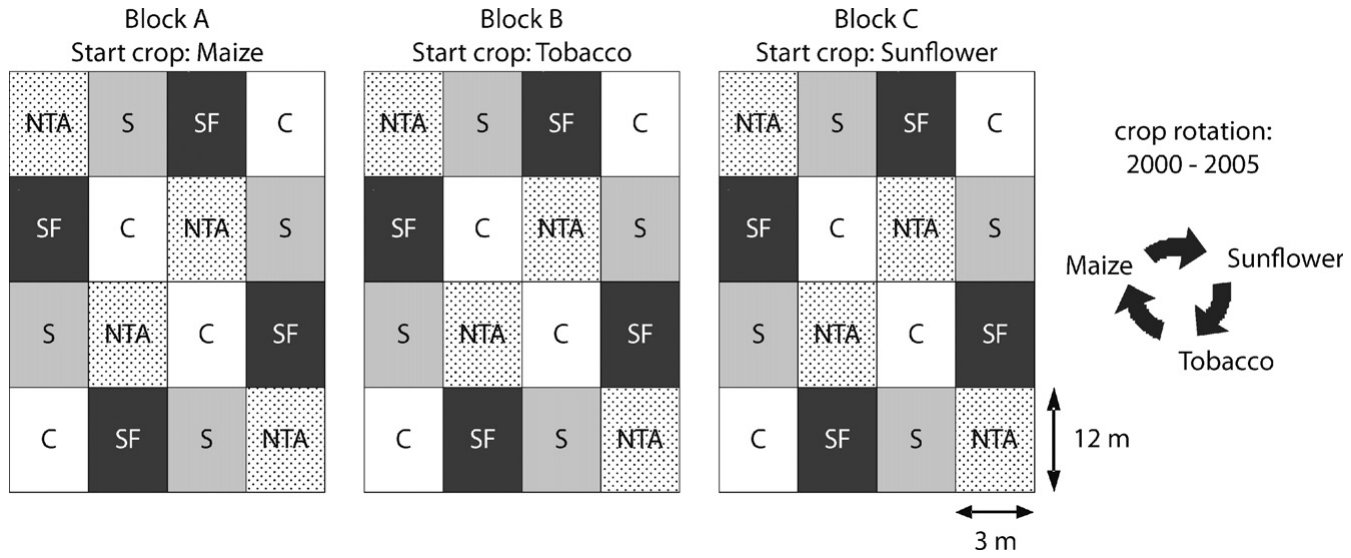
Maize (Zea mays L., cv. Magister), sunflower (Helianthus annuus L., cv. Sanluca), and tobacco (Nicotiana tabacum L., cv. Burley 92) were grown from 2000 to 2005 in a 3-year rotation scheme on three blocks in the experimental field. The rotation followed the order maize, sunflower, tobacco. All three crops were grown in each experimental year, but never consecutively on the same block (Fig. 1). Such rotation is standard agronomic practice in Switzerland and elsewhere. Maize and sunflower were sown around the 10th of May. Tobacco seedlings were planted around the 20th of May.
2000—2005年,在试验田的三个区组上按3年轮作方案种植玉米(Zea mays L.,品种Magister)、向日葵(Helianthus annuus L.,品种Sanluca)和烟草(Nicotiana tabacum L.,品种Burley 92)。轮作顺序为玉米、向日葵、烟草。每个试验年份三种作物均有种植,但同一区组上从不连续种植同一作物(图1)。这种轮作是瑞士及其他地区的标准农艺做法。玉米和向日葵于5月10日前后播种,烟草幼苗于5月20日前后移栽。
Each block was subdivided into 16 plots with a size of 12 m � 3 m each. Four treatments were applied in four replications to the plots of each block: (1) no amendment (control), (2) application of ammonium sulphate, (3) application of elemental sulphur and (4) application of nitrilotriacetic acid (NTA) (Fig. 1). The average amounts of sulphur applied in the ammonium sulphate treatment were 124, 195 and 69 kg ha�1 yr�1 for maize, tobacco and sunflower, respectively. In the elemental sulphur treatment, we applied 2139 kg ha�1 yr�1 sulphur with particle size
每个区组再划分为16个小区,每个小区面积为12 m × 3 m。在每个区组的小区上设置4个处理,各4次重复:(1)不施改良剂(对照),(2)施用硫酸铵,(3)施用单质硫,(4)施用次氮基三乙酸(NTA)(图1)。硫酸铵处理中玉米、烟草和向日葵的平均施硫量分别为124、195和69 kg ha−1 yr−1。单质硫处理中,我们向每种作物施用2139 kg ha−1 yr−1的硫,其粒径为
Total applied fertilizer in kg ha�1总施肥量(kg ha−1)
| Year年份 | Maize玉米 | Tobacco烟草 | Sunflower向日葵 | |||
|---|---|---|---|---|---|---|
| Block | N–P–K–Mg–S | Block | N–P–K–Mg–S | Block | N–P–K–Mg–S | |
| 2000 | A | 110–40–190–38–120 | B | 170–20–200–40–127 | C | 90–26–330–66–209 |
| 2001 | B | 110–40–190–38–120 | C | 170–20–200–40–127 | A | 90–26–330–66–209 |
| 2002 | C | 110–40–190–38–120 | A | 170–20–200–40–127 | B | 90–26–330–66–209 |
| 2003 | A | 80–40–190–38–120 | B | 170–20–200–40–127 | C | 90–26–330–66–209 |
| 2004 | B | 100–50–200–40–127 | C | 170–20–215–43–136 | A | 90–26–330–66–209 |
| 2005 | C | 145–50–200–40–127 | A | 170–20–215–43–136 | B | 90–26–330–66–209 |
N–P–K–Mg–S: N as NH4NO3 or (NH4)2SO4, P as Super Triple Phosphate (Ca(H2PO4)2�H2O), and K, Mg and S as Patentkali (K2SO4 and MgSO4).
N–P–K–Mg–S:N以NH4NO3或(NH4)2SO4形式施用,P以重过磷酸钙(Ca(H2PO4)2·H2O)形式施用,K、Mg和S以Patentkali(K2SO4和MgSO4)形式施用。
of 0.5–3.0 mm to each crop. Elemental sulphur and ammonium sulphate were applied just before sowing. In the NTA treatment, 110 ml of 200 mM NTA was injected into a depth of 20 cm by a selfmade syringe with four holes (pointing in the four directions) on both sides of each plant at a distance of 15 cm to the stems, corresponding to an application rate of 82.8 kg NTA ha�1 yr�1. NTA was applied 4 to 6 weeks after sowing, when the plant height was 30–40 cm. The rates of S and NTA applications were chosen on the basis of previous green house experiments (Wenger et al., 2002). The same treatments were repeated on the same plots annually for the duration of the experiment. All blocks were fertilized (N, P, K, Mg and S) according to the fertilizer recommendations of the Swiss Agricultural Research Stations (FAL and RAC, 2001). Fertilization was applied directly after sowing; N was applied a second time 2–3 weeks and a third time 4–5 weeks later (Table 1). Ammonium sulphate replaced ammonium nitrate as N source in the ammonium sulphate treatment. The total rates of N applied were the same in all treatments, but differed between the crops.
0.5–3.0 mm。单质硫和硫酸铵在播种前施用。NTA处理中,使用自制的四孔(分别朝向四个方向)注射器,在每株植物两侧距茎15 cm处,将110 ml浓度为200 mM的NTA注入20 cm深处,相当于施用量82.8 kg NTA ha−1 yr−1。NTA于播种后4至6周、株高30–40 cm时施用。S和NTA的施用量根据此前的温室试验确定(Wenger et al., 2002)。在整个试验期间,每年在相同小区上重复相同处理。所有区组均按照瑞士农业研究站的施肥建议(FAL and RAC, 2001)施用N、P、K、Mg和S肥料。播种后立即施肥;N在2–3周后第二次施用,4–5周后第三次施用(表1)。在硫酸铵处理中,以硫酸铵代替硝酸铵作为N源。各处理的施N总量相同,但不同作物之间有所差异。
2.3. Soil sampling and analysis2.3. 土壤采样与分析
Before the beginning of the experiment (1999) and after each harvest, 16 soil cores (0–20 cm depth) were sampled on each plot, bulked to one composite sample, dried in a convection oven at 40 8C to constant weight and sieved to 2 mm. According to Swiss standard methods, we used an extraction with boiling 2 M HNO3 to determine pseudo-total soil metal concentrations, while the soluble fractions of Cu, Zn and Cd were estimated using a 0.1 M NaNO3 extractant (ART and ACW, 2007). Zinc and Cu were analysed using ICP OES (Inductively Coupled Plasma Optical Emission Spectroscopy), S by XRF (X-Ray Fluorescence Spectroscopy) and Cd by GF-AAS (Graphite Furnace Atomic Absorption Spectroscopy). The CaCO3 content was determined using a calcimeter (ART and ACW, 2007) and organic carbon using the potassium dichromate oxidation method (ART and ACW, 2007). Soil pH was measured in H2O at a soil:solution ratio of 1:2.5. Soluble (plant available) P and K were extracted with CO2- saturated water and soluble Mg with 0.0125 M CaCl2 (FAL and RAC, 2001). Total and soluble metal concentrations were determined for the soil samples taken 1999, 2000, 2003 and 2005, soluble P, K and Mg for the samples taken in the years 1999, 2000, 2003 and 2004, while CaCO3 and Corg were determined only for the samples taken 1999, 2000 and 2005. Soil pH was determined from 1999 to 2005.
在试验开始前(1999年)及每次收获后,在每个小区采集16个土芯(0–20 cm深度),混合为一个混合样品,于40 °C对流烘箱中烘干至恒重,过2 mm筛。按照瑞士标准方法,采用沸腾2 M HNO3提取测定土壤金属准全量,同时采用0.1 M NaNO3提取剂估算Cu、Zn和Cd的可溶态组分(ART and ACW, 2007)。Zn和Cu采用ICP OES(电感耦合等离子体发射光谱法)分析,S采用XRF(X射线荧光光谱法)分析,Cd采用GF-AAS(石墨炉原子吸收光谱法)分析。CaCO3含量采用钙质计测定(ART and ACW, 2007),有机碳采用重铬酸钾氧化法测定(ART and ACW, 2007)。土壤pH在H2O中以土液比1:2.5测定。可溶性(植物有效)P和K采用CO2饱和水提取,可溶性Mg采用0.0125 M CaCl2提取(FAL and RAC, 2001)。对1999、2000、2003和2005年采集的土壤样品测定了全量和可溶态金属浓度,对1999、2000、2003和2004年采集的样品测定了可溶性P、K和Mg,而CaCO3和Corg仅对1999、2000和2005年采集的样品进行了测定。土壤pH的测定时间为1999—2005年。
In spring 2006, three plots per treatment were randomly selected for subsoil sampling. On each of the chosen plots, three soil cores (5 cm diameter) were taken down to a depth of 75 cm at increments of 25 cm using a hollow cylinder coring device (type HUMAX, Martin Burch AG, Luzern, Switzerland). The three sampling depths are designated as topsoil (0–25 cm), upper subsoil (25–50 cm), and lower subsoil (50–75 cm) in the following. The soil samples were oven-dried at 40 8C for 5 days and sieved to 2 mm mesh size. Soil pH, concentrations of total and soluble heavy metals, and contents of S, CaCO3 and Corg were determined.
2006年春季,每个处理随机选取3个小区进行底土采样。在每个选定小区上,使用空心圆柱取土器(HUMAX型,Martin Burch AG,Luzern,瑞士)按25 cm间隔采集3个土芯(直径5 cm),深度至75 cm。下文将三个采样深度分别称为表土(0–25 cm)、上层底土(25–50 cm)和下层底土(50–75 cm)。土壤样品于40 °C烘干5 d,过2 mm筛。测定了土壤pH、全量和可溶态重金属浓度以及S、CaCO3和Corg含量。
2.4. Plant sampling and analysis2.4. 植物采样与分析
Sunflowers were harvested always in the second half of August, maize and tobacco 1 month later. To avoid edge effects, plants of the outer rows and of the first and last 2 m of each plot were not included in the sampling. All the other plants were cut about 15 cm above ground and the total above-ground biomass (stem, leaves, seeds) was immediately passed through a chaff cutter. Roots were not collected. A 2 kg sample was taken at random from the harvest of each plot, oven-dried at 105 8C and ground to 1 mm, using an impact mill (AMA 102, Amman Langenthal, Switzerland). For P, K, Ca, Mg, Zn and Cu analysis, subsamples of 2.5 g plant material were ashed in a muffle furnace (prepASH 129, Precisa Instruments, Dietikon, Switzerland) at 600 8C for 2.5 h, dissolved in 5 ml of 6 M HCl, diluted to 50 ml with Millipore water, filtered and analysed using ICP OES. For Cd analysis subsamples of 0.5 g oven-dried plant material were microwave-digested in a mixture of 5 ml of HNO3 (65%), 3 ml of H2O2 (30%), and 2 ml of H2O. The digested samples were diluted to 25 ml with Millipore water, filtered and analysed with GF-AAS. For N analysis, the Dumas combustion method was used with an elementar analyser (varioMAX CN-Analyser, Elementar Analysensysteme GmbH, Hanau, Germany), using 1 g subsamples of oven-dried plant material.
向日葵均在8月下半月收获,玉米和烟草则晚1个月收获。为避免边际效应,各小区外侧行以及首尾各2 m范围内的植株不纳入采样。其余植株均在距地面约15 cm处刈割,全部地上部生物量(茎、叶、种子)立即用铡草机切碎。未采集根系。从每个小区的收获物中随机取2 kg样品,于105 °C烘干,并用冲击式粉碎机(AMA 102,Amman Langenthal,瑞士)粉碎至1 mm。用于P、K、Ca、Mg、Zn和Cu分析时,取2.5 g植物材料子样品于马弗炉(prepASH 129,Precisa Instruments,Dietikon,瑞士)中600 °C灰化2.5 h,用5 ml 6 M HCl溶解,以Millipore水定容至50 ml,过滤后采用ICP OES分析。用于Cd分析时,取0.5 g烘干植物材料子样品,在5 ml HNO3(65%)、3 ml H2O2(30%)和2 ml H2O的混合液中进行微波消解。消解样品以Millipore水定容至25 ml,过滤后采用GF-AAS分析。N的分析采用杜马斯燃烧法,使用元素分析仪(varioMAX CN-Analyser,Elementar Analysensysteme GmbH,Hanau,德国),取1 g烘干植物材料子样品进行测定。
2.5. Analytical quality assessment2.5. 分析质量评估
For quality assurance, we analysed ISE (International Soilanalytical Exchange, Wageningen, The Netherlands) and IAG (International Analytical Group, Linz, Austria) inter-laboratory comparison soil and plant samples together with the experimental samples. The maximal relative standard deviation (coefficient of variation) of repeated measurements of the reference samples was 7% and the respective maximal relative bias was 5% for all elements.
为保证质量,我们将ISE(国际土壤分析交流计划,Wageningen,荷兰)和IAG(国际分析小组,Linz,奥地利)的实验室间比对土壤和植物样品与试验样品一同分析。参比样品重复测定的最大相对标准偏差(变异系数)为7%,所有元素相应的最大相对偏倚为5%。
2.6. Statistical analysis2.6. 统计分析
Treatment effects were determined using analysis of variance in combination with post hoc analysis by Bonferroni tests. We used the following model (1) with the factors plant and treatment and two normally distributed and mutually independent random effects of block and year:
采用方差分析结合Bonferroni事后检验确定处理效应。我们采用以下模型(1),其中包含植物和处理两个因子,以及区组和年份两个正态分布且相互独立的随机效应:

where yijklm is the response (i.e. dependent) variable, m is the mean response, ai is the effect of treatment i (1 = control; 2 = ammonium sulphate; 3 = elemental sulphur; 4 = NTA), bj is the effect of plant species j (1 = sunflower; 2 = maize; 3 = tobacco), (ab)ij represents the interaction between treatment i and plant j, gk is the random effect of the year k (1 = 2000, . . ., 6 = 2005), dl(k) is the random effect of the block l (1 = block A, 2 = block B, 3 = block C) in year k, and eijklm is a normally distributed independent error (m = 1, . . ., 4). Each metal was analysed separately. Differences with p < 0.05 were considered significant. Data were log-transformed to get homoscedastic residuals. As we found significant interaction effects between treatments and plants, we analysed the treatment effects on metal accumulation also separately for each plant.
式中,yijklm为响应(即因)变量,m为平均响应,ai为处理i的效应(1 = 对照;2 = 硫酸铵;3 = 单质硫;4 = NTA),bj为植物种类j的效应(1 = 向日葵;2 = 玉米;3 = 烟草),(ab)ij表示处理i与植物j之间的交互作用,gk为年份k的随机效应(1 = 2000,. . .,6 = 2005),dl(k)为年份k中区组l的随机效应(1 = 区组A,2 = 区组B,3 = 区组C),eijklm为正态分布的独立误差(m = 1,. . .,4)。各金属分别进行分析。p < 0.05的差异被视为显著。数据经对数转换以获得方差齐性的残差。由于发现处理与植物之间存在显著的交互效应,我们还针对每种植物分别分析了处理对金属累积的影响。
3Results结果
3.1. Soil3.1. 土壤
On the basis of the topsoil (0–20 cm depth) samples taken at the beginning of the experiment (1999), which on average had sand, silt and clay fractions of 0.57, 0.24, and 0.19, respectively, the soil texture was classified as a sandy loam according to the US Soil Taxonomy. The pH of the soil was 7.4, the CaCO3 content 3.75%, and the Corg content 12.2%. The mean total concentrations of Cd, Cu and Zn in the 1999 samples were 1.37 � 0.03, 536 � 14, and 684 � 16 mg kg�1, respectively. Table 2 gives the properties of the untreated soil for the three sampling depths, topsoil (0–25 cm), upper subsoil (25–50 cm) and lower subsoil (50–75 cm), measured in 2006. The properties of the topsoil agree well with those of the composite samples (0–20 cm) taken in 1999 (see above), with the exception that the soil in the plots chosen for sampling in 2006 had a higher clay content (30.5%) than the average of the experimental field, indicating local variations in soil texture. The sand content decreased from 41% in the topsoil to 3% in the lower subsoil. Due to the increased silt content, the texture of the lower subsoil was classified as silty clay loam. Soil pH and CaCO3 content were highest in the topsoil, whereas Corg and S content were highest in the lower subsoil. The high CaCO3 content of the topsoil can be explained with the input of ashes that were deposited with the city wastes in the early 20th century, while the high Corg content of the lower parts of the profile is due to incomplete decomposition and residues of former peat layers. The contents of plant available nutrients in the topsoil were classified as ‘‘moderate’’ for P, ‘‘adequate’’ for Mg, and ‘‘available in reserve’’ for K according to Swiss standards (FAL and RAC, 2001). Total Cd, Cu and Zn concentrations were highest in the topsoil, still considerably above typical Swiss background concentrations in the upper subsoil and in the range of typical background concentrations in the lower subsoil. In addition, the soluble soil Cd, Cu and Zn concentrations decreased with depth. In contrast to Cu, this drop was not proportional to the decrease in total metal concentrations for Cd and Zn. The soluble Cd concentration decreased by less than a factor of 2 with depth from 1.3 in the topsoil to 0.8 mg kg�1 in the lower subsoil, while the total Cd concentration decreased by more than a factor of 5. The soluble Zn concentration decreased 4-fold from the topsoil to the subsoil, but did not decrease further with depth in the subsoil although the total Zn concentration decreased by a factor of almost 10 from the upper to the lower subsoil. The higher ratios between soluble and total Cd and
根据试验开始时(1999年)采集的表土(0–20 cm深度)样品,其砂粒、粉粒和黏粒组分平均分别为0.57、0.24和0.19,按美国土壤系统分类,土壤质地被划分为砂壤土。土壤pH为7.4,CaCO3含量为3.75%,Corg含量为12.2%。1999年样品中Cd、Cu和Zn的平均全量浓度分别为1.37 ± 0.03、536 ± 14和684 ± 16 mg kg−1。表2列出了2006年测定的未处理土壤在表土(0–25 cm)、上层底土(25–50 cm)和下层底土(50–75 cm)三个采样深度的性质。表土性质与1999年采集的混合样品(0–20 cm)(见上文)吻合良好,唯一的例外是2006年选定采样小区的土壤黏粒含量(30.5%)高于试验田平均值,表明土壤质地存在局部差异。砂粒含量从表土的41%降至下层底土的3%。由于粉粒含量增加,下层底土质地被划分为粉质黏壤土。土壤pH和CaCO3含量在表土中最高,而Corg和S含量在下层底土中最高。表土中CaCO3含量较高可归因于20世纪初随城市废弃物一同堆放的灰渣输入,而剖面下部Corg含量较高则源于原泥炭层的不完全分解及其残留物。按照瑞士标准(FAL and RAC, 2001),表土中植物有效养分含量分别被评为:P“中等”,Mg“充足”,K“有储备”。全量Cd、Cu和Zn浓度在表土中最高,在上层底土中仍显著高于瑞士典型背景浓度,在下层底土中则处于典型背景浓度范围内。此外,土壤可溶态Cd、Cu和Zn浓度随深度降低。与Cu不同,Cd和Zn可溶态浓度的下降与全量浓度的下降并不成比例。可溶态Cd浓度随深度下降不到2倍,从表土的1.3降至下层底土的0.8 mg kg−1,而全量Cd浓度下降超过5倍。可溶态Zn浓度从表土到底土下降了4倍,但在底土中未随深度进一步降低,尽管全量Zn浓度从上层底土到下层底土下降了近10倍。底土中可溶态与全量Cd和
Zn in the subsoil than in the topsoil correspond well to the drop in pH and CaCO3 content from topsoil to subsoil. The depth profiles thus do not indicate that any substantial leaching of these metals occurred.
Zn的比值高于表土,这与从表土到底土pH和CaCO3含量的下降相吻合。因此,深度剖面并未表明这些金属发生了明显的淋溶。
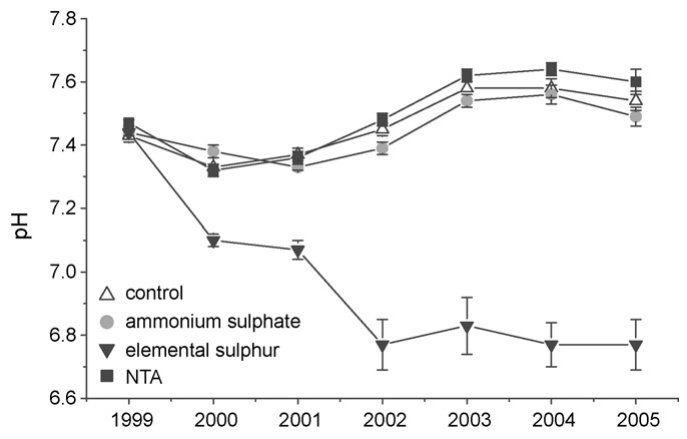
Significant treatment effects were limited to the topsoil of the elemental sulphur treatment, where the topsoil pH decreased from 7.4 to 6.7 between 1999 and 2002, and remained at this level for the rest of the experiment (Fig. 2). The soil CaCO3 content decreased over the experimental period in all treatments. The decrease was greater in the sulphur treatment than in the ammonium sulphate and the NTA treatments, which did not differ from the control (Fig. 3). Conversely, soluble Mg and Cd increased over time. The sulphur treatment caused a sharp increase in soluble Zn (Fig. 3) and a greater increase in soluble Mg than in the other treatments. There were no significant treatment effects at lower depths and no effects on the NaNO3- soluble Cu concentration, the total soil Cd, Zn and Cu concentrations or the organic carbon content.
显著的处理效应仅限于单质硫处理的表土,其表土pH在1999—2002年间从7.4降至6.7,并在试验剩余期间保持在该水平(图2)。在试验期间,所有处理的土壤CaCO3含量均有所下降。硫处理的下降幅度大于硫酸铵和NTA处理,后两者与对照无差异(图3)。相反,可溶性Mg和Cd随时间增加。硫处理导致可溶性Zn急剧增加(图3),且可溶性Mg的增幅大于其他处理。在较深土层中未观察到显著的处理效应,对NaNO3可溶态Cu浓度、土壤全量Cd、Zn和Cu浓度以及有机碳含量也均无影响。
3.2. Plants3.2. 植物
None of the plants showed deficiency symptoms, and yields were within the usual range for these three crops in Switzerland (Walter et al., 2001) for all treatments. Compared to the concentration ranges considered to indicate sufficient supply according to Bergmann (1993), the concentrations of N, P, K and Mg were suboptimal in maize, while N was suboptimal in sunflower (Table 3). Furthermore, N and Ca were above and Mg below the respective ranges of mineral sufficiency for tobacco. Only the sulphur treatment had a significant effect on the accumulation of nutrients. It increased the P concentration in maize from 1.85 to 2.15 g kg�1 and the Mg concentration in tobacco from 3.05 to 3.33 g kg�1 (data not shown), thus bringing the concentration of these two nutrients closer to the optimal range. The absence of deficiency symptoms despite the indication of suboptimal nutrient concentrations according to the reference values given by Bergmann (1993) may indicate that these reference values do not apply to the cultivars used in our study. Bergmann (1993) mentions that variability between cultivars is common. Plant nutrient concentrations can also vary substantially with weather conditions before harvest and with the age of the plant at harvest time (Bergmann, 1993).
所有处理中植物均未表现出缺素症状,产量均处于瑞士这三种作物的常规范围内(Walter et al., 2001)。与Bergmann(1993)提出的供应充足浓度范围相比,玉米中N、P、K和Mg浓度低于适宜水平,向日葵中N浓度低于适宜水平(表3)。此外,烟草中N和Ca浓度高于、Mg浓度低于各自的矿质充足范围。只有硫处理对养分累积有显著影响。硫处理使玉米中P浓度从1.85提高至2.15 g kg−1,使烟草中Mg浓度从3.05提高至3.33 g kg−1(数据未列出),从而使这两种养分的浓度更接近适宜范围。尽管按照Bergmann(1993)给出的参考值养分浓度表现为次优,但植株并未出现缺素症状,这可能表明这些参考值不适用于本研究所用品种。Bergmann(1993)指出,品种间的差异十分常见。植物养分浓度还可能随收获前的天气条件以及收获时的植株年龄而发生显著变化(Bergmann, 1993)。
Properties (mean values and standard errors in parenthesis) of the untreated soil, sampled at three depths (0–25, 25–50, and 50–75 cm) in spring 2006.
2006年春季在三个深度(0–25、25–50和50–75 cm)采集的未处理土壤的性质(平均值,括号内为标准误)。
| Soil properties土壤性质 | Topsoil (0–25 cm)表土(0–25 cm) | Upper subsoil (25–50 cm)上层底土(25–50 cm) | Lower subsoil (50–75 cm)下层底土(50–75 cm) |
|---|---|---|---|
| pH | 7.53 (0.02) | 7.23 (0.04) | 6.94 (0.03) |
| CaCO3 (%) | 3.78 (0.48) | 2.16 (0.62) | 0.11 (0.03) |
| Corg (%) | 10.03 (0.26) | 12.92 (0.79) | 18.86 (0.73) |
| CECpot (cmol+ kg�1) | 79.62 (1.57) | 127.05 (11.55) | 148.09 (9.71) |
| Clay (%) | 30.53 (3.06) | 49.15 (6.74) | 38.68 (9.33) |
| Silt (%) | 28.35 (1.17) | 27.42 (0.68) | 58.28 (10.00) |
| Sand (%) | 41.12 (4.03) | 23.43 (6.13) | 3.03 (0.97) |
| Cdtotal (mg kg�1) | 1.35 (0.03) | 0.69 (0.09) | 0.23 (0.05) |
| Cutotal (mg kg�1) | 477 (19) | 244 (37) | 28 (9) |
| Zntotal (mg kg�1) | 652 (31) | 381 (67) | 39 (13) |
| Stotal (mg kg�1) | 171 (7) | 256 (24) | 582 (29) |
| Cdsoluble (mg kg�1) | 1.32 (0.08) | 0.90 (0.07) | 0.79 (0.4) |
| Cusoluble (mg kg�1) | 469 (28) | 282 (39) | 28 (9) |
| Znsoluble (mg kg�1) | 81.8 (4.4) | 27.5 (9.3) | 21.1 (7.2) |
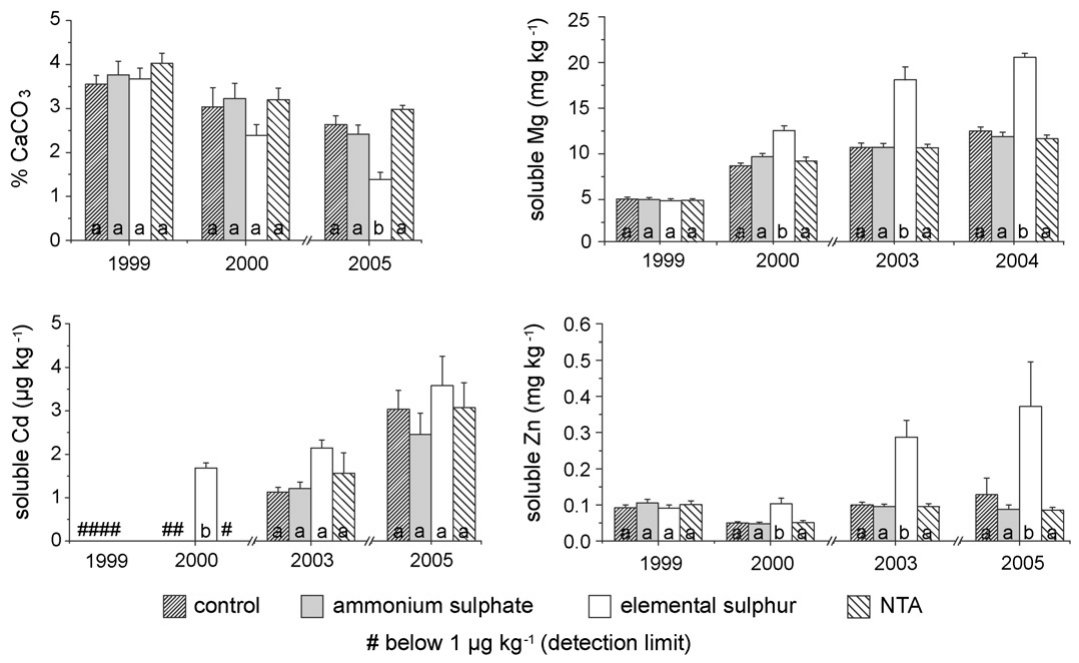
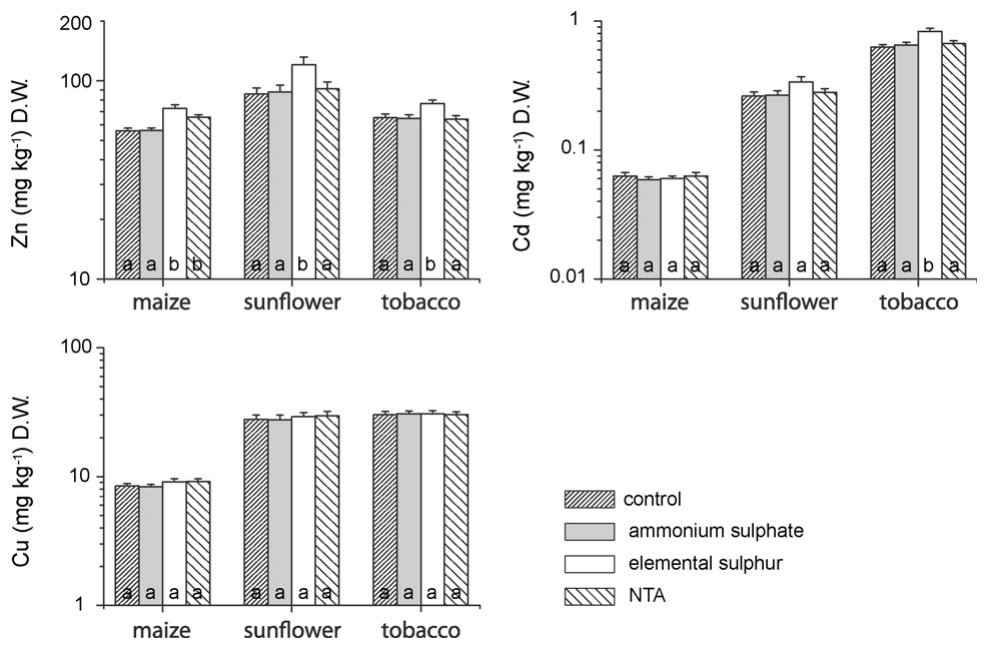
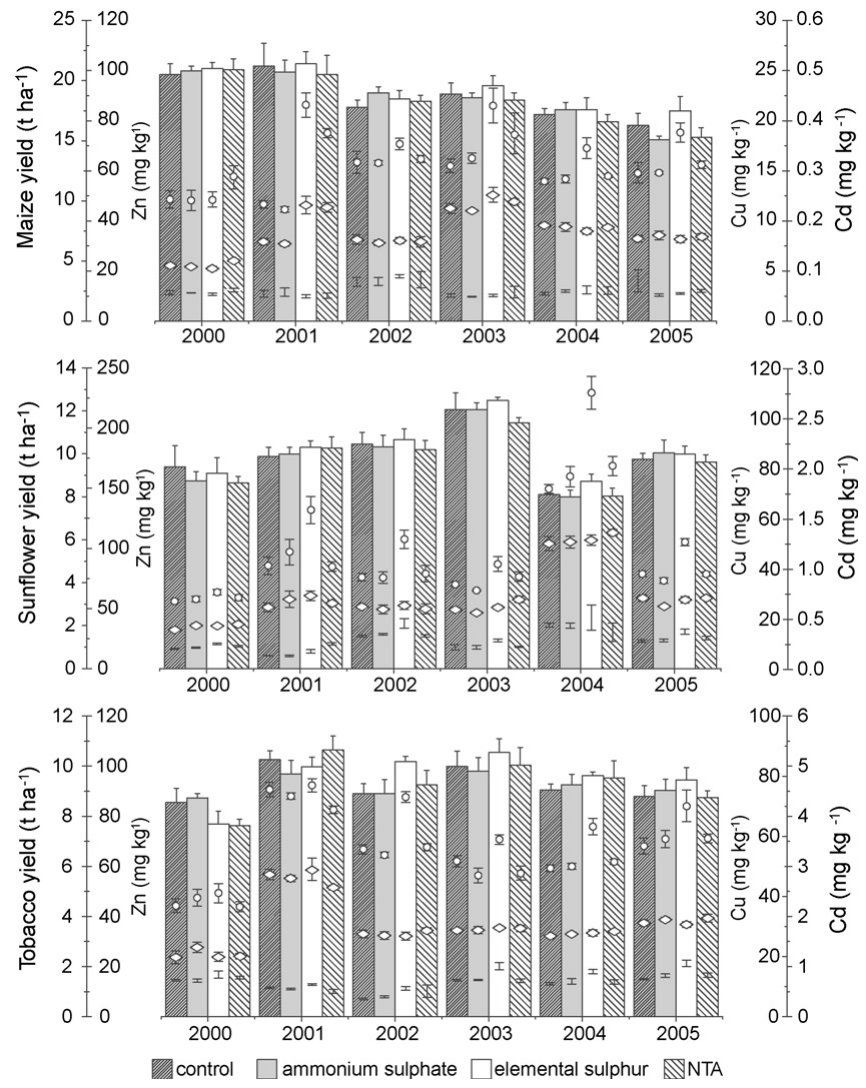
The increase in NaNO3-extractable soil Cd and Zn over the years in the sulphur-amended plots coincided with a significant increase in Cd and Zn accumulation in the tobacco shoots (Fig. 4). In maize and sunflower, only Zn but not Cd concentrations increased. The application of NTA slightly increased the Zn concentration in maize, although we observed no effect on soluble Zn in the soil. None of the treatments affected the concentration of Cu in any of the three experimental crop plants, which agrees well with the corresponding lack of effect on soluble soil Cu concentration. Compared to the controls, the sulphur treatment increased the mean Zn-to-Cd ratio in maize and sunflower by around 30% and 10%, respectively. In tobacco, the Zn-to-Cd ratio remained unaffected.
施硫小区中NaNO3可提取态土壤Cd和Zn逐年增加,与此同时烟草地上部Cd和Zn的累积量也显著增加(图4)。玉米和向日葵中仅Zn浓度增加,Cd浓度未增加。施用NTA使玉米中Zn浓度略有提高,但我们未观察到其对土壤可溶态Zn的影响。所有处理均未影响三种试验作物中的Cu浓度,这与各处理对土壤可溶态Cu浓度均无影响的结果一致。与对照相比,硫处理使玉米和向日葵的平均Zn/Cd比分别提高约30%和10%。烟草的Zn/Cd比未受影响。
Fig. 5 shows that the variations in yields and plant metal concentrations between years were generally larger than the differences between treatments in the same year. The variations in图5表明,产量和植物金属浓度的年际变化通常大于同一年份内处理间的差异。
yield and heavy metal accumulation were not correlated to the monthly means of temperature, precipitation or evapotranspiration, at nearby weather stations (Table 4). Fig. 6 shows that the effect of the sulphur treatment increased over the years in the case of Zn and Cd uptake by tobacco. The Zn concentration in maize increased, if we consider the value of 2001 to be an outlier. In sunflower, however, the effect of S on Zn uptake showed no consistent trend over the years. The increased accumulation of Zn and Cd by S-treated tobacco corresponds well with the continuous decrease in soil pH over the first three experimental years in the sulphur treatment.
产量和重金属累积的变化与附近气象站的月平均气温、降水量或蒸散量均无相关性(表4)。图6表明,就烟草对Zn和Cd的吸收而言,硫处理的效应逐年增强。若将2001年的数值视为异常值,则玉米中Zn浓度呈上升趋势。然而,在向日葵中,S对Zn吸收的影响在各年份间未表现出一致的趋势。经S处理的烟草对Zn和Cd累积的增加,与硫处理前三个试验年份土壤pH的持续下降吻合良好。
Giventhatthevariationsingrowthandplantmetalaccumulation from year to year did not exhibit any close correlation, the annual extraction of metals from the soil was not constant over time. The Cu extraction rates averaged 165, 270 and 285 g ha�1 yr�1, for maize, sunflower and tobacco, respectively, over the 6 years of the experiment. The treatment effects on metal extraction rates corresponded to those on metal accumulation, as there was no significant treatment effect on yields. The sulphur treatment increased the Zn extraction by maize, sunflower and tobacco by 34%, 45% and 22% (Table 5) and the Cd extraction by 0%, 34% and 36% (Table 6) for the respective plants. The highest Zn extraction was obtained by the sulphur-treated sunflowers in 2004 (best-case scenario), with an extraction rate of >2 kg ha�1, which was more than twice the average rate of the untreated sunflowers (control), and more than three times the average Zn extraction rate of tobacco, the weakest Zn extractor of the three crops. For Cd, tobacco was the best extractor. The highest Cd extraction rate (10.5 g ha�1) occurred in 2003 with the sulphur-treated tobacco. This was twice the average Cd extraction rate of untreated tobacco, and nine times the average extraction rate of maize, the weakest Cd extractor.
鉴于生长量和植物金属累积的年际变化之间并无密切相关性,每年从土壤中提取的金属量并非恒定不变。在6年试验期间,玉米、向日葵和烟草的Cu平均提取速率分别为165、270和285 g ha−1 yr−1。由于处理对产量无显著影响,处理对金属提取速率的影响与对金属累积的影响相对应。硫处理使玉米、向日葵和烟草的Zn提取量分别提高34%、45%和22%(表5),Cd提取量分别提高0%、34%和36%(表6)。Zn提取量最高的是2004年经硫处理的向日葵(最佳情景),提取速率 >2 kg ha−1,是未处理向日葵(对照)平均速率的两倍以上,是三种作物中Zn提取能力最弱的烟草平均Zn提取速率的三倍以上。就Cd而言,烟草的提取能力最强。Cd提取速率最高值(10.5 g ha−1)出现在2003年经硫处理的烟草中,是未处理烟草平均Cd提取速率的两倍,是Cd提取能力最弱的玉米平均提取速率的九倍。
Mean concentrations of macronutrients in the plants of the control treatment (averages for the years 2000–2005, standard errors in parenthesis), in comparison to the concentration ranges considered to indicate sufficiency according to Bergmann (1993).
对照处理植物中大量营养元素的平均浓度(2000—2005年平均值,括号内为标准误),并与Bergmann(1993)提出的充足浓度范围进行比较。
| Nutrient (g kg�1)养分(g kg−1) | Maize玉米 | Sunflower向日葵 | Tobacco烟草 | |||
|---|---|---|---|---|---|---|
| Measured | Reference | Measured | Reference | Measured | Reference | |
| N | 15.39 (0.16) | 35–50 | 22.78 (1.16) | 30–50 | 29.95 (0.45) | 22–25 |
| P | 1.85 (0.04) | 3.5–6.0 | 3.05 (0.21) | 2.5–5.0 | 2.49 (0.14) | 2.5–4.5 |
| K | 10.95 (0.29) | 30–45 | 39.29 (2.48) | 30–45 | 36.61 (1.94) | 25–45 |
| Ca | 3.43 (0.09) | 3–10 | 20.43 (1.08) | 8–20 | 27.93 (1.57) | 13–24 |
| Mg | 1.45 (0.04) | 2.5–5.0 | 4.13 (0.30) | 3–8 | 3.05 (0.16) | 4–8 |
Climate data for the growing seasons (May–September) of the experimental years 2000–2005 recorded at weather stations close to the experimental site.
试验场地附近气象站记录的2000—2005试验年份生长季(5—9月)气候数据。
| Parameter参数 | Month月份 | 2000 | 2001 | 2002 | 2003 | 2004 | 2005 |
|---|---|---|---|---|---|---|---|
| Temperature (8C) | May | 15 | 16 | 13 | 15 | 13 | 14 |
| June | 18 | 16 | 19 | 23 | 17 | 19 | |
| July | 17 | 19 | 19 | 21 | 19 | 19 | |
| August | 19 | 20 | 18 | 23 | 19 | 17 | |
| September | 16 | 12 | 14 | 15 | 16 | 16 | |
| Precipitation (mm) | May | 94 | 48 | 127 | 61 | 52 | 66 |
| June | 66 | 133 | 79 | 63 | 85 | 44 | |
| July | 155 | 112 | 116 | 73 | 75 | 39 | |
| August | 114 | 100 | 145 | 118 | 194 | 90 | |
| September | 56 | 119 | 57 | 65 | 28 | 78 | |
| ETpot (mm) | May | 119 | 120 | 89 | 106 | 119 | 105 |
| June | 148 | 125 | 143 | 179 | 126 | 156 | |
| July | 127 | 141 | 135 | 162 | 138 | 150 | |
| August | 127 | 131 | 109 | 162 | 119 | 114 | |
| September | 96 | 68 | 72 | 98 | 91 | 83 |
Temperatures and ETpot values are averages of the weather stations Neuenburg (47800100N, 685701400E, 484 m a.s.l.) and Payerne (4684804900N, 685603300E, 490 m a.s.l.). The potential evapotransportaion (ETpot) was calculated from data of these two stations, using the FAO Penman–Monteith equation (Allen et al., 1998). The precipitation was recorded at the weather station of Witzwil.
气温和ETpot值为Neuenburg气象站(47800100N,685701400E,海拔484 m)和Payerne气象站(4684804900N,685603300E,海拔490 m)的平均值。潜在蒸散量(ETpot)根据这两个气象站的数据,采用FAO Penman–Monteith方程(Allen et al., 1998)计算。降水量由Witzwil气象站记录。
4Discussion讨论
4.1. Soil properties4.1. 土壤性质
Whereas the total concentrations of Zn, Cd and Cu exceeded the respective guide or trigger values of the Swiss Federal ‘‘Ordinance Relating to Impacts on the Soil’’ (OIS, 1998), the NaNO3-soluble concentrations were below critical values which are 0.5 mg Zn, 0.02 mg Cd and 0.7 mg Cu per kg soil. The low metal solubility can be attributed primarily to the high pH and organic matter content of the soil. The contamination had aged for decades in the Witzwil soil (50–100 years), which may have resulted in reduced solubility of the contaminating metals over time (Tuin and Tels, 1990).
尽管Zn、Cd和Cu的全量浓度超过了瑞士联邦《土壤影响条例》(OIS, 1998)规定的相应指导值或触发值,但其NaNO3可溶态浓度低于临界值,即每kg土壤0.5 mg Zn、0.02 mg Cd和0.7 mg Cu。金属溶解度低主要可归因于土壤的高pH和高有机质含量。Witzwil土壤中的污染已老化数十年(50–100年),这可能导致污染金属的溶解度随时间推移而降低(Tuin and Tels, 1990)。
The experimental soil had an organic carbon content of 10–12% in the topsoil. Soil organic matter is an important sorbent for heavy metals, especially at a soil pH above 6.5 (Alloway and Jackson, 1991). All three contaminants are strongly bound by soil organic matter, in particular Cu (Sposito, 2008). The decrease in soil pH in the sulphur treatment was insufficient to significantly increase Cu solubility. This would have required a pH decrease below 5 (Hornburg and Bru¨mmer, 1993). In contrast, Cd and Zn solubility start to increase strongly with increasing soil acidification already at pH values below 7 and 6, respectively (Hornburg and Bru¨mmer, 1993). After 6 years of sulphur application, the pH of the experimental topsoil (0–20 cm) was still close to neutral (pH 6.7). The high buffering capacity of the CaCO3 in the soil reduced the acidifying and metal mobilizing effects of the S. Given that the carbonate content decreased to less than half of the initial concentration during the experiment, a stronger decrease in soil pH would have required another 6 years of sulphur applications at our annual dosage of 2.14 t ha�1.
试验土壤表土的有机碳含量为10–12%。土壤有机质是重金属的重要吸附剂,尤其是在土壤pH高于6.5时(Alloway and Jackson, 1991)。三种污染物均被土壤有机质强烈结合,尤以Cu为甚(Sposito, 2008)。硫处理中土壤pH的下降不足以显著提高Cu的溶解度,这需要pH降至5以下(Hornburg and Brümmer, 1993)。相比之下,Cd和Zn的溶解度分别在pH低于7和6时即开始随土壤酸化加剧而大幅增加(Hornburg and Brümmer, 1993)。施硫6年后,试验表土(0–20 cm)的pH仍接近中性(pH 6.7)。土壤中CaCO3的高缓冲能力削弱了S的酸化作用和金属活化作用。鉴于试验期间碳酸盐含量已降至初始浓度的一半以下,若要使土壤pH进一步明显下降,还需按我们每年2.14 t ha−1的用量再施硫6年。
In contrast to the sulphur treatment, we observed no increase in metal solubility in the NTA treatment, not even for Cu, which is known to form strong complexes with amino-carboxylates such as NTA (Nowack et al., 2006). Mobilization of Cu at higher soil pH could be achieved by the formation of Cu-complexes with dissolved organic ligands. The applied dose may have been too low for the NTA to compete with the undissolved organic matter of the soil for Cu. Furthermore, the applied NTA may have degraded too rapidly to result in a measurable effect on metal mobilization in the soil when it was sampled at harvest time. Tiedje and Mason (1974) reported that up to 80% of soil applied NTA had been degraded 24 days after application. They reported that NTA degradation rates in topsoils were positively correlated with the soil’s organic matter content. The high organic matter content in the Witzwil soil thus might have accelerated NTA degradation. Wenger (2000) investigated the degradation kinetics of NTA by monitoring its effect on the NaNO3-extractable Zn concentration in a calcareous metal-polluted soil over time. The application of 5 mmol NTA kg�1 dry soil increased the soluble soil Zn concentration from 4 to 200 mg kg�1, but after 20 days Zn solubility started to decrease again. With the addition of 25 mmol kg�1 the mobilizing effect of NTA on soluble Zn disappeared within 63 days. The results reported by Wenger (2000) suggest that some mobilization may also have occurred in our NTA treatments, but may have been too ephemeral to be detectable still in the soil at harvest time and to significantly affect plant metal accumulation. Such a transient effect may, however, explain the small NTA effect on Zn accumulation by maize. A sustained NTA effect on soil metal solubility would require repeated applications during the growing season. However, this is impractical in larger field experiments and even less in agricultural practice.
与硫处理不同,我们在NTA处理中未观察到金属溶解度的增加,即使是Cu也不例外,而已知Cu可与NTA等氨基羧酸盐形成强络合物(Nowack et al., 2006)。在较高土壤pH下,Cu可通过与溶解性有机配体形成Cu络合物而被活化。所施用的剂量可能过低,致使NTA无法与土壤中未溶解的有机质竞争Cu。此外,所施NTA可能降解过快,以致在收获时采样的土壤中未能检测到其对金属活化的可测效应。Tiedje and Mason(1974)报道,施入土壤的NTA在施用24 d后降解率高达80%。他们报道,表土中NTA的降解速率与土壤有机质含量呈正相关。因此,Witzwil土壤的高有机质含量可能加速了NTA的降解。Wenger(2000)通过监测NTA对一种石灰性金属污染土壤中NaNO3可提取态Zn浓度随时间的影响,研究了NTA的降解动力学。施用5 mmol NTA kg−1干土使土壤可溶态Zn浓度从4增至200 mg kg−1,但20 d后Zn的溶解度开始再次下降。添加25 mmol kg−1时,NTA对可溶态Zn的活化作用在63 d内消失。Wenger(2000)报道的结果表明,本研究的NTA处理中可能也发生了一定程度的活化,但可能过于短暂,以致在收获时的土壤中已无法检测到,也不足以显著影响植物金属累积。然而,这种短暂效应或许可以解释NTA对玉米Zn累积的微弱影响。要使NTA对土壤金属溶解度产生持续效应,需要在生长季内多次施用。然而,这在较大规模的田间试验中并不现实,在农业实践中更是如此。
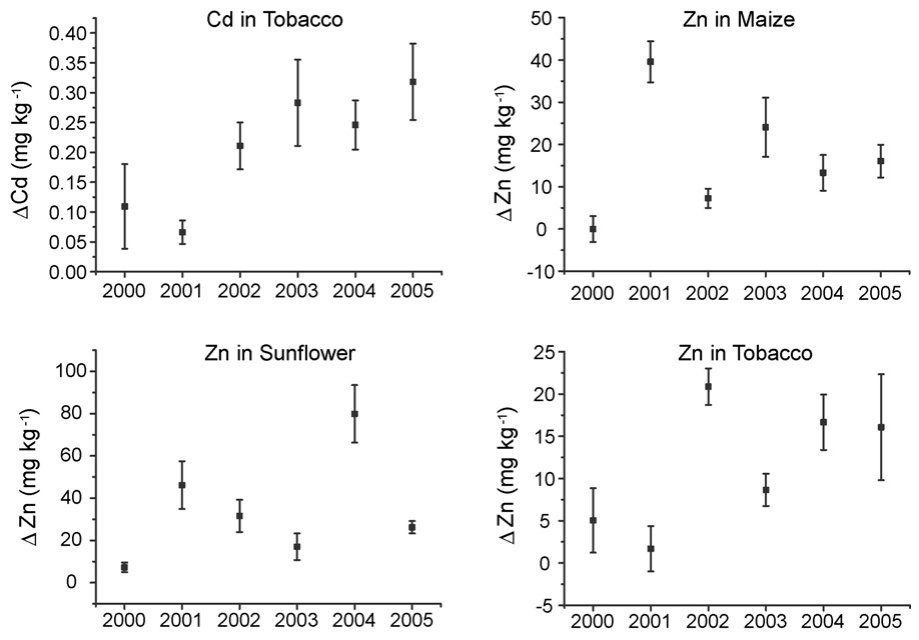
Table 5表5
Zinc extraction (g ha�1 yr�1) from soil by maize, sunflower and tobacco, in control and sulphur treatment.
对照和硫处理中玉米、向日葵和烟草从土壤中提取的Zn量(g ha−1 yr−1)。
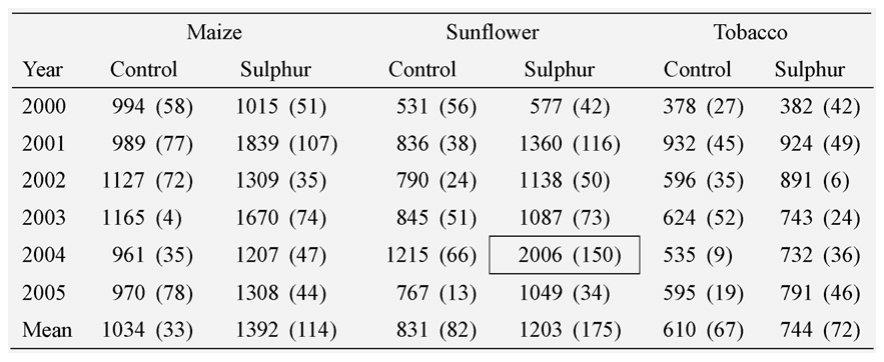
Standard errors in parentheses. Framed: best-case scenario.
括号内为标准误。加框者:最佳情景。
4.2. Plant concentrations4.2. 植物体内浓度
The relatively low plant metal concentrations may be partly due to short-range heterogeneity in the spatial distribution of the metals in the soil. Pronounced heterogeneity in the distribution of pollutants, even over short distances, is a typical phenomenon in field soils. Potted soils are usually homogeneous, thereby giving the roots little possibility to avoid contaminants. In contrast, under field conditions they generally have more possibility to evade contaminants by growing into zones of low concentrations (Keller, 2006). Contamination does not usually extend far into the subsoil, so that deeper roots encounter fewer toxicity problems than superficial roots. The contamination of the field soil studied here was more or less limited to the upper 50 cm of the soil. Roots of sunflower can reach depths of 1.5 m (Angelova et al., 2004), indicating that only part of the root system was involved in metal extraction. Keller et al. (2003) found a maximum rooting depth of 0.75 m for tobacco with a rapid decrease in rooting density below the first 0.1 m, whereas the rooting density of maize decreased less abruptly with depth, indicating that tobacco is more suitable for phytoextraction of contaminations in the upper layers and maize for phytoextraction of deeper contaminations. We found higher Cd and Cu concentrations in tobacco than in maize. The difference in Zn accumulation, however, was only marginal.
植物金属浓度相对较低,部分原因可能是土壤中金属空间分布的短程异质性。污染物分布即使在短距离内也存在显著异质性,这是田间土壤的典型现象。盆栽土壤通常较为均一,因而根系几乎无法避开污染物。相比之下,在田间条件下,根系通常更有可能通过向低浓度区域生长而避开污染物(Keller, 2006)。污染通常不会向底土深处延伸,因此较深的根系比浅层根系遇到的毒性问题更少。本研究田间土壤的污染大致局限于土壤上层50 cm。向日葵根系可深达1.5 m(Angelova et al., 2004),表明只有部分根系参与了金属提取。Keller et al.(2003)发现烟草的最大根深为0.75 m,且在0.1 m以下根系密度迅速降低,而玉米根系密度随深度的下降较为平缓,这表明烟草更适合用于上层污染的植物提取,而玉米更适合用于较深层污染的植物提取。我们发现烟草中Cd和Cu浓度高于玉米,但两者Zn累积的差异很小。
Plant metal concentrations and yield varied considerably from year to year. This shows that predictions of the time required to remediate a soil by means of phytoextraction are unreliable if based on experimental data from a single year only. Also Keller et al. (2003) found significant year-to-year variations in root development and metal uptake of different annual plants. To calculate the remediation time (tr) needed to reach target heavy metal concentrations as given the guide values (cgv) of the Swiss Federal ‘‘Ordinance Relating to Impacts on the Soil’’ (OIS, 1998), more realistic estimates will be obtained with data from experiments with a duration of several years. Using the mean annual metal extraction (cme) over the 6 years of our experiment and assuming a linear decrease in soil metal concentration according to Kayser et al. (2000), beginning from the soil metal concentration in 1999 (c0), the calculated remediation time would be around 240, 2900 and 870 years for Cd, Cu, and Zn, respectively, using Eq. (2):
植物金属浓度和产量的年际变化很大。这表明,若仅依据单一年份的试验数据,对利用植物提取修复土壤所需时间的预测并不可靠。Keller et al.(2003)同样发现不同一年生植物的根系发育和金属吸收存在显著的年际差异。为计算达到瑞士联邦《土壤影响条例》(OIS, 1998)指导值(cgv)所规定的目标重金属浓度所需的修复时间(tr),利用持续数年的试验数据可获得更符合实际的估算。采用本试验6年间的年均金属提取量(cme),并按照Kayser et al.(2000)的方法假设土壤金属浓度从1999年的土壤金属浓度(c0)起呈线性下降,利用式(2)计算得到Cd、Cu和Zn的修复时间分别约为240、2900和870年:
Table 6表6
Cadmium extraction (g ha�1 yr�1) from soil by maize, sunflower and tobacco, in control and sulphur treatment.
对照和硫处理中玉米、向日葵和烟草从土壤中提取的Cd量(g ha−1 yr−1)。
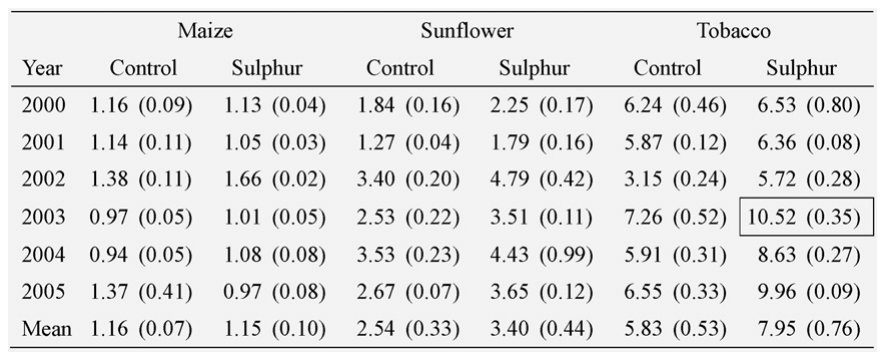
Standard error in parentheses. Framed: best-case scenario.
括号内为标准误。加框者:最佳情景。

For Cd and Zn, these times would decrease by about a quarter were the soil pH maintained at 6.7. Using the value of the highest metal extraction rate achieved in our experiment, which was 2 kg ha�1 for Zn in 2004 with sulphur-treated sunflower and 10.5 g ha�1 for Cd in 2003 with sulphur-treated tobacco, then the needed remediation time would still be 360 years for Zn and 70 years for Cd. Even in this unrealistic ‘‘best-case’’ scenario, the time needed to reach the remediation target would still be unacceptably long. Nevertheless, the low metal accumulation rates can be advantageous, as this means that the biomass could be used for human or animal nutrition without unacceptable toxicity risks. The concentrations of Cd, Cu and Zn in our plants were in the same range as plants grown on uncontaminated land (Chaney, 1989), and well below concentrations shown to be harmful to animals (Underwood and Suttle, 1999). The Cd concentrations were also below the Swiss threshold value for undesired substances in animal fodder (FMBV, 1999), while for Zn and Cu no such threshold values exist. Sulphur application may even increase the fodder quality because of the increased Zn-to-Cd ratio. Zinc, in contrast to Cd, is an essential nutrient for plants, human and animals, and becomes toxic only at high concentrations. Zinc deficiency usually is a more serious problem in human and animal nutrition than Zn toxicity. In particular, Zn deficiency can promote the absorption and retention of Cd by human and animals (Tang et al., 1998; Underwood and Suttle, 1999). Thus increasing the ratio of Zn-to-Cd accumulation in food and fodder plants could be beneficial with respect to health risk reduction. Crop residues with elevated Zn and Cu concentrations could also be used as green manure on agricultural land where the concentrations of these two plant nutrients are low. Here, phytomanagement would not only allow a profitable agricultural use of the polluted soil, but also gradually reduce its contamination and in the same time ameliorate micronutrient-deficient soil elsewhere.
若将土壤pH维持在6.7,Cd和Zn的修复时间将缩短约四分之一。若采用本试验中获得的最高金属提取速率,即2004年经硫处理的向日葵对Zn的2 kg ha−1和2003年经硫处理的烟草对Cd的10.5 g ha−1,所需修复时间仍分别为Zn 360年和Cd 70年。即使在这种不现实的“最佳情景”下,达到修复目标所需的时间仍然长得令人无法接受。尽管如此,较低的金属累积速率也可能是有利的,因为这意味着生物质可用于人类或动物营养而不会带来不可接受的毒性风险。本研究植物中Cd、Cu和Zn的浓度与生长在未污染土地上的植物处于同一范围(Chaney, 1989),且远低于已证明对动物有害的浓度(Underwood and Suttle, 1999)。Cd浓度也低于瑞士动物饲料中不良物质的阈值(FMBV, 1999),而Zn和Cu则无此类阈值。由于Zn/Cd比的提高,施硫甚至可能改善饲料品质。与Cd不同,Zn是植物、人类和动物的必需营养元素,仅在高浓度时才具有毒性。在人类和动物营养中,缺Zn通常是比Zn中毒更为严重的问题。特别是,缺Zn会促进人类和动物对Cd的吸收和滞留(Tang et al., 1998; Underwood and Suttle, 1999)。因此,提高粮食和饲料植物中Zn与Cd的累积比,可能有利于降低健康风险。Zn和Cu浓度较高的作物残体还可作为绿肥,施用于这两种植物营养元素浓度较低的农田。在这种情况下,植物管理不仅能够使污染土壤得到有经济效益的农业利用,还能逐步降低其污染程度,同时改良其他地区缺乏微量营养元素的土壤。
5Conclusions结论
The uptake of Cd, Zn and Cu by the untreated plants was in the range of values found in crop plants grown on uncontaminated land. Therefore, the rate of extraction of these metals was low. The ammonium sulphate treatment had no effect on plant metal uptake. The NTA treatment was ineffective, except for a slight increase in Zn accumulation by maize. Elemental sulphur significantly increased the accumulation of Zn by all three experimental plants as well as the accumulation of Cd by tobacco. The applied elemental sulphur treatment would decrease the remediation time for the Zn and Cd contamination by about a quarter. It also improved the fodder quality of maize and sunflower by increasing the Zn-to-Cd ratio and by enhancing the nutritional status of tobacco (Mg) and maize (P). A higher rate of sulphur application would probably result in a faster and stronger decrease in soil pH and, correspondingly, in a higher Zn and Cd mobilization. However, the remediation time would still be unacceptably long.
未处理植物对Cd、Zn和Cu的吸收处于生长在未污染土地上的作物的数值范围内,因此这些金属的提取速率较低。硫酸铵处理对植物金属吸收无影响。NTA处理无效,仅使玉米对Zn的累积略有增加。单质硫显著提高了三种试验植物对Zn的累积以及烟草对Cd的累积。所施用的单质硫处理可使Zn和Cd污染的修复时间缩短约四分之一。它还通过提高Zn/Cd比改善了玉米和向日葵的饲料品质,并改善了烟草(Mg)和玉米(P)的营养状况。更高的施硫量可能使土壤pH下降得更快、更显著,相应地使Zn和Cd的活化程度更高。然而,修复时间仍将长得令人无法接受。
Cleansing the experimental soil by phytoextraction is thus unrealistic using the approach studied here. However, the results suggest that phytomanagement, i.e. to use the contaminated land profitably for the production of valuable biomass (animal feeding, biofortification, biofuel production and other economical purposes), would be a good strategy without running any substantial health risks for humans or animals.
因此,采用本研究的方法通过植物提取净化试验土壤是不现实的。然而,结果表明,植物管理,即利用污染土地有经济效益地生产有价值的生物质(用于动物饲喂、生物强化、生物燃料生产及其他经济用途),将是一种良好的策略,且不会对人类或动物造成任何实质性的健康风险。
Acknowledgements致谢
We are grateful to the following field workers and lab technicians of the Agroscope Reckenholz-Ta¨nikon Research Station (ART) and the Institute of Terrestrial Ecosystems at ETH, for their technical support in the field and in the laboratory (listed in alphabetical order): Werner Attinger, Hans Jo¨rg Bachmann, Hans- Ruedi Bosshard, Diane Bu¨rge, Charlotte Da¨hler, Martha Ejem, Oskar Fankhauser, Anna Gru¨nwald, Corinne Ho¨rger, Rosmarie Hort, Uschi Linder, Urs Nyffeler, Jean Paul, Doris Rohner, Barbara Ropka, Christoph Ru¨eggsegger, Viktor Stadelmann and Fabian von Ka¨nel. The project was funded by the Federal Office for Education and Science within COST action 859.
感谢Agroscope Reckenholz-Tänikon研究站(ART)和苏黎世联邦理工学院陆地生态系统研究所的以下田间工作人员和实验室技术人员在田间和实验室提供的技术支持(按字母顺序排列):Werner Attinger、Hans Jörg Bachmann、Hans-Ruedi Bosshard、Diane Bürge、Charlotte Dähler、Martha Ejem、Oskar Fankhauser、Anna Grünwald、Corinne Hörger、Rosmarie Hort、Uschi Linder、Urs Nyffeler、Jean Paul、Doris Rohner、Barbara Ropka、Christoph Rüeggsegger、Viktor Stadelmann和Fabian von Känel。本项目由瑞士联邦教育与科学办公室在COST行动859框架下资助。
References参考文献
Allen, R.G., Pereira, L.S., Raes, D., Smith, M., 1998. Crop evapotranspiration—guidelines for computing crop water requirements. FAO Irrigation and Drainage Paper 56. FAO—Food and Agriculture Organization of the United Nations, Rome. Alloway, B.J., Jackson, A.P., 1991. The behaviour of heavy metals in sewage sludgeamended soils. Sci. Total Environ. 100, 151–176.
Angelova, V., Ivanova, R., Ivanov, K., 2004. Heavy metal accumulation and distribution in oil crops. Commun. Soil Sci. Plant Anal. 35, 2551–2566.
ART, ACW, 2007. Schweizerische Referenzmethoden der Eidgeno¨ssischen landwirtschaftlichen Forschungsanstalten ART und ACW. Agroscope Reckenholz- Ta¨nikon and Agroscope Changins-Wa¨denswil.
Bergmann, W., 1993. Erna¨hrungssto¨rungen bei Kulturpflanzen, third ed. Gustav Fischer Verlag Jena, Stuttgart.
Blaylock, M.J., Salt, D.E., Dushenkov, S., Zakharova, O., Gussman, C., Kapulnik, Y., Ensley, B.D., Raskin, I., 1997. Enhanced accumulation of Pb in Indian mustard by soil-applied chelating agents. Environ. Sci. Technol. 31, 860–865.
Brooks, R.R., Lee, J., Reeves, R.D., Jaffre, T., 1977. Detection of nickeliferous rocks by analysis of herbarium specimens of indicator plants. J. Geochem. Explor. 7, 49–57. Chaney, R.L., 1989. Toxic element accumulation in soils and crops: protecting soil fertility and agricultural food chains. In: Bar-Yosef, B., Barrow, N.J., Goldshmid, J. (Eds.), Inorganic Contaminants in the Vadose Zone. Springer, Berlin, p. 200.
Domı´nguez, M.T., Maran˜o´ n, T., Murillo, J.M., Schulin, R., Robinson, B.H., 2008. Trace element accumulation in woody plants of the Guadiamar Valley, SW Spain: a large-scale phytomanagement case study. Environ. Pollut. 152, 50–59.
FAL, RAC, 2001. Grundlagen fu¨r die Du¨ngung im Acker- und Futterbau der Eidgeno¨ssischen Forschungsanstalt fu¨r Agraro¨kologie und Landbau, Reckenholz (FAL), und der Eidgeno¨ssischen Forschungsanstalt fu¨r Pflanzenbau, Changins (RAC). Agrar Forschung 8, 1–80.
FMBV, 1999. Verordnung u¨ber die Produktion und das Inverkehrbringen von Futtermitteln, Zusatzstoffen fu¨r die Tiererna¨hrung, Silierzusa¨tzen und Dia¨tfuttermitteln (FMBV) des Eidgeno¨ssischen Volkswirtschaftsdepartements vom 10 Juni 1999, SR-Nr. 916.307.1. Eidgeno¨ssische Drucksachen- und Materialzentrale, Bern, p. 20.
Hornburg, V., Bru¨ mmer, G.W., 1993. Behaviour of heavy metals in soils. 1. Heavy metal mobility. Zeitschrift fu¨ r Pflanzenerna¨hrung und Bodenkunde 156, 467– 477.
Huang, J.W., Cunningham, S.D., 1996. Lead phytoextraction: species variation in lead uptake and translocation. New Phytol. 134, 75–84.
Kayser, A., Wenger, K., Keller, A., Attinger, W., Felix, H.R., Gupta, S.K., Schulin, R., 2000. Enhancement of phytoextraction of Zn, Cd, and Cu from calcareous soil: the use of NTA and sulfur amendments. Environ. Sci. Technol. 34, 1778–1783.
Keller, C., 2006. Factors limiting efficiency of phytoextraction at multi-metal contaminated sites. In: Morel, J.-L. (Ed.), Phytoremediation of Metal-Contaminated Soils. Springer, Dordrecht, pp. 241–266.
Keller, C., Hammer, D., Kayser, A., Richner, W., Brodbeck, M., Sennhauser, M., 2003. Root development and heavy metal phytoextraction efficiency: comparison of different plant species in the field. Plant Soil 249, 67–81.
Kulli, B., Balmer, M., Krebs, R., Lothenbach, B., Geiger, G., Schulin, R., 1999. The influence of nitrilotriacetate on heavy metal uptake of lettuce and ryegrass. J. Environ. Qual. 28, 1699–1705.
McGrath, S.P., Zhao, F.J., Lombi, E., 2002. Phytoremediation of metals, metalloids, and radionuclides. Adv. Agron. 75, 1–56.
Meers, E., Ruttens, A., Hopgood, M., Lesage, E., Tack, F.M.G., 2005. Potential of Brassic rapa, Cannabis sativa, Helianthus annuus and Zea mays for phytoextraction of heavy metals from calcareous dredged sediment derived soils. Chemosphere 61, 561–572.
Nor, Y.M., Tabatabai, M.A., 1977. Oxidation of elemental sulfur in soils. Soil Sci. Soc. Am. J. 41, 736–741.
Nowack, B., Schulin, R., Robinson, B.H., 2006. Critical assessment of chelantenhanced metal phytoextraction. Environ. Sci. Technol. 40, 5225–5232.
OIS, 1998. Ordinance Relating to Impacts on the Soil of the Swiss Federal Council, 1st of July 1998, SR 814.12. Eidgeno¨ssische Drucksachen- und Materialzentrale, Bern, p. 12.
Robinson, B.H., Green, S.R., Chancerel, B., Mills, T.M., Clothier, B.E., 2007. Poplar for the phytomanagement of boron contaminated sites. Environ. Pollut. 150, 225– 233.
Rytz, I., 2001. Bodenbelastung ‘‘Scherbenland Witzwil’’ Schlussbericht. Bodenschutzfachstelle des Kantons Bern, Zollikofen.
Salt, D.E., Blaylock, M., Kumar, N., Dushenkov, V., Ensley, B.D., Chet, I., Raskin, I., 1995. Phytoremediation: a novel strategy for the removal of toxic metals from the environment using plants. Biotechnology 13, 468–474.
Sposito, G., 2008. The Chemistry of Soils, second ed. Oxford University Press, New York.
Tandy, S., Schulin, R., Nowack, B., 2006. Uptake of metals during chelant-assisted phytoextraction with EDDS related to the solubilized metal concentration. Environ. Sci. Technol. 40, 2753–2758.
Tang, W., Sadovic, S., Shaikh, Z.A., 1998. Nephrotoxicity of cadmium–metallothionein: protection by zinc and role of glutathione. Toxicol. Appl. Pharmacol. 151, 276–282.
Tichy´, R., Fajtl, J., Kuzˇel, S., Kola´rˇ, L., 1997. Use of elemental sulphur to enhance a cadmium solubilization and its vegetative removal from contaminated soil. Nutr. Cycl. Agroecosyst. 46, 249–255.
Tiedje, J.M., Mason, B.B., 1974. Biodegradation of nitrilotriacetate (NTA) in soils. Soil Sci. Soc. Am. J. 38, 278–283.
Tuin, B.J.W., Tels, M., 1990. Extraction kinetics of six heavy metals from contaminated clay soils. Environ. Technol. 11, 541–554.
Underwood, E.J., Suttle, N.F., 1999. The Mineral Nutrition of Livestock, third ed. CAB International, Oxon, New York.
Walter, U., Ryser, J.-P., Flisch, R., 2001. Agrarforschung—Grundlagen fu¨ r die Du¨ngung im Acker- und Futterbau 2001. FAL/AMTRA, Zu¨ rich und Nyon.
Wenger, K., 2000. Ligand-assisted phytoextraction of heavy metals from contaminated soils using common crop plants. Diss. ETH No. 13900. Institute of Terrestrial Ecology, Swiss Federal Institute of Technology Zurich, Zurich.
Wenger, K., Kayser, A., Gupta, S.K., Furrer, G., Schulin, R., 2002. Comparison of NTA and elemental sulfur as potential soil amendments in phytoremediation. Soil Sediment Contam. 11, 655–672.