RESEARCH ARTICLE
Uptake and allocation of plant nutrients and Cd in maize, sunflower and tobacco growing on contaminated soil and the effect of soil conditioners under field conditions
Erika Fa¨ssler • Brett H. Robinson • Satish K. Gupta • Rainer Schulin
Received: 14 August 2009 / Accepted: 24 December 2009 / Published online: 7 January 2010 � Springer Science+Business Media B.V. 2010
Abstract Contaminated land may in many cases still be used for agriculture, provided that crops are chosen appropriately, as the accumulation of contaminants varies greatly among cultivars and also plant parts. We aimed to determine whether maize (Zea mays), sunflower (Helianthus annuus) and tobacco (Nicotiana tabaccum) grown on a heavy-metal contaminated soil containing copper (540 mg Cu kg-1), zinc (680 mg Zn kg-1) and cadmium (1.4 mg Cd kg-1) could be used to gradually remediate the soil, while producing valuable biomass. The soil was treated with either a normal fertiliser regime (control), elemental sulphur (S), or the biodegradable chelant NTA (nitrilotriacetic acid), to test how soil acidification or chelating organic compounds would affect the uptake and allocation of selected elements (Ca, Cd, Cu, Fe, K, Mg, Mn, P, S and Zn). The highest concentrations of Cd, Cu and Zn occurred in the leaves and/or roots, while seeds and grains contained much lower concentrations of these elements. All
摘要 在许多情况下,受污染土地仍可用于农业生产,前提是作物选择得当,因为不同品种之间以及植物不同部位之间对污染物的积累差异很大。本研究旨在确定,在含铜(540 mg Cu kg-1)、锌(680 mg Zn kg-1)和镉(1.4 mg Cd kg-1)的重金属污染土壤上种植玉米(Zea mays)、向日葵(Helianthus annuus)和烟草(Nicotiana tabaccum),能否在生产有价值生物质的同时逐步修复土壤。土壤分别采用常规施肥方案(对照)、单质硫(S)或可生物降解螯合剂NTA(氮川三乙酸)处理,以检验土壤酸化或螯合性有机化合物如何影响所选元素(Ca、Cd、Cu、Fe、K、Mg、Mn、P、S和Zn)的吸收与分配。Cd、Cu和Zn的最高浓度出现在叶片和/或根系中,而种子和籽粒中这些元素的浓度则低得多。然而,所有
E. Fa¨ssler (&) � R. Schulin Institute of Terrestrial Ecosystems, ETH Zurich, 8092 Zurich, Switzerland e-mail: erika.faessler@env.ethz.ch
B. H. Robinson Agriculture and Life Sciences Division, Lincoln University, Lincoln, Canterbury 7647, New Zealand
E. Fa¨ssler � S. K. Gupta
Agroscope Reckenholz-Ta¨nikon Research Station (ART), 8046 Zurich, Switzerland
these concentrations, however, were still in the ranges considered normal for the respective plant parts grown on uncontaminated soil. While sunflower and maize could be safely used as food and feed, tobacco would better be used for bioenergy than for cigarette production because of its relatively high foliar Cd concentration. The two treatments (S and NTA) had only slight effects on the uptake and allocation of plant nutrients and Cd. Thus, there was little benefit of these treatments for phytoextraction purposes at this site.
这些浓度仍处于在未污染土壤上生长的相应植物部位被视为正常的范围内。向日葵和玉米可安全地用作食品和饲料,而烟草由于叶片Cd浓度相对较高,更宜用于生物能源而非卷烟生产。两种处理(S和NTA)对植物养分和Cd的吸收与分配仅有轻微影响。因此,在该场地上这些处理对植物提取的益处甚微。
Keywords Heavy metal accumulation and distribution in crop plants � Phytomanagement � Tobacco � Maize � Sunflower � Zinc � Cadmium � Manganese � Copper
关键词 作物中重金属的积累与分布 · 植物管理 · 烟草 · 玉米 · 向日葵 · 锌 · 镉 · 锰 · 铜
1Introduction引言
Heavy metal contamination of agricultural soils is a worldwide problem. In particular, the deposition of industrial and traffic emissions, excessive use of lowquality fertilizers, and the application of biowastes as fertilizers have substantially increased soil metal concentrations on large areas of agricultural land. Using contaminated land for the production of food or feed crop plants bears the risk that the contaminants are transferred into food and feed stuffs and ultimately create health risks for humans and animals. On the other hand, leaving low- or moderately-contaminated land fallow may be wasting a precious natural resource, given the increasing shortage of fertile agricultural soil.
农业土壤重金属污染是一个全球性问题。尤其是工业和交通排放物的沉降、低质量肥料的过量施用以及将生物废弃物用作肥料,已使大面积农田的土壤金属浓度显著升高。利用受污染土地生产粮食或饲料作物存在污染物向食品和饲料转移、最终对人类和动物造成健康风险的隐患。另一方面,鉴于肥沃农业土壤日益短缺,将轻度或中度污染的土地闲置可能是对宝贵自然资源的浪费。
Remediating such large areas of land may be prohibitively expensive or even impossible. Baker et al. (1994) and Chaney et al. (1997) suggested that using plants to extract contaminants from such soil (phytoextraction) may be a low-cost and gentle remediation option that restores the fertility of the soil. Unfortunately, phytoextraction is slow and may take centuries to reach regulatory clean-up standards, even for relatively mobile trace metals such as Cd or Zn (Kayser et al. 2000). However, the treatment time would be less important if the soil was used simultaneously to produce profitable crops, an approach also known as phytomanagement (Domı´nguez et al. 2008).
修复如此大面积的土地可能代价过高,甚至无法实现。Baker et al. (1994)和Chaney et al. (1997)提出,利用植物从此类土壤中提取污染物(植物提取)可能是一种低成本、温和的修复方案,并可恢复土壤肥力。遗憾的是,植物提取过程缓慢,即使对于Cd或Zn等移动性相对较强的微量金属,达到法规规定的清理标准也可能需要数百年(Kayser et al. 2000)。然而,如果在修复的同时利用土壤生产有利可图的作物,处理时间就不那么重要了,这一方法也称为植物管理(Domı´nguez et al. 2008)。
Phytomanagement aims to combine the production of valuable biomass, such as timber, bioenergy or stock fodder, with the gradual removal of the contaminants, and simultaneously mitigates risks by preventing the off-site movement of contaminants via leaching, runoff or erosion. Studies have shown that the accumulation of contaminants or nutrients by plants varies greatly among crops and cultivars and also differs between different parts of a plant (Kurz et al. 1999; Liu et al. 2007). Seeds and fruits generally accumulate metals at lower concentrations than leaves or roots (McLaughlin et al. 1996, 1999; Wenger et al. 2002a; Angelova et al. 2004; Liu et al. 2007). For example, maize seed produced on contaminated land may be suitable for animal feed (Wenger et al. 2002a), while the stems and leaves could be used for non-food purposes such as bioenergy production (Meher et al. 1995; Licht and Isebrands 2005; Amon et al. 2007).
植物管理旨在将有价值生物质(如木材、生物能源或牲畜饲料)的生产与污染物的逐步去除相结合,同时通过防止污染物经淋溶、径流或侵蚀向场外迁移来降低风险。研究表明,植物对污染物或养分的积累在不同作物和品种之间差异很大,并且在植物不同部位之间也有所不同(Kurz et al. 1999; Liu et al. 2007)。种子和果实积累的金属浓度通常低于叶片或根系(McLaughlin et al. 1996, 1999; Wenger et al. 2002a; Angelova et al. 2004; Liu et al. 2007)。例如,在受污染土地上生产的玉米籽粒可能适合用作动物饲料(Wenger et al. 2002a),而茎和叶则可用于生物能源生产等非食用用途(Meher et al. 1995; Licht and Isebrands 2005; Amon et al. 2007)。
We had tested such a phytomanagement approach in a 6-year field experiment that began in 2000 on a heavy-metal contaminated agricultural soil that had developed from a peat soil after artificial drainage in the late nineteenth century (Fa¨ssler et al. 2009). From 2000–2005, maize, sunflower, and tobacco were cultivated in this field experiment in a 3-year crop rotation scheme. Four treatments were applied: (1) elemental sulphur (S), (2) nitrilotriacetic acid (NTA), and (3) ammonium sulphate fertilizer ((NH4)2SO4) to increase soil metal availability for uptake by plants (Kulli et al. 1999; Kayser et al. 2000; Wenger et al. 2002b), and (4) control (no amendment).
我们曾在一项始于2000年、为期6年的田间试验中检验了这种植物管理方法,试验地为一块重金属污染的农业土壤,该土壤由泥炭土在19世纪末人工排水后发育而来(Fa¨ssler et al. 2009)。2000—2005年间,该田间试验按3年轮作方案种植玉米、向日葵和烟草。共设4个处理:(1)单质硫(S),(2)氮川三乙酸(NTA),(3)硫酸铵肥料((NH4)2SO4),前三者用于提高土壤金属对植物吸收的有效性(Kulli et al. 1999; Kayser et al. 2000; Wenger et al. 2002b),以及(4)对照(不施改良剂)。
As expected, the elemental sulphur applications decreased soil pH and CaCO3 content, increased soil
正如预期,施用单质硫降低了土壤pH和CaCO3含量,提高了土壤
Cd and Zn solubility, and enhanced the uptake of Zn by all three plant species as well as the uptake of Cd by tobacco. NTA only increased the accumulation of Zn in maize. No NTA effect was found in the soil. The (NH4)2SO4 showed no effect on soil and plant metal uptake. None of the treatments affected crop yield. While the results indicated that soil cleansing via phytoextraction would require centuries, the plant concentrations were such that it may be viable use the plant material for fodder or bioenergy, while contemporaneously stabilising the soil and extracting some contaminants.
Cd和Zn的溶解度,并增强了三种植物对Zn的吸收以及烟草对Cd的吸收。NTA仅增加了玉米对Zn的积累,在土壤中未发现NTA效应。(NH4)2SO4对土壤及植物金属吸收均无影响。各处理均未影响作物产量。尽管结果表明通过植物提取净化土壤需要数百年,但植物中的金属浓度表明,可将植物材料用作饲料或生物能源,同时稳定土壤并提取部分污染物。
If the plants are to be used for food or stock fodder, then information on the metal allocation within the plants and how it is affected by potential amendments is critical, as allocation determines the potential human or animal exposure to contaminants. There is a lack of knowledge on the effects of S or chelant application on the distribution of metals in crop plants at harvest time. Studies on soil amendments focused on the soil-root and root-shoot transfer of contaminating metals, rather than on metal allocation in harvested plant parts.
如果植物将用作食品或牲畜饲料,那么关于金属在植物体内的分配及其如何受潜在改良剂影响的信息就至关重要,因为分配决定了人类或动物接触污染物的潜在程度。目前关于施用S或螯合剂对收获期作物体内金属分布影响的认识尚不足。有关土壤改良剂的研究主要关注污染金属从土壤到根系以及从根系到地上部的转移,而非金属在收获部位中的分配。
There are few data on the impact of such soil treatments on the nutritional status of crop plants (Kayser 2000). Some studies dealing with S-applications investigated S-deficient plants. Nasreen and Huq (2002) showed that S-application to an Sdeficient soil increased concentrations of N, P, K and S in sunflower to maximum values at a dose of 80 kg S ha-1, further additions caused a subsequent decrease in the plant concentrations of these macronutrients. Plant yield was positively correlated with plant macronutrient concentrations. Cimrin et al. (2008) reported similar results with lentils with an optimal dose of 120 kg S ha-1. However, neither of these studies investigated the effects of the treatment on soil pH. At a soil pH between 5.5 and 6.5 most nutrients are readily available for uptake by plants (Brady and Weil 2002). Changes in soil pH to values below or above this range may cause nutrient imbalances and reduce growth (Marschner 1995).
关于此类土壤处理对作物营养状况影响的数据很少(Kayser 2000)。一些涉及施S的研究考察的是缺S植物。Nasreen and Huq (2002)表明,向缺S土壤施用S可使向日葵中N、P、K和S的浓度在施用量为80 kg S ha-1时达到最大值,进一步增加施用量则导致植物中这些大量元素的浓度随之下降。植物产量与植物大量元素浓度呈正相关。Cimrin et al. (2008)在小扁豆上得到了类似结果,其最适施用量为120 kg S ha-1。然而,这两项研究均未考察处理对土壤pH的影响。在土壤pH为5.5~6.5时,大多数养分易于被植物吸收(Brady and Weil 2002)。土壤pH变化至该范围以下或以上可能导致养分失衡并抑制生长(Marschner 1995)。
In this study, our objective was to (1) determine the allocation of the contaminating elements Cd, Cu and Zn, and several plant nutrients, in maize, tobacco and sunflower plants grown on the above mentioned field, (2) investigate how this allocation is affected by soil amendments with S and NTA and (3) evaluate the possibility of using the land for a profitable production of these crops. For this purpose the field experiment described by Fa¨ssler et al. (2009) was extended for another year. The applied S and NTA dosages were doubled in comparison to the preceding years in order to produce stronger effects.
本研究的目的是:(1)确定在上述田块上生长的玉米、烟草和向日葵植株中污染元素Cd、Cu和Zn以及若干植物养分的分配;(2)探究施用S和NTA的土壤改良如何影响这种分配;(3)评估利用该土地有利可图地生产这些作物的可能性。为此,将Fa¨ssler et al. (2009)所述的田间试验再延长一年。为获得更强的效应,S和NTA的施用剂量较前几年加倍。
2Materials and methods材料与方法
3Experimental site and design试验地点与设计
The experiment was conducted on a field in the metal-contaminated area of Witzwil in the Bernese Seeland, Switzerland. The area is located between the lakes of Neuchaˆtel, Biel and Murten at an altitude of 432 m a.s.l. It has a mild and warm climate (9�C annual mean temperature) with an annual average rainfall of 980 mm. The sandy loam soil prevailing in this area had developed from a former peat soil that had been drained for agricultural use in the late nineteenth century. The soil contamination originated from the disposal of primarily organic city waste between 1913 and 1954, a practice originally also employed in order to increase the fertility of the reclaimed soil. While this objective was achieved, increasing amounts of contaminants including in particular Cd, Cu and Zn, were introduced into the soil in the same time, as the quality of the wastes decreased with time. The concentrations of these metals in the ploughed topsoil were approximately 1.4 mg kg-1 for Cd, 540 mg kg-1 for Cu, and 680 mg kg-1 for Zn (Fa¨ssler et al. 2009).
试验在瑞士伯尔尼塞兰地区Witzwil金属污染区的一块田地上进行。该区域位于纳沙泰尔湖、比尔湖和穆尔滕湖之间,海拔432 m。气候温和温暖(年平均气温9 °C),年平均降雨量980 mm。该区域主要的砂壤土由19世纪末为农业利用而排水的原泥炭土发育而来。土壤污染源于1913—1954年间主要为有机性质的城市垃圾的处置,这一做法最初也是为了提高开垦土壤的肥力。虽然这一目标得以实现,但由于垃圾质量随时间下降,同期也有越来越多的污染物(尤其是Cd、Cu和Zn)被带入土壤。耕作表层土壤中这些金属的浓度约为:Cd 1.4 mg kg-1,Cu 540 mg kg-1,Zn 680 mg kg-1(Fa¨ssler et al. 2009)。
Three blocks, each comprising 16 rectangular plot areas of 3 m 9 12 m size were cultivated since 2000 in a 3-year crop rotation scheme of maize (cv. Magister), sunflower (cv. Sanluca), and tobacco (cv. Burley 92). The rotation was phase-shifted between the three blocks, so that all three crops were grown every year, but shifting to another field each year. All plots were fertilized according to the fertilizer recommendation of the Swiss Agricultural Research Stations (RAC and FAL 2001). Four treatments were applied in the years 2000–2005 in four replications on the sixteen plots within each block: (1) S, (2) NTA, (3) (NH4)2SO4, and (4) no amendment (control treatment). Each treatment was repeated on the same plot every year.
自2000年起,在3个区组(每个区组包括16个3 m × 12 m的矩形小区)上按3年轮作方案种植玉米(品种Magister)、向日葵(品种Sanluca)和烟草(品种Burley 92)。3个区组之间的轮作相位错开,因此每年三种作物均有种植,但每年轮换至另一田块。所有小区均按瑞士农业研究站的施肥推荐施肥(RAC and FAL 2001)。2000—2005年间,在每个区组的16个小区上设4个处理,每个处理4次重复:(1)S,(2)NTA,(3)(NH4)2SO4,(4)不施改良剂(对照处理)。每个处理每年在同一小区上重复施用。
For the present study the experiment was extended one further year in 2006. For this purpose, S, NTA and control treatments were applied in spring 2006 on the same plots as previously, but the rates of S and NTA application were doubled in comparison to the years before. Thus, in the S treatment 0.427 kg sulphur were applied per m2, resulting in a cumulative total addition of 1.71 kg m-2 over the entire experimental time from 2000 to 2006. In the NTA treatment 110 ml of a 400 mM NTA solution (instead of 200 mM as in the years before) were injected on both sides of each plant at a distance of 15 cm from the stem. For reasons of feasibility, NTA was applied before the plants exceeded 40 cm in height, which was the case approximately 1.5 months after sowing.
为开展本研究,试验于2006年再延长一年。为此,于2006年春季在与此前相同的小区上施用S、NTA和对照处理,但S和NTA的施用量较前几年加倍。因此,S处理每m2施用0.427 kg硫,使2000—2006年整个试验期间的累计施用总量达1.71 kg m-2。NTA处理中,在距每株植物茎秆15 cm处的两侧各注入110 ml 400 mM NTA溶液(前几年为200 mM)。出于可操作性考虑,NTA在植株高度超过40 cm之前施用,即大约在播种后1.5个月。
4Sampling and sample analysis采样与样品分析
Sunflower was harvested on the 15th of August, maize and tobacco on the 19th of September 2006. Three plants per treatment (S, NTA and control) and species where chosen at random for analysis. Roots were excavated and separated from the adhering soil by washing. Shoots were divided immediately into stems, leaves, seeds (maize and sunflower) or flowers (tobacco) and ‘‘remainder’’ (sunflower heads without kernels, maize cobs without grains and male flower of maize). Tobacco seeds were not fully developed at the time of sampling. Thus, it was not possible to separate them from the flowers. The samples were packed into plastic bags and immediately transported into the laboratory. Here, they were well washed with tap water, cut into pieces, using a chaff cutter (Wintersteiger, LH 120) for the tobacco stems and secateurs for the other material, and then oven-dried for 5 days at 60�C. The dried maize grains and tobacco flowers were ground to 0.5 mm using a centrifugal mill (Retsch, ZM1). The dried sunflower seeds were ground using a coffee grinder (Trisa 6200). All root samples as well as the tobacco and maize stems were pre-ground to 5 mm using a knife mill (Fuchs, 180S) and then ground to 0.75 mm using a heavy-duty cutting mill (Retsch, SM1). All other plant material was directly ground to 0.75 mm using the Retsch mill. Subsamples (0.5 g) were microwavedigested in 5 ml of HNO3 (65%), 3 ml of H2O2 (30%), and 2 ml of H2O. The digests were diluted to 25 ml with Millipore water and filtered.
向日葵于2006年8月15日收获,玉米和烟草于2006年9月19日收获。每个处理(S、NTA和对照)每种作物随机选取3株植物用于分析。挖出根系并通过清洗与附着的土壤分离。地上部立即分为茎、叶、种子(玉米和向日葵)或花(烟草)以及“剩余部分”(去除籽实的向日葵花盘、去除籽粒的玉米穗轴和玉米雄花)。采样时烟草种子尚未完全发育,因此无法将其与花分离。样品装入塑料袋后立即运回实验室,用自来水充分洗净后切碎(烟草茎使用铡草机(Wintersteiger, LH 120),其他材料使用修枝剪),然后在60 °C下烘干5天。烘干的玉米籽粒和烟草花用离心磨(Retsch, ZM1)磨至0.5 mm。烘干的向日葵种子用咖啡研磨机(Trisa 6200)研磨。所有根系样品以及烟草和玉米茎先用刀式粉碎机(Fuchs, 180S)预磨至5 mm,再用重型切割磨(Retsch, SM1)磨至0.75 mm。其余植物材料直接用Retsch磨磨至0.75 mm。取0.5 g子样品,在5 ml HNO3(65%)、3 ml H2O2(30%)和2 ml H2O中进行微波消解。消解液用Millipore水定容至25 ml并过滤。
Calcium, Cu, Fe, K, Mg, P, S and Zn were analysed by inductively coupled plasma optical emission spectrometry (ICP-OES), Cd and Mn by ICP-MS (mass spectrometry). Certified material of Virginia tobacco leaves (CTA-VTL-2) was digested and analyzed together with the samples for quality assurance. The maximal relative standard deviation of repeated measurements of the reference samples was 7% and the respective maximal relative bias was 5% for all elements.
Ca、Cu、Fe、K、Mg、P、S和Zn采用电感耦合等离子体发射光谱法(ICP-OES)测定,Cd和Mn采用ICP-MS(质谱法)测定。为保证质量,将弗吉尼亚烟叶标准物质(CTA-VTL-2)与样品一同消解和分析。所有元素参比样品重复测定的最大相对标准偏差为7%,相应的最大相对偏差为5%。
After the plants had been harvested, 16 soil cores (0–20 cm depth) were sampled on each plot area, bulked to one composite sample, dried in an oven with air circulation at 40�C to constant weight, sieved to 2 mm and divided into subsamples for the following analyses. One 4-g subsample per sample was mixed with 0.9 g of wax and pressed into tablets under a pressure of 15 tons. The total element concentrations of Ca, Cd, Cu, Fe, K, Mg, Mn, P, S, and Zn were determined using X-ray fluorescence (XRF) spectrometer. A second subsample was digested using boiling 2 M HNO3, and the extract was analysed for the same elements as the first subsample except for S (ACW and ART 2007). The same elements as in the HNO3 extract were also analysed in extracts obtained from a third series of subsamples using 0.5 M CH3COONH4 and 0.03 M EDTA (ACW and ART 2007). The fourth subsample was extracted using 0.1 M NaNO3 solution to determine soluble Cd, Cu and Zn concentrations (ACW and ART 2007).
植物收获后,在每个小区采集16个土芯(0~20 cm深度),混合为一个混合样品,于40 °C鼓风烘箱中烘干至恒重,过2 mm筛,并分成若干子样品用于以下分析。每个样品取一份4 g子样品与0.9 g蜡混合,在15吨压力下压片。采用X射线荧光(XRF)光谱仪测定Ca、Cd、Cu、Fe、K、Mg、Mn、P、S和Zn的全量浓度。第二份子样品用沸腾的2 M HNO3消解,提取液分析除S以外与第一份子样品相同的元素(ACW and ART 2007)。第三组子样品分别用0.5 M CH3COONH4和0.03 M EDTA提取,提取液分析与HNO3提取液相同的元素(ACW and ART 2007)。第四份子样品用0.1 M NaNO3溶液提取,以测定可溶性Cd、Cu和Zn浓度(ACW and ART 2007)。
Cadmium was analyzed by GF-AAS, the other elements by ICP-OES. Soil pH was measured in H2O at a soil:solution ratio of 1:2.5. The CaCO3 content was determined with a calcimeter (ACW and ART 2007). Samples of certified sandy clay soil (no. 992, period 2005.2, obtained from the International Soilanalytical Exchange (ISE) program, Wageningen University) were analyzed together with the experimental samples for quality control. The maximal relative standard deviation of repeated measurements of the reference samples was 7% and the respective maximal relative bias was 5% for all elements.
Cd采用石墨炉原子吸收光谱法(GF-AAS)测定,其他元素采用ICP-OES测定。土壤pH在土水比1:2.5的条件下于H2O中测定。CaCO3含量用碳酸盐测定仪测定(ACW and ART 2007)。为进行质量控制,将砂质黏土标准样品(编号992,2005.2期,取自瓦赫宁根大学国际土壤分析交换(ISE)计划)与试验样品一同分析。所有元素参比样品重复测定的最大相对标准偏差为7%,相应的最大相对偏差为5%。
5Statistical data analysis统计分析
Treatment differences in the sample concentrations of the analyzed elements were determined by ANOVA and a post-hoc Bonferroni test, using SPSS (version 15). The data were log-transformed in order to normalize frequency distributions. Differences were judged significant if the error probability was 5% or less (P B 0.05).
采用SPSS(15版)通过ANOVA和Bonferroni事后检验确定各分析元素样品浓度的处理间差异。为使频率分布正态化,数据经对数转换。误差概率不超过5%(P ≤ 0.05)时判定差异显著。
6Results and discussion结果与讨论
7Soil土壤
The pH of the untreated topsoil was 7.7, the CaCO3 content 2.7%, and the soil organic carbon (Corg) content 10.7%. In 1999 the average soil pH had been 7.4, the CaCO3 content 3.6%, and the soil organic carbon content 12.3% (Fa¨ssler et al. 2009). Our measurements here confirm the trends already observed in our previous study: a slight tendency of the soil pH to increase over the years, and a marked decrease in CaCO3 and Corg contents. According to the fertilisation recommendations of the Swiss Agricultural Research Stations (RAC and FAL (2001), the Witzwil soil was adequately supplied with K and P and had a good stock in Mg (data not shown).
未处理表层土壤的pH为7.7,CaCO3含量为2.7%,土壤有机碳(Corg)含量为10.7%。1999年土壤平均pH为7.4,CaCO3含量为3.6%,土壤有机碳含量为12.3%(Fa¨ssler et al. 2009)。本研究的测定结果证实了前期研究中已观察到的趋势:土壤pH随年份略有升高的趋势,而CaCO3和Corg含量明显下降。根据瑞士农业研究站的施肥推荐(RAC and FAL (2001)),Witzwil土壤的K和P供应充足,Mg储量良好(数据未列出)。
The concentrations of HNO3-extractable Cd, Zn, and Cu (Table 1) exceeded the respective guide values (Cd: 0.8 mg kg-1, Cu: 40 mg kg-1, Zn: 150 mg kg-1) of the Swiss Federal Ordinance Relating to Impacts on the Soil (OIS 1998). These guide values indicate a pollution level at which the agricultural and ecological quality of a soil may be adversely affected in the long term according to Swiss environmental legislation (USG 1983). The HNO3-extractable Cu also exceeded the respective trigger value for this element (150 mg kg-1), indicating potential endangerment to exposed humans or animals (OIS 1998). The NaNO3-extractable (‘‘soluble’’) metal concentrations, however, were not found to exceed the respective OIS guide values (Cd: 0.02 mg kg-1, Cu: 0.7 mg kg-1, Zn: 0.5 mg kg-1). These results indicated that the availability of these metals for uptake by plants did not exceed legally tolerable limits.
HNO3可提取态Cd、Zn和Cu的浓度(表1)超过了瑞士《土壤影响条例》(OIS 1998)规定的相应指导值(Cd:0.8 mg kg-1,Cu:40 mg kg-1,Zn:150 mg kg-1)。根据瑞士环境立法(USG 1983),这些指导值表示土壤的农业和生态质量可能在长期内受到不利影响的污染水平。HNO3可提取态Cu还超过了该元素相应的触发值(150 mg kg-1),表明对暴露的人类或动物存在潜在危害(OIS 1998)。然而,NaNO3可提取态(“可溶性”)金属浓度未超过相应的OIS指导值(Cd:0.02 mg kg-1,Cu:0.7 mg kg-1,Zn:0.5 mg kg-1)。这些结果表明,这些金属对植物吸收的有效性未超过法定容许限值。
As a result of the S treatment over seven consecutive years, the soil pH decreased by around one unit to a value of 6.5 at harvest time in 2006. The decrease in soil pH would have been greater had it not been buffered by the dissolution of CaCO3. In the S treatment the CaCO3 content decreased from approximately 3.6% to 1.4% over the same 7 years. The high organic matter (OM) content added to the buffering capacity of the soil. Soil OM has its highest buffer effect at intermediate pH values (5–7) (Brady and Weil 2002).
经过连续7年的S处理,至2006年收获时土壤pH下降了约1个单位,降至6.5。若非CaCO3溶解的缓冲作用,土壤pH的降幅会更大。同期7年内,S处理中CaCO3含量从约3.6%降至1.4%。较高的有机质(OM)含量也增强了土壤的缓冲能力。土壤有机质在中等pH值(5~7)时缓冲作用最强(Brady and Weil 2002)。
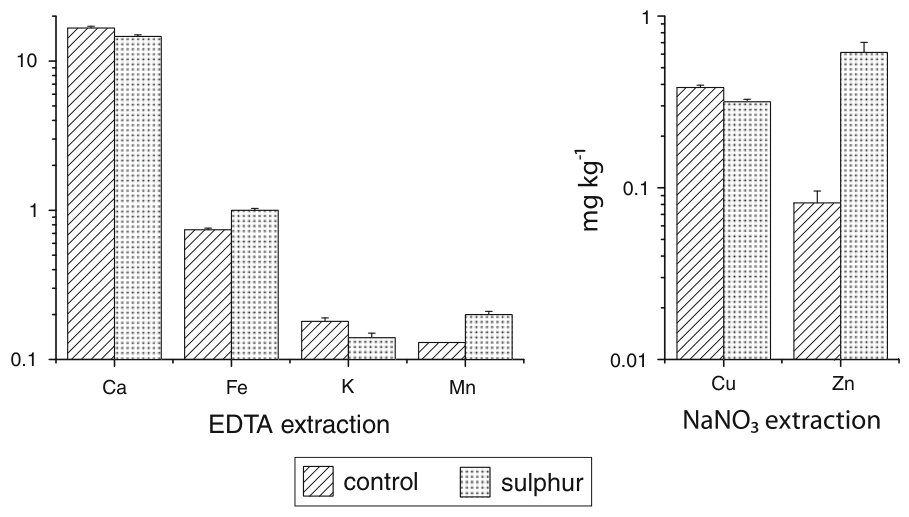
The S treatment did not significantly change the total concentration of any of the analyzed soil elements, except for the concentration of S itself, which was more than doubled (data not shown). However, it increased the EDTA-extractable Fe and Mn concentrations as well as the NaNO3-extractable Zn concentration, whereas it decreased the NaNO3- extractable Cu and the EDTA-extractable Ca and K concentrations (Fig. 1). The only significant effect of the NTA treatment was to increase EDTA-extractable P from 0.06 to 0.08 g kg-1.
除S本身的浓度增加一倍以上外(数据未列出),S处理未显著改变所分析土壤元素的全量浓度。然而,S处理提高了EDTA可提取态Fe和Mn浓度以及NaNO3可提取态Zn浓度,同时降低了NaNO3可提取态Cu以及EDTA可提取态Ca和K浓度(图1)。NTA处理唯一的显著效应是使EDTA可提取态P从0.06增至0.08 g kg-1。
| Element元素 | XRF (g kg-1) | HNO3 extraction (g kg-1)HNO3提取(g kg-1) | EDTA extraction (g kg-1)EDTA提取(g kg-1) | NaNO3 extraction (mg kg-1)NaNO3提取(mg kg-1) |
|---|---|---|---|---|
| Ca | 37.63 (0.60) | 33.15 (1.74) | 16.65 (0.47) | nd |
| Cd | nd | 0.0014 (0.0001) | 0.0013 (0.0000) | 0.0017 (0.0004) |
| Cu | 0.59 (0.03) | 0.53 (0.04) | 0.28 (0.01) | 0.381 (0.011) |
| Fe | 39.33 (0.84) | 20.42 (1.11) | 0.74 (0.02) | nd |
| K | 10.44 (0.10) | 0.74 (0.06) | 0.18 (0.01) | nd |
| Mg | 4.86 (0.07) | 2.95 (0.14) | 0.28 (0.01) | nd |
| Mn | 1.05 (0.02) | 1.00 (0.05) | 0.13 (0.00) | nd |
| P | 2.48 (0.06) | 1.69 (0.09) | 0.06 (0.00) | nd |
| S | 3.13 (0.08) | nd | nd | nd |
| Zn | 0.80 (0.03) | 0.68 (0.04) | 0.14 (0.01) | 0.081 (0.014) |
Standard errors of the means are in parentheses XRF X-ray fluorescence, nd not determined
括号内为平均值的标准误。XRF:X射线荧光;nd:未测定
Plant growth and element uptake on untreated soil
未处理土壤上的植物生长与元素吸收
Plant growth appeared to be normal. There were no visible symptoms of deficiency or toxicity. The yield was 20.5 t ha-1 for maize, 9.2 t ha-1 for sunflower, and 7.8 t ha-1 for tobacco, which was in or above the normal range for these crops in Switzerland (Walter et al. 2001). The total aboveground biomass of single plants was 0.25 ± 0.02 kg, 0.21 ± 0.01 kg, and 0.32 ± 0.05 kg for maize, sunflower, and tobacco, respectively. Fig. 2 shows the biomass ratios between different parts of the three plant species. Maize grains amounted to 46%, sunflower kernels to 26% and tobacco flowers only to 3–4% of the total dry weight (including roots) of the respective plants.
植物生长表现正常,未出现可见的缺素或毒害症状。玉米、向日葵和烟草的产量分别为20.5 t ha-1、9.2 t ha-1和7.8 t ha-1,处于或高于瑞士这些作物的正常范围(Walter et al. 2001)。玉米、向日葵和烟草单株地上部总生物量分别为0.25 ± 0.02 kg、0.21 ± 0.01 kg和0.32 ± 0.05 kg。图2显示了三种植物不同部位之间的生物量比例。玉米籽粒占相应植株总干重(包括根系)的46%,向日葵籽实占26%,而烟草花仅占3%~4%。
Judged by the respective lower and upper threshold concentrations given by Bergmann (1993) to indicate the ranges of sufficient nutrient supply for different crop plant species, the maize plants should have been considered slightly deficient in Cu, Ca, Fe, Mg and P, and even more clearly deficient in K and Mn (Table 2). Potassium only reached 1/4 and Mn 1/8 of the lower sufficiency threshold. Potassium and Mn concentrations were also below the respective lower threshold values in sunflower. In tobacco, Mg, Mn and P concentrations were deficient, while Cu was slightly above the respective threshold values. All other elements were within the respective ranges of sufficiency.
根据Bergmann (1993)给出的表示不同作物养分供应充足范围的下限和上限阈值浓度判断,玉米植株应被视为轻度缺乏Cu、Ca、Fe、Mg和P,且更明显地缺乏K和Mn(表2)。K仅达到充足下限阈值的1/4,Mn仅达到1/8。向日葵中K和Mn浓度也低于相应的下限阈值。烟草中Mg、Mn和P浓度不足,而Cu略高于相应阈值。其他所有元素均处于相应的充足范围内。
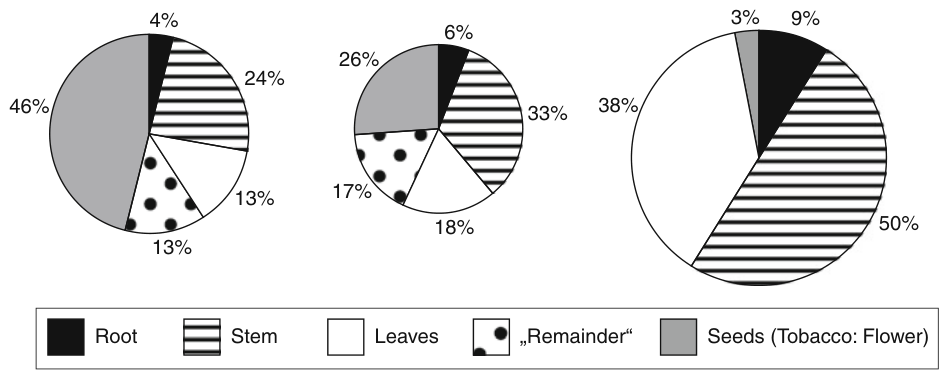
The areas of the circles are proportional to the total dry weights of the plants (0.25 ± 0.05 kg, 0.21 ± 0.01 kg, and 0.32 ± 0.05 kg for maize, sunflower and tobacco, respectively)
圆的面积与植株总干重成正比(玉米、向日葵和烟草分别为0.25 ± 0.05 kg、0.21 ± 0.01 kg和0.32 ± 0.05 kg)
That no deficiency symptoms were seen, even though the concentrations of some elements in each plant species were below the sufficiency threshold given by Bergmann (1993) for the respective species, indicates that not all of these values may apply to the cultivars used in the present study. Bergmann (1993) states that substantial variation between cultivars is common. Furthermore, the published sufficiency threshold values may not fully apply to the particular edaphic and climatic conditions of the study site.
尽管各植物中某些元素的浓度低于Bergmann (1993)为相应物种给出的充足阈值,但并未观察到缺素症状,这表明并非所有这些数值都适用于本研究所用的品种。Bergmann (1993)指出,品种间存在较大差异是常见现象。此外,已发表的充足阈值可能并不完全适用于研究地点特定的土壤和气候条件。
| Element元素 | Unit单位 | Maize玉米 | Sunflower向日葵 | Tobacco烟草 | |||
|---|---|---|---|---|---|---|---|
| Measured | Reference | Measured | Reference | Measured | Reference | ||
| Ca | g kg-1 | 2.38 (0.04) | 3–10a | 16.63 (0.10) | 8–20a | 22.80 (0.93) | 13–24a |
| Cd | mg kg-1 | 0.04 (0.00) | 0.2–3.0b | 0.28 (0.00) | 0.2–3.0b | 0.80 (0.02) | 0.2–3.0b |
| Cu | mg kg-1 | 3.16 (0.07) | 7–15a | 18.21 (0.33) | 10–20a | 18.58 (0.72) | 8–15a |
| Fe | mg kg-1 | 42.00 (2.88) | 50–250c | 64.60 (8.07) | 50–250c | 76.20 (7.18) | 50–250c |
| K | g kg-1 | 7.54 (0.37) | 30–45a | 25.84 (2.10) | 30–45a | 27.38 (2.18) | 25–45a |
| Mg | g kg-1 | 1.13 (0.05) | 2.5–5.0a | 3.38 (0.05) | 3–8a | 2.67 (0.04) | 4–8a |
| Mn | mg kg-1 | 4.80 (0.14) | 40–100a | 22.80 (0.43) | 25–100a | 17.90 (0.81) | 50–120a |
| P | g kg-1 | 1.51 (0.04) | 3.5–6.0a | 2.70 (0.20) | 2.5–5.0a | 2.01 (0.04) | 2.5–4.5a |
| S | g kg-1 | 1.01 (0.02) | 1–5d | 1.63 (0.02) | 1–5d | 3.38 (0.09) | 1–5d |
| Zn | mg kg-1 | 39.60 (1.50) | 30–70a | 61.40 (1.25) | 30–80a | 63.10 (1.63) | 25–70a |
Standard errors of the means are in parentheses括号内为平均值的标准误
a Sufficient range of mineral nutrients in the specific crop plant (tobacco, sunflower or maize)
a 特定作物(烟草、向日葵或玉米)中矿质养分的充足范围
b Normal range of heavy metal concentration in plants, grown on uncontaminated soils c Sufficient range of Fe concentration in plants d Range of S concentration in plants, grown under normal conditions
b 在未污染土壤上生长的植物中重金属浓度的正常范围 c 植物中Fe浓度的充足范围 d 正常条件下生长的植物中S浓度的范围
Both, soil and climate can have substantial influence on nutrient uptake (Bergmann 1993).
土壤和气候均可对养分吸收产生重大影响(Bergmann 1993)。
Plant Cd concentrations did not exceed values typically found on uncontaminated land. Copper and Zn concentrations were within the respective sufficiency ranges, indicating sufficient supply of these elements as micronutrients according to Bergmann (1993), with the exception that Cu just slightly exceeded the upper threshold of sufficiency for this element in tobacco (Table 2). The low uptake of these metals despite of their high total concentrations in the soil can be attributed to the alkaline soil pH and the high OM content. Low bioavailability of all three metals is also indicated by the rather low NaNO3- extractable metal concentrations as compared to the respective guide values.
植物Cd浓度未超过未污染土地上的典型值。根据Bergmann (1993),Cu和Zn浓度处于各自的充足范围内,表明这些元素作为微量营养元素供应充足,唯烟草中Cu略高于该元素的充足上限(表2)。尽管土壤中这些金属的全量浓度较高,但植物吸收量较低,这可归因于土壤呈碱性pH以及有机质含量高。与相应指导值相比,NaNO3可提取态金属浓度相当低,这也表明三种金属的生物有效性均较低。
8Element allocation in plants on untreated soil未处理土壤上植物体内的元素分配
The highest concentrations of the macronutrients S, Ca, K, and Mg occurred in the leaves of the three investigated species (Fig. 3). In maize, the concentrations of these elements differed less among roots, stems and leaves than in tobacco and sunflower. In particular, there were no significant differences in S, Ca, K and Mg concentrations in the leaves and roots of maize. The concentration of Ca in the seeds of maize and sunflower was significantly lower than in the other parts of these two species. This may be attributed to the low phloem mobility of this element (Marschner 1995).
三种供试植物中,大量营养元素S、Ca、K和Mg的最高浓度均出现在叶片中(图3)。与烟草和向日葵相比,玉米中这些元素在根、茎、叶之间的浓度差异较小。特别是玉米叶片与根系中S、Ca、K和Mg浓度无显著差异。玉米和向日葵种子中的Ca浓度显著低于这两种植物的其他部位,这可能归因于该元素在韧皮部中的移动性较低(Marschner 1995)。
In contrast to the other nutrients, the highest P concentrations were found in the seeds of maize and sunflower and of tobacco flowers. In seeds, most phosphate is bound as phytate (Marschner 1995). In cereal grains, nuts and legume seeds, phytate-P may represent up to 80% of the total seed P. Phytate plays an important role in pathogen resistance of seedlings, which is a major factor for seedling survival and growth (Frossard et al. 2000).
与其他养分不同,P的最高浓度出现在玉米和向日葵的种子以及烟草的花中。种子中大部分磷酸盐以植酸盐形式结合(Marschner 1995)。在谷物籽粒、坚果和豆类种子中,植酸磷可占种子总磷的80%。植酸盐在幼苗抗病性中发挥重要作用,而抗病性是幼苗存活和生长的主要因素(Frossard et al. 2000)。
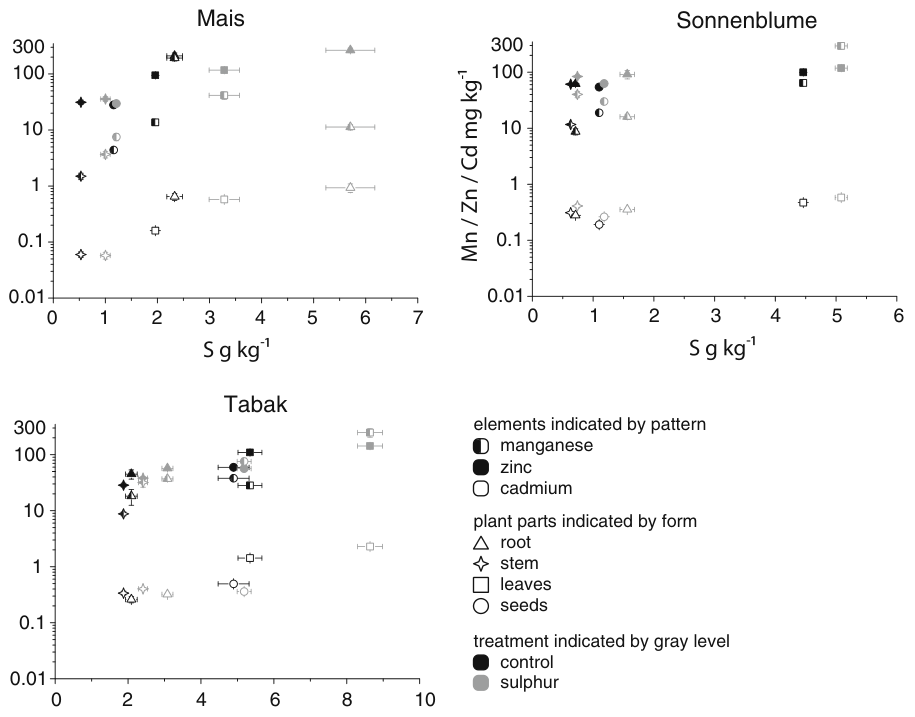
The allocation patterns of the micronutrients Cu, Fe, Mn, and Zn showed similar diversity as those of the macronutrients (Fig. 4). The allocation patterns of Cd were most similar to those of S, in particular for the vegetative parts, and resembled those of Zn and Mn (Fig. 5). In maize, the micronutrient concentrations were always highest in the roots and lower in stems and seeds than in the leaves. The Cd and Cu concentrations of maize seeds were below their respective detection limits. Maize is known as a shoot excluder of Cd, meaning that the root-shoot translocation of Cd is strongly restricted (Marschner 1995). In contrast, sunflower and tobacco translocated Cd, Zn, Mn, Cu and Fe efficiently into their upper parts. In these two plant species, Cd and Zn preferentially accumulated in the leaves. In sunflower this was also the case for Mn.
微量营养元素Cu、Fe、Mn和Zn的分配模式表现出与大量营养元素相似的多样性(图4)。Cd的分配模式与S最为相似(尤其是在营养器官中),并与Zn和Mn相似(图5)。玉米中,微量营养元素浓度总是在根系中最高,在茎和种子中低于叶片。玉米种子中的Cd和Cu浓度低于各自的检出限。玉米是已知的Cd地上部排斥型植物,即Cd从根系向地上部的转运受到强烈限制(Marschner 1995)。相比之下,向日葵和烟草能有效地将Cd、Zn、Mn、Cu和Fe转运至其上部。在这两种植物中,Cd和Zn优先在叶片中积累。向日葵中Mn也是如此。
Given that Cd preferentially accumulates in leaves compared to other aboveground plant parts, growing leafy vegetables may be riskier than producing grains for food or feed on Cd-contaminated soil (Alloway and Jackson 1991). However, for many crops it is the seeds that are consumed. A comparison of the element concentrations of maize and sunflower seeds with reference values given in the literature for human and animal nutrition is given in Table 3. Sunflower seeds contained normal concentrations of Ca, Fe and Zn. Copper, K, and Mg were slightly above the normal mean values. Maize had Ca and Cu concentrations far below the respective mean concentrations, whereas Mg and K exceeded reference values. The high K concentration of the maize grains is further evidence that the maize plants were not deficient in K, even though the average K concentration of the whole plant was below the respective reference value (as discussed above). There are no Swiss threshold values for concentrations of these elements in plant raw materials used for food or feed. Underwood and Suttle (1999) reported that the tolerable limit of Mg concentrations for ruminants was 5 g kg-1 dry matter by the US National Academy of Sciences.
鉴于与其他地上部位相比Cd优先在叶片中积累,在Cd污染土壤上种植叶菜类蔬菜的风险可能高于生产用作食品或饲料的谷物(Alloway and Jackson 1991)。然而,许多作物被食用的是种子。表3将玉米和向日葵种子的元素浓度与文献中给出的人类及动物营养参考值进行了比较。向日葵种子中Ca、Fe和Zn浓度正常,Cu、K和Mg略高于正常平均值。玉米中Ca和Cu浓度远低于相应平均浓度,而Mg和K超过参考值。玉米籽粒中较高的K浓度进一步证明玉米植株并不缺K,尽管整株平均K浓度低于相应参考值(如上所述)。瑞士对于用作食品或饲料的植物原料中这些元素的浓度没有阈值规定。Underwood and Suttle (1999)报道,美国国家科学院规定反刍动物对Mg浓度的耐受限值为5 g kg-1干物质。
There are no reported threshold values for K, however, a concentration of 60 g K per kg-1 fodder led to a decline of appetite and growth in calves (Underwood and Suttle 1999). Our measured Mg and K concentrations in maize grains of 1.18 g kg-1 and 3.18 g kg-1, should not negatively affect animal health. Moreover, grain Fe, Mn, S were in the normal range, while grain Zn was slightly above.
对于K尚无报道的阈值,但饲料中K浓度达60 g kg-1时导致犊牛食欲和生长下降(Underwood and Suttle 1999)。本研究测得玉米籽粒中Mg和K浓度分别为1.18 g kg-1和3.18 g kg-1,应不会对动物健康产生不利影响。此外,籽粒中Fe、Mn、S处于正常范围内,而Zn略高于正常范围。
The mineral nutritional value of seeds depends on the bioavailability of the nutrient elements to humans and animals, rather than just on the total concentrations. In particular, excessive levels of P in seeds, when it is primarily present in form of phytate, may reduce the bioavailability of nutrients as well as contaminants. In our case, the P concentration was slightly above the normal range for seeds in both plants (Table 3). The concentration of Cd, the main
种子的矿质营养价值取决于营养元素对人类和动物的生物有效性,而不仅仅取决于其全量浓度。特别是种子中过量的P,若主要以植酸盐形式存在,可能降低养分及污染物的生物有效性。本研究中,两种植物种子中的P浓度均略高于种子的正常范围(表3)。Cd作为本土壤中
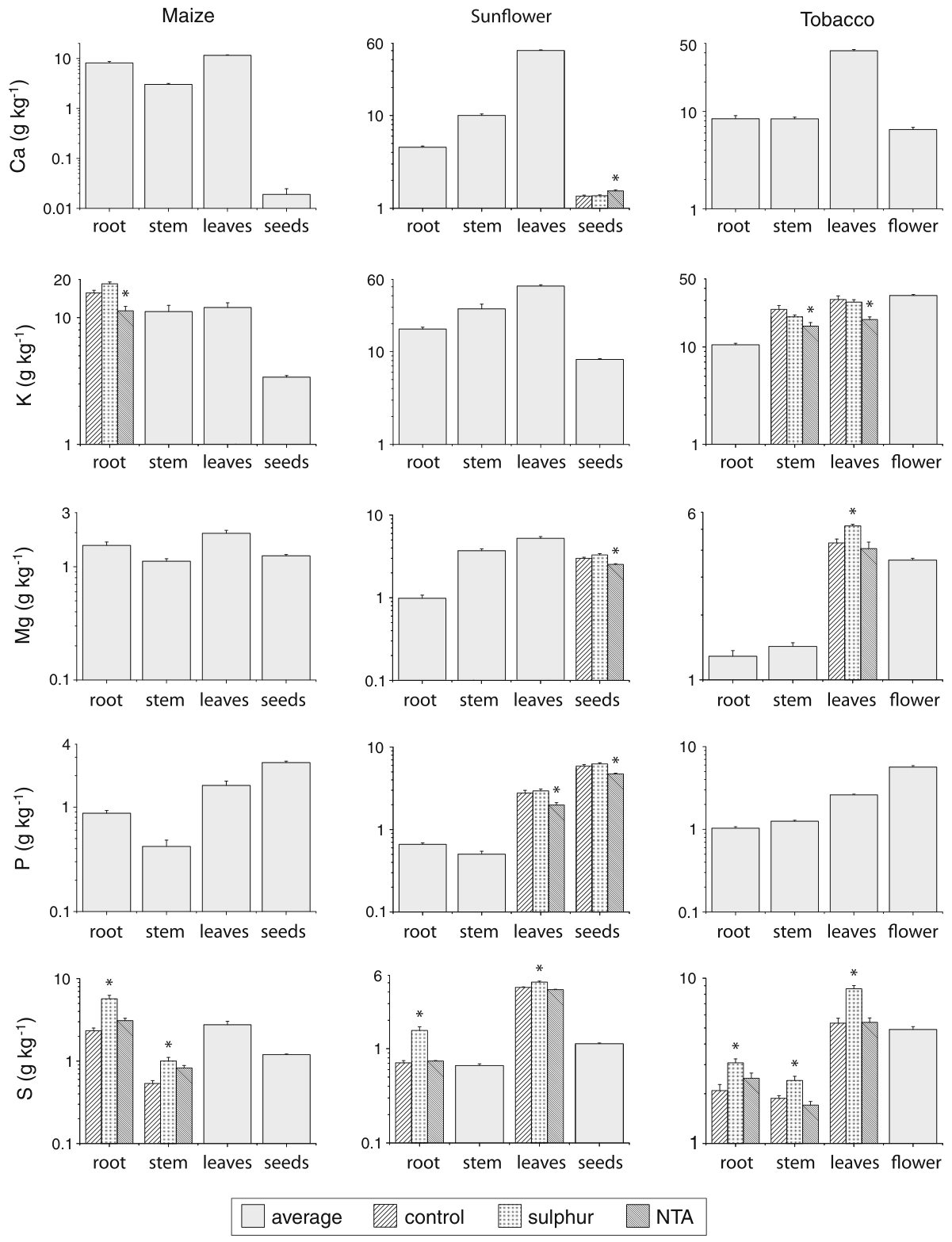
where no treatment effect was found. Asterisks indicate significant differences between treatment, and respective control. Error bars represent the standard errors of the means
未发现处理效应的部位的平均养分浓度。星号表示处理与相应对照之间差异显著。误差线表示平均值的标准误
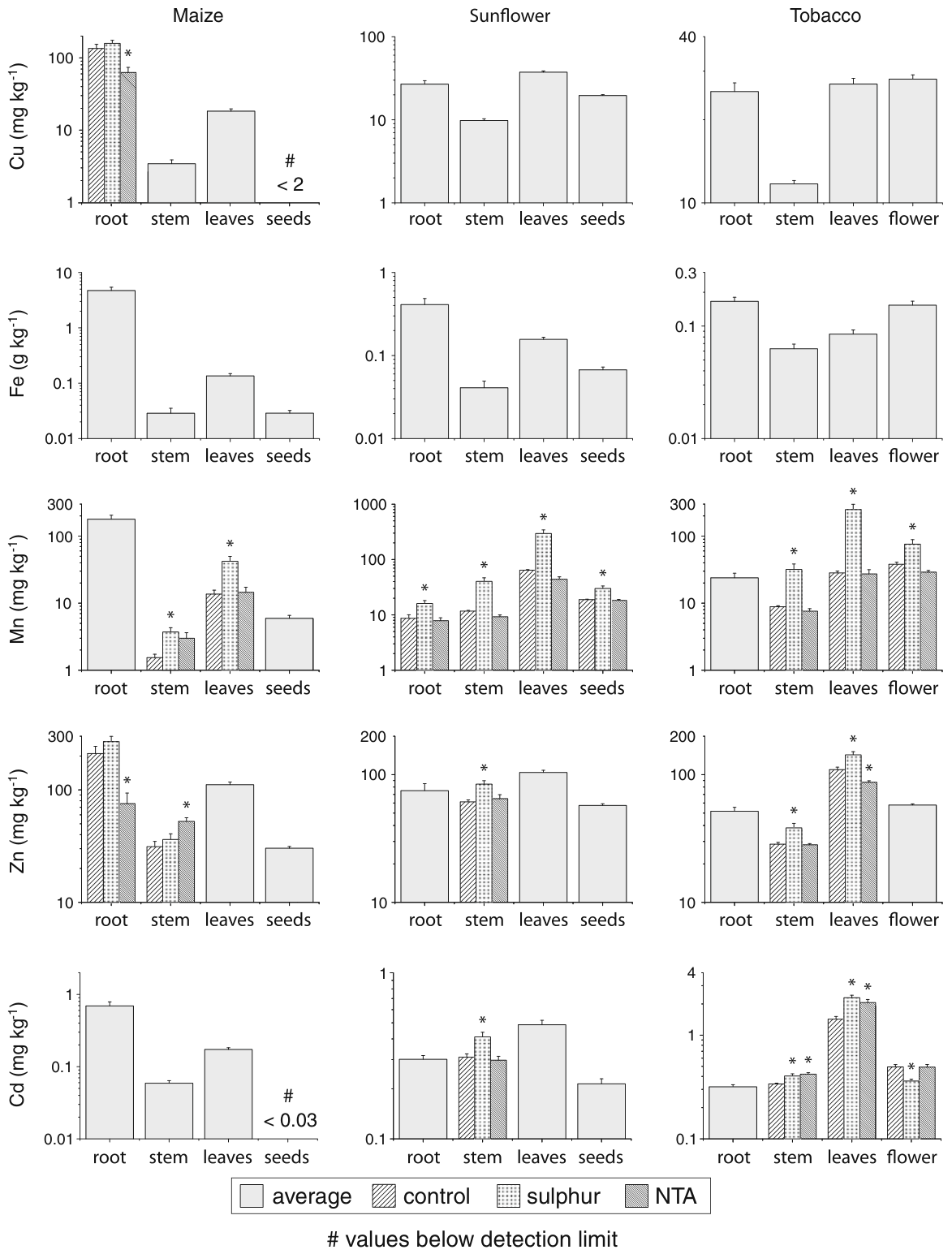
where no treatment effect was found. Asterisks indicate significant differences between treatment, and respective control. Error bars represent the standard errors of the means
未发现处理效应的部位的平均养分浓度。星号表示处理与相应对照之间差异显著。误差线表示平均值的标准误
| Element元素 | Unit单位 | Maize玉米 | Sunflower向日葵 | ||
|---|---|---|---|---|---|
| Measured | Reference | Measured | Reference | ||
| Ca | g kg-1 | 0.02 (0.00) | 0.5b | 1.35 (0.03) | 1.6b |
| Cd | mg kg-1 | \0.031 | 0.1c/1d | 0.19 (0.01) | 1.6c/1d |
| Cu | mg kg-1 | \2 | 9b | 18.93 (0.31) | 14b |
| Fe | mg kg-1 | 26.76 (5.47) | 25b | 62.09 (0.61) | 68b |
| K | g kg-1 | 3.18 (0.09) | 0.8a | 8.64 (0.26) | 6.4a |
| Mg | g kg-1 | 1.18 (0.03) | 0.2a | 3.00 (0.07) | 3.87a |
| Mn | mg kg-1 | 4.39 (0.39) | 5–8e | 18.86 (0.29) | |
| P | g kg-1 | 2.47 (0.09) | 3.4b | 5.87 (0.22) | 4.5a |
| S | g kg-1 | 1.16 (0.03) | 1e | 1.10 (0.02) | |
| Zn | mg kg-1 | 28.07 (0.87) | 21b | 54.32 (1.05) | 48b |
Standard errors of the means are in parentheses括号内为平均值的标准误
a Tables of nutritional values of foodstuffs [values of sunflower seeds and polenta (Maisgriess)] (SwissFIR 2008)
a 食品营养价值表[向日葵种子和玉米粗粉(Maisgriess)的数值](SwissFIR 2008)
b Tables of nutritional values of swine forage (values of sunflower seeds and maize corn) (ALP 2004)
b 猪饲料营养价值表(向日葵种子和玉米籽粒的数值)(ALP 2004)
c Threshold value for human nutrition [sunflower: value of oilseed, maize: value of cereals (u¨brige Getreide)] (FIV 1995) d Threshold value for undesired substances in plant raw materials for animal feeding (FMBV 1999)
c 人类营养阈值[向日葵:油料种子的数值;玉米:谷物(u¨brige Getreide)的数值](FIV 1995) d 动物饲料用植物原料中不良物质的阈值(FMBV 1999)
e Typical content in cereal grains (Underwood and Suttle 1999)
e 谷物籽粒中的典型含量(Underwood and Suttle 1999)
problem element in our soil with respect to food chain transfer, was below the threshold values in both, sunflower and maize seeds. Thus, they could be safely used at least as feed for animals.
食物链转移方面的主要问题元素,其在向日葵和玉米种子中的浓度均低于阈值。因此,它们至少可以安全地用作动物饲料。
9Treatment effects on plant growth, element uptake and allocation处理对植物生长、元素吸收与分配的影响
Neither the S nor the NTA applications significantly affected the biomass production of the plants (data not shown). They also had little effect on the uptake and allocation of the investigated macro- and microelements (Figs. 3, 4). Where it had an effect, the S treatment generally resulted in a slightly increased concentration of the affected element. Not surprisingly, the S treatment increased S concentrations in the plants. The greatest increase occurred in the roots of all three crops, but the S concentrations increased also in maize and tobacco stems as well as in sunflower and tobacco leaves, while no significant effects were found in the seeds and flowers.
S和NTA的施用均未显著影响植物的生物量(数据未列出),对所研究的大量和微量元素的吸收与分配也影响甚微(图3、图4)。在有影响的情况下,S处理通常使受影响元素的浓度略有升高。不出所料,S处理提高了植物中的S浓度。三种作物中增幅最大的均为根系,但玉米和烟草茎以及向日葵和烟草叶片中的S浓度也有所升高,而种子和花中未发现显著影响。
Apart from S itself, Mn, Zn and Cd responded most strongly to the S treatment (Fig. 5). These elements showed similar allocation patterns and similar relationships to the S concentration in the various plant parts. Most conspicuous was the increase in Mn accumulation, which was observed in all three plant species, primarily in the stems and leaves, and in sunflower roots and seeds as well as in the flowers of tobacco (Fig. 4). Sulphur applications were also found by other authors to increase plant Mn concentrations (Juste and Solda 1988; Cimrin et al. 2008). In sunflower and tobacco, Zn was slightly increased in the stems, but not in the seeds. An S effect on leaf Zn was only observed in tobacco. The S treatment effects on Cd concentrations were similar to those on Zn in sunflower and tobacco, with the exception of the rather unexpected result that Cd was slightly decreased in tobacco flowers. Magnesium was increased in tobacco leaves (Fig. 3).
除S本身外,Mn、Zn和Cd对S处理的响应最为强烈(图5)。这些元素在各植物部位中表现出相似的分配模式以及与S浓度的相似关系。最显著的是Mn积累的增加,这在三种植物中均有观察到,主要发生在茎和叶中,也见于向日葵的根和种子以及烟草的花中(图4)。其他作者也发现施用硫可提高植物Mn浓度(Juste and Solda 1988; Cimrin et al. 2008)。在向日葵和烟草中,茎中的Zn略有增加,但种子中没有。S对叶片Zn的影响仅在烟草中观察到。在向日葵和烟草中,S处理对Cd浓度的影响与对Zn的影响相似,例外的是一个颇为出乎意料的结果,即烟草花中的Cd略有下降。烟草叶片中Mg有所增加(图3)。
For a comparison with the results obtained in the previous study on the same experimental field (Fa¨ssler et al. 2009) we calculated the mean element concentrations for the whole above ground biomass from the values of the individual plant parts of the above ground biomass. In the previous study, the S treatment had led to increased Mg and Cd concentrations in tobacco and an increased Zn concentration in all three plants, which is consistent with what we obtained in the present study. The doubling of the S application in 2006 had little additional effect on plant metal uptake.
为与在同一试验田上前期研究所得结果(Fa¨ssler et al. 2009)进行比较,我们根据地上部各部位的数值计算了整个地上部生物量的平均元素浓度。在前期研究中,S处理导致烟草中Mg和Cd浓度升高,三种植物中Zn浓度均升高,这与本研究所得结果一致。2006年S施用量加倍对植物金属吸收几乎没有额外影响。
The results of the S treatment are also in good agreement with those of Kayser (2000), who investigated the response of maize and tobacco upon the addition of elemental S in two different soils (a carbonate rich silty clay loam with pH 7.4 and a low carbonate sandy loam with pH 6.8). While S applications decreased the pH of both soils, plant accumulation of S and Mn was only increased in the soil with low CaCO3, indicating that not the pH effect but the increased availability of S was the dominating factor for the increase in Mn uptake. In agreement with our findings here, Kayser (2000) reported that the responses of plant Cd and Zn concentrations were similar to those of plant S and Mn concentrations.
S处理的结果也与Kayser (2000)的结果高度一致,后者研究了玉米和烟草在两种不同土壤(pH 7.4的富碳酸盐粉砂质黏壤土和pH 6.8的低碳酸盐砂壤土)中对添加单质S的响应。虽然施S降低了两种土壤的pH,但仅在低CaCO3土壤中植物对S和Mn的积累增加,这表明Mn吸收增加的主导因素并非pH效应,而是S有效性的提高。与本研究结果一致,Kayser (2000)报道植物Cd和Zn浓度的响应与植物S和Mn浓度的响应相似。
The observed similarities in the accumulation and allocation patterns of Cd, Zn and Mn suggest that transport mechanisms common to all three of these elements played a role. Cadmium is taken up into plant cells among others through transporters belonging to the ZIP and Nramp families, which also transport Zn and Mn (Guerinot 2000; Pittman 2005).
观察到的Cd、Zn和Mn在积累和分配模式上的相似性表明,这三种元素共有的转运机制发挥了作用。Cd可通过ZIP和Nramp家族转运蛋白等途径进入植物细胞,而这些转运蛋白同样转运Zn和Mn(Guerinot 2000; Pittman 2005)。
The similarity in Zn and Cd allocation has been reported in other species. In Arabidopsis halleri it was not only found at the level of whole plant organs, but also of single cells (Ku¨pper et al. 2000). Ma et al. (2005) also found that Cd and Zn had similar subcellular localisation in the leaves of Thlaspi caerulescens. The similarity of the two metals also results in competition for binding sites. This is one reason why not only positive correlations are found between Cd and Zn uptake by plants, but also antagonistic effects (Cosio et al. 2004). However, plants discriminate between Cd and Zn by producing ligands that are particularly specific for one of them. Studying Cd-stressed Thlaspi caerulescens plants Ku¨pper et al. (2004) found that histidine was the main ligand for Zn, while SH-bearing ligands, such as phytochelatins, predominantly bound Cd.
其他物种中也有Zn和Cd分配相似的报道。在Arabidopsis halleri中,这种相似性不仅存在于整个植物器官水平,也存在于单细胞水平(Ku¨pper et al. 2000)。Ma et al. (2005)也发现Cd和Zn在Thlaspi caerulescens叶片中具有相似的亚细胞定位。两种金属的相似性还导致它们竞争结合位点。这是植物对Cd和Zn的吸收之间不仅存在正相关、也存在拮抗效应的原因之一(Cosio et al. 2004)。然而,植物通过产生对其中一种金属具有特异性的配体来区分Cd和Zn。Ku¨pper et al. (2004)在研究受Cd胁迫的Thlaspi caerulescens植株时发现,组氨酸是Zn的主要配体,而含巯基(SH)的配体(如植物螯合肽)主要结合Cd。
Phytochelatins have a particularly high binding affinity for Cd compared to other metal ions and are known to be involved in the detoxification of Cd in plants (Satofuka et al. 2001; Cobbett and Goldsbrough 2002). As phytochelatins are rich in S, the increased S accumulation observed in the crop plants on the S-treated plots may not only have been a response to higher S-availability in the soil but also to increased Cd stress due to the decrease in soil pH. This is consistent with the observation of an increased shoot S concentration in Cd-stressed Arabidopsis halleri plants by Ku¨pper et al. (2000).
与其他金属离子相比,植物螯合肽对Cd具有特别高的结合亲和力,并已知参与植物体内Cd的解毒(Satofuka et al. 2001; Cobbett and Goldsbrough 2002)。由于植物螯合肽富含S,在S处理小区作物中观察到的S积累增加,可能不仅是对土壤中S有效性提高的响应,也是对土壤pH下降导致的Cd胁迫加剧的响应。这与Ku¨pper et al. (2000)观察到受Cd胁迫的Arabidopsis halleri植株地上部S浓度升高相一致。
Competition in plant uptake was not only reported to exist between Cd and Zn (Cosio et al. 2004) but also between Cd and Mn. Hernandez et al. (1998) treated hydroponically grown Pisum sativum and Zea mais with 50 lM Cd and found that Mn uptake was almost completely inhibited, while Peng et al. (2008) found that the addition of 9.1–5,000 lM Mn to Cdtreated (10–50 lM) Phytolacca americana plants significantly reduced Cd accumulation and alleviated Cd toxicity in a hydroponic experiment. The increase in plant Mn concentrations on the S-treated plots may thus have counteracted a stronger increase in Cd uptake in our study.
据报道,植物吸收中的竞争不仅存在于Cd与Zn之间(Cosio et al. 2004),也存在于Cd与Mn之间。Hernandez et al. (1998)用50 μM Cd处理水培的Pisum sativum和Zea mais,发现Mn的吸收几乎被完全抑制;而Peng et al. (2008)在水培试验中发现,向经Cd处理(10~50 μM)的Phytolacca americana植株添加9.1~5,000 μM Mn,可显著减少Cd积累并缓解Cd毒性。因此,在本研究中,S处理小区植物Mn浓度的增加可能抑制了Cd吸收的更大幅度增加。
In the few cases, where we observed an NTA effect on the uptake or allocation of the investigated elements, it consisted of a slight decrease, with few exceptions. There were decreases in shoot concentrations of K and Zn in tobacco and P in sunflower (Figs. 3, 4), while Zn was increased in maize stems. The decrease in shoot K accumulation of tobacco led to a concentration below the sufficiency range given for this plant by Bergmann (Table 3). In contrast to the effects of S applications, NTA had no effects on Mn concentrations, but decreased the K, Cu and Zn concentrations in maize roots. The decrease in root Zn combined with the increase in stem Zn in maize may indicate an enhanced translocation of Zn from the roots to the shoot with NTA treatment. In sunflower seeds, NTA decreased Mg and P, and increased Ca. Also, in contrast to the observed S effects, NTA effects on Cd differed from those on Zn. The accumulation of Cd was increased in tobacco leaves and stems by NTA, but was unaffected in all other cases. While the increased Zn concentration in maize stems is consistent with the results obtained in previous years (Fa¨ssler et al. 2009), the increased Cd accumulation in tobacco was new and may be due to the doubling of the applied NTA concentration compared to the latter study.
在观察到NTA对所研究元素的吸收或分配产生影响的少数情况下,除少数例外,其效应均表现为轻微下降。烟草地上部K和Zn浓度以及向日葵P浓度有所下降(图3、图4),而玉米茎中Zn增加。烟草地上部K积累的下降使其浓度低于Bergmann为该植物给出的充足范围(表3)。与施S的效应不同,NTA对Mn浓度没有影响,但降低了玉米根系中的K、Cu和Zn浓度。玉米根系Zn的下降与茎中Zn的增加相结合,可能表明NTA处理增强了Zn从根系向地上部的转运。在向日葵种子中,NTA降低了Mg和P,提高了Ca。此外,与观察到的S效应不同,NTA对Cd的影响不同于对Zn的影响。NTA提高了烟草叶和茎中Cd的积累,但在其他所有情况下均无影响。虽然玉米茎中Zn浓度的增加与前几年所得结果(Fa¨ssler et al. 2009)一致,但烟草中Cd积累的增加是新发现,可能是由于所施NTA浓度较后一研究加倍所致。
Implications for agricultural crop production
对农业作物生产的启示
Although the HNO3-extractable soil Cd and Zn concentrations exceeded the respective OIS guide values and in the case of Cu, the trigger value, the concentrations of these elements in edible parts of all the plants in all treatments were below the values considered problematic for consumption by humans or animals (Tables 2, 3). Plant metal concentrations exceeding regulatory values were only observed in the case of tobacco, where leaf Cd concentrations exceeded the Swiss threshold value of 1 mg kg-1 for undesired substances in raw materials for animal feeding (FMBV 1999), in all treatments.
尽管HNO3可提取态土壤Cd和Zn浓度超过了相应的OIS指导值,Cu则超过了触发值,但所有处理中所有植物可食部位中这些元素的浓度均低于被认为对人类或动物食用存在问题的数值(表2、表3)。植物金属浓度超过法规限值的情况仅见于烟草:在所有处理中,烟草叶片Cd浓度均超过了瑞士规定的动物饲料原料中不良物质阈值1 mg kg-1(FMBV 1999)。
Although tobacco is not used as a food plant, the accumulation of Cd in tobacco may exacerbate the harmful effects of smoking, which is the main source of Cd intake by humans (Bernhard et al. 2005). Leaf concentrations of tobacco used for cigarette production are reported to vary between 0.5 and 5 mg kg-1 on uncontaminated soil (Lugon-Moulin et al. 2004). The leaf Cd concentrations found in our experiment on the untreated soil were in the lower part of this range and were still in this range after S or NTA treatments. To be on the safe side, however, tobacco plants may be used for energy production instead (Meher et al. 1995). The unexpected finding that Cd accumulation in the tobacco flowers was slightly decreased in the S treatment indicates that testing the effect of S amendments on the seeds and fruits of related plants, such as tomato (Solanum lycopersicum) or chilli peppers (Capsicum sp.) may be an interesting avenue for future research.
尽管烟草不是食用植物,但烟草中的Cd积累可能加剧吸烟的危害,而吸烟是人类摄入Cd的主要来源(Bernhard et al. 2005)。据报道,在未污染土壤上,用于卷烟生产的烟草叶片Cd浓度在0.5~5 mg kg-1之间(Lugon-Moulin et al. 2004)。本试验中未处理土壤上的叶片Cd浓度处于该范围的较低部分,经S或NTA处理后仍在该范围内。然而,为稳妥起见,烟草植株可改用于能源生产(Meher et al. 1995)。S处理使烟草花中Cd积累略有下降这一意外发现表明,检验S改良剂对番茄(Solanum lycopersicum)或辣椒(Capsicum sp.)等近缘植物种子和果实的影响,可能是未来研究的一个有意义的方向。
The elevated total soil metal concentrations are still relevant for crop contamination risks arising from the deposition of suspended soil particles on plant surfaces due to wind erosion or rain splash. We compared our plant concentrations with data obtained from plants grown the same field but harvested in usual agricultural manner, i.e. they were passed through a chaff cutter directly on the field without being washed (data not shown). The Cu concentrations were significantly lower in all three washed compared to the unwashed crops (maize 52%, sunflower 12% and tobacco 22%). Zinc concentrations in maize and sunflower were also significantly lower in the washed plants (maize 16%, sunflower 22%). No washing effect was found for Zn in tobacco and for Cd in all three plants. If economically feasible, washing the plants before feeding them to animals would thus reduce the animals’ exposure to Cu and Zn. As the amount of suspended soil particles on the plant surface certainly decreases with the distance to the soil surface, an increase in the cutting height might also reduce the contamination.
对于风蚀或雨滴溅击导致悬浮土壤颗粒沉积于植物表面而引起的作物污染风险而言,土壤中较高的金属全量浓度仍具有重要意义。我们将本研究的植物浓度与在同一田块上生长、但按常规农业方式收获(即在田间直接用铡草机切碎而不清洗)的植物数据进行了比较(数据未列出)。三种作物中,清洗后的Cu浓度均显著低于未清洗的作物(玉米52%,向日葵12%,烟草22%)。清洗后玉米和向日葵中的Zn浓度也显著降低(玉米16%,向日葵22%)。烟草中的Zn以及三种植物中的Cd均未发现清洗效应。因此,若经济上可行,在饲喂动物前清洗植物可减少动物对Cu和Zn的暴露。由于植物表面悬浮土壤颗粒的数量必然随距土壤表面距离的增加而减少,提高收割高度也可能减少污染。
Our results show that moderate concentrations of contaminating metals do not necessarily render agricultural soils unsuitable for the production of food or fodder plants. However, when planting crops on contaminated soil, it is important to monitor and control the availability of the soil contaminants to potential crop plants. Heavy metal concentrations in plant tissues may increase over time in response to changes in acidity, organic matter and other soil properties, thereby taking particular account of the allocation of potentially toxic elements in the harvested plant parts. In the case of the soil investigated here, all three tested crops are realistic options to be used in a sustainable phytomanagement of the land, with or without S treatment.
本研究结果表明,中等浓度的污染金属并不一定使农业土壤不适于生产粮食或饲料作物。然而,在受污染土壤上种植作物时,重要的是监测和控制土壤污染物对潜在作物的有效性。植物组织中的重金属浓度可能随酸度、有机质及其他土壤性质的变化而逐渐升高,因此应特别关注潜在有毒元素在收获部位中的分配。就本研究所考察的土壤而言,无论是否进行S处理,所试验的三种作物都是该土地可持续植物管理的现实选择。
Alloway BJ, Jackson AP (1991) The behaviour of heavy metals in sewage sludge-amended soils. Sci Total Environ 100: 151–176
Alloway BJ, Jackson AP (1991) The behaviour of heavy metals in sewage sludge-amended soils. Sci Total Environ 100: 151–176
ALP (2004) Fu¨tterungsempfehlungen und Na¨hrwerttabellen fu¨r Schweine. Eidgeno¨ssische landwirtschaftliche Forschungsanstalt fu¨r Nutztiere und Milchwirtschaft ALP (Agroscope Liebefeld-Posieux). Landwirtschaftliche Lehrmittelzentrale, Zollikofen
ALP (2004) Fu¨tterungsempfehlungen und Na¨hrwerttabellen fu¨r Schweine. Eidgeno¨ssische landwirtschaftliche Forschungsanstalt fu¨r Nutztiere und Milchwirtschaft ALP (Agroscope Liebefeld-Posieux). Landwirtschaftliche Lehrmittelzentrale, Zollikofen
Amon T, Amon B, Kryvoruchko V et al (2007) Methane production through anaerobic digestion of various energy crops grown in sustainable crop rotations. Bioresour Technol 98:3204–3212
Amon T, Amon B, Kryvoruchko V et al (2007) Methane production through anaerobic digestion of various energy crops grown in sustainable crop rotations. Bioresour Technol 98:3204–3212
Angelova V, Ivanova R, Ivanov K (2004) Heavy metal accumulation and distribution in oil crops. Commun Soil Sci Plant Anal 35:2551–2566
Angelova V, Ivanova R, Ivanov K (2004) Heavy metal accumulation and distribution in oil crops. Commun Soil Sci Plant Anal 35:2551–2566
Baker AJM, McGrath SP, Sidoli CMD et al (1994) The possibility of in situ heavy metal decontamination of polluted soils using crops of metal-accumulating plants. Resour Conserv Recycl 11:41–49
Baker AJM, McGrath SP, Sidoli CMD et al (1994) The possibility of in situ heavy metal decontamination of polluted soils using crops of metal-accumulating plants. Resour Conserv Recycl 11:41–49
Bergmann W (1993) Erna¨hrungssto¨rungen bei Kulturpflanzen. Gustav Fischer Verlag Jena, Stuttgart
Bergmann W (1993) Erna¨hrungssto¨rungen bei Kulturpflanzen. Gustav Fischer Verlag Jena, Stuttgart
10Conclusions结论
The studied soil contaminants at Witzwil were predominantly accumulated in the leaves and/or roots, rather than the seeds. Thus sunflower seeds or maize grain could be safely used as food or animal feed. In contrast, the production of leafy vegetables may result in these toxic elements presenting a health risk to humans or animals. Besides of the increase in Mn accumulation by all three tested crop plants after S application, both treatments (S and NTA) had only slight or no effects on the uptake and allocation of plant nutrients and Cd. Thus, there is little benefit of these treatments for phytoextraction purposes at this site, even though the application doses were doubled compared to the previous years. The use of sunflower, maize and tobacco without treatment, on the other hand, provides valuable biomass while the environmental risks posed by the soil contaminants are gradually reduced.
Witzwil试验地所研究的土壤污染物主要积累于叶片和/或根系中,而非种子中。因此,向日葵籽粒或玉米籽粒可安全地用作食品或动物饲料。相反,种植叶菜类蔬菜则可能使这些有毒元素对人类或动物构成健康风险。除施S后三种供试作物对Mn的积累均有所增加外,两种处理(S和NTA)对植物养分和Cd的吸收与分配仅有轻微影响或无影响。因此,尽管施用剂量较前几年增加了一倍,这些处理在该地点用于植物提取的效益仍然甚微。另一方面,在不加处理的情况下种植向日葵、玉米和烟草,既可提供有价值的生物质,又能逐步降低土壤污染物带来的环境风险。
Acknowledgments We are grateful to Werner Stauffer for the maintenanceofthe fieldexperimentandtoAnnaGru¨nwald,Diane Bu¨rgi, Fabian von Ka¨nel, and Viktor Stadelmann for technical assistance in the lab, as well as to Andreas Papritz for his help in statistical analysis. The project was funded by the Federal Office for Education and Science within COST action 859.
致谢 感谢Werner Stauffer对田间试验的维护,感谢Anna Grünwald、Diane Bürgi、Fabian von Känel和Viktor Stadelmann在实验室提供的技术协助,并感谢Andreas Papritz在统计分析方面给予的帮助。本项目由瑞士联邦教育与科学办公室在COST 859行动框架下资助。
11References参考文献
ACW, ART (2007) Schweizerische Referenzmethoden der Eidgeno¨ssischen landwirtschaftlichen Forschungsanstalten ART und ACW. Agroscope Reckenholz, Ta¨nikon and Agroscope Changins-Wa¨denswil
Bernhard D, Rossmann A, Wick G (2005) Metals in cigarette smoke. IUBMB Life 57:805–809
Brady NC, Weil RR (2002) The nature and properties of soils. Prentice Hall, Upper Saddle River
Chaney RL, Malik M, Li YM et al (1997) Phytoremediation of soil metals. Curr Opin Biotechnol 8:279–284
Cimrin KM, Togay Y, Togay N et al (2008) Effects of different sulphur and pyrite levels on yield, yield components and nutrients uptake of lentil (Lens culinaris). Indian J Agric Sci 78:543–547
Cobbett C, Goldsbrough P (2002) Phytochelatins and metallothioneins: roles in heavy metal detoxification and homeostasis. Annu Rev Plant Biol 53:159–182
Cosio C, Martinoia E, Keller C (2004) Hyperaccumulation of cadmium and zinc in Thlaspi caerulescens and Arabidopsis halleri at the leaf cellular level. Plant Physiol 134: 716–725
Domı´nguez MT, Maran˜o´n T, Murillo JM et al (2008) Trace element accumulation in woody plants of the Guadiamar Valley, SW Spain: a large-scale phytomanagement case study. Environ Pollut 152:50–59
Fa¨ssler E, Robinson BH, Stauffer W et al (2009) Phytomanagement of metal-contaminated agricultural land using sunflower, maize and tobacco. Agric Ecosyst Environ. doi:10.1016/j.agee.2009.11.007
FIV (1995) Verordnung u¨ber Fremd- und Inhaltsstoffe in Lebensmitteln (FIV) des Eidgeno¨ssischen Departements des Innern vom 26. Juni 1995, SR-Nr. 817.021.23. Eidgeno¨ssische Drucksachen- und Materialzentrale, Bern, p 170
FMBV (1999) Verordnung u¨ber die Produktion und das Inverkehrbringen von Futtermitteln, Zusatzstoffen fu¨r die Tiererna¨hrung, Silierzusa¨tzen und Dia¨tfuttermitteln (FMBV) des Eidgeno¨ssischen Volkswirtschaftsdepartements vom 10. Juni 1999, SR-Nr. 916.307.1. Eidgeno¨ssische Drucksachen- und Materialzentrale, Bern, p 20
Frossard E, Bucher M, Ma¨chler F et al (2000) Potential for increasing the content and bioavailability of Fe, Zn and Ca in plants for human nutrition. J Sci Food Agric 80: 861–879
Guerinot ML (2000) The ZIP family of metal transporters. Biochim Biophys Acta 1465:190–198
Hernandez LE, Lozano-Rodriguez E, Garate A et al (1998) Influence of cadmium on the uptake, tissue accumulation and subcellular distribution of manganese in pea seedlings. Plant Sci 132:139–151
Juste C, Solda P (1988) Changes in the cadmium, manganese, nickel and zinc bioavailability of a sewage sludge-treated sandy soil as a result of ammonium-sulfate, acid peat, lime or iron compound addition. Agronomie 8:897–904
Kayser A (2000) Evaluation and enhancement of phytoextraction of heavy metals from contaminated soils. Dissertation, ETH Zurich
Kayser A, Wenger K, Keller A et al (2000) Enhancement of phytoextraction of Zn, Cd, and Cu from calcareous soil: the use of NTA and sulfur amendments. Environ Sci Technol 34:1778–1783
Kulli B, Balmer M, Krebs R et al (1999) The influence of nitrilotriacetate on heavy metal uptake of lettuce and ryegrass. J Environ Qual 28:1699–1705
Ku¨pper H, Lombi E, Zhao FJ et al (2000) Cellular compartmentation of cadmium and zinc in relation to other elements in the hyperaccumulator Arabidopsis halleri. Planta 212:75–84
Ku¨pper H, Mijovilovich A, Meyer-Klaucke W et al (2004) Tissue- and age-dependent differences in the complexation of cadmium and zinc in the cadmium/zinc hyperaccumulator Thlaspi caerulescens (Ganges ecotype) revealed by X-ray absorption spectroscopy. Plant Physiol 134:748–757
Kurz H, Schulz R, Ro¨mheld V (1999) Selection of cultivars to reduce the concentration of cadmium and thallium in food and fodder plants. J Plant Nutr Soil Sci 162:323–328
Licht LA, Isebrands JG (2005) Linking phytoremediated pollutant removal to biomass economic opportunities. Biomass Bioenergy 28:203–218
Liu JG, Qian M, Cai GL et al (2007) Uptake and translocation of Cd in different rice cultivars and the relation with Cd accumulation in rice grain. J Hazard Mater 143:443–447
Lugon-Moulin N, Zhang M, Gadani F et al (2004) Critical review of the science and options for reducing cadmium in tobacco (Nicotiana tabacum L.) and other plants. Adv Agron 83:111–180
Ma JF, Ueno D, Zhao FJ et al (2005) Subcellular localisation of Cd and Zn in the leaves of a Cd-hyperaccumulating ecotype of Thlaspi caerulescens. Planta 220:731–736
McLaughlin MJ, Tiller KG, Naidu R et al (1996) Review: the behaviour and environmental impact of contaminants in fertilizers. Aust J Soil Res 34:1–54
McLaughlin MJ, Parker DR, Clarke JM (1999) Metals and micronutrients—food safety issues. Field Crops Res 60:143–163
Meher KK, Panchwagh AM, Rangrass S et al (1995) Biomethanation of tobacco waste. Environ Pollut 90:199–202
Nasreen S, Huq ISM (2002) Effect of sulphur fertilizer on yield and nutrient uptake of sunflower crop in an albaquept soil. Pak J Biol Sci 5:533–536
OIS (1998) Ordinance relating to impacts on the soil of the Swiss Federal Council, 1st of July 1998, SR 814.12. Eidgeno¨ssische Drucksachen- und Materialzentrale, Bern, p 12
Peng KJ, Luo CL, You WX et al (2008) Manganese uptake and interactions with cadmium in the hyperaccumulator— Phytolacca americana L. J Hazard Mater 154:674–681
Pittman JK (2005) Managing the manganese: molecular mechanisms of manganese transport and homeostasis. New Phytol 167:733–742
RAC, FAL (2001) Grundlagen fu¨r die Du¨ngung im Acker- und Futterbau der Eidgeno¨ssischen Forschungsanstalt fu¨r Agraro¨kologie und Landbau, Reckenholz (FAL), und der Eidgeno¨ssischen Forschungsanstalt fu¨r Pflanzenbau, Changins (RAC). Agrar Forschung 8:1–80
Satofuka H, Fukui T, Takagi M et al (2001) Metal-binding properties of phytochelatin-related peptides. J Inorg Biochem 86:595–602
SG U (1983) Umweltschutzgesetz (Environmental Protection Act, EPA) der Schweizerischen Bundesversammlung vom 7. Oktober 1983, SR-Nr. 814.01. Eidgeno¨ssische Drucksachen- und Materialzentrale, Bern, p 42
SwissFIR (2008) Schweizer Na¨hrwerttabellen. ETH Zu¨rich and Bundesamt fu¨r Gesundheit, Zu¨rich and Bern
Underwood EJ, Suttle NF (1999) The mineral nutrition of livestock. CAB International, Oxon
Walter U, Ryser J-P, Flisch R (2001) Agrarforschung - Grundlagen fu¨r die Du¨ngung im Acker- und Futterbau 2001. FAL/AMTRA, Zu¨rich und Nyon
Wenger K, Gupta SK, Furrer G et al (2002a) Zinc extraction potential of two common crop plants, Nicotiana tabacum and Zea mays. Plant Soil 242:217–225
Wenger K, Kayser A, Gupta SK et al (2002b) Comparison of NTA and elemental sulfur as potential soil amendments in phytoremediation. Soil Sediment Contam 11:655–672
Marschner H (1995) Mineral nutrition of higher plants. Academic, London