Contents lists available at ScienceDirect journal homepage: www.elsevier.com/locate/envexpbot
Erika Fässler a,b,∗,1, Sonia Plaza c,1,2, Adrien Pairraud c, Satish Kumar Gupta b, Brett Robinson a,3, Rainer Schulin a
a Institute of Terrestrial Ecosystems, ETH Zurich, Universitätstr. 16, 8092 Zurich, Switzerland b Agroscope Reckenholz-Tänikon Research Station (ART), Reckenholzstr. 191, 8046 Zurich, Switzerland c University of Fribourg, Plant Biology, 3 Albert Gockel, 1700 Fribourg, Switzerland
a 苏黎世联邦理工学院陆地生态系统研究所,Universitätstr. 16, 8092 Zurich, Switzerland b 瑞士农业研究站 Agroscope Reckenholz-Tänikon(ART),Reckenholzstr. 191, 8046 Zurich, Switzerland c 弗里堡大学植物生物学系,3 Albert Gockel, 1700 Fribourg, Switzerland
a r t i c l e i n f o
a b s t r a c t
Article history: Received 4 November 2009 Received in revised form 13 June 2010 Accepted 29 August 2010
Keywords: Cadmium Soil pollution Gene expression Transport and detoxification Field experiment Tobacco
关键词:镉;土壤污染;基因表达;转运与解毒;田间试验;烟草
We investigated the effect of a Cd solubilising soil treatment on the expression of genes regulating Cd uptake and detoxification in field-grown tobacco plants. Tobacco plants were grown on a heavy-metal contaminated soil to which elemental sulphur was applied to increase the phytoextraction of Cd. The expression of tobacco gene homologues for A. thaliana MRP3, PDR8, ATM3, Sultr1, LAST, APR2, APR3, GSHI, GSHII, and NAS3 was assayed by qualitative RT-PCR.
本研究考察了促进Cd溶解的土壤处理对田间种植烟草中调控Cd吸收与解毒相关基因表达的影响。烟草种植于重金属污染土壤上,该土壤施用了单质硫以提高Cd的植物提取效率。采用定性RT-PCR检测了与拟南芥(A. thaliana)MRP3、PDR8、ATM3、Sultr1、LAST、APR2、APR3、GSHI、GSHII和NAS3同源的烟草基因的表达。
Increased root and shoot Cd concentrations were associated with up-regulation of the putative Cd transporters and the genes involved in sulphur assimilation in root tissues. This is consistent with previous studies using hydroponics. However, unlike the previous studies, most of the genes tested in the leaves were unaffected by Cd concentration.
根系和地上部Cd浓度的升高与根组织中推定的Cd转运蛋白基因及硫同化相关基因的上调相关联。这与以往采用水培的研究结果一致。然而,与以往研究不同的是,叶片中所检测的大多数基因不受Cd浓度影响。
These differences may be due to the more complex stress situation that plants experienced here under field conditions. Moreover, unlike in hydroponic studies, our plants were sampled at maturity and not in the seedling stage. Our results indicate that hydroponic or agar experiments are useful predictors of effects that may be expected in the field. However, there is a need for studies investigating gene expression in response to multiple stresses representative for field conditions at later developmental stages.
这些差异可能源于本研究中植物在田间条件下所经历的更为复杂的胁迫状况。此外,与水培研究不同,本研究的植物是在成熟期而非幼苗期采样的。结果表明,水培或琼脂培养试验可以有效预测田间可能出现的效应。然而,仍有必要开展研究,在较晚的发育阶段考察基因表达对代表田间条件的多重胁迫的响应。
© 2010 Elsevier B.V. All rights reserved.
1Introduction引言
Cadmium (Cd) is a trace element that is non-essential for plants, animals and humans. It is toxic at elevated concentrations. Large areas of agricultural land are contaminated with Cd, which is readily taken up by plants and thus can easily enter food chains. Phytoextraction has been proposed to clean up such land (Chaney et al., 1997). Tobacco is a crop plant that produces a large biomass and accumulates relatively high concentrations of Cd (Lugon-Moulin et al., 2004). While the latter property exacerbates health problems for smokers, the combination of large biomass and high Cd accumulation also makes tobacco a candidate plant to be used for the remediation of agricultural soils with low to moderate Cd contamination. The application of elemental sulphur has shown to enhance phytoextraction of Cd on contaminated soil (Kayser et al., 2000; Wenger et al., 2002; Fässler et al., 2010b), as it increases solubility and plant availability of Cd. The Cd-mobilizing effect of sulphur addition results from the decrease in soil pH as elemental sulphur oxidized to sulphate by microbes (Tich´y et al., 1997; Wang and Wu, 2006).
镉(Cd)是一种对植物、动物和人类均非必需的微量元素,在浓度升高时具有毒性。大面积农田受到Cd污染,而Cd易被植物吸收,因而容易进入食物链。已有研究提出采用植物提取修复此类土地(Chaney et al., 1997)。烟草是一种生物量大且能积累相对较高浓度Cd的作物(Lugon-Moulin et al., 2004)。虽然后一特性加剧了吸烟者的健康问题,但生物量大与Cd积累能力强的结合也使烟草成为修复低至中度Cd污染农田土壤的候选植物。已有研究表明,施用单质硫可增强污染土壤中Cd的植物提取(Kayser et al., 2000; Wenger et al., 2002; Fässler et al., 2010b),因为它能提高Cd的溶解度和植物有效性。加硫对Cd的活化作用源于单质硫被微生物氧化为硫酸盐时引起的土壤pH下降(Tich´y et al., 1997; Wang and Wu, 2006)。
Abbreviations: ABC, ATP-binding cassette; APR, APS reductase; APS, adenosine 5′-phosphosulphate; ATM, ABC transporter of the mitochondria; BLAST, basic local alignment search tool; EDTA, ethylene diamine tetraacetic acid; EF, elongation factor; GSH, glutathione; LAST, low affinity sulphate transporter; MRP, multidrug resistance related proteine; NAS, nicotianamine synthase; PC, phytochelatine; PDR, pleiotropic drug resistance; RT-PCR, reverse transcription – polymerase chain reaction; Sultr, sulphate transporter.
缩略语:ABC,ATP结合盒;APR,APS还原酶;APS,腺苷5′-磷酸硫酸;ATM,线粒体ABC转运蛋白;BLAST,基本局部比对搜索工具;EDTA,乙二胺四乙酸;EF,延伸因子;GSH,谷胱甘肽;LAST,低亲和性硫酸盐转运蛋白;MRP,多药耐药相关蛋白;NAS,烟草胺合酶;PC,植物螯合肽;PDR,多效耐药;RT-PCR,逆转录–聚合酶链式反应;Sultr,硫酸盐转运蛋白。
∗ Corresponding author at: Institute of Terrestrial Ecosystems, ETH Zurich, Universitätstr. 16, 8092 Zurich, Switzerland. Tel.: +41 44 633 61 43; fax: +41 44 632 11 08.
∗ 通讯作者地址:苏黎世联邦理工学院陆地生态系统研究所,Universitätstr. 16, 8092 Zurich, Switzerland。电话:+41 44 633 61 43;传真:+41 44 632 11 08。
E-mail address: erika.faessler@env.ethz.ch (E. Fässler).
1 These authors contributed equally to the article.
1 这些作者对本文贡献相同。
2 Present address: University of Bern, Institute of Plant Sciences, Altenbergrain 21, 3013 Bern, Switzerland.
2 现地址:伯尔尼大学植物科学研究所,Altenbergrain 21, 3013 Bern, Switzerland。
3 Present address: Lincoln University, Agriculture and Life Sciences Division, P.O. Box 84, Lincoln 7647, Canterbury, New Zealand.
3 现地址:林肯大学农业与生命科学学部,P.O. Box 84, Lincoln 7647, 坎特伯雷,新西兰。
The expression of genes that are involved in the uptake, distribution and detoxification of Cd is affected by the exposure of plants to this element in the rhizosphere. Table 1 shows a list of genes that are suggested to be involved in Cd detoxification and/or transport in plants and their response to elevated concentrations of Cd in roots and shoots. Cadmium is taken up by plants due to (i) its chemical similarity with other cations that are essential for plants such as Ca and Zn and (ii) the lack of specificity of the uptake and distribution systems for these elements (Clemens et al., 2002). Genes that are involved in Cd-detoxification notably include ATP-binding cassette (ABC) proteins (Hall and Williams, 2003; Plaza and Bovet, 2008). Members of the ABC transporter family that are known to confer Cd tolerance to plants include MRP3 (multidrug-resistancerelated protein) (Kolukisaoglu et al., 2002), ATM3 (ABC transporter of the mitochondria) (Kim et al., 2006), and PDR8 (pleiotropic drug resistance) (Kim et al., 2007).
参与Cd吸收、分配和解毒的基因表达受植物在根际暴露于该元素的影响。表1列出了被认为参与植物Cd解毒和/或转运的基因及其对根系和地上部Cd浓度升高的响应。植物吸收Cd的原因在于:(i)Cd与Ca、Zn等植物必需阳离子在化学性质上相似;(ii)这些元素的吸收和分配系统缺乏特异性(Clemens et al., 2002)。参与Cd解毒的基因主要包括ATP结合盒(ABC)蛋白(Hall and Williams, 2003; Plaza and Bovet, 2008)。已知可赋予植物Cd耐性的ABC转运蛋白家族成员包括MRP3(多药耐药相关蛋白)(Kolukisaoglu et al., 2002)、ATM3(线粒体ABC转运蛋白)(Kim et al., 2006)和PDR8(多效耐药)(Kim et al., 2007)。
0098-8472/$ – see front matter © 2010 Elsevier B.V. All rights reserved.
0098-8472/$ – 见前页 © 2010 Elsevier B.V. 版权所有。
doi:10.1016/j.envexpbot.2010.08.012
Summary of studies in which Cd affects the expression of genes coding for enzymes that are involved in Cd uptake and detoxification.
Cd影响参与Cd吸收与解毒的酶编码基因表达的研究汇总。
| Gene基因 | Enzyme functiona酶功能a | Effects of trace elements微量元素 | or sulphur或硫 | on gene express对基因表达的影响 | ion | |||
|---|---|---|---|---|---|---|---|---|
| Study | Systemb | Plant species | Cd conc. | Effect | Exposure time/remarks | |||
| Root | Shoot | |||||||
| MRP3 | Involved in Cd resistance (Tommasini et al., 1998) | Bovet et al. (2003) | H | A. thaliana | 20�M | ↑ | → | 24 h |
| ATM3 | Heavy-metal detoxification (Kim et al., 2006; Rea, 2007) | Kim et al. (2006) | A | A. thaliana | 50�M | ↑ | → | 2 weeks |
| PDR8 | Cd resistance by efflux pumping from root epidermal cells (Kim et al., 2007) | Kim et al. (2007) | A | A. thaliana | 50�M | ↑ ↑ | ↑ n.d. | 12 h 2, 10 and 24 h |
| Sultr1 | Sulphur uptake by the roots (Smith et al., 1995; Yoshimoto et al., 2002) | Herbette et al. (2006) Herbette et al. (2006) | H H | A. thaliana A. thaliana | 50�M 50�M | → ↑ | n.d. n.d. | 2, 6, and 30 h/Sultr1;2 2, 6, and 30 h/Sultr1;1 |
| LAST | Uptake, translocation, distribution and | Sun et al. (2005) | H | B. napus | 30�M | ↑ | → | 2 and 3 days |
| reallocation of sulphate in plants (Sun | Heiss et al. (1999) | H | B. juncea | 25�M | ↓ | → | 48 h | |
| et al., 2005) | Sun et al. (2007) | H | B. napus | 20 and 40�M 80 and 120�M | ↓ ↓ | ↑ ↓ | 72 h | |
| APR2 | Reduction of APS to sulphite in sulphur assimilation, control function in | Herbette et al. (2006) | H | A. thaliana | 5�M | ↑ ↑ | n.d. n.d. | 2 and 6 h, (→) 30 h |
| sulphur pathway (Kopriva and | 50�M | 2, 6 and 30 h | ||||||
| Koprivova, 2004) | Weber et al. (2006) Heiss et al. (1999) | H H | A. thaliana B. juncea | 10 and 50�M 25�M | ↑ ↑ | n.d. ↑ | 2 h 48 h | |
| GSHI | Catalyses the first step in GSH | Xiang and Oliver (1998) | P | A. thaliana | 100�Mc | n.d. | ↑ | 12 h |
| synthesis (May et al., 1998b) | Xiang and Oliver (1998) | H | A. thaliana | 25, 50, 100�M 400�M | n.d. n.d. | ↑ ↓ | 12 h | |
| Schäfer et al. (1998) | Hd | B. juncea | 25�M | ↑ | ↑ | 10 days | ||
| Kim et al. (2006) | A | A. thaliana | 10�M | (↑) | (↑) | 2 weeks; () = increased in | ||
| the “seedlings” | ||||||||
| Sun et al. (2005) Herbette et al. (2006) | H H | B. napus A. thaliana | 30�M 5 and 50�M | ↑ → | ↑ → | 2 and 3 days 2, 6, and 30 h | ||
| GSHII | Catalyses the second step in GSH | Xiang and Oliver (1998) | P | A. thaliana | 100�Mc | n.d. | ↑ | 12 h |
synthesis (May et al., 1998b) | Xiang and Oliver (1998) | H | A. thaliana | 25, 50, 100�M 400�M | n.d. n.d. | ↑ ↓ | 12 h | |
| Schäfer et al. (1998) | Hd | B. juncea | 25�M | → | n.d. | 10 days | ||
| NAS3 | Transfer of excess metals from root to | Bovet et al. (2006) | H | N. tabacum | 1�M | ↑ | → | 7 days |
| shoots (Sharma and Dietz, 2006) | Bovet et al. (2006) | H | N. rustica | 1�M | ↑ | → | 7 days |
↑, up regulated; ↓, down regulated; →, expression not affected, (), see remarks; n.e., not expressed; n.d., not determined. a Linked to Cd. b A: agar; H: hydroponics; P: pot. c Plants sprayed with Cd solution. d In pots with sand, watered with nutrient solution.
↑,上调;↓,下调;→,表达不受影响;(),见备注;n.e.,未表达;n.d.,未测定。a 与Cd相关。b A:琼脂;H:水培;P:盆栽。c 植株喷施Cd溶液。d 盆装砂培,浇灌营养液。
An important role in Cd detoxification is played by phytochelatins (PC) (Howden et al., 1995), which are heavy metal-chelating polypeptides that are synthesized in the cells through a specific non-translational pathway from glutathione. The synthesis of GSH occurs in two ATP-dependent steps, which are catalyzed by �-glutamylcysteine synthetase (�-ECS) and glutathione synthetase (May et al., 1998b). These enzymes are encoded by the genes GSHI and GSHII, respectively (Zhu et al., 1999). An important component of GSH is sulphur (Leustek and Saito, 1999). Sulphur is taken up by plant roots primarily in the form of sulphate (SO42−) through high-affinity sulphate transporters, such as the Sultr1 (SULphate TRansporter) subfamily in A. thaliana (Saito, 2004). Low-affinity sulphate transporters (LAST) are involved in the translocation of sulphate from roots to shoots (Sun et al., 2005). In the sulphur assimilatory pathway, sulphate is reduced in several steps to sulphite. The key step in sulphur assimilation is the reduction of adenosine 5′-phosphosulphate (APS), which is catalyzed by the enzyme APS reductase (APR) (Kopriva and Koprivova, 2004). Due to their role in Cd detoxification, it is no surprise that the expression of the genes coding for the respective enzymes, i.e. Sultr1, LAST, APR, GSHI, and GSHII, is also responsive to Cd exposure (Xiang and Oliver, 1998; Kopriva and Koprivova, 2004; Sun et al., 2005) (see also Table 1). Furthermore, although not fully understood, nicotianamines (NA) are involved in Cd chelation, transport and detoxification in plants (Sharma and Dietz, 2006). Nicotianamines are ubiquitously present in plants and synthesized from three molecules of methionine by nicotianamine synthase (NAS) (Sharma and Dietz, 2006).
植物螯合肽(PC)在Cd解毒中发挥重要作用(Howden et al., 1995),它是一类重金属螯合多肽,在细胞内以谷胱甘肽为底物经特定的非翻译途径合成。GSH的合成分两个依赖ATP的步骤,分别由γ-谷氨酰半胱氨酸合成酶(γ-ECS)和谷胱甘肽合成酶催化(May et al., 1998b)。这两种酶分别由基因GSHI和GSHII编码(Zhu et al., 1999)。硫是GSH的重要组成成分(Leustek and Saito, 1999)。植物根系主要以硫酸根(SO42−)形式通过高亲和性硫酸盐转运蛋白吸收硫,如拟南芥(A. thaliana)中的Sultr1(硫酸盐转运蛋白)亚家族(Saito, 2004)。低亲和性硫酸盐转运蛋白(LAST)参与硫酸盐由根系向地上部的转运(Sun et al., 2005)。在硫同化途径中,硫酸盐经数步还原为亚硫酸盐。硫同化的关键步骤是腺苷5′-磷酸硫酸(APS)的还原,由APS还原酶(APR)催化(Kopriva and Koprivova, 2004)。鉴于这些酶在Cd解毒中的作用,编码相应酶的基因,即Sultr1、LAST、APR、GSHI和GSHII,其表达同样对Cd暴露产生响应也就不足为奇(Xiang and Oliver, 1998; Kopriva and Koprivova, 2004; Sun et al., 2005)(另见表1)。此外,尽管机制尚未完全阐明,烟草胺(NA)参与了植物体内Cd的螯合、转运和解毒(Sharma and Dietz, 2006)。烟草胺普遍存在于植物中,由烟草胺合酶(NAS)以三分子甲硫氨酸为原料合成(Sharma and Dietz, 2006)。
Most studies investigating the expression of genes involved in Cd uptake and detoxification were carried out using Arabidopsis thaliana, Brassica napus and Brassica juncea in hydroponic or agar systems (Table 1). In contrast, there are only few studies on Cd-induced gene expression using N. tabacum, which is surprising given the health problems for smokers associated with the accumulation of Cd by this plant. The times over which seedlings were exposed to Cd in the experiments investigating Cd effects on gene expression generally ranged between 2 h and 2 weeks. Thus, in such experiments plants were generally harvested at an early vegetative state. Bovet et al. (2003) showed that it is not always possible to extrapolate data on gene expression from seedlings to mature plants. Furthermore, previous experiments were often performed with excessively high Cd concentrations (Ernst et al., 2008). No studies on Cd-related gene expression have so far been performed under field conditions, where plants experience many other stress factors and are grown to maturity.
大多数研究参与Cd吸收与解毒的基因表达的工作是以拟南芥(Arabidopsis thaliana)、甘蓝型油菜(Brassica napus)和芥菜(Brassica juncea)为材料,在水培或琼脂体系中开展的(表1)。相比之下,以烟草(N. tabacum)为材料研究Cd诱导基因表达的工作很少,考虑到该植物积累Cd给吸烟者带来的健康问题,这一点令人意外。在研究Cd对基因表达影响的试验中,幼苗暴露于Cd的时间一般为2 h至2周。因此,这类试验中的植物通常在营养生长早期即被收获。Bovet et al.(2003)表明,并非总能将幼苗的基因表达数据外推至成熟植株。此外,以往试验常采用过高的Cd浓度(Ernst et al., 2008)。迄今尚无在田间条件下开展的Cd相关基因表达研究,而在田间条件下植物会经受许多其他胁迫因子并生长至成熟。
The aim of this study was to investigate the effects of increased Cd phytoavailability on the expression of genes that are involved in Cd uptake, distribution and detoxification in tobacco plants grown in a phytoextraction experiment on a heavy-metal contaminated soil in comparison to published results from hydroponic or agar experiments. In this field experiment some plots were treated with elemental sulphur in order to increase the Cd solubility in the soil and thereby the phytoextraction of this soil contaminant.
本研究旨在考察Cd植物有效性的提高对在重金属污染土壤上进行植物提取试验的烟草中参与Cd吸收、分配和解毒的基因表达的影响,并与已发表的水培或琼脂试验结果进行比较。在该田间试验中,部分小区施用了单质硫,以提高土壤中Cd的溶解度,进而提高对该土壤污染物的植物提取。
layer). This is more than usually needed by crop plants (4–6 g kg−1 (Bergmann, 1993)), but the S content remained in a range that is normal for soils of humid climatic zones, which is 0.02–2% (Scheffer et al., 2002).
层)。这一用量高于作物的通常需求(4–6 g kg−1(Bergmann, 1993)),但S含量仍处于湿润气候区土壤的正常范围内,即0.02–2%(Scheffer et al., 2002)。
2.2. Soil properties2.2. 土壤性质
Relevant soil properties, i.e. pH, CaCO3 content, organic carbon content, soluble and total metal and nutrient concentrations are listed in Table 2. Soluble metals were extracted by 0.1 M NaNO3. This extract is often used to determine the easily plant available fraction. Total metal concentrations were analysed in extracts obtained with boiling 2 M HNO3. Further details about soil sampling and analysis are given in Fässler et al. (2010a), from where the soil data were taken.
相关土壤性质,即pH、CaCO3含量、有机碳含量以及可溶态和全量金属与养分浓度列于表2。可溶态金属采用0.1 M NaNO3提取,该提取液常用于测定易被植物利用的组分。全量金属浓度采用沸腾的2 M HNO3提取后测定。土壤采样与分析的更多细节见Fässler et al.(2010a),本文土壤数据即引自该文。
2Materials and methods材料与方法
2.3. Cadmium and nutrient concentrations in tobacco2.3. 烟草中的镉和养分浓度
2.1. Experimental design2.1. 试验设计
The plants were taken from a field experiment (Fässler et al., 2010b) at Witzwil in the Bernese Seeland, Switzerland, on a former wetland soil that had been converted to agricultural use after drainage at the end of the 19th century. The land had been contaminated in the first half of the 20th century through the application of organic but also other wastes from the city of Bern. In the field experiment, which was started in the year 2000, maize (Zea mays, cv. Magister), sunflower (Helianthus annuus, cv. Sanluca), and tobacco (Nicotiana tabacum, cv. Burley 92) were grown on three parallel plots in a 3-year scheme of annual rotation between these crops. Each plot was subdivided into 16 sub-plots (3 m × 12 m) on which four treatments affecting Cd solubility were applied to the soil in four replicates. All fields were fertilized according to the nutritional requirements of the plants. For the study of gene expression reported here, we focus on tobacco plants, which were sampled in 2006 from plots treated with elemental sulphur and from control plots that had not received any chemical treatment apart from fertilization. Over a period of 7 years (2000–2006), a total of 1.71 kg sulphur per m2 had been added to the top soil (plough
供试植物取自位于瑞士伯尔尼塞兰(Bernese Seeland)Witzwil的一项田间试验(Fässler et al., 2010b),试验地为一片原湿地土壤,于19世纪末经排水后转为农用。该土地在20世纪上半叶因施用来自伯尔尼市的有机废物及其他废弃物而受到污染。该田间试验始于2000年,在三个平行地块上种植玉米(Zea mays, cv. Magister)、向日葵(Helianthus annuus, cv. Sanluca)和烟草(Nicotiana tabacum, cv. Burley 92),三种作物按3年一轮的方案逐年轮作。每个地块再划分为16个子小区(3 m × 12 m),在其上施加四种影响Cd溶解度的土壤处理,每种处理四次重复。所有田块均按植物营养需求施肥。本文基因表达研究聚焦于烟草植株,这些植株于2006年采自施用单质硫的小区以及除施肥外未经任何化学处理的对照小区。在7年间(2000–2006),每m2表层土壤累计施入硫共1.71 kg(耕
After 20 weeks of growth we took four randomly selected plants from a sulphur treated sub-plot and four plants from a control sub-plot. The leaves of each plant were grouped into bottom, middle and top leaves, taking the same amount of leaves for each category. Roots were excavated using a garden fork and washed carefully with water to remove soil particles. For gene expression analyses, some fresh material was taken from the root and leaf samples and conserved at −80 ◦C. The rest was cut into small pieces, oven-dried for three days at 60 ◦C and ground to a particle size of approximately 0.75 mm using a heavy-duty cutting mill (Retsch, SM1). The root samples were first coarsely ground using a knife mill (Fuchs, 180S), before they were passed through the cutting mill. A subsample of 0.5 g was taken from each sample and microwave-digested in a mixture of 5 ml HNO3 (65%), 3 ml H2O2 (30%), and 2 ml H2O. The digested samples were diluted by adding Millipore water to a total volume of 25 ml and then filtered (filter paper grade MN 640 d, average retention capacity 2–4 �m). Cadmium was analyzed by means of graphite furnace atomic absorption spectroscopy (GF- AAS, Varian GTA120/AA240Z). Concentrations of the micro- and macronutrient elements Cu, Fe, Mg, Mn, S and Zn were determined by inductively coupled plasma optical emission spectroscopy (ICP
生长20周后,我们从一个硫处理子小区和一个对照子小区中各随机选取四株植物。将每株植物的叶片分为下部、中部和上部叶,每类取相同数量的叶片。用园艺叉挖出根系,并用水仔细冲洗以去除土壤颗粒。用于基因表达分析的部分新鲜根、叶样品保存于−80 ◦C。其余样品切成小块,60 ◦C烘干三天,并用重型切割磨(Retsch, SM1)粉碎至约0.75 mm粒径。根样先用刀式粉碎机(Fuchs, 180S)粗磨,再经切割磨粉碎。每个样品取0.5 g子样,在5 ml HNO3(65%)、3 ml H2O2(30%)和2 ml H2O的混合液中进行微波消解。消解液用Millipore水定容至25 ml后过滤(MN 640 d级滤纸,平均截留粒径2–4 μm)。Cd采用石墨炉原子吸收光谱法(GF- AAS, Varian GTA120/AA240Z)测定。微量和大量营养元素Cu、Fe、Mg、Mn、S和Zn的浓度采用电感耦合等离子体发射光谱法(ICP
Total and soluble concentrations of selected metals, total S concentration, pH and CaCO3 content of treated and control top soil samples (0–20 cm).
处理和对照表层土壤样品(0–20 cm)中所选金属的全量与可溶态浓度、全S浓度、pH及CaCO3含量。
| Property性质 | Methoda方法a | Unit单位 | Control对照 | Sulphur treatment硫处理 |
|---|---|---|---|---|
| Cd conc. | HNO3 | mg kg−1 | 1.444 ± 0.095 | 1.366 ± 0.121 |
| NaNO3 | �g kg−1 | 1.673 ± 0.439 | 3.493 ± 0.516* | |
| Cu conc. | HNO3 | mg kg−1 | 588 ± 27 | 593 ± 30 |
| EDTA | mg kg−1 | 284 ± 13 | 280 ± 14 | |
| Fe conc. | HNO3 | % | 2.042 ± 0.112 | 2.019 ± 0.154 |
| EDTA | % | 0.074 ± 0.002 | 0.100 ± 0.003* | |
| Mg conc. | HNO3 | mg kg−1 | 2954 ± 148 | 2678 ± 195 |
| EDTA | mg kg−1 | 278 ± 10 | 291 ± 10 | |
| Mn conc. | HNO3 | mg kg−1 | 999 ± 57 | 953 ± 70 |
| EDTA | mg kg−1 | 131 ± 5 | 195 ± 5* | |
| S conc. | XRF | mg kg−1 | 3128 ± 81 | 7130 ± 336* |
| Zn conc. | HNO3 | mg kg−1 | 683 ± 41 | 645 ± 55 |
| NaNO3 | �g kg−1 | 81 ± 14 | 614 ± 88* | |
| pH | H2O | 7.71 ± 0.03 | 6.48 ± 0.09* | |
| CaCO3 contentb | % | 2.72 ± 0.32 | 1.38 ± 0.14* | |
| Corg contentc | % | 11.1 ± 0.3 | 11.0 ± 1.1 |
a HNO3: extraction with boiling 2 M HNO3; NaNO3: extraction with 0.1 M NaNO3; EDTA: extraction with 0.5 M ammonium acetate and 0.03 M EDTA, metal analysis of the extractions: Cd by means of GF-AAS (graphite furnace atomic absorption spectroscopy), analysis of all other elements by means of ICP-OES (inductively coupled plasma optical emission spectrometry); XRF: determination by means of X-ray fluorescence; H2O: measurement of pH in H2O at a soil:solution ratio of 1:2.5. b Determination by means of calcimeter. c Determination with potassium dichromate method. * Asterisks indicate significant differences between the treatments.
a HNO3:用沸腾的2 M HNO3提取;NaNO3:用0.1 M NaNO3提取;EDTA:用0.5 M乙酸铵和0.03 M EDTA提取;提取液的金属分析:Cd采用GF-AAS(石墨炉原子吸收光谱法)测定,其他所有元素采用ICP-OES(电感耦合等离子体发射光谱法)测定;XRF:采用X射线荧光法测定;H2O:在土水比1:2.5条件下测定H2O中的pH。b 采用碳酸钙计测定。c 采用重铬酸钾法测定。* 星号表示处理间差异显著。
List of primers used for the qualitative RT-PCRs.
定性RT-PCR所用引物列表。
| Gene基因 | Forward primer正向引物 | Reverse primer反向引物 | Arabidopsis thaliana homolog拟南芥(Arabidopsis thaliana) 同源基因 |
|---|---|---|---|
| NtMRP ~~a~~ | GAGGATGTTCCTCAGCTTCA | AGGTACGGGCCAACAAAAG | AtMRP3 |
| NtATM a | AATCAGAGATGCAAACGATGC | TTTCCAGAATGGGTGTCAAAG | AtATM3 |
| NtPDR ~~a~~ | GGGATCAATGTATGCTGCTG | TTCAAATCCAATCATAGCATAGACA | AtPDR8 |
| NtSultr ~~a~~ | CCCCAAAACAGGACATATTCA | CAATGGTGAGACCAGCAATAA | AtSultr1;2 |
| NtLAST | TATTCTGGCTACCGGCTATTG | GATAATGACCCCACAATGTTCA | AtLAST |
| NtAPR ~~a~~ | AAGGAGTGTGGATTGCACAAG | TTAACACCTGAACCAGCCAAC | AtAPR2 |
| NtAPR ~~b~~ | GCTAATTGGTGGTGATTTGGA | TGTGTAACCTCCCAGAGGATG | AtAPR3 |
| NtGSHIa | TGCAGCCTATTGCTACAGCTC | ATGCACACAACCTTCTCCAAG | AtGSHI |
| NtGSHIIa | GAACTGTTCCTGGAGTTGGA | AATTACCAACCTAGACAGTGATTGC | AtGSHII |
| NtNAS | GGCATCTGACCCTGACTTGTA | CGTCTGTTGGATGGTGGATAG | AtNAS3 |
| NtTubulin | ATTTGTTGACTGGTGCCCAAC | TCTTCATCGTCAACTTCAGCA | AtTubulin |
| NtEF a | TTGGAAATGGATATGCTCCAG | CACCAACAGCAACAGTTTGAC | AtEF1 |
a In the tobacco genome only 1 copy for each gene is apparently present.
a 烟草基因组中每个基因显然仅存在1个拷贝。
OES, Varian Vista-MPX). For quality control certified material of Virginia tobacco leaves (CTA-VTL-2 (Dybczynski et al., 1998)) was digested and analyzed together with the samples. The maximal relative standard deviation of repeated measurements of the reference samples was 7% and the respective maximal relative bias was 5% for all elements.
OES, Varian Vista-MPX)测定。为进行质量控制,将弗吉尼亚烟叶认证标准物质(CTA-VTL-2(Dybczynski et al., 1998))与样品一同消解和分析。对于所有元素,标准样品重复测定的最大相对标准偏差为7%,相应的最大相对偏差为5%。
2.4. Gene expression analysis2.4. 基因表达分析
Gene expression was analysed by qualitative RT-PCR using frozen plant material. All RT-PCRs were repeated twice on each plant sample. The design of primers was based on tobacco sequences available from the National Center for Biotechnology Information (NCBI) and the University of Fribourg access to the tobacco genome initiative TGI (NC State University, 2008) (Table 3 gives a complete list of the primers). The selection of tobacco genes was based on the literature listed in Table 1 and on a search using the sequence similarity search program BLAST (Basic Local Alignment Search Tool) (Ye et al., 2006). For a few accessions only partial sequences were available. Using deduced amino acid sequence homologies from putative coding sequence of more than 200 bp (size of the fragments tested by qualitative RT-PCR), we were able to find significant degrees of homology (>85%) with Arabidopsis protein, thereby attesting that the sequences selected were close to the sequences of Arabidopsis genes. The BLAST analysis gave a sequence of the tobacco genome that belongs to the Sultr family and is close to the sequences of the AtSultr1;1, AtSultr1;2 and AtSultr1;3 genes. A specific Sultr homologue for tobacco could not be assigned. Therefore, the designation AtSultr1 was chosen. Specific tobacco APR2 homologues could not be ascertained either. Sequences similar to AtAPR2 and AtAPR3 were chosen therefore. Total RNA was purified from the root and leaf samples using the RNeasy Plant Mini Kit (Qiagen, Basel, Switzerland) and stored at −80 ◦C after quantification by spectrophotometry. After DNAse treatment (RQ1, RNase free, Promega Catalys, Wallisellen, Switzerland), cDNAs were prepared using M-MLV reverse transcriptase (RNase H minus, point mutant, Promega Catalys) as prescribed by the manufacturer and stored at −20 ◦C. An aliquot of the cDNAs was diluted 1:10 in water and used for PCR. After 2 min denaturation at 95 ◦C, 35 PCR cycles (95 ◦C for 30 s, 50–58 ◦C (depending primers Tm) for 30 s and 72 ◦C for 30 s) were run. PCR was performed in a final volume of 15 �L containing the following mixture: PCR buffer 1×, 5 mM MgCl2, 0.2 mM dNTPs, 1 �M of both forward and reverse primers, 1 U Go Taq DNA polymerase (Promega Catalys). Thirty-five PCR cycles were performed in order to ensure detection of all transcripts. By using the same number of cycles of RT-PCR for all genes, a qualitative comparison of the level of gene expression was possible. For PCR adjustment, we used the housekeeping gene “elongation factor A” (NtEFA), the tobacco homolog of the AtEF1 gene, for the root samples and the NtTubulin gene homolog to At4G14960 for the shoot samples.
采用冷冻植物材料通过定性RT-PCR分析基因表达。所有RT-PCR对每个植物样品均重复两次。引物设计基于美国国家生物技术信息中心(NCBI)提供的烟草序列,以及弗里堡大学对烟草基因组计划TGI(NC State University, 2008)的访问权限(表3列出了全部引物)。烟草基因的选择依据表1所列文献,以及利用序列相似性搜索程序BLAST(基本局部比对搜索工具)(Ye et al., 2006)的检索结果。少数登录号仅有部分序列可用。利用推定编码序列超过200 bp(定性RT-PCR所检测片段的大小)推导出的氨基酸序列同源性,我们发现其与拟南芥蛋白具有显著的同源性(>85%),从而证实所选序列与拟南芥基因序列相近。BLAST分析得到烟草基因组中一条属于Sultr家族的序列,与AtSultr1;1、AtSultr1;2和AtSultr1;3基因序列相近。由于无法确定烟草特定的Sultr同源基因,因此采用AtSultr1这一命名。同样也无法确定烟草特定的APR2同源基因,因此选择了与AtAPR2和AtAPR3相似的序列。采用RNeasy Plant Mini Kit(Qiagen, Basel, Switzerland)从根和叶样品中纯化总RNA,经分光光度法定量后保存于−80 ◦C。经DNA酶处理(RQ1, RNase free, Promega Catalys, Wallisellen, Switzerland)后,按生产商说明使用M-MLV逆转录酶(RNase H minus, point mutant, Promega Catalys)制备cDNA,并保存于−20 ◦C。取一份cDNA用水按1:10稀释后用于PCR。95 ◦C预变性2 min后,进行35个PCR循环(95 ◦C 30 s,50–58 ◦C(视引物Tm而定)30 s,72 ◦C 30 s)。PCR反应终体积为15 μL,包含以下混合物:1× PCR缓冲液、5 mM MgCl2、0.2 mM dNTPs、正向和反向引物各1 μM、1 U Go Taq DNA聚合酶(Promega Catalys)。进行35个PCR循环以确保检测到所有转录本。由于所有基因的RT-PCR均采用相同的循环数,因此可对基因表达水平进行定性比较。在PCR校正中,根样品采用管家基因“延伸因子A”(NtEFA,即AtEF1基因的烟草同源基因),地上部样品采用与At4G14960同源的NtTubulin基因。
2.5. Statistical analysis2.5. 统计分析
Treatment effects and variations between plant parts were analysed by means of one-way analysis of variance (ANOVA) and tested for significance between group means by the Bonferroni post hoc test using SPSS version 15. Differences were considered significant if P < 0.05.
采用单因素方差分析(ANOVA)分析处理效应及植物部位间的差异,并使用SPSS 15.0版通过Bonferroni事后检验检验组均值间差异的显著性。P < 0.05视为差异显著。
3Results结果
3.1. Treatment effects on soil properties3.1. 处理对土壤性质的影响
The pertinent changes in soil parameters that were found in response to the sulphur treatment are shown in Table 2. The acidity generated by the oxidation of the applied sulphur markedly decreased the soil pH from 7.7 to 6.5. Buffering of the acidity by dissolved carbonate led to a reduction of the calcium carbonate content from 27 to 14 g kg−1. The acidification of the soil caused soluble Zn to increase by an order of magnitude from 81 to 614 �g kg−1, while soluble Cd was doubled from 1.67 to 3.49 �g kg−1. In addition, soluble Fe and Mn slightly increased, whereas there were no significant effects on soluble Cu and Mg. The total S concentration was approximately doubled in the sulphur treated plots.
硫处理引起的土壤参数的相关变化见表2。施入硫的氧化所产生的酸度使土壤pH由7.7显著降至6.5。碳酸盐溶解对酸度的缓冲导致碳酸钙含量由27降至14 g kg−1。土壤酸化使可溶态Zn增加了一个数量级,由81增至614 μg kg−1,而可溶态Cd则由1.67增加一倍至3.49 μg kg−1。此外,可溶态Fe和Mn略有增加,而可溶态Cu和Mg无显著变化。硫处理小区的全S浓度约增加了一倍。
3.2. Treatment effects on element uptake by the plants3.2. 处理对植物元素吸收的影响
The sulphur treatment had no visible effect on plant phenotypes and did not affect the biomass production (data not shown). The plants showed no signs of toxicity and grew well in both treatments. The mean leaf Cd concentration increased from 1.42 ± 0.09 mg kg−1 in the controls to 2.30 ± 0.13 mg kg−1 in the sulphur treatments. These values are in the concentration range of tobacco plants grown on uncontaminated land and used for cigarette production (Lugon- Moulin et al., 2004). The sulphur treatment significantly increased leaf Cd concentrations along the entire length of the stem (Fig. 1). The concentration was the highest in the bottom leaves but the differences were not significant between the positions. In contrast, Lugon-Moulin et al. (2004) reported clearly higher concentrations in bottom than in top leaves. Root Cd concentrations on the other hand, did not respond to the sulphur treatment in our field experiment. As a result, the leaf/root Cd concentration ratio increased from 5.5 in the control to 7.2 in the sulphur treatment. This suggests that the sulphur treatment stimulated the xylem loading of Cd. Cellular detoxification in the roots generally includes both compartmentalization of Cd complexes and xylem loading (Clemens et al., 2002).
硫处理对植物表型无可见影响,也未影响生物量(数据未列出)。两种处理下植物均未表现出毒害症状,生长良好。叶片Cd平均浓度由对照的1.42 ± 0.09 mg kg−1增至硫处理的2.30 ± 0.13 mg kg−1。这些数值处于在未污染土地上种植并用于卷烟生产的烟草的浓度范围内(Lugon- Moulin et al., 2004)。硫处理显著提高了沿整个茎秆各部位叶片的Cd浓度(图1)。下部叶的Cd浓度最高,但不同部位间差异不显著。与此相反,Lugon-Moulin et al.(2004)报道下部叶的浓度明显高于上部叶。另一方面,在本田间试验中根系Cd浓度对硫处理无响应。因此,叶/根Cd浓度比由对照的5.5增至硫处理的7.2。这表明硫处理促进了Cd的木质部装载。根系中的细胞解毒通常包括Cd络合物的区隔化和木质部装载两方面(Clemens et al., 2002)。
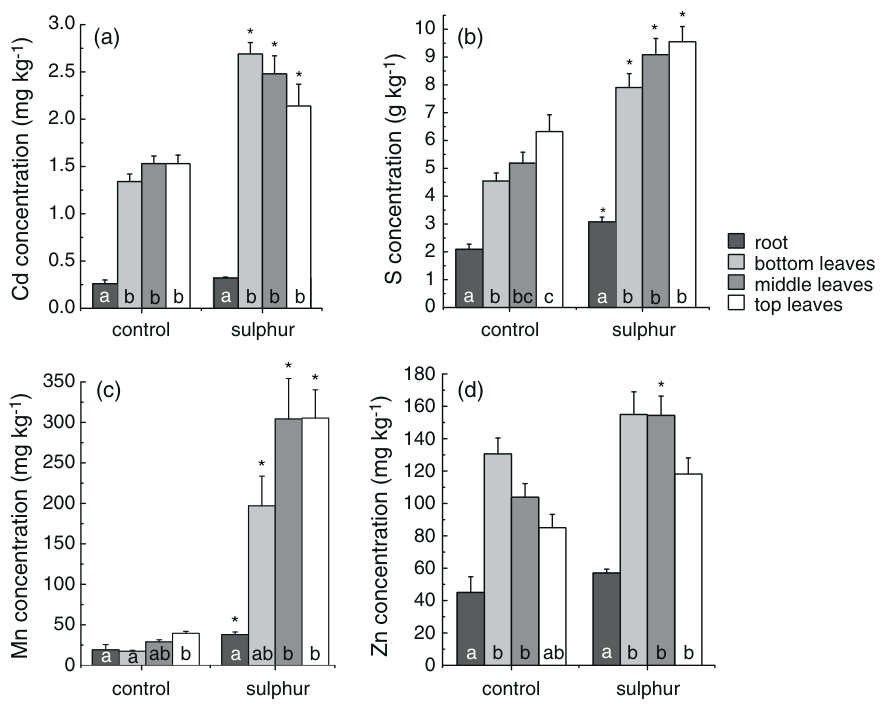
The plant S concentrations were significantly increased by the increased sulphur supply (Fig. 1). However, the ratio between leaf and root S concentrations was not affected. In each treatment, the root S concentration was less than half that of the leaf concentration, indicating that the S taken up by the roots was effectively translocated into the shoots. As in the case of Cd, the increased concentration of EDTA-soluble Mn and NaNO3-soluble Zn in the Streated soil were associated with enhanced accumulation of these elements in the shoots (Fig. 1). The increase in Zn accumulation was marginal and significant only in younger leaves. However, leaf Mn concentrations increased by an order of magnitude. In the roots the concentration of this element was doubled by the sulphur treatment, whereas the concentration of Zn was not significantly increased. The sulphur treatment also increased the concentration of Mg from a mean leaf concentration of 4.34 ± 0.16 g kg−1 to 5.18 ± 0.08 g kg−1, although no change was observed in the EDTAextractable Mg concentration of the soil (Table 2). The root Mg concentration was 1.25 g kg−1, with and without sulphur treatment. On the other hand, there was no change in Fe accumulation, although EDTA extractable soil Fe concentrations were significantly increased by the S-treatment. For Fe we measured 140 ± 34 mg in the roots and 81 ± 6 mg in the shoots per kg dry weight, pooled over both treatments (i.e. with and without sulphur application). In addition, no treatment effects on Cu accumulation were observed. The concentration in roots and shoots were 20.1 ± 2.6 mg kg−1 and 26.0 ± 1.3 mg kg−1, respectively, in both treatments.
硫供应的增加显著提高了植物S浓度(图1),但叶片与根系S浓度之比不受影响。在每种处理中,根系S浓度均不足叶片浓度的一半,表明根系吸收的S被有效地转运至地上部。与Cd的情况类似,S处理土壤中EDTA可溶态Mn和NaNO3可溶态Zn浓度的增加与这些元素在地上部积累的增强相关联(图1)。Zn积累的增加幅度很小,仅在较幼嫩叶片中显著。然而,叶片Mn浓度增加了一个数量级。在根系中,硫处理使Mn浓度增加一倍,而Zn浓度无显著增加。硫处理还使叶片Mg平均浓度由4.34 ± 0.16 g kg−1提高至5.18 ± 0.08 g kg−1,尽管土壤EDTA可提取态Mg浓度未见变化(表2)。无论是否进行硫处理,根系Mg浓度均为1.25 g kg−1。另一方面,尽管S处理显著提高了土壤EDTA可提取态Fe浓度,但Fe的积累并无变化。两种处理(即施硫与不施硫)合并计算,根系和地上部Fe含量分别为每kg干重140 ± 34 mg和81 ± 6 mg。此外,未观察到处理对Cu积累的影响。两种处理中根系和地上部Cu浓度分别为20.1 ± 2.6 mg kg−1和26.0 ± 1.3 mg kg−1。
3.3. Gene expression3.3. 基因表达
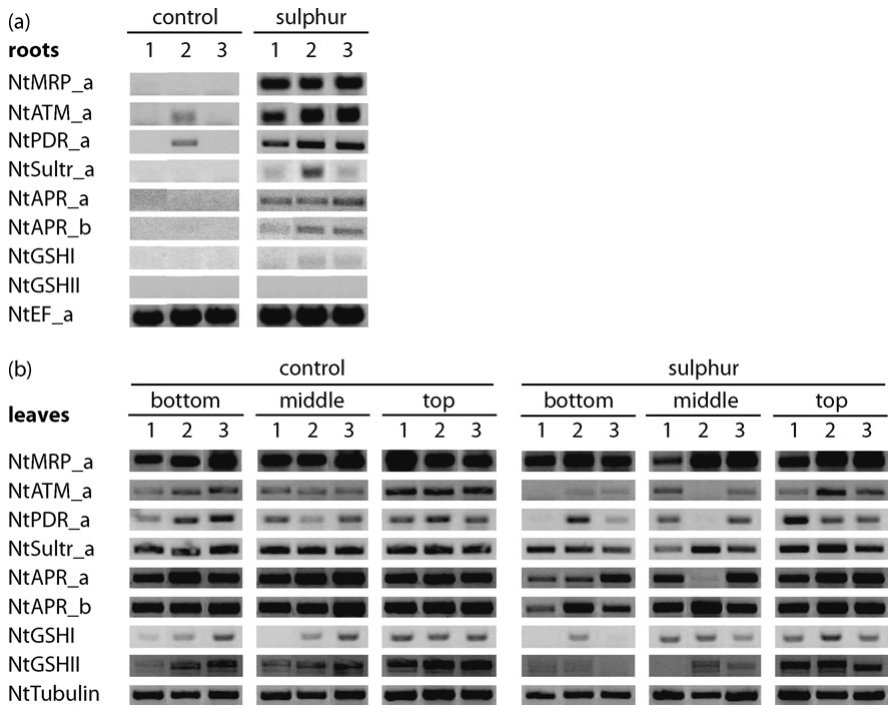
In the control plants none of the genes involved in Cd transport and detoxification was expressed in the roots (Fig. 2a). However, most of them were constitutively expressed in the shoots (Fig. 2b). The sulphur treatment induced the expression of NtMRP a, NtATM a, and NtPDR a also in the roots. The activation of the ABC transporters in the roots was likely linked to heavy metal transport and may explain the increased root-shoot translocation of Cd that was indicated by the increased shoot/root Cd concentration ratio.
在对照植株中,参与Cd转运与解毒的基因在根系中均未表达(图2a)。然而,其中大多数基因在地上部组成性表达(图2b)。硫处理还诱导了NtMRP a、NtATM a和NtPDR a在根系中的表达。根系中ABC转运蛋白的激活可能与重金属转运有关,并可解释地上部/根系Cd浓度比升高所反映的Cd由根向地上部转运的增加。
In the leaves, NtMRP a and NtATM a were constitutively expressed in all positions with and without sulphur treatment. This is in agreement with studies of other authors who found no changes in shoot AtMRP3 and AtATM3 expression upon addition of Cd to the nutrient solution (Bovet et al., 2003; Kim et al., 2006). NtPDR a expression in leaves showed considerable variation between replicates, independently of treatment and leaf age (or position along the stem), suggesting that NtPDR a responded to local stress conditions in the field, e.g. pathogens, and not to S treatment or Cd uptake. Stein et al. (2006) reported that AtPDR8 transporter in the leaves of A. thaliana also play a role in pathogen infection.
在叶片中,无论是否进行硫处理,NtMRP a和NtATM a在所有部位均组成性表达。这与其他作者的研究一致,他们发现向营养液中添加Cd后地上部AtMRP3和AtATM3的表达无变化(Bovet et al., 2003; Kim et al., 2006)。叶片中NtPDR a的表达在重复间差异较大,且与处理和叶龄(或沿茎的位置)无关,表明NtPDR a响应的是田间局部胁迫条件(如病原菌),而非S处理或Cd吸收。Stein et al.(2006)报道,拟南芥(A. thaliana)叶片中的AtPDR8转运蛋白也在病原菌侵染中发挥作用。
In the roots of the control plants we detected no expression of the genes involved in sulphur uptake, transport or assimilation. Only the house-keeping gene NtEF a was clearly expressed. Whereas NtLAST was not expressed at all (data not shown), NtSultr a, NtAPR a, and NtAPR b were strongly expressed in the shoots of the control plants. In the sulphur treatment all three genes were up-regulated in the roots, while NtAPR a and NtAPR b tended to be down-regulated in the bottom leaves (in 1–2 out of 3 replicates in each case). It may be noteworthy that this tendency increased with the leaf S content (data not shown). The observed increases in root gene expression caused by the sulphur treatment agree with findings reported by Herbette et al. (2006) and Weber et al. (2006). As NtSultr1 was up-regulated in the roots of our tobacco plants, and Herbette et al. (2006) found a strong up-regulation of Sultr1;1 expression in Arabidopsis exposed to elevated Cd concentrations, while Sultr1;2 remained unaffected by Cd, NtSultr a seems to be more closely related to AtSultr1;1 than to AtSultr1;2.
在对照植株根系中,未检测到参与硫吸收、转运或同化的基因表达,仅管家基因NtEF a有明显表达。NtLAST完全未表达(数据未列出),而NtSultr a、NtAPR a和NtAPR b在对照植株地上部强烈表达。在硫处理中,这三个基因在根系中均上调,而NtAPR a和NtAPR b在下部叶中呈下调趋势(每种情况下3个重复中有1–2个)。值得注意的是,这一趋势随叶片S含量的增加而增强(数据未列出)。硫处理引起的根系基因表达增加与Herbette et al.(2006)和Weber et al.(2006)报道的结果一致。由于NtSultr1在本研究烟草根系中上调,而Herbette et al.(2006)发现暴露于高浓度Cd的拟南芥中Sultr1;1表达强烈上调,Sultr1;2则不受Cd影响,因此NtSultr a似乎与AtSultr1;1的亲缘关系比与AtSultr1;2更近。
The sulphur treatment only marginally induced NtGSHI expression in the roots, while there was no expression of root NtGSHII, neither in the control, nor in the sulphur treatment. It is possible that the base level of glutathione was either sufficient for Cd detoxification, or glutathione production was stimulated otherwise. May et al. (1998b) and Herbette et al. (2006) related increased GSHI activity in response to Cd exposure to post-transcriptional up-regulation of GSHI. Both genes were more strongly expressed in younger (top) than in the older (bottom) leaves independent of the treatment. The NtNAS a gene was not expressed in both root and shoot (data not shown).
硫处理仅轻微诱导了根系中NtGSHI的表达,而无论对照还是硫处理,根系中均无NtGSHII表达。可能是谷胱甘肽的基础水平已足以满足Cd解毒需要,或者谷胱甘肽的合成通过其他途径受到刺激。May et al.(1998b)和Herbette et al.(2006)将Cd暴露下GSHI活性的增加归因于GSHI的转录后上调。与处理无关,这两个基因在较幼嫩(上部)叶片中的表达均强于较老(下部)叶片。NtNAS a基因在根系和地上部均未表达(数据未列出)。
4Discussion讨论
In Table 4 we compared the expression of Cd-induced genes between tobacco cultivated in sulphur amended soil with observations on gene expression in other studies as listed in Table 1. The expression of the genes in the roots of our plants mostly agreed with the reported results. Exceptions were NtLAST, NtGSHII and NtNAS a, which were not expressed at all.
在表4中,我们将硫改良土壤中种植的烟草Cd诱导基因的表达与表1所列其他研究中的基因表达观测结果进行了比较。本研究植株根系中的基因表达大多与已报道结果一致。例外的是NtLAST、NtGSHII和NtNAS a,它们完全未表达。
The strong up-regulation effects in the roots on genes that are putatively involved in Cd detoxification indicate that the ATPase and the ABC transporters might have been activated by both the increased Cd concentration and the increased availability of sulphur. The influence of sulphur supply on the expression of these genes in plants has received scant attention. Kolukisaoglu et al. (2002) and Glombitza et al. (2004) found that leaf AtMRP3 was not only inducible by Cd, but also by other stressors such as xenobiotics and oxidative stress. Considering that an increased S supply would enhance glutathione production and that glutathione is involved in the reduction of oxidative stress in plants (May et al., 1998a), the Cd effect on NtMRP a may have been partially compensated by the increase in soil S concentration in the sulphur treatments.
根系中推定参与Cd解毒的基因的强烈上调效应表明,ATP酶和ABC转运蛋白可能同时受到Cd浓度升高和硫有效性提高的激活。硫供应对植物中这些基因表达的影响很少受到关注。Kolukisaoglu et al.(2002)和Glombitza et al.(2004)发现,叶片AtMRP3不仅可被Cd诱导,还可被外源化合物和氧化胁迫等其他胁迫因子诱导。考虑到S供应的增加会促进谷胱甘肽的合成,而谷胱甘肽参与减轻植物的氧化胁迫(May et al., 1998a),硫处理中土壤S浓度的增加可能部分抵消了Cd对NtMRP a的作用。
Summary of the effects of sulphur application on gene expression in roots and shoots of field-grown tobacco plants in comparison to expectation based on the literature discussed in the text.
施硫对田间种植烟草根系和地上部基因表达的影响汇总,并与基于正文所讨论文献的预期结果进行比较。
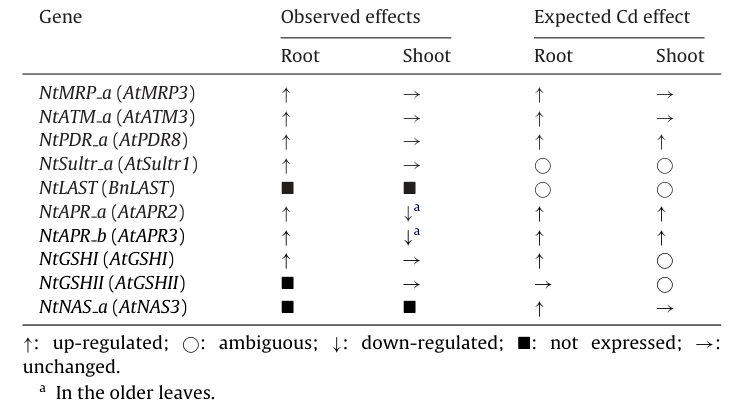
In the leaves, however, most of the genes studied here were either not affected or down-regulated, as in the case of the bottom leaves, while up-regulation or no effects were expected according to the literature. The down-regulation of the genes in the bottom leaves in our plants may have been due to a senescence effect. In other studies the experimental plants were harvested well before maturity and not divided into bottom, middle and top leaves. The bottom leaves of our plants showed first signs of senescence at harvest. Down-regulation has been reported for many genes in senescent leaves (Quirino et al., 2000). Down-regulation of genes involved in sulphur uptake and assimilation might also result from changes in sulphur supply. Many genes involved in the acquisition and assimilation of sulphate from soil are known to respond to the S status of a plant (Leustek and Saito, 1999; Hawkesford, 2000; Saito, 2000). Sulphur starvation has been found to activate sulphur acquisition and assimilation mechanisms in the same way as the exposure of plants to Cd (Yoshimoto et al., 2002; Herbette et al., 2006). The expression of AtAPR was found to be up-regulated in the roots and shoots of A. thaliana under sulphur deficiency (Takahashi et al., 1997; Hirai et al., 2003). Little is known about the effects of excessive sulphur supply, a condition that was more likely the case in our field experiment than sulphur deficiency, on gene expression. An excess of SO42− in nutrient solution was found to decrease the activity of APS sulphurylase (Brunold et al., 1987). This enzyme was recently found to be identical with APR (Suter et al., 2000). Thus, it is plausible that the expression of NtAPR a and NtAPR b became down-regulated in older leaves of the field-grown tobacco plants in our experiment in response to an over-supply of sulphate. This is in line with the observation that down-regulation tended to increase with leaf S content.
然而,在叶片中,本研究所检测的大多数基因要么不受影响,要么下调(如下部叶),而根据文献预期应为上调或无影响。本研究植株下部叶中基因的下调可能源于衰老效应。在其他研究中,试验植物在远未成熟时即被收获,且未分为下部、中部和上部叶。本研究植株的下部叶在收获时已出现初步衰老迹象。已有报道表明许多基因在衰老叶片中下调(Quirino et al., 2000)。参与硫吸收和同化的基因下调也可能源于硫供应的变化。已知许多参与从土壤中获取和同化硫酸盐的基因会对植物的S状况作出响应(Leustek and Saito, 1999; Hawkesford, 2000; Saito, 2000)。研究发现,缺硫以与植物暴露于Cd相同的方式激活硫获取和同化机制(Yoshimoto et al., 2002; Herbette et al., 2006)。在缺硫条件下,拟南芥(A. thaliana)根系和地上部AtAPR的表达上调(Takahashi et al., 1997; Hirai et al., 2003)。关于硫供应过量对基因表达的影响所知甚少,而在本田间试验中,硫过量比缺硫更可能是实际情况。研究发现,营养液中SO42−过量会降低APS硫酸化酶的活性(Brunold et al., 1987)。最近发现该酶与APR是同一种酶(Suter et al., 2000)。因此,本试验中田间种植烟草较老叶片中NtAPR a和NtAPR b表达的下调,很可能是对硫酸盐供应过量的响应。这与下调趋势随叶片S含量增加而增强的观察结果一致。
Gene expression may also have been affected by the increase in the solubility of Fe, Mg, Mn, and Zn. There are few studies investigating Zn, Fe and Mg effects on the expression of the genes that were under study here. While, e.g. Xiang and Oliver (1998) and Kim et al. (2006) NtMRP a and NtATM a found no effects of Zn on the expression of AtGSHI, AtGSHII and AtATM3 in A. thaliana, Bovet et al. (2003) found a slight up-regulation effect of Zn on AtMPR3 expression. Similar to Cd, Zn is known to up-regulate the expression of Sultr1;1 in roots (Ernst et al., 2008). Zinc may thus also have been involved in the up-regulation of these genes in the S-treatment of our field experiment. Magnesium effects on the expression of the investigated genes have not been reported. The detoxification of cells through ABC transporters is mediated by MgATP-energized GS-conjugate transport (Rea, 1999, 2007) but this does not necessarily indicate that there are changes in the gene expression when the soluble Mg concentration in the soil changes. However, the increase in plant Fe was not significant, and the increases in plant Zn and Mg were not significant in all leave fractions, either. It is thus unlikely that these metals had a substantial effect on gene expression. There are no reports of the effects of Mn on the expression of the studied genes. Manganese was the element of which the accumulation was increased most by the sulphur treatment.
Fe、Mg、Mn和Zn溶解度的增加也可能影响了基因表达。考察Zn、Fe和Mg对本研究所涉及基因表达影响的研究很少。例如,Xiang and Oliver(1998)和Kim et al.(2006)NtMRP a和NtATM a发现Zn对拟南芥(A. thaliana)中AtGSHI、AtGSHII和AtATM3的表达无影响,而Bovet et al.(2003)发现Zn对AtMPR3表达有轻微的上调作用。与Cd类似,已知Zn可上调根系中Sultr1;1的表达(Ernst et al., 2008)。因此,Zn也可能参与了本田间试验S处理中这些基因的上调。Mg对所研究基因表达的影响尚未见报道。ABC转运蛋白介导的细胞解毒是通过MgATP供能的GS-共轭物转运实现的(Rea, 1999, 2007),但这并不一定意味着土壤中可溶态Mg浓度变化时基因表达会发生改变。然而,植物Fe的增加并不显著,植物Zn和Mg的增加也并非在所有叶片组分中都显著。因此,这些金属不太可能对基因表达产生实质性影响。目前尚无Mn对所研究基因表达影响的报道。Mn是硫处理下积累量增加最多的元素。
The decrease in soil pH itself might have an effect. Changes in rhizosphere pH can affect a wide range of proteins such as ABCtransporters (Reeve et al., 2004) or enzymes of bacteria and plants involved in sulphur assimilation (APR) (Setya et al., 1996). Sulphate transporters are pH-dependent (Saito, 2004), and glutathione production in Escherichia coli bacteria was found to decrease with external pH (Smirnova et al., 2003). The impacts of changes in soil pH on gene expression have not been tested for the genes that were studied here.
土壤pH的降低本身也可能产生影响。根际pH的变化可影响多种蛋白质,如ABC转运蛋白(Reeve et al., 2004)或细菌和植物中参与硫同化的酶(APR)(Setya et al., 1996)。硫酸盐转运蛋白具有pH依赖性(Saito, 2004),并且研究发现大肠杆菌(Escherichia coli)中谷胱甘肽的合成随外部pH的降低而减少(Smirnova et al., 2003)。土壤pH变化对本研究所涉及基因表达的影响尚未得到检验。
5Conclusion结论
The up-regulation observed in the expression of most of the investigated genes in the roots agreed well with findings reported from hydroponic experiments in the literature. However, there were also differences, in particular the lack of effects on gene expression in the shoots. These findings indicate that factors other than increased exposure to Cd played an important role, in particular the higher concentrations of S and soluble Mn, Fe and Zn in the soil, and the lower soil pH. The leaves investigated here were obtained from mature plants, while hydroponically grown plants are usually harvested at an early stage. Nevertheless, our results indicate that hydroponic or agar experiments are useful predictors of gene expression effects that may be expected in field conditions. In order to become more comparable to field situations, future laboratory studies on the expression of genes expected to respond to environmental stresses should also look into the effects of combinations of different stress factors and investigate such effects also at later developmental stages.
根系中所观察到的大多数基因表达上调与文献中水培试验的报道结果吻合良好。然而,二者也存在差异,尤其是地上部基因表达未受影响。这些结果表明,除Cd暴露增加外,其他因素也发挥了重要作用,尤其是土壤中较高的S浓度和可溶态Mn、Fe和Zn浓度,以及较低的土壤pH。本研究所检测的叶片取自成熟植株,而水培植物通常在早期阶段即被收获。尽管如此,结果表明水培或琼脂试验可以有效预测田间条件下可能出现的基因表达效应。为了更好地与田间情况相比较,今后针对预期对环境胁迫作出响应的基因表达的实验室研究,还应考察不同胁迫因子组合的效应,并在较晚的发育阶段研究此类效应。
Acknowledgments致谢
We thank Werner Stauffer for the maintenance of the field experiment and Diane Bürge, Amélie Fragnière, Régis Mark and Fabian von Känel for technical assistance in the lab.
感谢Werner Stauffer对田间试验的维护,感谢Diane Bürge、Amélie Fragnière、Régis Mark和Fabian von Känel在实验室提供的技术协助。
References参考文献
Bergmann, W., 1993. Ernährungsstörungen bei Kulturpflanzen, 3rd ed. Gustav Fischer Verlag, Jena/Stuttgart.
Bovet, L., Eggmann, T., Meylan-Bettex, M., Polier, J., Kammer, P., Marin, E., Feller, U., Martinoia, E., 2003. Transcript levels of AtMRPs after cadmium treatment: induction of AtMRP3. Plant Cell Environ. 26, 371–381.
Bovet, L., Rossi, L., Lugon-Moulin, N., 2006. Cadmium partitioning and gene expression studies in Nicotiana tabacum and Nicotiana rustica. Physiol. Plant. 128, 466–475. Brunold, C., Suter, M., Lavanchy, P., 1987. Effect of high and low sulfate concentrations on adenosine 5′-phosphosulfate sulfotransferase activity from Lemna minor. Physiol. Plant. 70, 168–174. Chaney, R.L., Malik, M., Li, Y.M., Brown, S.L., Brewer, E.P., Angle, J.S., Baker, A.J.M., 1997. Phytoremediation of soil metals. Curr. Opin. Biotechnol. 8, 279–284. Clemens, S., Palmgren, M.G., Krämer, U., 2002. A long way ahead: understanding and engineering plant metal accumulation. Trends Plant Sci. 7, 309–315. Dybczynski, R., Polkowska-Motrenko, H., Samczynski, Z., Szopa, Z., 1998. Virginia Tobacco Leaves (CTA-VTL-2)—new polish CRM for inorganic trace analysis including microanalysis. Anal. Bioanal. Chem. 360, 384–387. Ernst, W.H.O., Krauss, G.J., Verkleij, J.A.C., Wesenberg, D., 2008. Interaction of heavy metals with the sulphur metabolism in angiosperms from an ecological point of view. Plant Cell Environ. 31, 123–143. Fässler, E., Robinson, B.H., Gupta, S.K., Schulin, R., 2010a. Uptake and allocation of plant nutrients and Cd in maize, sunflower and tobacco growing on contaminated soil and the effect of soil conditioners under field conditions. Nutr. Cycl. Agroecosyst..
Fässler, E., Robinson, B.H., Stauffer, W., Gupta, S.K., Papritz, A., Schulin, R., 2010b. Phytomanagement of metal-contaminated agricultural land using sunflower, maize and tobacco. Agric. Ecosyst. Environ. 136, 49–58. Glombitza, S., Dubuis, P.H., Thulke, O., Welzl, G., Bovet, L., Götz, M., Affenzeller, M., Geist, B., Hehn, A., Asnaghi, C., Ernst, D., Seidlitz, H.K., Gundlach, H., Mayer, K.F., Martinoia, E., Werck-Reichhart, D., Mauch, F., Schäffner, A.R., 2004. Crosstalk and differential response to abiotic and biotic stressors reflected at the transcriptional level of effector genes from secondary metabolism. Plant Mol. Biol. 54, 817–835. Hall, J.L., Williams, L.E., 2003. Transition metal transporters in plants. J. Exp. Bot. 54, 2601–2613. Hawkesford, M.J., 2000. Plant responses to sulphur deficiency and the genetic manipulation of sulphate transporters to improve S-utilization efficiency. J. Exp. Bot. 51, 131–138. Heiss, S., Schäfer, H.J., Haag-Kerwer, A., Rausch, T., 1999. Cloning sulfur assimilation genes of Brassica juncea L.: cadmium differentially affects the expression of a putative low-affinity sulfate transporter and isoforms of ATP sulfurylase and APS reductase. Plant Mol. Biol. 39, 847–857. Herbette, S., Taconnat, L., Hugouvieux, V., Piette, L., Magniette, M.L.M., Cuine, S., Auroy, P., Richaud, P., Forestier, C., Bourguignon, J., Renou, J.P., Vavasseur, A., Leonhardt, N., 2006. Genome-wide transcriptome profiling of the early cadmium response of Arabidopsis roots and shoots. Biochimie 88, 1751–1765. Hirai, M.Y., Fujiwara, T., Awazuhara, M., Kimura, T., Noji, M., Saito, K., 2003. Global expression profiling of sulfur-starved Arabidopsis by DNA macroarray reveals the role of O-acetyl-L-serine as a general regulator of gene expression in response to sulfur nutrition. Plant J. 33, 651–663. Howden, R., Goldsbrough, P.B., Andersen, C.R., Cobbett, C.S., 1995. Cadmiumsensitive, cad1 mutants of Arabidopsis thaliana are phytochelatin deficient. Plant Physiol. 107, 1059–1066. Kayser, A., Wenger, K., Keller, A., Attinger, W., Felix, H.R., Gupta, S.K., Schulin, R., 2000. Enhancement of phytoextraction of Zn, Cd, and Cu from calcareous soil: the use of NTA and sulfur amendments. Environ. Sci. Technol. 34, 1778–1783. Kim, D.Y., Bovet, L., Kushnir, S., Noh, E.W., Martinoia, E., Lee, Y., 2006. AtATM3 is involved in heavy metal resistance in Arabidopsis. Plant Physiol. 140, 922–932. Kim, D.Y., Bovet, L., Maeshima, M., Martinoia, E., Lee, Y., 2007. The ABC transporter AtPDR8 is a cadmium extrusion pump conferring heavy metal resistance. Plant J. 50, 207–218. Kolukisaoglu, H.Ü., Bovet, L., Klein, M., Eggmann, T., Geisler, M., Wanke, D., Martinoia, E., Schulz, B., 2002. Family business: the multidrug-resistance related protein (MRP) ABC transporter genes in Arabidopsis thaliana. Planta 216, 107–119. Kopriva, S., Koprivova, A., 2004. Plant adenosine 5′-phosphosulphate reductase: the past, the present, and the future. J. Exp. Bot. 55, 1775–1783. Leustek, T., Saito, K., 1999. Sulfate transport and assimilation in plants. Plant Physiol. 120, 637–643. Lugon-Moulin, N., Zhang, M., Gadani, F., Rossi, L., Koller, D., Krauss, M., Wagner, G.J., 2004. Critical review of the science and options for reducing cadmium in tobacco (Nicotiana tabacum L.) and other plants. Adv. Agron. 83, 111–180.
May, M.J., Vernoux, T., Leaver, C., Van Montagu, M., Inzé, D., 1998a. Glutathione homeostasis in plants: implications for environmental sensing and plant development. J. Exp. Bot. 49, 649–667.
May, M.J., Vernoux, T., Sánchez-Fernández, R., Van Montagu, M., Inzé, D., 1998b. Evidence for posttranscriptional activation of �-glutamylcysteine synthetase during plant stress responses. Proc. Natl. Acad. Sci. U.S.A. 95, 12049–12054.
NC State University, 2008. Tobacco genome initiative. http://tgi.ncsu.edu.
Plaza, S., Bovet, L., 2008. Cadmium detoxification in plants: involvement of ABC transporters. In: Prasad, M.N.V. (Ed.), Trace Elements as Contaminants and Nutrients: Consequences in Ecosystems and Human Health. Wiley, Weinheim, pp. 449–469.
Quirino, B.F., Noh, Y.S., Himelblau, E., Amasino, R.M., 2000. Molecular aspects of leaf senescence. Trends Plant Sci. 5, 278–282. Rea, P.A., 1999. MRP subfamily ABC transporters from plants and yeast. J. Exp. Bot. 50, 895–913. Rea, P.A., 2007. Plant ATP-binding cassette transporters. Annu. Rev. Plant Biol. 58, 347–375.
Reeve, W.G., Tiwari, R.P., Guerreiro, N., Stubbs, J., Dilworth, M.J., Glenn, A.R., Rolfe, B.G., Djordjevic, M.A., Howieson, J.G., 2004. Probing for pH-regulated proteins in
Sinorhizobium medicae using proteomic analysis. J. Mol. Microbiol. Biotechnol. 7, 140–147.
Saito, K., 2000. Regulation of sulfate transport and synthesis of sulfur-containing amino acids. Curr. Opin. Plant Biol. 3, 188–195.
Saito, K., 2004. Sulfur assimilatory metabolism. The long and smelling road. Plant Physiol. 136, 2443–2450.
Schäfer, H.J., Haag-Kerwer, A., Rausch, T., 1998. cDNA cloning and expression analysis of genes encoding GSH synthesis in roots of the heavy-metal accumulator Brassica juncea L.: evidence for Cd-induction of a putative mitochondrial �- glutamylcysteine synthetase isoform. Plant Mol. Biol. 37, 87–97.
Scheffer, F., Schachtschabel, P., Blume, H.-P., 2002. Lehrbuch der Bodenkunde, 15th ed. Spektrum Akademischer Verlag, Heidelberg.
Setya, A., Murillo, M., Leustek, T., 1996. Sulfate reduction in higher plants: molecular evidence for a novel 5′-adenylylsulfate reductase. Proc. Natl. Acad. Sci. U.S.A. 93, 13383–13388.
Sharma, S.S., Dietz, K.J., 2006. The significance of amino acids and amino acid-derived molecules in plant responses and adaptation to heavy metal stress. J. Exp. Bot. 57, 711–726.
Smirnova, G.V., Torkhova, O.A., Oktyabr’skii, O.N., 2003. The status and the role of glutathione under disturbed ionic balance and pH homeostasis in Escherichia coli. Mikrobiology 72, 542–547.
Smith, F.W., Ealing, P.M., Hawkesford, M.J., Clarkson, D.T., 1995. Plant members of a family of sulfate transporters reveal functional subtypes. Proc. Natl. Acad. Sci. U.S.A. 92, 9373–9377.
Stein, M., Dittgen, J., Sánchez-Rodríguez, C., Hou, B.H., Molina, A., Schulze-Lefert, P., Lipka, V., Somerville, S., 2006. Arabidopsis PEN3/PDR8, an ATP binding cassette transporter, contributes to nonhost resistance to inappropriate pathogens that enter by direct penetration. Plant Cell 18, 731–746.
Sun, X., Sun, X.M., Yang, Z.M., Li, S.Q., Wang, J., Wang, S.H., 2005. Expression of Brassica napus L. �-Glutamylcysteine synthetase and low- and high-affinity sulfate transporters in response to excess cadmium. J. Integr. Plant Biol. 47, 243– 250.
Sun, X.M., Lu, B., Huang, S.Q., Mehta, S.K., Xu, L.L., Yang, Z.M., 2007. Coordinated expression of sulfate transporters and its relation with sulfur metabolites in Brassica napus exposed to cadmium. Bot. Stud. 48, 43–54.
Suter, M., von Ballmoos, P., Kopriva, S., den Camp, R.O., Schaller, J., Kuhlemeier, C., Schürmann, P., Brunold, C., 2000. Adenosine 5′-phosphosulfate sulfotransferase and adenosine 5′-phosphosulfate reductase are identical enzymes. J. Biol. Chem. 275, 930–936.
Takahashi, H., Yamazaki, M., Sasakura, N., Watanabe, A., Leustek, T., De Almeida Engler, J., Engler, G., Van Montagu, M., Saito, K., 1997. Regulation of sulfur assimilation in higher plants: a sulfate transporter induced in sulfate-starved roots plays a central role in Arabidopsis thaliana. Proc. Natl. Acad. Sci. U.S.A. 94, 11102–11107.
Tich´y, R., Fajtl, J., Kuˇzel, S., Koláˇr, L., 1997. Use of elemental sulphur to enhance a cadmium solubilization and its vegetative removal from contaminated soil. Nutr. Cycl. Agroecosyst. 46, 249–255.
Tommasini, R., Vogt, E., Fromenteau, M., Hörtensteiner, S., Matile, P., Amrhein, N., Martinoia, E., 1998. An ABC-transporter of Arabidopsis thaliana has both glutathione-conjugate and chlorophyll catabolite transport activity. Plant J. 13, 773–780.
Wang, T.L., Wu, M., 2006. An ATP-binding cassette transporter related to yeast vacuolar ScYCF1 is important for Cd sequestration in Chlamydomonas reinhardtii. Plant Cell Environ. 29, 1901–1912.
Weber, M., Trampczynska, A., Clemens, S., 2006. Comparative transcriptome analysis of toxic metal responses in Arabidopsis thaliana and the Cd2+-hypertolerant facultative metallophyte Arabidopsis halleri. Plant Cell Environ. 29, 950–963.
Wenger, K., Kayser, A., Gupta, S.K., Furrer, G., Schulin, R., 2002. Comparison of NTA and elemental sulfur as potential soil amendments in phytoremediation. Soil Sediment Contam. 11, 655–672.
Xiang, C.B., Oliver, D.J., 1998. Glutathione metabolic genes coordinately respond to heavy metals and jasmonic acid in Arabidopsis. Plant Cell 10, 1539–1550.
Ye, J., McGinnis, S., Madden, T.L., 2006. BLAST: improvements for better sequence analysis. Nucleic Acids Res. 34, W6–W9.
Yoshimoto, N., Takahashi, H., Smith, F.W., Yamaya, T., Saito, K., 2002. Two distinct high-affinity sulfate transporters with different inducibilities mediate uptake of sulfate in Arabidopsis roots. Plant J. 29, 465–473.
Zhu, Y.L., Pilon-Smits, E.A.H., Jouanin, L., Terry, N., 1999. Overexpression of glutathione synthetase in Indian mustard enhances cadmium accumulation and tolerance. Plant Physiol. 119, 73–79.