Brett H. Robinson1,3, Marc Leblanc2, Daniel Petit3, Robert R. Brooks1, John H. Kirkman1 and Paul E.H. Gregg1
1Department of Soil Science, Massey University, Palmerston North, New Zealand∗, 2G´eofluides-Bassins-Eau, CNRS, Universit´e de Montpellier 2, Montpellier, 34095 France and 3Laboratoire de G´en´etique et Evolution des Populations V´eg´etales, CNRS, Universit´e de Lille 1, Villeneuve d’Ascq, F59655 France
1梅西大学土壤科学系,新西兰北帕默斯顿∗, 2蒙彼利埃第二大学 CNRS 地质流体—盆地—水实验室(Géofluides-Bassins-Eau),法国蒙彼利埃 34095; 3里尔第一大学 CNRS 植物种群遗传与进化实验室(Laboratoire de Génétique et Evolution des Populations Végétales),法国阿斯克新城 F59655
Received 25 September 1997. Accepted in revised form 10 June 1998
Key words: cadmium, phytoremediation, Thlaspi caerulescens, zinc
关键词:镉,植物修复,Thlaspi caerulescens,锌
1Abstract摘要
Uptake of Cd, Zn, Pb and Mn by the hyperaccumulator Thlaspi caerulescens was studied by pot trials in plant growth units and in populations of wild plants growing over Pb/Zn base-metal mine wastes at Les Malines in the south of France. The pot trials utilised metal-contaminated soils from Auby in the Lille area. Zinc and Cd concentrations in wild plants averaged 1.16% and 0.16% (dry weight) respectively. The unfertilised biomass of the plants was 2.6 t/ha. A single fertilised crop with the above metal content could remove 60 kg of Zn and 8.4 kg Cd per hectare. Experiments with pot-grown and wild plants showed that metal concentrations (dry weight basis) were up to 1% Zn (4% Zn in the soil) and just over 0.1% Cd (0.02% Cd in the soil). The metal content of the plants was correlated strongly with the plant-available fraction in the soils as measured by extraction with ammonium acetate and was inversely correlated with pH. Bioaccumulation coefficients (plant/soil metal concentration quotients) were in general higher for Cd than for Zn except at low metal concentrations in the soil. There was a tendency for these coefficients to increase with decreasing metal concentrations in the soil. It is proposed that phytoremediation using Thlaspi caerulescens would be entirely feasible for low levels of Cd where only a single crop would be needed to halve a Cd content of 10 µg/g in the soil. It will never be possible to remediate elevated Zn concentrations within an economic time frame (<10 yr) because of the lower bioaccumulation coefficient for this element coupled with the much higher Zn content of the soils.
通过在植物培养室中开展的盆栽试验,以及对法国南部 Les Malines 铅锌贱金属矿山废弃物上生长的野生植物种群的调查,研究了超富集植物Thlaspi caerulescens对 Cd、Zn、Pb 和 Mn 的吸收。盆栽试验采用了来自里尔地区 Auby 的金属污染土壤。野生植物中 Zn 和 Cd 的平均浓度分别为 1.16% 和 0.16%(干重)。未施肥植物的生物量为 2.6 t/ha。一季施肥作物若具有上述金属含量,每公顷可去除 60 kg Zn 和 8.4 kg Cd。盆栽植物和野生植物的试验表明,植物中的金属浓度(以干重计)最高可达 1% Zn(土壤中 Zn 为 4%)和略高于 0.1% Cd(土壤中 Cd 为 0.02%)。植物的金属含量与经乙酸铵提取测定的土壤植物有效态组分呈强相关,而与 pH 呈负相关。除土壤金属浓度较低的情况外,Cd 的生物富集系数(植物/土壤金属浓度比值)总体高于 Zn。这些系数有随土壤金属浓度降低而升高的趋势。研究认为,利用Thlaspi caerulescens对低含量 Cd 进行植物修复是完全可行的,仅需种植一季即可将土壤中 10 µg/g 的 Cd 含量减半。由于该植物对 Zn 的生物富集系数较低,加之土壤中 Zn 含量高得多,因此在经济合理的时间范围内(<10 yr)修复高浓度 Zn 污染将永远无法实现。
2Introduction引言
The inordinately high uptake of Zn by Thlaspi calaminare (Lej.) Lej. and Court. (Brassicaceae) was first described by Baumann (1885) who found that this plant accumulated over 1% Zn in dry tissue. This represents the first record of a plant hyperaccumulator of a heavy metal. The term hyperaccumulator was first used by Brooks et al. (1977) in relation to plants containing more than 1000 µg/g (0.1%) Ni in dry tissue. Later, Reeves and Brooks (1983) studied uptake of Zn by numerous Thlaspi L. species and found several that were able to hyperaccumulate both Zn and Ni.
Baumann(1885)首次描述了Thlaspi calaminare(Lej.)Lej. and Court.(十字花科)对 Zn 的异常高吸收,发现该植物干组织中积累的 Zn 超过 1%。这是植物重金属超富集植物的首次记录。“超富集植物”一词由 Brooks et al.(1977)首次使用,指干组织中 Ni 含量超过 1000 µg/g(0.1%)的植物。随后,Reeves and Brooks(1983)研究了众多Thlaspi L. 属物种对 Zn 的吸收,发现其中若干物种能够同时超富集 Zn 和 Ni。
The threshold of hyperaccumulation for Zn was set at 10,000 µg/g (1%) in dry matter.
Zn 的超富集阈值设定为干物质中 10,000 µg/g(1%)。
It was not until the early 1980s (Chaney, 1983) that it was realised that hyperaccumulators might be used to remediate polluted soils by growing a crop of one of these plants and harvesting it to remove the pollutants. A benchmark paper by McGrath et al. (1993) reported the results of field trials in which several hyperaccumulatorswere grown in polluted soils to reduce the soil content of Zn from 440 µg/g to <300 µg/g (the threshold established by the Commission of the European Community (CEC, 1986).
直到 20 世纪 80 年代初(Chaney, 1983),人们才认识到可以利用超富集植物修复污染土壤,即种植此类植物并收获以去除污染物。McGrath et al.(1993)的一篇标志性论文报道了田间试验结果:在污染土壤中种植数种超富集植物,使土壤 Zn 含量由 440 µg/g 降至 <300 µg/g(欧洲共同体委员会规定的阈值(CEC, 1986))。
During the past five years there has been increasing interest in the possibility of using plants to remediate
过去五年间,利用植物修复
∗ FAX No.: 646 350 5632. E-mail: r.brooks@massey.ac.nz
contaminated soils (Salt et al. 1995) because of the high cost and environmentally undesirable alternatives such as:
污染土壤的可能性日益受到关注(Salt et al. 1995),原因在于其他替代方法成本高昂且对环境不利,例如:
1. removal and storage of such soils;
1. 移除并贮存此类土壤;
2. covering soils with concrete or fresh topsoil;
2. 用混凝土或新表土覆盖土壤;
3. acid leaching of heavy metal pollutants from soils.
3. 用酸淋溶去除土壤中的重金属污染物。
The most important consideration in phytoremediation is that the plant should translocate metals from the soil to the aerial parts allowing a significant quantity of metal to be removed from the soil with each crop. There are hyperaccumulators of several heavy metals including As, Cd, Cu, Co, Mn, Ni, Pb and Zn (Brooks et al. 1995) which could potentially be used for phytoremediation. In some cases, there are plants (such as Thlaspi L.) that can hyperaccumulate two or more elements at the same time and there is also the possibility of growing a mixed crop of two or more species to improve the versatility of the phytoremediation method.
植物修复中最重要的考虑是植物应能将金属从土壤转运至地上部分,从而使每季作物都能从土壤中去除相当数量的金属。目前已知存在多种重金属的超富集植物,包括 As、Cd、Cu、Co、Mn、Ni、Pb 和 Zn(Brooks et al. 1995),它们均有可能用于植物修复。某些情况下,有些植物(如Thlaspi L.)能够同时超富集两种或更多元素;此外,还可以混种两种或更多物种,以提高植物修复方法的适用性。
Suitable plants for phytoremediation operations generally fall into two categories. The first is plants such as Thlaspi with a very high foliar metal concentration, that usually do not provide a high annual biomass. The second category consists of plants such as Brassica juncea (Indian mustard) that have a lower metal concentration but have a large biomass production so that the actual amount of removed metal is higher.
适用于植物修复的植物通常分为两类。第一类是如Thlaspi这样叶片金属浓度极高、但年生物量通常不高的植物。第二类是如Brassica juncea(印度芥菜)这样金属浓度较低、但生物量大的植物,因而其实际去除的金属量更高。
Thlaspi caerulescens J.C. & R. Presl falls into the first category. It is a biennial herbaceous plant which is known to have a very high foliar Zn content (up to 3% dry weight – Baker and Brooks, 1989). It will also hyperaccumulate Cd and Ni (>0.1% d.w. in each case). It occurs frequently on mineralised soils, particularly those with a high Zn content.
Thlaspi caerulescens J.C. & R. Presl 属于第一类。它是一种二年生草本植物,已知其叶片 Zn 含量极高(最高可达干重的 3%——Baker and Brooks, 1989)。它还能超富集 Cd 和 Ni(两者均 >0.1% d.w.)。该植物常见于矿化土壤,尤其是 Zn 含量高的土壤。
Except for studies by McGrath et al. (1993) and Brown et al. (1994, 1995a), most experiments with Thlaspi caerulescens (Brown et al., 1995b; Pollard and Baker, 1996; Vázquez et al., 1992) have used hydroponic experiments to test the behaviour of this species with respect to Zn and Cd. Hydroponic experiments are perhaps favoured probably because it is very easy to control the conditions so that the data are inherently more reproducible than where soil mixtures are used. We believe however, that experiments such as ours, using soils rather than solutions, approximate more closely to field and natural conditions where the effect of soil buffering capacity influences nutrient availability to plants.
除 McGrath et al.(1993)和 Brown et al.(1994, 1995a)的研究外,大多数关于Thlaspi caerulescens的试验(Brown et al., 1995b; Pollard and Baker, 1996; Vázquez et al., 1992)均采用水培试验来检验该物种对 Zn 和 Cd 的响应。水培试验之所以受到青睐,可能是因为其条件极易控制,所得数据本身比使用土壤混合物时更具可重复性。然而我们认为,像本研究这样使用土壤而非溶液的试验,更接近田间和自然条件,因为在这些条件下土壤缓冲能力会影响植物对养分的有效性。
The aims of this present study were to investigate the phytoextractive potential of T. caerulescens to remediate metal-contaminated soils and involved a combination of both pot trials and studies on wild plants. Specific aims were to:
本研究旨在探讨T. caerulescens用于修复金属污染土壤的植物提取潜力,研究结合了盆栽试验和野生植物调查。具体目标为:
1. determine what metals might be extracted using T. caerulescens;
1. 确定利用T. caerulescens可以提取哪些金属;
2. establish how much metal could be extracted per hectare per annum;
2. 确定每公顷每年可提取的金属量;
3. calculate the number of annual crops that might be needed to decontaminate soils with specific metal concentrations;
3. 计算将具有特定金属浓度的土壤去污所需的年作物季数;
4. relate bioaccumulation coefficients (plant/soil metal concentration quotients) to the total metal concentration in the soil.
4. 将生物富集系数(植物/土壤金属浓度比值)与土壤金属全量浓度相关联。
3Materials and methods材料与方法
Site description场地概况
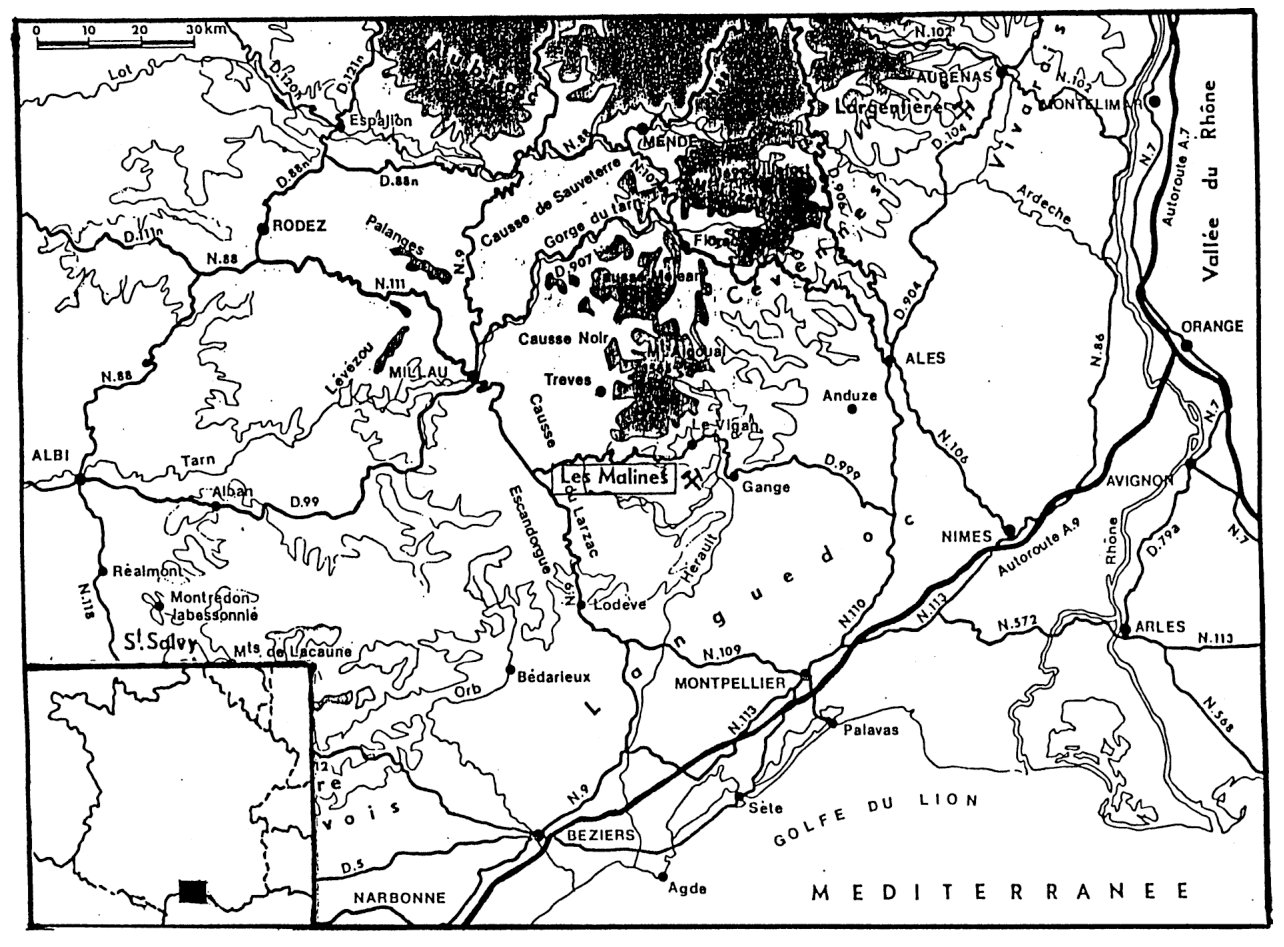
Samples were collected from sites around St Laurent le Minier, Southern France (Figure 1). The region, known as Les Malines, is the location of one of the largest base metal mines in Europe that has been exploited since Roman times and only ceased operations about 5 yr ago. The mineralisation consists of Zn/Pb sulphides and oxides associated with barite. Although operations have now ceased, an attempt is being made to revegetate and ameliorate the enormous area of mine waste that now surrounds the little town of St Laurent le Minier.
样品采自法国南部 St Laurent le Minier 周边各地点(图1)。该地区称为 Les Malines,是欧洲最大的贱金属矿山之一的所在地,自罗马时代起即被开采,直到约 5 年前才停止生产。矿化体由与重晶石伴生的 Zn/Pb 硫化物和氧化物组成。尽管开采已经停止,但目前正尝试对环绕 St Laurent le Minier 小镇的大面积矿山废弃物进行植被恢复和改良。
The mine tips contain typically several percent of both Pb and Zn with associated thallium and Cd.
矿渣堆中 Pb 和 Zn 含量通常均达百分之几,并伴有铊和 Cd。
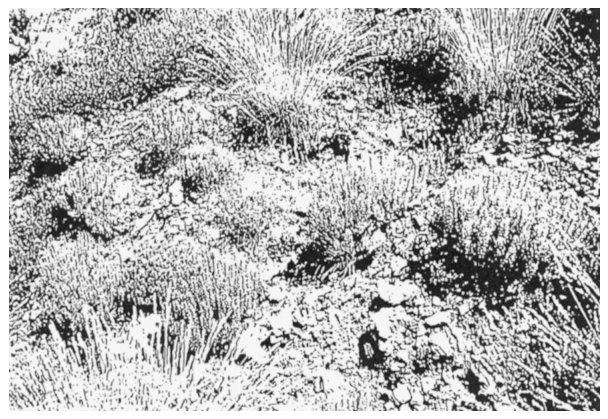
The pH of the tailings is typically 7.3 (mean of 60 samples) with a range of 6.4–7.7. The surprisingly high pH is due to the presence of calcareous material in the tailings. The mine waste has been colonised by a typical base metal flora dominated by Minuartia verna (L.) Hiern. and Thlaspi caerulescens with associated Iberis intermedia Guersent and Armeria maritima (Miller) Willd. Figure 2 shows a view of the base-metal plant community in this region.
尾矿的 pH 通常为 7.3(60 个样品的平均值),范围为 6.4–7.7。pH 出人意料地高是由于尾矿中含有钙质物质。矿山废弃物上已定植了典型的贱金属植物区系,以Minuartia verna(L.)Hiern. 和Thlaspi caerulescens为优势种,伴生Iberis intermedia Guersent 和Armeria maritima(Miller)Willd.。图2展示了该地区贱金属植物群落的景观。
Sample collection样品采集
Sixty plants were taken at various sites within Les Malines. The soils in which the plants were growing were also sampled. The diameter of each plant was measured and the dried (70 ◦C) plant weighed. From these values an estimation of the biomass production per hectare could be made. This was done by calculating how many plants could cover one hectare assuming 70% ground cover. This value was then multiplied by the dry weight of the plant to give the theoretical yield per hectare.
在 Les Malines 内不同地点采集了 60 株植物,同时采集了植物生长所在的土壤。测量每株植物的直径,并称量烘干(70 ◦C)后的植株重量。据此可估算每公顷的生物量产量:假设地面覆盖率为 70%,计算覆盖一公顷所需的植株数,再乘以单株干重,即得每公顷理论产量。
Experiments performed in plant growth units
植物培养室试验
Contaminated soil from the town of Auby, Northern France was used in the glasshouse experiment. The Auby soil contained 4% Zn, 1% Pb and 360 µg/g Cd and was mixed with soil from the University of Lille (which contains negligible amounts of these elements) in the following proportions (Auby:Lille): 1:0, 1:1, 1:3, 1:7, 1:15, 0:1.
温室试验采用了法国北部 Auby 镇的污染土壤。Auby 土壤含 4% Zn、1% Pb 和 360 µg/g Cd,将其与里尔大学的土壤(上述元素含量可忽略不计)按以下比例(Auby:Lille)混合:1:0、1:1、1:3、1:7、1:15、0:1。
Whereas the soil used in the glasshouse experiment was different to that sampled in the field survey, both were heavily contaminated by similar sources, i.e. smelting/mining operations. An experimental protocol was developed that avoided the use of addition of soluble metal salts to soil in order to study metal rate/plant response functions, a practice known to poorly simulate the behaviour of metal contaminants in situ. The highly contaminated Auby soil (pH 7.0) was mixed with a non-contaminated soil (of similar pH and mineralogy) from the University of Lille at Villeneuve d’Ascq.
虽然温室试验所用土壤与野外调查中采集的土壤不同,但两者均受到类似来源(即冶炼/采矿活动)的严重污染。本研究制定的试验方案避免了向土壤中添加可溶性金属盐来研究金属添加量/植物响应函数的做法,已知该做法难以模拟金属污染物的原位行为。将高度污染的 Auby 土壤(pH 7.0)与来自阿斯克新城里尔大学的未污染土壤(pH 和矿物组成相近)混合。
A few seeds of Thlaspi caerulescens (from Les Malines near Montpellier) were placed in individual 250 mL pots (10 containers for each of six mixtures). After germination and appearance of the first pair of true leaves, seedlings were thinned out to leave only one in each pot. The growth medium had a bulk density close to 1.0. There were no added nutrients but the plants were watered as required and the pots rotated in a random manner to equalise light exposure. The experiments were performed in an unheated plant growth unit and the growing period was May–November 1996. The plants were harvested and analysed as described below.
将少量Thlaspi caerulescens种子(采自蒙彼利埃附近的 Les Malines)播于单个 250 mL 盆中(六种混合土壤各 10 盆)。种子萌发并长出第一对真叶后间苗,每盆仅保留一株。生长基质的容重接近 1.0。未添加养分,但根据需要浇水,并随机轮换花盆位置以使光照均匀。试验在无加温的植物培养室中进行,生长期为 1996 年 5 月至 11 月。植物收获后按下述方法进行分析。
tilled water for a period of 1 h. After being allowed to settle for 24 h, the samples were again shaken for a few minutes and the pH measured after an appropriate settling period.
馏水振荡 1 h。静置 24 h 后,再次振荡数分钟,经适当沉降后测定 pH。
Chemical analysis化学分析
Chemical analyses on the plant and soil solutions were performed using a GBC 904 atomic absorption spectrometer. The following elements were quantified: Cd, Mn, Pb and Zn.
植物和土壤溶液的化学分析采用 GBC 904 原子吸收光谱仪进行。测定元素为 Cd、Mn、Pb 和 Zn。
4Results and discussion结果与讨论
Preliminary sample treatment样品预处理
Plants were rinsed thoroughly in distilled water and dried at 50 ◦C. Approximately 0.2 g of material from each plant was accurately weighed into a set of 20 mL boiling tubes. Concentrated nitric acid (10 mL) was added to each tube and the mixtures heated on a heating block until a final volume of ca. 3 mL was reached. The samples were then diluted to 50 mL using distilled water and stored in polythene containers.
植物用蒸馏水彻底冲洗,于 50 ◦C 烘干。每株植物准确称取约 0.2 g 材料置于一组 20 mL 消解管中。每管加入浓硝酸(10 mL),在加热块上加热至最终体积约 3 mL。然后用蒸馏水将样品稀释至 50 mL,贮存于聚乙烯容器中。
Soil digestion土壤消解
Soil samples were dried at 50 ◦C and sieved to <2 mm size using a nylon sieve. About 0.2 g quantities of sieved soil were ground using a mortar and pestle and then accurately weighed into boiling tubes. Ten mL of concentrated nitric acid was then added and the mixtures boiled until a final volume of 3 mL was reached. A further 10 mL of concentrated hydrochloric acid was then added and the mixtures again evaporated to 3 mL. After filtration, the solutions were diluted to 100 mL with distilled water.
土壤样品于 50 ◦C 烘干,用尼龙筛过 <2 mm 筛。取约 0.2 g 过筛土壤用研钵研磨,然后准确称入消解管中。加入 10 mL 浓硝酸,煮沸至最终体积 3 mL。再加入 10 mL 浓盐酸,再次蒸发至 3 mL。过滤后,用蒸馏水将溶液稀释至 100 mL。
Estimation of the pH and plant-available elemental fractions in the soils and mine waste土壤和矿山废弃物 pH 及植物有效态元素组分的测定
Approximately 5 g samples of sieved soil were weighed accurately into 150 mL polythene containers. Then 50 mL of 1M ammonium acetate was added to each container. Samples were gently agitated (75 rpm) for 24 h, filtered (Whatman No. 41), and stored in polythene containers. Ammonium acetate was chosen for the experiments because of its well proven use as a measure of the plant-available fraction of soils (Ernst, 1996).
准确称取约 5 g 过筛土壤样品置于 150 mL 聚乙烯容器中,每个容器加入 50 mL 1M 乙酸铵。样品轻缓振荡(75 rpm)24 h,过滤(Whatman No. 41),贮存于聚乙烯容器中。选用乙酸铵是因为其作为土壤植物有效态组分测定方法已得到充分验证(Ernst, 1996)。
The pH measurements were made by shaking 4 g samples of soils or mine waste with 10 mL of dis-
pH 的测定方法为:将 4 g 土壤或矿山废弃物样品与 10 mL 蒸
Accumulation of metals by wild specimens of Thlaspi caerulescensThlaspi caerulescens 野生植株对金属的积累
The metal content of wild plants and associated soils collected from St Laurent le Minier is shown in Table 1. Since the data were lognormally distributed, the data (all as % except where otherwise stated) are shown as geometric means with the corresponding standard deviation ranges.
从 St Laurent le Minier 采集的野生植物及相应土壤的金属含量见表1。由于数据呈对数正态分布,数据(除另有说明外均以 % 表示)以几何平均值及相应的标准差范围列出。
All plant specimens contained elevated concentrations of Cd, Mn, Pb and Zn relative to ‘normal’ plants growing in non-mineralised soils (see Table 1), for which respective concentrations of these four elements are of the order of 0.5, 10, 5 and 20 µg/g in the dry plant material (Brooks et al., 1995). From Table 1 it will be noted that the mean elemental contents of Cd, Mn, Pb and Zn in one-year-old plants were respectively 3236, 6.1, 169 and 581 times higher than for other plants growing in non-mineralised soils. For two-year-old plants the respective values were 1054, 1.6, 44 and 262. The lower metal concentrations in older plants may be due to the dilution effect of higher biomass if metal uptake is not proportional to this biomass increase. It might have been argued that the higher metal concentrations in younger plants could be due to their greater proximity to the ground and hence greater risk of contamination from wind-borne soil. However, if all the Pb content of the plants is assumed to be due to contamination, and knowing the Cd/Pb and Zn/Pb quotients in the soils (0.01 and 2.30, respectively) corrected concentration values can be obtained for Cd and Zn in Thlaspi that do not differ greatly from the total metal burden (see Table 1). Because the Cd concentration in the plants was considerably higher than that in the soil, the effect of contamination from wind-blown dust would have been to reduce the original metal content of the plants rather than to increase it.
与生长在非矿化土壤上的“正常”植物相比,所有植物样品中 Cd、Mn、Pb 和 Zn 的浓度均偏高(见表1);正常植物干物质中这四种元素的浓度分别约为 0.5、10、5 和 20 µg/g(Brooks et al., 1995)。由表1可见,一年生植株中 Cd、Mn、Pb 和 Zn 的平均含量分别为非矿化土壤上其他植物的 3236、6.1、169 和 581 倍;二年生植株的相应倍数为 1054、1.6、44 和 262。若金属吸收与生物量增长不成比例,则较老植株中金属浓度较低可能是较高生物量的稀释效应所致。有人或许会认为,幼株中金属浓度较高可能是因为其更贴近地面,从而受风扬土壤污染的风险更大。然而,若假定植物中的 Pb 全部来自污染,并已知土壤中 Cd/Pb 和 Zn/Pb 比值(分别为 0.01 和 2.30),则可求得Thlaspi中 Cd 和 Zn 的校正浓度,其与金属总负荷差别不大(见表1)。由于植物中的 Cd 浓度远高于土壤,风扬尘埃污染的效应只会降低而非提高植物原有的金属含量。
| Material材料 | N | Zn | Cd | Pb | Mn |
|---|---|---|---|---|---|
| Soil (geom. mean) | 60 | 38,010 | 163 | 16,531 | 688 |
| (std. dev. range) | 60 | 9907–157,939 | 45–997 | 3074–67,427 | 144–4493 |
| Normala plants | – | 20 | 0.5 | 5 | 10 |
| One-year_Thlaspi_plants (geom. mean) | 40 | 11,627 | 1618 | 844 | 61 |
| (std. dev. range) | 40 | 5463–27,385 | 378–3689 | 95–4318 | 10–515 |
| (corrected valuesb) | 40 | 10,207 | 1695 | – | 59 |
| Two-year_Thlaspi_plants (geom. mean) | 20 | 5242 | 527 | 219 | 16 |
| (std. dev. range) | 20 | 1137–29,238 | 107–2413 | 6–2143 | 3–152 |
| (corrected valuesb) | 20 | 4866 | 532 | – | 7 |
aMean elemental concentrations to be expected in vegetation not growing over mineralisation (Brooks et al. 1995). bCorrected values assuming that all of the lead content is derived from wind-borne contamination.
a非矿化区植被中预期的元素平均浓度(Brooks et al. 1995)。b假定全部铅含量均来自风扬污染的校正值。
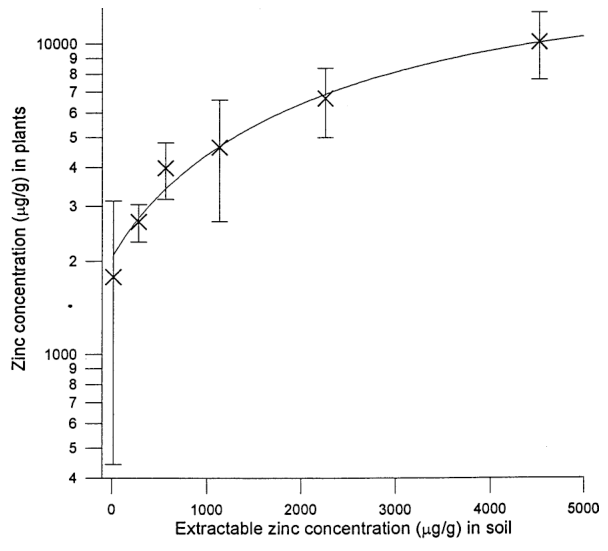
Table 1 also shows the ‘corrected’ Cd and Zn concentrations in the plants, assuming that the entire Pb burden is derived from wind-blown contamination.表1还列出了假定全部 Pb 负荷均来自风扬污染时植物中 Cd 和 Zn 的“校正”浓度。
Metal accumulation by T. caerulescens under controlled conditions可控条件下 T. caerulescens 对金属的积累
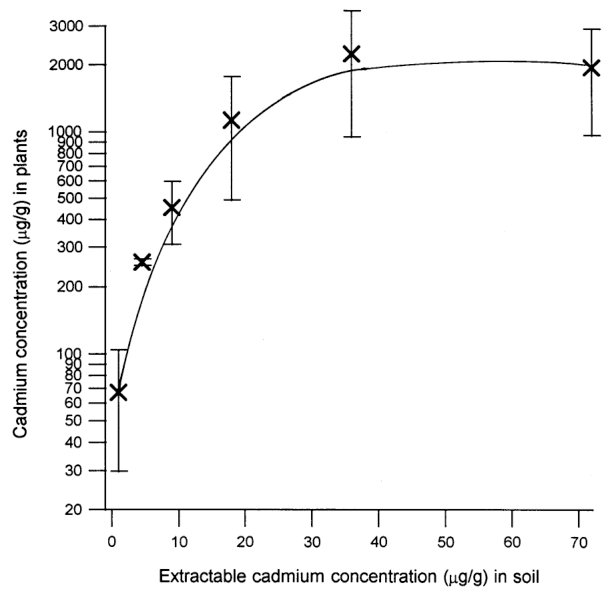
The results of experiments with T. caerulescens raised in plant growth units at the University of Lille are shown in Figures 3 and 4. In the case of Zn (Figure 3) there was a gradual increase of the metal concentration in the plants to about 1% d.w. as the extractable Zn concentration in the soil increased to 0.5%. A similar observation can be made for Cd (Figure 4) where there appeared to be a limiting value approached 0.2% (2000 µg/g) for soils containing 50–70 µg/g extractable Cd. There was no detectable decrease in biomass yield for increasing metal concentrations in the soil except at the very highest concentrations of 0.5% Zn and 50 µg/g Cd.
在里尔大学植物培养室中培育的T. caerulescens的试验结果见图3和图4。就 Zn 而言(图3),随着土壤可提取态 Zn 浓度增至 0.5%,植物中该金属浓度逐渐升高至约 1% d.w.。Cd 也有类似现象(图4),对于可提取态 Cd 为 50–70 µg/g 的土壤,植物 Cd 浓度似乎趋近于 0.2%(2000 µg/g)的极限值。除土壤中最高浓度 0.5% Zn 和 50 µg/g Cd 外,未检测到生物量产量随土壤金属浓度增加而下降。
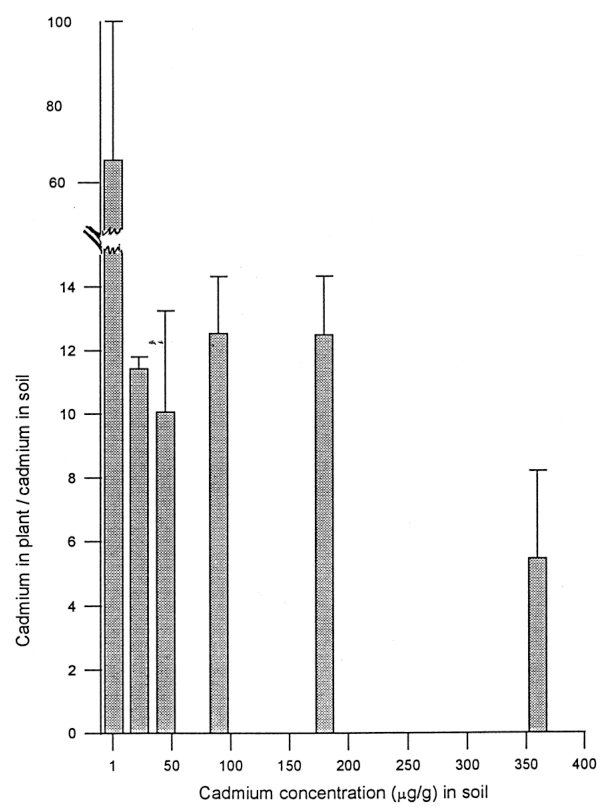
Bioaccumulation coefficients (concentration of the metal in dried plants divided by the extractable soil content of the same element) for Zn and Cd as a function of the total metal content of the soil for the plant growth unit experiments are shown in Figures 5 and 6.
植物培养室试验中 Zn 和 Cd 的生物富集系数(干燥植物中金属浓度除以土壤中同一元素的可提取态含量)与土壤金属全量的关系见图5和图6。
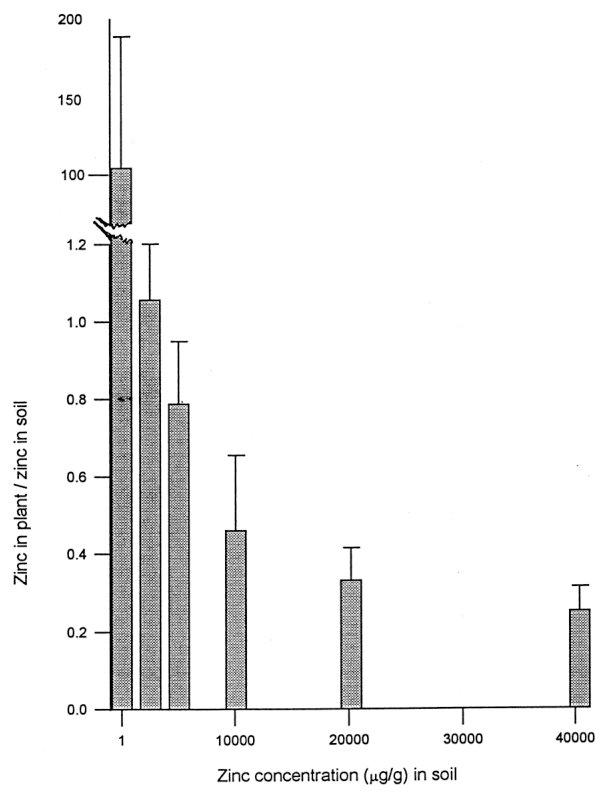
Inspection of these two plots allows for the following observations to be made:
通过考察这两幅图,可得出以下结论:
1. In the case of Zn (Figure 5), bioaccumulation coefficients (BC) decreased with increasing metal content in the soil. The BC values ranged from 104 (0.0017% Zn) to 0.25 (4% Zn). For Cd (Figure 6) the BC values ranged from 67 (1 µg/g Cd) to 5.4 (360 µg/g Cd). It follows therefore, that if Thlaspi caerulescens were to be used for phytoremediation of Cd and Zn in contaminated soils, the efficiency of removal would be inversely related to the degree of contamination of the substrate, since BC values are higher at these lower concentrations of the two metals.
1. 就 Zn 而言(图5),生物富集系数(BC)随土壤金属含量增加而降低。BC 值范围为 104(0.0017% Zn)至 0.25(4% Zn)。就 Cd 而言(图6),BC 值范围为 67(1 µg/g Cd)至 5.4(360 µg/g Cd)。因此,若利用Thlaspi caerulescens对污染土壤中的 Cd 和 Zn 进行植物修复,由于这两种金属浓度较低时 BC 值较高,其去除效率将与基质的污染程度呈反比。
2. As indicated by the high error bars (i.e. standard deviations) of the data points in the two figures, there was a great deal of variability in individual metal contents. For example, the Cd content of the plants varied from 1000–4000 µg/g for 200 µg/g Cd in the soil. In the case of Zn, the corresponding figures were 2500–7500 µg/g for 1% of this metal in the soils. This large variation between individuals was encountered despite the plants being closely controlled and having been planted in homogeneous soil mixtures.
2. 如两幅图中数据点较大的误差线(即标准差)所示,个体金属含量存在很大变异。例如,土壤 Cd 为 200 µg/g 时,植物 Cd 含量在 1000–4000 µg/g 之间变化;就 Zn 而言,土壤中该金属为 1% 时,相应数值为 2500–7500 µg/g。尽管植物处于严格控制之下且种植于均质的混合土壤中,个体之间仍出现如此大的差异。
The high degree of variability of metal levels in T. caerulescens found in our study has been mirrored in hydroponic experiments by Pollard and Baker (1996) who reported 1.8–3.3% Zn in foliar material. McGrath et al. (1993) reported a range of Zn concentrations from 0.25–0.66% in plants for a metal content of just under 300 µg/g in the soil.
本研究发现的T. caerulescens金属含量高度变异,在 Pollard and Baker(1996)的水培试验中也有体现,他们报道叶片材料中 Zn 含量为 1.8–3.3%。McGrath et al.(1993)报道,在土壤金属含量略低于 300 µg/g 时,植物中 Zn 浓度范围为 0.25–0.66%。
Biomass production of Thlaspi caerulescens under natural conditions
自然条件下 Thlaspi caerulescens 的生物量产量
Our field observations and measurements on natural populations of Thlaspi caerulescens growing over base-metal waste near St Laurent le Minier, southern France, have shown that unfertilised plants have an annual biomass production of 2.6 t/ha. This is very low compared with maize (30 t/ha) or even the Ni hyperaccumulator Alyssum bertolonii at 4.5 t/ha (Robinson et al., 1997). Taking the mean Zn content of the plants of 1.16% (Table 1) and Cd content of 0.16%, it can be calculated that a crop of this same biomass could remove 30.2 kg/ha of Zn and 4.2 kg/ha of Cd.
我们对法国南部 St Laurent le Minier 附近贱金属废弃物上生长的Thlaspi caerulescens自然种群的野外观测和测定表明,未施肥植物的年生物量产量为 2.6 t/ha。这与玉米(30 t/ha)相比非常低,甚至低于 Ni 超富集植物Alyssum bertolonii的 4.5 t/ha(Robinson et al., 1997)。以植物平均 Zn 含量 1.16%(表1)和 Cd 含量 0.16% 计算,相同生物量的一季作物可去除 30.2 kg/ha Zn 和 4.2 kg/ha Cd。
Bennett et al. (1998) have shown that fertilising crops of T. caerulescens grown in base-metal mine tailings from the Tui Mine, Te Aroha, New Zealand, can increase the biomass by a factor of three without appreciable reduction in the Zn or Cd concentrations. If we adopt a conservative approach and use a factor of two, a biomass production of 5.2 t/ha would yield 60 kg/ha of Zn and 8.4 kg/ha of Cd. This is in reasonable agreement with the findings of McGrath et al. (1993) who reported 30.1 kg/ha for Zn extracted by moderately fertilised plants from soils containing only 444 µg/g. In relative terms, the data of McGrath et al. (1993) indicate a much higher uptake than found by us. However, as mentioned above, BCs are much higher for lower metal concentrations in the substrate so that the two sets of data are not in conflict.
Bennett et al.(1998)研究表明,对种植于新西兰 Te Aroha 的 Tui 矿贱金属尾矿中的T. caerulescens施肥,可使生物量提高三倍,而 Zn 或 Cd 浓度无明显降低。若采取保守估计,取两倍系数,则 5.2 t/ha 的生物量产量可提取 60 kg/ha Zn 和 8.4 kg/ha Cd。这与 McGrath et al.(1993)的结果基本一致,他们报道适度施肥的植物从仅含 444 µg/g 的土壤中提取 Zn 30.1 kg/ha。相对而言,McGrath et al.(1993)的数据显示出比我们高得多的吸收量。然而如前所述,基质中金属浓度较低时 BC 要高得多,因此两组数据并不矛盾。
The relationship between plant metal concentrations and soil properties
植物金属浓度与土壤性质的关系
Table 2 shows a matrix of correlations based on lognormally distributed abundance data for elemental concentrations in soils and one-year- and two-year-old wild plants from mine tailings at Les Malines. Considering the soils alone, all three elements tested (Cd, Pb and Zn) had concentrations (total and/or extractable) that were significantly correlated with each other except for extractable Cd vs. total Zn and total Pb. This is despite the fact that total Cd/Zn relationship (r=0.95) is by far the strongest in the set. The difference in extractability of two of the elements (11.6% of total for Cd and 5.7% of total for Zn) may explain why BCs (based on total concentrations) for Cd were in general higher than those for Zn except at very low concentrations of either element in the soil.表2列出了基于对数正态分布丰度数据的相关矩阵,涉及 Les Malines 尾矿土壤及一年生和二年生野生植株中的元素浓度。仅就土壤而言,所测三种元素(Cd、Pb 和 Zn)的浓度(全量和/或可提取态)之间均显著相关,但可提取态 Cd 与全量 Zn 及全量 Pb 之间除外。尽管如此,全量 Cd/Zn 关系(r=0.95)仍是该组中最强的。其中两种元素可提取性的差异(Cd 为全量的 11.6%,Zn 为全量的 5.7%)可以解释为何除土壤中任一元素浓度极低的情况外,Cd 的 BC(基于全量浓度)总体高于 Zn。
It is well known (e.g. Brown et al., 1994) that the pH of the soil is one of the most important factors governing elemental accumulation by plants. It will be noted from Table 2, that pH was inversely correlated with all elements in soils and with the same three metals in two-year-old plants. The pH vs. soil inverse correlations for extractable metals merely highlight the well-known fact that solubility of most elements in soils decreases when the pH is raised. It would appear however that only the two-year-old plants showed an inverse correlation between pH and elemental abundances in their tissues. It is clear that metal yields will be able to be increased by addition of acidifying agents such as sulphur or acidic fertilisers such as ammonium sulphate to the soils.
众所周知(例如 Brown et al., 1994),土壤 pH 是控制植物元素积累的最重要因素之一。由表2可见,pH 与土壤中所有元素以及二年生植株中的这三种金属均呈负相关。pH 与土壤可提取态金属的负相关仅反映了一个众所周知的事实,即 pH 升高时土壤中大多数元素的溶解度降低。然而,似乎只有二年生植株的组织中元素丰度与 pH 呈负相关。显然,向土壤中添加硫等酸化剂或硫酸铵等酸性肥料可提高金属产量。
Despite the overriding effect of pH on metal uptake, it must be realised that the pH range of the Les Malines tailings was only 6.4-7.7 with a mean of 7.3. This mean was very close to that of the Auby soils (7.0) and allows for a certain degree of comparison between the two types of soil as well as allowing for meaningful observations on plant/soil relationships in the Les Malines region. This does not of course allow for other differences in the soils such as humus content and absorptive properties that would affect the bioavailability of metals.
尽管 pH 对金属吸收具有决定性影响,但必须认识到 Les Malines 尾矿的 pH 范围仅为 6.4-7.7,平均值为 7.3。该平均值与 Auby 土壤(7.0)非常接近,使两类土壤之间具有一定程度的可比性,也使对 Les Malines 地区植物/土壤关系的观察具有意义。当然,这并未考虑土壤中其他会影响金属生物有效性的差异,如腐殖质含量和吸附性质。
The concentrations of Zn and Cd in both one-year- and two-year-old wild plants (Table 2) showed a highly or very highly significant correlation with the extractable metal content of the supporting soils. For plants raised in plant growth units, the correlation was less strong but nevertheless significant (0.05 > P > 0.01).
一年生和二年生野生植株中的 Zn 和 Cd 浓度(表2)与所在土壤的可提取态金属含量呈高度显著或极显著相关。对于在植物培养室中培育的植物,相关性较弱但仍显著(0.05 > P > 0.01)。
In the case of Pb in soils, relationships with the content of this metal in plants were inconclusive.
就土壤中的 Pb 而言,其与植物中该金属含量的关系尚无定论。
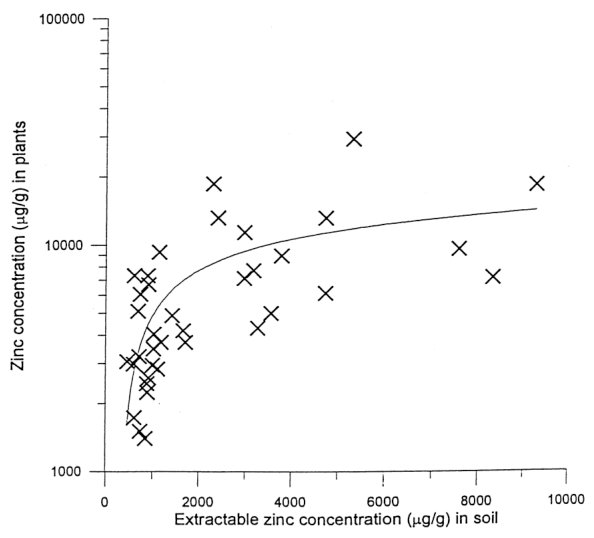
Figures 7 and 8 show the relationship between Zn and Cd concentrations in Thlaspi plants as a function of the corresponding concentrations in ammonium acetate extracts of the supporting soils. These plots do not differentiate between young and mature plants and for both elements show a trend towards limiting values of just over 1000 µg/g Cd and 10,000 µg/g (1%) Zn. The two plots are similar in shape to the plant/soil relationships for Auby soils (Figures 3 and 4) and appear to show a similar behaviour for both metals bioac-图7和图8显示了Thlaspi植株中 Zn 和 Cd 浓度与所在土壤乙酸铵提取液中相应浓度的关系。这些图未区分幼株和成株,两种元素均显示出趋向极限值的趋势,即 Cd 略高于 1000 µg/g,Zn 为 10,000 µg/g(1%)。这两幅图的形状与 Auby 土壤的植物/土壤关系(图3和图4)相似,表明无论是从受冶炼排放污染的 Auby 土壤还是从 Les Malines 矿山废弃物中富
| aCd | aPb | aZn | bCd | bPb | bZn | cCd | cPb | cZn | dCd | dPb | dZn | |
|---|---|---|---|---|---|---|---|---|---|---|---|---|
| aPb | S∗ | |||||||||||
| aZn | S∗ | S∗∗ | ||||||||||
| bCd | S∗ | S∗∗ | S∗∗ | |||||||||
| bPb | NS | S∗∗ | S∗∗ | S∗∗ | ||||||||
| bZn | NS | S∗∗ | S∗∗ | S∗∗ | S∗∗ | |||||||
| cCd | S∗∗ | NS | NS | NS | NS | NS | ||||||
| cPb | NS | S∗ | S∗ | S∗ | NS | NS | NS | |||||
| cZn | S∗ | S∗ | S∗ | S∗∗ | NS | NS | NS | S∗∗ | ||||
| dCd | S∗ | NS | NS | NS | NS | NS | S∗∗ | NS | NS | |||
| dPb | NS | S∗∗ | NS | NS | S∗ | NS | NS | NS | NS | NS | ||
| dZn | NS | NS | S∗∗ | S∗ | NS | S∗ | NS | S∗∗ | S∗∗ | NS | NS | |
| pH | −S∗ | −S∗∗ | −S∗ | −S∗ | −S∗ | −S∗ | NS | NS | NS | −S∗ | −S∗ | −S∗ |
a – extractable element in soil; b – total element in soil; c – one-year plants; d – two-year plants.
a——土壤可提取态元素;b——土壤元素全量;c——一年生植株;d——二年生植株。
S∗∗ – very highly significant (P < 0.001); S∗ – highly significant (0.001 < P < 0.01); NS – not significant (P > 0.01).
S∗∗——极显著(P < 0.001);S∗——高度显著(0.001 < P < 0.01);NS——不显著(P > 0.01)。
NB – negative symbols imply an inverse relationship.
注:负号表示负相关关系。
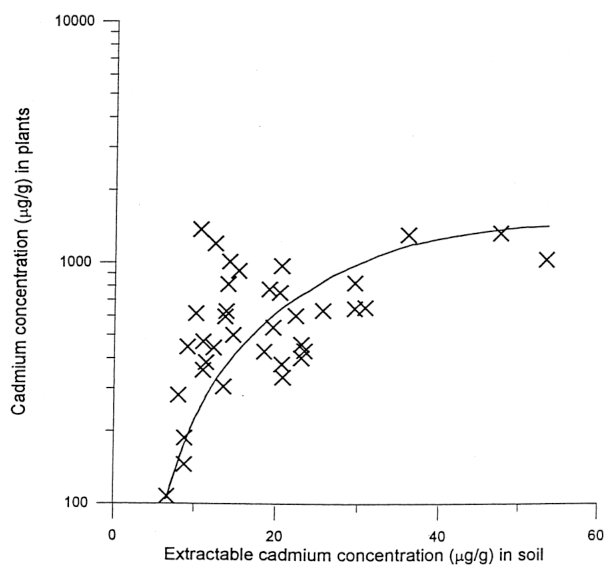
cumulated either from Auby soils contaminated by smelter emissions or from mine waste at Les Malines.
集的这两种金属,其行为均相似。
Potential of Thlaspi caerulescens for phytoremediation论 Thlaspi caerulescens 的植物修复潜力
For the successful practical application of phytoremediation a number of variables must be considered. Among the most important of these is the product of biomass and metal content of the plant material. This has been shown by Bennett et al. (1998) in experiments with Thlaspi caerulescens growing over base-metal mine waste. The product of biomass (weight of individual plants) and the Zn concentration in the plants rose from 22 µg for unfertilised specimens to 497 µg for plants fertilised with 50 µg/g nitrogen as calcium ammonium nitrate. The second variable to be considered is the time span (i.e. number of annual crops) needed to achieve the desired degree of remediation of the soil. In making these calculations it can not be assumed that all of the target element is plant-available. Adopting the conservative approach, however, that only half of the total metal content of the soils will be available to plants, we have calculated the total number of annual croppings of T. caerulescens needed to remove half of the metal burden of contaminated soils down to a depth of 15 cm assuming that the soil has a bulk density of 1.3. The plant is assumed to have a fertilised biomass of 5.2 t/ha and to contain 1.16% Zn and 0.16% Cd. These data are shown in Table 3.
要成功地将植物修复付诸实际应用,必须考虑多个变量。其中最重要的是植物材料生物量与金属含量的乘积。Bennett et al.(1998)在贱金属矿山废弃物上种植Thlaspi caerulescens的试验中证明了这一点。生物量(单株重量)与植物 Zn 浓度的乘积由未施肥植株的 22 µg 增至施用 50 µg/g 氮(以硝酸铵钙形式)植株的 497 µg。需考虑的第二个变量是达到预期土壤修复程度所需的时间跨度(即年作物季数)。在进行这些计算时,不能假定目标元素全部为植物有效态。然而,我们采取保守估计,假定土壤中金属全量仅有一半可被植物利用,并假设土壤容重为 1.3,计算了去除污染土壤 15 cm 深度内一半金属负荷所需的T. caerulescens年种植总季数。假定该植物施肥后生物量为 5.2 t/ha,含 1.16% Zn 和 0.16% Cd。结果见表3。
Some of the values in Table 3 are of course extraordinarily high and have only been included for the sake of completeness. Any period of annual cropping exceeding 10 yr (or even less) would obviously be totally uneconomic. It should also be realised that the amounts of metal extracted may decrease after sequential crops (Brown et al., 1994), though not in proportion to the residual metal content of the soil. This factor has, however, already been allowed for in our conservative assumption that only half of the metal burden will be extractable. This implies that only contaminated soils with <500 µg/g Zn could be remediated to half this value within the limits of 10 years (actual time 8.13 years). This is somewhat lower than the 13 croppings suggested by McGrath et al. (1993) to reduce a soil content of 444 µg/g Zn to 300 µg/g but can be accounted for by the higher biomass reported by us for fertilised plants. It is obvious that it will never be economically feasible to remediate mine tips or heavily contaminated soils by phytoremediation if Zn is the target metal.
表3中的部分数值当然极高,列出仅为完整起见。任何超过 10 yr(甚至更短)的逐年种植期显然都完全不经济。还应认识到,连续种植后提取的金属量可能会减少(Brown et al., 1994),但并不与土壤残留金属含量成比例。不过,这一因素已在我们仅一半金属负荷可被提取的保守假设中予以考虑。这意味着只有 Zn 含量 <500 µg/g 的污染土壤才能在 10 年之内(实际时间 8.13 年)修复至该值的一半。这略低于 McGrath et al.(1993)提出的将土壤 Zn 含量由 444 µg/g 降至 300 µg/g 所需的 13 季种植,但可由我们报道的施肥植物生物量较高来解释。显然,若以 Zn 为目标金属,利用植物修复治理矿渣堆或重度污染土壤在经济上永远不可行。
| Initial metal content (_µ_g/g)初始金属含量(_µ_g/g) | Mass of metal (kg)金属质量(kg) | Zinc锌 | Cadmium镉 |
|---|---|---|---|
| 100,000 (10%) | 150,000 | 1625 | 11,606 |
| 20,000 (2%) | 30,000 | 325 | 2320 |
| 10,000 (1%) | 15,000 | 163 | 1160 |
| 2000 (0.2%) | 3000 | 33 | 231 |
| 1500 (0.15%) | 2250 | 24 | 174 |
| 1000 (0.1%) | 1500 | 16 | 116 |
| 500 (0.05%) | 750 | 8.1 | 59 |
| 200 (0.02%) | 300 | 3.3 | 23 |
| 100 (0.01%) | 150 | 1.6 | 12 |
| 20 (0.002%) | 30 | 0.33 | 2.3 |
| 10 (0.001%) | 15 | 0.17 | 1.2 |
| 2 (0.0002%) | 3 | 0.04 | 0.23 |
NB – It is assumed that only half of the metal content of soils is extractable. This conservative assumption also compensates for the fact that metal extraction decreases, though not in proportion, with sequential crops.
注:假定土壤金属含量中仅有一半可被提取。这一保守假设也弥补了金属提取量随连续种植而减少(但不成比例)这一事实。
In the case of Cd, the problem is different. Much lower concentrations of Cd than of Zn, are to be expected in contaminated soils and the mean BC for Thlaspi caerulescens is much higher for Cd than Zn, except where the concentrations of both elements are <1 µg/g in the supporting soil. From Table 3, a burden of 500 µg/g Cd (hardly to be expected under natural conditions) would require just under 60 crops to be reduced to half this value. However, 20 µg/g could be reduced to 10 µg/g in just over 2 years and if the soil contained 10 µg/g Cd, a single crop would reduce this to nearly one half after only one year.
Cd 的情况则不同。污染土壤中 Cd 的浓度预期远低于 Zn,而且除所在土壤中两种元素浓度均 <1 µg/g 的情况外,Thlaspi caerulescens对 Cd 的平均 BC 远高于 Zn。由表3可知,500 µg/g 的 Cd 负荷(在自然条件下几乎不可能出现)需要将近 60 季作物才能降至该值的一半。然而,20 µg/g 可在略多于 2 年内降至 10 µg/g;若土壤含 10 µg/g Cd,仅种植一季,一年后即可降至接近一半。
There is at present much concern worldwide about the steady build-up of Cd in soils from atmospheric deposition, application of sewage sludges and phosphatic fertilisers. Concentrations as high as 7 µg/g have been recorded in soils (Taylor and Percival, 1994)
目前,全世界都十分关注大气沉降、施用污水污泥和磷肥导致土壤中 Cd 的持续累积。土壤中已记录到高达 7 µg/g 的浓度(Taylor and Percival, 1994),
and it would seem that growing a crop of Thlaspi caerulescens might be an efficaceous and cost-saving option in specific cases. However, a few words of caution must be expressed with regard to this suggestion.
因此,在特定情况下种植Thlaspi caerulescens似乎可能是一种有效且节约成本的选择。然而,对于这一建议必须提出几点告诫。
In suggesting that T. caerulescens might be used for phytoremediationof low levels of Cd (i.e. <2 µg/g) in soils, it is assumed that the BCs are a linear function of soil Cd concentration. This may not be the case (Brown et al., 1995a) so that the BCs reported here at high soil Cd concentrations are not likely to be applicable to lower Cd concentrations. It is also assumed that competition from weeds (never a problem over highly mineralised soils) could be controlled.
在提出T. caerulescens可用于土壤中低含量 Cd(即 <2 µg/g)的植物修复时,假定了 BC 是土壤 Cd 浓度的线性函数。事实可能并非如此(Brown et al., 1995a),因此本文在土壤高 Cd 浓度下报道的 BC 不太可能适用于较低的 Cd 浓度。此外还假定杂草竞争(在高度矿化的土壤上从来不是问题)可以得到控制。
Because of the much higher phytotoxicity of Cd with respect to Zn, there is even the possibility of removing the former selectively from mine tailings in order to make the substrate more amenable to revegetation with other species.
由于 Cd 的植物毒性远高于 Zn,甚至有可能从尾矿中选择性地去除 Cd,从而使基质更适于用其他物种进行植被恢复。
A new and burgeoning technology in phytoremediation of contaminated soils involves the use of complexing agents such as EDTA in order to increase the solubility of metals. So far the emphasis has been on complexing of Pb (Huang and Cunningham, 1996), but a recent paper by Blaylock et al. (1997) has shown that addition of chelating agents to Indian mustard can be used to phytoremediatecadmium-contaminated soils. There is no reason why the same procedure should not be used to increase Zn uptake by Thlaspi or other plant accumulators. It is probable that sat-
污染土壤植物修复中一项新兴且迅速发展的技术是利用 EDTA 等络合剂提高金属的溶解度。迄今为止,研究重点一直是 Pb 的络合(Huang and Cunningham, 1996),但 Blaylock et al.(1997)最近的一篇论文表明,对印度芥菜添加螯合剂可用于镉污染土壤的植物修复。没有理由不能采用同样的方法来提高Thlaspi或其他富集植物对 Zn 的吸收。很可能
uration has already been reached by Thlaspi for Zn, but there should be some scope to increase the Cd uptake by this plant. If this could be achieved, the use of Thlaspi caerulescens, at least for phytoremediation of Cd contamination, will become an entirely feasible proposition.
Thlaspi对 Zn 的吸收已经达到饱和,但提高该植物对 Cd 的吸收应仍有一定空间。如能实现这一点,利用Thlaspi caerulescens至少对 Cd 污染进行植物修复将成为完全可行的方案。
CEC (Commission of the European Community) 1986 Council directive of 12 June 1986 on the protection of the environment, and in particular of the soil, when sewage sludge is used in agriculture. Off. J. Europ. Communities L181 (86/278/EEC), 6–12.
CEC (Commission of the European Community) 1986 Council directive of 12 June 1986 on the protection of the environment, and in particular of the soil, when sewage sludge is used in agriculture. Off. J. Europ. Communities L181 (86/278/EEC), 6–12.
Chaney R L 1983 Plant uptake of inorganic waste constituents. In Land Treatment of Hazardous Wastes. Eds. J F Parr et al. pp 50– 76. Noyes Data Corp, Park Ridge.
Chaney R L 1983 Plant uptake of inorganic waste constituents. In Land Treatment of Hazardous Wastes. Eds. J F Parr et al. pp 50– 76. Noyes Data Corp, Park Ridge.
Ernst W H O Bioavailability of heavy metals and decontamination of soils by plants. Appl. Geochem. 11, 163–167.
Ernst W H O Bioavailability of heavy metals and decontamination of soils by plants. Appl. Geochem. 11, 163–167.
5References参考文献
Baker A J M and Brooks R R 1989 Terrestrial higher plants which hyperaccumulate heavy elements: a review of their distribution, ecology and phytochemistry. Biorecovery 1, 81–126.
Baumann A 1885 Das Verhalten von Zinksalzen gegen Pflanzen und in Böden. Landwirt. Vers. Stn. 31, 1–53.
Bennett F A, Tyler E K, Brooks R R, Gregg P E H and Stewart R B 1998 Fertilisation of hyperaccumulators to enhance their potential for phytoremediation and phytomining. In Plants that Hyperaccumulate Heavy Metals. Ed. R R Brooks. CAB International, Wallingford.
Blaylock M J, Salt D E, Dushenkov S, Zakharova O, Gussman C, Kapulnik Y, Ensley B D and Raskin I 1997 Enhanced accumulation of Pb in Indian mustard by soil-applied chelating agents. Environ. Sci. Technol. 31, 860–865, 1997.
Brooks R R, Lee J, Reeves R D and Jaffrè T 1977 Detection of nickeliferous rocks by analysis of herbarium specimens of indicator plants. J. Geochem. Explor. 7, 49–57.
Brooks R R, Dunn C E and Hall G E M 1995 Biological Systems in Mineral Exploration and Processing. Ellis Horwood, Hemel Hempstead.
Brown S L, Chaney R L, Angle J S and Baker A J M 1994 Phytoremediation potential of Thlaspi caerulescens and bladder campion for zinc- and cadmium-contaminated soil. J. Environ. Qual. 23, 1151–1157.
Brown S L, Chaney R L, Angle J S and Baker A J M 1995a Zinc and cadmium uptake by hyperaccumulator Thlaspi caerulescens and metal-tolerant Silene vulgaris grown on sludge-amended soils. Environ. Sci. Technol. 29, 1581–1585.
Brown S L, Chaney R L, Angle J S and Baker A J M 1995b Zinc and cadmium uptake by hyperaccumulator Thlaspi caerulescens grown in nutrient solution. Soil Sci. Soc. Am. J. 59, 125–133.
Huang J W and Cunningham S D 1996 Lead phytoextraction: species variation in lead uptake and translocation. New Phytol. 134, 75–84.
McGrath S P, Sidoli C M D, Baker A J M and Reeves R D 1993 The potential for the use of metal-accumulating plants for the in situ decontamination of metal-polluted soils. In Integrated Soil and Sediment Reseach: A Basis for Proper Protection. Eds. H J P Eijsackers and T Hamers. pp 673–676. Kluwer Academic Publishers, Dordrecht, the Netherlands.
Pollard J A and Baker A J M 1996 Quantitative genetics of zinc hyperaccumulation in Thlaspi caerulescens. New Phytol. 132, 113–118.
Reeves R D and Brooks R R 1983 European species of Thlaspi L. (Cruciferae) as indicators of nickel and zinc. J. Geochem. Explor. 18, 275–283.
Robinson B H, Chiarucci A, Brooks R R, Petit D, Kirkman J H, Gregg P E H and De Dominicis V 1997 The nickel hyperaccumulator plant Alyssum bertolonii as a potential agent for phytoremediation and phytomining of nickel. J. Geochem. Explor. 59, 75–86.
Salt D E, Blaylock M, Kumar N P B A, Dushenkov V, Ensley B, Chet I and Raskin I 1995 Phytoremediation: a novel strategy for the removal of toxic metals from the environment using plants. Bio/Technology 13, 468–474.
Taylor M and Percival H J 1994 Cadmium in soils and soil solutions from a transect of soils away from a fertiliser bin. In Proc. of Third Cadmium Research Liaison Meeting. Ed. J Lee. 5 p. AgResearch, Palmerston North, New Zealand.
Vàzquez M D, Barcelo J, Poschenrieder C, M˘adico J, Hatton P, Baker A J M and Cope G H 1992 Localization of zinc and cadmium in Thlaspi caerulescens (Brassicaceae), a metallophyte that can hyperaccumulate both metals. J. Pl.Physiol. 140, 350–355.