C H A P T E R F O U R
Nanthi S. Bolan,*,† Jin Hee Park,*,†,1 Brett Robinson,‡ Ravi Naidu,*,† and Keun Young Huh§
| Contents目录 | |
|---|---|
| 1. Introduction | 146 |
| 2. The Importance of Bioavailability in Phytostabilization | 148 |
| 3. Phytostabilization Concepts | 148 |
| 4. Processes Involved in Phytostabilization | 151 |
| 4.1. Contaminant removal | 151 |
| 4.2. Soil cover | 155 |
| 4.3. Rhizosphere modification | 160 |
| 4.4. Hydraulic control | 163 |
| 5. Factors Affecting Phytostabilization | 164 |
| 5.1. Soil factors | 164 |
| 5.2. Plant factors | 171 |
| 5.3. Contaminant factors | 175 |
| 5.4. Environmental factors | 177 |
| 6. Advantages and Disadvantages of Phytostabilization | 178 |
| 7. Enhancement of Phytostabilization | 179 |
| 7.1. Plant growth-promoting bacteria | 179 |
| 7.2. Inorganic amendments | 183 |
| 7.3. Organic amendments | 185 |
| 7.4. Geotextile capping | 187 |
| 8. Conclusions and Future Research Needs | 188 |
| Acknowledgments | 189 |
| References | 189 |
* Centre for Environmental Risk Assessment and Remediation (CERAR), University of South Australia, Adelaide, Australia
* Centre for Environmental Risk Assessment and Remediation (CERAR),南澳大学,阿德莱德,澳大利亚
{ Cooperative Research Centre for Contaminants Assessment and Remediation of the Environment (CRC CARE), University of South Australia, Adelaide, Australia
{ Cooperative Research Centre for Contaminants Assessment and Remediation of the Environment (CRC CARE),南澳大学,阿德莱德,澳大利亚
{ Department of Soil Science, Lincoln University, Lincoln, New Zealand
{ 林肯大学土壤科学系,林肯,新西兰
} Department of Landscape Architecture, Gyeongnam National University of Science and Technology, Dongjin-ro 33, Jinju, Gyeongnam, Republic of Korea
} 庆南国立科学技术大学景观建筑系,Dongjin-ro 33,晋州,庆尚南道,韩国
1 Current address: Centre for Mined Land Rehabilitation (CMLR), University of Queensland, Brisbane, Australia
1 现地址:昆士兰大学矿区土地复垦中心(CMLR),布里斯班,澳大利亚
| Advances in Agronomy,VolAdvances in Agronomy,卷 | ume 112 | #2011 Elsevier Inc.©2011 Elsevier Inc. |
|---|---|---|
| ISSN 0065-2113, DOI: 1 | 0.1016/B978-0-12-385538-1.00004-4 | All rights reserved. |
Abstract摘要
Phytostabilization involves the establishment of a plant cover on the surface of the contaminated sites with the aim of reducing the mobility of contaminants within the vadose zone through accumulation by roots or immobilization within the rhizosphere, thereby reducing off-site contamination. The process includes transpiration and root growth that immobilizes contaminants by reducing leaching, controlling erosion, creating an aerobic environment in the root zone, and adding organic matter to the substrate that binds the contaminant. Microbial activity associated with the plant roots may accelerate the degradation of organic contaminants such as pesticides and hydrocarbons to nontoxic forms. Phytostabilization can be enhanced by using soil amendments that immobilize metal(loid)s combined with plant species that are tolerant of high levels of contaminants and low-fertility soils or tailings. Although this technology is effective in the containment of metal(loid)s, the site requires regular monitoring to ensure that the stabilizing conditions are maintained. Soil amendments used to enhance immobilization may need to be periodically reapplied to maintain their effectiveness. We critically examine the applicability of this technology to manage metal(loid)s contaminated soils and identify fertile areas for future research.
植物稳定是指在污染场地表面建立植被覆盖,通过根系积累或在根际内的固定作用降低污染物在包气带中的迁移性,从而减少场地外污染。该过程包括蒸腾作用和根系生长,其通过减少淋溶、控制侵蚀、在根区营造好氧环境以及向基质中添加可结合污染物的有机质来固定污染物。与植物根系相关的微生物活动可加速农药和烃类等有机污染物降解为无毒形态。将可固定金属(类金属)的土壤改良剂与耐受高浓度污染物及低肥力土壤或尾矿的植物物种相结合,可强化植物稳定效果。尽管该技术能有效封存金属(类金属),但场地仍需定期监测,以确保稳定条件得以维持。用于强化固定作用的土壤改良剂可能需要定期重复施用以维持其效果。本文批判性地审视了该技术在管理金属(类金属)污染土壤方面的适用性,并指出了未来研究中富有前景的方向。
1Introduction引言
Phytoremediation comprises technologies that use higher plants to clean up and revegetate contaminated sites (Adriano et al., 2004; Pulford and Watson, 2003; Robinson et al., 2009). Many techniques and applications are included in the term phytoremediation. They differ in the process by which plants can remove, immobilize, or degrade contaminants. For example, the process in which plants are used to remove organic or inorganic contaminants from soil and water and store them in harvestable tissue is called phytoextraction, rhizoextraction, or phytofiltration. Similarly, the technique in which plants are used to remove contaminants through volatilization is called phytovolatilization (Moreno et al., 2005). In phytostabilization, inorganic contaminants such as heavy metal(loid)s in the soil are immobilized, thereby minimizing their transport in water or dust. This technology may enhance the degradation of organic contaminants such as pesticides and hydrocarbons via microbial activity associated with the plant roots that accelerates the transformation of these contaminants into nontoxic forms (Berti and Cunningham, 2000).
植物修复是指利用高等植物清理污染场地并恢复其植被的一系列技术(Adriano et al., 2004; Pulford and Watson, 2003; Robinson et al., 2009)。植物修复一词涵盖多种技术和应用,它们的区别在于植物去除、固定或降解污染物的过程。例如,利用植物从土壤和水中去除有机或无机污染物并将其储存在可收获组织中的过程,称为植物提取、根际提取或植物过滤。同样,利用植物通过挥发作用去除污染物的技术称为植物挥发(Moreno et al., 2005)。在植物稳定中,土壤中重金属(类金属)等无机污染物被固定,从而使其随水或粉尘的迁移降至最低。该技术还可通过与植物根系相关的微生物活动促进农药和烃类等有机污染物的降解,这些微生物活动可加速此类污染物向无毒形态的转化(Berti and Cunningham, 2000)。
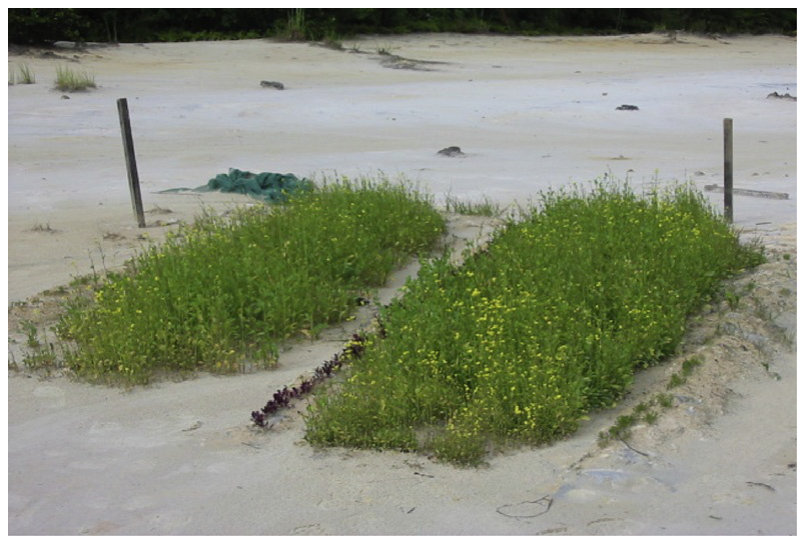
Phytostabilization aims to contain contaminants within the vadose zone through accumulation by roots or precipitation within the rhizosphere. This prevents off-site contamination through their migration via wind and water erosion, leaching, and soil dispersion. Phytostabilization also refers to establishing a plant cover on the surface of the contaminated soils, which reduces their exposure to wind, water, and direct contact with humans or animals. Phytostabilization can be enhanced by using soil amendments that are effective in the immobilization of metal(loid)s and plant species that are tolerant of high levels of contaminants (Plate 1; Kumpiene et al., 2007; Park et al., 2011a; Vangronsveld et al., 1995a).
植物稳定旨在通过根系积累或在根际内沉淀,将污染物封存于包气带中,从而防止污染物经风蚀、水蚀、淋溶及土壤分散而迁移,造成场地外污染。植物稳定也指在污染土壤表面建立植被覆盖,以减少土壤受风、水作用以及与人或动物的直接接触。利用能有效固定金属(类金属)的土壤改良剂和耐受高浓度污染物的植物物种,可强化植物稳定效果(图版1;Kumpiene et al., 2007; Park et al., 2011a; Vangronsveld et al., 1995a)。
Phytostabilization reduces the mobility, and therefore the risk, of inorganic contaminants without necessarily removing them from the site. This technology does not generate contaminated secondary waste that needs further treatment. It also enhances soil fertility, thereby achieving ecosystem restoration. However, since the contaminants are left in place, the site requires regular monitoring to ensure that the optimal stabilizing conditions are maintained. If soil amendments are used to enhance immobilization, they may need to be periodically reapplied to maintain their effectiveness (Bolan et al., 2003a; Keller et al., 2005).
植物稳定可降低无机污染物的迁移性,进而降低其风险,而不必将其从场地中移除。该技术不会产生需要进一步处理的受污染二次废弃物,还能提高土壤肥力,从而实现生态系统恢复。然而,由于污染物仍留存于原地,场地需要定期监测,以确保最佳稳定条件得以维持。若使用土壤改良剂强化固定作用,则可能需要定期重复施用以维持其效果(Bolan et al., 2003a; Keller et al., 2005)。
While some organic contaminants undergo microbial or chemical degradation, inorganic contaminants such as metal(loid)s are immutable. Therefore, containment of metal(loid)s through phytostabilization is critical in managing contaminated sites. This review examines the various approaches to remediate contaminated sites; processes involved in phytostabilization of metal(loid)s; soil and plant factors affecting this technology; advantages and disadvantages; and enhancement of this technology using soil amendments.
某些有机污染物可发生微生物降解或化学降解,而金属(类金属)等无机污染物则不可降解。因此,通过植物稳定封存金属(类金属)对污染场地的管理至关重要。本综述探讨了修复污染场地的各种方法、金属(类金属)植物稳定所涉及的过程、影响该技术的土壤和植物因素、该技术的优缺点,以及利用土壤改良剂强化该技术的途径。
2The Importance of Bioavailability in Phytostabilization生物有效性在植物稳定中的重要性
Naidu et al. (2008a) defined the bioavailability of contaminants in soil as the fraction of the total metal(loid) in the interstitial pore water (i.e., soil solution) and soil particles that is available to the receptor organism. There is controversy in the literature regarding the definition and the methods for the measurement of bioavailability. Microbiologists often regard the concentration that can induce a change either in morphology or physiology of the organism as the bioavailable fraction, whereas plant scientists regard the plant available pool as the bioavailable fraction (Adriano et al., 2004). Recent studies (e.g., McLaughlin et al., 2000; Peijnenburg et al., 2007; Vig et al., 2003) indicate that the transformation of contaminants in soils is a dynamic process, which indicates that bioavailability changes with time.
Naidu et al. (2008a) 将土壤中污染物的生物有效性定义为间隙孔隙水(即土壤溶液)和土壤颗粒中总金属(类金属)可被受体生物利用的部分。关于生物有效性的定义及其测定方法,文献中存在争议。微生物学家通常将能够引起生物形态或生理变化的浓度视为生物有效部分,而植物学家则将植物可利用库视为生物有效部分(Adriano et al., 2004)。近期研究(如 McLaughlin et al., 2000; Peijnenburg et al., 2007; Vig et al., 2003)表明,土壤中污染物的转化是一个动态过程,这意味着生物有效性随时间而变化。
A generic definition of bioavailability is the potential for living organisms to take up metal(loid)s through ingestion or from the abiotic environment (i.e., external) to the extent that the metal(loid)s may become involved in the metabolism of the organism (NRC, 2003). More specifically, it refers to the biologically available fraction (or pool) that can be taken up by an organism and can react with its metabolic machinery, or it refers to the fraction of the total concentration that can interact with a biological target (Vangronsveld and Cunningham, 1998). Bioavailability requires that the metal(loid)s come in contact with the organism (i.e., physical accessibility). Moreover, metal(loid)s need to be in a particular form (i.e., chemical accessibility) to enter biota. Bioavailable metal(loid)s are soluble and in an accessible form to the target organism.
生物有效性的一般定义是:生物体通过摄食或从非生物环境(即外部)吸收金属(类金属),并使其可能参与生物体代谢的潜力(NRC, 2003)。更具体而言,它指可被生物体吸收并能与其代谢机制发生反应的生物可利用部分(或库),或指总浓度中能够与生物靶标相互作用的部分(Vangronsveld and Cunningham, 1998)。生物有效性要求金属(类金属)与生物体接触(即物理可及性),此外,金属(类金属)还需以特定形态存在(即化学可及性)才能进入生物体。生物有效的金属(类金属)是可溶的,且以目标生物体可及的形态存在。
Immobilization technologies minimize the bioavailability of metal(loid)s by allowing them to react with the soil for a longer period (aging; i.e., natural attenuation) or by adding soil amendments. Many studies have documented the effect of aging on the immobilization of metal(loid)s in soils (Lock and Janssen, 2003; Lothenbach et al., 1999) and also the potential value of various organic and inorganic soil amendments in reducing the bioavailability of metal(loid)s in soil (Cheng and Hseu, 2002; Kumpiene et al., 2007; Park et al., 2011a). For example, various phosphate compounds have been found to be effective in the immobilization of Pb in soils (McGowen et al., 2001), and USEPA recommends this technique for risk-based remediation of Pb-contaminated sites (USEPA, 2001) (refer to Section 7).
固定化技术通过使金属(类金属)与土壤长时间反应(老化,即自然衰减)或添加土壤改良剂,将其生物有效性降至最低。许多研究记录了老化对土壤中金属(类金属)固定的影响(Lock and Janssen, 2003; Lothenbach et al., 1999),以及各种有机和无机土壤改良剂在降低土壤中金属(类金属)生物有效性方面的潜在价值(Cheng and Hseu, 2002; Kumpiene et al., 2007; Park et al., 2011a)。例如,已发现多种磷酸盐化合物可有效固定土壤中的 Pb(McGowen et al., 2001),USEPA 推荐将该技术用于 Pb 污染场地基于风险的修复(USEPA, 2001)(参见第7节)。
3Phytostabilization Concepts植物稳定的概念
Most legislative schemes require that a soil be remediated if the total concentration of one or more contaminants (e.g., heavy metal(loid)s) is exceeded in a designated part (topsoil, subsoil) of the soil profile (Swartjes, 1999). Such a regulatory environment is not conducive to phytostabilization, since in an ideal phytostabilization operation, the total concentration of metal(loid) contaminants remain unchanged.
大多数法规体系要求,若土壤剖面指定部分(表土、底土)中一种或多种污染物(如重金属(类金属))的总浓度超标,则须对土壤进行修复(Swartjes, 1999)。这样的监管环境不利于植物稳定,因为在理想的植物稳定操作中,金属(类金属)污染物的总浓度保持不变。
Regulators are now recognizing the influence of metal(loid) solubility and mobility on environmental risk. Consequently, there is an increasing adoption of a risk-based approach when assessing soil quality (Fernandez et al., 2005; Naidu et al., 2008b; Swartjes, 1999). Such risk-based regulatory systems are based on the effect of the contaminant, rather than on its total concentration in the soil (Naidu et al., 2008b). Higher plants immobilize metal(loid)-polluted soils by affecting changes in the rhizosphere, which has distinct physical, chemical, and biological conditions. The rhizosphere is the few millimeters of soil surrounding the plant roots and influenced by their activity as well as the microbial assemblages associated with the roots. Functionally, the rhizosphere is a highly dynamic, solar/plant-driven microenvironment that is characterized by feedback loops of interactions between root processes, soil characteristics, and the dynamics of the associated microbial population (Adriano et al., 2004; McGrath et al., 2001). Soil characteristics such as pH and redox potential, nutrient status, the presence of contaminants, and physical properties all influence plant growth and the dynamics of microbial population (Marschner et al., 2001). Most root exudates are ultimately responsible for many of the rhizosphere’s unique characteristics. Root exudates stimulate microbial activity and biochemical transformations and/or enhancement of mineralization of metal(loid)s in the rhizosphere (Anderson et al., 1993; Paterson, 2003). Between 10% and 40% of the total net C assimilated by crops is released in the form of soluble root exudates and insoluble materials such as cell walls and mucilage (Bolan et al., 2011; Rasse et al., 2005).
监管机构目前已开始认识到金属(类金属)溶解度和迁移性对环境风险的影响。因此,在评价土壤质量时越来越多地采用基于风险的方法(Fernandez et al., 2005; Naidu et al., 2008b; Swartjes, 1999)。这类基于风险的监管体系以污染物的效应而非其在土壤中的总浓度为依据(Naidu et al., 2008b)。高等植物通过影响根际的变化来固定金属(类金属)污染土壤,根际具有独特的物理、化学和生物条件。根际是指环绕植物根系、受根系活动及与根系相关的微生物群落影响的数毫米范围内的土壤。从功能上看,根际是一个由太阳能/植物驱动的高度动态的微环境,其特征是根系过程、土壤特性及相关微生物种群动态之间相互作用的反馈回路(Adriano et al., 2004; McGrath et al., 2001)。pH和氧化还原电位、养分状况、污染物的存在以及物理性质等土壤特性均会影响植物生长和微生物种群动态(Marschner et al., 2001)。根际的许多独特特性最终大多源于根系分泌物。根系分泌物可刺激根际中的微生物活动和生物化学转化,和/或促进金属(类金属)的矿化(Anderson et al., 1993; Paterson, 2003)。作物同化的总净C中,有10%至40%以可溶性根系分泌物以及细胞壁和黏液等不溶性物质的形式释放(Bolan et al., 2011; Rasse et al., 2005)。
The chemical and biological reactions occurring in the rhizosphere play an important role in the bioavailability of metal(loid)s to plants. Plant roots change the physical, chemical, and biological conditions of the soil in the rhizosphere which, in comparison to bulk soil, is enriched with organic substances of plant and microbial origin, including organic acids, sugars, amino acids, lipids, coumarins, flavonoids, proteins, enzymes, aliphatics, aromatics, and carbohydrates (Chang et al., 2002; Hinsinger et al., 2005). Common organic acids in the rhizosphere are acetic, butyric, citric, fumaric, lactic, malic, malonic, oxalic, propionic, tartaric, and succinic acids. Organic acids in the rhizosphere affect the dynamics of metal(loid)s in soils via their effect on acidification, metal(loid)s chelation and complexation, precipitation, redox reactions, microbial activity, rhizosphere physical properties, and root morphology.
根际中发生的化学和生物反应对金属(类金属)的植物有效性起着重要作用。植物根系改变了根际土壤的物理、化学和生物条件;与土体相比,根际富含植物和微生物来源的有机物质,包括有机酸、糖类、氨基酸、脂类、香豆素、类黄酮、蛋白质、酶、脂肪族化合物、芳香族化合物和碳水化合物(Chang et al., 2002; Hinsinger et al., 2005)。根际中常见的有机酸有乙酸、丁酸、柠檬酸、富马酸、乳酸、苹果酸、丙二酸、草酸、丙酸、酒石酸和琥珀酸。根际有机酸通过影响酸化、金属(类金属)螯合与络合、沉淀、氧化还原反应、微生物活动、根际物理性质以及根系形态,进而影响土壤中金属(类金属)的动态。
Plants may be identified and/or engineered that exude compounds capable of immobilizing contaminants using redox processes or precipitation of insoluble compounds in the rhizosphere. For example, Pb is precipitated as phosphate (Cotter-Howells and Caporn, 1996; Cotter-Howells et al., 1994) and Cd forms complexes with sulfide (de Knecht et al., 1994) in the roots and the rhizosphere of Agrostis capillaris and Silene vulgaris, respectively.
可以筛选和/或培育能够分泌特定化合物的植物,这些化合物可通过氧化还原过程或在根际中沉淀为不溶性化合物来固定污染物。例如,在 Agrostis capillaris 和 Silene vulgaris 的根系及根际中,Pb 分别以磷酸盐形式沉淀(Cotter-Howells and Caporn, 1996; Cotter-Howells et al., 1994),Cd 则与硫化物形成络合物(de Knecht et al., 1994)。
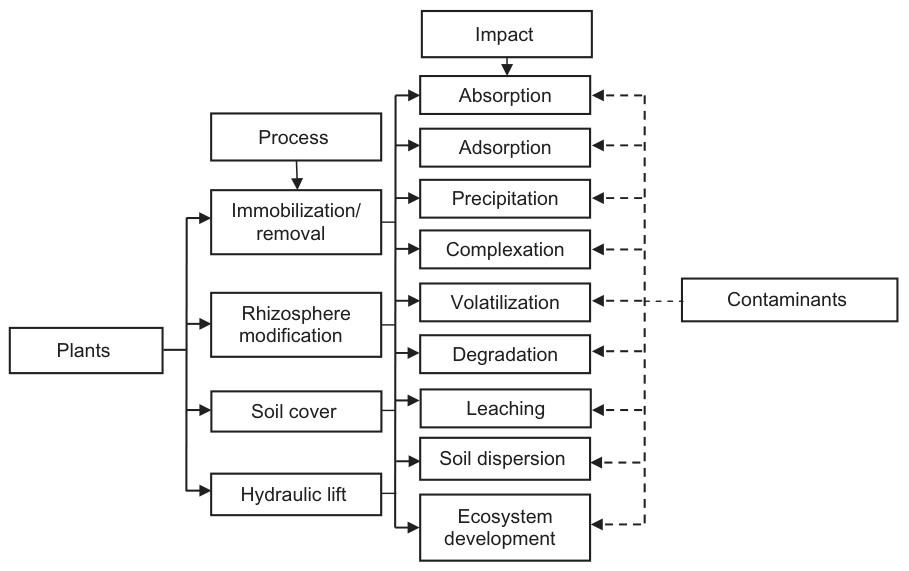
Plants reduce the mobility and transport of pollutants in the environment either by uptake or immobilization (Pulford and Watson, 2003). Phytostabilization can be enhanced by using soil amendments that are effective in the immobilization of metal(loid)s and is readily suited to the monitored natural remediation of contaminated sites, which is employed within the context of a carefully controlled and monitored site cleanup strategy to be able to achieve site-specific remediation objectives within a time frame that is more reasonable than that offered by other more invasive methods (Adriano et al., 2004; Fig. 1).
植物通过吸收或固定作用降低污染物在环境中的迁移性和传输(Pulford and Watson, 2003)。利用能有效固定金属(类金属)的土壤改良剂可强化植物稳定;该技术非常适合用于污染场地的受监测自然修复,即在严格控制和监测的场地清理策略框架下实施,以便在比其他侵入性更强的方法更合理的时间内实现特定场地的修复目标(Adriano et al., 2004;图1)。
Volatilization of contaminants into atmosphere via plants may be an important process in the phytostabilization of soils where high concentrations of organic contaminants are present (Ouyang, 2002; Schnoor et al., 1995). Phytovolatilization has some potential to remediate soils contaminated with metal(loid)s that form volatile hydride and methyl compounds. Recent efforts have concentrated on developing transgenic species with increased potential for volatilizing Hg (Moreno et al., 2005; Rugh et al., 1998) and Se (de Souza et al., 2002; Robinson et al., 2009; Terry et al., 2000). One drawback of volatilization is that there is no control on the final destination of the contaminants.
在有机污染物浓度较高的土壤中,污染物经植物挥发进入大气可能是植物稳定的一个重要过程(Ouyang, 2002; Schnoor et al., 1995)。对于形成挥发性氢化物和甲基化合物的金属(类金属)污染土壤,植物挥发具有一定的修复潜力。近期研究集中于培育挥发 Hg(Moreno et al., 2005; Rugh et al., 1998)和 Se(de Souza et al., 2002; Robinson et al., 2009; Terry et al., 2000)潜力更强的转基因物种。挥发作用的一个缺点是无法控制污染物的最终去向。
4Processes Involved in Phytostabilization植物稳定涉及的过程
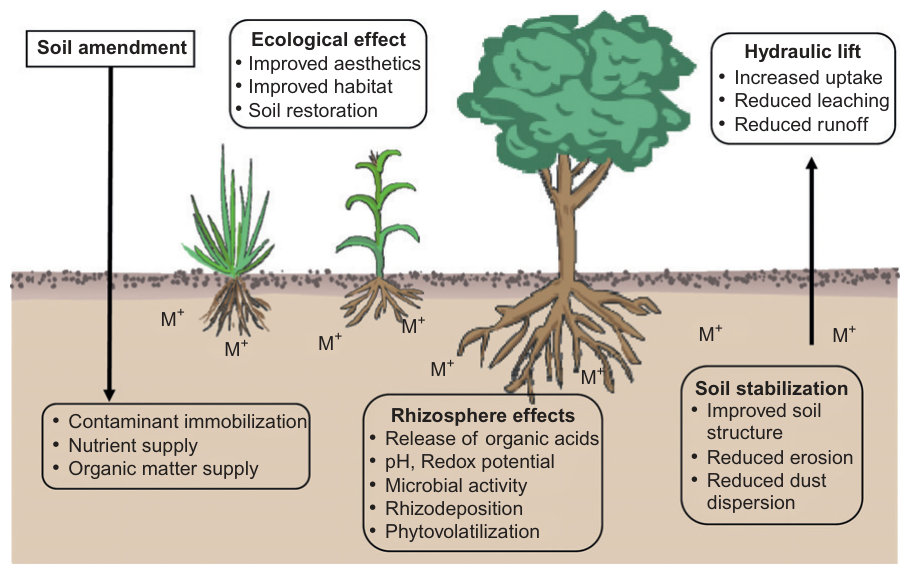
Figure 2 shows the processes involved in reducing the mobility and bioavailability of contaminants. The most important of these are图2展示了降低污染物迁移性和生物有效性所涉及的过程,其中最重要的包括:
� uptake and sequestration of contaminants in the root system;
• 根系对污染物的吸收和封存;
� alteration of soil factors that influence the speciation and immobilization of contaminants (pH, organic matter, redox levels);
• 改变影响污染物形态和固定的土壤因素(pH、有机质、氧化还原水平);
� root exudates that regulate the precipitation and immobilization of the contaminants;
• 根系分泌物调控污染物的沉淀和固定;
� establishment of vegetation barrier that reduces the likelihood of physical contact with the soil by animals and humans;
• 建立植被屏障,降低动物和人类与土壤发生物理接触的可能性;
� mechanical stabilization of the site to minimize erosion by wind and water;
• 对场地进行机械稳定,使风蚀和水蚀降至最低;
� enhancement of evapotranspiration, thereby reducing the leaching of contaminants.
• 增强蒸散作用,从而减少污染物的淋溶。
4.1. Contaminant removal4.1. 污染物去除
Although the removal of contaminants through plant uptake may not be the main process involved in phytostabilization, plant removal of contaminants may still play a role in this technology. Fa¨ssler et al. (2010) showed that agricultural crops could enhance the phytostabilization of a metal-contaminated soil, while producing Zn-rich biomass that could be used as nutritious stock fodder. Poplars used in the phytostabilization of a B-contaminated sawdust pile extracted high concentrations of B (Robinson et al., 2007). Here the biomass could be used as a B-rich mulch on nearby orchards that were deficient in this element. In both cases, the primary role of the plants was the stabilization of the site. The extraction of the metal(loid)s enhanced the value of the biomass.
尽管通过植物吸收去除污染物可能并非植物稳定的主要过程,但植物对污染物的去除在该技术中仍可发挥作用。Fässler et al. (2010) 表明,农作物可强化金属污染土壤的植物稳定,同时产出富含 Zn 的生物量,可用作营养丰富的牲畜饲料。用于 B 污染锯末堆植物稳定的杨树提取了高浓度的 B(Robinson et al., 2007),其生物量可作为富 B 覆盖物用于附近缺乏该元素的果园。在这两个案例中,植物的主要作用都是稳定场地,而对金属(类金属)的提取则提升了生物量的价值。
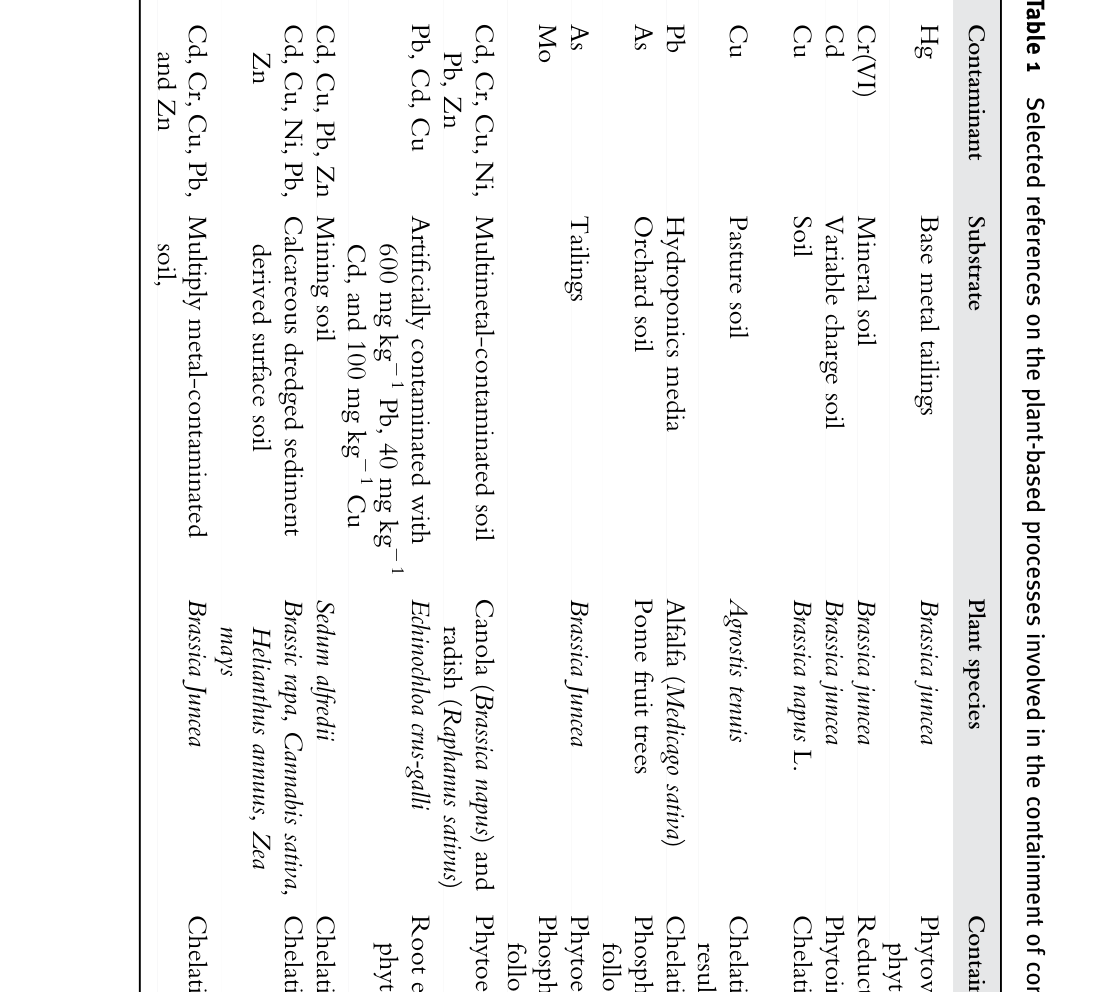
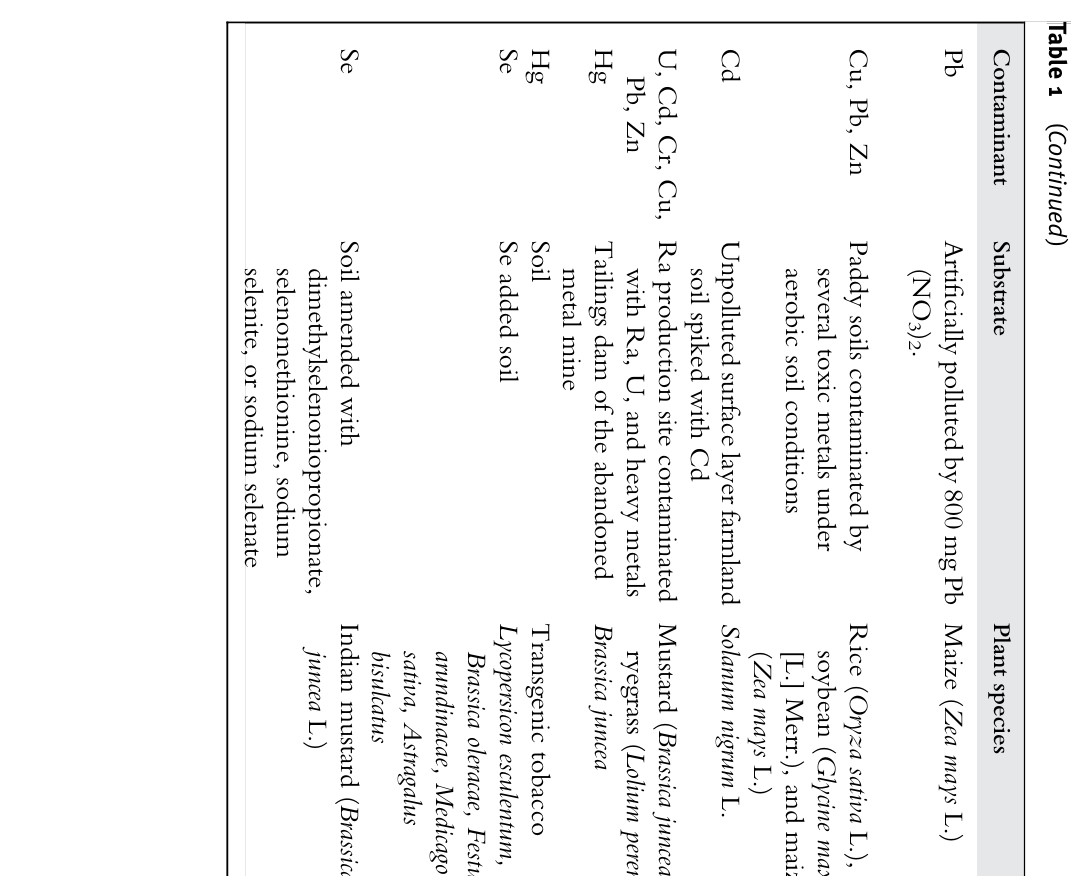
Hyperaccumulating plants that are effective in the removal of metal(loid)s can be used to enhance this technology (Wong, 2003). Plants employ various mechanisms to take up metal(loid)s from soil (Table 1). For example, concentrations of phytosiderophores up to molar levels have been measured for nonsterile conditions in the rhizosphere of Fe-deficient plants (Romheld, 1991). Awad et al. (1994) found enhanced Fe mobilization up to a distance of 4 mm from the wheat roots and concluded that phytosiderophores are highly effective in Fe acquisition. Phytosiderophores also form chelates with Zn, Cu, and Mn and facilitate the solubilization of these metals in calcareous soils (Romheld, 1991; Shenker et al., 2001). Grasses release phytosiderophores in response to Zn deficiency (Cakmak et al., 1994; Walter et al., 1994; Zhang et al., 1991). Cakmak et al. (1996) demonstrated that the enhanced release of phytosiderophores correlates with Zn efficiency in wheat genotypes. Von Wiren et al. (1996) proposed two possible pathways for the uptake of Zn from Zn phytosiderophores in grasses: (1) via the transport of the free Zn cation and (2) the uptake of nondissociated Zn–phytosiderophore complexes. A defining feature of these metal(loid) transport systems is that they have poor specificity (Reid and Hayes, 2003). Therefore, nonessential metal(loid) ions with a similar size to nutrients may be taken up into the symplast and ultimately be translocated to the shoots. Khattak et al. (1991) and Peryea and Kammereck (1997) demonstrated that plants take up arsenate (AsO43�) via the same physiological mechanism as phosphate (PO43�). Similarly, Tl+ may enter via the K+ ion channel (Skulsky, 1991), Cd2+ may enter via either Ca2+ or Zn2+ transport system, and Ni2+ may enter along with Mg2+.
能有效去除金属(类金属)的超富集植物可用于强化该技术(Wong, 2003)。植物采用多种机制从土壤中吸收金属(类金属)(表1)。例如,在非无菌条件下,缺 Fe 植物根际中测得的植物铁载体浓度可高达摩尔级(Romheld, 1991)。Awad et al. (1994) 发现,在距小麦根系4 mm范围内 Fe 的活化作用增强,并得出植物铁载体在 Fe 获取方面非常有效的结论。植物铁载体还可与 Zn、Cu 和 Mn 形成螯合物,促进这些金属在石灰性土壤中的溶解(Romheld, 1991; Shenker et al., 2001)。禾本科植物在缺 Zn 时会释放植物铁载体(Cakmak et al., 1994; Walter et al., 1994; Zhang et al., 1991)。Cakmak et al. (1996) 证明,植物铁载体释放量的增加与小麦基因型的 Zn 效率相关。Von Wiren et al. (1996) 提出了禾本科植物从 Zn-植物铁载体中吸收 Zn 的两种可能途径:(1)通过游离 Zn 阳离子的转运;(2)吸收未解离的 Zn-植物铁载体络合物。这些金属(类金属)转运系统的一个显著特征是专一性较差(Reid and Hayes, 2003)。因此,与养分离子大小相近的非必需金属(类金属)离子可能被吸收进入共质体,并最终转运至地上部。Khattak et al. (1991) 以及 Peryea and Kammereck (1997) 证明,植物吸收砷酸根(AsO43−)的生理机制与磷酸根(PO43−)相同。同样,Tl+ 可能经 K+ 离子通道进入(Skulsky, 1991),Cd2+ 可能经 Ca2+ 或 Zn2+ 转运系统进入,Ni2+ 则可能随 Mg2+ 一同进入。
Mench and Martin (1991) collected dissolved root exudates from two tobacco species (Nicotiana tabacum, Nicotiana rustica) and corn (Zea mays) to extract metal(loid)s from two soils. They observed increased extractability of Mn and Cu, while Ni and Zn remained recalcitrant. Root exudates from the tobacco species enhanced the solubility of Cd, and the amount extracted by the root exudates was in the range of Cd uptake in these plants grown on soil (N. tabacum > N. rustica > Z. mays). Therefore, increased solubility of Cd in the rhizosphere due to the release of organic exudates in the apical root zone can be viewed as a mechanism promoting Cd accumulation in tobacco.
Mench and Martin (1991) 收集了两种烟草(Nicotiana tabacum、Nicotiana rustica)和玉米(Zea mays)的溶解性根系分泌物,用于提取两种土壤中的金属(类金属)。他们观察到 Mn 和 Cu 的可提取性增加,而 Ni 和 Zn 仍难以提取。烟草根系分泌物提高了 Cd 的溶解度,且根系分泌物提取的 Cd 量与这些植物在土壤中生长时的 Cd 吸收量处于同一范围(N. tabacum > N. rustica > Z. mays)。因此,根尖区释放有机分泌物导致根际中 Cd 溶解度增加,可视为促进烟草积累 Cd 的一种机制。
Youssef and Chino (1989) found relatively lower concentrations of dissolved Cu and Zn in the rhizosphere soil being associated with higher pH.
Youssef and Chino (1989) 发现,根际土壤中溶解态 Cu 和 Zn 浓度相对较低,这与较高的pH有关。
Neng-Chang and Huai-Man (1992) observed that the impact of root activity on the rhizosphere pH was influenced by edaphic conditions. For example, the extractability of Cd by 0.1 M CaCl2 was inversely correlated with the pH. In turn, the uptake balance between the anions and the cations influenced the rhizosphere pH. Thus, in terms of physiologically controlled mechanism, uptake of nitrate from fertilizer application could induce higher rhizosphere pH, limiting the solubilization of metals and their subsequent uptake. Whereas an increase in soil pH can increase the concentration of mobile metal(loid) species such as As5+ and Cr6+ and also increase the solubilization of organic matter, thereby releasing metal(loid)s that are associated with organic matter (Bolan et al., 2011; van Herreweghe et al., 2002).
Neng-Chang and Huai-Man (1992) 观察到,根系活动对根际pH的影响受土壤条件制约。例如,0.1 M CaCl2 对 Cd 的可提取性与pH呈负相关。反过来,阴阳离子的吸收平衡又影响根际pH。因此,就生理调控机制而言,吸收施肥带入的硝酸盐可导致根际pH升高,从而限制金属的溶解及随后的吸收。然而,土壤pH升高可增加 As5+ 和 Cr6+ 等可移动金属(类金属)形态的浓度,并促进有机质的溶解,从而释放与有机质结合的金属(类金属)(Bolan et al., 2011; van Herreweghe et al., 2002)。
The establishment of mycorrhizal fungi is a prerequisite for the success of any soil restoration program (Haselwandter and Bowen, 1996; Meier et al., 2011), and hence the relationships between roots and microorganisms in the rhizosphere need to be elucidated. Inoculation with specific mycorrhizal fungi has been considered to increase the uptake of nutrients and pollutants by phytoextractor species (Entry et al., 1996). Rogers and Williams (1986) found that inoculation of Melilotus officinalis and Sorghum sudanense with vesicular arbuscular mycorrhizae increased the uptake of 137Cs by 30 Bq g�1 ash. The association of Pteris vittata with mycorrhizal fungi increased its capacity to uptake As up to 1031 mg As kg�1 dry weight compared to 527 mg As kg�1 in the nonmycorrhizal plants (Leung et al., 2010). Similarly, Dı´az et al. (1996) reported increased mycorrhizal fungi enhanced plant metal tolerance (Schutzendubel and Polle, 2002) by absorbing metal(loid)s in their hyphal sheath and external mycelium. The hydrophobic fungal sheath may reduce metal(loid) access to the root. Fungal chelants may complex metal(loid)s reducing their bioavailability ( Jentschke and Godbold, 2000). The mechanisms of plant nutrient uptake by the fungi and their subsequent translocation into the root may be more specific than the corresponding plant uptake mechanisms, reducing the amount of toxic metal(loid)s that enter the plant (Meier et al., 2011).
菌根真菌的定殖是任何土壤恢复计划取得成功的前提(Haselwandter and Bowen, 1996; Meier et al., 2011),因此需要阐明根际中根系与微生物之间的关系。接种特定菌根真菌被认为可增加植物提取物种对养分和污染物的吸收(Entry et al., 1996)。Rogers and Williams (1986) 发现,给 Melilotus officinalis 和 Sorghum sudanense 接种丛枝菌根后,137Cs 的吸收量增加了30 Bq g−1灰分。Pteris vittata 与菌根真菌共生后,其 As 吸收能力提高至1031 mg As kg−1干重,而非菌根植物为527 mg As kg−1(Leung et al., 2010)。同样,Díaz et al. (1996) 报道,菌根真菌增多可通过在其菌丝鞘和外延菌丝中吸收金属(类金属)而增强植物的金属耐受性(Schutzendubel and Polle, 2002)。疏水性真菌鞘可能减少金属(类金属)到达根系的机会。真菌螯合剂可络合金属(类金属),降低其生物有效性(Jentschke and Godbold, 2000)。真菌吸收植物养分并随后将其转运至根系的机制可能比相应的植物吸收机制更具专一性,从而减少进入植物体内的有毒金属(类金属)量(Meier et al., 2011)。
Results from greenhouse studies on the effect of mycorrhizae on contaminant uptake cannot be directly extrapolated to field conditions because of varying environmental conditions and time scale (short-term green house vs. long-term field conditions). Plant physiological and soil conditions in the field typically differ greatly, both spatially and temporally from those obtained in greenhouse experiments (Entry et al., 1996).
由于环境条件和时间尺度不同(短期温室与长期田间条件),温室研究中关于菌根对污染物吸收影响的结果不能直接外推至田间条件。田间的植物生理和土壤条件在空间和时间上通常与温室试验中的条件存在很大差异(Entry et al., 1996)。
4.2. Soil cover4.2. 土壤覆盖
Vegetation acts as a sink for contaminants by uptake or assimilation, thus reducing the amount of contaminant available for transport to groundwater. Vegetative cover also plays a vital role in stabilization by reducing the water flux through the soil profile and mechanically stabilizing the soil through root growth. This reduces the movement of soil and the associated contaminants. Soil erosion potential is increased if the soil has no or sparse vegetative cover of plants and/or plant residues. Plant and residue cover protects the soil from rain-splash and slows the movement of surface runoff thereby increasing infiltration. Similarly, vegetation reduces the wind velocity, thereby mitigating the dispersion of soil and sediments. The vegetation-induced reduction in soil erosion is likely to reduce the movement of contaminants and subsequent off-site contamination (Table 2).
植被通过吸收或同化作用充当污染物的汇,从而减少可迁移至地下水的污染物量。植被覆盖还通过减少穿过土壤剖面的水通量以及借助根系生长对土壤进行机械稳定,在稳定化过程中发挥至关重要的作用,这减少了土壤及其所含污染物的移动。若土壤缺乏或仅有稀疏的植物和/或植物残体覆盖,其侵蚀潜力将增大。植物和残体覆盖可保护土壤免受雨滴溅蚀,减缓地表径流速度,从而增加入渗。同样,植被可降低风速,从而减轻土壤和沉积物的扩散。植被引起的土壤侵蚀减少很可能减少污染物的迁移及随后的场地外污染(表2)。
The major effects of vegetation on water and wind erosion include:
植被对水蚀和风蚀的主要影响包括:
� interception of the direct impact of rainfall drops and wind;
• 拦截雨滴和风的直接冲击;
� decreasing the velocity of runoff, and hence the cutting action of water and its capacity to entrain soil and sediment;
• 降低径流速度,从而减弱水流的切割作用及其挟带土壤和沉积物的能力;
� root-induced compaction and increases in soil strength, aggregation, and porosity;
• 根系引起的压实作用,以及土壤强度、团聚性和孔隙度的提高;
� enhancement of vegetation-induced biological activities and their influence on soil aggregation and porosity;
• 增强植被引起的生物活动及其对土壤团聚性和孔隙度的影响;
� transpiration of water, leading to the subsequent drying out of the soil;
• 水分蒸腾,导致土壤随后变干;
� insulation of the soil against temperature variation which can result in cracking or “frost heave.”
• 使土壤免受温度变化的影响,温度变化可能导致开裂或“冻胀”。
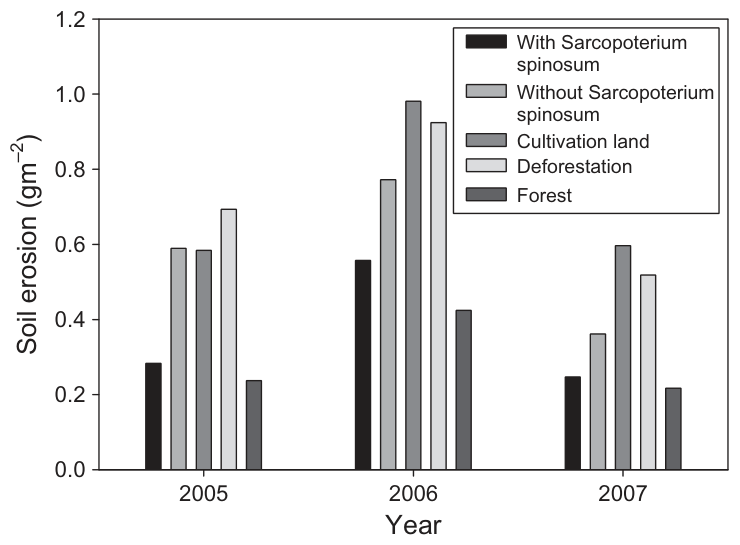
The erosion-reducing effectiveness of plant and/or residue covers depends on the type, extent, and quantity of cover (Fig. 3). Vegetation and residue combinations that completely cover the soil, and which intercept all falling raindrops at and close to the surface, are the most efficient in controlling soil erosion. Residual roots and earthworms are also important as these provide channels (biopores) that allow surface water to move into the soil, thereby reducing surface runoff and soil erosion (Bronick and Lal, 2005; McCallum et al., 2004). Maintaining living ground covers, to provide the best protection against loss of soil because they slow down runoff water after rain, allows water to infiltrate into the soil and lessen evaporation losses. For example, vegetative cover in rehabilitated mined land increased infiltration rate and declined erosion from stimulated storm from 30–35 t ha�1 at 0% vegetative cover to 0.5 t ha�1 at 47% cover (Loch, 2000). Tree roots were found to increase soil strength by 2–8 kPa depending on species, while grass roots contributed 6–18 kPa, thereby decreasing the erosion potential of soils (Simon and Collison, 2002).
植物和/或残体覆盖的减蚀效果取决于覆盖的类型、范围和数量(图3)。完全覆盖土壤并能在地表及近地表拦截所有降落雨滴的植被与残体组合,在控制土壤侵蚀方面最为有效。残留根系和蚯蚓也很重要,因为它们提供了使地表水进入土壤的通道(生物孔隙),从而减少地表径流和土壤侵蚀(Bronick and Lal, 2005; McCallum et al., 2004)。保持活体地面覆盖可提供最佳的防止土壤流失保护,因为它能减缓降雨后的径流,使水分入渗土壤并减少蒸发损失。例如,在复垦矿区土地上,植被覆盖提高了入渗速率,模拟暴雨造成的侵蚀量从0%植被覆盖时的30–35 t ha−1降至47%覆盖时的0.5 t ha−1(Loch, 2000)。研究发现,树木根系可使土壤强度提高2–8 kPa(因物种而异),而草本根系可提高6–18 kPa,从而降低土壤的侵蚀潜力(Simon and Collison, 2002)。
Lumber production is an important land use in New Zealand. Plantation forests of Pinus radiata cover some 6% of the land area. To prevent decay, lumber products are treated with biocides, with Copper Chromium and Arsenic (CCA) being the treatment of choice. Historically, pentachlorophenol (PCP) has been used. Boron is used to prevent sap stain. The use of these treatments has resulted in the contamination of sites used for wood waste disposal. Piles of wood waste, primarily sawdust, leach B, CCA, and PCP thus pose a serious environmental risk. One such pile, 3.6 ha and
木材生产是新西兰一种重要的土地利用方式。辐射松(Pinus radiata)人工林约占国土面积的6%。为防止腐朽,木材产品需用杀菌剂处理,其中首选铜铬砷(CCA)处理。历史上曾使用五氯苯酚(PCP),硼则用于防止边材变色。这些处理的使用导致用于处置木材废料的场地受到污染。木材废料堆(主要是锯末)淋溶出 B、CCA 和 PCP,因而构成严重的环境风险。其中一个面积为3.6 ha的废料堆
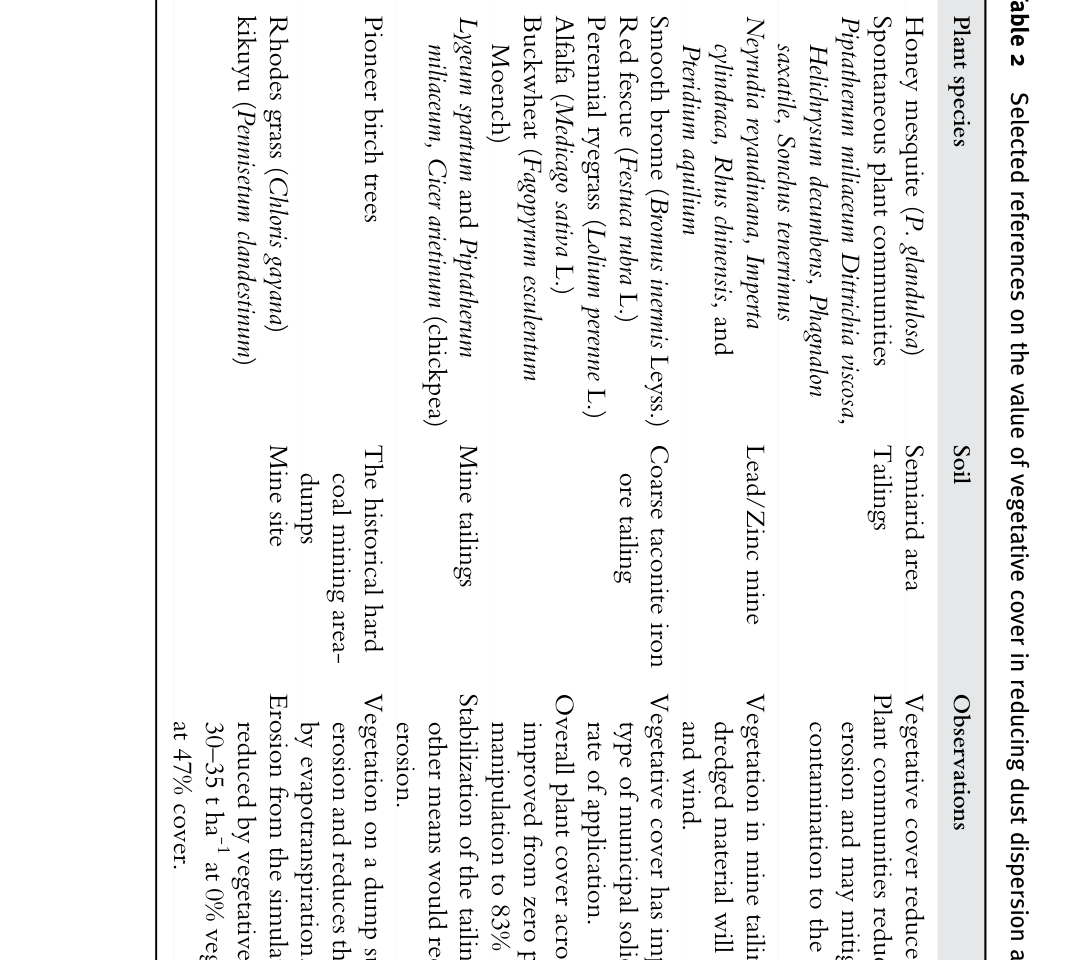
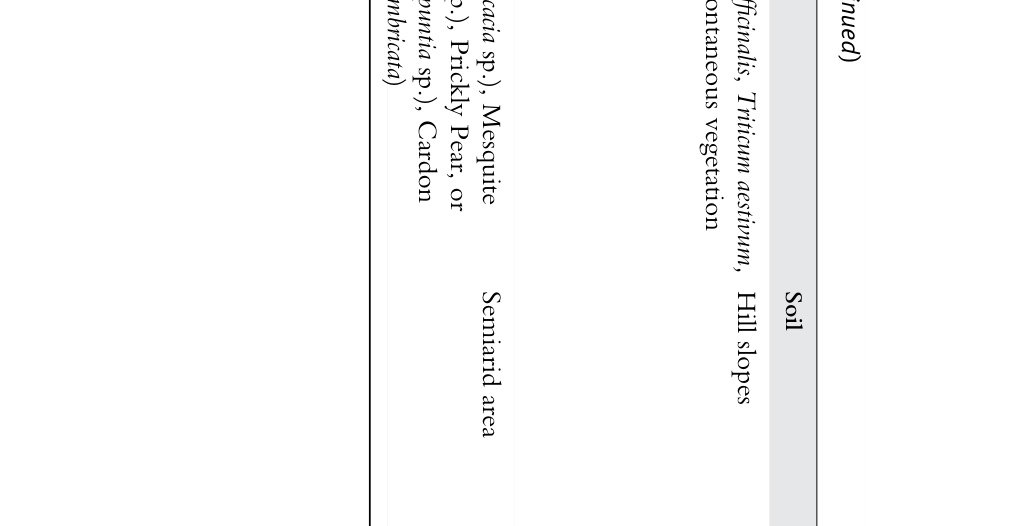
Table 2 (Continued)表2(续)
located near the town of Kopu, New Zealand, was leaching high concentrations of B into local streams, resulting the degradation of ecosystems and fisheries. The presence of high B concentrations and a C:N ratio of 400 had prevented vegetation from establishing on the pile. Consequently, virtually all of the annual 1135 mm of rainfall resulted in leaching events. Saturated material occurred at depths as shallow as 20 mm, resulting in anaerobic conditions that reduced the rate of biodegradation of the wood waste and resulted in methane production.
位于新西兰 Kopu 镇附近,向当地溪流淋溶出高浓度的 B,导致生态系统和渔业退化。高浓度的 B 和400的C:N比使植被无法在废料堆上定植。因此,年降雨量1135 mm几乎全部形成了淋溶事件。在浅至20 mm的深度即出现饱和物料,形成厌氧条件,降低了木材废料的生物降解速率并导致甲烷产生。
Robinson et al. (2007) describes the phytostabilization of this pile using poplar trees. Poplar clones were selected that tolerate high B concentrations (Plate 2). The pile was heavily fertilized with nitrogen, and a collection pond to store any leachate was installed at the foot of the pile. After 3 years of growth, the trees have reduced leaching events from the pile during the Southern hemisphere winter (June–September). The holding pond collects most of this leachate, which is used for irrigation during the summer months. Occasional winter storms result in the holding pond discharging into the local stream. However, these storm events result in dilution of the contaminants to levels below the New Zealand Drinking Water Standard of 1.4 mg L�1B.
Robinson et al. (2007) 描述了利用杨树对该废料堆进行植物稳定的过程。选用了耐高浓度 B 的杨树无性系(图版2)。废料堆施用了大量氮肥,并在堆脚修建了收集池以储存渗滤液。经过3年生长,树木减少了南半球冬季(6月–9月)废料堆的淋溶事件。收集池收集了大部分渗滤液,用于夏季灌溉。偶发的冬季暴雨会导致收集池向当地溪流排水,但这些暴雨事件使污染物被稀释至新西兰饮用水标准(1.4 mg L−1 B)以下。
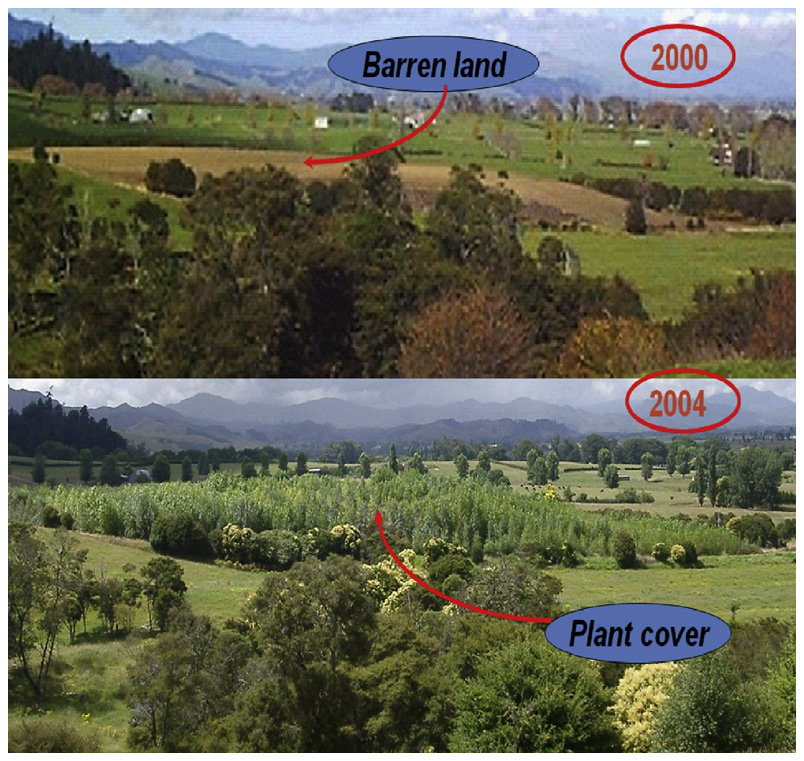
The poplar trees accumulated high concentrations (>1000 mg kg�1) of B in the leaves, while the concentrations of other contaminants, namely Cu, Cr, and As, were all <1 mg kg�1. It was suggested that the trees be periodically coppiced and used as an organic B-rich mulch on nearby orchards that are deficient in this essential micronutrient. Such a strategy relies on only coppicing a fraction of the trees on the pile, so that hydraulic control is maintained.
杨树叶片中积累了高浓度的 B(>1000 mg kg−1),而其他污染物即 Cu、Cr 和 As 的浓度均 <1 mg kg−1。有人建议定期对树木进行平茬,并将其用作富 B 有机覆盖物,施用于附近缺乏这种必需微量养分的果园。该策略仅对废料堆上的部分树木进行平茬,以维持水力控制。
4.3. Rhizosphere modification4.3. 根际改造
Rhizosphere-induced changes in soil biochemical properties regulate the transformation, mobility, and bioavailability of metal(loid)s, thereby affecting the phytostabilization of contaminated sites. The major rhizosphere-induced biochemical properties that influence metal(loid) dynamics include acidification, release of organic acids, and increased microbial activity (Table 3).
根际引起的土壤生物化学性质变化调控着金属(类金属)的转化、迁移性和生物有效性,从而影响污染场地的植物稳定。影响金属(类金属)动态的主要根际生物化学性质包括酸化、有机酸释放和微生物活性增强(表3)。
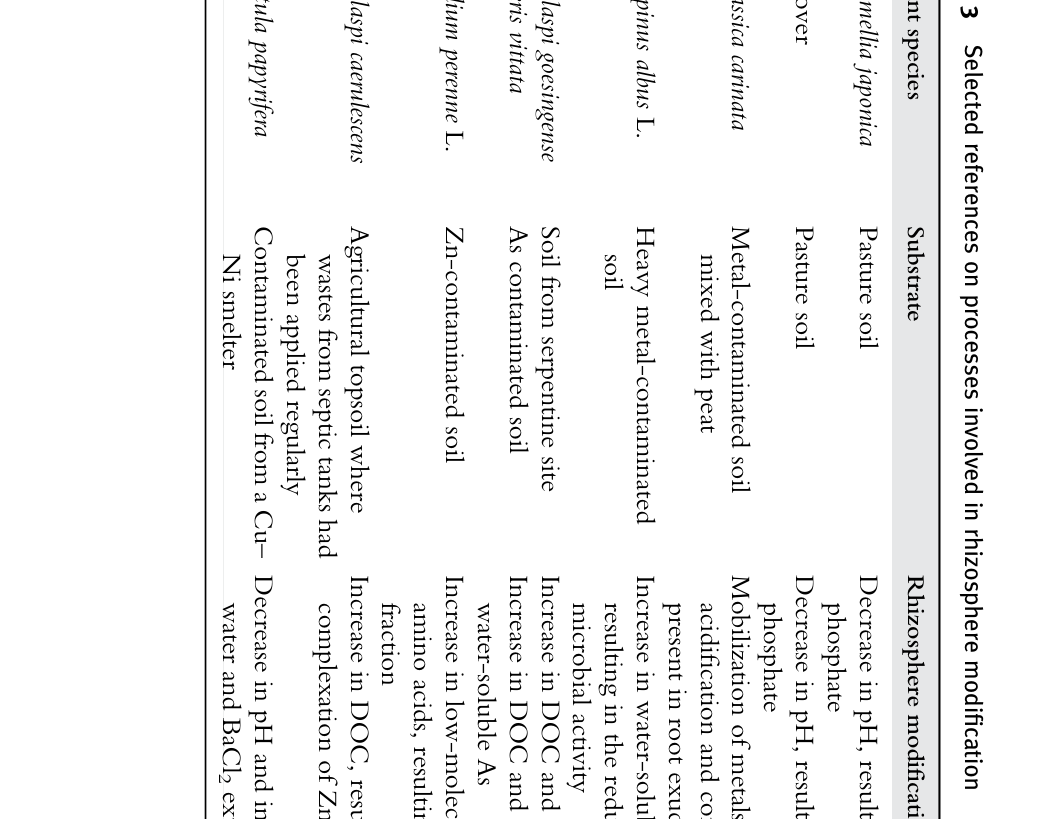
The major source of plant-based OH�/H+ fluxes affecting pH in the rhizosphere is related to the differential uptake of cations and anions by plant roots (Tang and Rengel, 2003). For example, plants receiving NH4+ will counterbalance the corresponding excess of positive charges by releasing equivalent amounts of H+ in the rhizosphere, thereby decreasing rhizosphere pH. Apart from this, nitrogen transformation and nitrate leaching in the nitrogen cycle have been suggested to be major causes of soil acidification (Bolan and Hedley, 2003).
影响根际pH的植物源 OH−/H+ 通量的主要来源,与植物根系对阳离子和阴离子的差异吸收有关(Tang and Rengel, 2003)。例如,吸收 NH4+ 的植物会在根际释放等量的 H+ 以平衡相应的过剩正电荷,从而降低根际pH。此外,氮循环中的氮转化和硝酸盐淋溶被认为是土壤酸化的主要原因(Bolan and Hedley, 2003)。
Acidification affects the solubility and speciation of metal(loid) ions in several ways, foremost of which include: (a) modification of surface charge in variable charge soils; (b) altering the speciation of metal(loid)s; and (c) influencing the redox reactions of the metal(loid)s (Adriano, 2001). Adsorption of metals almost invariably decreases with increasing soil acidity (or decreasing pH; Tiller, 1989; Yang et al., 2006). Three possible reasons have been advanced for this phenomenon (Naidu et al., 1994). First, in variable charge soils, a decrease in pH causes a decrease in surface negative charge resulting in lower cation adsorption. Second, a decrease in soil pH is likely to decrease hydroxy species of metal cations (MOHn+) which are adsorbed preferentially over mere metal cation. And third, acidification causes the dissolution of metal(loid) compounds, resulting in an increase in their concentration in soil solution.
酸化通过多种方式影响金属(类金属)离子的溶解度和形态,其中最主要的包括:(a)改变可变电荷土壤的表面电荷;(b)改变金属(类金属)的形态;(c)影响金属(类金属)的氧化还原反应(Adriano, 2001)。金属的吸附几乎总是随土壤酸度增加(或pH降低)而减少(Tiller, 1989; Yang et al., 2006)。对此现象已提出三种可能的解释(Naidu et al., 1994)。第一,在可变电荷土壤中,pH降低导致表面负电荷减少,从而降低阳离子吸附。第二,土壤pH降低可能减少金属阳离子的羟基形态(MOHn+),而此类形态比单纯的金属阳离子更易被优先吸附。第三,酸化导致金属(类金属)化合物溶解,使其在土壤溶液中的浓度升高。
In the case of metalloids, such as As, the effect of soil acidity on adsorption is manifested through two interacting factors—the increasing negative surface potential on the plane of adsorption and the increasing amount of negatively charged As5+ species present in soil solution. While the first factor results in lower As5+ adsorption, the second factor is likely to increase adsorption. Thus, the pH effect on As5+ adsorption is largely influenced by the nature of the mineral surface. For example, in soils with low oxide content, increasing pH had little effect on adsorption, while in highly oxidic soils, adsorption decreased with increasing pH (Smith et al., 1999).
对于 As 等类金属,土壤酸度对吸附的影响通过两个相互作用的因素体现——吸附面上负表面电位的增加以及土壤溶液中带负电荷的 As5+ 形态数量的增加。第一个因素导致 As5+ 吸附减少,而第二个因素则可能增加吸附。因此,pH对 As5+ 吸附的影响在很大程度上取决于矿物表面的性质。例如,在氧化物含量低的土壤中,pH升高对吸附影响甚微;而在高氧化物土壤中,吸附随pH升高而减少(Smith et al., 1999)。
Carbon compounds and nutrients are released by plant roots into the rhizosphere by “rhizodeposition” (Grayston et al., 1997; Jones et al., 2004). Rhizodeposits, which mostly consist of carbohydrates, carboxylic acids, and amino acids, are responsible for enhanced microbial growth (Aira et al., 2010; Lynch and Whipps, 1990). The role of various compounds in root exudates has been examined for their potential impact on the biogeochemistry of metal(loid)s via complexation and redox reactions. Among the range of carboxylates exuded in the rhizosphere, malate, citrate, and oxalate are expected to have the most dramatic effect due to their implication in the complexation of metal(loid)s (Bolan et al., 1996; Hinsinger, 2001).
植物根系通过“根际沉积”向根际释放碳化合物和养分(Grayston et al., 1997; Jones et al., 2004)。根际沉积物主要由碳水化合物、羧酸和氨基酸组成,可促进微生物生长(Aira et al., 2010; Lynch and Whipps, 1990)。已有研究考察了根系分泌物中各类化合物通过络合和氧化还原反应对金属(类金属)生物地球化学可能产生的影响。在根际分泌的各种羧酸盐中,苹果酸盐、柠檬酸盐和草酸盐因参与金属(类金属)络合,预计影响最为显著(Bolan et al., 1996; Hinsinger, 2001)。
In rhizosphere, some prokaryotic (bacteria, Archaea) and eukaryotic (algae, fungi) microorganisms excrete extracellular polymeric substances (EPS), such as polysaccharides, glycoprotein, lipopolysaccharide, soluble peptide, etc. These substances possess a substantial quantity of anion functional groups that can absorb metal(loid) ions. A number of microbes are involved in EPS production viz, Bacillus megaterium, Acinetobacter, Pseudomonas aeruginosa, sulfate-reducing bacteria, and Cyanobacteria (Satpute et al., 2010). The cell wall of microbes also plays a major role in metal(loid) adsorption and redox reactions. The metal(loid)s uptake by stoichiometric interaction between functional groups of cell wall composition, including phosphate, carboxyl, amine as well as phosphodiester, has been well documented (Liu et al., 2003; Schiewer and Volesky, 1995). Similarly, the higher rates of volatile Se produced from the vegetated plots with added methionine compared to bare irrigated plots have been attributed to additional microbial activity associated with plant roots (Banuelos and Lin, 2007).
在根际中,一些原核微生物(细菌、古菌)和真核微生物(藻类、真菌)会分泌胞外聚合物(EPS),如多糖、糖蛋白、脂多糖、可溶性肽等。这些物质含有大量可吸附金属(类金属)离子的阴离子官能团。参与 EPS 产生的微生物有多种,如 Bacillus megaterium、Acinetobacter、Pseudomonas aeruginosa、硫酸盐还原菌和蓝细菌(Satpute et al., 2010)。微生物细胞壁在金属(类金属)吸附和氧化还原反应中也起着重要作用。细胞壁组分官能团(包括磷酸基、羧基、胺基以及磷酸二酯基)与金属(类金属)之间通过化学计量相互作用进行吸收,这一点已有充分记录(Liu et al., 2003; Schiewer and Volesky, 1995)。同样,与灌溉裸地相比,添加甲硫氨酸的植被小区产生挥发性 Se 的速率更高,这被归因于与植物根系相关的额外微生物活动(Banuelos and Lin, 2007)。
4.4. Hydraulic control4.4. 水力控制
Hydraulic control is the term given to the use of plants to control the migration of subsurface water through the rapid uptake of large volumes of water by the plants through transpiration. The plants are effectively acting as natural hydraulic pumps, which—when a dense root network has been established near the water table in the soil—can transpire large volume of water per day (e.g., 6 L of water plant�1 m�2 d�1; equal to 2190 mm per year—Ashwath and Venkatraman, 2010). Terrestrial plants add 32 � 103 billion tones of water vapor to the atmosphere annually through transpiration—equivalent to about 30% of the precipitation that falls on land (Hetherington and Woodward, 2003). This fact has been utilized to decrease the migration of contaminants from surface water into the groundwater and drinking water supplies.
水力控制是指利用植物通过蒸腾作用快速吸收大量水分来控制地下水迁移。植物实际上充当着天然的水力泵:当土壤中地下水位附近形成了致密的根系网络时,植物每天可蒸腾大量水分(例如6 L 水 plant−1 m−2 d−1,相当于每年2190 mm——Ashwath and Venkatraman, 2010)。陆生植物每年通过蒸腾作用向大气输送32 × 103十亿吨水汽,约相当于陆地降水量的30%(Hetherington and Woodward, 2003)。这一事实已被用于减少污染物从地表水向地下水和饮用水源的迁移。
Plants regulate the movement of contaminants through leaching and surface runoff by controlling the flow of water in soils (i.e., hydraulic control). For example, phytostabilization (i.e., phytocapping) of contaminated sites involves placing a layer of soil material and growing dense vegetation on top of the soil layer (Chen et al., 2007; Venkatraman and Ashwath, 2007). The water holding capacity of the soil layer allows it to act as a “sponge” to reduce infiltration during rain events, particularly when plants are inactive. During the growing season, the evapotranspiration activity of the plants and soil surface acts as a “bio-pump” that reduces the moisture content of the soil layer during rain and irrigation events. For an effective site water balance, it is important that appropriate plant species are chosen and the soil growing conditions including depth and fertility optimized. Trapping and consuming water in the root zone result in less volume of water to act as a vehicle to carry contaminants beyond the grasp of roots, thereby leading in their leaching to groundwater (Clothier and Green, 1997). Barton et al. (2005) noticed that phytostabilization of a landfill site containing coal waste using loblolly (Pinus taeda) and Virginia (Pinus virginiana) has resulted in a decrease in the drainage volume by facilitating water loss through transpiration.
植物通过控制土壤中的水流(即水力控制)来调节污染物经淋溶和地表径流的迁移。例如,污染场地的植物稳定(即植物覆盖层)包括铺设一层土壤材料并在该土层上种植茂密的植被(Chen et al., 2007; Venkatraman and Ashwath, 2007)。土层的持水能力使其能够像“海绵”一样在降雨期间减少入渗,尤其是在植物不活跃时。在生长季,植物和土壤表面的蒸散作用如同“生物泵”,在降雨和灌溉期间降低土层含水量。为实现有效的场地水量平衡,须选择适宜的植物物种,并优化包括深度和肥力在内的土壤生长条件。在根区截留和消耗水分,可减少作为载体将污染物带出根系作用范围并使其淋溶至地下水的水量(Clothier and Green, 1997)。Barton et al. (2005) 注意到,利用火炬松(Pinus taeda)和弗吉尼亚松(Pinus virginiana)对含煤矸石的填埋场进行植物稳定,通过促进蒸腾失水减少了排水量。
Contaminants move in soils by diffusion and mass flow processes (Grifoll and Cohen, 1996). Solutes diffuse through soils and aquifer materials in response to differences in energy from one point to another. These energy gradients may be caused by differences in concentration or temperature within the system. The principal process of movement of contaminants in soils and groundwater is mass flow. Dissolved constituents in water move through the soil, with the water acting as a carrier of the contaminants. Plant-induced hydraulic control influences both these transport processes, thereby regulating the movement of contaminants in soils (Robinson et al., 2006).
污染物在土壤中通过扩散和质流过程迁移(Grifoll and Cohen, 1996)。溶质响应不同位置间的能量差异而在土壤和含水层介质中扩散,这些能量梯度可能由系统内的浓度差或温度差引起。污染物在土壤和地下水中迁移的主要过程是质流,即溶解组分随水在土壤中移动,水充当污染物的载体。植物引起的水力控制对这两种传输过程均有影响,从而调节污染物在土壤中的迁移(Robinson et al., 2006)。
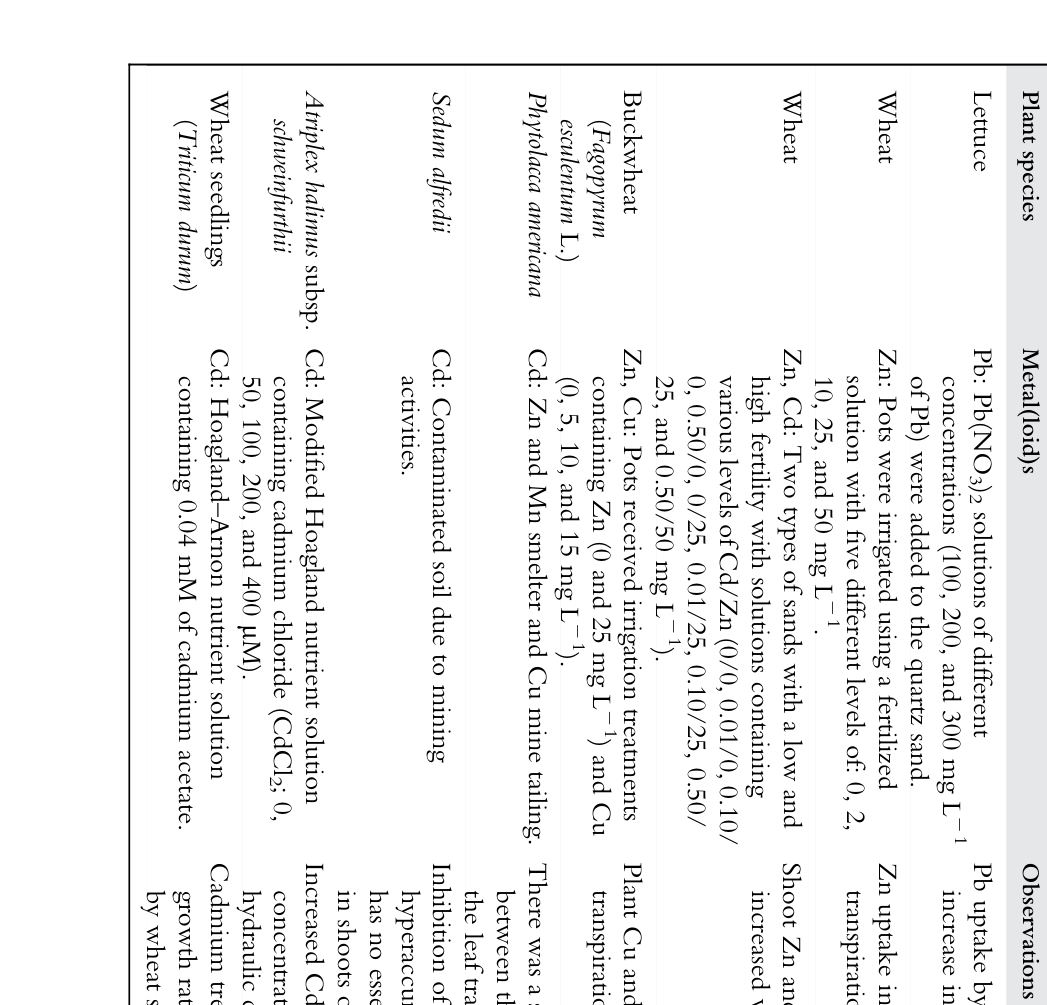
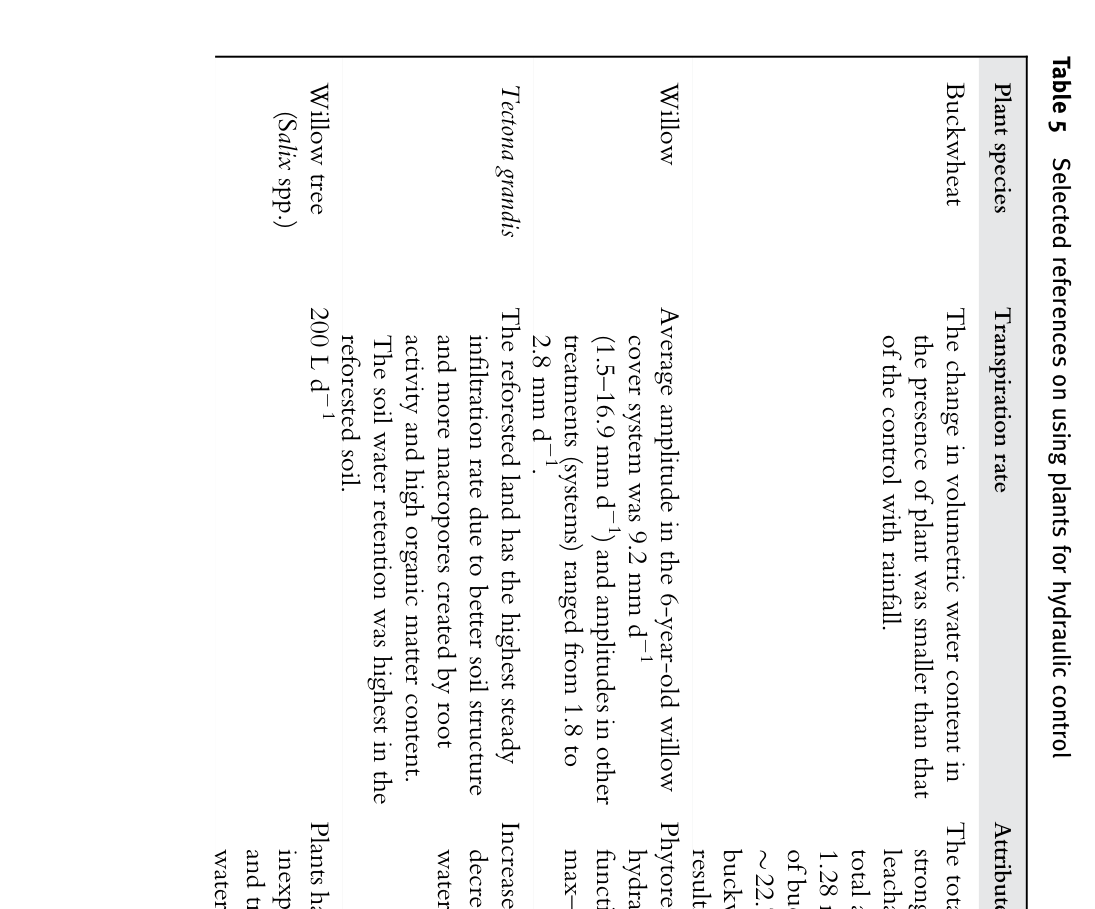
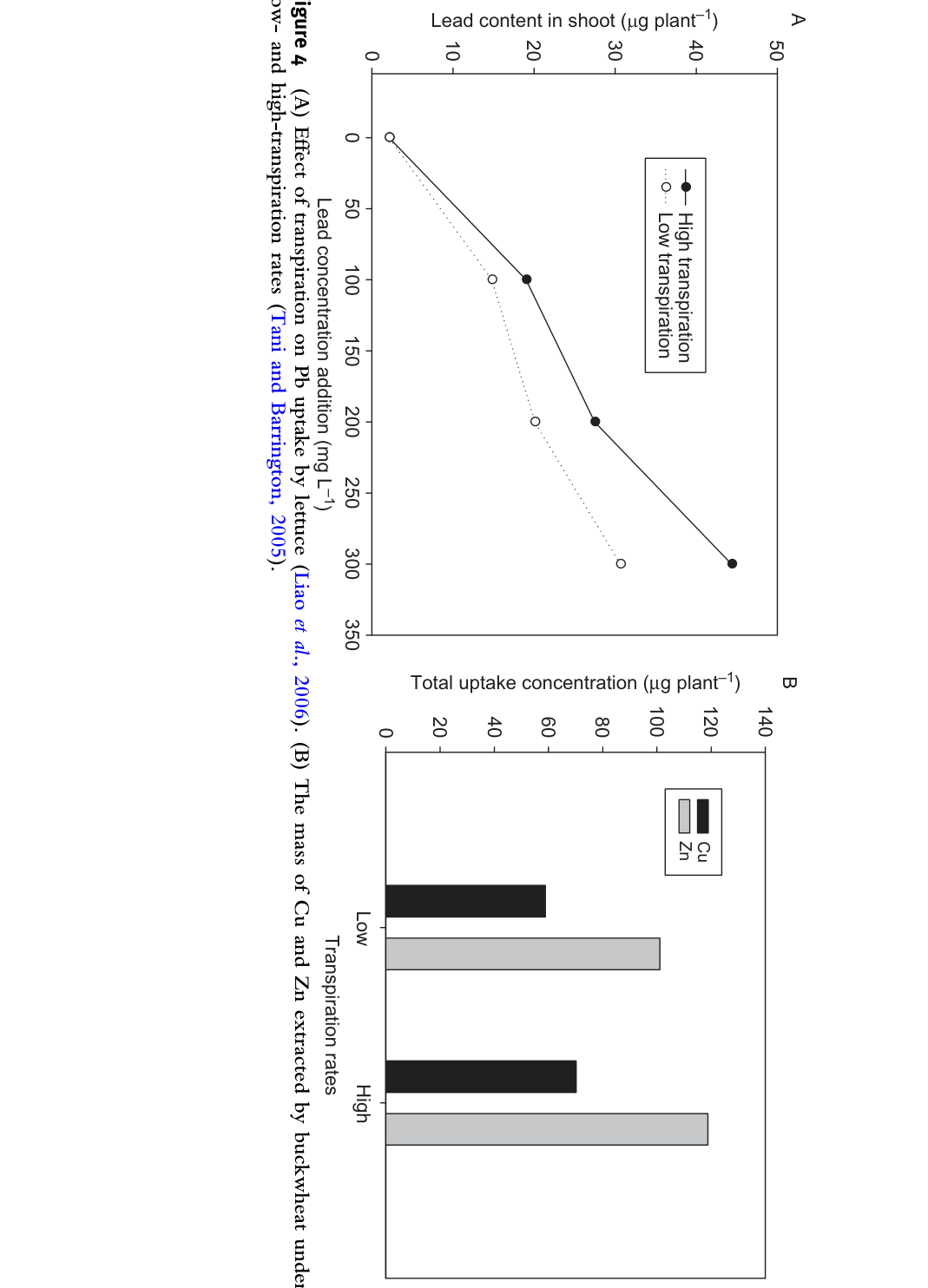
Some of the metal(loid)s are essential for both microorganisms and higher plants and their physiological uptake involves both active and passive processes (Huang, 2004). Both microorganisms and higher plants exhibit specific mechanisms for the uptake of metal(loid)s that involve carrier systems associated with active ionic influxes across the cell membrane. Metabolically active processes are slower than passive absorption, demanding the presence of suitable energy source and ambient conditions. It has often been observed that an increase in transpiration rate results in higher metal(loid)s uptake, especially those elements that are taken up via passive process (Tables 4 and 5). For example, Liao et al (2006) and Grifferty and Barrington (2000) observed an increase in Pb and Zn uptake by lettuce and wheat, respectively, with an increase in transpiration rate. In these studies, high-transpiration rate produced significantly larger quantity of transpiration stream of water to drive water-soluble Zn and Pb uptake across plasma membranes in roots than low transpiration did (Fig. 4A and B).
部分金属(类金属)是微生物和高等植物的必需元素,其生理吸收涉及主动和被动过程(Huang, 2004)。微生物和高等植物均具有吸收金属(类金属)的特定机制,涉及与跨细胞膜主动离子内流相关的载体系统。代谢主动过程比被动吸收慢,且需要适宜的能量来源和环境条件。人们经常观察到,蒸腾速率增加会导致金属(类金属)吸收增加,尤其是经被动过程吸收的元素(表4和表5)。例如,Liao et al (2006) 和 Grifferty and Barrington (2000) 分别观察到莴苣和小麦对 Pb 和 Zn 的吸收随蒸腾速率增加而增加。在这些研究中,与低蒸腾相比,高蒸腾速率产生了显著更大量的蒸腾水流,驱动水溶性 Zn 和 Pb 跨根系质膜被吸收(图4A和B)。
5Factors Affecting Phytostabilization影响植物稳定的因素
Soil, plant, contaminant, and environmental factors determine the successful outcome of phytostabilization technology in relation to both the remediation and revegetation of contaminated sites.
土壤、植物、污染物和环境因素决定了植物稳定技术在污染场地修复和植被恢复两方面能否取得成功。
5.1. Soil factors5.1. 土壤因素
As the establishment of vegetation is critical to phytostabilization, the physical, chemical, and biological properties of soils which control plant growth determine the successful outcome of this technology. Further, soil properties also regulate the dynamics of metal(loid)s thereby affecting their stabilization in soils.
由于植被建立对植物稳定至关重要,控制植物生长的土壤物理、化学和生物学性质决定着该技术能否成功。此外,土壤性质还调控着金属(类金属)的动态,从而影响其在土壤中的稳定。
Often, contaminated sites are not conducive for plant growth due to metal(loid) toxicity, lack of nutrients and microbial activity, and poor physical properties. For this reason, the phytostabilization of contaminated sites may require the amendment of the soils to stimulate plant growth. Some of the common amendments used to improve the soil conditions include biosolids, lime, and green waste. Some of these amendments used for improving the soil properties also enhance the efficiency of phytostabilization by altering the solubility and bioavailability of contaminants (see Section 7). For example, biosolids are generally applied to the cultivated land, given that it contains a wide range of nutrients and carbon, thereby improving the soil conditions for crop production. However, it has been recognized that the long-term application of biosolids to cultivated land has potential detrimental effect in terms of food safety due to the contaminants such as heavy metal(loid)s contained in the biosolids. Therefore, the application of biosolids to contaminated sites for phytostabilization performance will be more socially acceptable. Moreover, the contaminants in the biosolids could be also remediated by the plants.
由于金属(类金属)毒性、养分和微生物活动缺乏以及物理性质不良,污染场地往往不利于植物生长。因此,污染场地的植物稳定可能需要对土壤进行改良以促进植物生长。用于改善土壤条件的常见改良剂包括生物固体(污泥)、石灰和园林绿色废弃物。其中一些用于改善土壤性质的改良剂还可通过改变污染物的溶解度和生物有效性来提高植物稳定的效率(参见第7节)。例如,由于生物固体含有多种养分和碳,通常被施用于耕地,以改善作物生产的土壤条件。然而,人们已经认识到,由于生物固体中含有重金属(类金属)等污染物,长期向耕地施用生物固体可能对食品安全产生不利影响。因此,将生物固体施用于污染场地以实现植物稳定将更易为社会所接受。此外,生物固体中的污染物也可由植物加以修复。
Soil plays a significant role in controlling the immobilization and bioavailability of contaminants in the environment, thereby affecting the phytostabilization of contaminated sites. The primary soil factors influencing the immobilization and bioavailability of contaminants include soil pH, soil organic matter, cation and anion exchange capacities (AECs; available charged sites on soil surfaces), texture (clay content), and soil type.
土壤在控制环境中污染物的固定和生物有效性方面起着重要作用,从而影响污染场地的植物稳定。影响污染物固定和生物有效性的主要土壤因素包括土壤pH、土壤有机质、阳离子和阴离子交换量(AECs;土壤表面可用的带电位点)、质地(黏粒含量)和土壤类型。
Soil pH is one of the key parameters influencing the sorption of both inorganic and ionizable organic contaminants given that it controls virtually all aspects of contaminant and biogeochemical processes in soils. These processes include solubility, precipitation, speciation, and sorption as well as microbial activity. In most variable charge soils such as the strongly weathered tropical soils and less-weathered Andisols, increasing soil pH results in an increase in the number of negatively charged sites with a concomitant decrease in the positively charged sites (Auxtero et al., 2004; Bolan et al., 1999; Naidu et al., 1994, 1996). In addition to its effect on surface chemical properties, soil pH also controls the speciation of contaminants. For metals, the net charge of the metal complexes and their precipitation/dissolution reactions are directly impacted by soil pH (Zeng et al., 2010).
土壤pH是影响无机污染物和可电离有机污染物吸附的关键参数之一,因为它几乎控制着土壤中污染物和生物地球化学过程的所有方面,包括溶解、沉淀、形态、吸附以及微生物活动。在大多数可变电荷土壤(如强风化热带土壤和弱风化的火山灰土)中,土壤pH升高导致带负电荷位点数量增加,同时带正电荷位点数量减少(Auxtero et al., 2004; Bolan et al., 1999; Naidu et al., 1994, 1996)。除影响表面化学性质外,土壤pH还控制着污染物的形态。对于金属而言,金属络合物的净电荷及其沉淀/溶解反应直接受土壤pH的影响(Zeng et al., 2010)。
Organic contaminants and most metal(loid)s bind strongly to organic matter in soils, thereby reducing their bioavailability. Organic contaminants preferentially partition to the nonpolar domain of organic matter relative to the polar aqueous phase (Chiou et al., 1984; Poerschmann and Kopinke, 2001), while the organic acid functional groups typically present in organic matter have a high affinity to attract metal cations (Zaccone et al., 2009). Organic matter also plays a vital role in the reduction of metal(loid)s such as Cr6+, thereby reducing their toxicity and bioavailability (Bolan et al., 2003b). Another indirect effect of soil components including organic matter is their role on limiting contaminant mass transfer. The rate of mass transfer of a contaminant from soil particles to the surrounding pore water is inversely proportional to the contaminant’s soil pore water distribution coefficient (Clothier et al., 2008; Menzie et al., 2000). Therefore, with increasing organic matter content, retention of some metal(loid)s increases and rates of release decrease, thereby decreasing their overall bioavailability (Stokes et al., 2005).
有机污染物和大多数金属(类金属)与土壤有机质强烈结合,从而降低其生物有效性。相对于极性水相,有机污染物优先分配到有机质的非极性区域(Chiou et al., 1984; Poerschmann and Kopinke, 2001),而有机质中通常存在的有机酸官能团对金属阳离子具有很高的亲和力(Zaccone et al., 2009)。有机质在 Cr6+ 等金属(类金属)的还原中也起着至关重要的作用,从而降低其毒性和生物有效性(Bolan et al., 2003b)。包括有机质在内的土壤组分的另一间接效应是限制污染物的传质。污染物从土壤颗粒向周围孔隙水的传质速率与该污染物的土壤-孔隙水分配系数成反比(Clothier et al., 2008; Menzie et al., 2000)。因此,随着有机质含量增加,某些金属(类金属)的保持量增加、释放速率降低,从而降低其总体生物有效性(Stokes et al., 2005)。
As discussed above, pH influences sorption through its effect on surface charge as quantified by cation and AECs of soils. In variable charge soils, while the AEC, a measure of available positively charged surface sites, decreases with increasing soil pH, the cation exchange capacity (CEC), a measure of negatively charged sites, increases with pH. Both AEC and CEC vary with the clay mineral content and type, organic matter, and soil pH (Bohn et al., 1985). Soils with high clay content will have a high affinity to sorb cationic metal(loid) species due to high CEC, thus making contaminants less bioavailable relative to sandy soils. The AEC of most soils is small. Therefore, it is not generally considered an important parameter in assessing contaminant availability at most sites in the temperate regions. However, soils in the tropics and in volcanic and less-weathered soils such as Andepts can have a significant AEC.
如上所述,pH通过影响以土壤阳离子和阴离子交换量(AECs)量化的表面电荷来影响吸附。在可变电荷土壤中,阴离子交换量(AEC,衡量可用的带正电荷表面位点)随土壤pH升高而降低,而阳离子交换量(CEC,衡量带负电荷位点)则随pH升高而增加。AEC和CEC均随黏土矿物的含量和类型、有机质以及土壤pH而变化(Bohn et al., 1985)。由于CEC较高,黏粒含量高的土壤对阳离子型金属(类金属)形态具有较高的吸附亲和力,因而与砂质土壤相比,污染物的生物有效性较低。大多数土壤的AEC很小,因此在温带地区的大多数场地,一般不将其视为评估污染物有效性的重要参数。然而,热带土壤以及火山灰土壤和弱风化土壤(如 Andepts)可能具有显著的AEC。
In addition to soil pH, many other environmental variables influence the ion exchange characteristics of soils. These include the presence of inorganic and organic ligands that bind specifically to soil colloid surface. While the specific sorption of anions onto variable charge components has often been shown to increase the net surface charge (i.e., CEC) of soils and consequently increase the capacity of soils to bind cationic metals, sorption of cations increases the net positive charge, resulting in increased retention of anions (Bolan et al., 1999). This process has been described by a number of researchers as anion-induced cation sorption (Bolan et al., 1999, 1977; Wann and Uehara, 1978) and cation-induced anion retention (Bolan et al., 1994; Cichota et al., 2007). Metall(oid)s can also form complexes and precipitates with inorganic soil constituents, such as carbonate and phosphate minerals under certain soil conditions (Bolan et al., 2003a). Carbonate– and phosphate–metal complexes have varying degrees of solubility and reactivity depending on the metal, its oxidation state, the ligand to which it is bound, and pH. Environmental managers often use changes in surface chemical properties of soils as influenced by pH and ligand ions such as P to reduce metal bioavailability in soils (Basta et al., 2001; Bolan et al., 2003a; Kumpiene et al., 2007). Raising the soil pH using lime amendments reduces plant uptake of heavy metal such as Cd due to enhanced binding and hence reduced bioavailability of the metal (Bolan et al., 2003c).
除土壤pH外,许多其他环境变量也影响土壤的离子交换特性,包括与土壤胶体表面发生专性结合的无机和有机配体。阴离子在可变电荷组分上的专性吸附通常被证明会增加土壤的净表面电荷(即CEC),进而提高土壤结合阳离子金属的能力;而阳离子的吸附则增加净正电荷,导致阴离子保持增加(Bolan et al., 1999)。许多研究者将这一过程描述为阴离子诱导的阳离子吸附(Bolan et al., 1999, 1977; Wann and Uehara, 1978)和阳离子诱导的阴离子保持(Bolan et al., 1994; Cichota et al., 2007)。在一定土壤条件下,金属(类金属)还可与碳酸盐和磷酸盐矿物等无机土壤组分形成络合物和沉淀(Bolan et al., 2003a)。碳酸盐–金属和磷酸盐–金属络合物的溶解度和反应活性各不相同,取决于金属种类、其氧化态、与其结合的配体以及pH。环境管理者常利用受pH和配体离子(如 P)影响的土壤表面化学性质变化来降低土壤中金属的生物有效性(Basta et al., 2001; Bolan et al., 2003a; Kumpiene et al., 2007)。施用石灰改良剂提高土壤pH,可增强对 Cd 等重金属的结合,进而降低其生物有效性,从而减少植物对其的吸收(Bolan et al., 2003c)。
The nature of soil types varies considerably depending on the geographical location. Alfisols, Entisols, Inceptisols, Ultisols, Vertisols, and Oxisols are all commonly found in tropical and subtropical regions receiving more than 500 mm mean annual rainfall. Landscapes throughout the tropics and subtropics are, however, dominated by Oxisols and Ultisols occupying extensive areas of potentially highly productive soils. Given the widely different surface charge and chemical properties of the soils, their ability to adsorb contaminants varies considerably. Consequently, contaminant bioavailability varies significantly with soil type due to differences in soil properties. For instance, Naidu et al. (2008b) examined the effect of soil types on sorption of Cd and demonstrated that soils from the temperate region consisting of 2:1 layer silicate minerals generally sorbed the highest amount of Cd while the least was recorded for an Oxisol with a pH of 5.
土壤类型的性质因地理位置不同而差异显著。Alfisols(淋溶土)、Entisols(新成土)、Inceptisols(始成土)、Ultisols(老成土)、Vertisols(变性土)和Oxisols(氧化土)均常见于年均降水量超过500 mm的热带和亚热带地区。然而,整个热带和亚热带地区的景观以氧化土和老成土为主,这些土壤分布面积广,具有很高的潜在生产力。由于各类土壤的表面电荷和化学性质差异很大,其吸附污染物的能力也差异显著。因此,由于土壤性质的差异,污染物的生物有效性随土壤类型而显著不同。例如,Naidu et al. (2008b) 研究了土壤类型对Cd吸附的影响,结果表明,由2:1型层状硅酸盐矿物组成的温带土壤通常吸附的Cd量最高,而pH为5的氧化土吸附量最低。
5.2. Plant factors5.2. 植物因素
Plants are central to phytostabilization because plant characteristics regulate both the transformation of metal(loid)s and binding of soil particles. Nyer and Gatliff (1996) predict that phytoremediation will be the next hot technology for the environmental remediation field, yet they caution “. . . that this technology is not simply the buying of plants from the local K-mart and placing them in the soil near a contaminated site!.” Subsequently, phytostabilization has been slowly adopted to remediate some contaminated sites, while the technical and commercial success of phytoextraction is conspicuously absent (Robinson et al., 2009). Plants with desirable phenotypic and genotypic characteristics are selected for the sustainable management of soil remediation (Tables 5 and 6). The density, morphology, and depth to which plant roots penetrate the soil are critical to potential application of this technology. Enhancement of root biomass and morphology is therefore desirable in any phytostabilization operation. Plants with dense and deep roots that can exploit larger volumes of contaminated soils have much larger surface area, thus facilitating the stabilization of soils and enhancing the microbial volatilization of metal(loid)s in the rhizosphere. Fibrous roots offer a large surface area for contaminant absorption (facilitating phytoextraction) and plant–microbe interactions (facilitating phytovolatilization). In addition, deep-rooted plants with high transpiration rates, such as hybrid poplar, can access deeper soil depths of as much as 6 m deep (Unterbrunner et al., 2007). Deep-rooted willow species have been identified to accumulate substantial amounts of Cd and Zn (Utmazian et al., 2007) and hold promise for their use in phytoextraction. Granel et al. (2002) observed a large variation in both leaf concentration of Cd and its bioaccumulation coefficient (plant:soil concentration ratio) among 15 clones of Tangoio willow (Salix matsudana) which they attributed to the difference in genetically controlled, plant-mediated changes in Cd bioavailability.
植物是植物稳定技术的核心,因为植物特性既调控金属(类金属)的转化,也调控土壤颗粒的固结。Nyer and Gatliff (1996) 预测植物修复将成为环境修复领域的下一项热门技术,但他们同时告诫:“……这项技术并不只是从当地的K-mart买些植物,种在污染场地附近的土壤中!”此后,植物稳定技术已被逐步用于修复部分污染场地,而植物提取在技术和商业上的成功则明显缺乏(Robinson et al., 2009)。为实现土壤修复的可持续管理,需选择具有理想表型和基因型特征的植物(表5和表6)。植物根系的密度、形态及其穿透土壤的深度对该技术的潜在应用至关重要。因此,在任何植物稳定工程中,提高根系生物量和改善根系形态都是可取的。根系密集且深的植物能够利用更大体积的污染土壤,其表面积也大得多,从而有利于土壤的稳定,并促进根际中金属(类金属)的微生物挥发。须根为污染物吸收(有利于植物提取)和植物–微生物相互作用(有利于植物挥发)提供了较大的表面积。此外,杂交杨树等蒸腾速率高的深根植物可到达深达6 m的土层(Unterbrunner et al., 2007)。已发现深根柳树物种可积累大量Cd和Zn(Utmazian et al., 2007),在植物提取中具有应用前景。Granel et al. (2002) 观察到,15个Tangoio柳树(Salix matsudana,旱柳)无性系之间叶片Cd浓度及其生物富集系数(植物/土壤浓度比)均存在很大差异,他们将其归因于受遗传控制的、由植物介导的Cd生物有效性变化的差异。
Strategies to increase root biomass and to enhance root/rhizosphere associations, including mycorrhizae, have been reviewed by several authors (Cunningham et al., 1997; Entry et al., 1996; Morgan et al., 2005; Stomp
已有多位作者综述了增加根系生物量及增强根系/根际联合(包括菌根)的策略(Cunningham et al., 1997; Entry et al., 1996; Morgan et al., 2005; Stomp
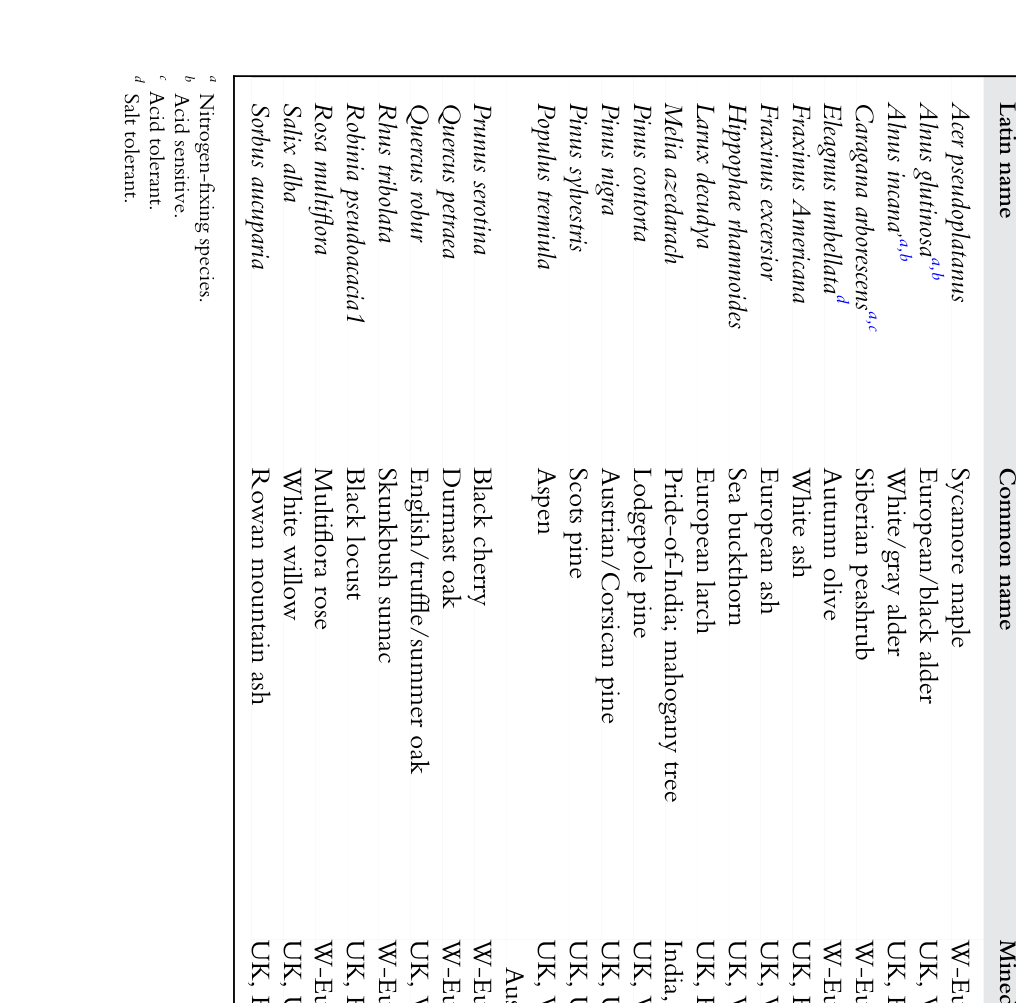
Table 6 Some tree and shrub species used for revegetating mined land (Flege, 2000)表6 用于矿区土地植被恢复的部分乔木和灌木物种(Flege, 2000)
et al., 1993). Genetic engineering may provide a tool to modify root morphology and/or to identify and clone relevant enzyme-controlling genes into more deep-rooted plants. However, as demonstrated by the recent discovery of As-accumulating fern species (Francesconi et al., 2002; Ma et al., 2001), additional screening combined with traditional breeding also offers a promising resource for enhancing phytoextraction and associated rhizosphere capabilities (Baker and Whiting, 2002; Fitz et al., 2003). However, it is unlikely that genetically modified plants that extract contaminants will find widespread use. First, the technology of phytoextraction, for which these plants would be used, is unsuitable for most contaminated sites (Robinson et al., 2009), and second, environmentalists could reasonably claim that such plants represent an environmental and human health risk by facilitating the passage of toxic elements into the food chain. Modification of root morphology could change microbial associations in the rhizosphere qualitatively and quantitatively (Cunningham et al., 1997). For example, a mature scotch pine has been estimated to have 50,000 m of roots with 5 million root tips. These root tips could support the growth of about 5 kg of bacteria. Agrobacterium rhizogenes transformation could increase the number of root tips two- to fourfold and result in enhanced microbially mediated remediation (Stomp et al., 1993). This is complemented by findings that uptake of Cd from sewage sludge by A. rhizogenes transformed Calystegia pepium plants was higher than in nontransformed specimen (Tepfer et al., 1989).
et al., 1993)。基因工程可为改变根系形态和/或鉴定相关酶控制基因并将其克隆到根系更深的植物中提供一种手段。然而,正如最近发现的As富集蕨类物种所表明的那样(Francesconi et al., 2002; Ma et al., 2001),进一步的筛选结合传统育种同样为增强植物提取及相关根际功能提供了有前景的资源(Baker and Whiting, 2002; Fitz et al., 2003)。不过,能够提取污染物的转基因植物不太可能得到广泛应用。首先,这类植物所服务的植物提取技术并不适用于大多数污染场地(Robinson et al., 2009);其次,环保人士可以合理地认为,这类植物会促进有毒元素进入食物链,从而构成环境和人体健康风险。根系形态的改变可在质和量上改变根际中的微生物联合(Cunningham et al., 1997)。例如,据估计,一棵成熟的欧洲赤松拥有50,000 m的根系和500万个根尖,这些根尖可支持约5 kg细菌的生长。发根农杆菌(Agrobacterium rhizogenes)转化可使根尖数量增加2~4倍,从而增强微生物介导的修复(Stomp et al., 1993)。与此相印证的是,经A. rhizogenes转化的Calystegia pepium植株对污水污泥中Cd的吸收高于未转化植株(Tepfer et al., 1989)。
Among the most extreme examples of metal(loid)-tolerant plant are the so-called hyperaccumulators, which can accumulate elements such as Zn, Mn, Ni, Co, Cd, or Se at high concentrations in their above-ground biomass (Yang et al., 2005). Hyperaccumulators are defined as the plant species that are capable of accumulating metal(loid)s above the threshold concentrations of 10,000 mg kg�1 dry weight of shoots for Zn and Mn, 1000 mg kg�1 for Co, Cu, Ni, As, and Se, and 100 mg kg�1 for Cd (Baker and Brooks, 1989; Brown et al., 1994). Instead of these rather arbitrary values, the bioconcentration factor (the shoot:root ratio of metal(loid) concentration) greater than 1, which is indicating efficient root-to-shoot transportation, is now used to define hyperaccumulators (McGrath and Zhao, 2003). The major processes of metal(loid) hyperaccumulation by the plants include: (a) bioactivation of metal(loid)s in the rhizosphere through root–microbe interaction; (b) enhanced uptake by metal(loid) transporters in the plasma membranes; (c) detoxification of metal(loid)s by distributing to the apoplasts like binding to cell walls and chelation of metal(loid)s in the cytoplasm with various ligands (e.g., phytochelatins, metallothioneins, metal(loid)-binding proteins); (d) sequestration of metal(loid)s into the vacuole by tonoplast-located transporters (Yang et al., 2005).
金属(类金属)耐性植物中最极端的例子之一是所谓的超富集植物,它们能够在地上部生物量中积累高浓度的Zn、Mn、Ni、Co、Cd或Se等元素(Yang et al., 2005)。超富集植物被定义为地上部干重中金属(类金属)积累量超过以下阈值浓度的植物物种:Zn和Mn为10,000 mg kg−1,Co、Cu、Ni、As和Se为1000 mg kg−1,Cd为100 mg kg−1(Baker and Brooks, 1989; Brown et al., 1994)。目前已不再采用这些较为主观的数值,而是以生物富集系数(地上部与根部金属(类金属)浓度之比)大于1来界定超富集植物,该值表明其具有高效的根–地上部转运能力(McGrath and Zhao, 2003)。植物超富集金属(类金属)的主要过程包括:(a)通过根–微生物相互作用在根际中活化金属(类金属);(b)质膜上金属(类金属)转运蛋白增强吸收;(c)通过分配至质外体(如与细胞壁结合)以及在细胞质中与多种配体(如植物螯合肽、金属硫蛋白、金属(类金属)结合蛋白)螯合来实现金属(类金属)解毒;(d)通过液泡膜上的转运蛋白将金属(类金属)区隔于液泡中(Yang et al., 2005)。
The first recognized hyperaccumulators were members of the Brassicaceae and Fabaceae families, and to date, more than 400 plant species of metal (loid) hyperaccumulator plants have been reported in the literature (Salt et al., 1998). An alternative to hyperaccumulators is the use of high biomass producing nonaccumulator plants or excluder plants, which actively restrict metal(loid) uptake into the shoots. These kinds of plants can be employed for revegetation of heavy metal(loid)-contaminated sites coupled with manipulation of soil conditions to increase the metal(loid) stabilization and improve plant growth (Pulford and Watson, 2003). Revegetation of heavy metal(loid)-contaminated sites can achieve the objectives of stabilization, pollution control, visual improvement, and removal of threats to human beings (Freitas et al., 2004).
最早被识别的超富集植物属于十字花科(Brassicaceae)和豆科(Fabaceae),迄今文献中已报道了400多种金属(类金属)超富集植物(Salt et al., 1998)。超富集植物的替代方案是利用高生物量的非富集植物或排异植物,这类植物会主动限制金属(类金属)向地上部的吸收。此类植物可用于重金属(类金属)污染场地的植被恢复,并结合对土壤条件的调控,以提高金属(类金属)的稳定化程度并改善植物生长(Pulford and Watson, 2003)。重金属(类金属)污染场地的植被恢复可实现稳定化、污染控制、景观改善以及消除对人类威胁等目标(Freitas et al., 2004)。
The role of hyperaccumulators in phytostabilization is unclear. Generally, hyperaccumulators have a low biomass production, are exotic to most environments, and potentially facilitate the entry of metals into the food chain. Nevertheless, the hyperaccumulator Alyssum bertolonii has been used successfully as a colonizing plant in mine spoil (Robinson et al., 2009). Here, the desirable property of the hyperaccumulator was its ability to tolerate nutrient imbalances and high Ni concentrations in the mine spoil, while adding organic matter to the spoil, thus allowing the spontaneous colonization of other species.
超富集植物在植物稳定中的作用尚不明确。一般而言,超富集植物生物量较低,对大多数环境而言属于外来物种,并可能促进金属进入食物链。尽管如此,超富集植物Alyssum bertolonii已被成功用作矿山弃土上的先锋定植植物(Robinson et al., 2009)。在此情形下,该超富集植物的理想特性在于它能够耐受矿山弃土中的养分失衡和高Ni浓度,同时向弃土中添加有机质,从而使其他物种得以自然定植。
The selection of plants suitable for therestoration isone of thekey factors to accomplish revegetation of heavy metal(loid)-contaminated sites. Plant community tolerant to the metal(loid)s plays a major role in restoration of heavy metal(loid)-contaminated sites (Banuelos and Ajwa, 1999). Plants suitable for restoration should develop an extensive root system and a large amount of biomass while keeping the translocation of metal(loid)s from roots to shoots as low as possible in soils with high metal(loid) concentrations (Rizzi et al., 2004). In addition, they must adapt to diverse site conditions, establish readily, and require little money and effort to maintain. Further, they must be able to survive and reproduce in contaminated soil (Flege, 2000).
选择适于修复的植物是实现重金属(类金属)污染场地植被恢复的关键因素之一。耐金属(类金属)的植物群落在重金属(类金属)污染场地的修复中发挥着重要作用(Banuelos and Ajwa, 1999)。适于修复的植物应在金属(类金属)浓度高的土壤中形成发达的根系和大量生物量,同时尽可能降低金属(类金属)从根部向地上部的转运(Rizzi et al., 2004)。此外,这些植物必须能适应多样的场地条件,易于定植,且维护所需的资金和人力较少。再者,它们必须能够在污染土壤中存活和繁殖(Flege, 2000)。
The identification of plants which exclude heavy metal(loid)s in soils is important for phytostabilization. Metal(loid) excluders can not only survive in highly polluted soils but also take up low levels of heavy metal(loid)s even in the presence of high concentrations in soils (Baker, 1981; Wenzel et al., 2003). In particular, weed species often possess stress-resistant properties compared with crops and can maintain growth under adverse water and fertilizer conditions (Wei et al., 2005).
鉴定能排斥土壤中重金属(类金属)的植物对植物稳定具有重要意义。金属(类金属)排异植物不仅能在重度污染土壤中存活,而且即使在土壤中重金属(类金属)浓度很高的情况下,其吸收量也很低(Baker, 1981; Wenzel et al., 2003)。特别是,与作物相比,杂草物种通常具有抗逆特性,能够在不利的水分和肥料条件下维持生长(Wei et al., 2005)。
Plants possess various tolerance mechanisms to withstand metal(loid) stress. Extracellularly metal(loid) tolerance may include roles for mycorrhizae and for cell wall and extracellular exudates. Tolerance could also involve the plasma membrane, either by reducing the uptake of heavy metal(loid)s or by stimulating the efflux pumping of metal(loid)s that have entered the cytosol. A variety of potential mechanisms occur within the protoplast. The mechanisms involve the repair of stress-damaged proteins such as heat shock proteins and metallothioneins, and the chelation of metal(loid)s by organic acids, amino acids, or peptides, or their compartmentation away from metabolic processes by transport into the vacuole (Hall, 2002).
植物具有多种耐受机制以抵御金属(类金属)胁迫。在细胞外,金属(类金属)耐性可能涉及菌根以及细胞壁和胞外分泌物的作用。耐性还可能涉及质膜,即减少重金属(类金属)的吸收,或促进已进入胞质溶胶的金属(类金属)的外排泵出。原生质体内也存在多种潜在机制,包括对胁迫损伤蛋白的修复(如热激蛋白和金属硫蛋白),以及通过有机酸、氨基酸或肽螯合金属(类金属),或将其转运至液泡中,使其与代谢过程区隔开来(Hall, 2002)。
Plant tolerance of heavy metal(loid)s may also be achieved by causing chemical changes to specific metal(loid)s, thereby decreasing their bioavailability (Chaney et al., 1997). Deep-rooted plants can reduce the highly toxic Cr6+ to Cr3+, which is less soluble and therefore less bioavailable (Chaney et al., 1997). For example, Eichhornia crassipes (water hyacinth) reduced Cr6+ to Cr3+ in the fine lateral roots and transported a portion of the detoxified Cr to leaf tissues (Lytle et al., 1998). Similarly, Pulford et al. (2001) noticed that Cr was held in plant roots and poorly translocated from root to shoot whether supplied as Cr6+ or Cr3+, which may demonstrate reduction and stabilization of Cr in the plant roots (Pulford and Watson, 2003). Lead also can be immobilized within plant roots by the formation of the lead phosphate mineral (Cotter-Howells et al., 1994). However, the effect of plants on the bioavailability of other metal(loid)s is uncertain (Pulford and Watson, 2003). The effect of plant roots and their interaction with rhizosphere bacteria on the chemistry and bioavailability of heavy metal(loid)s in contaminated soils is an area that requires much more study for successful restoration.
植物对重金属(类金属)的耐性也可通过使特定金属(类金属)发生化学变化、从而降低其生物有效性来实现(Chaney et al., 1997)。深根植物可将剧毒的Cr6+还原为溶解度较低、因而生物有效性较低的Cr3+(Chaney et al., 1997)。例如,Eichhornia crassipes(凤眼莲)在细小侧根中将Cr6+还原为Cr3+,并将部分已解毒的Cr转运至叶片组织(Lytle et al., 1998)。同样,Pulford et al. (2001) 注意到,无论以Cr6+还是Cr3+形式供给,Cr均滞留于植物根部,由根向地上部的转运很少,这可能表明Cr在植物根部被还原和稳定(Pulford and Watson, 2003)。铅也可通过形成磷酸铅矿物而固定在植物根内(Cotter-Howells et al., 1994)。然而,植物对其他金属(类金属)生物有效性的影响尚不确定(Pulford and Watson, 2003)。植物根系及其与根际细菌的相互作用对污染土壤中重金属(类金属)化学行为和生物有效性的影响,是实现成功修复所需深入研究的领域。
5.3. Contaminant factors5.3. 污染物因素
The reactions of contaminants affect their bioavailability and mobility, thereby influencing phytostabilization. Metal(loid)s introduced to soils undergo a number of reactions that include adsorption, complexation, precipitation, and reduction, which control their leaching and runoff losses, and bioavailability. Chemical interactions that contribute to metal(loid) retention by soil colloids include sorption and complexation with inorganic and organic ligands. Charged ions are attracted to charged soil surfaces by electrostatic and/or stronger covalent bonds (Mott, 1981), which can be specific or nonspecific in nature (Bolan et al., 1999). In nonspecific adsorption, the ion charge balances on the soil surface by electrostatic attraction, while in specific adsorption, chemical bonds form between the ions and the soil surface (Spark, 1986; Sposito, 1984).
污染物的反应影响其生物有效性和迁移性,进而影响植物稳定。进入土壤的金属(类金属)会发生吸附、络合、沉淀和还原等一系列反应,这些反应控制着其淋溶和径流损失以及生物有效性。促使土壤胶体保持金属(类金属)的化学作用包括吸附以及与无机和有机配体的络合。带电离子通过静电作用和/或更强的共价键被吸引到带电的土壤表面(Mott, 1981),这种作用在性质上可以是专性的或非专性的(Bolan et al., 1999)。在非专性吸附中,离子电荷通过静电引力在土壤表面达到平衡;而在专性吸附中,离子与土壤表面之间形成化学键(Spark, 1986; Sposito, 1984)。
Most metal(loid) cations are strongly retained as inner sphere complexes with variable chargedsurfaces bythe formation of covalent bonds. Metal(loid)s can react with soil organic matter by ion exchange, complexation, and precipitation. Metal(loid)s are known to form organic complexes which affect their sorption onto soil particles (Adriano, 2001). For example, Bolan et al. (2003d) demonstrated that the addition of organic manures increased the complexation of Cu in soils. Additionally, they observed that while Cu2+ adsorption measured as the change in the total Cu in soil solution was not affected by biosolids addition, Cu complexation measured as the change in free Cu2+ concentration increased with increasing level of biosolids. The extent of metal (loid)s–organic complex formation, however, varies with a number of factors including temperature, steric factors, and concentration. All these interactions are controlled by solution pH and ionic strength, the nature of the metal(loid) s species, dominant cation, and inorganic and organic ligands present in the soil solution.
大多数金属(类金属)阳离子通过形成共价键,以内圈络合物的形式被可变电荷表面强烈保持。金属(类金属)可通过离子交换、络合和沉淀与土壤有机质发生反应。已知金属(类金属)会形成有机络合物,从而影响其在土壤颗粒上的吸附(Adriano, 2001)。例如,Bolan et al. (2003d) 证明,添加有机肥增加了土壤中Cu的络合。此外,他们观察到,以土壤溶液中总Cu变化表征的Cu2+吸附不受生物固体(污泥)添加的影响,而以游离Cu2+浓度变化表征的Cu络合则随生物固体添加量的增加而增加。然而,金属(类金属)–有机络合物的形成程度随温度、空间位阻因素和浓度等多种因素而变化。所有这些相互作用均受溶液pH和离子强度、金属(类金属)形态的性质、优势阳离子以及土壤溶液中存在的无机和有机配体所控制。
At high soil pH and in the presence of SO42�, CO32�, OH�, and HPO42�, precipitation appears to be the predominant process when metal(loid) cation concentrations are high (Naidu et al., 1996). This occurs when the ionic product in the solution exceeds the solubility product of that phase. In normal soils, precipitation is relatively unimportant, but in heavy metal-contaminated soils, precipitation process can play a major role in remediation, especially under alkaline conditions. Increasingly, addition of phosphate is being used to precipitate excessive levels of metals such as Zn (He et al., 2005) and Pb (Park et al., 2011b), although phosphate may mobilize arsenic if this is present as a co-contaminant.
在土壤pH较高且存在SO₄²⁻、CO₃²⁻、OH⁻和HPO₄²⁻的条件下,当金属(类金属)阳离子浓度较高时,沉淀似乎成为主导过程(Naidu et al., 1996)。当溶液中的离子积超过该相的溶度积时即发生沉淀。在一般土壤中,沉淀作用相对次要;但在重金属污染土壤中,尤其是在碱性条件下,沉淀过程可在修复中发挥重要作用。添加磷酸盐正越来越多地用于沉淀过量的Zn(He et al., 2005)和Pb(Park et al., 2011b)等金属,但如果砷作为共存污染物存在,磷酸盐可能使其活化。
Both chemical and biological redox reactions affect the bioavailability of metal(loid)s such as As, Hg, and Se. Because of the great heterogeneity in the pore space of most soils, zones of reducing and oxidizing conditions are often in close proximity to one another allowing roots to access the available forms at different points in the soil. Volatilization occurs through microbial conversion of metal(loid)s to their respective metallic, hydride, or methylated forms. These forms have low boiling points and/or high vapor pressure and are therefore susceptible for volatilization. Methylation is considered to be the major process of volatilization of As, Hg, and Se in soils and sediments, resulting in the release of poisonous methyl gas (Adriano et al., 2004). Although methylation of metal(loid)s occurs through both chemical (abiotic) and biological processes, biological methylation (biomethylation) is considered to be the dominant process in soils and aquatic environments. Microorganisms in soils and sediments act as biologically active methylators. Organic matter provides the source of methyl donor for both biomethylation and abiotic methylation in soils and sediments. Selenium biomethylation is of interest because it represents a potential mechanism for the removal of Se from contaminated environments, and it is believed that methylated compounds, such as dimethyl selenide, are less toxic than dissolved Se oxyanions (Meyer et al., 2007).
化学和生物氧化还原反应均会影响As、Hg和Se等金属(类金属)的生物有效性。由于大多数土壤孔隙空间高度异质,还原区和氧化区往往彼此紧邻,使根系能够在土壤的不同位置获取有效形态。挥发作用是通过微生物将金属(类金属)转化为相应的金属态、氢化物或甲基化形态而发生的。这些形态沸点低和/或蒸气压高,因而易于挥发。甲基化被认为是土壤和沉积物中As、Hg和Se挥发的主要过程,会释放有毒的甲基气体(Adriano et al., 2004)。虽然金属(类金属)的甲基化可通过化学(非生物)和生物过程发生,但在土壤和水环境中,生物甲基化被认为是主导过程。土壤和沉积物中的微生物是具有生物活性的甲基化者。在土壤和沉积物中,有机质为生物甲基化和非生物甲基化提供甲基供体来源。硒的生物甲基化备受关注,因为它是从污染环境中去除Se的一种潜在机制,而且一般认为二甲基硒等甲基化化合物的毒性低于溶解态Se含氧阴离子(Meyer et al., 2007)。
Contaminants affect phytostabilization by changing plant growth and associated microbial communities. Phytostabilization of mine tailings is sometimes impractical, as tailings are characterized by elevated concentrations of metals such as As, Cd, Co, Mn, Pb, and Zn, and microbial community is extremely low (Mendez and Maier, 2008). In such cases, the establishment of vegetation requires soil amendments to reduce the bioavailability of phytotoxic metal(loid)s using soil amendments. For example, Ko et al (2008) noted that germination of Indian mustard seeds (Brassica juncea) was inhibited in the presence of high levels of As5+ in mine tailings and application of lime and iron oxide decreased bioavailable As concentration, thereby increasing germination.
污染物通过改变植物生长及相关微生物群落而影响植物稳定。尾矿的植物稳定有时并不可行,因为尾矿的特点是As、Cd、Co、Mn、Pb和Zn等金属浓度升高,且微生物群落极为贫乏(Mendez and Maier, 2008)。在这种情况下,植被的建立需要施用土壤改良剂以降低植物毒性金属(类金属)的生物有效性。例如,Ko et al (2008) 发现,尾矿中高含量As5+的存在抑制了印度芥菜(Brassica juncea)种子的萌发,而施用石灰和氧化铁降低了生物有效As浓度,从而提高了萌发率。
Mine spoils are the most common environments where high metal(loid) concentrations limit plant establishment. An example is the 1.5 ha Tui Mines, Te Aroha, which has had the worst environmental effects of any New Zealand mine (Morrell et al., 1996). The tailings contain 0.5% Pb and 8 mg kg�1 Hg. Oxidation of sulfide minerals has resulted in a pH of <3, and consequently, high concentrations of the aforementioned metals are leaching into nearby waterways (Sabti et al., 2000). Vegetation has failed to establish on the tailings and there is considerable wind and water erosion, which spreads contaminated materials onto surrounding areas. Robinson and Anderson (2007) report the results of a phytostabilization field trial on these tailings. The trial involved raising the pH of the tailings with repeated lime applications, the incorporation of organic matter (mushroom compost) into the top 15 cm of the tailings, and indigenous metal-tolerant species planted. Vegetation was successfully established on the 10 � 10 m plot (Plate 1). This has persisted and prevented further oxidation of the sulfides beneath the plot. The roles of the plants in this phytostabilization operation are to eliminate erosion and reduce the water flux through the site and hence reduce Pb and Hg leaching.
矿山弃土是高金属(类金属)浓度限制植物定植的最常见环境。一个例子是位于Te Aroha、面积1.5 ha的Tui矿,它是新西兰所有矿山中环境影响最严重的一处(Morrell et al., 1996)。其尾矿含0.5%的Pb和8 mg kg−1的Hg。硫化物矿物的氧化导致pH <3,因此上述金属以高浓度淋溶进入附近水道(Sabti et al., 2000)。植被未能在尾矿上建立,风蚀和水蚀严重,致使污染物质扩散到周边区域。Robinson and Anderson (2007) 报道了在该尾矿上开展的植物稳定田间试验结果。该试验包括反复施用石灰以提高尾矿pH,将有机质(蘑菇堆肥)混入尾矿表层15 cm,并种植本土耐金属物种。植被在10 × 10 m的小区上成功建立(图版1),并得以持续存在,阻止了小区下方硫化物的进一步氧化。在该植物稳定工程中,植物的作用是消除侵蚀、减少通过场地的水通量,从而减少Pb和Hg的淋溶。
5.4. Environmental factors5.4. 环境因素
Rainfall and temperature affect phytostabilization through their effects on plant growth, contaminant reactions, and soil erosion. As most contaminated sites may not have ready access to regular water supply for irrigation, rainfall plays a vital role in the establishment of vegetation. Rainfall also controls the leaching of contaminants and erosion of soil and sediments. Temperature affects both the plant growth and soil surface characteristics such as cracking and crust formation. While cracking increases the leaching of contaminants, loose, dry, and bare soil is susceptible to wind erosion by dispersion.
降雨和温度通过影响植物生长、污染物反应和土壤侵蚀而影响植物稳定。由于大多数污染场地可能无法便捷地获得常规灌溉水源,降雨在植被建立中起着至关重要的作用。降雨还控制着污染物的淋溶以及土壤和沉积物的侵蚀。温度既影响植物生长,也影响土壤表面特性,如开裂和结皮形成。开裂会增加污染物的淋溶,而疏松、干燥、裸露的土壤则易因分散而遭受风蚀。
Phytostabilization requires that the plants tolerate trace elements in the substrate. The species or varieties should also tolerate any nutrient imbalances in the substrate. Use of exotic species in this role is fraught, as they may establish themselves as weeds. However, exotic species are less likely to suffer from native herbivores, thus increasing growth and reducing the amount of contaminant that enters into the food chain. Competition from weeds is often more problematic than soil contaminants in phytostabilization (Dickinson et al., 2009).
植物稳定要求植物能耐受基质中的微量元素。所选物种或品种还应能耐受基质中的任何养分失衡。在此用途中使用外来物种存在风险,因为它们可能成为杂草。然而,外来物种较少受到本地食草动物的取食,从而可促进生长并减少进入食物链的污染物量。在植物稳定中,杂草竞争往往比土壤污染物问题更大(Dickinson et al., 2009)。
Each contaminated site has a unique environment. Therefore, choosing the most suitable species requires a short planting trial that tests several varieties on a small area of the site, particularly for nonsoil media such as mine spoil or biosolids.
每个污染场地都有其独特的环境。因此,选择最适宜的物种需要开展短期种植试验,在场地的小块区域上测试若干品种,尤其是对于矿山弃土或生物固体(污泥)等非土壤介质。
6Advantages and Disadvantages of Phytostabilization植物稳定的优点与缺点
Phytostabilization is considerably less expensive than other remediation technologies such as capping and soil removal (Miller and Miller, 2007). Nevertheless, phytostabilization has significant setup and ongoing costs. Phytostabilization requires that the site be assessed and the most suitable soil amendments and plant species are chosen. Thus, science costs are part of phytostabilization. Whole system models, such as the Phyto-DSS (Robinson etal.,2003),canbeusedtocalculatetheimpactofvegetationonthesiteandthus determine whether phytostabilization will meet environmental regulations. Thereareusuallyongoingmonitoringcostsforphytostabilization.Phytostabilization will only be used if it satisfies environmental regulations, costs less than competing technologies, and costs less than inaction (Robinson et al., 2009).
植物稳定的成本远低于覆盖封顶和土壤移除等其他修复技术(Miller and Miller, 2007)。尽管如此,植物稳定仍有相当大的建设成本和持续成本。植物稳定需要对场地进行评估,并选择最适宜的土壤改良剂和植物物种,因此科研成本是植物稳定的组成部分。可利用Phyto-DSS(Robinson et al., 2003)等全系统模型计算植被对场地的影响,从而判断植物稳定能否满足环境法规要求。植物稳定通常还需要持续的监测费用。只有当植物稳定满足环境法规、成本低于其他竞争技术且低于不采取行动的代价时,才会被采用(Robinson et al., 2009)。
There is potential to generate income from the vegetation used in phytostabilization. Phytostabilized sites can be managed so that they produce valuable products from the biomass of the vegetation. These may be nonedible products such as timber, bioenergy, biochar, or the production of essential oils or phytochemicals. Revenue may also be obtained from carbon fixation schemes because the plants, left on the site in perpetuity, represent a small carbon sink.
用于植物稳定的植被具有创造收入的潜力。经植物稳定的场地可通过管理,利用植被生物量生产有价值的产品。这些产品可以是非食用产品,如木材、生物能源、生物炭,或精油及植物化学品的生产。由于永久留在场地上的植物构成一个小型碳汇,还可通过碳固定计划获得收益。
Phytostabilization can be used to create an ecosystem of indigenous flora and fauna, thus adding to the ecological value of the site (Plate 3). In cases such as the Guadiamar river phytomanagement scheme, the vegetation used to phytostabilize the site provides a “green corridor” for migrating animals between two national parks (Dominguez et al., 2010). As the site is necessarily left vegetated, it is thus more esthetically appealing than sites capped with concrete,orpitsresultingfromsoilremoval.Establishingvegetation withmore than 250,000 trees, shrubs, and saltbush around a lead smelter site in Port Pirie, SouthAustraliahasbeencrucialinreducingPbdustmovement.Redgumtrees have been planted on site and Arundo donax formed thick stable clumps which have ability to act as a windbreak (http://www.tenby10.com/Index).
植物稳定可用于营造由本土动植物构成的生态系统,从而提升场地的生态价值(图版3)。例如,在Guadiamar河植物管理项目中,用于稳定场地的植被为两个国家公园之间迁徙的动物提供了一条“绿色走廊”(Dominguez et al., 2010)。由于场地必须保持植被覆盖,其在美学上比用混凝土封顶的场地或因土壤移除而形成的坑地更具吸引力。在南澳大利亚Port Pirie一处铅冶炼厂周围种植了逾250,000株乔木、灌木和滨藜,这对减少Pb粉尘的迁移起到了关键作用。场地内种植了赤桉,Arundo donax(芦竹)形成了茂密而稳定的株丛,可起到防风林的作用(http://www.tenby10.com/Index)。
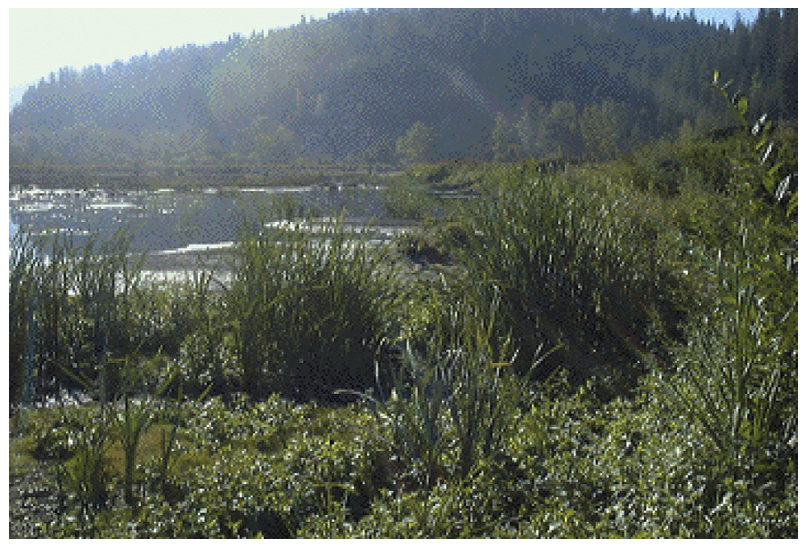
One of the major issues with phytostabilization technology is a successful operation that entails the contaminants remain on site. Therefore, site will always be contaminated and unsuitable for other land uses. The land is no longer able to be used for food production. In contrast, some engineering technologies, such as soil replacement, can return the site to its former land use. Phytostabilization suffers from a risk of future adverse advents and thus requires ongoing monitoring. Some soil processes, such as the oxidation of carbonates, can result in a rapid drop in pH and remobilization of metal (loid)s. Extreme weather events, such as high rainfall and flooding, can result in mass migration of contaminants.
植物稳定技术的主要问题之一在于,一项成功的工程意味着污染物仍留在场地内。因此,场地将始终处于污染状态,不适合其他土地用途,也不再能用于粮食生产。相比之下,一些工程技术(如土壤置换)可使场地恢复到原有的土地用途。植物稳定面临未来发生不利事件的风险,因此需要持续监测。某些土壤过程(如碳酸盐的氧化)可导致pH迅速下降和金属(类金属)的再活化。强降雨和洪水等极端天气事件可导致污染物的大规模迁移。
The vegetation may provide an exposure pathway for contaminants to enter food chains. Dominguez et al. (2010) showed that the use of Populus alba in the Guadiamar phytostabilization program exposes herbivores to high Cd concentrations through accumulation into the leaves.
植被可能为污染物进入食物链提供暴露途径。Dominguez et al. (2010) 表明,在Guadiamar植物稳定项目中使用Populus alba(银白杨),会因其叶片积累Cd而使食草动物暴露于高浓度Cd。
7Enhancement of Phytostabilization植物稳定的强化
Phytostabilization can be enhanced by increasing plant growth and altering bioavailability of metal(loid)s using both organic and inorganic amendments. Although fertilizer application increases plant growth thereby enhancing phytostabilization, this approach can lead to environmental degradation resulting from the loss of nutrients through leaching and gaseous emission. Therefore, organic amendments such as biosolids and manures and biological inoculants such as plant growth-promoting bacteria (PGPB) are used to enhance plant growth. Similarly, a number of organic and inorganic amendments are used to alter the bioavailability of metal(loid)s. This section examines the values of some of these amendments in enhancing phytostabilization technology.
可通过施用有机和无机改良剂来促进植物生长和改变金属(类金属)的生物有效性,从而强化植物稳定。虽然施肥可促进植物生长,进而强化植物稳定,但该方法可能因养分通过淋溶和气体排放损失而导致环境退化。因此,人们采用生物固体(污泥)和粪肥等有机改良剂以及植物促生细菌(PGPB)等生物接种剂来促进植物生长。同样,多种有机和无机改良剂被用于改变金属(类金属)的生物有效性。本节探讨其中部分改良剂在强化植物稳定技术方面的价值。
7.1. Plant growth-promoting bacteria7.1. 植物促生细菌
Bacteria associated with plants may have profound effects on the plant growth and nutrition through a number of mechanisms such as increasing nutrient availability and altering root morphology and surface area.
与植物相关的细菌可通过提高养分有效性、改变根系形态和表面积等多种机制,对植物生长和营养产生深远影响。
Improvement of the interactions between plants and beneficial rhizosphere microorganisms can enhance biomass production and tolerance of the plants to heavy metal(loid)s, thereby leading to successful phytostablization (Belimov et al., 2005). Although these strains are helpful and persistent in pot trial for the phytostabilization (de-Bashan et al., 2010), microorganisms under field conditions might face competition problems with existing microbial communities (Sessitsch and Puschenreiter, 2008).
改善植物与有益根际微生物之间的相互作用,可提高植物的生物量产量及其对重金属(类金属)的耐性,从而实现成功的植物稳定(Belimov et al., 2005)。虽然这些菌株在植物稳定的盆栽试验中有益且持久(de-Bashan et al., 2010),但在田间条件下,微生物可能面临与原有微生物群落竞争的问题(Sessitsch and Puschenreiter, 2008)。
7.1.1. Increase in nutrients availability7.1.1. 提高养分有效性
Nitrogen availability is the main yield-limiting factor in plant growth, especially in contaminated sites (Mantelin and Touraine, 2004). Many of the PGPB can provide nitrogen fixed to the host plant (Mantelin and Touraine, 2004). Nitrogen deficiencies can be corrected initially by applying fertilizer, but their effects are not permanent. However, PGPB can support long-term nitrogen cycling by providing a continuous supply of nitrogen (Flege, 2000).
氮素有效性是植物生长的主要产量限制因子,在污染场地尤其如此(Mantelin and Touraine, 2004)。许多PGPB能够向宿主植物提供固定的氮(Mantelin and Touraine, 2004)。施肥可在初期纠正氮素缺乏,但其效果并不持久。而PGPB可通过持续供应氮来支持长期的氮循环(Flege, 2000)。
Sajjad et al. (2004) have demonstrated that nitrogen fixing and phytohormone producing bacteria Enterobacter sp. isolated from sugarcane have beneficial effects on the growth of micropropagated sugarcane plantlets. By using 15N isotope dilution technique, maximum nitrogen fixation contribution (28% of total plant nitrogen) was detected in plantlets inoculated with bacteria (Sajjad et al., 2004). Similarly Bashan et al. (1998) showed that diazotrophic filamentous cyanobacterium Microcoleus chthonoplastes inoculated onto young mangrove seedlings significantly increased the levels of total N and 15N isotope in the inoculated leaves over the noninoculated plants. Azospirillium brasilense has been shown to stimulate N accumulation by the roots and N concentration in the tissues, thereby increasing plant growth (Marı´a et al., 2002).
Sajjad et al. (2004) 证明,从甘蔗中分离的具有固氮和产植物激素能力的肠杆菌(Enterobacter sp.)对微繁殖甘蔗小苗的生长具有有益作用。利用15N同位素稀释技术,在接种细菌的小苗中检测到最大固氮贡献(占植物总氮的28%)(Sajjad et al., 2004)。同样,Bashan et al. (1998) 表明,将固氮丝状蓝藻Microcoleus chthonoplastes接种到红树林幼苗上,与未接种植株相比,接种植株叶片中总N和15N同位素水平显著提高。已有研究表明,Azospirillium brasilense可促进根系对N的积累并提高组织中的N浓度,从而促进植物生长(Marı´a et al., 2002)。
Application of phosphorus solubilizing bacteria, Bacillus megatherium var. Phosphaticum to soil planted with sugarcane has been shown to increase the plant available P status in the soil, thereby increasing cane yield (Sundara et al., 2002). Similarly, Harris et al. (2006) noticed an increase in the solubilization of dicalcium phosphate with phosphate-solubilizing bacteria, which resulted in an increase in wheat grain yield. Villegas and Fortin (2002) reported that the interactions between arbuscular mycorrhizal fungi with phosphate-solubilizing bacteria such as Pseudomonas aeruginosa and Pseudomonas putida significantly increased the levels of soluble P in soil.
研究表明,向种植甘蔗的土壤施用解磷细菌Bacillus megatherium var. Phosphaticum,可提高土壤中植物有效P水平,从而提高甘蔗产量(Sundara et al., 2002)。同样,Harris et al. (2006) 发现解磷细菌可增加磷酸二钙的溶解,从而提高小麦籽粒产量。Villegas and Fortin (2002) 报道,丛枝菌根真菌与Pseudomonas aeruginosa(铜绿假单胞菌)和Pseudomonas putida(恶臭假单胞菌)等解磷细菌之间的相互作用显著提高了土壤中可溶性P的水平。
In addition to N and P, other micro- and macronutrients uptake can be stimulated by bacteria. Inoculation with associative rhizobacteria slightly stimulated root length and biomass of hydroponically grown Cd-treated barley seedlings. The bacteria significantly increased the total amount of nutrients such as P, Mg, Ca, Fe, Mn, and Na in roots and shoots of the Cd-treated plants. The results showed that associative bacteria were capable of decreasing partially the toxicity of Cd for the barley plants through the improvement in uptake of nutrient elements (Belimov and Dietz, 2000). Siderophores are low-molecular-weight Fe3+ coordination compounds that bacteria excrete under Fe-deficient conditions (Gadd, 1992). The elevated level of heavy metal(loid)s in soil interfere with uptake of nutrients such as Fe and P, but siderophores producing bacteria can promote plant growth by increasing nutrient uptake (Zayed and Terry, 2003). Siderophore-producing and phosphate-solubilizing isolates, Pseudomonas sp. and Bacillus sp., protected the plants against the inhibitory effects of Cr and these effects might be the results of enhanced uptake of soil minerals such as Fe and P by the plants (Rajkumar et al., 2006). Sharma and Johri (2003) used Pseudomonas fluorescens sp., which produced siderophores for maize growth promotion experiments. Inoculation of seeds with the bacteria showed significant increase in germination percentage and plant growth. Maximum shoot and root length and dry weight were observed with 10 mM Fe3+ along with bacterial inoculants suggesting the value of siderophores producing PGPB in enhancing crop productivity in calcareous soil system which is deficient in Fe (Sharma and Johri, 2003).
除N和P外,细菌还可促进其他微量和大量营养元素的吸收。接种联合根际细菌略微促进了经Cd处理的水培大麦幼苗的根长和生物量。该细菌显著增加了Cd处理植株根和地上部中P、Mg、Ca、Fe、Mn和Na等营养元素的总量。结果表明,联合细菌能够通过改善营养元素的吸收,部分降低Cd对大麦植株的毒性(Belimov and Dietz, 2000)。铁载体是细菌在缺Fe条件下分泌的低分子量Fe3+配位化合物(Gadd, 1992)。土壤中重金属(类金属)含量升高会干扰Fe和P等养分的吸收,而产铁载体细菌可通过增加养分吸收促进植物生长(Zayed and Terry, 2003)。产铁载体和解磷的分离菌株Pseudomonas sp.和Bacillus sp.保护植物免受Cr的抑制作用,这些效应可能是植物对Fe和P等土壤矿质元素吸收增强的结果(Rajkumar et al., 2006)。Sharma and Johri (2003) 在玉米促生试验中使用了可产铁载体的Pseudomonas fluorescens sp.(荧光假单胞菌)。用该细菌接种种子后,发芽率和植物生长均显著提高。在10 mM Fe3+与细菌接种剂共同作用下,地上部和根的长度及干重达到最大,这表明产铁载体PGPB在缺Fe的石灰性土壤体系中对提高作物生产力具有价值(Sharma and Johri, 2003)。
Burd et al. (2000) inoculated Kluyvera ascorbata and a siderophore overproducing mutant of this bacterium into tomato, canola, and Indian mustard seeds in Ni, Zn, and Pb-contaminated soils. In most cases, the siderophore overproducing mutant K. ascorbata exerted a more pronounced effect on plant growth than the wild-type bacterium. The data indicate that the ability of these bacteria to protect plants against the inhibitory effects of high concentrations of Ni, Pb, and Zn is related to the bacteria providing the plants with sufficient Fe by siderophore production (Burd et al., 2000).
Burd et al. (2000) 将Kluyvera ascorbata及其铁载体过量产生突变株接种到Ni、Zn和Pb污染土壤中的番茄、油菜和印度芥菜种子上。在大多数情况下,铁载体过量产生突变株K. ascorbata对植物生长的影响比野生型细菌更为显著。数据表明,这些细菌保护植物免受高浓度Ni、Pb和Zn抑制作用的能力,与细菌通过产生铁载体为植物提供充足的Fe有关(Burd et al., 2000)。
Similar to other PGPB, siderophore-producing PGPB also can protect host plants from phytopathogenic diseases. PGPB control the damage to plants from phytopathogens by secretion of siderophores to prevent pathogens in the immediate vicinity from proliferating (Glick and Bashan, 1997). Serratia plymuthica isolated from soil around melon roots produced the antibiotic pyrrolnitrin, siderophores, and Indole-3-acetic acid (IAA), thereby suppressing a wide range of phytopathogenic fungi in vitro. Foliar application of the bacteria protected cucumber against Botrytis cinerea gray mold and Sclerotinia sclerotiorum white mold diseases of leaves under greenhouse conditions (Kamensky et al., 2003).
与其他PGPB类似,产铁载体PGPB也能保护宿主植物免受植物病原性病害的侵害。PGPB通过分泌铁载体阻止邻近区域病原菌增殖,从而控制植物病原菌对植物造成的损害(Glick and Bashan, 1997)。从甜瓜根际土壤中分离的Serratia plymuthica可产生抗生素硝吡咯菌素、铁载体和吲哚-3-乙酸(IAA),从而在离体条件下抑制多种植物病原真菌。在温室条件下,叶面喷施该细菌可保护黄瓜叶片免受Botrytis cinerea灰霉病和Sclerotinia sclerotiorum白霉病的危害(Kamensky et al., 2003)。
7.1.2. Alteration of root morphology7.1.2. 根系形态的改变
An increase in the root surface area and the volume of soil explored by the root, which leads to increased nutrient uptake, is the most commonly proposed explanation for the beneficial effects of PGPB on plant growth. The improvement in mineral nutrition promotes shoot growth and this rationale is consistent with the observation that plants inoculated with Azopsirillum take up N, P, K, and microelements more efficiently from the soil (Okon and Vanderleyden, 1997). In the nutrient deficient conditions, PGPB increase the elongation rate of lateral roots resulting in a more branched root system and an increase in root surface area. This results in increased mineral uptake which, in turn, enhances shoot biomass accumulation (Lifshitz et al., 1987; Mantelin and Touraine, 2004).
根系表面积以及根系所探索的土壤体积增加,进而导致养分吸收增加,是对PGPB促进植物生长有益作用最常见的解释。矿质营养的改善促进了地上部生长,这一解释与接种Azopsirillum的植物能更有效地从土壤中吸收N、P、K及微量元素的观察结果相一致(Okon and Vanderleyden, 1997)。在养分缺乏条件下,PGPB可提高侧根的伸长速率,使根系分枝更多、根系表面积增加,从而增加矿质元素吸收,进而促进地上部生物量的积累(Lifshitz et al., 1987; Mantelin and Touraine, 2004)。
Soil physical parameters are critical for plant growth. Many metal(loid)- contaminated mine sites have poor soil structure, resulting in poor water infiltration or retention. Alami et al. (2000) demonstrated that Rhizobium sp. isolated from the rhizosphere of sunflower caused a significant increase in root-adhering soil per root dry mass and in soil macropore volume even in dry conditions. Further, inoculated sunflower increased nitrogen uptake, thereby promoting plant growth. Isolated strain was also able to relieve the effect of water stress on sunflower growth (Alami et al., 2000).
土壤物理参数对植物生长至关重要。许多金属(类金属)污染的矿区土壤结构不良,导致水分入渗或保持能力差。Alami et al. (2000) 证明,从向日葵根际分离的Rhizobium sp.(根瘤菌)即使在干旱条件下,也能显著增加单位根干重的根际黏附土量以及土壤大孔隙体积。此外,接种的向日葵氮吸收增加,从而促进了植物生长。所分离的菌株还能缓解水分胁迫对向日葵生长的影响(Alami et al., 2000)。
Plants produce ethylene in response to stress (Deikman, 1997). However, high levels of ethylene lead to the inhibition of root elongation. PGPRs contain an enzyme, 1-aminocyclopropane-1-carboxylate (ACC) deaminase, that catalyzes the cleavage of ACC, which is the precursor of ethylene, and as a result, the endogenous ethylene concentration in plants is reduced (Glick et al., 1998). These processes can promote plant growth by decreasing plant’s ethylene level. When canola seeds were imbibed in several ACC deaminase containing strains of bacteria, the ACC levels in these roots were lowered and the growth of canola seedling roots was increased (Penrose et al., 2001). Hall et al. (1996) demonstrated that PGPB promote root elongation in a variety of plants. Seeds of canola, lettuce, tomato, and wheat when inoculated with PGPB (P. putida) increased the root lengths. These observations are consistent with a model in which promotion of root growth by P. putida is a consequence of inhibition of ethylene production within the developing seedling (Hall et al., 1996).
植物在胁迫下会产生乙烯(Deikman, 1997)。然而,高水平的乙烯会抑制根的伸长。PGPR含有1-氨基环丙烷-1-羧酸(ACC)脱氨酶,该酶可催化乙烯前体ACC的裂解,从而降低植物体内源乙烯浓度(Glick et al., 1998)。这些过程可通过降低植物的乙烯水平来促进植物生长。当油菜种子在若干含ACC脱氨酶的细菌菌株中吸胀时,根中的ACC水平降低,油菜幼苗根的生长增加(Penrose et al., 2001)。Hall et al. (1996) 证明,PGPB可促进多种植物根的伸长。油菜、莴苣、番茄和小麦种子接种PGPB(P. putida)后,根长均有所增加。这些观察结果与以下模型相符:P. putida对根生长的促进作用是其抑制发育中幼苗乙烯生成的结果(Hall et al., 1996)。
ACC deaminase activity can not only improve root growth but also protect plant from pathogenic disease. Transformed Pseudomonas fluorescens strains with ACC deaminase activity improved its ability to protect cucumber against Pythium damping-off, and potato tubers against Erwinia soft rot in small completely sealed containers (Wang et al., 2000).
ACC脱氨酶活性不仅能促进根系生长,还能保护植物免受病原性病害侵害。在小型完全密封容器中,具有ACC脱氨酶活性的转化Pseudomonas fluorescens菌株提高了其保护黄瓜免受腐霉猝倒病以及保护马铃薯块茎免受欧文氏菌软腐病危害的能力(Wang et al., 2000)。
Production of the phytohormone IAA is widespread among bacteria that inhabit the rhizosphere of plants (Patten and Glick, 1996). An Ni tolerant Bacillus subtilis produced substantial amount of IAA during stationary phase of growth in the medium and showed time-dependent increase in IAA production. Enhanced production of IAA (55 mg mL�1) was noticed in the presence of tryptophan (500 mg mL�1). The phytohormone IAA production offers great promise for sustaining the increased crop productivity (Zaidi et al., 2006). In addition, Cd-tolerant bacterial strains, Variovorax paradoxus and Rhodococcus sp., isolated from the rhizosphere of Indian mustard seedlings grown in highly Cd-contaminated sites produced IAA. The bacteria also showed increased tolerance to other metal(loid)s including
植物激素IAA的产生在栖息于植物根际的细菌中普遍存在(Patten and Glick, 1996)。一株耐Ni的Bacillus subtilis(枯草芽孢杆菌)在培养基中生长的稳定期产生了大量IAA,且IAA产量随时间增加。在色氨酸(500 mg mL−1)存在下,IAA产量提高(55 mg mL−1)。产生植物激素IAA对维持作物生产力的提高具有广阔前景(Zaidi et al., 2006)。此外,从生长于重度Cd污染场地的印度芥菜幼苗根际中分离的耐Cd细菌菌株Variovorax paradoxus和Rhodococcus sp.也能产生IAA。这些细菌还对其他金属(类金属)表现出更高的耐性,包括
Zn, Cu, Ni, and Co. These strains were capable of stimulating root elongation of B. juncea seedlings either in the presence or absence of toxic Cd concentrations (Belimov et al., 2005), and Pseudomonas sp. and Bacillus sp. facilitated rape growth (Sheng and Xia, 2006).
Zn、Cu、Ni和Co。无论是否存在毒性浓度的Cd,这些菌株均能促进B. juncea幼苗根的伸长(Belimov et al., 2005),而Pseudomonas sp.和Bacillus sp.则促进了油菜的生长(Sheng and Xia, 2006)。
The primary roots of canola seedlings from seeds treated with wild-type P. putida were on average 35–50% longer than the roots from seeds treated with the IAA-deficient mutant and the roots from uninoculated seeds, and these results suggest that bacterial IAA plays a major role in the development of the host plant root system (Patten and Glick, 2002). Rajkumar et al. (2006) isolate Cr6+ resistant PGPB, Pseudomonas sp. from heavy metal(loid) contaminated soils. They noticed that the inoculation of bacteria protected the plants against the inhibitory effects of Cr and promoted the growth of Indian mustard and this effect was higher in IAA producing bacteria than IAA nonproducing bacteria.
经野生型P. putida处理的种子所长出的油菜幼苗主根,平均比经IAA缺陷突变株处理的种子和未接种种子所长出的根长35%~50%,这些结果表明细菌产生的IAA在宿主植物根系发育中发挥着重要作用(Patten and Glick, 2002)。Rajkumar et al. (2006) 从重金属(类金属)污染土壤中分离出耐Cr6+的PGPB Pseudomonas sp.。他们发现,接种该细菌可保护植物免受Cr的抑制作用并促进印度芥菜生长,且产IAA细菌的效果高于不产IAA的细菌。
Gibberellins are phytohormones that control a number of developmental and physiological processes in plants (Crozier et al., 2000) and affect root elongation (Tanimoto, 1987), promotion of root growth, and root hair abundance (Bottini et al., 2004). Bacteria and fungi also produce Gibberellins. Bacillus pumilus and Bacillus licheniformis, isolated from the rhizosphere of alder, had a strong growth-promoting activity. Gibberellins (GA1, GA3, GA4, and GA20) in extracts of bacterial media were detected by full-scan gas chromatography–mass spectrometry analyses.
赤霉素是一类控制植物多种发育和生理过程的植物激素(Crozier et al., 2000),可影响根的伸长(Tanimoto, 1987)、促进根系生长并增加根毛数量(Bottini et al., 2004)。细菌和真菌也能产生赤霉素。从桤木根际分离的Bacillus pumilus(短小芽孢杆菌)和Bacillus licheniformis(地衣芽孢杆菌)具有很强的促生活性。通过全扫描气相色谱–质谱分析,在细菌培养基提取物中检测到了赤霉素(GA1、GA3、GA4和GA20)。
7.2. Inorganic amendments7.2. 无机改良剂
A number of inorganic amendments such as liming materials, phosphate compounds, and clay materials are used for immobilizing heavy metal(loid)s and improving soil conditions to facilitate revegetation of contaminated soils (Kumpiene et al., 2007). For example, the addition of liming materials is a common practice to overcome plant growth constrains relating to soil acidification. Normally, as the pH decreases, the mobility of some metal(loid)s is elevated. The solubility of Zn and Ni in dredged sediment increased when the pH was less than 6, pH 4 for Cd, pH 6 for Co, and pH 2 for Cu and Pb (Tack et al., 1996). The addition of lime as ground limestone not only raises pH but also renders metal(loid)s insoluble, thus reducing their bioavailability to plants (Down, 1975).
石灰类物质、磷酸盐化合物和黏土矿物等多种无机改良剂被用于固定重金属(类金属)和改善土壤条件,以促进污染土壤的植被恢复(Kumpiene et al., 2007)。例如,施用石灰类物质是克服土壤酸化对植物生长限制的常用做法。通常,随着pH降低,某些金属(类金属)的迁移性会提高。当pH低于6时,疏浚沉积物中Zn和Ni的溶解度增加;Cd、Co以及Cu和Pb对应的pH阈值分别为4、6和2(Tack et al., 1996)。以石灰石粉形式施用石灰不仅能提高pH,还能使金属(类金属)变得不溶,从而降低其对植物的生物有效性(Down, 1975)。
Lime is effective in reducing the phytoavailability of Cd and Cr3+ (Bolan and Duraisamy, 2003). Sugar beet lime, a residual material from the sugar manufacturing process with 70–80% (dry basis) of CaCO3 and biosolids compost, reduced CaCl2-extractable Cd, Cu, and Zn concentrations. This behavior seems to be related to the pH increase as it is well known that increasing the pH of the soil leads to a decrease in metal(loid) mobility. Soluble Cd, Cu, and Zn concentrations in soils are often found to be negatively correlated with pH values (Burgos et al., 2006).
石灰能有效降低Cd和Cr3+的植物有效性(Bolan and Duraisamy, 2003)。甜菜石灰(制糖过程中的残余物,CaCO₃含量为70%~80%(干基))与生物固体(污泥)堆肥降低了CaCl₂可提取态Cd、Cu和Zn的浓度。这一现象似乎与pH升高有关,因为众所周知,提高土壤pH会降低金属(类金属)的迁移性。土壤中可溶性Cd、Cu和Zn浓度常与pH值呈负相关(Burgos et al., 2006)。
Gray et al. (2006) evaluated the effectiveness of lime to reduce Pb availability, and the treatment reduced Pb concentration of pore water and NH4NO3-extractable Pb concentration of the amended soil. Three soil amendments (red mud, beringite, and lime) were applied to metal(loid)- contaminated soil. Treatment of lime and red mud reduced Pb concentrations in plants. Treatment applications shifted the distribution of Pb from the exchangeable fraction to the carbonate and oxide fraction and decreased acid extractability of Pb. Lead solubility is generally very low in nonacidic soils, and the amendments used can only slightly reduce its mobility (McGrath et al., 2002).
Gray et al. (2006) 评估了石灰降低Pb有效性的效果,该处理降低了改良土壤孔隙水中的Pb浓度和NH₄NO₃可提取态Pb浓度。研究人员向金属(类金属)污染土壤施用了三种土壤改良剂(赤泥、beringite和石灰)。石灰和赤泥处理降低了植物中的Pb浓度。这些处理使Pb的分布由可交换态转向碳酸盐结合态和氧化物结合态,并降低了Pb的酸可提取性。在非酸性土壤中,Pb的溶解度通常很低,所用改良剂只能略微降低其迁移性(McGrath et al., 2002)。
Inorganic amendments such as quarry waste, pulverized refuse, and pulverized fuel ash have also been used to improve substrate characteristics (Wong, 2003). For instance, expanded clay and N and P fertilizer increased the plant biomass of Andropogon gerardii in mine tailings (Hetrick et al., 1994). Lead immobilization efficiency in artificially polluted soil with modified clay was 93% for Mn-montmorillonite, 86% for Mn-diatomite, 81% for Fe-montmorillonite, and 80% for Fe-diatomite. The results of sequential extraction of Pb from soil after immobilization with modified clays indicated that mobile fraction (i.e., exchangeable and carbonate fraction) decreased as contact time increased, while less mobile (i.e., reducible) fraction increased from 27% to 60% of the total amount extracted (Park and Shin, 2006). Bolan and Duraisamy (2003) demonstrated that P compounds immobilized Cd through phosphate-induced metal(loid) adsorption and the formation of cadmium–phosphate complex. Similarly, Park et al. (2011b) have demonstrated the potential value of both soluble and insoluble P compounds in the immobilization of Pb, thereby reducing its bioavailability and toxicity.
采石废料、粉碎垃圾和粉煤灰等无机改良剂也被用于改善基质特性(Wong, 2003)。例如,膨胀黏土与N、P肥料提高了尾矿中Andropogon gerardii(大须芒草)的生物量(Hetrick et al., 1994)。在人工污染土壤中,改性黏土对Pb的固定效率分别为:Mn-蒙脱石93%,Mn-硅藻土86%,Fe-蒙脱石81%,Fe-硅藻土80%。改性黏土固定后土壤中Pb的连续提取结果表明,随着接触时间的延长,活性组分(即可交换态和碳酸盐结合态)减少,而活性较低的组分(即可还原态)占提取总量的比例由27%增至60%(Park and Shin, 2006)。Bolan and Duraisamy (2003) 证明,P化合物通过磷酸盐诱导的金属(类金属)吸附和镉–磷酸盐络合物的形成来固定Cd。同样,Park et al. (2011b) 证明了可溶性和不溶性P化合物在固定Pb、从而降低其生物有效性和毒性方面的潜在价值。
Some minerals are known to have a metal(loid) immobilizing capacity. The application of synthetic zeolite pellets to Cd-contaminated soils has been shown to significantly reduce the concentrations of Cd in the roots and shoots of a range of crop plants (Gworek, 1992). The addition of beringite, a modified aluminosilicate, resulted in a complete disappearance of visual and metabolic symptoms of metal(loid) phytotoxicity by metal(loid) immobilization. The high metal(loid) immobilizing capacity of beringite is based on chemical precipitation, ion exchange, and crystal growth (Vangronsveld et al., 1995b).
已知某些矿物具有固定金属(类金属)的能力。研究表明,向Cd污染土壤施用合成沸石颗粒可显著降低多种作物根和地上部的Cd浓度(Gworek, 1992)。添加beringite(一种改性铝硅酸盐)通过固定金属(类金属),使金属(类金属)植物毒性的外观症状和代谢症状完全消失。beringite对金属(类金属)的高固定能力基于化学沉淀、离子交换和晶体生长(Vangronsveld et al., 1995b)。
When combined with compost, inorganic metal(loid) immobilizing amendments resulted in better plant responses when compared to the addition of inorganic amendments alone. Compost, beringite, and steel shots treatment in metal(loid)-contaminated sandy soil reduced phytotoxicity and metal(loid) accumulation in grasses. This may be attributed to an increased efficiency of metal(loid) binding on Fe or Mn oxides due to the high pH and precipitation of Fe oxides on clay particles induced by the beringite (Ruttens et al., 2006). Hydrous manganese oxides reduced Cd or
与单独添加无机改良剂相比,无机金属(类金属)固定改良剂与堆肥配合施用可使植物产生更好的响应。在金属(类金属)污染的砂质土壤中,堆肥、beringite和钢丸处理降低了植物毒性以及禾草对金属(类金属)的积累。这可能归因于beringite引起的高pH以及Fe氧化物在黏粒上的沉淀,提高了Fe或Mn氧化物对金属(类金属)的结合效率(Ruttens et al., 2006)。水合锰氧化物减少了Cd或
Pb transfer from soil to soil solution and their entry into the food chain via plant uptake. This material would be promising for restoration of Cd and Pb-contaminated soils (Mench et al., 1994).
Pb从土壤向土壤溶液的迁移及其通过植物吸收进入食物链。该材料有望用于Cd和Pb污染土壤的修复(Mench et al., 1994)。
Castaldi et al. (2005) amended Pb-contaminated soils with zeolite, compost, and Ca(OH)2. The amendments increased the residual fraction of heavy metal(loid)s in the soils and decreased the Pb uptake by white lupin (Lupinus albus L., cv. Multitalia). The concentration of Pb in the aerial part of plants grown in compost soil was 87% lower than in the control sample. All treatments with amendments had higher plant yield than control, especially, compost and Ca(OH)2. Similarly, Ciccu et al. (2003) used red mud, bauxite ore processing waste, and/or fly ash produced by coal-fired power stations to immobilize the heavy metal(loid)s in severely contaminated soils. Eluted Pb concentration from red mud and fly ash amended soil was reduced by 59–97% compared to the control.
Castaldi et al. (2005) 用沸石、堆肥和Ca(OH)₂改良Pb污染土壤。这些改良剂增加了土壤中重金属(类金属)的残渣态比例,并降低了白羽扇豆(Lupinus albus L., cv. Multitalia)对Pb的吸收。生长在堆肥处理土壤中的植株地上部Pb浓度比对照低87%。所有改良剂处理的植物产量均高于对照,尤其是堆肥和Ca(OH)₂处理。同样,Ciccu et al. (2003) 利用赤泥(铝土矿加工废料)和/或燃煤电厂产生的粉煤灰固定重度污染土壤中的重金属(类金属)。与对照相比,赤泥和粉煤灰改良土壤的Pb淋出浓度降低了59%~97%。
7.3. Organic amendments7.3. 有机改良剂
Organic materials such as sewage sludge, domestic refuse, peat, and topsoil improve the physical nature of soils by increasing water holding capacity and also provide plant nutrients in a slow-release form (Park et al., 2011b; Tordoff et al., 2000; Wong, 2003). In particular, organic amendments have a high CEC and can form stable organic–heavy metal(loid) complexes, thereby lowering metal(loid) availability in contaminated soil (Hetrick et al., 1994). Cerezo et al. (1999) have shown that the treatment of a clay quarry with sewage sludge increased the pH and organic matter content and decreased the available heavy metal(loid)s over time due to complexation and immobilization processes.
污水污泥、生活垃圾、泥炭和表土等有机物料可通过提高持水能力改善土壤的物理性质,并以缓释形式提供植物养分(Park et al., 2011b; Tordoff et al., 2000; Wong, 2003)。特别是,有机改良剂具有较高的阳离子交换量(CEC),能够形成稳定的有机–重金属(类金属)络合物,从而降低污染土壤中金属(类金属)的有效性(Hetrick et al., 1994)。Cerezo et al. (1999) 表明,用污水污泥处理黏土采石场可提高pH和有机质含量,并由于络合和固定作用,使有效态重金属(类金属)随时间推移而减少。
Rizzi et al. (2004) noticed that compost treatment in soils from an Italian mining area improved soil physical characteristics such as particle size distribution, cracking pattern, and porosity. The development of better soil structural characteristics may prevent the dispersion of metal(loid)- contaminated particles by formation of water-stable aggregates. Compost addition improved the growth of Lolium italicum and Festuca arundinacea and decreased Zn and Pb content in stems and leaves.
Rizzi et al. (2004) 发现,对意大利某矿区土壤进行堆肥处理改善了土壤的物理特性,如粒径分布、开裂模式和孔隙度。更好的土壤结构特性的形成可通过形成水稳性团聚体,防止金属(类金属)污染颗粒的扩散。添加堆肥促进了Lolium italicum(多花黑麦草)和Festuca arundinacea(苇状羊茅)的生长,并降低了茎和叶中Zn和Pb的含量。
The addition of manure byproducts increases the complexation of metal(loid)s in soils, the extent of which is related to the amount of dissolved organic carbon (DOC; Hesterberg et al., 1993). The mobility of metal(loid)s may be facilitated greatly in soils receiving DOC because of the increased concentration of soluble metal(loid)–organic complex in solution and decrease in metal(loid) sorption (Bolan et al., 2011). Accordingly, in soils containing large amounts of organic matter, such as pasture soils, muck, peaty soils, and organic manure-amended soils, only a small proportion of soil solution metal(loid) remains as free metal(loid) ion and a large portion is complexed with DOC. For example, using cation-exchange column experiments as well as anodic stripping voltametry measurements, del Castilho et al. (1993) observed that 30–70% of the dissolved Cu and all Cd in soils treated with cattle manure slurry was bound in relatively fast dissociating organic–metal(loid) complexes.
添加粪肥副产品会增加土壤中金属(类金属)的络合,其程度与溶解性有机碳(DOC)的含量有关(Hesterberg et al., 1993)。在输入DOC的土壤中,由于溶液中可溶性金属(类金属)–有机络合物浓度增加以及金属(类金属)吸附减少,金属(类金属)的迁移性可能大大增强(Bolan et al., 2011)。因此,在含大量有机质的土壤中,如草地土壤、腐泥土、泥炭土和施用有机肥的土壤,土壤溶液中只有一小部分金属(类金属)以游离离子形式存在,而大部分与DOC络合。例如,del Castilho et al. (1993) 利用阳离子交换柱试验和阳极溶出伏安法测定,发现在施用牛粪浆的土壤中,30%~70%的溶解态Cu和全部Cd与解离相对较快的有机–金属(类金属)络合物结合。
Although a wide variety of organic compounds in DOC are involved in the formation of soluble complexes with metal(loid)s (Daum and Newland, 1982), Zhou, and Wong (2001) and del Castilho et al. (1993) observed that the low-molecular-weight fractions, such as hydrophilic bases in biosolids and manures, have strong affinity for forming soluble complexes with Cd, Cu, and Zn. Thus, the formation of soluble aqueous metal(loid)–organic and, to a lesser extent, metal(loid)–inorganic complexes is expected to dominate the solution chemistry of metal(loid)s in manure-amended soils (Hesterberg et al., 1993).
尽管溶解性有机碳(DOC)中多种有机化合物均参与了与金属(类金属)形成可溶性络合物的过程(Daum and Newland, 1982),但Zhou and Wong(2001)以及del Castilho et al.(1993)观察到,低分子量组分(如生物固体(污泥)和畜禽粪肥中的亲水性碱)对与Cd、Cu和Zn形成可溶性络合物具有很强的亲和力。因此,在施用粪肥的土壤中,金属(类金属)的溶液化学预计将主要受可溶性金属(类金属)–有机络合物的形成所支配,其次为金属(类金属)–无机络合物(Hesterberg et al., 1993)。
A number of studies have shown that addition of organic matter-rich soil amendments enhances the reduction or transformation of certain metal(loid)s, such as Cr and Se (Alexander, 1999; Frankenberger and Losi, 1995). For example, Ajwa et al. (1998) noticed enhanced loss of Se in the presence of organic amendments such as manure, which they attributed to manure-facilitated volatilization due to the reduction of Se. Similarly, Losi et al. (1994) and Higgins et al. (1998) have noticed that the addition of cattle manure resulted in the reduction of Cr6+ to less-toxic and less-mobile Cr3+ (Fig. 5). Various reasons could be attributed to the enhanced reduction (i.e., lowering in valency) of Cr6+ in the presence of the organic manure compost, including the supply of carbon and protons and the stimulation of microorganisms that mediate and facilitate the reduction of Cr6+ to Cr3+ (Losi et al., 1994).
大量研究表明,添加富含有机质的土壤改良剂可促进某些金属(类金属)(如Cr和Se)的还原或转化(Alexander, 1999; Frankenberger and Losi, 1995)。例如,Ajwa et al.(1998)发现,在施用粪肥等有机改良剂的条件下Se的损失增加,并将其归因于Se被还原后粪肥促进了其挥发。同样,Losi et al.(1994)和Higgins et al.(1998)发现,添加牛粪可使Cr6+还原为毒性更低、迁移性更弱的Cr3+(图5)。有机粪肥堆肥存在时Cr6+还原(即化合价降低)增强的原因可能有多种,包括碳和质子的供给,以及对介导和促进Cr6+还原为Cr3+的微生物的刺激作用(Losi et al., 1994)。
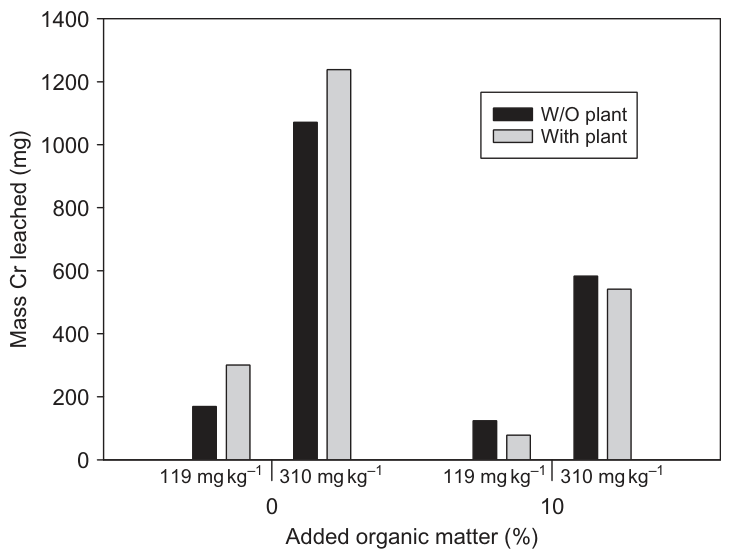
At the same level of total organic carbon addition, Bolan et al. (2003b) observed significant difference in the extent of Cr6+ reduction between various organic manure composts. The extent of Cr6+ reduction increased with increasing level of DOC added through manure addition, which has been identified to facilitate the reduction of Cr6+ to Cr3+ in soils ( Jardine et al., 1999). For example, the hydroquinone groups in organic matter have been identified as the major source of electron donor for the reduction of Cr6+ to Cr3+ in soils (Elovitz and Fish, 1995).
在总有机碳添加量相同的条件下,Bolan et al.(2003b)观察到不同有机粪肥堆肥之间Cr6+的还原程度存在显著差异。Cr6+的还原程度随粪肥添加所带入的DOC水平的升高而增加,而DOC已被证实可促进土壤中Cr6+还原为Cr3+(Jardine et al., 1999)。例如,有机质中的氢醌基团已被确定为土壤中Cr6+还原为Cr3+的主要电子供体来源(Elovitz and Fish, 1995)。
The increase in Cr6+ reduction in the presence of organic manure addition may also result from enhanced microbial activity. Although Cr6+ reduction can occur through both chemical and biological processes, the biological reduction is considered to be the dominant process in most arable soils which are low in Fe2+ ion. It has been shown that the addition of manure compost caused a larger increase in the biological reduction than chemical reduction of Cr6+, indicating that the supply of microorganisms is more important than the supply of organic carbon in enhancing the reduction of Cr6+ when compost is added (Banks et al., 2006; Chiu et al., 2009; Losi et al., 1994). Addition of manure compost has often been shown to increase the microbial activity of soil, as measured by increased respiration and enzymatic activities (Chang et al., 2008; Kanazawa et al., 1988; Saha et al., 2008; Tejada, 2009). This arises from both increased supply of carbon and nutrients, such as nitrogen, phosphorus, and sulfur (Tejada et al., 2006; Wardle, 1992).
添加有机粪肥后Cr6+还原的增加也可能源于微生物活性的增强。尽管Cr6+的还原可通过化学和生物两种过程发生,但在大多数Fe2+离子含量较低的耕作土壤中,生物还原被认为是主导过程。研究表明,添加粪肥堆肥对Cr6+生物还原的促进作用大于对化学还原的促进作用,这表明在施用堆肥时,微生物的供给比有机碳的供给对增强Cr6+还原更为重要(Banks et al., 2006; Chiu et al., 2009; Losi et al., 1994)。已有研究多次表明,添加粪肥堆肥可提高土壤微生物活性,表现为呼吸作用和酶活性的增强(Chang et al., 2008; Kanazawa et al., 1988; Saha et al., 2008; Tejada, 2009)。这既源于碳供给的增加,也源于氮、磷、硫等养分供给的增加(Tejada et al., 2006; Wardle, 1992)。
7.4. Geotextile capping7.4. 土工织物覆盖
Geosynthetics are thin polymeric materials that are widely used in geotechnical, environmental, and hydraulic applications (Bouazza et al., 2006). A geotextile is a geosynthetic fabricated to be permeable and can be classified by the way they are manufactured as either woven or nonwoven (Koerner and Koerner, 2006). Nonwoven geotextiles are felt-like materials which are formed by a random placement of threads and do not have any visible thread pattern (Koerner and Koerner, 2006). They can also be used in canals and channels that are downstream from dredging operations, such as for the dewatering of sediments in geotubes (Moo-Young and Tucker, 2002) and other geotextile containers in one- (Kutay and Aydilek, 2004) and two-layer systems (Kutay and Aydilek, 2005). Geotextiles have been used along shorelines and landfill sites to reduce the introduction of suspended material through erosion (e.g., Bouazza and Vangpaisal, 2007; Brachman and Gudina, 2008).
土工合成材料是一类薄型聚合物材料,广泛应用于岩土工程、环境工程和水利工程领域(Bouazza et al., 2006)。土工织物是一种具有透水性的土工合成材料,按制造方式可分为有纺和无纺两类(Koerner and Koerner, 2006)。无纺土工织物是由纤维随机排布而成的毡状材料,没有可见的纤维纹理(Koerner and Koerner, 2006)。它们还可用于疏浚作业下游的运河和渠道,例如用于土工管袋中沉积物的脱水(Moo-Young and Tucker, 2002),以及单层(Kutay and Aydilek, 2004)和双层系统(Kutay and Aydilek, 2005)中的其他土工织物容器。土工织物已被用于海岸线和垃圾填埋场,以减少侵蚀带入的悬浮物质(如Bouazza and Vangpaisal, 2007; Brachman and Gudina, 2008)。
Various reactive materials (e.g., activated carbon, apatite, organoclay, zeolite, zero-valent iron) used for the immobilization of contaminants may be applicable to in situ capping using geotextile mat. For example, geosynthetic clay liners (GCLs) consisting of a thin layer of bentonite supported by one or two layers of geosynthetics are now well recognized as an alternative to traditional compacted clay liners. A number of studies have established the use of clays for attenuating metallic contaminants. A reactive material mat will have several advantages over loose placement of reactive materials, including (Olsta et al., 2006): (1) uniform and verifiable mass per area placement of reactive or adsorptive material; (2) ability to mix reactive or adsorptive materials in defined proportions; (3) easy separation of the reactive material from the contaminated sediment and cover material; (4) providing barrier to biointrusion, resistance to uplift and differential settlement, and stability on sloped areas. Geotextiles also help to separate micropollutants such as Cd, Zn, and Cu from the underlying soil in landfill sites, therefore preventing groundwater from becoming contaminated and are also effective in attenuating metals from mining leachates (Lange et al., 2007).
用于污染物固定化的各种反应材料(如活性炭、磷灰石、有机黏土、沸石、零价铁)可适用于采用土工织物垫的原位覆盖。例如,由一薄层膨润土及一层或两层土工合成材料支撑构成的土工合成黏土衬垫(GCLs),目前已被广泛认可为传统压实黏土衬垫的替代方案。大量研究已证实黏土可用于削减金属污染物。与松散铺设反应材料相比,反应材料垫具有以下优点(Olsta et al., 2006):(1)反应性或吸附性材料的单位面积质量铺设均匀且可验证;(2)能够按确定比例混合反应性或吸附性材料;(3)反应材料易于与受污染沉积物及覆盖材料分离;(4)可阻隔生物侵入,抵抗隆起和不均匀沉降,并在坡地上保持稳定。土工织物还有助于在垃圾填埋场中将Cd、Zn和Cu等微污染物与下伏土壤隔离,从而防止地下水受到污染,同时对削减采矿渗滤液中的金属也很有效(Lange et al., 2007)。
8Conclusions and Future Research Needs结论与未来研究需求
Phytostabilization is primarily aimed at containing the mobility of contaminants through their immobilization within the root zone of plants and “holding” soil and sediments, thereby preventing off-site contamination through their migration via wind and water erosion and leaching, and soil dispersion. Phytostabilization also results in the removal of contaminants through plant uptake and volatilization and this technology can be enhanced by using soil amendments that are effective in the immobilization of metal(loid)s. This technique is readily suited to monitor natural attenuation of contaminated sites which is employed within the context of a carefully controlled site-specific cleanup strategy. For example, this technology (i.e., phytocapping) has been found to be very effective in mitigating leachate and greenhouse gas generation in the management of landfill sites. The main advantage of this technology is that it reduces the mobility, and therefore, the risk of contaminants without necessarily removing them from their source location. Further, this technology does not generate contaminated secondary waste that needs treatment and also provides ecosystem development to achieve biodiversity corridors. However, since the contaminants are left in place, the site requires regular monitoring in order to maintain the stabilizing conditions. If soil amendments are used to enhance immobilization, they may need to be periodically reapplied to maintain the effectiveness of the phytoimmobilization.
植物稳定的主要目的是通过将污染物固定在植物根区内并“固持”土壤和沉积物来限制污染物的迁移性,从而防止污染物通过风蚀、水蚀、淋溶以及土壤分散而迁移,造成场外污染。植物稳定还可通过植物吸收和挥发去除污染物,并可通过施用能有效固定金属(类金属)的土壤改良剂来强化该技术。该技术非常适合对污染场地的自然衰减进行监测,而自然衰减是在严格控制的场地特定修复策略框架下采用的。例如,该技术(即植物覆盖)已被证实在垃圾填埋场管理中可非常有效地减少渗滤液和温室气体的产生。该技术的主要优点在于,它能够在不必将污染物从其源位置移除的情况下降低污染物的迁移性,从而降低其风险。此外,该技术不会产生需要处理的受污染二次废物,还能促进生态系统发育,形成生物多样性廊道。然而,由于污染物仍留在原地,场地需要定期监测,以维持稳定化条件。如果使用土壤改良剂来增强固定作用,则可能需要定期重复施用,以维持植物固定的效果。
Given the current knowledge of phytostabilization technology, the following research areas could be pursued:
基于目前对植物稳定技术的认识,可在以下研究领域开展工作:
� Impact of plant roots and associated microorganisms on the nature and extent of immobilization, volatilization, and methylation of metal(loid)s (Hg, Pb, As, and Se).
• 植物根系及相关微生物对金属(类金属)(Hg、Pb、As和Se)固定、挥发和甲基化的性质及程度的影响。
� Effect of various carbon fractions (e.g., DOM) on sorption/desorption of metal(loid)s and their transport to soil strata, streams, and lakes.
• 各种碳组分(如DOM)对金属(类金属)吸附/解吸及其向土层、溪流和湖泊迁移的影响。
� Impact of harvesting and natural death of plants on the solubility, mobility, and dispersion of contaminants.
• 植物收获和自然死亡对污染物溶解性、迁移性和分散的影响。
� Nature and extent of soil mineral-OM-microbe interactions as influenced by environmental factors such as land use and acid rain, and edaphic factors such as soil type and clay mineralogy.
• 受土地利用和酸雨等环境因素以及土壤类型和黏土矿物组成等土壤因素影响的土壤矿物–有机质–微生物相互作用的性质和程度。
� Nature of microbial communities as affected by OM dynamics and their role on the degradation of OM.
• 受有机质动态影响的微生物群落特征及其在有机质降解中的作用。
� Effect of heterogeneity on the performance of the system. Both contaminants and plant nutrients are distributed heterogeneously in soil. Avoidance/foraging of hotspots may have a large effect on plant uptake and leaching.
• 异质性对系统性能的影响。污染物和植物养分在土壤中均呈异质性分布。植物根系对热点区域的回避或觅取可能对植物吸收和淋溶产生很大影响。
� Modeling phytostabilization systems. Since plants on each contaminated site comprise a unique ecosystem, experiments are required to determine both the feasibility and costs of phytostabilization. Full-system models could reduce these costs.
• 植物稳定系统的建模。由于每个污染场地上的植物构成独特的生态系统,因此需要开展试验以确定植物稳定的可行性和成本。全系统模型可降低这些成本。
ACKNOWLEDGMENTS致谢
We would like to thank CRC CARE for providing funding (No 2-3-09-07/08) and Gyeongnam National University of Science and Technology to undertake research on landfill site remediation; part of the chapter was derived from these projects.
感谢CRC CARE(资助编号2-3-09-07/08)和Gyeongnam National University of Science and Technology为垃圾填埋场修复研究提供资助;本章部分内容来源于这些项目。
REFERENCES参考文献
Adriano, D. C. (2001). Trace Elements in Terrestrial Environments; Biogeochemistry, Bioavailability and Risks of Metals. 2nd edn., Springer, New York, NY.
Adriano, D. C., Wenzel, W. W., Vangronsveld, J., and Bolan, N. S. (2004). Role of assisted natural remediation in environmental cleanup. Geoderma 122, 121–142.
Aira, M., Go´mez-Brando´n, M., Lazcano, C., and Domı´nguez, J. (2010). Plant genotype strongly modifies the structure and growth of maize rhizosphere microbial communities. Soil Biol. Biochem. 42, 2276–2281.
Ajwa, H. A., Banuelos, G. S., and Mayland, H. F. (1998). Selenium uptake by plants from soils amended with inorganic and organic materials. J. Environ. Qual. 27, 1218–1227.
Alami, Y., Achouak, W., Marol, C., and Heulin, T. (2000). Rhizosphere soil aggregation and plant growth promotion of sunflowers by an exopolysaccharide-producing Rhizobium sp. strain isolated from sunflower roots. Appl. Environ. Microbiol. 66, 3393–3398.
Alexander, M. (1999). Biodegradation and Bioremediation. 2nd edn., CA Academic Press, San Diego. Anderson, T. A., Guthrie, E. A., and Walton, B. T. (1993). Bioremediation in the rhizosphere. Environ. Sci. Technol. 27, 2630–2636. Ashwath, N., and Venkatraman, K. (2010). Phytocapping: An alternative technique for landfill remediation. Int. J. Environ. Waste Manage. 6, 51–70. Auxtero, E., Madeira, M., and Sousa, E. (2004). Variable charge characteristics of selected Andisols from the Azores, Portugal. Catena 56, 111–125. Awad, F., Romheld, V., and Marschner, H. (1994). Effect of root exudates on mobilization in the rhizosphere and uptake of iron by wheat plants. Plant Soil 165, 213–218. Baker, A. J. M. (1981). Accumulators and excluders—Strategies in the response of plants to heavy metals. J. Plant Nutr. 3, 643–654.
Baker, A. J. M., and Brooks, R. R. (1989). Terrestrial higher plants which hyperaccumulate metallic elements—A review of their distribution, ecology and phytochemistry. Biorecovery 1, 81–126.
Baker, A. J. M., and Whiting, S. N. (2002). In search of the Holy Grail—A further step in understanding metal hyperaccumulation? Sci. Total Environ. 155, 1–4. Banks, M. K., Schwab, A. P., and Henderson, C. (2006). Leaching and reduction of chromium in soil as affected by soil organic content and plants. Chemosphere 62, 255–264. Banuelos, G. S., and Ajwa, H. A. (1999). Trace elements in soils and plants: An overview. J. Environ. Sci. Health A Tox. Hazard Subst. Environ. Eng. 34, 951–974. Banuelos, G. S., and Lin, Z. Q. (2007). Acceleration of selenium volatilization in seleniferous agricultural drainage sediments amended with methionine and casein. Envrion. Pollut. 150, 306–312.
Barton, C., Marx, D., Adriano, D. C., Koo, B. J., Newman, L., Czapka, S., and Blake, J. (2005). Phytostabilization of a landfill containing coal combustion waste. Environ. Geosci. 12, 251–265.
Bashan, Y., Puente, M. E., Myrold, D. D., and Toledo, G. (1998). In vitro transfer of fixed nitrogen from diazotrophic filamentous cyanobacteria to black mangrove seedlings. FEMS Microbiol. Ecol. 26, 165–170.
Basta, N. T., Gradwohl, R., Snethen, K. L., and Schroder, J. L. (2001). Chemical immobilisation of lead, zinc and cadmium in smelter-contaminated sols using biosolids and rock phosphate. J. Environ. Qual. 30, 1222–1230.
Belimov, A. A., and Dietz, K. (2000). Effect of associative bacteria on element composition of barley seedling grown in solution culture at toxic cadmium concentrations. Microbiol. Res. 155, 113–121.
Belimov, A. A., Hontzeas, N., Safronova, V. I., Demchinskaya, S. V., Piluzza, G., Bullitta, S., and Glick, B. R. (2005). Cadmium-tolerant plant growth-promoting bacteria associated with the roots of Indian mustard (Brassica juncea L. Czern.). Soil Biol. Biochem. 37, 241–250.
Berti, W. R., and Cunningham, S. D. (2000). Phytostabilization of metals. In “Phytoremediation of Toxic Metals: Using Plants to Clean Up the Environment” (I. B. Raskin and D. Ensley, Eds.), pp. 71–88. Wiley, New York. Bohn, H., McNeal, B., and O’Connor, G. (1985). In “Soil Chemistry”, 2nd edn., Wiley, New York.
Bolan, N. S., and Duraisamy, V. P. (2003). Role of inorganic and organic soil amendments on immobilisation and phytoavailability of heavy metals: A review involving specific case studies. Aust. J. Soil Res. 41, 533–555.
Bolan, N. S., and Hedley, M. J. (2003). The role of carbon, nitrogen and sulphur in soil acidification. In “Hand Book of Soil Acidification” (Z. Rengel, Ed.), pp. 29–56. Marcel and Dekker Inc., New York.
Bolan, N. S., Naidu, R., Mahimairaja, S., and Baskaran, S. (1994). Influence of low molecular weight organic acid on the solubilization of phosphorus in soils. Biol. Fertil. Soils 18, 311–319.
Bolan, N. S., Elliott, J., Gregg, P. E. H., and Weil, S. (1996). Rhizosphere induced dissolution of phosphate rocks in soils. Biol. Fertil. Soils 24, 169–174.
Bolan, N. S., Naidu, R., Syers, J. K., and Tillman, R. W. (1999). Surface charge and solute interactions in soils. Adv. Agron. 67, 88–141.
Bolan, N. S., Adriano, D. C., and Naidu, R. (2003a). Role of phosphorus in (im)mobilization and bioavailability of heavy metals in the soil-plant system. Rev. Environ. Contam. Toxicol. 177, 1–44.
Bolan, N. S., Adriano, D. C., Natesan, R., and Koo, B. J. (2003b). Effects of organic amendments on the phytoavailability of chromate in mineral soil. J. Environ. Qual. 32, 120–128.
Bolan, N. S., Adriano, D. C., Mani, P., Duraisamy, A., and Arulmozhiselvan, S. (2003c). Immobilization and phytoavailability of cadmium in variable charge soils: II effect of lime addition. Plant Soil 250, 187–198.
Bolan, N. S., Adriano, D. C., Mani, S., and Khan, A. R. (2003d). Adsorption, complexation and phytoavailability of copper as influenced by organic manure. Environ. Toxicol. Chem. 22, 450–456.
Bolan, N. S., Adriano, D., Senesi, N., Kunhikrishnan, A., James, T., and McDowell, R. (2011). Dissolved organic carbon: Biogeochemistry, dynamics and agro-environmental significance in soils. Adv. Agron. 110, 1–75.
Bolland, M. D. A., Posner, A. M., and Quirk, J. P. (1977). Zinc adsorption by goethite in the absence and presence of phosphate. Aust. J. Soil Res. 15, 279–286.
Bottini, R., Cassan, F., and Piccoli, P. (2004). Gibberellin production by bacteria and its involvement in plant growth promotion and yield increase. Appl. Microbiol. Biotechnol. 65, 497–503.
Bouazza, A., and Vangpaisal, T. (2007). Gas transmissivity at the interface of a geomembrane and the geotextile cover of a partially hydrated geosynthetic clay liner. Geosynth. Int. 14, 316–319.
Bouazza, A., Freund, M., and Nahlawl, H. (2006). Water retention of nonwoven polyester geotextiles. Polym. Test. 25, 1038–1043.
Brachman, R. W. I., and Gudina, S. (2008). Gravel contacts and geomembrane strains for a GM/CCL composite liner. Geotext. Geomembr. 26, 448–459.
Bronick, C. J., and Lal, R. (2005). Soil structure and management: A review. Geoderma 124, 3–22.
Brown, S. L., Chaney, R. L., Angle, J. S., and Baker, A. J. M. (1994). Phytoremediation potential of Thlaspi caerulescens and Bladder Campion for zinc- and cadmium-contaminated soil. J. Environ. Qual. 23, 1151–1157.
Burd, G. I., Dixon, D. G., and Glick, B. R. (2000). Plant growth-promoting bacteria that decrease heavy metal toxicity in plants. Can. J. Microbiol. 46, 237–245.
Burgos, P., Madejon, E., Perez-De-Mora, A., and Cabrera, F. (2006). Spatial variability of the chemical characteristics of a trace-element-contaminated soil before and after remediation. Geoderma 130, 157–175.
Cakmak, I., Gulut, K. Y., Marschner, H., and Graham, R. D. (1994). Effect of zinc and iron-deficiency on phytosiderophore release in wheat genotypes differing in zinc efficiency. J. Plant Nutr. 17, 1–17.
Cakmak, I., Sari, N., Marschner, H., Ekiz, H., Kalayci, M., Yilmaz, A., and Braun, H. J. (1996). Phytosiderophore release in bread and durum wheat genotypes differing in zinc efficiency. Plant Soil 180, 183–189.
Castaldi, P., Santona, L., and Melis, P. (2005). Heavy metal immobilization by chemical amendments in a polluted soil and influence on white lupin growth. Chemosphere 60, 365–371.
Cerezo, L. M. L., Marcos, F. M. L., and Rodriguez, A. E. (1999). Heavy metals in mine soils amended with sewage sludge. Land Degrad. Dev. 10, 555–564.
Chaney, R. L., Malik, M., Li, Y. M., Brown, S. L., Brewer, E. P., Angle, J. S., and Baker, A. J. (1997). Phytoremediation of soil metals. Curr. Opin. Biotechnol. 8, 279–284. Chang, A. C., Page, A. L., and Koo, B. J. (2002). Biogeochemistry of phosphorus, iron, and trace elements in soils as influenced by soil-plant-microbial interactions. Dev. Soil Sci. 28, 43–57.
Chang, E. H., Chung, R. S., and Wang, F. N. (2008). Effect of different types of organic fertilizers on the chemical properties and enzymatic activities of an oxisol under intensive cultivation of vegetables for 4 years. Soil Sci. Plant Nut. 54, 587–599.
Chen, L., Huang, Z., Gong, J., Fu, B., and Huang, Y. (2007). The effect of land cover/ vegetation on soil water dynamic in the hilly area of the loess plateau, China. Catena 70, 200–208.
Cheng, S. F., and Hseu, Z. Y. (2002). In-situ immobilization of cadmium and lead by different amendments in two contaminated soils. Water Air Soil Pollut. 140, 73–84.
Chiou, C. T., Porter, P. E., and Shoup, T. D. (1984). Partition equilibria of nonionic organic-compounds between soil organic-matter and water. Environ. Sci. Technol. 18, 295–297.
Chiu, C. C., Cheng, C. J., Lin, T. H., Juang, K. W., and Lee, D. Y. (2009). The effectiveness of four organic matter amendments for decreasing resin-extractable Cr (VI) in Cr (VI)-contaminated soils. J. Hazard. Mater. 161, 1239–1244.
Ciccu, R., Ghiani, M., Serci, A., Fadda, S., Peretti, R., and Zucca, A. (2003). Heavy metal immobilization in the mining-contaminated soils using various industrial wastes. Miner. Eng. 16, 187–192.
Cichota, R., Vogeler, I., Bolan, N. S., and Clothier, B. E. (2007). Simultaneous adsorption of calcium and sulfate and its effect on their movement. Soil Sci. Soc. Am. 71, 703–710. Clothier, B. E., and Green, S. R. (1997). Roots: The big movers of water and chemical in soil. Soil Sci. 162, 534–543.
Clothier, B. E., Green, S. R., Robinson, B. R., Thaylakumaran, T., Scotter, D. R., Vogeler, I., Mills, T. M., Deurer, M., van der Velde, M., and Granel, Th. (2008). Contaminants in the rootzone: Bioavailability, uptake and transport, and their implications for remediation. In “Chemical Bioavailability in Terrestrial Environment”
(R. Naidu, Ed.), pp. 633–655. Elsevier, Amsterdam.
Conesa, H. M., Garcı´a, G., Faz, A´ ., and Arnaldos, R. (2007). Dynamics of metal tolerant plant communities’ development in mine tailings from the Cartagena-La Unio´n Mining District (SE Spain) and their interest for further revegetation purposes. Chemosphere 68, 1180–1185.
Conesa, H. M., Moradi, A. B., Robinson, B. H., Ku¨hne, G., Lehmann, E., and Schulin, R. (2009). Response of native grasses and Cicer arietinum to soil polluted with mining wastes: Implications for the management of land adjacent to mine sites. Environ. Exp. Bot. 65, 198–204.
Cotter-Howells, J., and Caporn, S. (1996). Remediation of contaminated land by formation of heavy metal phosphates. Appl. Geochem. 11, 335–342.
Cotter-Howells, J. D., Champness, P. E., Charnock, J. M., and Pattrick, R. A. (1994). Identification of pyromorphite in mine-waste contaminated soils by ATEM and EXAFS. Eur. J. Soil Sci. 45, 393–402.
Crozier, A., Kamiya, Y., Bishop, G., and Yokota, T. (2000). Biosynthesis of hormones and elicitor molecules. In “Biochemistry and Molecular Biology of Plants” (B. B. Buchanan, W. Gruissem, and R. L. Jones, Eds.), pp. 850–929. American Society of Plant Physiologists, Rockville.
Cunningham, S. D., Shann, J. R., Crowley, D. E., and Anderson, T. A. (1997). Phytoremediation of contaminated water and soil. In “Phytoremediation of Soil Water
Contaminants” (E. L. Kruger, T. A. Anderson, and J. R. Coats, Eds.), pp. 2–17. American Chemical Society, Washington, DC.
Daum, K. A., and Newland, L. W. (1982). Complexing effects on behavior of some metals. In “The Hand Book of Environmental Chemistry: Reactions and Processes” (O. Huntzinger, Ed.), pp. 129–140. Springer-Verlag, New York.
de Knecht, J. A., van Dillen, M., Koevoets, P. L. M., Schat, H., Verkleij, J. A. C., and Ernst, W. H. O. (1994). Phytochelatins in cadmium-sensitive and cadmium-tolerant Silene vulgaris (chain length distribution and sulfide incorporation). Plant Physiol. 104, 255–261.
De Souza, M. P., Lytle, C. M., Mulholland, M. M., Otte, M. L., and Terry, N. (2000). Selenium assimilation and volatilization from dimethylselenoniopropionate by Indian mustard. Plant Physiol. 122, 1281–1288.
De Souza, M. P., Pickering, I. J., Walla, M., and Terry, N. (2002). Selenium assimilation and volatilization from selenocyanate-treated Indian mustard and muskgrass. Plant Physiol. 128, 625–633.
de-Bashan, L. E., Hernandez, J. P., Nelson, K. N., Bashan, Y., and Maier, R. M. (2010). Growth of quail bush in acidic, metalliferous desert mine tailings: Effect of Azospirillum brasilense Sp6 on biomass production and rhizosphere community structure. Microb. Ecol. 60, 1–13.
Deikman, J. (1997). Molecular mechanisms of ethylene regulation of gene transcription. Physiol. Plantarum. 100, 561–566.
del Castilho, P., Chardon, W. J., and Salomons, W. (1993). Influence of cattle-manure slurry application on the solubility of cadmium, copper, and zinc in a manure acidic, loamy-sand soil. J. Environ. Qual. 22, 689–697.
Dessureault-Rompre´, J., Luster, J., Schulin, R., Tercier-Waeber, M. L., and Nowack, B. (2010). Decrease of labile Zn and Cd in the rhizosphere of hyperaccumulating Thlaspi caerulescens with time. Environ. Pollut. 158, 1955–1962.
Dı´az, G., Azco´n-Aguilar, C., and Hornubia, M. (1996). Influence of arbuscular mycorrhizae on heavy metal (Zn and Pb) uptake and growth of Lygeum spartum and Anthyllis cystoides. Plant Soil 180, 241–249.
Dickinson, N., Baker, A., Doronila, A., Laidlaw, S., and Reeves, R. (2009). Phytoremediation of inorganics: Realism and synergies. Int. J. Phytoremediation 11, 97–114.
Dominguez, M. T., Maranon, T., Murillo, J. M., Schulin, R., and Robinson, B. H. (2010). Nutritional status of Mediterranean trees growing in a contaminated and remediated area. Water Air Soil Pollut. 205, 305–321.
Down, C. G. (1975). Problems in vegetating metal-toxic mine wastes. In “Minerals and the Environment, Proceedings of an International Symposium London” (M. J. Jones, Ed.), pp. 395–408. Institute of Mining and Metallurgy, London.
Duckart, E. C., Waldron, L. J., and Donner, H. E. (1992). Selenium uptake and volatilization from plants growing in soil. Soil Sci. 153, 94–99.
Duqucˇne, L., Vandenhove, H., Tack, F., Meers, E., Baeten, J., and Wannijn, J. (2009). Enhanced phytoextraction of uranium and selected heavy metals by Indian mustard and ryegrass using biodegradable soil amendments. Sci. Total Environ. 407, 1496–1505.
Elovitz, M. S., and Fish, W. (1995). Redox interactions of Cr(VI) and substituted phenols: Products and mechanisms. Environ. Sci. Technol. 29, 1933–1943.
Entry, J. A., Vance, N. A., Hamilton, M. A., Zabowsky, D., Watrud, L. S., and Adriano, D. C. (1996). Phytoremediation of soil contaminated with low concentrations of radionuclides. Water Air Soil Pollut. 88, 167–176.
Fa¨ssler, E., Robinson, B. H., Stauffer, W., Gupta, S. K., Papritz, A., and Schulin, R. (2010). Phytomanagement of metal-contaminated agricultural land using sunflower, maize and tobacco. Agric. Ecosyst. Environ. 136, 49–58.
Fernandez, M. D., Cagigal, E., Vega, M. M., Urzelai, A., Babin, M., Pro, J., and Tarazona, J. V. (2005). Ecological risk assessment of contaminated soils through direct toxicity assessment. Ecotoxicol. Environ. Saf. 62, 174–184.
Fitz, W. J., Wenzel, W. W., Zhang, H., Nurmi, J., Stipek, K., Fischerova, Z., Schweiger, P., Kollensperger, G., Ma, L. Q., and Stingeder, G. (2003). Rhizosphere characteristics of the arsenic hyperaccumulator Pteris vittata L. and monitoring of phytoremoval efficiency. Environ. Sci. Technol. 37, 5008–5014.
Flege, A. (2000). Forest recultivation of coal-mined land: Problems and prospects. In “Reclaimed Land” (M. J. Haigh, Ed.), pp. 291–337. A.A. Balkema, Rotterdam, Netherlands.
Francesconi, K., Visoottiviseth, P., Sridokchan, W., and Goessler, W. (2002). Arsenic species in an arsenic hyperaccumulating fern, Pityrogramma calomelanos: A potential phytoremediator of arsenic-contaminated soils. Sci. Total Environ. 284, 27–35.
Frankenberger, W. T., and Losi, M. E. (1995). Application of bioremediation in the cleanup of heavy elements and metalloids. In “Bioremediation: Science and Applications” (H. D. Skipper and R. F. Turco, Eds.), Soil Science Special Publication No. 43, pp. 173–210. Soil Science Society of America, Madison, WI.
Freitas, H., Prasad, M. N. V., and Pratas, J. (2004). Plant community tolerant to trace elements growing on the degraded soils of Sao Domingos mine in the south east of Portugal: Environmental implications. Environ. Int. 30, 65–72.
Gadd, G. M. (1992). Microbial control of heavy metal pollution. In “Microbial Control of Pollution” ( J. C. Fry, G. M. Gadd, R. A. Herbert, C. W. Jones, and I. A. Watson-Craik, Eds.), pp. 69–88. Society for General Microbiology, Great Britain.
Gao, Y., Miao, C., Mao, L., Zhou, P., Jin, Z., and Shi, W. (2010). Improvement of phytoextraction and antioxidative defense in Solanum nigrum L. under cadmium stress by application of cadmium-resistant strain and citric acid. J. Hazard. Mater. 181, 771–777.
Garten, C. T. Jr. (1999). Modeling the potential role of a forest ecosystem in phytostabilization and phytoextraction of 90Sr at a contaminated watershed. J. Environ. Radioact. 43, 305–323.
Gatliff, E. G. (1994). Vegetative remediation process offers advantages over traditional pump-and-treat technologies. Remed. J. 4, 343–352.
Glick, B. R., and Bashan, Y. (1997). Genetic manipulation of plant growth-promoting
bacteria to enhanced biocontrol of phytopathogens. Biotechnol. Adv. 15, 353–378.
Glick, B. R., Penrose, D. M., and Li, J. (1998). A model for the lowering of plant ethylene
concentrations by plant growth-promoting bacteria. J. Therm. Biol. 190, 63–68.
Gonzaga, M. I. S., Santos, J. A. G., and Ma, L. Q. (2006). Arsenic chemistry in the
rhizosphere of Pteris vittata L. and Nephrolepis exaltata L. Environ. Pollut. 143, 254–260.
Granel, T., Robinson, B., Mills, T., Clothier, B., Green, S., and Fung, L. (2002). Cadmium accumulation by willow clones used for soil conservation, stock fodder, and phytoremediation. Aust. J. Soil Res. 40, 1331–1337.
Gray, C. W., Dunham, S. J., Dennis, P. G., Zhao, F. J., and McGrath, S. P. (2006). Field evaluation of in situ remediation of a heavy metal contaminated soil using lime and redmud. Environ. Pollut. 142, 530–539.
Grayston, S. J., Vaughan, D., and Jones, D. (1997). Rhizosphere carbon flow in trees, in comparison with annual plants: The importance of root exudation and its impact on microbial activity and nutrient availability. Appl. Soil Ecol. 5, 29–56.
Grifferty, A., and Barrington, S. (2000). Zinc uptake by young wheat plants under two transpiration regimes. J. Environ. Qual. 29, 443–446.
Grifoll, J., and Cohen, Y. (1996). Contaminant migration in the unsaturated soil zone: The effect of rainfall and evapotranspiration. J. Contam. Hydrol. 23, 185–211.
Gworek, B. (1992). Inactivation of cadmium in contaminated soils using synthetic zeolites. Environ. Pollut. 75, 269–271.
Hadi, F., Bano, A., and Fuller, M. P. (2010). The improved phytoextraction of lead (Pb) and the growth of maize (Zea mays L.): The role of plant growth regulators (GA3 and IAA) and EDTA alone and in combinations. Chemosphere 80, 457–462.
Hall, J. L. (2002). Cellular mechanisms for heavy metal detoxification and tolerance. J. Exp. Bot. 53, 1–11.
Hall, J. A., Peirson, D., Ghosh, S., and Glick, B. R. (1996). Root elongation in various agronomic crops by the plant growth promoting rhizobacterium Pseudomonas putida GR12-2. Isr. J. Plant Sci. 44, 37–42.
Harris, J. N., New, P. B., and Martin, P. M. (2006). Laboratory tests can predict beneficial effects of phosphate-solubilising bacteria on plants. Soil Biol. Biochem. 38, 1521–1526.
Haselwandter, K., and Bowen, G. (1996). Mycorrhizal relations in trees for agroforestry and land rehabilitation. Forest. Ecol. Manage. 81, 1–17.
He, Y. K., Sun, J. G., Feng, X. Z., Czako, M., and Marton, L. (2001). Differential mercury volatilization by tobacco organs expressing a modified bacterial merA gene. Cell Res. 11, 231–236.
He, Z. L., Yang, X. E., and Stoffella, P. J. (2005). Trace elements in agroecosystems and impacts on the environment. J. Trace Elem. Med. Biol. 19, 125–140.
Hesterberg, D., Bril, J., and del Castilho, P. (1993). Thermodynamic modeling of zinc, cadmium, and copper solubility in manure, acidic loamy-sand topsoil. J. Environ. Qual. 22, 681–1993.
Hetherington, A. M., and Woodward, F. I. (2003). The role of stomata in sensing and driving environmental change. Nature 424, 901–908.
Hetrick, B. A. D., Wilson, G. W. T., and Figge, D. A. H. (1994). The influence of mycorrhizal symbiosis and fertilizer amendments on establishment of vegetation in heavy metal mine spoil. Environ. Pollut. 86, 171–179.
Higgins, T. E., Halloran, A. R., Dobbins, M. E., and Pittignano, A. J. (1998). In situ reduction of hexavalent chromium in alkaline soils enriched with chromites ore processing residue. J. Air Waste Manage. Assoc. 48, 100–1106.
Hinsinger, P. (2001). Bioavailability of soil inorganic P in the rhizosphere as affected by root-induced chemical changes: A review. Plant Soil 237, 173–195.
Hinsinger, P., Gobran, G. R., Gregory, P. J., and Wenzel, W. W. (2005). Rhizosphere geometry and heterogeneity arising from root-mediated physical and chemical processes. New Phytol. 168, 293–303.
Honda, M., Tamura, H., Kimura, T., Kinoshita, T., Mastsufuru, H., and Sasto, T. (2007). Control of lead polluted leachate in a box-scale phytoremediation test using common buckwheat (Fagopyrum esculentum Moench) grown on lead contaminated soil. Environ. Technol. 28, 425–431, http://www.tenby10.com/Index.
Huang, P. M. (2004). Soil mineral-organic matter-microorganism interactions: Fundamentals and impacts. Adv. Agron. 82, 391–472.
Hupy, J. P. (2004). Influence of vegetation cover and crust type on wind-blown sediment in a semi-arid climate. J. Arid Environ. 58, 167–179.
Jardine, P. M., Fendorf, S. E., Mayes, M. A., Larsen, I. L., Brooks, S. C., and Bailey, W. B. (1999). Fate and transport of hexavalent chromium in undisturbed heterogeneous soil. Environ. Sci. Technol. 33, 2939–2944.
Jentschke, G., and Godbold, D. L. (2000). Metal toxicity and ectomycorrhizas. Physiol. Plant. 109, 107–116.
Jones, D. L., Hodge, A., and Kuzyakov, Y. (2004). Plant and mycorrhizal regulation of rhizodeposition. New Phytol. 163, 459–480.
Kamensky, M., Ovadis, M., Chet, I., and Chernin, L. (2003). Soil-borne strain IC14 of Serratia plymuthica with multiple mechanisms of antifungal activity provides biocontrol of Botrytis cinerea and Sclerotinia sclerotiorum diseases. Soil Biol. Biochem. 35, 323–331.
Kanazawa, S., Asakawa, S., and Takai, S. (1988). Effect of fertilizer and manure application on microbial numbers, biomass, and enzyme activities in volcanic ash soils. 1. Microbial numbers and biomass carbon. Soil Sci. Plant Nutri. 34, 429–439.
Keller, C., Marchetti, M., Rossi, L., and Lugon-Moulin, N. (2005). Reduction of cadmium availability to tobacco (Nicotiana tabacum) plants using soil amendments in low cadmiumcontaminated agricultural soils: A pot experiment. Plant Soil 276, 69–84.
Khattak, R. A., Page, A. L., Parker, D. R., and Bakhtar, D. (1991). Accumulation and interactions of arsenic, selenium, molybdenum and phosphorous in alfalfa. J. Environ. Qual. 20, 165–168.
Kim, S., Lim, H., and Lee, I. (2010). Enhanced heavy metal phytoextraction by Echinochloa crus-galli using root exudates. J. Biosci. Bioeng. 109, 47–50.
Kline, A. B. (2008). Hydraulic Control in Willow Phytoremediation Systems at Fort Drum. State University of New York College of Environmental Science and Forestry, New York, M.Sc. thesis.
Ko, B. G., Anderson, C. W. N., Bolan, N. S., Huh, K. Y., and Vogeler, I. (2008). Potential for the phytoremediation of arsenic-contaminated mine tailings in Fiji. Aust. J. Soil Res. 46, 493–501.
Koerner, G. R., and Koerner, R. M. (2006). Geotextile tube assessment using a hanging bag test. Geotex. Geomembr. 24, 129–137.
Kumpiene, J., Lagerkvist, A., and Maurice, C. (2007). Stabilization of As, Cr, Cu, Pb and Zn in soils using amendments—A review. Waste Manage. 28, 215–225.
Kutay, M. E., and Aydilek, A. H. (2004). Retention performance of geotextile containers confining geomaterials. Geosynth. Int. 11, 100–113.
Kutay, M. E., and Aydilek, A. H. (2005). Filtration performance of two-layer geotextile systems. Geotech. Test. J. 28, 79–91.
Lan, C. Y., Shu, W. S., and Wong, M. H. (1997). Revegetation of lead/zinc mine tailings at Shaoguan, Guandong province, China: Phytotoxicity of the tailings. Stud. Environ. Sci. 66, 119–130.
Lange, K., Rowe, R. K., and Jamieson, H. (2007). The potential role of geosynthetic clay liners in mine water treatment systems. Geotext. Geomembr. 28, 199–205.
Legrand, P., Turmel, M. C., Sauve´, S., and Courchesne, F. (2005). Speciation and bioavailability of trace metals (Cd, Cu, Ni, Pb, Zn) in the rhizosphere of contaminated soils. In “Biogeochemistry of Trace Elements in the Rhizosphere” (P. M. Huang and G. R. Gobran, Eds.), pp. 261–299. Elsevier, New York.
Leung, H. M., Wu, F. Y., Cheung, K. C., Ye, Z. H., and Wong, M. H. (2010). The effect of arbuscular mycorrhizal fungi and phosphate amendment on arsenic uptake, accumulation and growth of pteris vittata in As-contaminated soil. Int. J. Phytoremediation 12, 384–403. Liao, Y. C., Chien, S. W. C., Wang, M. C., Shen, Y., Hung, P. L., and Das, B. (2006). Effect of transpiration on Pb uptake by lettuce and on water soluble low molecular weight organic acids in rhizosphere. Chemosphere 65, 343–351.
Lifshitz, R., Kloepper, J. W., Kozlowski, M., Simonson, C., Carlson, J., Tipping, E. M., and Zaleska, I. (1987). Growth promotion of canola (rapeseed) seedlings by a strain of Pseudomonas putida under gnotobiotic conditions. Can. J. Microbiol. 33, 390–395.
Liu, J., Liang, J., Li, K., Zhang, Z., Yu, B., Lu, X., Yang, J., and Zhu, Q. (2003). Correlations between cadmium and mineral nutrients in absorption and accumulation in various genotypes of rice under cadmium stress. Chemosphere 52, 1467–1473.
Liu, D., Islam, E., Li, T., Yang, X., Jin, X., and Mahmood, Q. (2008). Comparison of synthetic chelators and low molecular weight organic acids in enhancing phytoextraction of heavy metals by two ecotypes of Sedum alfredii Hance. J. Hazard. Mater. 153, 114–122.
Liu, X., Peng, K., Wang, A., Lian, C., and Shen, Z. (2010). Cadmium accumulation and distribution in populations of Phytolacca americana L. and the role of transpiration. Chemosphere 78, 1136–1141.
Loch, R. J. (2000). Effects of vegetation cover on runoff and erosion under simulated rain and overland flow on a rehabilitated site on the Meandu mine, Tarong, Queensland. Aust. J. Soil Res. 38, 299–312.
Lock, K., and Janssen, C. R. (2003). Influence of aging on metal availability in soils. Rev. Environ. Contam. Toxicol. 179, 1–21.
Lo´pez, M. L., Peralta-Videa, J. R., Benitez, T., and Gardea-Torresdey, J. L. (2005). Enhancement of lead uptake by alfalfa (Medicago sativa) using EDTA and a plant growth promoter. Chemosphere 61, 595–598.
Losi, M. E., Amrhein, C., and Frankenberger, W. T. (1994). Factors affecting chemical and biological reduction of Cr(VI)in soil. Environ. Toxicol. Chem. 13, 1727–1735.
Lothenbach, B., Furrer, G., Scha¨rli, H., and Schulin, R. (1999). Immobilization of zinc and cadmium by montmorillonite compounds: Effects of aging and subsequent acidification. Environ. Sci. Technol. 33, 2945–2952.
Lu, L., Tian, S., Yang, X., Li, T., and He, Z. (2009). Cadmium uptake and xylem loading are active processes in the hyperaccumulator Sedum alfredii. J. Plant Physiol. 166, 579–587. Lynch, J. M., and Whipps, J. M. (1990). Substrate flow in the rhizosphere. Plant Soil 129, 1–10.
Lytle, C. M., Lytle, F. W., Yang, N., Qian, J. H., Hansen, D., Zayed, A., and Terry, N. (1998). Reduction of Cr (VI) to Cr (III) by wetland plants: Potential for in situ heavy metal detoxification. Environ. Sci. Technol. 32, 3087–3093.
Ma, L. Q., Komar, K. M., Tu, C., Zhang, W. H., Cai, Y., and Kennelley, E. D. (2001). A fern that hyperaccumulates arsenic—A hardy, versatile, fast-growing plant helps to remove arsenic from contaminated soils. Nature 409, 579.
Mantelin, S., and Touraine, B. (2004). Plant growth-promoting bacteria and nitrate availability: Impacts on root development and nitrate uptake. J. Exp. Bot. 55, 27–34.
Mapa, R. B. (1995). Effect of reforestation using Tectona grandis on infiltration and soil water retention. For. Ecol. Manage. 77, 119–125.
Marchiol, L., Assolari, S., Sacco, P., and Zerbi, G. (2004). Phytoextraction of heavy metals by canola (Brassica napus) and radish (Raphanus sativus) grown on multicontaminated soil. Environ. Pollut. 132, 21–27.
Marı´a, I. S., Nora, F., and Atilio, J. B. (2002). The effect of inoculation with Azospirillum brasilense on growth and nitrogen utilization by wheat plants. Plant Soil 245, 215–222.
Marschner, P., Yang, C. H., Lieberei, R., and Crowley, D. E. (2001). Soil and plant specific effects on bacterial community composition in the rhizosphere. Soil Biol. Biochem. 33, 1437–1445.
Martı´nez-Alcala´, I., Walker, D. J., and Bernal, M. P. (2010). Chemical and biological properties in the rhizosphere of Lupinus albus alter soil heavy metal fractionation. Ecotoxicol. Environ. Saf. 73, 595–602.
McCallum, M. H., Kirkegaard, J. A., Green, T. W., Cresswell, H. P., Davies, S. L., Angus, J. F., and Peoples, M. B. (2004). Improved subsoil macroporosity following perennial pastures. Aust. J. Exp. Agric. 44, 299–307.
McGowen, S. L., Basta, N. T., and Brown, G. O. (2001). Use of diammonium phosphate to reduce heavy metal solubility and transport in smelter-contaminated soil. J. Environ. Qual. 30, 493–500.
McGrath, S. P., and Zhao, F. (2003). Phytoextraction of metals and metalloids from contaminated soils. Curr. Opin. Biotechnol. 14, 277–282.
McGrath, S. P., Zhao, F. J., and Lombi, E. (2001). Plant and rhizosphere processes involved in phytoremediation of metal-contaminated soils. Plant Soil 232, 207–214.
McGrath, S. P., Zhao, F. J., and Lombi, E. (2002). Phytoremediation of metals, metalloids, and radionuclides. Adv. Agron. 75, 1–56.
McLaughlin, M. J., Hamon, R. E., McLaren, R. G., Speir, T. W., and Rogers, S. L. (2000). Review: A bioavailability-based rationale for controlling metal and metalloid
contamination of agricultural land in Australia and New Zealand. Aust. J. Soil Res. 38, 1037–1086. Meers, E., Ruttens, A., Hopgood, M., Lesage, E., and Tack, F. M. G. (2005). Potential of Brassic rapa, Cannabis sativa, Helianthus annuus and Zea mays for phytoextraction of heavy metals from calcareous dredged sediment derived soils. Chemosphere 61, 561–572. Meier, S., Borie, F., Bolan, N., and Cornejo, P. (2011). Remediation of metal polluted soils by arbuscular mycorrhizal fungi. Crit. Rev. Environ. Sci. Technol.(accepted for publication). Mench, M., and Martin, E. (1991). Mobilization of cadmium and other metals from 2 soils by root exudates of zea-mays L., nicotiana-tabacum L. and nicotiana rustica L.. Plant Soil 132, 187–196.
Mench, M. J., Didier, V. L., Loffler, M., Gomez, A., and Masson, P. (1994). A mimicked in-situ remediation study of metal-contaminated soils with emphasis on cadmium and lead. J. Environ. Qual. 23, 58–63. Mendez, M. O., and Maier, R. M. (2008). Phytostabilization of mine tailings in arid and semiarid environments-an emerging remediation technology. Environ. Health Perspect. 116, 278.
Menzie, C., Burke, A. M., Grasso, D., Harnois, M., Magee, B., McDonald, D., Montgomery, C., Nichols, A., Pignatello, J., Price, B., Price, R., Rose, J., et al. (2000). An approach for incorporating information on chemical availability in soils into risk assessment and risk-based decision making. Hum. Ecol. Risk Assess. 6, 479–510. Meyer, J., Schmidt, A., Michalke, K., and Hensel, R. (2007). Volatilisation of metals and metalloids by the microbial population of an alluvial soil. Syst. Appl. Microbiol. 30, 229–238.
Miller, J. R., and Miller, S. M. O. (2007). Contaminated Rivers. Springer, Dordrecht.
Mohammad, A. G., and Adam, M. A. (2010). The impact of vegetative cover type on runoff and soil erosion under different land uses. Catena 81, 97–103.
Moo-Young, H., and Tucker, W. R. (2002). Evaluation of vacuum filtration testing for geotextile tubes. Geotext. Geomembr. 20, 191–212.
Moreno, F. N., Anderson, C. W. N., Stewart, R. B., and Robinson, B. H. (2005). Mercury volatilisation and phytoextraction from base-metal mine tailings. Environ. Pollut. 136, 341–352.
Morgan, J. A. W., Bending, G. D., and White, P. J. (2005). Biological costs and benefits to plant–microbe interactions in the rhizosphere. J. Exp. Bot. 56, 1729.
Morrell, J., Stewart, R. B., Gregg, P. E. H., Bolan, N. S., and Horne, D. (1996). An assessment of sulphide oxidation in abandoned base-metal tailings, Te Aroha, New Zealand. Environ. Pollut. 94, 217–225.
Mott, C. J. B. (1981). Anion and ligand exchange. In “The Chemistry of Soil Processes” (D. J. Greenland and M. H. B. Haynes, Eds.), pp. 179–219. John Wiley & Sons, New York.
Murakami, M., and Ae, N. (2009). Potential for phytoextraction of copper, lead, and zinc by rice (Oryza sativa L.), soybean (Glycine max [L.] Merr.), and maize (Zea mays L.). J. Hazard. Mater. 162, 1185–1192.
Naidu, R., Bolan, N. S., Kookona, R., and Tiller, K. (1994). Effect of ionic strength on the adsorption of cadmium by soils. Eur. J. Soil Sci. 45, 419–430.
Naidu, R., Kookana, R. S., Sumner, M. E., Harter, R. D., and Tiller, K. G. (1996). Cadmium adsorption and transport in variable charge soils: A review. J. Environ. Qual. 26, 602–617.
Naidu, R., Semple, K. T., Megharaj, M., Juhasz, A. L., Bolan, N. S., Gupta, S., Clothier, B., Schulin, R., and Chaney, R. (2008a). Bioavailability, definition, assessment and implications for risk assessment. In “Chemical Bioavailability in Terrestrial Environment”
(R. Naidu, Ed.), pp. 39–52. Elsevier, Amsterdam.
Naidu, R., Pollard, S. J. T., Bolan, N. S., Owens, G., and Pruszinski, A. W. (2008b). Bioavailability: The underlying basis for risk based land management. In “Chemical Bioavailability in Terrestrial Environment” (R. Naidu, Ed.), pp. 53–72. Elsevier, Amsterdam.
Nedjimi, B., and Daoud, Y. (2009). Cadmium accumulation in Atriplex halimus subsp. schweinfurthii and its influence on growth, proline, root hydraulic conductivity and nutrient uptake. Flora-Morphol. Distribution. Funct. Ecol. Plant. 204, 316–324.
Neng-Chang, C., and Huai-Man, C. (1992). Chemical behavior of cadmium in wheat rhizosphere. Pedosphere 2, 363–371.
Neunhauserer, C., Berreck, M., and Insam, H. (2001). Remediation of soils contaminated with molybdenum using soil amendments and phytoremediation. Water Air Soil Pollut. 128, 85–96.
Norland, M. R., and Veith, D. L. (1995). Revegetation of coarse taconite iron ore tailing using municipal solid waste compost. J. Hazard. Mater. 41, 123–134.
NRC. National Research Council. (2003). Bioavailability of Contaminants in Soils and Sediments. Academy Press, Washington.
Nyer, E. K., and Gatliff, E. G. (1996). Phytoremediation. Ground Water Monit. Rem. 16, 58–62.
Okon, Y., and Vanderleyden, J. (1997). Root-associated Azospirillum species can stimulate plants. ASM News 63, 366–370.
Olsta, J. T., Hornaday, C. J., and Darlington, J. W. (2006). Reactive material options for in situ capping. In “Contaminated Sediments: Evaluation and Remediation Techniques” (M. Fukue, K. Kita, M. Ohtsubo, R. Chaney, M. Fukue, K. Kita, M. Ohtsubo, and R. Chaney, Eds.), pp. 248–253. American Society for Testing and Materials Special, Technical Publication, West Conshohocken.
Ouyang, Y. (2002). Phytoremediation: Modeling plant uptake and contaminant transport in the soil-plant-atmosphere continuum. J. Hydrol. 266, 66–82.
Park, J. H., and Shin, W. S. (2006). Immobilization of Pb contaminated soil using modified clay. Water Pract. Technol. 1, 1–10.
Park, J. H., Panneerselvam, P., Lamb, D., Choppala, G., and Bolan, N. S. (2011a). Role of organic amendments on enhanced bioremediation of heavy metal(loid) contaminated soils. J. Hazard. Mater. 185, 549–574.
Park, J. H., Bolan, N. S., Mallavarapu, M., and Naidu, R. (2011b). Comparative value of phosphate sources on the immobilization of lead, and leaching of lead and phosphorus in lead contaminated soils. Sci. Total Environ. 409, 853–860.
Paterson, E. (2003). Importance of rhizodeposition in the coupling of plant and microbial productivity. Eur. J. Soil Sci. 54, 741–750.
Patten, C. L., and Glick, B. R. (1996). Bacterial biosynthesis of indole-3-acetic acid. Can. J. Microbiol. 42, 207–220.
Patten, C. L., and Glick, B. R. (2002). Role of Pseudomonas putida indoleacetic acid in development of the host plant root system. Appl. Environ. Microbiol. 68, 3795–3801.
Peijnenburg, W. J. G. M., Zablotskaja, M., and Vijver, M. G. (2007). Monitoring metals in terrestrial environments within a bioavailability framework and a focus on soil extraction. Ecotoxicol. Environ. Saf. 67, 163–179.
Penrose, D. M., Moffatt, B. A., and Glick, B. R. (2001). Determination of 1-aminocycopropane-1-carboxylic acid (ACC) to assess the effects of ACC deaminase-containing bacteria on roots of canola seedlings. Can. J. Microbiol. 47, 77–80.
Peryea, F. J. (1991). Phosphate-induced release of arsenic from soils contaminated with lead arsenate. Soil Sci. Soc. Am. J. 55, 1301–1306.
Peryea, F. J., and Kammereck, R. (1997). Phosphate-enhanced movement of arsenic out of lead arsenate-contaminated topsoil and through uncontaminated subsoil. Water Air Soil Pollut. 93, 243–254.
Poerschmann, J., and Kopinke, F. D. (2001). Sorption of very hydrophobic organic compounds (VHOCs) on dissolved humic organic matter (DOM). 2. Measurement of sorption and application of a Flory-Huggins concept to interpret the data. Environ. Sci. Technol. 35, 1142–1148.
Pulford, I. D., and Watson, C. (2003). Phytoremediation of heavy metal-contaminated land by trees—A review. Environ. Int. 29, 529–540.
Pulford, I. D., Watson, C., and McGregor, S. D. (2001). Uptake of chromium by trees: Prospects for phytoremediation. Environ. Geochem. Health 23, 307–311.
Quartacci, M. F., Argilla, A., Baker, A. J. M., and Navari-Izzo, F. (2006). Phytoextraction of
metals from a multiply contaminated soil by Indian mustard. Chemosphere 63, 918–925. Quartacci, M. F., Irtelli, B., Gonnelli, C., Gabbrielli, R., and Navari-Izzo, F. (2009). Naturally-assisted metal phytoextraction by Brassica carinata: Role of root exudates. Environ. Pollut. 157, 2697–2703.
Rajkumar, M., Nagendran, R., Lee, K. J., Lee, W. H., and Kim, S. Z. (2006). Influence of plant growth promoting bacteria and Cr6+ on the growth of Indian mustard. Chemosphere 62, 741–748.
Rasse, D. P., Rumpel, C., and Dignac, M. F. (2005). Is soil carbon mostly root carbon? Mechanisms for a specific stabilisation. Plant Soil 269, 341–356.
Reid, R., and Hayes, J. (2003). Mechanisms and control of nutrient uptake in plants. Int. Rev. Cytol. 229, 73–114.
Rizzi, L., Petruzzelli, G., Poggio, G., and Guidi, G. V. (2004). Soil physical changes and plant availability of Zn and Pb in a treatability test of phytostabilization. Chemosphere 57, 1039–1046.
Robinson, B., and Anderson, C. (2007). Phytoremediation in New Zealand and Australia. Phytoremediation 23, 455–468.
Robinson, B. H., Green, S. R., Mills, T. M., Clothier, B. E., van der Velde, M., Laplane, R., Fung, L., Deurer, M., Hurst, S., Thayalakumaran, T., and van den Dijssel, C. (2003). Phytoremediation: Using plants as biopumps to improve degraded environments. Aust. J. Soil Res. 41, 599–611.
Robinson, B., Schulin, R., Nowack, B., Roulier, S., Menon, M., Clothier, B., Green, S., and Mills, T. (2006). Phytoremediation for the management of metal flux in contaminated sites. For. Snow Landsc. Res. 80, 221–234.
Robinson, B. H., Green, S. R., Chancerel, B., Mills, T. M., and Clothier, B. E. (2007). Poplar for the phytomanagement of boron contaminated sites. Environ. Pollut. 150, 225–233.
Robinson, B. H., Banuelos, G., Conesa, H. M., Evangelou, M. W. H., and Schulin, R. (2009). The phytomanagement of trace elements in soil. Crit. Rev. Plant Sci. 28, 240–266.
Rogers, R. D., and Williams, S. E. (1986). Vesicular arbuscular mycorrhiza—Influence on plant uptake of cesium and cobalt. Soil Biol. Biochem. 18, 371–376.
Romheld, V. (1991). The role of phytosiderophopes in acquisiderophores in acquisition of iron and other micronutrients in gramineous soecies—Aneciligical approach. Plant Soil 130, 127–134.
Rugh, C. L., Gragson, G. M., and Meagher, R. B. (1998). Toxic mercury reduction and remediation using transgenic plants with a modified bacterial gene. HortScience 33, 618– 621.
Ruttens, A., Mench, M., Colpaert, J. V., Boisson, J., Carleer, R., and Vangronsveld, J. (2006). Phytostabilization of a metal contaminated sandy soil. I: Influence of compost and/or inorganic metal immobilizing soil amendments on phytotoxicity and plant availability of metals. Environ. Pollut. 144, 524–532.
Sabti, H., Hossain, M., Brooks, R., and Stewart, R. (2000). The current environmental impact of base metal mining at the Tui Mine, Te Aroha, New Zealand. J. R. Soc. N. Z. 30, 197–208.
Saha, S., Mina, B. L., Gopinath, K. A., Kundu, S., and Gupta, H. S. (2008). Organic amendments affect biochemical properties of a subtemperate soil of the Indian Himalayas. Nutr. Cycl. Agroecosyst. 80, 233–242.
Sajjad, M., Waseem, A., Farooq, L., Jacqueline, H., Rene, B., Philippe, N., and Kauser, A. M. (2004). Isolation, partial characterization, and the effect of plant growth-promoting bacteria (PGPB) on micro-propagated sugarcane in vitro. Plant Soil 237, 47–54.
Salah, S. A., and Barrington, S. F. (2006). Effect of soil fertility and transpiration rate on young wheat plants (Triticum aestivum) Cd/Zn uptake and yield. Agric. Water Manage. 82, 177–192.
Salt, D. E., Smith, R. D., and Raskin, I. (1998). Phytoremediation. Annu. Rev. Plant Phys. 49, 643–668.
Sander, M. L., and Ericsson, T. (1998). Vertical distributions of plant nutrients and heavy metals in Salix viminalis stems and their implications for sampling. Biomass Bioenergy 14, 57–66.
Satpute, S. K., Banat, I. M., Dhakephalkar, P. K., Banpurkar, A. G., and Chopade, B. A. (2010). Biosurfactants, bioemulsifiers and exopolysaccharides from marine microorganisms. Biotechnol. Adv. 28, 436–450.
Schiewer, S., and Volesky, B. (1995). Modeling of the proton-metal ion-exchange in biosorption. Environ. Sci. Technol. 29, 3049–3058.
Schnoor, J. L., Licht, L. A., McCutcheon, S. C., Wolfe, N. L., and Carreira, L. H. (1995). Phytoremediation of organic and nutrient contaminants. Environ. Sci. Technol. 29, A318– A323.
Schutzendubel, A., and Polle, A. (2002). Plant responses to abiotic stresses: Heavy metal-
induced oxidative stress and protection by mycorrhization. J. Exp. Bot. 53, 1351–1365. Sessitsch, A., and Puschenreiter, M. (2008). Endophytes and rhizosphere bacteria of plants
growing in heavy metal-containing soils. In “Microbiology of Extreme Soils” (P. Dion and C. S. Nautiyal, Eds.), 978-3-540-74230-2, pp. 317–332. Springer, Berlin Heidelberg.
Sharma, A., and Johri, B. N. (2003). Growth promoting influence of siderophore-producing
Pseudomonas strains GRP3A and PRS9 in maize (Zea mays L.) under iron limiting conditions. Microbiol. Res. 158, 243–248.
Sheng, X., and Xia, J. (2006). Improvement of rape (Brassica napus) plant growth and cadmium uptake by cadmium-resistant bacteria. Chemosphere 64, 1036–1042.
Shenker, M., Fan, T. W. M., and Crowley, D. E. (2001). Phytosiderophores influence on cadmium mobilization and uptake by wheat and barley plants. J. Environ. Qual. 30, 2091–2098.
Simon, A., and Collison, A. J. C. (2002). Quantifying the mechanical and hydrologic effects of riparian vegetation on streambank stability. Earth Surf. Process. Landforms 27, 527–546. Skulsky, I. A. (1991). Isomorphism of Tl+ and K+ in membrane-transport processes. Tsitologiya 33, 118–129.
Smith, E., Naidu, R., and Alston, A. M. (1999). Chemistry of arsenic in soils: I sorption of arsenate and arsenite by four Australian soils. J. Environ. Qual. 28, 1719–1726.
Spark, D. L. (1986). Soil Physical Chemistry. CRC Press, Boca Raton, FL.
Sposito, G. (1984). The Surface Chemistry of Soils. Oxford University Press, New York.
Stokes, J. D., Paton, G. I., and Semple, K. T. (2005). Behaviour and assessment of bioavailability of organic contaminants in soil: Relevance for risk assessment and remediation. Soil Use Manage. 24, 475–486.
Stomp, A. M., Han, K. H., Wilbert, S., and Gordon, M. P. (1993). Genetic-improvement of tree species for remediation of hazardous wastes. In Vitro Cell. Dev. Biol. Plant 29, 227–232. Sundara, B., Natarajan, V., and Hari, K. (2002). Influence of phosphorus solubilizing bacteria on the changes in soil available phosphorus and sugarcane and sugar yields. Field Crop. Res. 77, 43–49.
Swartjes, F. A. (1999). Risk-based assessment of soil and groundwater quality in the Netherlands: Standards and remediation urgency. Risk Anal. 19, 1235–1249.
Tack, F. M., Callewaert, O. W. J. J., and Verloo, M. G. (1996). Metal solubility as a function of pH in a contaminated, dredged sediment affected by oxidation. Environ. Pollut. 91, 199–208.
Tang, C., and Rengel, Z. (2003). Role of plant cation/anion uptake ratio in soil acidification. In “Handbook of Soil Acidity” (Z. Rengel, Ed.), pp. 57–81. Marcel Dekker, New York.
Tani,F. H.,and Barrington,S.(2005). Zincandcopper uptake by plantsundertwotranspiration rates. Part II. Buckwheat (Fagopyrum esculentum L.). Environ. Pollut. 138, 548–558.
Tanimoto, E. (1987). Gibberellin-dpendent root elongation in Lactuca sativa: Recovery from growth retardant-suppressed elongation with thickening by low concentration of GA3. Plant Cell Physiol. 28, 963–973.
Tejada, M. (2009). Application of different organic wastes in a soil polluted by cadmium: Effects on soil biological properties. Geoderma 153, 254–268.
Tejada, M., Hernandez, M. T., and Garcia, C. (2006). Application of two organic amendments on soil restoration: Effects on the soil biological properties. J. Environ. Qual. 35, 1010–1017.
Tepfer, D., Metzger, L., and Prost, R. (1989). Use of roots transformed by agrobacteriumrhizogenes in rhizosphere research—Applications in studies of candmium assimilation from sewage sludges. Plant Mol. Biol. 13, 295–302.
Terry, N., Zayed, A. M., de Souza, M. P., and Tarun, A. S. (2000). Selenium in higher plants. Annu. Rev. Plant Physiol. Plant Mol. Boil. 51, 401–432.
Thayalakumaran, T., Robinson, B. H., Vogeler, I., Scotter, D. R., Clothier, B. E., and Percival, H. J. (2003). Plant uptake and leaching of copper during EDTA-enhanced phytoremediation of repacked and undisturbed soil. Plant Soil 254, 415–423.
Tiller, K. G. (1989). Heavy metals in soils and their environmental significance. Adv. Soil Sci. 9, 113–142.
Tordoff, G. M., Baker, A. J. M., and Willis, A. J. (2000). Current approaches to the revegetation and reclamation of metalliferous mine wastes. Chemosphere 41, 219–228. Unterbrunner, R., Puschenreiter, M., Sommer, P., Wieshammer, G., Tlustos, P., Zupan, M., and Wenzel, W. W. (2007). Heavy metal accumulation in trees growing on contaminated sites in Central Europe. Environ. Pollut. 148, 107–114.
USEPA (2001). Best Management Practices for Lead at Outdoor Shooting Ranges.EPA- 902-B01-001.
Utmazian, M. N. D., Wieshammer, G., Vega, R., and Wenzel, W. W. (2007). Hydroponic screening for metal resistance and accumulation of cadmium and zinc in twenty clones of willows and poplars. Environ. Pollut. 148, 155–165.
Van Herreweghe, S., Swennen, R., Cappuyns, V., and Vandecasteele, C. (2002). Chemical associations of heavy metals and metalloids in contaminated soils near former ore treatment plants: A differentiated approach with emphasis on pHstat-leaching. J. Geochem. Explor. 76, 113–138.
Vangronsveld, J., and Cunningham, S. (1998). Introduction to the concepts. In “In situ Inactivation and Phytorestoration of Metal Contaminated Soils” ( J. Vangronsveld and S. Cunningham, Eds.), pp. 1–15. Springer-Verlag and R.G. Landes Company, Berlin Heidelberg, Georgetown.
Vangronsveld, J., Van Assche, F., and Clijsters, H. (1995a). Reclamation of a bare industrial area contaminated by non-ferrous metals: In situ metal immobilization and revegetation. Environ. Pollut. 87, 51–59.
Vangronsveld, J., Sterckx, J., Van Assche, F., and Clijsters, H. (1995b). Rehabilitation studies on an old non-ferrous waste dumping ground: Effects of revegetation and metal immobilization by beringite. J. Geochem. Explor. 52, 221–229.
Va´squez-Me´ndez, R., Ventura-Ramos, E., Oleschko, K., Herna´ndez-Sandoval, L., Parrot, J. F., and Nearing, M. A. (2010). Soil erosion and runoff in different vegetation patches from semiarid Central Mexico. Catena 80, 162–169.
Venkatraman, K., and Ashwath, N. (2007). Phytocapping: An alternative technique for reducing leachate and methane generation from municipal landfills. Environmentalist 27, 155–164.
Veselov, G., Kudoyarova, G., Symonyan, M., and Veselov, S. T. (2003). Effect of cadmium on ion uptake, transpiration and cytokinin content in wheat seedlings. Bulg. J. Plant Physiol.(Special Issue), 353–359.
Vig, K., Megharaj, M., Sethunathan, N., and Naidu, R. (2003). Bioavailability and toxicity of cadmium to microorganisms and their activities in soil: A review. Adv. Environ. Res. 8, 121–135.
Villegas, J., and Fortin, J. A. (2002). Phosphorus solubilization and pH changes as a result of the interactions between soil bacteria and arbuscular mycorrhizal fungi on a medium containing NO3� as nitrogen source. Can. J. Chem. 80, 571–576.
Von Wiren, N., Marschner, H., and Ro¨mheld, V. (1996). Roots of iron efficient maize also absorb phytosiderophore-chelated zinc. Plant Physiol. 111, 1119–1125.
Walter, A., Romheld, V., Marschner, H., and Mori, S. (1994). Is the release of phytosiderophores in zinc—Deficient wheat plants a response to response to impaired iron utilization. Physiol. Plant. 92, 493–500.
Wang, C., Knill, E., Glick, B. R., and Defago, G. (2000). Effect of transferring 1-aminocyclopropane-1-carboxylic acid (ACC) deaminase genes into Pseudomonas fluorescens strain CHA0 and its gacA derivative CHA96 on their growth-promoting and diseasesuppressive capacities. Can. J. Microbiol. 46, 898–907.
Wann, S. S., and Uehara, G. (1978). Surface charge manipulation in constant surface potential soil colloids: I. Relation to sorbed phosphorus. Soil Sci. Soc. Am. J. 42, 565–570. Wardle, D. A. (1992). A comparative assessment of factors which influence microbial biomass carbon and nitrogen levels in soil. Biol. Rev. 67, 321–358.
Wei, S., Zhou, Q., and Wang, X. (2005). Identification of weed plants excluding the uptake of heavy metals. Environ. Int. 31, 829–834.
Wenzel, W. W., Bunkowski, M., Puschenreiter, M., and Horak, O. (2003). Rhizosphere characteristics of indigenously growing nickel hyperaccumulator and excluder plants on serpentine soil. Environ. Pollut. 123, 131–138.
Willscher, S., Hertwig, T., Frenzel, M., Felix, M., and Starke, S. (2010). Results of remediation of hard coal overburden and tailings dumps after a few decades: Insights and conclusions. Hydrometallurgy 104, 506–517.
Wong, M. H. (2003). Ecological restoration of mine degraded soils, with emphasis on metal contaminated soils. Chemosphere 50, 775–780.
Xu, W. H., Liu, H., Ma, Q. F., and Xiong, Z. T. (2007). Root exudates, rhizosphere Zn fractions, and Zn accumulation of ryegrass at different soil Zn levels. Pedosphere 17, 389–396.
Yang, X., Feng, Y., He, Z., and Stoffella, P. J. (2005). Molecular mechanisms of heavy metal hyperaccumulation and phytoremediation. J. Trace Elem. Med. Biol. 18, 339–353.
Yang, J. Y., Yang, X. E., He, Z. L., Li, T. Q., Shentu, J. L., and Stoffella, P. J. (2006). Effects of pH, organic acids, and inorganic ions on lead desorption from soils. Environ. Pollut. 143, 9–15.
Youssef, R. A., and Chino, M. (1989). Root-induced changes in the rhizosphere of plants.2. distribution of heavy-metals across the rhizosphere in soil. Plant Nutr. Soil Sci. 35, 609–621. Zaccone, C., Soler-Rovira, P., Plaza, C., Cocozza, C., and Miano, T. M. (2009). Variability in As, Ca, Cr, K, Mn, Sr, and Ti concentrations among humic acids isolated from peat using NaOH, Na4P2O7 and NaOH + Na4P2O7 solutions. J. Hazard. Mater. 167, 987–994.
Zaidi, S., Usmani, S., Singh, B. R., and Musarrat, J. (2006). Significance of Bacillus subtilis strain SJ-101 as a bioinoculant for concurrent plant growth promotion and nickel accumulation in Brassica juncea. Chemosphere 64, 991–997.
Zayed, A. M., and Terry, N. (2003). Chromium in the environment: Factors affecting biological remediation. Plant Soil 249, 139–156.
Zeng, F., Ali, S., Zhang, H., Ouyang, Y., Qiu, B., Wu, F., and Zhang, G. (2010). The influence of pH and organic matter content in paddy soil on heavy metal availability and their uptake by rice plants. Environ. Pollut. 159, 84–91.
Zeremski-Sˇkoric, T., Sekulic, P.Ð., Maksimovic, I. V., Sˇeremesic, S. I., Ninkov, J. M., Milic, S. B., and Vasin, J. R. (2010). Chelate-assisted phytoextraction: Effect of EDTA and EDDS on copper uptake by Brassica napus L. J. Serb. Chem. Soc. 75, 1279–1289.
Zhang, F. S., Treeby, M., Romheld, V., and Marschner, H. (1991). Mobilzation of iron by phytosiderophores as affected by other micronutrients. Plant Soil 130, 173–178.
Zhou, L. X., and Wong, J. W. C. (2001). Effect of dissolved organic matter from sludge and sludge compost on soil copper sorption. J. Environ. Qual. 30, 878–883.
Zoysa, A. K. N., Loganathan, P., and Hedley, M. J. (1997). A technique for studying rhizosphere processes in tree crops: Soil phosphorus depletion around camellia (Camellia japonica L) roots. Plant Soil 190, 253–265.
Zuazo, V. H. D., Martinez, J. R. F., and Raya, A. M. (2004). Impact of vegetative cover on runoff and soil erosion at hillslope scale in Lanjaron, Spain. Environmentalist 24, 39–48.