Available online at www.sciencedirect.com
http://www.elsevier.com/locate/biombioe
a Dipartimento di Scienze Ambientali, University of Parma, viale Usberti 33/A, 43124 Parma, Italy b Agriculture and Life Sciences Division, PO Box 84, Lincoln University, Lincoln 7647, New Zealand c Plant and Food Research, Private Bag 11 030, Palmerston North, New Zealand
a 意大利 帕尔马大学环境科学系(Dipartimento di Scienze Ambientali),viale Usberti 33/A, 43124 Parma, Italy b 新西兰 林肯大学农业与生命科学学部,PO Box 84, Lincoln 7647, New Zealand c 新西兰 植物与食品研究所(Plant and Food Research),Private Bag 11 030, Palmerston North, New Zealand
d Division of Information Technology, Engineering and the Environment, University of South Australia, Mawson Lakes Campus, Adelaide, Australia
e Institute of Terrestrial Ecosystems, Universita¨tstrasse 16, ETH Zentrum CHN F50.4, CH-8092 Zu¨rich, Switzerland
a r t i c l e i n f o
a b s t r a c t
Article history: Received 31 January 2011 Received in revised form 1 December 2011 Accepted 1 December 2011 Available online 19 December 2011 Keywords: Fodder Land treatment Phytomanagement Phytoremediation Salix
The land treatment of Dairy Effluent (DE), comprising urine and faeces is common practice, yet can lead to nutrient imbalances in plants and soils. We aimed to determine the growth, transpiration, and elemental composition of Salix kinuyanagi Kimura (Clone No. PN 386) as affected by DE application. DE was applied for 15 weeks to eighteen 122 dm3 lysimeters, either bare or planted with S. kinuyanagi, at N application rates of 0e558 kg ha�1 over three months. DE application increased biomass and transpiration. Chlorosis, possibly caused by excess Cl, appeared in the highest treatment. DE application increased foliar concentrations ofN, P, K, Cl, and the foliar N:S ratio to above 15, a level indicative of S deficiency. Concentrations of essential trace elements were unaffected. Trees receiving the N equivalent of 279 kg ha�1 removed similar amounts of N and K as were applied in the DE. All DE treatments added more Cl than the plants removed. Soil chloride accumulation may be harmful in drier climes. Future work should include a field trial to determine the long-term sustainability of DE application to willows, and the potential use of willows as animal fodder.
以土地处理方式消纳由尿液和粪便组成的奶牛场废水(Dairy Effluent,DE)是一种常见做法,但可能导致植物和土壤中养分失衡。本研究旨在确定施用DE对Salix kinuyanagi Kimura(克隆号PN 386)生长、蒸腾及元素组成的影响。在三个月内,以0–558 kg ha�1的N施用量,对18个容积为122 dm3、裸露或种植S. kinuyanagi的渗漏计连续施用DE 15周。施用DE提高了生物量和蒸腾量。最高施用处理中出现了黄化现象,可能由Cl过量所致。施用DE提高了叶片N、P、K、Cl浓度,并使叶片N:S比升至15以上,该水平指示S缺乏。必需微量元素浓度未受影响。接受相当于279 kg ha�1 N的树木移除的N和K量与DE施入量相近。所有DE处理施入的Cl均多于植物移除量。在较干旱的气候条件下,土壤氯化物累积可能产生危害。今后的研究应开展田间试验,以确定向柳树施用DE的长期可持续性,以及柳树作为动物饲料的潜在用途。
ª 2011 Elsevier Ltd. All rights reserved.
1Introduction引言
Dairy production, and the housing of cattle during winter, results in large volumes of nutrient-rich dairy effluent (DE), comprising urine, faeces and possibly chemicals used to cleanse the milking or stabling area [1]. Typically, DE contains high concentrations of ammonium-N, P, K, dissolved organic carbon (DOC) and pathogens, such as Enterococcus faecalis [2]. Disposal of the untreated DE into waterways is illegal in most countries because the contents may present a human health risk and can induce eutrophication of rivers and lakes [1]. Disposal of the DE in the conventional sewerage system or installing an onsite aerobic or anaerobic treatment ponds can be expensive and may not be effective. Therefore, the application of DE onto land, normally pasture, either raw or after preliminary treatment [3], as an N-rich fertiliser has become commonplace [4]. DE application to pasture significantly enhances plant growth [5]. However, the long-term application
奶牛生产以及冬季牛只舍饲会产生大量富含养分的奶牛场废水(DE),其成分包括尿液、粪便,以及可能用于清洗挤奶区或畜舍的化学品[1]。DE通常含有高浓度的铵态氮、P、K、溶解性有机碳(DOC)以及粪肠球菌(Enterococcus faecalis)等病原体[2]。由于其成分可能对人体健康构成风险,并可引发河流和湖泊富营养化,大多数国家禁止将未经处理的DE排入水体[1]。将DE排入常规污水管网或建设现场好氧或厌氧处理塘成本高昂,且可能效果不佳。因此,将DE以原液或经初步处理后[3]作为富氮肥料施用于土地(通常为牧场)已十分普遍[4]。向牧场施用DE可显著促进植物生长[5]。然而,长期施用
* Corresponding author. Tel.: +39 0521905687; fax: +39 0521906123.
* 通讯作者。电话:+39 0521905687;传真:+39 0521906123。
E-mail addresses: marta.marmiroli@unipr.it (M. Marmiroli), brett.robinson@lincoln.ac.nz (B.H. Robinson), brent.clothier@plantandfood.co.nz (B.E. Clothier), nanthi.bolan@unisa.edu.au (N.S. Bolan), rainer.schulin@env.ethz.ch (R. Schulin). 0961-9534/$ e see front matter ª 2011 Elsevier Ltd. All rights reserved. doi:10.1016/j.biombioe.2011.12.001 of DE results in the accumulation of K in the topsoil and reduces the concentrations of Ca and Mg in pasture, which may possibly lead to deficiencies of these elements in grazing animals [5].
电子邮件地址:marta.marmiroli@unipr.it(M. Marmiroli),brett.robinson@lincoln.ac.nz(B.H. Robinson),brent.clothier@plantandfood.co.nz(B.E. Clothier),nanthi.bolan@unisa.edu.au(N.S. Bolan),rainer.schulin@env.ethz.ch(R. Schulin)。0961-9534/$ – 见前言 © 2011 Elsevier Ltd. 版权所有。doi:10.1016/j.biombioe.2011.12.001 DE会导致K在表土中累积,并降低牧草中Ca和Mg的浓度,进而可能造成放牧动物体内这些元素缺乏[5]。
DE may also be applied to trees. Roygard et al. [6,7] demonstrated, using a lysimeter study, that the willow clone Salix kinuyanagi Kimura, could maintain nitrate concentrations in the drainage water below the New Zealand Drinking Water Standard of 11.3 g NO3eN m�3 when irrigated with DE containing the N equivalent of 870 kg ha�1 over two years, more than twice the rate permitted by law. Numerous studies in North America and Northern Europe showed that sewage sludge and other effluents could be applied to willow plantations for biomass production [8e12]. Although willows can mitigate nitrate leaching from DE application, there is a lack of information on effect of various DE application rates on the growth and transpiration of willow.
DE也可施用于树木。Roygard et al. [6,7]通过渗漏计研究证明,柳树克隆Salix kinuyanagi Kimura在两年内接受含相当于870 kg ha�1 N的DE灌溉(超过法定允许施用量的两倍)时,仍可将排水中的硝酸盐浓度维持在新西兰饮用水标准11.3 g NO3-N m�3以下。北美和北欧的大量研究表明,污水污泥及其他废水可施用于柳树人工林以生产生物质[8–12]。尽管柳树能够减轻施用DE引起的硝酸盐淋溶,但关于不同DE施用量对柳树生长和蒸腾影响的信息仍较缺乏。
Potentially, willow biomass produced in the treatment of DE may be fed to stock. Willows are used extensively in New Zealand as supplementary stock fodder during times of drought [13]. Douglas et al. [14] demonstrated that both foliage and small twigs of S. kinuyanagi are palatable for cattle. Robinson et al. [15] showed that S. kinuyanagi accumulated high concentrations of the essential animal nutrients Co, Fe, Mn, and Zn relative to pasture. The willow leaf Zn concentrations were >140 mg kg�1, some seven times higher than that of pasture growing in the same soil.
在处理DE过程中产生的柳树生物质有可能用于饲喂牲畜。在新西兰,柳树在干旱期间被广泛用作补充饲料[13]。Douglas et al. [14]证明,S. kinuyanagi的叶片和细枝对牛均具有良好的适口性。Robinson et al. [15]表明,与牧草相比,S. kinuyanagi累积了较高浓度的动物必需营养元素Co、Fe、Mn和Zn。柳树叶片Zn浓度>140 mg kg�1,约为同一土壤中生长牧草的7倍。
The high concentration of DOC in DE may enhance trace element solubility in soils [16]. However, trace elements that are complexed with DE may be unavailable for plant uptake [17]. The application of DE to soil may therefore reduce the uptake of beneficial trace elements by willows. Accumulation of cations, such as K, in the root zone may compete with trace elements for binding sites on soil particles and in the plants’ root system, thereby changing plant trace element concentrations.
DE中高浓度的DOC可能提高土壤中微量元素的溶解度[16]。然而,与DE络合的微量元素可能无法被植物吸收[17]。因此,向土壤施用DE可能降低柳树对有益微量元素的吸收。K等阳离子在根区的累积可能与微量元素竞争土壤颗粒及植物根系上的结合位点,从而改变植物体内微量元素浓度。
We investigated the effect of various levels of DE application on the growth, transpiration, and elemental concentrations of S. kinuyanagi (Clone No. PN 386), with a view to its use for the land treatment of DE combined with stock fodder production. Potentially, S. kinuyanagi, already proven to mitigate nitrate leaching when irrigated with dairy effluent, could provide a nutritious supplementary feed source that is rich in essential trace elements.
本研究考察了不同DE施用水平对S. kinuyanagi(克隆号PN 386)生长、蒸腾及元素浓度的影响,以期将其用于DE土地处理并兼顾牲畜饲料生产。S. kinuyanagi已被证明在以奶牛场废水灌溉时能够减轻硝酸盐淋溶,其有望提供一种富含必需微量元素的营养型补充饲料来源。
2Materials and methods材料与方法
We conducted a lysimeter experiment from September 2004 to February 2005 in a shade house at Plant and Food Research, Palmerston North, New Zealand (40�22041.940’S, 175�36’51.01”E, elevation 34 m). A meteorological station installed in the greenhouse recorded temperature, solar radiation, and relative humidity. Table 1 shows the average daily temperatures and potential evapotranspiration, which was calculated using the PenmaneMonteith equation. In September, we set up eighteen 0.122 m3 lysmeters. Each lysimeter was 1 m high and had diameters of 76 cm at the top and 65 cm at the base. The surface area of the soil was 4536 cm2. Perforated drainage collection tubes (internal diameter 1.2 cm) were installed at the bottom of each lysimeter. The drainage was collected in 0.01 m3 polythene jerry cans located in a trench below the level of the bottom of the lysimeters. The drainage collection tubes were covered with river gravel with an average particle diameter of 5 mm to a depth of 50 mm. We filled each lysimeter with 900 mm of loamy sand, repacked to a bulk density of 1500 kg m�3. Table 2 gives the chemical properties of the soil. The sand, silt, and clay fractions were 0.84, 0.10, and 0.06 g g�1 respectively. The lysimeters were irrigated to field capacity, corresponding to a water content of 46%, and left for two weeks. DE was applied weakly on the surface of the lysimeters.
2004年9月至2005年2月,在新西兰Palmerston North植物与食品研究所的荫棚中开展了渗漏计试验(40�22041.940’S,175�36’51.01”E,海拔34 m)。温室内安装的气象站记录了温度、太阳辐射和相对湿度。表1列出了日平均温度和潜在蒸散量,后者采用Penman-Monteith方程计算。9月份,共布设18个0.122 m3的渗漏计。每个渗漏计高1 m,顶部直径76 cm,底部直径65 cm,土壤表面积为4536 cm2。各渗漏计底部安装有带孔排水收集管(内径1.2 cm)。排水收集于置于渗漏计底部以下沟槽中的0.01 m3聚乙烯桶内。排水收集管上覆盖平均粒径5 mm的河砾石,厚度50 mm。每个渗漏计填入900 mm壤质砂土,回填至容重1500 kg m�3。表2列出了土壤的化学性质。砂粒、粉粒和黏粒含量分别为0.84、0.10和0.06 g g�1。将渗漏计灌溉至田间持水量(对应含水量46%),并静置两周。DE每周施于渗漏计表面。
| Minimum最小值 | Maximum最大值 | Potential潜在 | |
|---|---|---|---|
| temp (�C) | temp (�C) | evapotranspiration (mm) | |
| September 04 | 7.4 | 16.8 | 2.3 |
| October 04 | 9.8 | 19.2 | 2.5 |
| November 04 | 11.9 | 23.6 | 4.4 |
| December 04 | 11.5 | 22.2 | 3.6 |
| January 05 | 14.6 | 26.3 | 4.5 |
| February 05 | 20.3 | 31.7 | 6.7 |
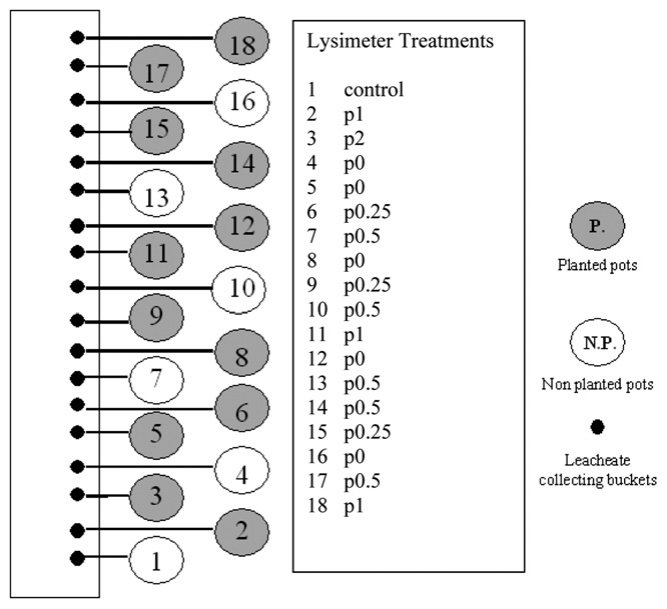
On the 1st of October (Day Of Experiment, DOE = 1), 12 of the lysimeters were planted with one 1 m unrooted willow rod each, inserted to a depth of 200 mm The poles had an average diameter of 32 mm and an average fresh weight of 540 g. Six of the lysimeters remained unplanted. Table 3 lists the treatments and the amounts of water, DE, and N that the lysimeters received. There were two control treatments (np0, p0), which received only water and four DE treatments (np0.5, p0.25, p0.5 and p1), with mixtures of water and DE. There were three replicates of each treatment distributed in a block design. Fig. 1 shows the experimental set up.
10月1日(试验日,DOE = 1),在其中12个渗漏计中各扦插一根长1 m的未生根柳树插条,插入深度200 mm。插条平均直径32 mm,平均鲜重540 g。其余6个渗漏计不种植。表3列出了各处理及渗漏计所接受的水、DE和N量。共设两个对照处理(np0、p0),仅施水;以及四个DE处理(np0.5、p0.25、p0.5和p1),施用水与DE的混合液。每个处理设三次重复,按区组设计排列。图1为试验装置示意。
| Effluent (g m�3)废水(g m�3) | Soil (mg kg�1)土壤(mg kg�1) | |
|---|---|---|
| pH | 7.8 | 5.7 |
| Organic carbon | 185 | 9000 |
| Total N | 110 | 475 |
| NH4eN | 95 | n.d. |
| NO3eN | 15 | n.d. |
| P | 24 | 287 |
| S | 2 | 41 |
| K | 168 | 10784 |
| Ca | 23 | 6332 |
| Mg | 14 | 2260 |
| Na | 8 | 3436 |
| Fe | 0.62 | 21729 |
| Zn | 0.11 | 40 |
| Mn | 0.68 | 332 |
| B | <0.1 | 2.3 |
| Co | n.d. | 8.3 |
| Mo | n.d. | 1.8 |
| Cl | 75 | 71 |
| Cu | <0.1 | 10.2 |
| Label标记 | Water added (m3)加水 量 (m3) | DE added (kg m�3)DE施加量 (kg m�3) | Equivalent DE application rate (kg Nitrogen ha�1)等效DE 施用量 (kg 氮 ha�1) | |
|---|---|---|---|---|
| np0 | no tree | 0.121 | 0 | 0 |
| np0.5 | no tree | 0.118 | 112000 | 279 |
| p0 | tree | 0.307 | 0 | 0 |
| p0.25 | tree | 0.331 | 56000 | 139 |
| p0.5 | tree | 0.345 | 112000 | 278 |
| p1 | tree | 0.343 | 224000 | 558 |
When we started the DE application, the willow rods had developed primary branches ca. 300 mm in length.
开始施用DE时,柳树插条已长出长约300 mm的一级枝条。
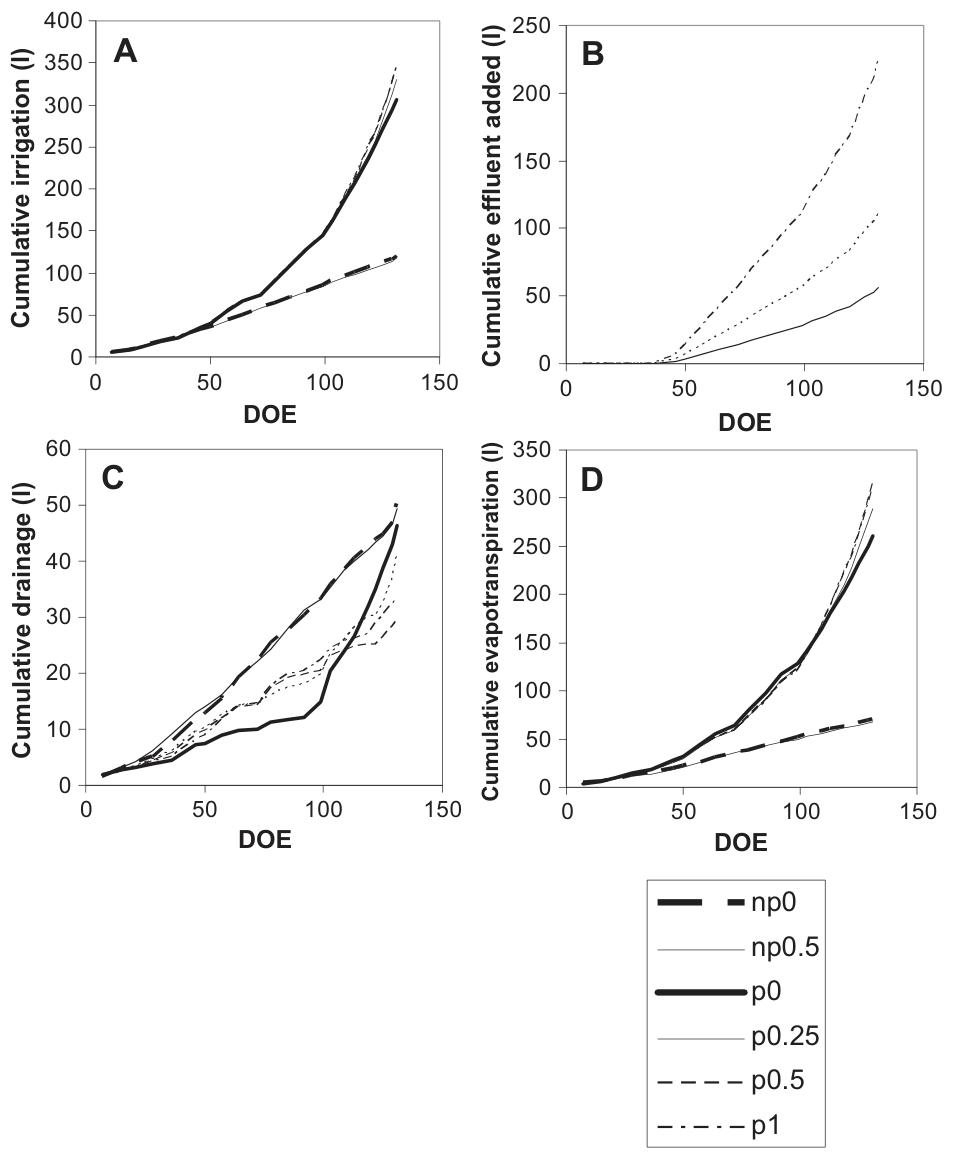
The DE used for this experiment was collected from an effluent storage pond on Massey University’s No. 4 dairy unit in early November. Table 2 shows the composition of the effluent. Effluent treatments began on the 15th of November (DOE ¼ 46). The DE along with extra water were applied daily at 8 am, to achieve 100e500 m3 of drainage per day. The control treatments were irrigated similarly with water. Fig. 2A and Fig. 2B show the cumulative volume of water and DE applied to each treatment. Drainage (Fig. 2C) was collected weekly and weighed. In the p0 treatment at DOE = 99, we increased the irrigation by 500 m3 per day in response to falling drainage volumes that were approaching our minimum threshold of 700 m3 per week. This caused a sharp increase in drainage volumes for this treatment (Fig. 2C). We did not determine the chemical composition of the drainage solutions.
本试验所用DE于11月初采自梅西大学第4号奶牛场的废水贮存池。表2列出了该废水的成分。废水处理于11月15日(DOE = 46)开始。每日上午8时施用DE及额外补充的水,使日排水量达到100–500 m3。对照处理以同样方式灌溉清水。图2A和图2B显示了各处理累计施用的水量和DE量。排水(图2C)每周收集并称重。在p0处理中,由于排水量下降并接近每周700 m3的最低阈值,于DOE = 99时将灌溉量每日增加500 m3,导致该处理排水量急剧增加(图2C)。本研究未测定排水溶液的化学组成。
An estimation of evapotranspiration was calculated by subtracting the drainage volume from the irrigation volume. An estimation of transpiration was calculated by subtracting the evaporation of the unplanted lysimeters from the evapotranspiration of the planted lysimeters.
以灌溉量减去排水量估算蒸散量;以种植渗漏计的蒸散量减去未种植渗漏计的蒸发量估算蒸腾量。
original poles, and the leaves separated from the stems. Plant materials were dried in an oven at 80 �C until a constant weight was obtained. The samples were weighed, ground using a Tecator - Cyclotek 1093 sample mill, and stored for analyses. For each lysimeter, ca. 100 g soil samples were taken from three depths: 25e30 cm, 30e60 cm and 60e80 cm. The samples were dried at 105 �C for 72 h, and then sieved to < 2 mm using a nylon sieve.
原始插条上分离,并将叶片与茎分开。植物材料于80 �C烘箱中烘干至恒重。样品称重后用Tecator - Cyclotek 1093样品磨粉碎,保存待分析。每个渗漏计分别在25–30 cm、30–60 cm和60–80 cm三个深度采集约100 g土样。样品于105 �C干燥72 h,然后用尼龙筛过< 2 mm筛。
2.1. Elemental determination2.1. 元素测定
Four grams of ground material were mixed with 0.9 g of wax and pressed into tablets under a force of 21 GPa. The total element concentrations of the tablets were determined at ETH Zu¨ rich, Switzerland, using a Spectro X-lab 2000 X-Ray Fluorescence (XRF) spectrometer. For quality assurance, we analysed 4 Wageningen soil standards, 958, 998, 989, and 951 [18] as well as a certified plant reference material (poplar leaves NCS DC73350, China National Analysis Center for Iron and Steel, Beijing, China). The average recoveries (our measured concentration as a percentage of the certified reference concentration) for soils were: Ca 113%, Cu 117%, Fe 106%, K 100%, Mg 89%, Mn 112%, P 154%, S 193%, Zn 101%. For the plant standard, the recoveries were: Ca 96%, Cu 101%, Fe 98%, K 97%, Mg 67%, Mn 126%, P 82%, S 87%, Zn 99%.
取4 g粉碎样品与0.9 g蜡混合,在21 GPa压力下压制成片。样片的全量元素浓度在瑞士苏黎世联邦理工学院(ETH Zürich)采用Spectro X-lab 2000 X射线荧光(XRF)光谱仪测定。为保证质量,分析了4个Wageningen土壤标样(958、998、989和951)[18]以及一种植物有证标准物质(杨树叶NCS DC73350,中国钢铁分析测试中心,北京,中国)。土壤的平均回收率(实测浓度占标准参考浓度的百分比)为:Ca 113%,Cu 117%,Fe 106%,K 100%,Mg 89%,Mn 112%,P 154%,S 193%,Zn 101%。植物标样的回收率为:Ca 96%,Cu 101%,Fe 98%,K 97%,Mg 67%,Mn 126%,P 82%,S 87%,Zn 99%。
The concentrations of cations in the DE were measured using a Varian ICP-OES. Total N in the DE, soil and leaf samples, as well as the DOC concentration in the DE was determined by a certified external laboratory (Laboratorio REI, s.r.l., via Spaggiari 110/A, 43100 Parma, Italy).
DE中的阳离子浓度采用Varian ICP-OES测定。DE、土壤和叶片样品的全N以及DE中的DOC浓度由一家经认证的外部实验室(Laboratorio REI, s.r.l., via Spaggiari 110/A, 43100 Parma, Italy)测定。
Significant differences between plant biomass production and water use, as well as elemental concentrations in plants and soils were analysed using ANOVA with Fisher’s Least- Significant-Difference post-hoc test to compare means. The level of significance was 0.05. The statistical package used was Minitab� 16.
采用ANOVA分析植物生物量生产和用水量以及植物和土壤元素浓度的显著性差异,并以Fisher最小显著差数(LSD)事后检验比较均值。显著性水平为0.05。所用统计软件为Minitab� 16。
On the 14th of February, the aboveground portions of the willows were excised, the new shoots separated from the
2月14日,剪下柳树地上部分,将新梢从
3Results and discussion结果与讨论
3.1. Tree water use and biomass production3.1. 树木用水与生物量生产
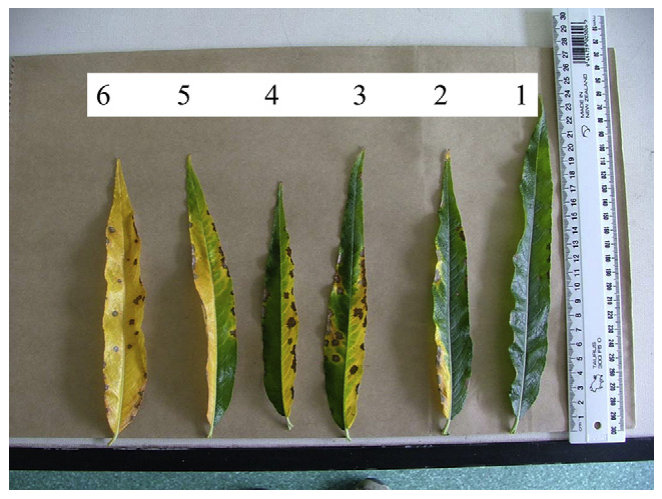
All trees grew throughout the experiment, although there were signs of chlorosis in the p1 treatment (Fig. 3). The p0.5 treatment produced the highest shoot biomass (Table 4). The roots of all trees in all the treatments had spread throughout the lysimeter. We did not quantify root mass or root distribution. Fig. 2D shows the cumulative evaporation (SE) for the unplanted lysimeters and the cumulative evapotranspiration (SET) from the planted lysimeters. The SET from the planted lysimeters was between 3.7 and 4.5 times that of the SE from the unplanted treatments. The p0.25, p0.5, and p1 treatments had significantly higher SET, than p0. There were no significant differences between the DE treatments. The cumulative transpiration (Table 4), as measured by subtracting the SE of unplanted treatment from those of the planted treatments, followed a similar pattern as SET. Leaf biomass as a percentage of total biomass (Table 4) was significantly higher in the p0.5 treatment. The higher proportion of leaf production upon DE application is advantageous because leaves are more palatable than stems to livestock, and have higher concentrations of essential elements (Table 5). The water use efficiency (WUE), calculated by the dividing the total aboveground biomass (kg) by the total water use (m3), was significantly higher in the p0.5 treatment compared to the other treatments.
试验期间所有树木均持续生长,但p1处理出现了黄化迹象(图3)。p0.5处理的地上部生物量最高(表4)。所有处理中树木根系均已遍布整个渗漏计。本研究未对根系质量或根系分布进行定量。图2D显示了未种植渗漏计的累计蒸发量(SE)和种植渗漏计的累计蒸散量(SET)。种植渗漏计的SET为未种植处理SE的3.7–4.5倍。p0.25、p0.5和p1处理的SET显著高于p0。各DE处理之间无显著差异。以种植处理的SE减去未种植处理的SE所得的累计蒸腾量(表4)呈现与SET相似的规律。p0.5处理中叶片生物量占总生物量的百分比(表4)显著较高。施用DE后叶片产量比例提高是有利的,因为叶片对牲畜的适口性优于茎,且必需元素浓度更高(表5)。以地上部总生物量(kg)除以总用水量(m3)计算的水分利用效率(WUE),p0.5处理显著高于其他处理。
3.2. Effect of DE addition on the elemental composition of plants and soils3.2. 添加DE对植物和土壤元素组成的影响
Table 5 shows the elemental concentrations in the leaves and stems of the willows at the end of the experiment. Plants in lysimeters receiving DE had significantly higher N, P, K and Cl concentrations compared to the control plants. There were no consistent increases or decreases among the trace elements or the macronutrients, Mg and Ca. This indicates that the application of DE is unlikely to affect the uptake of essential trace elements in animal nutrition, such as Zn, Cu and Fe.表5列出了试验结束时柳树叶片和茎中的元素浓度。与对照植物相比,接受DE的渗漏计中植物的N、P、K和Cl浓度显著较高。微量元素以及大量营养元素Mg和Ca均未出现一致的升高或降低。这表明施用DE不太可能影响动物营养所需的必需微量元素(如Zn、Cu和Fe)的吸收。
| Treatment处理 | p0 | p0.25 | p0.5 | p1 |
|---|---|---|---|---|
| Total dry shoot biomass (g) | 376 (39)a | 462 (21)ab | 581 (3)c | 536 (39)bc |
| % of total biomass as leaves | 42 (2)a | 52 (2)b | 57 (1)c | 54 (2)b |
| Transpiration (l) | 191 (11)a | 220 (10)b | 246 (4)b | 239 (7)b |
| WUE (kgm�3) | 1.97 (0.17)a | 2.10 (0.02)ab | 2.37 (0.04)b | 2.23 (0.13)ab |
Leaf N concentrations of the plants in this study were higher than corresponding values reported by Weih and Nordh [19] for various willow clones in agricultural soil that received 20 and 150 kg ha�1 of Nitrogen. However, levels were within the same range as those of Salix viminalis grown on arable land amended with 150e300 kg ha�1 of Nitrogen in a study conducted by Jung et al. [20]. Leaf phosphorous concentrations were below 1.8 g kg�1, a value reported by van den Burg [21] as sufficient for willow growth, although our values were comparable with those (ca 1e2 g kg�1) reported by von Fircks et al. [22] for healthy specimens of Salix dasyclados near the end of the growing season. Potassium concentrations were within the range (10e15 g kg�1) that Dimitiou et al. [23] reported for five willow clones grown on arable land in central Sweden.
本研究中植物叶片N浓度高于Weih and Nordh [19]报道的施用20和150 kg ha�1氮的农业土壤中多种柳树克隆的相应值。然而,其水平与Jung et al. [20]研究中施用150–300 kg ha�1氮的耕地上生长的Salix viminalis处于同一范围。叶片磷浓度低于van den Burg [21]报道的柳树生长充足值1.8 g kg�1,但与von Fircks et al. [22]报道的生长季末健康Salix dasyclados植株的数值(约1–2 g kg�1)相当。钾浓度处于Dimitiou et al. [23]报道的瑞典中部耕地上5个柳树克隆的范围(10–15 g kg�1)之内。
| Treatment处理 | p0 | p0.25 | p0.5 | p1 |
|---|---|---|---|---|
| N leaves | 24.1 (0.8)a | 31.6 (3.1)bc | 43.5 (0.4)c | |
| P leaves | 1.1 (0.1)a | 1.4 (0.1)ab | 1.4 (0.1)ab | 1.5 (0.1)b |
| P stems | 0.6 (0.0)a | 0.8 (0.0)ab | 0.9 (0.1)b | 0.9 (0.1)b |
| S leaves | 2.0 (0.1)a | 1.8 (0.1)a | 1.8 (0.1)a | 1.7 (0.1)a |
| N:S leaves | 12.0 (1.2)a | 16.5 (1.3)ab | 18.1 (2.1)b | 25.7 (1.6)c |
| S stems | 0.4 (0.0)a | 0.4 (0.0)a | 0.5 (0.1)a | 0.4 (0.0)a |
| K leaves | 11.6 (0.4)a | 14.3 (0.2)b | 14.8 (0.3)b | 14.8 (1.1)b |
| K stems | 3.6 (0.2)a | 5.2 (0.4)ab | 5.9 (0.8)b | 5.6 (0.6)b |
| Ca leaves | 11.2 (0.7)a | 13.2 (1.0) a | 11.6 (1.4)a | 11.6 (1.0)a |
| Ca stems | 6.6 (0.4)a | 7.2 (1.0) a | 7.6 (0.3)a | 7.8 (0.5)a |
| Mg leaves | 0.9 (0.0)a | 0.9 (0.0)a | 0.9 (0.1)a | 1.0 (0.0)a |
| Mg stems | 0.3 (0.0)a | 0.3 (0.0)ab | 0.4 (0.0)ab | 0.3 (0.0)b |
| Cl leaves | 1.6 (0.1)a | 2.4 (0.2)b | 2.8 (0.2)b | 3.4 (0.1)c |
| Cl stems | 0.1 (0.0)a | 0.2 (0.0)ab | 0.6 (0.2)ab | 0.8 (0.3)b |
| þFe leaves | 134 (2)a | 123 (19)ab | 85 (7)b | 117 (12)ab |
| þFe stems | 15 (1)a | 17(3)ab | 26 (3)b | 16 (3)a |
| þMn leaves | 55 (2)a | 52 (4)a | 48 (5)a | 73 (7)b |
| þMn stems | 22 (1)a | 18 (1)b | 19 (1)ab | 18 (1)b |
| þZn leaves | 36 (6)a | 51 (9)a | 50 (8)a | 38 (1)a |
| þZn stems | 40 (2)a | 46 (4)a | 42 (2)a | 36 (4)a |
| þCu leaves | 5.5 (0.2)a | 6.5 (0.2)b | 6.0 (0.4)a | 7.7 (0.2)b |
| þCu stems | 3.8 (0.3)a | 5.0 (0.1)b | 5.3 (0.5)ab | 5.3 (0.5)b |
| þB leaves | 17 (6)a | 35 (18)a | 25 (3)a | 25 (1)a |
There was a significant increase the foliar N:S concentration ratio in the DE treatments. This ratio was >15 in all the DE treatments, which may indicate an S deficiency [24]. In all treatments, foliar S concentrations were at the lower end of the range of concentrations (1.6e9.1 g kg�1) reported for healthy willow trees [23,25e27]. The decrease in plant S concentrations may not necessarily be caused by a reduction in S uptake by the roots. The higher biomass production of the treatments relative to the control implies that the shoot S concentration would decrease even if the root uptake remained constant.
DE处理中叶片N:S浓度比显著升高。所有DE处理中该比值均>15,可能指示S缺乏[24]。所有处理中,叶片S浓度均处于健康柳树报道浓度范围(1.6–9.1 g kg�1)的低端[23,25–27]。植物S浓度的降低并不一定由根系S吸收减少所致。与对照相比,各处理生物量产量较高,这意味着即使根系吸收保持不变,地上部S浓度也会降低。
There was a consistent increase in both the leaf and stem Cl concentration with increasing rates of DE application. Plant material from the p1 treatment contained twice the Cl concentration of the control (p0). In all plants, leaf Cl concentrations were an order of magnitude higher than 0.1 g kg�1, a value reported by Salisbury et al. [28] as adequate for higher plants. Zalesny and Bauer [27] reported no symptoms of Cl toxicity in willows with foliar Cl concentrations up to 1.9 mg kg�1, a concentration exceeded by all the DE treatments in this experiment. At the end of the experiment, one third of the leaves in plants under p1 regime were chlorotic, with symptoms resembling chloride toxicity (Fig. 3). Older leaves were the most affected, which is consistent with the toxicity symptoms of a xylem-transported element, such as Cl [28].
随着DE施用量增加,叶片和茎中Cl浓度均持续升高。p1处理植物材料中的Cl浓度为对照(p0)的两倍。所有植物叶片Cl浓度均比Salisbury et al. [28]报道的高等植物适宜值0.1 g kg�1高一个数量级。Zalesny and Bauer [27]报道,叶片Cl浓度高达1.9 mg kg�1的柳树未出现Cl毒害症状,而本试验所有DE处理均超过该浓度。试验结束时,p1处理植物中三分之一的叶片出现黄化,症状类似氯化物毒害(图3)。老叶受影响最严重,这与Cl等经木质部运输元素的毒害症状一致[28]。
With the exception of Cl, there were no significant differences in the elemental composition of the soils at the end of the experiment in any of the lysimeters (data not shown). Soil Cl concentrations (and standard errors) in the p0, p0.25, p0.5 and p1 treatments were 50(8), 70(21), 81(11), and 166(35) mg kg�1 respectively. This indicates that Cl accumulated in the DE treatments throughout the experiment. More chloride was added in the DE treatments than the plants accumulated in the shoots (Table 6). Except for a few soils with a high anion exchange capacity, chloride moves freely down the soil profile with percolating water [29]. In free-draining stands of DEirrigated willows, excess chloride will leach below the rootzone when rainfall is greater than evapotranspiration. Therefore, Cl toxicity is more likely in arid climes.
除Cl外,试验结束时各渗漏计土壤元素组成均无显著差异(数据未列出)。p0、p0.25、p0.5和p1处理的土壤Cl浓度(及标准误)分别为50(8)、70(21)、81(11)和166(35) mg kg�1。这表明试验期间Cl在DE处理中发生了累积。DE处理施入的氯化物多于植物地上部累积量(表6)。除少数阴离子交换量较高的土壤外,氯化物会随渗滤水沿土壤剖面自由下移[29]。在排水良好的DE灌溉柳树林分中,当降雨量大于蒸散量时,多余的氯化物将淋溶至根区以下。因此,Cl毒害更可能发生在干旱气候区。
| Treatment处理 | p0 | p0.25 | p0.5 | p1 |
|---|---|---|---|---|
| Cl added in effluent | 0 | 4.2 | 8.4 | 16.8 |
| Cl removed by plant | 0.3 (0.0)a | 0.6 (0.1)b | 1.1 (0.1)bc | 1.2 (0.1)c |
| Balance | �0.3 | 3.6 | 7.3 | 15.6 |
| N added in effluent | 0.0 | 6.2 | 12.3 | 24.6 |
| N removed by plant* | 3.8 (0.6)a | 7.0 (0.5)b | 10.4 (0.9)c | 12.7 (1.4)c |
| Balance | �3.8 | �0.8 | 1.9 | 11.9 |
| K added in effluent | 0.0 | 5.1 | 10.2 | 20.4 |
| K removed by plant | 2.6 (0.4)a | 4.6 (0.3)bc | 6.4 (0.1)c | 5.2 (0.4)c |
| Balance | �2.6 | 0.5 | 3.8 | 14.7 |
3.3. The amount of N, K, and Cl removed by the willows compared to that applied in the DE3.3. 柳树移除的N、K和Cl量与DE施入量的比较
Table 6 shows the total mass of N and K removed by the trees compared to the total mass of N and K that was applied with the DE. For the p0.5 and p1 treatments, the application rates both elements exceeded their rates of removal by the trees. This indicates that effluent application rates equivalent to the p0.5 and p1 treatments may result in high levels of N leaching (not measured in this study) and the accumulation of K in the soil. In the p0.5 treatment, equivalent to an N application rate of 279 kg ha�1 yr�1, the amounts of N and K extracted were similar to those applied. Nevertheless, leaching may occur in such a system due to preferential flow processes in the soil, which depend on rainfall distribution and soil type. Therefore, similar to pasture, the application rate of DE to willows should be determined with a series of field trials using recommended practices or, more efficiently, using simulations with mechanistic models such as SPASMO [30]. The acceptable rates of application are site-specific depending on local climatic and edaphic conditions.
表6列出了树木移除的N和K总量与随DE施入的N和K总量的比较。在p0.5和p1处理中,两种元素的施入量均超过树木的移除量。这表明相当于p0.5和p1处理的废水施用量可能导致较高水平的N淋溶(本研究未测定)以及K在土壤中累积。在相当于N施用量279 kg ha�1 yr�1的p0.5处理中,N和K的提取量与施入量相近。然而,由于土壤中存在优先流过程(取决于降雨分布和土壤类型),该系统中仍可能发生淋溶。因此,与牧场类似,向柳树施用DE的施用量应通过采用推荐做法的一系列田间试验确定,或更高效地利用SPASMO等机理模型进行模拟确定[30]。可接受的施用量具有场地特异性,取决于当地的气候和土壤条件。
Any leaching from a land treatment system could be mitigated if the drainage from the application area could be re-circulated onto the trees. Here, the maximum tolerable level of effluent application would be dependent on the tree health, rather than environmental concerns regarding the leaching. The long-term functioning of such systems may be susceptible to nutrient imbalances or the build up of solutes such as Cl and K. in the soil.
如果能将施用区的排水再循环回灌至树木,则可减轻土地处理系统的任何淋溶。在此情况下,废水施用的最大耐受水平将取决于树木健康状况,而非与淋溶相关的环境问题。此类系统的长期运行可能易受养分失衡或Cl和K等溶质在土壤中累积的影响。
4Conclusions结论
Potentially, dairy effluent could be irrigated onto stands of S. kinuyanagi to increase growth and produce nutritious biomass that could be fed back to the cows, thus resulting in increased nutrient cycling. The application of DE to S. kinuyanagi at rates up to the equivalent of 279 kg ha�1 of Nitrogen increased growth, transpiration, water use efficiency, and the percentage of biomass as leaves. There were no decreases in the shoot concentrations of animal-essential elements. The amounts of N and K removed by the plant were similar to those applied in the effluent. Soil Cl accumulation and consequent Cl toxicity may be problematic in areas where evapotranspiration exceeds rainfall.
奶牛场废水有望灌溉于S. kinuyanagi林分,以促进生长并生产可回饲奶牛的营养型生物质,从而增强养分循环。以最高相当于279 kg ha�1氮的施用量向S. kinuyanagi施用DE,提高了其生长量、蒸腾量、水分利用效率以及叶片占生物量的百分比。地上部动物必需元素浓度未见降低。植物移除的N和K量与随废水施入量相近。在蒸散量超过降雨量的地区,土壤Cl累积及由此引起的Cl毒害可能成为问题。
The results of this three-month study do not necessarily indicate the long-term response of willows to DE application. Therefore, a long-term field trial is warranted to test the relative efficiencies of willows and pasture under various DE treatment regimens. The results of such a trial could be used to develop guidelines for the maximum allowable rates of DE application to stands of willow.
本项为期三个月的研究结果并不一定能反映柳树对DE施用的长期响应。因此,有必要开展长期田间试验,以检验不同DE处理方案下柳树与牧草的相对效率。此类试验结果可用于制定柳树林分DE最大允许施用量的指南。
Acknowledgements致谢
The senior author gratefully acknowledges the receipt of an OECD fellowship for this work in New Zealand.
第一作者衷心感谢OECD奖学金对其在新西兰开展本研究的资助。
r e f e r e n c e s
[1] Houlbrooke DJ, Horne DJ, Hedley MJ, Hanly JA, Snow VO. A review of literature on the land treatment of farm-dairy effluent in New Zealand and its impact on water quality. New Zeal J Agr Res 2004;47(4):499e511.
[1] Houlbrooke DJ, Horne DJ, Hedley MJ, Hanly JA, Snow VO. A review of literature on the land treatment of farm-dairy effluent in New Zealand and its impact on water quality. New Zeal J Agr Res 2004;47(4):499e511.
[2] Di HJ, Cameron KC. Nitrate leaching and pasture production from different nitrogen sources on a shallow stoney soil under flood-irrigated dairy pasture. Aust J Soil Res 2002;40(2): 317e34.
[2] Di HJ, Cameron KC. Nitrate leaching and pasture production from different nitrogen sources on a shallow stoney soil under flood-irrigated dairy pasture. Aust J Soil Res 2002;40(2): 317e34.
[3] Sukias JPS, Tanner CC, Davies-Colley RJ, Nagels JW, Wolters R. Algal abundance, organic matter, and physicochemical characteristics of dairy farm facultative ponds: implications for treatment performance. New Zeal J Agr Res 2001;44(4):279e96.
[3] Sukias JPS, Tanner CC, Davies-Colley RJ, Nagels JW, Wolters R. Algal abundance, organic matter, and physicochemical characteristics of dairy farm facultative ponds: implications for treatment performance. New Zeal J Agr Res 2001;44(4):279e96.
[4] Hawke RM, Summers SA. Land application of farm dairy effluent: results from a case study, Wairarapa, New Zealand. New Zeal J Agri Res 2003;46(4):339e46.
[4] Hawke RM, Summers SA. Land application of farm dairy effluent: results from a case study, Wairarapa, New Zealand. New Zeal J Agri Res 2003;46(4):339e46.
[5] Bolan NS, Horne DJ, Currie LD. Growth and chemical composition of legume-based pasture irrigated with dairy farm effluent. New Zeal J Agri Res 2004;47(1):85e93.
[5] Bolan NS, Horne DJ, Currie LD. Growth and chemical composition of legume-based pasture irrigated with dairy farm effluent. New Zeal J Agri Res 2004;47(1):85e93.
[6] Roygard JKF, Clothier BE, Green SR, Bolan NS. Tree species for recovering nitrogen from dairy-farm effluent in New Zealand. J Environ Qual 2001;30(3):1064e70.
[6] Roygard JKF, Clothier BE, Green SR, Bolan NS. Tree species for recovering nitrogen from dairy-farm effluent in New Zealand. J Environ Qual 2001;30(3):1064e70.
[7] Bolan NS, Roygard JKF, Clothier BE, Green SR, Sims REH. Short rotation forestry for land treatment of effluent: a lysimeter study. Aust J Soil Res 1999;37(5):983e92.
[7] Bolan NS, Roygard JKF, Clothier BE, Green SR, Sims REH. Short rotation forestry for land treatment of effluent: a lysimeter study. Aust J Soil Res 1999;37(5):983e92.
[8] Aronsson PG, Bergstrom LF. Nitrate leaching from lysimetergrown short-rotation willow coppice in relation to Napplication, irrigation and soil type. Biomass Bioenerg 2001; 21(3):155e64.
[8] Aronsson PG, Bergstrom LF. Nitrate leaching from lysimetergrown short-rotation willow coppice in relation to Napplication, irrigation and soil type. Biomass Bioenerg 2001; 21(3):155e64.
[9] Elowson S. Willow as a vegetation filter for cleaning of polluted drainage water from agricultural land. Biomass Bioenerg 1999;16(4):281e90.
[9] Elowson S. Willow as a vegetation filter for cleaning of polluted drainage water from agricultural land. Biomass Bioenerg 1999;16(4):281e90.
[10] Hofmann-Schielle C, Jug A, Makeschin F, Rehfuess KE. Short-rotation plantations of balsam poplars, aspen and willows on former arable land in the Federal Republic of Germany. I. Site-growth relationships. For Ecol Manag 1999;121(1e2): 41e55.
[10] Hofmann-Schielle C, Jug A, Makeschin F, Rehfuess KE. Short-rotation plantations of balsam poplars, aspen and willows on former arable land in the Federal Republic of Germany. I. Site-growth relationships. For Ecol Manag 1999;121(1e2): 41e55.
[11] Labrecque M, Teodorescu TI, Daigle S. Effect of wastewater sludge on growth and heavy metal bioaccumulation of two Salix species. Plant Soil 1995;171(2):303e16.
[11] Labrecque M, Teodorescu TI, Daigle S. Effect of wastewater sludge on growth and heavy metal bioaccumulation of two Salix species. Plant Soil 1995;171(2):303e16.
[12] Heaton RJ, Sims REH, Tungcul RO. The root growth of Salix viminalis and Eucalyptus nitens in response to dairy farm pond effluent irrigation. Bioresour Technol 2002;81(1):1e6.
[12] Heaton RJ, Sims REH, Tungcul RO. The root growth of Salix viminalis and Eucalyptus nitens in response to dairy farm pond effluent irrigation. Bioresour Technol 2002;81(1):1e6.
[13] Wilkinson AG. Poplars and willows for soil erosion control in New Zealand. Biomass Bioenerg 1999;16(4):263e74.
[13] Wilkinson AG. Poplars and willows for soil erosion control in New Zealand. Biomass Bioenerg 1999;16(4):263e74.
[14] Douglas GB, Bulloch BT, Foote AG. Cutting management of willows (Salix spp) and leguminous shrubs for forage during summer. New Zeal J Agr Res 1996;39(2):175e84.
[14] Douglas GB, Bulloch BT, Foote AG. Cutting management of willows (Salix spp) and leguminous shrubs for forage during summer. New Zeal J Agr Res 1996;39(2):175e84.
[15] Robinson B, Mills T, Green S, Chancerel B, Clothier B, Fung L, et al. Trace element accumulation by poplars and willows used for stock fodder. New Zeal J Agr Res 2005;48(4):489e97.
[15] Robinson B, Mills T, Green S, Chancerel B, Clothier B, Fung L, et al. Trace element accumulation by poplars and willows used for stock fodder. New Zeal J Agr Res 2005;48(4):489e97.
[16] Weng LP, Temminghoff EJM, Lofts S, Tipping E, Van Riemsdijk WH. Complexation with dissolved organic matter and solubility control of heavy metals in a sandy soil. Environ Sci Technol 2002;36(22):4804e10.
[16] Weng LP, Temminghoff EJM, Lofts S, Tipping E, Van Riemsdijk WH. Complexation with dissolved organic matter and solubility control of heavy metals in a sandy soil. Environ Sci Technol 2002;36(22):4804e10.
[17] Bolan NS, Duraisamy VP. Role of inorganic and organic soil amendments on immobilisation and phytoavailability of heavy metals: a review involving specific case studies. Aust J Soil Res 2003;41(3):533e55.
[17] Bolan NS, Duraisamy VP. Role of inorganic and organic soil amendments on immobilisation and phytoavailability of heavy metals: a review involving specific case studies. Aust J Soil Res 2003;41(3):533e55.
[18] International soil-analytical exchange. World soil Resource Report 103 Wangeningen, Netherlands: EPAL Quarterly report 2006. ISSN 0532 0488 (http://www.fao.org/ag/agl/agll/ wrb/doc/wrb2006final.pdf).
[18] International soil-analytical exchange. World soil Resource Report 103 Wangeningen, Netherlands: EPAL Quarterly report 2006. ISSN 0532 0488 (http://www.fao.org/ag/agl/agll/ wrb/doc/wrb2006final.pdf).
[19] Weih M, Nordh NE. Characterising willows for biomass and phytoremediation: growth, nitrogen and water use of 14
[19] Weih M, Nordh NE. Characterising willows for biomass and phytoremediation: growth, nitrogen and water use of 14
willow clones under different irrigation and fertilisation regimes. Biomass Bioenerg 2002;23(6):397e413.
willow clones under different irrigation and fertilisation regimes. Biomass Bioenerg 2002;23(6):397e413.
[20] Jug A, Hofmann-Schielle C, Makeschin F, Rehfuess KE. Short-rotation plantations of balsam poplars, aspen and willows on former arable land in the Federal Republic of Germany. II. Nutritional status and bioelement export by harvested shoot axes. For Ecol Manag 1999;121(1e2):67e83.
[20] Jug A, Hofmann-Schielle C, Makeschin F, Rehfuess KE. Short-rotation plantations of balsam poplars, aspen and willows on former arable land in the Federal Republic of Germany. II. Nutritional status and bioelement export by harvested shoot axes. For Ecol Manag 1999;121(1e2):67e83.
[21] van den Burg J. Foliar analysis for determination of tree nutrient status - a compilation of literature data. De Dorschkamp. Wageningen, Netherlands: Institute of Forestry and Urban Ecology; 1990.
[21] van den Burg J. Foliar analysis for determination of tree nutrient status - a compilation of literature data. De Dorschkamp. Wageningen, Netherlands: Institute of Forestry and Urban Ecology; 1990.
[22] von Fircks Y, Ericsson T, Sennerby-Forsse L. Seasonal variation of macronutrients in leaves, stems and roots of Salix dasyclados Wimm. grown at two nutrient levels. Biomass Bioenerg 2001;21(5):321e34.
[22] von Fircks Y, Ericsson T, Sennerby-Forsse L. Seasonal variation of macronutrients in leaves, stems and roots of Salix dasyclados Wimm. grown at two nutrient levels. Biomass Bioenerg 2001;21(5):321e34.
[23] Dimitriou I, Aronsson P, Weih M. Stress tolerance of five willow clones after irrigation with different amounts of landfill leachate. Bioresour Technol 2006;97(1):150e7.
[23] Dimitriou I, Aronsson P, Weih M. Stress tolerance of five willow clones after irrigation with different amounts of landfill leachate. Bioresour Technol 2006;97(1):150e7.
[24] Duke SH, Reisenauer HM. Roles and requirements of sulfur in plant nutrition. In: Tabatabai MA, editor. Agronomy: a series of Monographs. Madison, Wisconsin, USA: American Society of Agronomy, Inc, Crops Science Society of America, Inc, Soils Science Society of America, Inc; 1986. p. 123.
[24] Duke SH, Reisenauer HM. Roles and requirements of sulfur in plant nutrition. In: Tabatabai MA, editor. Agronomy: a series of Monographs. Madison, Wisconsin, USA: American Society of Agronomy, Inc, Crops Science Society of America, Inc, Soils Science Society of America, Inc; 1986. p. 123.
[25] Garten CT. Species, part and seasonal differences in sulfur concentrations in woody-plants. Bull Environ Contam Toxicol 1977;17(2):127e31.
[25] Garten CT. Species, part and seasonal differences in sulfur concentrations in woody-plants. Bull Environ Contam Toxicol 1977;17(2):127e31.
[26] McBride MB. Trace metals and sulfur in soils and forage of a chronic wasting disease locus. Environ Chem 2007;4:134e9.
[26] McBride MB. Trace metals and sulfur in soils and forage of a chronic wasting disease locus. Environ Chem 2007;4:134e9.
[27] Zalesny RS, Bauer EO. Evaluation of Populus and Salix continuously irrigated with landfill leachate I. Genotypespecific elemental phytoremediation. Int J Phytorem 2007; 9(4):281e306.
[27] Zalesny RS, Bauer EO. Evaluation of Populus and Salix continuously irrigated with landfill leachate I. Genotypespecific elemental phytoremediation. Int J Phytorem 2007; 9(4):281e306.
[28] Salisbury FB, Ross CW. Plant Physiology. 4th ed. Belmont, CA: Wadsworth; 1992.
[28] Salisbury FB, Ross CW. Plant Physiology. 4th ed. Belmont, CA: Wadsworth; 1992.
[29] Mattern S, Vanclooster M. Estimating travel time of recharge water through a deep vadose zone using a transfer function model. Environ Fluid Mech 2010;10(1e2):121e35.
[29] Mattern S, Vanclooster M. Estimating travel time of recharge water through a deep vadose zone using a transfer function model. Environ Fluid Mech 2010;10(1e2):121e35.
[30] Green SR, Clothier BE, Mills TM, Millar A. Risk assessment of the irrigation requirements of field crops in a maritime climate. J Crop Prod 1999;2(2):353e77.
[30] Green SR, Clothier BE, Mills TM, Millar A. Risk assessment of the irrigation requirements of field crops in a maritime climate. J Crop Prod 1999;2(2):353e77.