REGULAR ARTICLE
Rainer Rees & Brett H. Robinson & Michael W. H. Evangelou & Eberhard Lehmann & Rainer Schulin
Received: 16 November 2011 /Accepted: 10 February 2012 /Published online: 8 March 2012 # Springer Science+Business Media B.V. 2012
1Abstract摘要
Background Poplars accumulate inordinate amounts of B in their leaves and are candidate plants for the remediation of B contaminated soil. We aimed to determine the effect of heterogeneous B distribution in soil by comparing the growth and B accumulation of young Populus tremula trees growing in soil with heterogeneous and homogeneous B distributions. Methods The first of two experiments focused on the tolerance and B accumulation of P. tremula under heterogeneous soil B distributions, while the second was designed to study fine root growth under such conditions in detail.
背景 杨树叶片可累积大量B,是修复B污染土壤的候选植物。本研究通过比较在B呈非均质分布与均质分布的土壤中生长的欧洲山杨(Populus tremula)幼树的生长及B累积,旨在明确土壤中B非均质分布的影响。方法 两项试验中,第一项试验着重研究土壤B非均质分布条件下P. tremula的耐受性及B累积,第二项试验则用于详细研究此类条件下细根的生长。
Responsible Editor: Juan Barcelo.
R. Rees (*) : M. W. H. Evangelou : R. Schulin Institute of Terrestrial Ecosystems, ETH Zurich, Universitätstrasse 16, 8092 Zürich, Switzerland e-mail: rainer.rees@env.ethz.ch
M. W. H. Evangelou e-mail: michael.evangelou@env.ethz.ch R. Schulin e-mail: rainer.schulin@env.ethz.ch
Results Growth and B accumulation of P. tremula were unaffected by the spatial distribution of B. Root and shoot growth were both reduced simultaneously when leaf B concentrations increased above 800 mg kg−1. In the heterogeneous soil B treatments, root growth was more reduced in spiked soil portions with B concentrations >20 mg kg−1. Fine root length growth was stronger inhibited by B stress than secondary growth. Conclusions The root growth responses of P. tremula to B are primarily a systemic effect induced by shoot B toxicity and local toxicity effects on roots become dominant only at rather high soil B concentrations. Local heterogeneity in soil B should have little influence on the phytoremediation of contaminated sites.
结果 P. tremula的生长及B累积不受B空间分布的影响。当叶片B浓度超过800 mg kg−1时,根系与地上部生长同时受到抑制。在土壤B非均质处理中,B浓度>20 mg kg−1的加标土壤部分中根系生长受抑制程度更大。与次生生长相比,细根长度生长受B胁迫的抑制更强。结论 P. tremula根系生长对B的响应主要是由地上部B毒害诱发的系统性效应,只有在土壤B浓度相当高时,根系的局部毒害效应才占主导地位。土壤B的局部非均质性对污染场地植物修复的影响应较小。
Keywords Boron . Heterogeneity. Local and systemic response . Root traits
关键词 硼.非均质性.局部与系统响应.根系性状
2Abbreviations缩略语
B Boron NR Neutron radiography FR Fine roots
B 硼 NR 中子成像 FR 细根
B. H. Robinson Soil and Physical Sciences, Burns 222, Lincoln University, PO Box 84, Lincoln 7647, Christchurch, New Zealand e-mail: Brett.Robinson@lincoln.ac.nz
E. Lehmann Spallation Neutron Source Division, Paul-Scherrer-Institut, 5232 Villigen PSI, Switzerland e-mail: eberhard.lehmann@psi.ch
3Introduction引言
Boron in soils
土壤中的硼
Boron (B) is an essential plant and animal micronutrient that becomes toxic at elevated concentrations (Mastromatteo and Sullivan 1994; Salisbury and Ross 1992; Xu et al. 2007). Boron deficiency symptoms become evident in plants at tissue concentrations of 10– 30 mg kg−1 (Bell 1997), while tissue concentrations >100 mg kg−1 are toxic for most plants. However, there is a wide range of toxicity thresholds in plants, sometimes even among varieties of the same species (Gupta et al. 1985; Nable et al. 1997).
硼(B)是植物和动物必需的微量营养元素,浓度升高时则具有毒性(Mastromatteo and Sullivan 1994; Salisbury and Ross 1992; Xu et al. 2007)。当组织B浓度为10–30 mg kg−1时,植物即表现出明显的缺B症状(Bell 1997),而组织浓度>100 mg kg−1对大多数植物具有毒性。然而,植物的毒性阈值范围很宽,有时甚至在同一物种的不同品种之间也存在差异(Gupta et al. 1985; Nable et al. 1997)。
Boron uptake by plants is closely related to soil B concentrations, which depend on geological parent material, soil type, soil pH, soil organic matter, natural and anthropogenic inputs and soil temperature (Goldberg 1997; Goldberg et al. 1993). High B concentrations occur naturally in many arid soils. Human activities leading to high soil B concentrations include the irrigation of agricultural fields with B laden waste or ground water, surface mining and the application of fly ash on agricultural fields (Nable et al. 1997; Parks and Edwards 2005).
植物对B的吸收与土壤B浓度密切相关,而后者取决于地质母质、土壤类型、土壤pH、土壤有机质、自然与人为输入以及土壤温度(Goldberg 1997; Goldberg et al. 1993)。许多干旱土壤中天然存在高浓度B。导致土壤B浓度升高的人类活动包括以含B废水或地下水灌溉农田、露天采矿以及在农田施用粉煤灰(Nable et al. 1997; Parks and Edwards 2005)。
Boron retention in soils generally increases with pH, organic matter and clay content (Goldberg 1997). The major form of B in the soil solution is boric acid, H3BO3 (pKa: 9.24) (Power and Woods 1997). Since soils generally have a pH <9.24, the neutral species is predominant in the soil solution of most soils (Hu and Brown 1997). Soil organic matter has a higher capacity for B sorption than mineral soil constituents (Goldberg 1997). Sorbed B is released into soil solution when B-binding soil organic matter gets decomposed by microbial activity (Evans and Sparks 1983; Van et al. 2005). Boron adsorption on soil mineral surfaces takes place rapidly via ligand exchange (Goldberg 1997). It can usually be described by Langmuir and Freundlich isotherms (Communar et al. 2004; Goldberg et al. 1993).
土壤对B的持留一般随pH、有机质及黏粒含量的增加而增强(Goldberg 1997)。土壤溶液中B的主要形态为硼酸H3BO3(pKa:9.24)(Power and Woods 1997)。由于土壤pH一般<9.24,大多数土壤的土壤溶液中以中性形态为主(Hu and Brown 1997)。土壤有机质对B的吸附能力高于土壤矿物组分(Goldberg 1997)。当结合B的土壤有机质被微生物活动分解时,被吸附的B即释放进入土壤溶液(Evans and Sparks 1983; Van et al. 2005)。B在土壤矿物表面的吸附通过配体交换迅速发生(Goldberg 1997),通常可用Langmuir和Freundlich等温线描述(Communar et al. 2004; Goldberg et al. 1993)。
4Phytomanagement of boron硼的植物管理
Boron contamination should be well suited for phytoremediation, as B is very mobile in soils and readily taken up by plants. Boron is primarily transported by convection with the flow of soil water (Blevins and Lukaszewski 1998; Ishak et al. 2002; Kabata-Pendias and Pendias 2001). It is taken up by plants as undissociated H3BO3, which is small enough to pass through cell membranes via aquaporins (Tanaka and Fujiwara 2008). Passive uptake and translocation with the stream of transpiration water explains the results of Rees et al. (2011) who found the highest B concentrations in the oldest leaves of a hybrid poplar clone. In B-deficient conditions, active uptake may occur in some plant species (Miwa and Fujiwara 2010). Poplars are widely used for the phytomanagement of contaminated sites and are particularly suited for the revegetation of B contaminated sites because they are tolerant of high soil and leaf B concentrations (Bañuelos et al. 2010; Robinson et al. 2007, 2009). The species of Populus used in this experiment, P. tremula is known for its adaptability to a wide range of climate and soil conditions, is highly drought tolerant and may be the world’s most widely distributed tree species (Worrell 1995). The B tolerance and accumulation potential of P. tremula has not been evaluated, however P. tremula is tolerant of elevated soil loadings of other trace elements such as Zn and Cd (Dos Santos Utmazian et al. 2007; Menon et al. 2007a).
B污染应非常适合采用植物修复,因为B在土壤中迁移性很强,且易被植物吸收。B主要随土壤水流以对流方式迁移(Blevins and Lukaszewski 1998; Ishak et al. 2002; Kabata-Pendias and Pendias 2001)。植物以未解离的H3BO3形式吸收B,该分子足够小,可经水通道蛋白穿过细胞膜(Tanaka and Fujiwara 2008)。被动吸收及随蒸腾水流的转运可解释Rees et al.(2011)的结果,即在一个杂交杨无性系中最老叶片的B浓度最高。在缺B条件下,某些植物物种可能发生主动吸收(Miwa and Fujiwara 2010)。杨树被广泛用于污染场地的植物管理,由于其能耐受较高的土壤及叶片B浓度,尤其适用于B污染场地的植被重建(Bañuelos et al. 2010; Robinson et al. 2007, 2009)。本试验所用的杨属物种P. tremula以对多种气候和土壤条件的适应性著称,高度耐旱,可能是世界上分布最广的树种(Worrell 1995)。P. tremula的B耐受性及累积潜力尚未得到评估,但P. tremula能耐受土壤中较高负荷的其他微量元素,如Zn和Cd(Dos Santos Utmazian et al. 2007; Menon et al. 2007a)。
5Heterogeneity and phytomanagement非均质性与植物管理
While test trials in growth chambers or greenhouses provide useful information about the potential use of plants in phytomanagement, the performance of the same plants may be vastly different in the field. One important problem is the heterogeneous distribution of contaminants in field soils, which is usually not represented in pot experiments (Robinson et al. 2009; Wenzel 2009). This may affect contaminant tolerance and uptake, which are of critical importance in phytomanagement.
尽管在生长室或温室中进行的试验可为植物在植物管理中的潜在应用提供有用信息,但同一植物在田间的表现可能大不相同。一个重要问题是田间土壤中污染物呈非均质分布,而盆栽试验通常无法体现这一点(Robinson et al. 2009; Wenzel 2009)。这可能影响植物对污染物的耐受性和吸收,而二者对植物管理至关重要。
Soil B concentrations may change by an order of magnitude or more over just a few centimeters (Hall 1971; McLaren and Cameron 1996). Plant root growth can respond to soil patches with increased trace element concentrations in three different ways: reduction/ avoidance (Breckle and Kahle 1992; Moradi et al. 2009b), indifference (Moradi et al. 2009b) or proliferation (Liu et al. 2010; Schwartz et al. 1999; Whiting et al. 2000). In contrast to macronutrient patchiness effects (Robinson 1994), little is known about the response of roots to B enriched soil patches. Menon et al. (2007b) found that roots of Lupinus albus L. did not grow into patches of high B concentrations in soil.
土壤B浓度在仅几厘米的范围内即可变化一个数量级甚至更多(Hall 1971; McLaren and Cameron 1996)。植物根系生长对微量元素浓度较高的土壤斑块可能有三种不同响应:减少/回避(Breckle and Kahle 1992; Moradi et al. 2009b)、无差异(Moradi et al. 2009b)或增生(Liu et al. 2010; Schwartz et al. 1999; Whiting et al. 2000)。与大量营养元素斑块效应(Robinson 1994)不同,关于根系对富B土壤斑块的响应知之甚少。Menon et al.(2007b)发现,白羽扇豆(Lupinus albus L.)的根系不会长入土壤中的高B浓度斑块。
Poplars are plastic in their responses to variations in soil conditions (Friend et al. 1999; Mulia and Dupraz 2006). Rees et al. (2011) observed that the root:shoot ratio decreased in young poplar plants with increasing soil B concentration, indicating that root biomass responds more sensitively to B stress than the aboveground biomass in poplar. Adjusting the morphology of their fine roots (FR) to varying soil conditions enables them to adapt to a wide range of stress conditions in soil (Pregitzer and Friend 1996). Fine root diameter and particularly relative FR diameter class length (ratio of FR length per diameter class/total FR length) are sensitive parameters often used to assess the response of FR to changing soil chemical conditions (Borken et al. 2007; Zobel 2008). However, there are no studies on the effect of patchy soil B distributions on poplar root growth.
杨树对土壤条件变化的响应具有可塑性(Friend et al. 1999; Mulia and Dupraz 2006)。Rees et al.(2011)观察到,杨树幼株的根冠比随土壤B浓度的升高而降低,表明杨树根系生物量对B胁迫的响应比地上部生物量更为敏感。通过调整细根(FR)形态以适应不同的土壤条件,杨树能够适应多种土壤胁迫条件(Pregitzer and Friend 1996)。细根直径,尤其是相对细根径级长度(各径级细根长度/细根总长度之比),是常用于评估细根对土壤化学条件变化响应的敏感参数(Borken et al. 2007; Zobel 2008)。然而,目前尚无关于土壤B斑块状分布对杨树根系生长影响的研究。
Given the lack of knowledge on root responses to heterogeneous B distributions in soil and the potential implications of these responses for the phytomanagement of B-contaminated sites, the objectives of this study were to investigate (1) whether P. tremula tolerates higher average soil B concentrations when B is heterogeneously distributed than when it is homogeneously distributed, (2) how P. tremula roots respond to B-enriched soil patches, and (3) how B-uptake by P. tremula is affected by spatial heterogeneity in soil B. Root growth responses to soil heterogeneity are notoriously challenging to assess under field conditions, because it is usually difficult to determine the spatial distribution of all relevant factors around plant roots with sufficient accuracy or to control confounding factors. Therefore, we used pot experiments to assess growth and B uptake of P. tremula seedlings to welldefined constructed heterogeneities in the soil B distribution.
鉴于目前对根系响应土壤中B非均质分布的认识不足,以及这些响应对B污染场地植物管理的潜在意义,本研究的目的是探讨:(1)与B均质分布相比,当B呈非均质分布时P. tremula是否能耐受更高的土壤平均B浓度;(2)P. tremula根系如何响应富B土壤斑块;(3)土壤B的空间非均质性如何影响P. tremula对B的吸收。在田间条件下评估根系生长对土壤非均质性的响应极具挑战性,因为通常难以足够准确地测定植物根系周围所有相关因子的空间分布,也难以控制混杂因子。因此,本研究采用盆栽试验,评估P. tremula幼苗在人为构建的、明确界定的土壤B非均质分布条件下的生长及B吸收。
6Material & methods材料与方法
7Experiment 1试验1
Two experiments were performed. In the first experiment (Exp 1) we compared the growth and B uptake of P. tremula seedlings growing on soil with heterogeneous B distribution to that of P. tremula growing on soil with homogeneous B distribution. We used subsoil, an acidic loamy sand (87% sand, 8% silt, 5% clay) originating from a Haplic Alisol from Eiken, Switzerland. The B concentration of this soil was 2.1 mg kg−1. Other physical and chemical soil properties have been described by Nowack et al. (2006) and Moradi et al. (2009a). This soil was chosen for both experiments because it allowed for easy root visualization by means of neutron radiography (NR) in Experiment 2 (Moradi et al. 2009a). To facilitate plant establishment and to avoid Al-toxicity, the soil pH was raised from 4.2 to 6.5 by addition of CaCO3. A small portion of this soil was thoroughly mixed with H3BO3 powder giving a stock of soil with a total B concentration of 26.4 mg kg−1. By means of stepwise dilution of the stock soil with unspiked soil, we produced soil batches with B concentrations of 2.7, 3.3, 4.3, 7.3 and 13.5 mg kg−1. One set of Al containers (internal dimensions of 17 height×15 width×1.2 depth cm) was filled homogeneously with spiked soil from these batches and un-spiked soil for control. Containers of a second set of containers were each filled with unspiked soil on one and spiked soil on the other side. For this purpose they were divided into two compartments by a temporary divider during filling. After filling, the divider was removed, taking care that the two soils did not mix. Each of the resulting 2×6 heterogeneous and homogeneous treatments with B-spiked soil as well as the homogeneous treatment with unspiked soil (control) were prepared in triplicate. A 5 cm cutting of a P. tremula provenance Birmensdorf (Qin et al. 2007) clone was planted in the middle of each container. The plants were grown for 86 days in a climate chamber (16 hday (22°C)/7 h night (15°C) cycle, 0.5 h transition time, 75% relative humidity). The pots were irrigated every 2nd to 3rd day to keep the soil water content between 15 and 20%. Water and Bfree Hoagland’s solution (Hoagland and Arnon 1938) were alternately used for irrigation to meet the nutrient demands of the plants.
本研究共进行了两项试验。在第一项试验(Exp 1)中,比较了P. tremula幼苗在B非均质分布土壤与B均质分布土壤中的生长及B吸收。供试土壤为采自瑞士Eiken的一种简育高活性强酸土(Haplic Alisol)的底土,为酸性壤质砂土(砂粒87%、粉粒8%、黏粒5%)。该土壤B浓度为2.1 mg kg−1,其他理化性质见Nowack et al.(2006)和Moradi et al.(2009a)。两项试验均选用该土壤,因其便于在试验2中利用中子成像(NR)观测根系(Moradi et al. 2009a)。为促进植物定植并避免Al毒害,通过添加CaCO3将土壤pH由4.2提高至6.5。取少量该土壤与H3BO3粉末充分混匀,制得总B浓度为26.4 mg kg−1的母土。通过用未加标土壤逐级稀释母土,制备了B浓度分别为2.7、3.3、4.3、7.3和13.5 mg kg−1的系列土壤。第一组Al制容器(内部尺寸为高17 cm×宽15 cm×深1.2 cm)均匀装填上述各批次加标土壤,对照则装填未加标土壤。第二组容器每个均一侧装填未加标土壤、另一侧装填加标土壤。为此,装填时用临时隔板将容器分为两室;装填完成后移除隔板,并注意避免两种土壤混合。由此得到的2×6个含B加标土壤的非均质与均质处理,以及未加标土壤的均质处理(对照),均设3次重复。在每个容器中央扦插一段5 cm长的P. tremula(种源Birmensdorf)无性系插条(Qin et al. 2007)。植物在人工气候室中生长86天(光照16 h(22°C)/黑暗7 h(15°C)循环,过渡时间0.5 h,相对湿度75%)。每隔2nd至3rd天灌溉一次,使土壤含水量保持在15%–20%。灌溉时交替使用水和不含B的Hoagland营养液(Hoagland and Arnon 1938),以满足植物的养分需求。
8Experiment 2试验2
The second experiment (Exp 2) focused on FR growth responses to heterogeneous B distribution. Here, Alcontainers with internal dimensions of 67 height×64 width×1.2 depth cm were used. The same soil and cuttings of the same P. tremula clone were used as in Exp 1. Again a control (unspiked soil), a homo- and a heterogeneous B-treatment were established in triplicate. In each container of the heterogeneous treatment, a lateral third of the total soil packing was spiked with the same total amount of H3BO3 as the whole packing in the homogeneous treatment. The resulting concentrations were 8.9 mg kg−1 in the homogenous treatment and 22.5 mg kg−1 in the spiked portion of the heterogeneous treatment. To avoid soil layering, the containers were laid down, the front panel was removed and the containers were filled from the open front side.
第二项试验(Exp 2)着重研究细根生长对B非均质分布的响应。本试验采用内部尺寸为高67 cm×宽64 cm×深1.2 cm的Al制容器,所用土壤及P. tremula无性系插条与试验1相同。同样设置对照(未加标土壤)、B均质处理和B非均质处理,各3次重复。在非均质处理的每个容器中,对全部装填土壤侧向的三分之一进行加标,所加H3BO3总量与均质处理整个容器装填土壤的加标量相同。由此,均质处理的B浓度为8.9 mg kg−1,非均质处理加标部分的B浓度为22.5 mg kg−1。为避免土壤分层,将容器平放、拆除前面板,从敞开的正面装填土壤。
Before planting, the bare soil was irrigated for 2 weeks to allow the soil to settle. For the first 2 months, the plants were grown under greenhouse conditions with natural lighting at the Paul-Scherrer- Institute (PSI), Villigen, Switzerland. Then the containers were transferred for logistic reasons into the climate chamber at ETH, where the experiment was continued for another 4 months. As in Exp 1, the gravimetric water content of the soil was kept at 15– 20%, which was a compromise avoiding water stress on one hand but still giving sufficient root-soil contrast in neutron radiography images on the other hand (Moradi et al. 2009a).
种植前,对裸土灌溉2周以使土壤沉实。在前2个月,植物在瑞士Villigen的Paul Scherrer研究所(PSI)温室中于自然光照条件下生长。随后出于后勤原因,将容器转移至ETH的人工气候室,试验又持续了4个月。与试验1相同,土壤质量含水量保持在15%–20%,这一折中方案一方面可避免水分胁迫,另一方面又能在中子成像图像中获得足够的根–土对比度(Moradi et al. 2009a)。
9Neutron radiography中子成像
Neutron imaging of root growth in Exp 2 was performed at the NEUTRA facility (Lehmann et al. 2001) of the PSI every 3–4 weeks over 6 months. Neutron radiography is a non-invasive and non-destructive technique that can be used to study the development of plant roots in soil (Luster et al. 2009; Menon et al. 2007b; Moradi et al. 2009a). Because hydrogen strongly attenuates neutrons, NR can image root structures non-destructively with high spatial resolution if there is sufficient contrast between the moisture content of the surrounding porous medium and the roots. As roots have a higher water content than soil, optimum contrast is achieved when the soil water content is low. The size of the scintillator used was 279× 234 mm (1,048×879 pixel). The exposure time was 30 s and the scintillator object distance was 10 cm. The NR images were corrected using the method described by Moradi et al. (2009a). After correction, the 9 NR partial images of a given recording needed to cover a whole container were assembled to one single picture. Depth growth of the main root was measured manually by means of an image analysis program. To determine the minimum root diameter of roots visible in the neutron radiographs, the root length in the neutron radiographs were compared with root length measurements by size classes from WinRhizo (Regent Instruments, Inc. 2009).
试验2中根系生长的中子成像在PSI的NEUTRA装置(Lehmann et al. 2001)上进行,6个月内每3–4周成像一次。中子成像是一种非侵入性、非破坏性技术,可用于研究土壤中植物根系的发育(Luster et al. 2009; Menon et al. 2007b; Moradi et al. 2009a)。由于氢对中子具有强衰减作用,若周围多孔介质与根系的含水量之间存在足够对比,NR即可以高空间分辨率无损地对根系结构成像。由于根系含水量高于土壤,土壤含水量较低时可获得最佳对比度。所用闪烁体尺寸为279×234 mm(1,048×879像素),曝光时间为30 s,闪烁体与样品距离为10 cm。NR图像按Moradi et al.(2009a)所述方法进行校正。校正后,将覆盖整个容器所需的某次记录的9幅NR局部图像拼接为一幅完整图像。主根的纵深生长借助图像分析程序人工测量。为确定中子成像图中可见根系的最小根径,将中子成像图中的根长与WinRhizo(Regent Instruments, Inc. 2009)按径级测得的根长进行了比较。
10Analysis of plant samples植物样品分析
At the end of each experiment, the aboveground biomass of all seedlings was harvested, separated into stems and leaves and dried until no further weight loss occurred. After harvesting the plants, the containers were opened laterally and in the case of Exp 1 the soil of each container was sub-divided into two equal portions, representing the two halves of the container. In the case of Exp 2, the soil of each container was divided into 3×3 equal portions, representing the 3 soil depths layers and 3 vertical columns that had been imaged separately. The roots of each soil portion were separated from the soil by washing. In Exp 2, the roots were scanned in a water bath at 400 dpi with a backlighting scanner (Epson Expression 10000XL) prior to drying and further analysis. The maximum scanning density of 3 cm root lengths cm−2 scanner surface recommended by Himmelbauer et al. (2004) was not exceeded. After scanning, root lengths and diameters were determined by means of image analysis software WinRhizo. The containers were stored at 4°C in a cooling chamber until scanning.
每项试验结束时,收获所有幼苗的地上部生物量,分为茎和叶,干燥至恒重。收获植物后,从侧面打开容器;试验1中每个容器的土壤被分为相等的两部分,分别代表容器的两半。试验2中每个容器的土壤被分为3×3个相等部分,分别代表此前分别成像的3个土壤深度层和3个纵向列。各土壤部分中的根系通过冲洗与土壤分离。试验2中,根系在干燥及进一步分析之前,用背光扫描仪(Epson Expression 10000XL)在水浴中以400 dpi进行扫描,扫描密度未超过Himmelbauer et al.(2004)推荐的最大值3 cm根长 cm−2扫描面积。扫描后,利用图像分析软件WinRhizo测定根长和根径。扫描前,容器置于4°C冷藏室中保存。
In both experiments, total root mass and FR biomass (<2 mm) were determined after drying at 40°C until a constant weight was obtained. For chemical analysis all plant samples (stems, leaves, roots) from both experiments were digested in a heating block at 130°C with 65% HNO3 and analyzed for B and other elements using ICP-OES (Vista MPX, Varian, Australia). To minimize B memory effects the instrument was rinsed with a 2% mannitol solution after each sample.
两项试验中,总根质量和细根生物量(<2 mm)均在40°C下干燥至恒重后测定。化学分析时,两项试验的所有植物样品(茎、叶、根)均在加热块中于130°C用65% HNO3消解,并采用ICP-OES(Vista MPX,Varian,澳大利亚)测定B及其他元素。为尽量减小B记忆效应,每个样品测定后用2%甘露醇溶液冲洗仪器。
11Statistics统计分析
Mean shoot B concentrations were calculated as massweighted averages of the B concentrations of the individual plant parts. Analysis of variance was performed to test for treatment effects on biomass and B concentrations, followed by Fisher-LSD post-hoc test to compare pair-wise differences between treatments. Values given for correlations between variables represent Pearson’s correlation coefficients. All statistical analyses were carried out using Sigma Plot 11 (Systat Software 2008).
地上部平均B浓度按各植物部位B浓度的质量加权平均值计算。采用方差分析检验处理对生物量和B浓度的影响,随后采用Fisher-LSD事后检验比较处理间的两两差异。变量间相关性采用Pearson相关系数表示。所有统计分析均使用Sigma Plot 11(Systat Software 2008)完成。
12Results结果
13Shoot and root growth地上部与根系生长
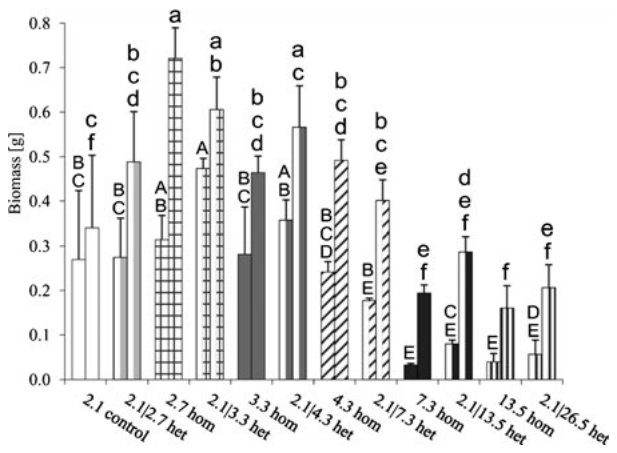
The soil B concentrations applied in Exp 1 resulted in a concentration series covering the entire range from deficiency to toxicity. The control treatment had the lowest soil B concentration (2.1 mg kg−1) and here the plants seemed to be marginal B deficient, as indicated by the significantly lower shoot growth compared to the homogeneous 2.7 mg kg−1 and the heterogeneous 2.1|3.3 mg kg−1 treatments. These two treatments had the same average soil B concentration and the largest shoot growth of all treatments (Fig. 1). Compared to the homogeneous 2.7 mg kg−1 and the heterogeneous 2.1|3.3 mg kg−1 treatment shoot growth was significantly reduced at soil B concentrations ≥7.3 mg kg−1 and symptoms of B toxicity like burned leaf margins became visible. The plants did not survive at the highest homogeneous B treatment level (26.5 mg kg−1) in contrast to the highest heterogeneous treatment level (2.1|26.5 mg kg−1), at which the average B concentration was similar to the homogeneous 13.5 mg kg−1 treatment. Although there was a trend for larger shoot growth in the heterogeneous treatments compared to the respective homogeneous treatments at average soil B concentrations ≥7.3 mg kg−1, these differences were not significant. Compared to the homogeneous treatments the plants in the heterogeneous treatments did not benefit from the presence of half of their root system in low B soil.
试验1中施加的土壤B浓度形成了一个涵盖从缺乏到毒害整个范围的浓度系列。对照处理的土壤B浓度最低(2.1 mg kg−1),此处植物似乎处于轻微缺B状态,表现为其地上部生长显著低于均质2.7 mg kg−1处理和非均质2.1|3.3 mg kg−1处理。后两个处理的土壤平均B浓度相同,且地上部生长在所有处理中最大(图1)。与均质2.7 mg kg−1处理和非均质2.1|3.3 mg kg−1处理相比,土壤B浓度≥7.3 mg kg−1时地上部生长显著降低,并出现叶缘焦枯等B毒害症状。在最高B水平的均质处理(26.5 mg kg−1)中植物未能存活,而在最高水平的非均质处理(2.1|26.5 mg kg−1)中植物存活,该处理的平均B浓度与均质13.5 mg kg−1处理相近。尽管在土壤平均B浓度≥7.3 mg kg−1时,非均质处理的地上部生长有大于相应均质处理的趋势,但差异不显著。与均质处理相比,非均质处理中的植物并未因一半根系处于低B土壤中而受益。
While shoot biomass was always larger than root biomass, both were closely correlated to each other (y01.11 x+0.17; r²00.78; p<0.001). At low average soil B concentrations (2.1–2.7 mg kg−1), shoot growth was more stimulated by B spiking than root growth. The root:shoot ratio was significantly lower in the homogeneous 2.7 mg kg−1 treatment than in the control (data not shown). The maximum root:shoot ratio (0.8) was found in the heterogeneous treatment with an average soil B concentration of 2.7 mg kg−1. At soil B concentrations ≥7.3 mg kg−1 the root:shoot ratio significantly declined, indicating a stronger B toxicity in the roots than in the shoots.
尽管地上部生物量始终大于根系生物量,但二者密切相关(y = 1.11x + 0.17;r² = 0.78;p<0.001)。在土壤平均B浓度较低(2.1–2.7 mg kg−1)时,B加标对地上部生长的促进作用大于根系生长。均质2.7 mg kg−1处理的根冠比显著低于对照(数据未列出)。最大根冠比(0.8)出现在土壤平均B浓度为2.7 mg kg−1的非均质处理中。土壤B浓度≥7.3 mg kg−1时根冠比显著下降,表明根系所受B毒害强于地上部。
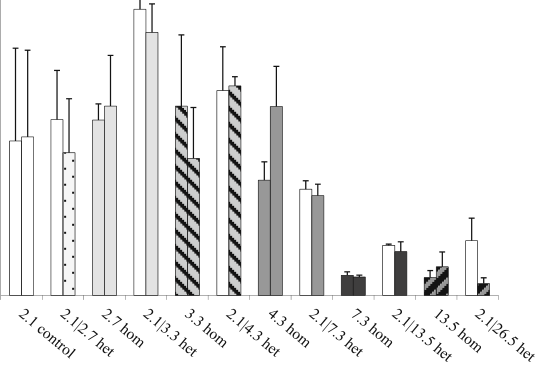
In Exp 1 we found no significant effects of the heterogeneous distribution of soil B on FR biomass when we compared the spiked with the unspiked portions of the containers (Fig. 2). At the highest B level in the heterogeneous treatment, FR biomass was 4 times lower in the spiked than in the unspiked portion, but this difference was not significant, due to the high variability in FR biomass. In the heterogeneous treatments it became obvious that the significantly reduced total FR biomass (Fig. 1) at average soil B concentrations ≥7.3 mg kg−1 was due to root growth reduction in the spiked and the unspiked soil portions.
在试验1中,比较容器加标部分与未加标部分时,未发现土壤B非均质分布对细根生物量有显著影响(图2)。在非均质处理的最高B水平下,加标部分的细根生物量比未加标部分低4倍,但由于细根生物量变异较大,该差异不显著。在非均质处理中可以明显看出,土壤平均B浓度≥7.3 mg kg−1时细根总生物量的显著降低(图1)是由于加标和未加标土壤部分的根系生长均受到抑制所致。
Exp 2 showed that FR length was more affected by high B concentrations than FR biomass. The B treatments did not affect FR length in the uppermost third of the soil (0–21 cm) and total FR length. In contrast, we found significantly reduced FR lengths compared to the control in the heterogeneous B-treatment at soil depth >21 cm and in the homogeneous B treatment at soil depth >42 cm (Fig. 3). In two of the three
试验2表明,细根长度比细根生物量更易受高B浓度的影响。B处理未影响最上层三分之一土壤(0–21 cm)中的细根长度及细根总长度。相反,与对照相比,非均质B处理在土壤深度>21 cm处、均质B处理在土壤深度>42 cm处的细根长度显著降低(图3)。在三个中的两个
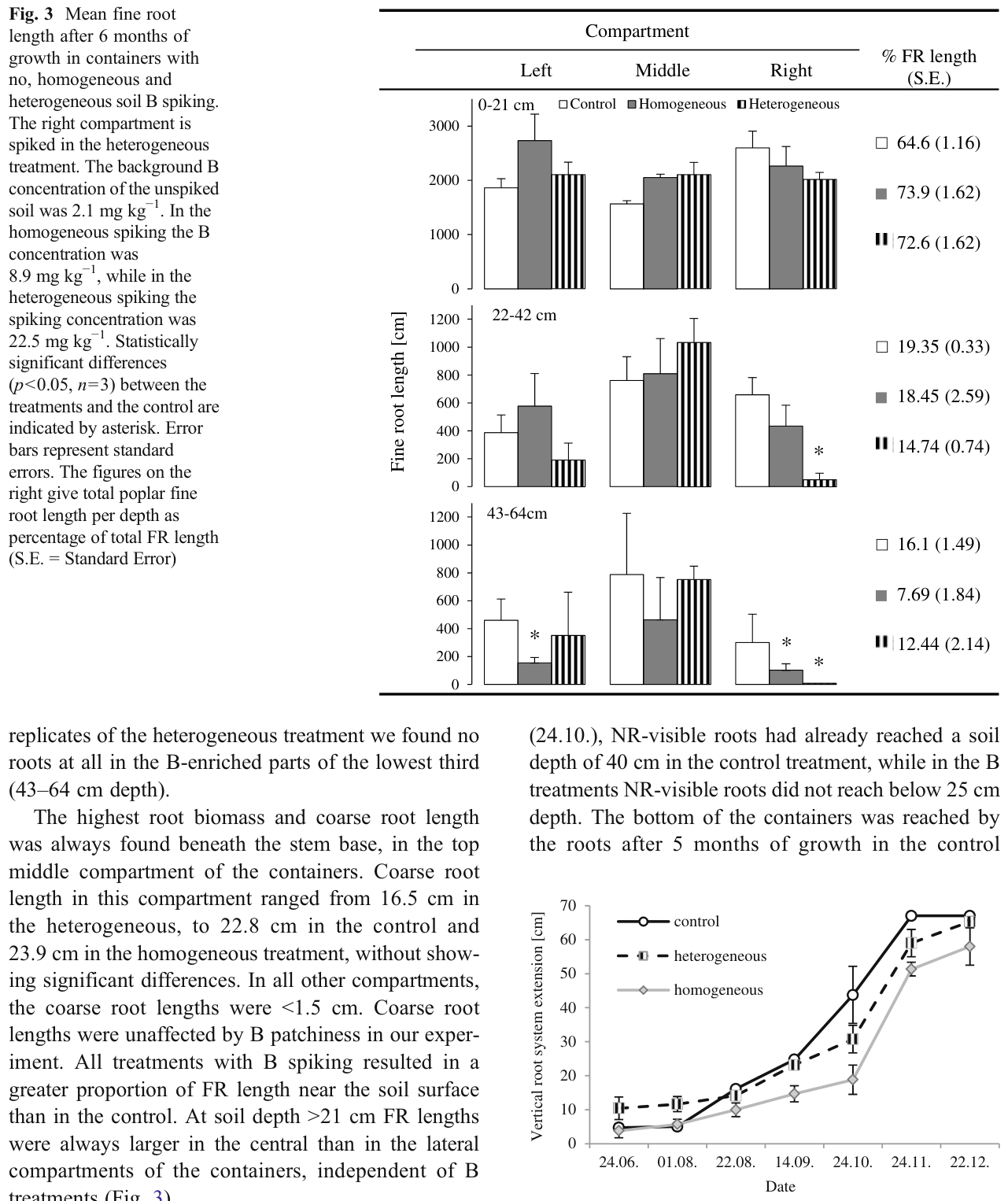
The highest root biomass and coarse root length was always found beneath the stem base, in the top middle compartment of the containers. Coarse root length in this compartment ranged from 16.5 cm in the heterogeneous, to 22.8 cm in the control and 23.9 cm in the homogeneous treatment, without showing significant differences. In all other compartments, the coarse root lengths were <1.5 cm. Coarse root lengths were unaffected by B patchiness in our experiment. All treatments with B spiking resulted in a greater proportion of FR length near the soil surface than in the control. At soil depth >21 cm FR lengths were always larger in the central than in the lateral compartments of the containers, independent of B treatments (Fig. 3).
最高的根系生物量和粗根长度始终出现在茎基部下方,即容器上部中间隔室。该隔室中的粗根长度在非均质处理中为16.5 cm,对照中为22.8 cm,均质处理中为23.9 cm,差异不显著。在其他所有隔室中,粗根长度均<1.5 cm。本试验中粗根长度不受B斑块分布的影响。与对照相比,所有B加标处理均使更大比例的细根长度分布于近地表土壤。在土壤深度>21 cm处,无论B处理如何,容器中部隔室的细根长度始终大于侧部隔室(图3)。
Despite the large variability in root growth patterns, the neutron radiographs taken in Exp 2 revealed faster root system development in the control than in both B-treatments (Fig. 4). This effect was stronger in the homogeneous B treatment. After 4 months of growth treatment, while it was not reached during the course of the experiment in the homogeneous B treatment. These observations are in line with the greater fraction of FR in the uppermost soil in B-spiked than in unspiked soil mentioned before. Delayed root depth growth could make stand establishment difficult under field conditions, especially when factors such as water or nutrient deficiencies lead to additional stress.
尽管根系生长格局变异较大,试验2中拍摄的中子成像图显示,对照的根系发育快于两种B处理(图4),且这一效应在均质B处理中更为明显。经过4个月的生长处理后,……而在均质B处理中,整个试验期间均未达到这一深度。这些观察结果与前述B加标土壤中最上层土壤细根比例高于未加标土壤的结果一致。在田间条件下,根系向深处生长的延迟可能使林分建立困难,尤其是当水分或养分缺乏等因素造成额外胁迫时。
The total length of the roots that were collected by soil washing was on average 15 times larger than the total root length determined from the NR images. The total length of roots determined by NR imaging was approximately equivalent to the length of roots with a diameter >0.7 mm obtained by soil washing. Thus, we considered the NR visible fraction as insufficient for a more detailed analysis of the root system. Nonetheless, there was a close relationship (r2 00.77; y0 323.66 x+14.71; p<0.001) between total root biomass and NR-visible root length in the individual compartments, when we excluded the uppermost central compartment because of the extremely large root mass in this part of the container.
通过冲洗土壤收集的根系总长度平均为NR图像测得根系总长度的15倍。NR成像测得的根系总长度约相当于冲洗土壤所得直径>0.7 mm根系的长度。因此,我们认为NR可见部分不足以对根系进行更详细的分析。尽管如此,在排除最上层中部隔室(因该部分根质量极大)后,各隔室中的根系总生物量与NR可见根长之间存在密切关系(r2 = 0.77;y = 323.66x + 14.71;p<0.001)。
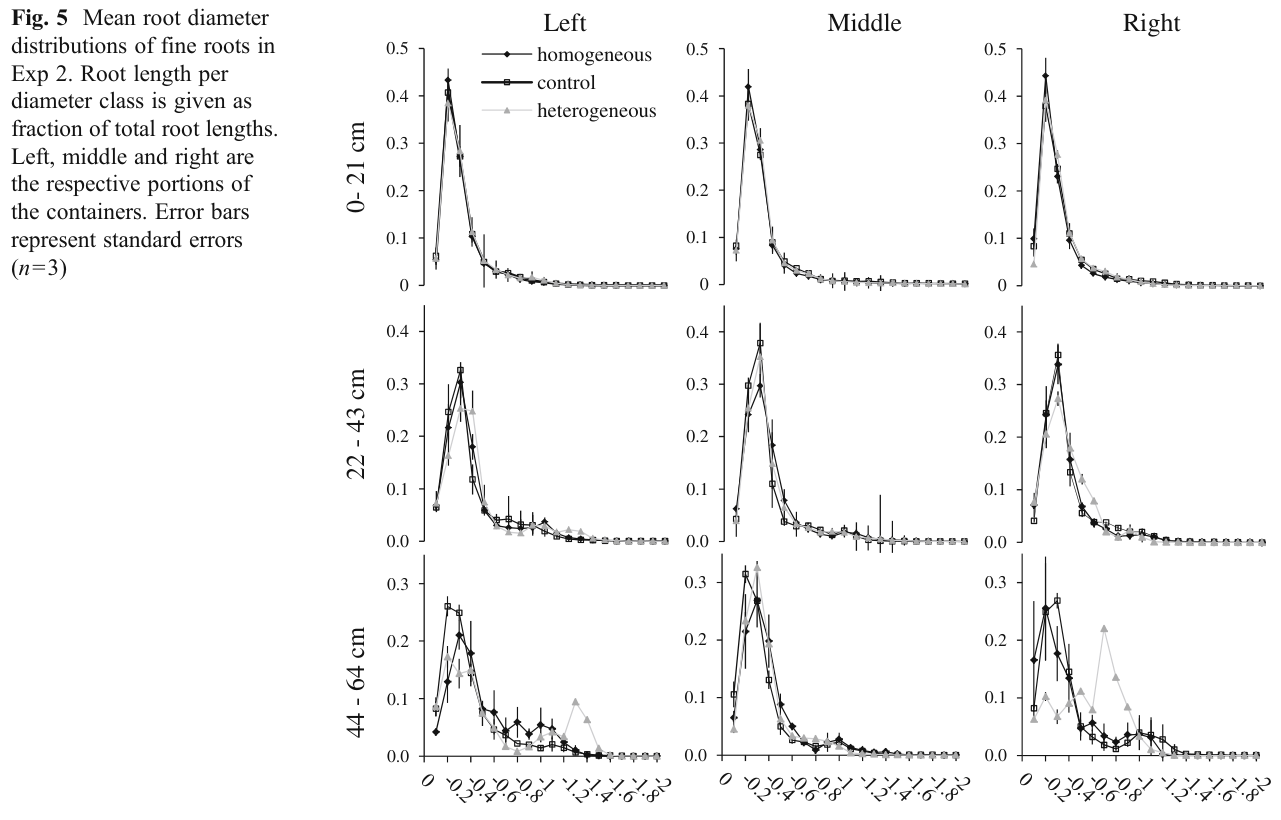
The lower two thirds of the B-treatments differed significantly in their root diameter distributions from the control treatment and the uppermost soil layer of the B-treatments. While in the control treatment and in the uppermost soil layer in the B-treatments, roots diameters of 0.1–0.3 mm were dominant, the peaks of the frequency distributions were broader and shifted to higher diameter classes in B-spiked soil (Fig. 5). These effects increased with soil depth and lateral distance from the stem.
B处理下部三分之二土壤中的根径分布与对照处理及B处理最上层土壤存在显著差异。在对照处理和B处理的最上层土壤中,以直径0.1–0.3 mm的根为主;而在B加标土壤中,频率分布峰变宽并向较大径级偏移(图5)。这些效应随土壤深度及距茎干侧向距离的增加而增强。
14Influence of accumulated plant B on growth植物累积B对生长的影响
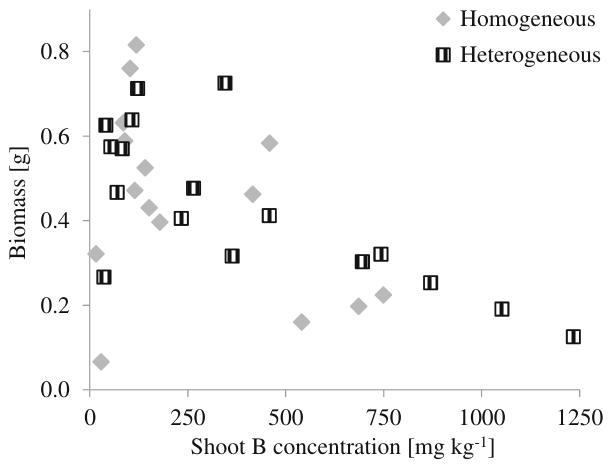
Figure 6 shows high shoot biomass variability at shoot B concentrations <500 mg kg−1. The maximum growth was found in plants with shoot B concentrations of 40–150 mg kg−1. At shoot B concentrations above 500 mg kg−1 shoot growth was reduced, indicating B toxicity. The leaf B concentrations found at average shoot B concentrations >500 mg kg−1 were in the range 800–1,660 mg kg−1, showing an onset of toxicity at similar leaf concentrations as found by Rees et al. (2011) in Populus nigra x euramericana.图6显示,地上部B浓度<500 mg kg−1时地上部生物量变异较大。地上部B浓度为40–150 mg kg−1的植株生长量最大。地上部B浓度超过500 mg kg−1时地上部生长受到抑制,表明发生了B毒害。地上部平均B浓度>500 mg kg−1时,叶片B浓度为800–1,660 mg kg−1,表明毒害开始出现时的叶片浓度与Rees et al.(2011)在Populus nigra x euramericana中发现的相近。
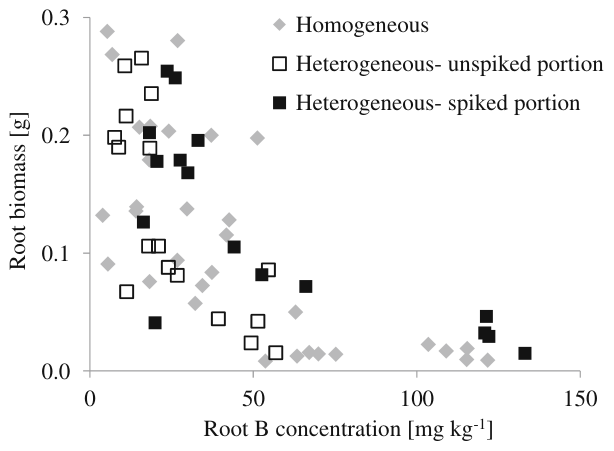
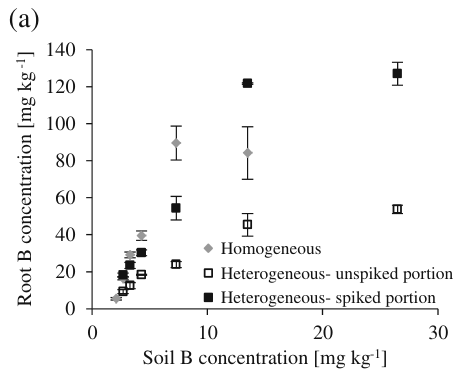
Paralleling the larger variability in shoot biomass at shoot B concentrations <500 mg kg−1, there was also a large variability in root biomass at root B concentrations <35 mg kg−1, indicating that at lower B concentrations the accumulation of excessive B in the plants was not a growth-limiting factor. The maximum root biomass was significantly reduced when root B concentrations exceeded 35 mg kg−1 in B-spiked soil (Fig. 7). This was the case at soil B concentrations of ≥4.3 mg kg−1 in the homogeneous treatment (Fig. 8a). In the unspiked soil portions of the heterogeneous treatments, root growth tended to be reduced at root B concentrations >20 mg kg−1, which occurred again at average soil B concentrations ≥4.3 mg kg−1 in the heterogeneous treatments (B concentrations in the spiked portions: ≥7.3 mg kg−1) (Fig. 8a).
与地上部B浓度<500 mg kg−1时地上部生物量变异较大相对应,根系B浓度<35 mg kg−1时根系生物量同样变异较大,表明在较低B浓度下,植物体内过量B的累积并非生长限制因子。在B加标土壤中,当根系B浓度超过35 mg kg−1时,最大根系生物量显著降低(图7)。均质处理中土壤B浓度≥4.3 mg kg−1时即出现这种情况(图8a)。在非均质处理的未加标土壤部分中,根系B浓度>20 mg kg−1时根系生长有降低趋势,这同样出现在非均质处理土壤平均B浓度≥4.3 mg kg−1时(加标部分B浓度:≥7.3 mg kg−1)(图8a)。
Figure 8a shows that B accumulation by roots in the unspiked soil parts of the heterogeneous treatments increased proportionally to the B concentrations of the roots in the spiked parts of the soil, with a ratio of approximately 1:2 between the B concentrations in the roots of the unspiked and the spiked soil in a given treatment. The highest uptake of B into roots took place in the spiked soil at the two highest B levels in the heterogeneous treatments. In these cases, root B concentrations of up to 130 mg kg−1 were found. The results from Exp 2 agreed with the findings of Exp 1 that root toxicity effects started to occur in B spiked soil when root B concentrations exceeded 35 mg kg−1 (data not shown). Root B concentrations exceeded 35 mg kg−1 in Exp 2 in the homogeneously spiked soil as well as in the spiked portion of the heterogeneous treatment and at the same time also FR length was reduced.
图8a显示,非均质处理未加标土壤部分中根系的B累积随加标土壤部分中根系B浓度的升高而成比例增加,同一处理中未加标与加标土壤中根系B浓度之比约为1:2。根系对B的最高吸收出现在非均质处理两个最高B水平的加标土壤中,此时根系B浓度高达130 mg kg−1。试验2的结果与试验1的发现一致,即当根系B浓度超过35 mg kg−1时,B加标土壤中开始出现根系毒害效应(数据未列出)。在试验2中,均质加标土壤及非均质处理加标部分中的根系B浓度均超过35 mg kg−1,同时细根长度也有所降低。
Leaf B concentrations increased with increasing average soil B concentrations up to 1,350 mg kg−1 at average soil B concentrations of 13–14 mg kg−1, irrespective of the B distribution. Between average soil B concentrations of 3 and 8 mg kg−1 this increase was almost linear; then it leveled off (Fig. 8b). In Exp 2 leaf B concentrations ranged between 36.7 (control), 260 (homogeneous treatment) and 380 mg B kg−1 (heterogeneous treatment). Significant differences were only found between the control and the two B treatments, but not among the homogeneous and the heterogeneous treatments. This was consistent with the result from Exp 1 that B uptake was only due to the average soil B concentration. In the B treatments of Exp 2 leaf B concentrations did not exceed the leaf toxicity threshold found in Exp 1 (800 mg kg−1), which may explain the absence of significant effects on the shoot biomass (data not shown).
无论B分布如何,叶片B浓度均随土壤平均B浓度的升高而增加,在土壤平均B浓度为13–14 mg kg−1时达到1,350 mg kg−1。土壤平均B浓度在3–8 mg kg−1之间时,这一增加近似线性,之后趋于平稳(图8b)。试验2中叶片B浓度分别为36.7(对照)、260(均质处理)和380 mg B kg−1(非均质处理)。仅对照与两个B处理之间存在显著差异,而均质与非均质处理之间无显著差异。这与试验1中B吸收仅取决于土壤平均B浓度的结果一致。在试验2的B处理中,叶片B浓度未超过试验1中得出的叶片毒性阈值(800 mg kg−1),这可能解释了地上部生物量未受到显著影响的原因(数据未列出)。
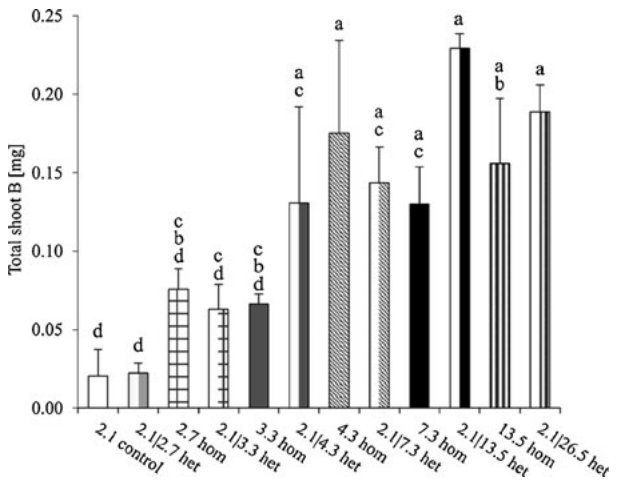
The total uptake of B into the shoot biomass of P. tremula in Exp 1 ranged between 0.02 and 0.23 mg (Fig. 9). Significant difference in the accumulated B amounts emerged only between treatments with average soil B concentrations ≤3.3 mg kg−1 and those with higher soil B concentrations. At similar average soil B concentrations no significant differences between heterogeneous and homogeneous treatments were found in Exp 1 and Exp 2. The maximum percentage of B initially present in the soil extracted was 11% (0.18 mg) in the homogeneous 4.3 mg kg−1 treatment. At higher soil B concentrations the percentage of initially present soil B extracted decreased due to the greater total amounts of B in the soils.
试验1中P. tremula地上部生物量对B的总吸收量为0.02–0.23 mg(图9)。B累积量的显著差异仅出现在土壤平均B浓度≤3.3 mg kg−1的处理与土壤B浓度更高的处理之间。在试验1和试验2中,土壤平均B浓度相近时,非均质与均质处理之间均无显著差异。土壤初始B被提取的最大比例为11%(0.18 mg),出现在均质4.3 mg kg−1处理中。在更高的土壤B浓度下,由于土壤中B总量更大,土壤初始B被提取的比例降低。
15Discussion讨论
From a meta-analysis of published data, Audet and Charest (2008) concluded that plants tend to allocate relatively more biomass into roots with increasing soil metal concentrations. However, our data on the root: shoot ratio of P. tremula exposed to high soil B concentrations did not show this pattern, which is consistent with the findings of Reid et al. (2004) for wheat and Rees et al. (2011) for poplars. The fact that root biomass was also reduced in the unspiked soil portion in the heterogeneous treatments at average soil B concentrations ≥4.3 mg kg−1 in Exp 1, indicates a systemic plant response. In contrast, the unilateral reduction in root growth at soil B concentrations >20 mg kg−1 in the heterogeneous treatment of Exp 2 (and also in Exp 1, although not significant in the latter) indicates a local response. This local root growth response may have simply resulted from toxicity, resulting from direct exposure to the high soil B concentrations, but it may also represent an active response, reflecting a root growth strategy. Any growth strategy would need a signaling mechanism, with roots near or in the B patch communicating the location of the patch to the remainder of the root system. Such communication has been shown to occur via auxin-abscisic acid-ethylene cross-talks in poplars (Popko et al. 2010). However, recent findings indicate that auxin is not involved in B toxicity signaling in Arabidopsis and the main signaling mechanism for B toxicity seems to be abscisic acid, which triggers root growth inhibition via a hydric stress response (Aquea et al. 2011).
Audet and Charest(2008)通过对已发表数据的荟萃分析得出结论:随着土壤金属浓度升高,植物倾向于将相对更多的生物量分配至根系。然而,本研究中暴露于高土壤B浓度的P. tremula的根冠比数据并未表现出这一规律,这与Reid et al.(2004)对小麦及Rees et al.(2011)对杨树的研究结果一致。在试验1中,土壤平均B浓度≥4.3 mg kg−1时,非均质处理未加标土壤部分的根系生物量同样降低,表明这是一种系统性的植物响应。相反,在试验2的非均质处理中(试验1中亦如此,但后者不显著),土壤B浓度>20 mg kg−1时根系生长的单侧降低表明存在局部响应。这种局部根系生长响应可能仅是直接暴露于高土壤B浓度所导致的毒害结果,但也可能代表一种主动响应,反映了一种根系生长策略。任何生长策略都需要一种信号机制,由靠近或位于B斑块中的根系将斑块位置传递给根系的其余部分。已有研究表明,杨树中的此类信号传递通过生长素–脱落酸–乙烯的交互作用实现(Popko et al. 2010)。然而,最新研究表明,在拟南芥(Arabidopsis)中生长素并不参与B毒害信号传导,B毒害的主要信号机制似乎是脱落酸,其通过水分胁迫响应引发根系生长抑制(Aquea et al. 2011)。
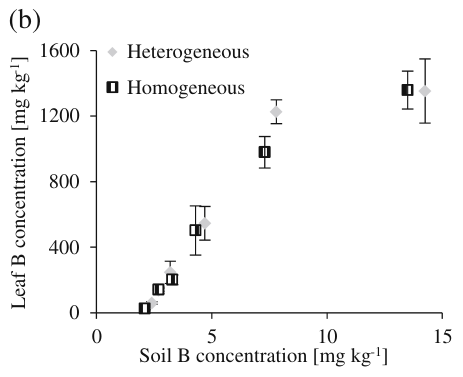
soil portions. b Mean leaf B concentration as function of the average B concentration in soil with heterogeneous or homogeneous B spiking in Exp 1. Error bars represent standard errors (n03)
土壤部分的B浓度作图。b 试验1中B非均质或均质加标土壤中平均叶片B浓度与土壤平均B浓度的关系。误差线表示标准误(n = 3)
Although, NR has been applied for root growth investigations in various studies (Menon et al. 2007b; Moradi et al. 2009a), a quantitative comparison of the NR detectable root length and the real length of the root system was unavailable yet. The results of this comparison were disappointing, as only 6–8% of the total root system length was detectable with NR. However, future developments of the technique might further improve the proportion of the NR detectable root length and other plant species with higher root diameters should be better suited for working with this technique.
尽管NR已在多项研究中用于根系生长研究(Menon et al. 2007b; Moradi et al. 2009a),但此前尚无关于NR可检测根长与根系实际长度的定量比较。该比较结果令人失望,因为NR仅能检测到根系总长度的6%–8%。然而,该技术的未来发展可能会进一步提高NR可检测根长的比例,且根径较大的其他植物物种应更适合采用该技术。
Changes in the root diameter distributions were also found in the unspiked soil of the heterogeneous B treatment, indicating a systemic root system response. An explanation for these changes in diameter class distributions could be that P. tremula switches to an extensive rooting strategy under stress conditions, in which they invest more assimilates into exudate production and less into increasing specific root length [cm g−1] (Lohmus et al. 2006; Ostonen et al. 2007). As far as the differences in root diameters reflect local toxicity effects, they could also have been due to a higher survival probability of thicker roots as well as to a stronger B toxicity effect on length than on diameter growth. The observed shift to higher FR diameters could be disadvantageous for nutrient and water acquisition because the fraction of soil pore space that can be accessed by roots decreases with root diameter. As coarse roots develop from FR by secondary thickening, coarse roots cannot establish in soil where FR cannot establish. Therefore, the inhibition of FR growth in a larger volume of soil will also impair the development of coarse roots and might thus reduce the stability of a tree as it grows and needs increasing anchorage in the soil.
在非均质B处理的未加标土壤中也发现了根径分布的变化,表明这是一种系统性的根系响应。对径级分布变化的一种解释可能是,P. tremula在胁迫条件下转向粗放型生根策略,即将更多同化物投入分泌物的产生,而较少用于增加比根长[cm g−1](Lohmus et al. 2006; Ostonen et al. 2007)。就根径差异反映局部毒害效应而言,这也可能是由于较粗根系的存活概率较高,以及B毒害对长度生长的影响强于对直径生长的影响。观察到的细根直径增大可能不利于养分和水分的获取,因为根系可进入的土壤孔隙空间比例随根径增大而减小。由于粗根由细根经次生加粗发育而来,细根无法定植的土壤中粗根也无法定植。因此,在更大土壤体积中细根生长受到抑制,也将妨碍粗根发育,从而可能降低树木在生长过程中对土壤锚固需求不断增加时的稳定性。
The relationship between shoot biomass and shoot B accumulation was the same in heterogeneous and homogeneous treatments, suggesting that any B toxicity effect on shoot growth was only dependent on the shoot B concentrations. The leaf B toxicity threshold of 800 mg kg−1 found in our experiment shows that P. tremula is highly B tolerant compared to other plant species and lies in the same range as found in hybrid poplars (Rees et al. 2011; Robinson et al. 2007). In Quercus rubra L., decreased growth was found at leaf B concentrations around 230 mg kg−1 and some Eucalyptus species showed growth decline at B concentrations of only 75 mg kg−1 (Crews and Dick 1998; Lehto et al. 2010). All plants with shoot B concentrations <40 mg kg−1 produced less than 0.35 g biomass during the three months growth period of Exp 1. This was less than 40% of the maximum growth and the shoot biomass in the unspiked control treatment was significantly lower than in the homogeneous 2.7 mg kg−1 and the heterogeneous 2.1|3.3 mg kg−1 treatments. The corresponding leaf B concentrations of these plants were below 45 mg kg−1 and the concentration in the top 3 leaves of one of those trees was only 15.1 mg kg−1. While one of the plants with such a low B concentration was found in the heterogeneous treatment with the lowest level of B spiking, two others were obtained from the treatment with unspiked soil (control). Boron deficiency limits for tree foliage are in the range of 4 (Picea Abies (L.) H.Karst., Pinus Sylvestris L.) to 16 mg kg−1 (Eucalyptus globulus (Labill)) in the youngest emerged leaf and are generally higher in broadleaf species than in conifers (Lehto et al. 2010). Our results indicate that P. tremula has a similarly sensitivity to low soil B supply as E. globulus and P. tremula has a higher B requirement than many other plant species (Bell 1997). This may be due to a lack of transporters for active xylem loading of B under deficiency conditions in P. tremula (Tuskan et al. 2006). The first symptom of B deficiency in plants usually is decreased root growth in relation to shoot growth (Dell and Huang 1997). Such an effect was not found here. We also found no enhanced proliferation of roots in B-enriched patches to compensate for low B supply in the heterogeneous treatments.
地上部生物量与地上部B累积之间的关系在非均质与均质处理中相同,表明B毒害对地上部生长的任何影响仅取决于地上部B浓度。本试验中得出的叶片B毒性阈值800 mg kg−1表明,与其他植物物种相比,P. tremula具有很强的B耐受性,且该阈值与杂交杨的阈值处于同一范围(Rees et al. 2011; Robinson et al. 2007)。北美红栎(Quercus rubra L.)在叶片B浓度约230 mg kg−1时即出现生长下降,某些桉属(Eucalyptus)物种在B浓度仅为75 mg kg−1时即出现生长衰退(Crews and Dick 1998; Lehto et al. 2010)。在试验1的三个月生长期内,所有地上部B浓度<40 mg kg−1的植株生物量均不足0.35 g,不到最大生长量的40%;未加标对照处理的地上部生物量显著低于均质2.7 mg kg−1处理和非均质2.1|3.3 mg kg−1处理。这些植株相应的叶片B浓度低于45 mg kg−1,其中一株树顶部3片叶的B浓度仅为15.1 mg kg−1。B浓度如此之低的植株中,一株来自B加标水平最低的非均质处理,另两株来自未加标土壤处理(对照)。树木叶片的缺B临界值在最幼嫩展开叶中为4(欧洲云杉Picea Abies (L.) H.Karst.、欧洲赤松Pinus Sylvestris L.)至16 mg kg−1(蓝桉Eucalyptus globulus (Labill)),且阔叶树种一般高于针叶树种(Lehto et al. 2010)。本研究结果表明,P. tremula对土壤低B供应的敏感性与E. globulus相近,且P. tremula对B的需求高于许多其他植物物种(Bell 1997)。这可能是由于P. tremula缺乏在缺B条件下将B主动装载入木质部的转运蛋白(Tuskan et al. 2006)。植物缺B的首个症状通常是根系生长相对于地上部生长下降(Dell and Huang 1997),但本研究中未发现此类效应。我们也未发现在非均质处理中根系通过在富B斑块中增生来补偿低B供应。
We showed roots grown in the unspiked soil of the heterogeneous treatment to be growth-reduced at root B concentrations of only >20 mg kg−1. This growth reduction occurred at soil B concentrations >7.3 mg kg−1 in the spiked compartments of the heterogeneous treatments, indicating that the root growth inhibition observed at moderately elevated B treatment levels was not a toxicity response to the accumulation of B in the roots or to soil B, but a systemic response to B in the shoots. This hypothesis also agrees with the observation that root biomass was more sensitive to the B treatments at moderately elevated B concentrations than shoot biomass.
本研究表明,在非均质处理未加标土壤中生长的根系,在根系B浓度仅>20 mg kg−1时生长即受到抑制。这种生长抑制出现在非均质处理加标隔室土壤B浓度>7.3 mg kg−1时,表明在中等偏高的B处理水平下观察到的根系生长抑制,并非对根系B累积或土壤B的毒害响应,而是对地上部B的系统性响应。这一假设也与以下观察结果相符:在中等偏高的B浓度下,根系生物量对B处理比地上部生物量更为敏感。
The B accumulation of the roots in the unspiked soil parts of the heterogeneous treatment took place at a ratio of 1:2 compared to the accumulation in the spiked portions of the heterogeneous treatments. This ratio is much lower than one would expect from the B accumulation in the control soil. Therefore, there must have been substantial lateral B transfer from the spiked to the unspiked soil compartments. Such transfer could have occurred through roots extending from the unspiked into the spiked soil as well as through the soil solution. Even though transfer of B from spiked to unspiked soil portions via the soil solution was favored by the soil type, it was probably not the main transfer pathway of B, as the addition of CaCO3 to the soil should have increased B retention (Goldberg 1997). Lateral B transfer should have mitigated the probably rather uncommon situation of B poor soil next to excess B soil in the heterogeneous treatments in Exp 1, as an increase in B concentration of only 0.6 mg kg−1 would have led to an optimal soil B concentration. The addition of CaCO3 might have also decreased the plant available fraction of soil B and thus its toxicity. Transfer of B within the root system could be another explanation for the high B concentrations in roots from unspiked soil portions (Bellaloui et al. 1999; Brown and Hu 1996).
非均质处理未加标土壤部分中根系的B累积量与加标部分中的累积量之比为1:2。该比值远低于根据对照土壤中B累积量所预期的比值。因此,从加标土壤隔室向未加标土壤隔室必定发生了大量的侧向B转移。此类转移既可能通过从未加标土壤伸入加标土壤的根系发生,也可能通过土壤溶液发生。尽管该土壤类型有利于B经土壤溶液从加标部分向未加标部分转移,但这可能并非B的主要转移途径,因为向土壤中添加CaCO3应会增强B的持留(Goldberg 1997)。在试验1的非均质处理中,侧向B转移应能缓解低B土壤与过量B土壤相邻这一可能相当少见的情况,因为B浓度仅增加0.6 mg kg−1即可使土壤B浓度达到最适水平。添加CaCO3也可能降低了土壤B的植物有效部分,从而降低其毒性。根系内部B的转移可能是未加标土壤部分中根系B浓度较高的另一解释(Bellaloui et al. 1999; Brown and Hu 1996)。
The finding that the accumulation of B in the leaves only depended on the average concentration of B in the soil and not on its spatial distribution indicates that the spiked and the unspiked parts contributed equally to B uptake in the heterogeneous treatments. This is in agreement with the hypothesis that toxicity effects in the roots were primarily systemic plant responses to B accumulation in the shoots and thus similar in spiked and unspiked soil portions. In this regard B uptake appears to differ from the uptake of other trace elements with heterogeneous distribution in soil (Millis et al. 2004).
叶片中B的累积仅取决于土壤中B的平均浓度而与其空间分布无关,这一发现表明在非均质处理中加标和未加标部分对B吸收的贡献相同。这与以下假设一致:根系中的毒害效应主要是植物对地上部B累积的系统性响应,因而在加标和未加标土壤部分中相似。在这方面,B的吸收似乎不同于在土壤中呈非均质分布的其他微量元素的吸收(Millis et al. 2004)。
Our results on B tolerance and uptake from heterogeneously contaminated soils have implications for the phytomanagement of B contaminated sites. Long clean-up times are one of the major disadvantages of phytoremediation (Pulford and Watson 2003; Robinson et al. 2009). Thus, the finding that patchy soil B distribution did not lead to decreased B accumulation in the shoots, while it tended to result in larger growth compared to a homogenous distribution of the same amount of B is an encouraging result for further field applications of P. tremula in phytoremediation, as heterogeneous contamination is rather the rule than the exception under field conditions (Robinson et al. 2009). Breeding of poplars and their hybrids for B phytoremediation should focus on the B tolerance of poplars leaf tissue as it seems to govern the whole plant status.
本研究关于非均质污染土壤中B耐受性及吸收的结果,对B污染场地的植物管理具有重要意义。修复周期长是植物修复的主要缺点之一(Pulford and Watson 2003; Robinson et al. 2009)。因此,与等量B的均质分布相比,土壤B斑块状分布并未导致地上部B累积减少,反而有使生长增加的趋势,这一发现对P. tremula在植物修复中的进一步田间应用而言是令人鼓舞的结果,因为在田间条件下非均质污染是常态而非例外(Robinson et al. 2009)。用于B植物修复的杨树及其杂种的育种应侧重于杨树叶片组织的B耐受性,因为它似乎决定着整株植物的状态。
16Conclusions结论
The tolerance of P. tremula to the average soil B concentrations applied in this study was the same, regardless if B was heterogeneously or homogeneously distributed in the soil. Furthermore, the heterogeneity of the soil B distribution had no effect on the B accumulation in the leaves of P. tremula and the total amount of B taken up into the shoots. Our results indicate that at low to medium soil B concentrations B toxicity on root growth is primarily a systemic response to B toxicity in the shoots, while only at high local soil B concentrations local effects on roots become dominant. We conclude from these results that local heterogeneity in soil B should have little influence on the phytoremediation of contaminated sites using P. tremula, as long as the contamination allows root growth.
无论土壤中硼(B)呈非均质分布还是均质分布,P. tremula对本研究所施加的平均土壤B浓度的耐受性均相同。此外,土壤B分布的非均质性对P. tremula叶片中的B积累以及地上部吸收的B总量均无影响。结果表明,在低至中等土壤B浓度下,B对根系生长的毒性主要是对地上部B毒害的系统性响应,而仅在局部土壤B浓度较高时,对根系的局部效应才占主导地位。据此得出结论:只要污染程度允许根系生长,土壤B的局部非均质性对利用P. tremula开展污染场地植物修复的影响应当很小。
Acknowledgments Funds for this study came from the Swiss National Science Foundation (SNSF). Funding for M.W.H. Evangelou came from the DFG (Deutsche Forschungsgemeinschaft). The technical assistance provided by S. Hartmann and P. Vontobel from PSI is gratefully acknowledged. We would also like to thank N. Grisel from the Swiss Federal Institute for Forest, Snow and Landscape Research (WSL) for the poplar cuttings. We would also like to thank H. M. Conesa for accepting to pre-review the manuscript and two anonymous reviewers for their very helpful review comments.
致谢 本研究由瑞士国家科学基金会(SNSF)资助。M.W.H. Evangelou的经费来自DFG(德国科学基金会)。衷心感谢PSI的S. Hartmann和P. Vontobel提供的技术协助。同时感谢瑞士联邦森林、雪与景观研究所(WSL)的N. Grisel提供杨树插条。还要感谢H. M. Conesa同意对本稿进行预审,以及两位匿名审稿人提出的非常有益的审稿意见。
17References参考文献
Aquea F, Federici F, Moscoso C, Vega A, Jullian P, Haseloff JIM, Arce-Johnson P (2011) A molecular framework for the inhibition of Arabidopsis root growth in response to boron toxicity. Plant Cell Environ doi:10.1111/j.1365- 3040.2011.02446.x
Audet P, Charest C (2008) Allocation plasticity and plant-metal partitioning: meta-analytical perspectives in phytoremediation. Environ Pollut 156:290–296
Bañuelos GS, LeDuc D, Johnson J (2010) Evaluating the tolerance of young hybrid poplar trees to recycled waters high in salinity and boron. Int J Phytoremediat 12:419–439
Bell RW (1997) Diagnosis and prediction of boron deficiency for plant production. Plant Soil 193:149–168
Bellaloui N, Brown PH, Dandekar AM (1999) Manipulation of in vivo sorbitol production alters boron uptake and transport in tobacco. Plant Physiol 119:735–741
Blevins DG, Lukaszewski KM (1998) Boron in plant structure and function. Annu Rev Plant Physiol Plant Mol Biol 49:481–500
Borken W, Kossmann G, Matzner E (2007) Biomass, morphology and nutrient contents of fine roots in four Norway spruce stands. Plant Soil 292:79–93
Breckle SW, Kahle H (1992) Effects of toxic heavy-metals (Cd, Pb) on growth and mineral-nutrition of beech (Fagus-Sylvatica). Vegetatio 101:43–53
Brown PH, Hu HN (1996) Phloem mobility of boron is species dependent: evidence for phloem mobility in sorbitol-rich species. Ann Bot 77:497–505
Communar G, Keren R, Li F (2004) Deriving boron adsorption isotherms from soil column displacement experiments. Soil Sci Soc Am J 68:481–488
Crews JT, Dick WA (1998) Liming acid forest soils with flue gas desulfurization by-product: growth of Northern red oak and leachate water quality. Environ Poll 103:55–61
Dell B, Huang LB (1997) Physiological response of plants to low boron. Plant Soil 193:103–120
Dos Santos Utmazian MN, Wieshammer G, Vega R, Wenzel WW (2007) Hydroponic screening for metal resistance and accumulation of cadmium and zinc in twenty clones of willows and poplars. Environ Poll 148:155–165
Evans CM, Sparks DL (1983) On the chemistry and mineralogy of boron in pure and mixed systems—a review. Commun Soil Sci Plan 14:827–846
Friend AL, Mobley JA, Ryan EA, Bradshaw HD (1999) Root growth plasticity of hybrid poplar in response to soil nutrient gradients. J Sust For 10:133–140
Goldberg S (1997) Reactions of boron with soils. Plant Soil 193:35–48
Goldberg S, Forster HS, Heick EL (1993) Temperature effects on boron adsorption by reference minerals and soils. Soil Sci 156:316–321
Gupta UC, Jame YW, Campbell CA, Leyshon AJ, Nicholaichuk W (1985) Boron toxicity and deficiency—a review. Can J Soil Sci 65:381–409
Hall JB (1971) Pattern in a chalk grassland community. J Ecol 59:749–762
Himmelbauer ML, Loiskandl AW, Kastanek AF (2004) Estimating length, average diameter and surface area of roots using two different image analyses systems. Plant Soil 260:111–120
Hoagland DR, Arnon DI (1938) The water-culture method for growing plants without soil. Calif Agric Exp Stn Circ 357:1–39
Hu H, Brown PH (1997) Absorption of boron by plant roots. Plant Soil 193:49–58
Ishak CF, Seaman JC, Miller WP, Sumner M (2002) Contaminant mobility in soils amended with fly ash and flue-gas gypsum: intact soil cores and repacked columns. Water Air Soil Poll 134:285–303
Kabata-Pendias A, Pendias H (2001) Trace elements in soils and plants. CRC Press, Boca Raton
Lehmann EH, Vontobel P, Wiezel L (2001) Properties of the radiography facility NEUTRA at SINQ and its potential for use as European reference facility. Nondest Test Eval 16:191–202
Lehto T, Ruuhola T, Dell B (2010) Boron in forest trees and forest ecosystems. For Ecol Manage 260:2053–2069
Liu F, Tang Y, Du R, Yang H, Wu Q, Qiu R (2010) Root foraging for zinc and cadmium requirement in the Zn/Cd hyperaccumulator plant Sedum alfredii. Plant Soil 327:365–375
Lohmus K, Truu J, Truu M, Kaar E, Ostonen I, Alma S, Kuznetsova T, Rosenvald K, Vares A, Uri V et al (2006) Black alder as a perspective deciduous species for reclaiming of oil shale mining areas. In: Brebbia CA, Mander Ü (eds) Brownfields III prevention, assessment, rehabilitation and development of Brownfield sites. WIT Press, Southampton, pp 87–97
Luster J, Gottlein A, Nowack B, Sarret G (2009) Sampling, defining, characterising and modeling the rhizosphere-the soil science tool box. Plant Soil 321:457–482
Mastromatteo E, Sullivan F (1994) Summary- International Symposium on the health-effects of boron and its compounds. Environ Health Perspect 102:139–141
McLaren RG, Cameron KC (1996) Soil science: sustainable production and environmental protection. Oxford University Press, Oxford
Menon M, Hermle S, Günthardt-Goerg M, Schulin R (2007a) Effects of heavy metal soil pollution and acid rain on growth and water use efficiency of a young model forest ecosystem. Plant Soil 297:171–183
Menon M, Robinson B, Oswald SE, Kaestner A, Abbaspour KC, Lehmann E, Schulin R (2007b) Visualization of root growth in heterogeneously contaminated soil using neutron radiography. Eur J Soil Sci 58:802–810
Millis PR, Ramsey MH, John EA (2004) Heterogeneity of cadmium concentration in soil as a source of uncertainty in plant uptake and its implications for human health risk assessment. Sci Total Environ 326:49–53
Miwa K, Fujiwara T (2010) Boron transport in plants: coordinated regulation of transporters. Ann Bot 105:1103–1108
Moradi AB, Conesa HM, Robinson B, Lehmann E, Kuehne G, Kaestner A, Oswald S, Schulin R (2009a) Neutron radiography as a tool for revealing root development in soil: capabilities and limitations. Plant Soil 318:243–255
Moradi AB, Conesa HM, Robinson BH, Lehmann E, Kaestner A, Schulin R (2009b) Root responses to soil Ni heterogeneity in a hyperaccumulator and a non-accumulator species. Environ Pollut 157:2189–2196
Mulia R, Dupraz C (2006) Unusual fine root distributions of two deciduous tree species in southern france: what consequences for modelling of tree root dynamics? Plant Soil 281:71– 85
Nable RO, Banuelos GS, Paull JG (1997) Boron toxicity. Plant Soil 193:181–198
Nowack B, Rais D, Frey B, Menon M, Schulin R, Guenthardt- Goerg MS, Luster J (2006) Influence of metal contamination on soil parameters in a lysimeter experiment designed to evaluate phytostabilization by afforestation. For Snow Landsc Res 80:201–211
Ostonen I, Puttsepp U, Biel C, Alberton O, Bakker MR, Lohmus K, Majdi H, Metcalfe D, Olsthoorn AFM, Pronk A et al (2007) Specific root length as an indicator of environmental change. Plant Biosyst 141:426–442
Parks JL, Edwards M (2005) Boron in the environment. Crit Rev Environ Sci Techn 35:81–114
Popko J, Hansch R, Mendel RR, Polle A, Teichmann T (2010) The role of abscisic acid and auxin in the response of poplar to abiotic stress. Plant Biol 12:242–258
Power PP, Woods WG (1997) The chemistry of boron and its speciation in plants. Plant Soil 193:1–13
Pregitzer KS, Friend AL (1996) The structure and function of Populus root systems. In: Stettler RF, Bradshaw HD Jr, Heilman PE, Hinckley TM (eds) Biology of Populus and its implications for management and conservation. National Research Council of Canada, Ottawa, pp 331–354
Pulford ID, Watson C (2003) Phytoremediation of heavy metalcontaminated land by trees—a review. Environ Int 29:529–540
Qin RJ, Hirano Y, Brunner I (2007) Exudation of organic acid anions from poplar roots after exposure to Al, Cu and Zn. Tree Physiol 27:313–320
Rees R, Robinson BH, Menon M, Lehmann E, Guenthardt- Goerg MS, Schulin R (2011) Boron accumulation and toxicity in hybrid poplar (Populus nigra x euramericana). Environ Sci Technol 45:10538–10543
Regent Instruments (2009) WinRhizo Pro. 2009c Regent Instruments
Reid RJ, Hayes JE, Post A, Stangoulis JCR, Graham RD (2004) A critical analysis of the causes of boron toxicity in plants. Plant Cell Environ 27:1405–1414
Robinson D (1994) The responses of plants to non-uniform supplies of nutrients. New Phytol 127:635–674
Robinson BH, Green SR, Chancerel B, Mills TM, Clothier BE (2007) Poplar for the phytomanagement of boron contaminated sites. Environ Pollut 150:225–233
Robinson BH, Banuelos G, Conesa HM, Evangelou MWH, Schulin R (2009) The phytomanagement of trace elements in soil. Crit Rev Plant Sci 28:240–266
Salisbury FB, Ross CW (1992) Plant physiology. Wadsworth Publishing Co. Inc., Belmont
Schwartz C, Morel JL, Saumier S, Whiting SN, Baker AJM (1999) Root development of the Zinc-hyperaccumulator plant Thlaspi caerulescens as affected by metal origin, content and localization in soil. Plant Soil 208:103–115
Systat Software (2008) Sigma Plot 11. Systat Software Inc.
Tanaka M, Fujiwara T (2008) Physiological roles and transport mechanisms of boron: perspectives from plants. Pflugers Archiv-Eur J Physiol 456:671–677
Tuskan GA, DiFazio S, Jansson S, Bohlmann J, Grigoriev I, Hellsten U, Putnam N, Ralph S, Rombauts S, Salamov A et al (2006) The genome of black cottonwood, Populus trichocarpa (Torr. & Gray). Science 313:1596–1604
Van TK, Kang Y, Sakurai K (2005) Boron fixation and its release in soils and bark compost. Soil Sci Plant Nutr 51:69–74
Wenzel W (2009) Rhizosphere processes and management in plant-assisted bioremediation (phytoremediation) of soils. Plant Soil 321:385–408
Whiting SN, Leake JR, McGrath SP, Baker AJM (2000) Positive responses to Zn and Cd by roots of the Zn and Cd hyperaccumulator Thlaspi caerulescens. New Phytol 145:199–210
Worrell R (1995) European aspen (Populus tremula L.): a review with particular reference to Scotland I. Distribution, ecology and genetic variation. Forestry 68:93–105
Xu F, Goldbach HE, Brown PH, Bell RW, Fujiwara T, Hunt CD, Goldberg S, Shi L (eds) (2007) Advances in plant and animal boron nutrition. Springer, Dordrecht
Zobel RW (2008) Hardware and software efficacy in assessment of fine root diameter distributions. Comput Electron Agr 60:178–189