Email: mingyuan [dot] liu [at] pg [dot] canterbury [dot] ac [dot] nz
电子邮箱:mingyuan [dot] liu [at] pg [dot] canterbury [dot] ac [dot] nz
1The Canterbury earthquakes & the Red Zone坎特伯雷地震与红区
Starting on the 4th of September 2010, the Canterbury Region experienced a series of earthquakes with a magnitude 7.1 tremor. While this event caused infrastructure damage, the magnitude 6.3 aftershock on 22 February 2011 proved catastrophic. Striking shallowly and close to the Christchurch Central Business District (CBD), it generated violent ground shaking and resulted in 185 fatalities.
2010 年 9 月 4 日,坎特伯雷地区发生 7.1 级地震,此后余震不断。这次地震损毁了不少基础设施,但真正造成灾难性后果的,是 2011 年 2 月 22 日的 6.3 级余震:震源浅、震中又紧邻基督城中央商务区,地面剧烈震动,造成 185 人死亡。
The earthquakes caused unprecedented land damage, particularly in the eastern suburbs and the Port Hills. Extensive liquefaction (where soil behaves like liquid) and lateral spreading rendered large areas of land unstable.
地震造成了前所未有的土地损毁,东部郊区和 Port Hills 一带尤为严重。大范围的砂土液化(土壤表现得像液体一样)与侧向扩展,使大片土地失去了稳定性。
In June 2011, the Government announced a zoning system to guide the recovery. The "Red Zone" (RZ) designated land where remediation was uneconomic and rebuilding infeasible. The government implemented a buyout scheme for property owners in these areas. This process led to the demolition and removal of more than 8,000 residential properties across approximately 630 hectares. Entire neighbourhoods ceased to exist as residential areas.
2011 年 6 月,政府公布了一套分区制度来指导灾后重建。其中「红区」指的是治理不划算、重建也不可行的土地。政府对该范围内的业主实施了收购计划。这一过程最终拆除并清理了约 630 公顷范围内的 8000 多处住宅,整片整片的社区不再作为居住区存在。
2Soil contamination土壤污染
Soil analysis in the Red Zone identified elevated concentrations of heavy metals, including lead (Pb), arsenic (As), and coal tar, a source of polycyclic aromatic hydrocarbons (PAHs) that present a threat to human health and ecosystem function. Some 20% of Red Zone soil samples exceed New Zealand safety guidelines for Pb.
红区的土壤分析发现重金属浓度偏高,包括铅(Pb)和砷(As),还有煤焦油——多环芳烃(PAHs)的来源之一,对人体健康和生态系统功能都构成威胁。红区约 20% 的土壤样品铅含量超过新西兰的安全导则值。
- Rain and erosion transport contaminants from RZ soils into waterways.
- Migration of contaminants to the nearby estuary affects shellfish quality, such as cockles and pipi.
- Public health authorities issue warnings against gathering seafood from this area.
- Dust from the RZ affects food production in community gardens.
- 降雨与侵蚀把红区土壤中的污染物带入水体。
- 污染物迁移到邻近的河口湾,影响鸟蛤、pipi 等贝类的品质。
- 公共卫生部门已就在该水域采捕海鲜发出警告。
- 红区扬起的尘土影响社区菜园的食物生产。
3Why not conventional remediation?为何不用常规修复方法?
Remediation using established techniques such as excavation or capping is infeasible for the Red Zone:
对红区而言,开挖外运、覆盖封闭这类成熟技术都不可行:
Excavation ("dig and dump")开挖外运(「挖走填埋」)
Excavating the top 500 mm of soil across the 630-hectare Red Zone yields over 3 million cubic metres of waste. This volume exceeds local landfill capacity and requires extensive transport logistics, generating high carbon emissions.
把 630 公顷红区表层 500 毫米的土壤全部挖走,会产生 300 多万立方米废土。这一体量超出了当地填埋场的容量,还需要庞大的运输组织,碳排放很高。
Capping覆盖封闭
Alternative remediation via capping (importing 0.5 m to 1.0 m of clean soil) creates hydrological risk. Raising ground levels eliminates the flood retention capacity of the Otakaro Avon River Corridor, removing a primary defence against future city flooding.
另一种做法是覆盖封闭,即外运 0.5 至 1.0 米厚的洁净土覆盖地表,但这会带来水文风险:抬高地面等于取消了 Ōtākaro / Avon 河廊道的蓄洪能力,而那是这座城市未来抵御洪水的主要屏障。
4Phytomanagement: a nature-based solution植物管理:一种基于自然的方案
Phytomanagement is an alternative remediation strategy that uses plants and soil conditioners to simultaneously mitigate environmental risks and generate economic or ecological value. Unlike excavation or capping, phytomanagement is far less costly and minimises land disturbance.
植物管理是另一条修复路径:借助植物与土壤改良剂,在降低环境风险的同时创造经济或生态价值。与开挖外运或覆盖封闭相比,它的成本低得多,对土地的扰动也最小。
For the Christchurch Red Zone, phytomanagement aligns with future land-use goals by establishing native vegetation that enhances biodiversity, creates green corridors, and potentially offers economic returns through products like essential oils or honey, while managing soil toxicity.
就基督城红区而言,植物管理与未来的土地利用目标相契合:营建原生植被既提升生物多样性、形成绿色廊道,又可能通过精油、蜂蜜等产品带来经济回报,同时把土壤毒性控制住。
5The field trial田间试验
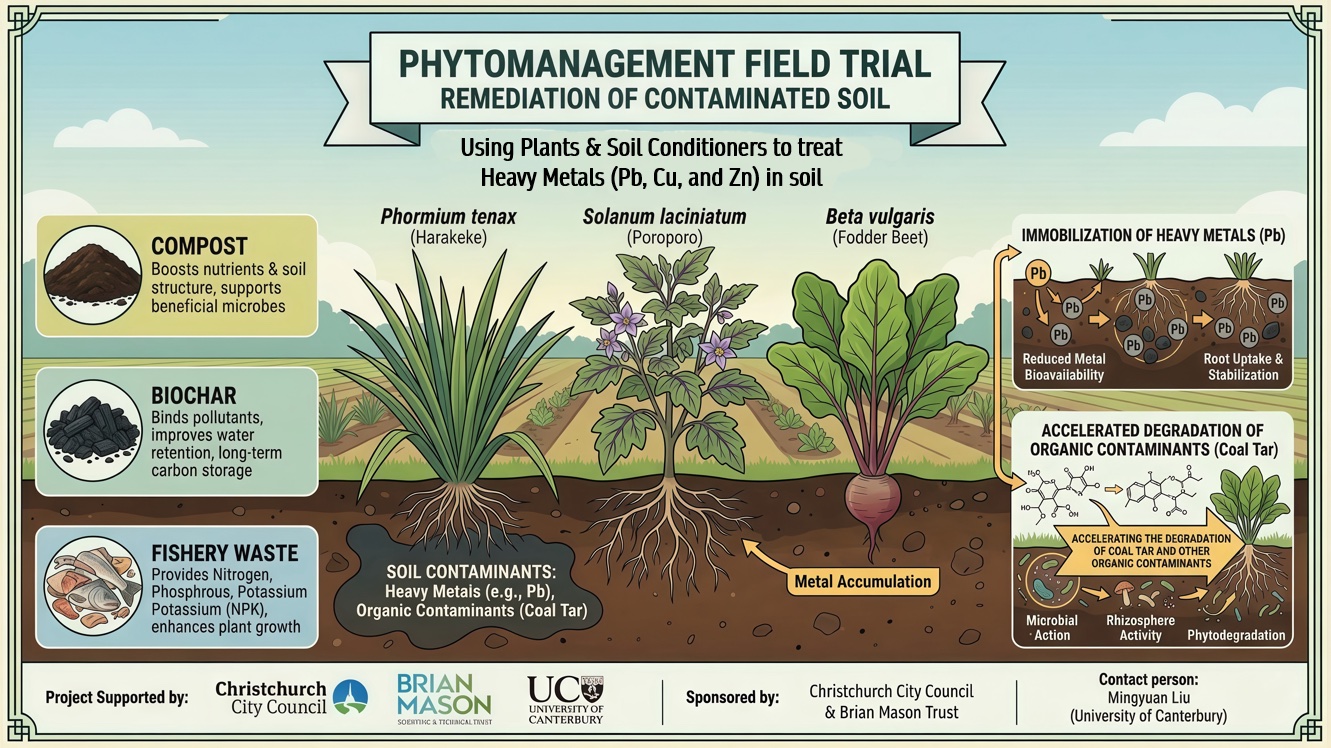
A field trial site has been established within the Residential Red Zone. This experiment evaluates the performance of specific vegetation and soil conditioners in managing heavy metal contamination, particularly reducing contaminant leaching into the groundwater or entering the food chain. The vegetation cover physically stabilises the surface, mitigating wind erosion and the subsequent inhalation of metal-laden dust.
我们在住宅红区内建立了一处田间试验场地,考察特定植被与土壤改良剂在治理重金属污染方面的表现,重点是减少污染物淋溶进入地下水或进入食物链。植被覆盖还从物理上稳定了地表,减轻风蚀,也就减少了含金属粉尘被吸入的风险。
Soil amendments from municipal waste来自城市废弃物的土壤改良剂
The trial uses soil amendments derived from Christchurch's municipal waste stream:
试验所用的土壤改良剂全部来自基督城的城市废弃物:
- Compost — Produced from the city's kerbside green waste collection, it introduces high levels of organic matter containing humic and fulvic acids, which immobilise contaminants. Compost boosts nutrients and soil structure, and supports beneficial microbes.
- Biochar — A carbon-rich product created through the pyrolysis of organic waste. Its porous structure provides a vast surface area for adsorption. The addition of biochar increases soil pH, causing metals to precipitate out of the soil solution and become immobile. Biochar also improves water retention and provides long-term carbon storage.
- Fishery waste — Provides nitrogen, phosphorus, and potassium (NPK) and enhances plant growth.
- 堆肥 — 由全市路边收集的绿化废弃物制成,带来大量含腐殖酸与富里酸的有机质,可以固定污染物。堆肥还能提高养分含量、改善土壤结构,并养育有益微生物。
- 生物炭 — 有机废弃物经热解得到的富碳产物。其多孔结构提供了巨大的吸附表面积。施用生物炭会提高土壤 pH,使金属从土壤溶液中沉淀出来、不再迁移。生物炭同时改善保水能力,并实现长期固碳。
- 渔业废弃物 — 提供氮、磷、钾(NPK),促进植物生长。
Plant species供试植物
- Phormium tenax (Harakeke) — Native New Zealand flax used for metal stabilisation.
- Solanum laciniatum (Poroporo) — A native plant trialled for phytoremediation.
- Beta vulgaris (Fodder Beet) — Evaluated for metal accumulation capacity.
- Phormium tenax(新西兰麻,harakeke) — 新西兰原生麻类,用于稳定金属。
- Solanum laciniatum(裂叶茄,poroporo) — 用于植物修复试验的原生植物。
- Beta vulgaris(饲用甜菜) — 用于评估金属富集能力。
Anthropic soil人为土
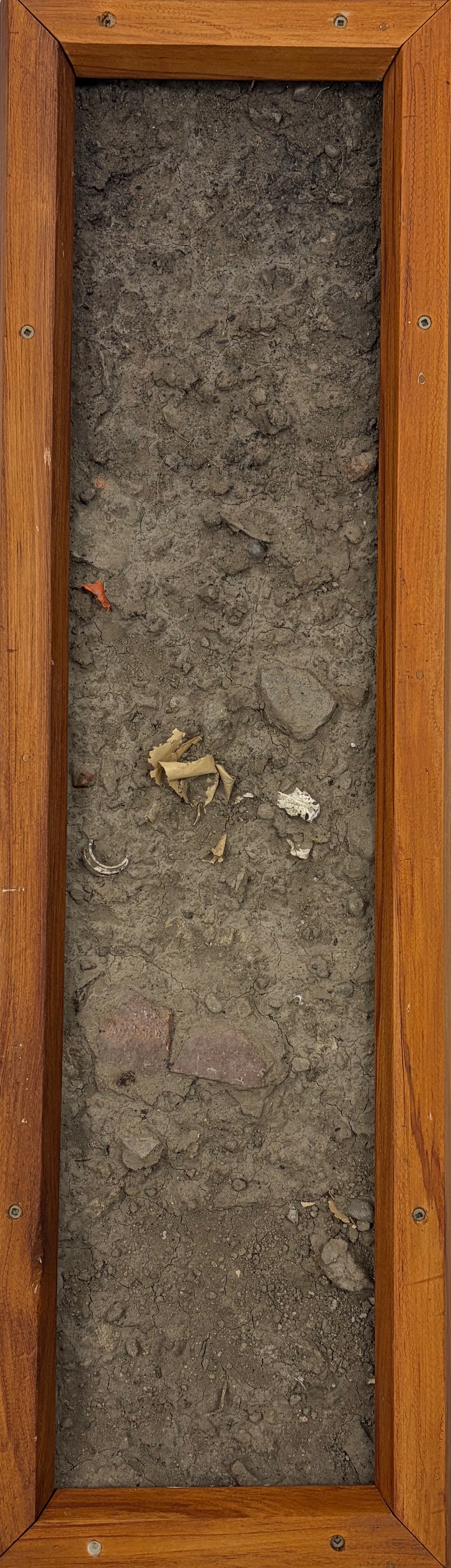
The soil profile from the field trial site reveals an anthropogenic soil, containing anthropogenic objects such as brick, concrete, glass, and timber fragments throughout the profile. These artefacts are remnants of the demolished residential properties. The soil is low in soil organic carbon, reflecting its degraded condition. The dark surface layer is biochar, applied as a soil amendment to immobilise heavy metals and improve soil structure.
试验场地的土壤剖面显示这是一种人为土:整个剖面中夹杂着砖块、混凝土、玻璃和木材碎片等人工物体,都是被拆除住宅留下的遗迹。土壤有机碳含量低,反映出它已经退化。表层的深色层是生物炭,作为土壤改良剂施入,用以固定重金属并改善土壤结构。
This project demonstrates a circular economy model. Urban environments generate significant organic waste and often contain degraded, contaminated soils. By converting the former into conditioners for the latter, the project achieves two goals: soil remediation and waste minimisation.
这个项目展示了一种循环经济模式。城市既产生大量有机废弃物,又往往留有退化和受污染的土壤。把前者转化为改良后者的材料,项目同时达成了两个目标:修复土壤,以及减少废弃物。
Project supported by项目支持方
Christchurch City Council基督城市议会 ↗ · University of Canterbury坎特伯雷大学 ↗ · Brian Mason Scientific & Technical TrustBrian Mason 科学与技术信托基金 ↗ · Resycl Limited ↗