Michael Simmler,†,‡ Lisa Ciadamidaro,§ Rainer Schulin,‡ Paula Madejón,§ René Reiser,∥ Lynne Clucas,† Paul Weber,⊥ and Brett Robinson*,†
†Department of Soil and Physical Sciences, Lincoln University, New Zealand
‡Institute of Terrestrial Ecosystems, ETH Zurich, Switzerland
§Institute for Natural Resources and Agrobiology, Seville, Spain
∥Agroscope Reckenholz-Tänikon ART, Switzerland
⊥Solid Energy New Zealand, 15 Show Place, Christchurch, New Zealand
*S Supporting Information
ABSTRACT: Repeated application of Cd-rich phosphate fertilizers can lead to the accumulation of this nonessential element in soil. This can result in increased plant uptake, with possible breaches of food or feed safety standards. We aimed to determine whether lignite (brown coal) can reduce Cd solubility and plant uptake in New Zealand pasture soils. In batch sorption experiments, we tested the capacity of lignite and lignite-soil mixtures to sorb Cd at various soil pH and Cd loadings. Over a pH range of 4−7, Cd sorption by lignite was 1−2 orders of magnitude greater than by a typic immature pallic soil containing 2% carbon. The addition of 5 wt % lignite to a range of soils revealed that lignite addition was most effective in reducing soluble Cd in soils with low pH. In a
摘要:长期施用富含Cd的磷肥可导致这一非必需元素在土壤中累积,进而增加植物吸收,并可能导致食品或饲料安全标准超标。本研究旨在确定褐煤(lignite)能否降低新西兰牧场土壤中Cd的溶解度及植物吸收。通过批量吸附试验,考察了褐煤及褐煤-土壤混合物在不同土壤pH和Cd负载条件下对Cd的吸附能力。在pH 4−7范围内,褐煤对Cd的吸附量比含碳2%的典型未成熟淡色土(typic immature pallic soil)高1−2个数量级。向多种土壤中添加5 wt %褐煤的结果表明,褐煤添加在低pH土壤中降低可溶性Cd的效果最为显著。在
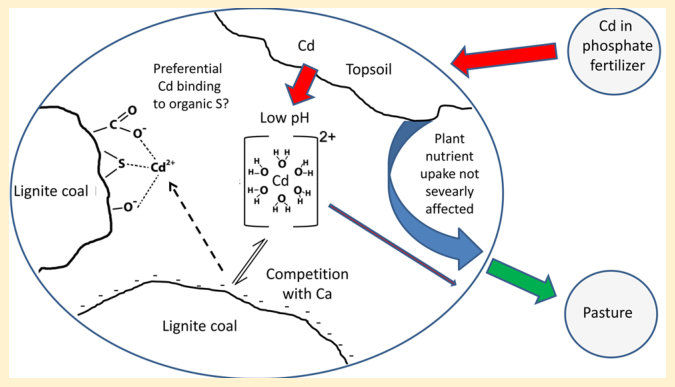
greenhouse experiment, we tested the effect of lignite on the accumulation of Cd and other elements by perennial ryegrass, Lolium perenne (L.). The addition of just 1 wt % lignite to the aforementioned soil reduced plant Cd uptake by 30%, without adversely affecting biomass or the uptake of essential nutrient elements including copper and zinc. This may be due to preferential binding of Cd to organic sulfur in lignite.
温室试验中,考察了褐煤对多年生黑麦草Lolium perenne (L.)累积Cd及其他元素的影响。向上述土壤中仅添加1 wt %褐煤即可使植物Cd吸收降低30%,且对生物量及铜、锌等必需营养元素的吸收无不利影响。这可能是由于Cd优先与褐煤中的有机硫结合所致。
1INTRODUCTION引言
Cadmium (Cd) is a nonessential element1 that is readily taken up by plants and transferred through fodder and food products into animals and humans.2 Enrichment of Cd in soils has been reported worldwide, through the land application of biosolids, industrial effluents, and Cd-rich phosphate fertilizers.1,3,4 In a New Zealand (NZ) soil survey, Taylor et al.5 reported an average Cd concentration in pasture soils of 0.43 mg/kg (N = 825). This is more than double the background concentration of 0.16 mg/kg (N = 372).5 The main sources of Cd in these soils are phosphate fertilizers containing Cd as an impurity that originates from the phosphate rock used for their production.6 Grazing animals take up Cd mainly via consumption of herbage; intake through soil ingestion is generally lower.6,7
镉(Cd)是一种非必需元素1,易被植物吸收,并经由饲料和食品转移至动物和人体。2由于生物固体(污泥)、工业废水及富Cd磷肥的土地施用,世界各地均有土壤Cd富集的报道。1,3,4在新西兰(NZ)的一项土壤调查中,Taylor等5报道牧场土壤Cd平均浓度为0.43 mg/kg(N = 825),是背景浓度0.16 mg/kg(N = 372)的两倍以上。5这些土壤中Cd的主要来源是磷肥,其所含Cd杂质来源于生产磷肥所用的磷矿石。6放牧动物主要通过采食牧草摄入Cd,经由摄食土壤的摄入量通常较低。6,7
For agricultural soils, a suitable risk-mitigation technology must be low-cost and leave the soil fertile. Potentially, in situ fixation may fulfill these requirements. By applying a fixing additive to soil, Cd is transferred to a form that is less available for plant uptake. Organic (e.g., leaves, bark sawdust, peat, compost) and inorganic (e.g., lime, hydroxyapatite) amendments can effectively reduce Cd solubility and plant uptake in contaminated soils and tailings,8,9 by forming insoluble organometallic compounds.10 Lignite is discussed as a source of soil organic matter to improve soil fertility in degraded soils11 and as a fixing additive in remediation of metalcontaminated soils.10,12,13 Compared to other organic amendments such as compost, lignite is more resistant to decomposition and mineralization and shows a long-lasting activity in soil.10 In contrast to some biochars, which also sorb Cd,14,15 lignite is abundant worldwide and mined in great quantities. The proven recoverable world lignite resources are ca. 195 billion tonnes, with 333 million tonnes located in NZ.16
对于农业土壤而言,适宜的风险缓解技术必须成本低廉并能保持土壤肥力。原位固定技术有望满足上述要求。通过向土壤中施加固定剂,可使Cd转化为较难被植物吸收的形态。有机(如落叶、树皮锯末、泥炭、堆肥)和无机(如石灰、羟基磷灰石)改良剂可通过形成不溶性有机金属化合物10,有效降低污染土壤和尾矿中Cd的溶解度及植物吸收。8,9褐煤被认为可作为土壤有机质来源以改善退化土壤的肥力11,也可作为固定剂用于金属污染土壤的修复。10,12,13与堆肥等其他有机改良剂相比,褐煤更耐分解和矿化,在土壤中具有持久的活性。10与某些同样可吸附Cd的生物炭14,15不同,褐煤在全球储量丰富且开采量巨大。全球已探明可采褐煤资源约1950亿吨,其中3.33亿吨位于新西兰。16
The prevalent mechanism by which metal ions are sorbed to lignite is ion exchange, but specific adsorption also plays a role.17 Lignite contains large amounts of humic and fulvic acids18 that have similar properties as their equivalents in soil.11 Being a chalcophile, Cd is expected to bind strongly to organic sulfur groups,1 R-SH, R-S-R, R-SS-R and heterocyclic S, which can be present in lignite.19 Such binding may be important at low, biologically relevant Cd concentrations, typical for low to medium level polluted agricultural soil (e.g., Taylor5). In batch sorption experiments, lignite and other low rank coals effectively sorbed Cd from aqueous solution containing high Cd concentrations.17,20−27 These studies are not representative of agricultural soils though, where Cd concentrations typically reach a few mg/kg at most.28 Other studies found a decrease in plant uptake of Cd when Cd-contaminated soil was blended with lignite. The metal concentrations used in these treatments were usually high and resulted in reduced plant growth.10,12,13 The findings of these studies nevertheless indicate that lignite application could potentially reduce the plant uptake of Cd from pasture soils with subphytotoxic levels of Cd contamination originating from Cd-containing P fertilizer applications.
金属离子在褐煤上吸附的主要机制是离子交换,但专性吸附也起一定作用。17褐煤含有大量腐殖酸和富里酸18,其性质与土壤中的相应组分相似。11Cd作为亲硫元素,预计会与有机硫基团(R-SH、R-S-R、R-SS-R及杂环S)强烈结合1,而褐煤中可能存在这些基团。19在低浓度、具有生物学意义的Cd水平下(这是轻度至中度污染农业土壤的典型情况,如Taylor5),此类结合可能十分重要。在批量吸附试验中,褐煤及其他低阶煤能有效吸附高Cd浓度水溶液中的Cd。17,20−27然而,这些研究并不能代表农业土壤的情况,因为农业土壤中Cd浓度通常最多仅为数mg/kg。28另有研究发现,将Cd污染土壤与褐煤混合后,植物对Cd的吸收降低。但这些处理中所用的金属浓度通常较高,并导致植物生长受抑。10,12,13尽管如此,这些研究结果表明,对于因施用含Cd磷肥而受到亚植物毒性水平Cd污染的牧场土壤,施用褐煤有望降低植物对Cd的吸收。
Received: August 1, 2012 Revised: March 3, 2013 Accepted: March 14, 2013
Published: March 14, 2013
| biosolids生物固体 | lignite褐煤 | Soil 1土壤1 | Soil 2土壤2 | Soil 3土壤3 | Soil 4土壤4 | Soil 5土壤5 | Soil 6土壤6 | |
|---|---|---|---|---|---|---|---|---|
| moisture (%) | 53 | 38 | <1 | <1 | <1 | <1 | <1 | <1 |
| clay/silt/sand (%) | n.d. | <200 μm | 4/20/76 | 3/42/55 | 40/46/14 | 17/44/39 | 20/30/50 | 19/25/56 |
| pH (H2O) | 4.1 | 4.5 | 5.1 | 5.5 | 5.3 | 4.8 | 6.8 | 5.5 |
| CECa (meq/100g) | n.d. | 44.8 | 12.3 | n.d. | n.d. | n.d. | n.d. | n.d. |
| BSb (%) | n.d. | 95.2 | 50.3 | n.d. | n.d. | n.d. | n.d. | n.d. |
| C (%) | 28.0 (0.2) | 57.2 (0.2) | 3.3 (0.03) | 6.1 | 4.9 | 8.7 | 2.0 | 13.3 |
| N (%) | 2.7 (0.03) | 0.8 (0.01) | 0.3 (0.00) | 0.6 | 0.3 | 0.6 | 0.2 | 1.0 |
| P | 4683 (2) | 57.6 (0.2) | 732 (11) | 1470 | 876 | 786 | 605 | 2108 |
| S | 6972 (43) | 6539 (35) | 383 (6) | 784 | 447 | 578 | 217 | 1381 |
| Ca | 9818 (176) | 17502 (119) | 3229 (58) | 4350 | 3310 | 8272 | 11090 | 4210 |
| Mg | 2204 (17) | 2815 (11) | 3426 (71) | 1235 | 1921 | 1779 | 1934 | 1231 |
| K | 4330 (67) | 219 (2) | 2541 (279) | 3781 | 3768 | 4422 | 3585 | 1256 |
| Cd | 2.8 (0.0) | 0.06 (0.007) | 0.13 (0.00) | 0.86 | 1.34 | 0.75 | 1.07 | 1.53 |
| Zn | 878 (13) | 9 (1) | 70 (2) | 43 | 76 | 49 | 67 | 61 |
| Cu | 561 (33) | 2 (0) | 5 (0) | 6 | 23 | 6 | 23 | 38 |
| Mo | n.d. | 0.1 (0.00) | 0.1 (0.01) | 0.3 | 0.6 | 0.2 | 0.2 | 0.9 |
| B | n.d. | 36.3 (0.1) | 7.3 (1.0) | 4.1 | 4.6 | 3.1 | 5.6 | 4.5 |
| Fe | n.d. | 12918 (145) | 17727 (353) | 21039 | 38664 | 20501 | 34912 | 33082 |
| Mn | n.d. | 280 (3) | 357 (20) | 154 | 2346 | 320 | 577 | 814 |
aCation Exchange Capacity. bBase Saturation. cValues in brackets represent standard error (SE) of the mean. (N = 3 when SE is given; N = 1 when no SE is given). All units are in mg/kg unless otherwise indicated. Soil type according to the New Zealand Fundamental Soil Layer 50 given at the bottom. n.d. = not determined. Soil 1: typic immature pallic soil (43°38′11.35″ S, 172°26′17.00″ E), Soil 2: typic orthic brown soil (42°20′18.51″ S, 171°33′54.34″ E), Soil 3: weathered rendzic melanic soil (40°56′36.24″ S, 172°53′33.53″ E), Soil 4: typic sandy recent soil (43°22′4.00″ S, 170°11′12.20″ E), Soil 5: acidic orthic brown soil (41°23′18.27″ S, 172°48′47.73″ E), Soil 6: pallic orthic brown soil (38°29′5.48″ S, 174°59′49.38″ E).
a阳离子交换量。b盐基饱和度。c括号内数值为平均值的标准误(SE)(给出SE时N = 3;未给出SE时N = 1)。除另有说明外,单位均为mg/kg。表底给出依据新西兰基础土壤图层(New Zealand Fundamental Soil Layer)50的土壤类型。n.d. = 未测定。土壤1:典型未成熟淡色土(typic immature pallic soil)(43°38′11.35″ S, 172°26′17.00″ E);土壤2:典型正常棕色土(typic orthic brown soil)(42°20′18.51″ S, 171°33′54.34″ E);土壤3:风化黑色石灰土(weathered rendzic melanic soil)(40°56′36.24″ S, 172°53′33.53″ E);土壤4:典型砂质新成土(typic sandy recent soil)(43°22′4.00″ S, 170°11′12.20″ E);土壤5:酸性正常棕色土(acidic orthic brown soil)(41°23′18.27″ S, 172°48′47.73″ E);土壤6:淡色正常棕色土(pallic orthic brown soil)(38°29′5.48″ S, 174°59′49.38″ E)。
The goal of this study was to investigate whether lignite could be used as soil amendment for in situ fixation of Cd in NZ pastureland. Specifically we sought to determine the following:
本研究旨在探讨褐煤能否作为土壤改良剂用于新西兰牧场中Cd的原位固定。具体研究内容如下:
1) Cd sorption by lignite at biologically relevant concentrations and pH values, 2) the effect of lignite amendments on Cd sorption and pH of various NZ pasture soils, 3) lignite treatment effects on plant growth and uptake of elements, and 4) the influence of liming on the lignite treatment effects.
1)在具有生物学意义的浓度和pH条件下褐煤对Cd的吸附;2)褐煤改良对新西兰多种牧场土壤Cd吸附及pH的影响;3)褐煤处理对植物生长和元素吸收的影响;4)施石灰对褐煤处理效果的影响。
2MATERIALS AND METHODS材料与方法
Powdered lignite (particle size <200 μm) mined in the New Vale open cast mine in Southland (NZ) was provided by Solid Energy New Zealand Ltd. The lignite was obtained from the W7 rider seam, which is low calorific value lignite ∼14.5 MJ/kg, compared to the main W6 seam that is mined for thermal coal (∼15.5 MJ/kg). The lower calorific value is due to partial oxidation of the W7 seam as this rider seam is shallower and closer to ground level. Biosolids, a soil amendment with typically elevated Cd concentrations, were obtained from Kaikoura regional treatment works, NZ, homogenized, and sieved to <20 mm. Relevant properties of the biosolids used are given in Table 1. Six pasture soils from NZ were used. The soil types and properties are given in Table 1. Soil 1 was collected on the Lincoln University Commercial Dairy Farm. Soils 2−6 were selected from a survey of a total of 69 soils from both islands on the rationale of covering a broad range of soil pH values, carbon contents, and textures. All soils had been modified by agriculture, i.e. amendment of liming agents and fertilizers, and occasionally tilling and sowing. Table 1 also gives the properties of the lignite used.
粉末状褐煤(粒径<200 μm)由Solid Energy New Zealand Ltd提供,开采自新西兰Southland的New Vale露天矿。该褐煤取自W7伴生煤层,属低热值褐煤(约14.5 MJ/kg),而作为动力煤开采的主煤层W6热值约为15.5 MJ/kg。热值较低是由于W7伴生煤层埋藏较浅、更接近地表,因而发生了部分氧化。生物固体是一种Cd浓度通常较高的土壤改良剂,取自新西兰Kaikoura地区污水处理厂,经均质化后过<20 mm筛。所用生物固体的相关性质见表1。试验采用6种新西兰牧场土壤,其类型和性质见表1。土壤1采自Lincoln University商业奶牛场。土壤2−6选自对南北两岛共69种土壤的调查,选择依据是尽可能涵盖广泛的土壤pH、碳含量和质地范围。所有土壤均受到农业活动的改变,即施用过石灰类物质和肥料,并偶有耕作和播种。表1同时给出了所用褐煤的性质。
Batch Sorption Experiments. The influence of pH and spiked Cd solution concentration on Cd sorption by lignite and soil was studied in Batch Experiment 1 (BE1). The influence of lignite addition on Cd adsorption in contrasting soil types was investigated in Batch Experiment 2 (BE2).
批量吸附试验。批量试验1(BE1)研究了pH和加标Cd溶液浓度对褐煤和土壤吸附Cd的影响。批量试验2(BE2)研究了褐煤添加对不同类型土壤Cd吸附的影响。
The soils used for the experiments were dried and passed through a 2 mm nylon sieve. The lignite powder was used without drying to avoid hydrophobicity. The moisture content of the lignite was taken into account in determining solid-solution ratios. Both sorption experiments were conducted using 40 mL centrifuge tubes with 4 replicates per treatment. Three replicates per treatment were used for element analysis and one for pH determination.
试验用土壤经风干后过2 mm尼龙筛。为避免产生疏水性,褐煤粉末未经干燥直接使用,在确定固液比时已考虑褐煤的含水量。两项吸附试验均在40 mL离心管中进行,每个处理设4个重复,其中3个重复用于元素分析,1个用于测定pH。
The tubes were continuously agitated for 2 h on an endoverend shaker in order to reach sorption equilibrium (determined in a previous experiment). The pH of the slurry was measured after shaking. The tubes were centrifuged for 10 min at 3300 rpm. The supernatant was decanted and filtered through Whatman 52 filter paper (pore size 7 μm). Solution element concentrations were measured by ICP-OES (Varian 720-ES). Total and organic carbon in solution was determined using a total carbon analyzer (Shimadzu TOC-5000A).
离心管在翻转振荡器上连续振荡2 h以达到吸附平衡(由前期试验确定)。振荡后测定悬浊液pH。离心管以3300 rpm离心10 min,倾出上清液并经Whatman 52滤纸(孔径7 μm)过滤。溶液元素浓度采用ICP-OES(Varian 720-ES)测定。溶液中总碳和有机碳采用总碳分析仪(Shimadzu TOC-5000A)测定。
Treatments BE1. Five grams of lignite or Soil 1 was added to 30 mL of 0.05 M Ca(NO3)2 (BDH AnalaR Ca(NO3)2•4H2O) solution spiked with various amounts of Cd (BDH AnalaR 3Cd(SO4)•8H2O). The initial solution Cd concentrations were 0, 0.12, 0.39, 1.26, and 3.75 mg/L. The solution pH was adjusted to values ranging from 2.8 to 8.3 after addition of the sorbent by using HNO3 (BDH ARISTAR nitric acid 70%) or KOH (BDH AnalaR KOH) to decrease or increase pH, respectively (Table S1). Centrifuge tubes containing solutions without soil or lignite were prepared as a control for each Cd concentration to determine the extent of any Cd sorption by the tubes or filter papers. The results indicated that such sorption was negligible.
BE1处理。将5 g褐煤或土壤1加入30 mL 0.05 M Ca(NO3)2(BDH AnalaR Ca(NO3)2•4H2O)溶液中,溶液中加入不同量的Cd(BDH AnalaR 3Cd(SO4)•8H2O)。初始溶液Cd浓度分别为0、0.12、0.39、1.26和3.75 mg/L。加入吸附剂后,分别用HNO3(BDH ARISTAR硝酸70%)或KOH(BDH AnalaR KOH)降低或升高溶液pH,使其介于2.8至8.3之间(表S1)。针对每一Cd浓度,均设置不含土壤或褐煤的溶液离心管作为对照,以确定离心管或滤纸对Cd的吸附程度。结果表明此类吸附可忽略不计。
Treatments BE2. In this experiment we compared the effect of lignite addition on Cd sorption of Soil 1 with five other soils (Soil 2−6). For this purpose, we prepared mixtures of 4.75 g of soil with 0.25 g of lignite (5 wt %) and for Soil 1 additionally mixtures of 4.5 g of soil with 0.5 g of lignite (10 wt %). Five grams of soil or soil/lignite mixture was added to 30 mL of 0.05 M Ca(NO3)2 solution without spiking or spiked with 0.39 mg/ L Cd, respectively. Were most of this added Cd sorbed by the soil, the soil concentration would be ca. 2.34 mg/kg, which is at the high end of the Cd concentrations found in NZ soils.5
BE2处理。本试验比较了褐煤添加对土壤1及其他5种土壤(土壤2−6)Cd吸附的影响。为此,制备了4.75 g土壤与0.25 g褐煤(5 wt %)的混合物,对土壤1另制备了4.5 g土壤与0.5 g褐煤(10 wt %)的混合物。将5 g土壤或土壤/褐煤混合物分别加入30 mL未加标或加标0.39 mg/ L Cd的0.05 M Ca(NO3)2溶液中。若所添加的Cd大部分被土壤吸附,则土壤Cd浓度约为2.34 mg/kg,处于新西兰土壤Cd浓度的高值区间。5
Pot Experiment. In a greenhouse at Lincoln University (NZ), we grew Lolium perenne (L.) in 2.5-L pots holding ca. 3 kg of Soil 1, an alluvial soil similar to that found on many NZ lowland farms. Soil treatments included no spiking, spiking with 1.1 mg/kg Cd (added as CdSO4 solution), or blending with 10% biosolids by volume (equivalent to 3.7 wt %). The Cdspiked treatment was intended to simulate a future scenario where soil Cd concentrations exceed guideline values due to the continued application of Cd-containing phosphate fertilizers. The biosolids treatment raised the Cd concentration of Soil 1 from 0.13 mg/kg to 0.23 mg/kg. Undried lignite (38 wt % H2O) was mixed into the unspiked and the biosolid-treated soil treatments at rates of 0, 25, 100, and 250 g per pot (equivalent to dry weight lignite concentrations of 0, 1.0, 3.4, and 7.1 wt %). The spiked soils were amended with 0, 1.0, and 3.4 wt % lignite. Two treatment series, one with and one without lime addition (65 g Ravensdown AgLime per pot, average particle size <0.5 mm), were prepared in five replicates each. Before filling into the pots, the soils were mixed using a concrete mixer. All treatments were added at the same time. The filled pots were placed in a randomized block design and allowed to stand for 2 weeks. Soil samples for chemical analysis were taken prior to sowing. L. perenne was sown directly on the wet soil surface at a rate of ca. 100 seeds per pot without any further soil working. A dense cover of seedlings developed in all pots. Plants were irrigated daily, and no fertilizer was applied. The above-ground biomass was harvested 29 days after sowing, washed thouroughly in deionized water, and dried at 60 °C until a constant weight was obtained.
盆栽试验。在Lincoln University(新西兰)温室中,将Lolium perenne (L.)种植于2.5 L花盆中,每盆装约3 kg土壤1(一种与新西兰许多低地农场相似的冲积土)。土壤处理包括不加标、加标1.1 mg/kg Cd(以CdSO4溶液形式添加)或按体积混入10%生物固体(相当于3.7 wt %)。Cd加标处理旨在模拟因持续施用含Cd磷肥而导致土壤Cd浓度超过指导值的未来情景。生物固体处理使土壤1的Cd浓度由0.13 mg/kg升至0.23 mg/kg。将未干燥褐煤(含水38 wt %)按每盆0、25、100和250 g(相当于褐煤干重浓度0、1.0、3.4和7.1 wt %)混入未加标及生物固体处理土壤中。加标土壤分别添加0、1.0和3.4 wt %褐煤。设置施石灰(每盆65 g Ravensdown AgLime,平均粒径<0.5 mm)与不施石灰两个处理系列,每个处理5个重复。装盆前,土壤用混凝土搅拌机混匀,所有处理同时添加。装好的花盆按随机区组设计摆放,静置2周。播种前采集土样用于化学分析。L. perenne以每盆约100粒种子的播量直接播于湿润土壤表面,未进行任何进一步的整土。所有花盆均形成了致密的幼苗覆盖。每日灌溉,不施肥。播种后29 d收获地上部生物量,用去离子水彻底洗净,于60 °C烘干至恒重。
Sample Analysis. The C and N content of the lignite, soil, and plant material was determined using an Elementar vario MAX CN element analyzer. Pseudototal element concentrations were measured in acid digests using ICP-OES. For both lignite and soil, 0.5 g was digested in 5 mL of HNO3/1 mL of H2O2 (Merck hydrogen peroxide 30%). The digest was diluted with Milli Q (Barnstead, EASYpure RF, 18.3 MΩ-cm) to a volume of 25 mL and filtered with a Whatman 52 filter paper. Plant material (0.3 g) was digested in 5 mL of HNO3 and subsequently diluted to a volume of 20 mL. Wageningen reference soil (ISE 989) and plant (IPE 100) material were analyzed for quality assurance (giving recoveries of >95% for all elements).29 Soluble element concentrations, henceforth referred to as “solution concentrations”, in soil samples were measured in calcium nitrate extracts using ICP-OES. Five grams of soil was weighted into centrifuge tubes (V = 40 mL), and 30 mL of 0.05 M Ca(NO3)2 was added. Tubes were agitated for 2 h on an end-over-end shaker, subsequently centrifuged for 10 min at 3300 rpm, and finally filtered using a Whatman 52 filter paper. Extracts were stored at 4 °C. Soil pH was measured in Milli Q water at a solid-solution ratio of 1:2.5 using a Mettler Toledo pH meter. The cation exchange capacity (CEC) and base saturation (BS) for the lignite powder and Soil 1 was determined using the silver thio-urea method of Blakemore et al.30 The grain size distribution of the Soils 1−6 was determined using the pipet method according to the reference methods of the Swiss federal agricultural research stations.31
样品分析。褐煤、土壤和植物样品的C和N含量采用Elementar vario MAX CN元素分析仪测定。采用ICP-OES测定酸消解液中的准全量元素浓度。褐煤和土壤均称取0.5 g,用5 mL HNO3/1 mL H2O2(Merck过氧化氢30%)消解。消解液用Milli Q水(Barnstead, EASYpure RF, 18.3 MΩ-cm)定容至25 mL,并经Whatman 52滤纸过滤。植物样品(0.3 g)用5 mL HNO3消解后定容至20 mL。采用Wageningen参考土壤(ISE 989)和植物(IPE 100)标准物质进行质量控制(所有元素回收率均>95%)。29土壤样品中的可溶性元素浓度(以下称“溶液浓度”)采用硝酸钙浸提、ICP-OES测定。称取5 g土壤于离心管(V = 40 mL)中,加入30 mL 0.05 M Ca(NO3)2,在翻转振荡器上振荡2 h,随后以3300 rpm离心10 min,最后经Whatman 52滤纸过滤。浸提液于4 °C保存。土壤pH以Milli Q水按固液比1:2.5浸提,用Mettler Toledo pH计测定。褐煤粉末和土壤1的阳离子交换量(CEC)和盐基饱和度(BS)采用Blakemore等30的硫脲银法测定。土壤1−6的粒径分布依照瑞士联邦农业研究站的参考方法,采用吸管法测定。31
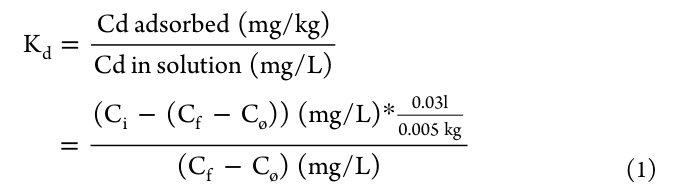
Data Analysis. Solid-solution distribution coefficients Kd were calculated from the experimental results using eq 1, where Cf is the Cd solution concentration after equilibration in a given batch with Cd spiking, Cø is the Cd solution concentration in the corresponding batch without Cd spiking, and Ci is the initial Cd solution concentration. Following the review by Degryse et al.32 these Kd values characterize the equilibrium of labile Cd sorption.
数据分析。根据试验结果,采用式1计算固液分配系数Kd,其中Cf为某一加标批次平衡后溶液中的Cd浓度,Cø为相应未加标批次溶液中的Cd浓度,Ci为初始溶液Cd浓度。依据Degryse等32的综述,这些Kd值表征了活性Cd吸附的平衡状态。
Microsoft Excel 2007 was used for general data analysis and visualization. (Log-)linear regressions and Fisher’s least significant difference tests (LSD-test) were computed using the statistical software R (http://www.r-project.org/). For Fisher’s test the R package Agricolae was used (http://tarwi. lamolina.edu.pe/∼fmendiburu).
采用Microsoft Excel 2007进行常规数据分析和可视化。(对数)线性回归和Fisher最小显著差异检验(LSD检验)采用统计软件R(http://www.r-project.org/)进行计算。Fisher检验使用R软件包Agricolae(http://tarwi. lamolina.edu.pe/∼fmendiburu)。
3RESULTS AND DISCUSSION结果与讨论
Cd Adsorption As a Function of pH and Cd Loading (BE1). Figure 1 shows that in the experimental range of solution pH between 3.4 and 6.8 and at a range of Cd concentrations found in pasturelands, the lignite used in this study sorbed 1 to 2 orders of magnitude more Cd than Soil 1. Sorption isotherms were linear in the experimental range of Cd loadings. Thus, the Kd values were independent of Cd loading, indicating that Cd binding was due to adsorption to sites that are well below saturation. On the log scale, Kd values increased linearly with pH for both materials up to neutral pH values. For lignite, where we had also batches with pH values of 8.0 and 8.4, sorption then decreased again by more than 1 order of magnitude between the maximum at the experimental pH value of 6.8 and these alkaline conditions. Although the difference in Kd between lignite and Soil 1 was greater at higher pH, the difference in terms of percentage adsorbed was highest at lower pH and diminished with increasing pH. Using the regression functions given in Figure 1 and assuming a solid-solution ratio of 1:6, 87% and 42% of the Cd was calculated to be bound to lignite and Soil 1, respectively, at pH 3.4, whereas respective >99% and 96% were obtained for pH 6. Thus, lignite addition to soil might be most effective at low pH.
pH和Cd负载对Cd吸附的影响(BE1)。由图1可见,在溶液pH 3.4至6.8的试验范围内,以及在牧场中常见的Cd浓度范围内,本研究所用褐煤对Cd的吸附量比土壤1高1至2个数量级。在试验Cd负载范围内,吸附等温线呈线性,因此Kd值与Cd负载无关,表明Cd的结合是由于吸附在远未饱和的位点上。在对数尺度上,两种材料的Kd值在中性pH以下均随pH线性增加。对于褐煤,在pH 8.0和8.4的批次中,吸附量从试验pH 6.8时的最大值下降了1个数量级以上。尽管褐煤与土壤1之间的Kd差异在较高pH下更大,但以吸附百分比计,二者差异在较低pH下最大,并随pH升高而减小。利用图1中的回归方程并假定固液比为1:6,计算得出pH 3.4时褐煤和土壤1分别结合87%和42%的Cd,而pH 6时分别为>99%和96%。因此,向土壤中添加褐煤在低pH条件下可能最为有效。
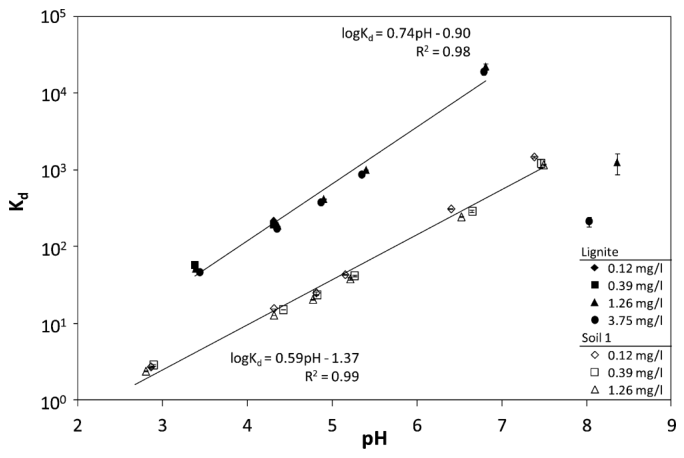
The phenomenon of increasing Kd with increasing pH is well-known for soils and was also described for lignite.20,24 The log−linear relationship indicates that the sorption mechanism is dominated by a competition reaction with H+ following the law of mass action. Dissociation of acid groups and complexation of Cd with the charged conjugate groups is expected to account for the observed pH effect on Cd sorption of lignite. Phenolic and thiol groups typically have pKa values above pH 824,33 and are therefore not expected to deprotonate in great quantities under acidic conditions. Adsorption onto dissociated carboxylic (COO−) groups may account for the increase in Cd adsorption onto lignite with increasing pH. Titration of the lignite slurry produced a gradual change of pH over the whole pH range (Figure S1) and no distinct titration edges. This indicates that our lignite contained functional groups with a relative broad range of pKa values typical for carboxylic groups.25 This does not rule out sorption onto other functional groups, such as sulfur groups. Karlsson et al.33 found that surface complexation with sulfur groups might be the dominant mechanism of Cd binding in soils with a concentration of <5 mg Cd/g organic C.33 Lignite contains a sufficient number of sulfur groups that can play an important role in Cd binding at these concentrations. The large percentage of spiked Cd adsorbed at pH 3.4 may indicate sulfur binding, as the amount of Cd bound to reduced sulfur is expected to be approximately constant over the pH range investigated (see modeling by Karlsson et al.33).
Kd随pH升高而增加的现象在土壤中已为人熟知,在褐煤中亦有报道。20,24对数线性关系表明,吸附机制主要受遵循质量作用定律的H+竞争反应控制。酸性基团的解离以及Cd与带电共轭基团的络合,预计可解释所观察到的pH对褐煤Cd吸附的影响。酚基和巯基的pKa值通常高于pH 824,33,因此在酸性条件下预计不会大量去质子化。Cd在已解离羧基(COO−)上的吸附可能是褐煤Cd吸附随pH升高而增加的原因。褐煤悬浊液的滴定在整个pH范围内呈现pH的渐变(图S1),无明显的滴定突跃。这表明所用褐煤含有pKa值分布较宽的官能团,这是羧基的典型特征。25但这并不排除Cd在硫基团等其他官能团上的吸附。Karlsson等33发现,在Cd浓度<5 mg Cd/g有机C的土壤中,与硫基团的表面络合可能是Cd结合的主要机制。33褐煤含有足够数量的硫基团,在此类浓度下可能对Cd结合起重要作用。pH 3.4时加标Cd的吸附百分比较高,可能指示硫结合的存在,因为与还原态硫结合的Cd量在所研究的pH范围内预计大致恒定(参见Karlsson等33的模拟)。
The decrease in Cd sorption by lignite above neutral pH might be due to dissolution of humic acids. An increase of such organic ligands in solution increases the solution concentration of Cd by forming soluble Cd-humic acid complexes. This is a well-known phenomenon for Cu.34 The dissolved organic carbon (DOC) concentration released from the lignite in BE1 increased exponentially with increasing pH according to eq 2:
中性pH以上褐煤对Cd吸附的下降可能是腐殖酸溶解所致。溶液中此类有机配体的增加可通过形成可溶性Cd-腐殖酸络合物而提高溶液Cd浓度,这一现象在Cu中已广为人知。34BE1中褐煤释放的溶解性有机碳(DOC)浓度随pH升高呈指数增加,符合式2:
2 log DOC (mg/L) = 0.19pH + 0.42 R = 0.94 (2)
2 log DOC (mg/L) = 0.19pH + 0.42 R = 0.94 (2)
However, at low pH values (<5.5) the DOC approached an approximately constant level of 14 mg/L. At these pH values, DOM is largely composed of fulvic acids. With increasing solution pH the fraction of humic acids, which are not soluble at pH < 2, increases in solution. This is consistent with a higher concentration of humic as opposed to fulvic acids in lignite.18 A fraction of the fulvic and humic acids in solution may actually be present in the form of submicrometer colloids and not truly dissolved. The dissolved organic carbon released from Soil 1 was almost constant (ca. 120 mg/L) over the studied pH range (pH 2.8−7.5), indicating that it was dominated by fulvic acids, and thus no similar decrease in Kd should be expected at pH > 7 as for lignite. Whether lignite addition to soil might fail to lower plant Cd concentrations finally depends on whether or not humic acid-Cd complexes contribute to the availability of soil Cd for plant uptake. Antoniadis and Alloway35 found that the application of dissolved organic matter (DOM) significantly increased the uptake of Cd by L. perenne.35 Evangelou et al.36 observed that humic acid amendment to soil increased Cd uptake by Nicotiana tabacum (L.).36 The bioavailability of metal-DOC/DOM complexes depends on a number of factors including the nature of organic compounds in DOC, the solubility, and dissociation constants of these complexes.37,38
然而,在低pH(<5.5)条件下,DOC趋于约14 mg/L的近似恒定水平。在此pH下,DOM主要由富里酸组成。随着溶液pH升高,在pH < 2时不溶的腐殖酸在溶液中所占比例增加。这与褐煤中腐殖酸浓度高于富里酸的结果一致。18溶液中部分富里酸和腐殖酸实际上可能以亚微米胶体形式存在,而非真正溶解。在所研究的pH范围(pH 2.8−7.5)内,土壤1释放的溶解性有机碳几乎恒定(约120 mg/L),表明其以富里酸为主,因此预计在pH > 7时不会出现与褐煤类似的Kd下降。向土壤中添加褐煤能否降低植物Cd浓度,最终取决于腐殖酸-Cd络合物是否对土壤Cd的植物有效性有贡献。Antoniadis和Alloway35发现,施用溶解性有机质(DOM)显著增加了L. perenne对Cd的吸收。35Evangelou等36观察到,向土壤中添加腐殖酸增加了Nicotiana tabacum (L.)对Cd的吸收。36金属-DOC/DOM络合物的生物有效性取决于多种因素,包括DOC中有机化合物的性质以及这些络合物的溶解度和解离常数。37,38
Cd Sorption of Various Soils Amended with Lignite (BE2). The capacity of lignite to decrease the solubility of Cd in soil varied strongly with soil type (Figure 2). Lignite addition may affect the affinity of a soil to sorb Cd directly by changing the density and composition of sorption sites as well as indirectly by changing conditions that affect sorption, in particular pH. Given that Cd sorption was stronger by lignite than by soil, an increase in Cd sorption should be expected upon lignite addition as long as this direct effect was not outmatched by Cd solubilization due to a decrease in pH. With the addition of the lignite amendment, the soil pH showed slight changes in all soils except Soil 5. Of these soils, Kd was either unchanged (Soils 1, 2, and 4) or significantly increased (Soils 3 and 6). In Soil 5, lignite addition caused a 0.8 unit drop in pH and a significant decrease in Kd. Comparing Soil 2 and 6 reveals that they differ remarkably in clay content, total carbon content, and concentrations of the (hydr)oxide forming metals Fe and Mn (Table 1). Therefore, interactions of lignite with soil minerals as well as soil organic matter may be different in Soil 2 and Soil 6.
添加褐煤的不同土壤对Cd的吸附(BE2)。褐煤降低土壤中Cd溶解度的能力因土壤类型而差异很大(图2)。褐煤添加可通过改变吸附位点的密度和组成直接影响土壤对Cd的吸附亲和力,也可通过改变影响吸附的条件(尤其是pH)间接产生影响。鉴于褐煤对Cd的吸附强于土壤,只要这一直接效应未被pH下降导致的Cd溶出所抵消,添加褐煤后Cd吸附预计会增加。添加褐煤改良剂后,除土壤5外,其余土壤pH均仅有轻微变化。在这些土壤中,Kd或保持不变(土壤1、2和4),或显著增加(土壤3和6)。在土壤5中,褐煤添加使pH下降0.8个单位,Kd显著降低。比较土壤2和土壤6可见,二者在黏粒含量、总碳含量以及形成(氢)氧化物的金属Fe和Mn浓度方面差异显著(表1)。因此,褐煤与土壤矿物及土壤有机质之间的相互作用在土壤2和土壤6中可能有所不同。
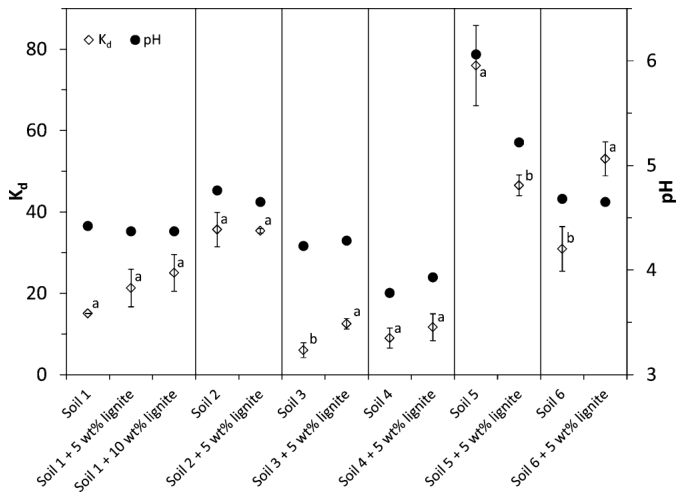
Lignite alone equilibrated with the Ca(NO3)2 solution at pH 4.3. Soil 1 came to equilibrium at approximately the same pH. Therefore, the pH of the Soil 1−lignite mixture would be expected to also be around 4.3, and this is what was observed. For a soil that equilibrates with the solution above pH 4.3, a decrease in pH should be expected when it is blended with lignite. Likewise, an increase in pH is expected for a soil equilibrating with the solution below pH 4.3. The data in Figure 2 confirm these expectations. The critical pH value is a function of the lignite type and pretreatment and is also expected to vary between different lignites, depending on the acidic properties of their functional groups and their base saturation.
褐煤单独与Ca(NO3)2溶液平衡时pH为4.3,土壤1达到平衡时的pH与之大致相同。因此,土壤1−褐煤混合物的pH预计也在4.3左右,观测结果亦是如此。对于与溶液平衡时pH高于4.3的土壤,与褐煤混合后pH预计会下降;同理,对于平衡pH低于4.3的土壤,pH预计会升高。图2中的数据证实了上述预期。该临界pH值取决于褐煤类型及预处理方式,并预计因褐煤不同而异,取决于其官能团的酸性性质及盐基饱和度。
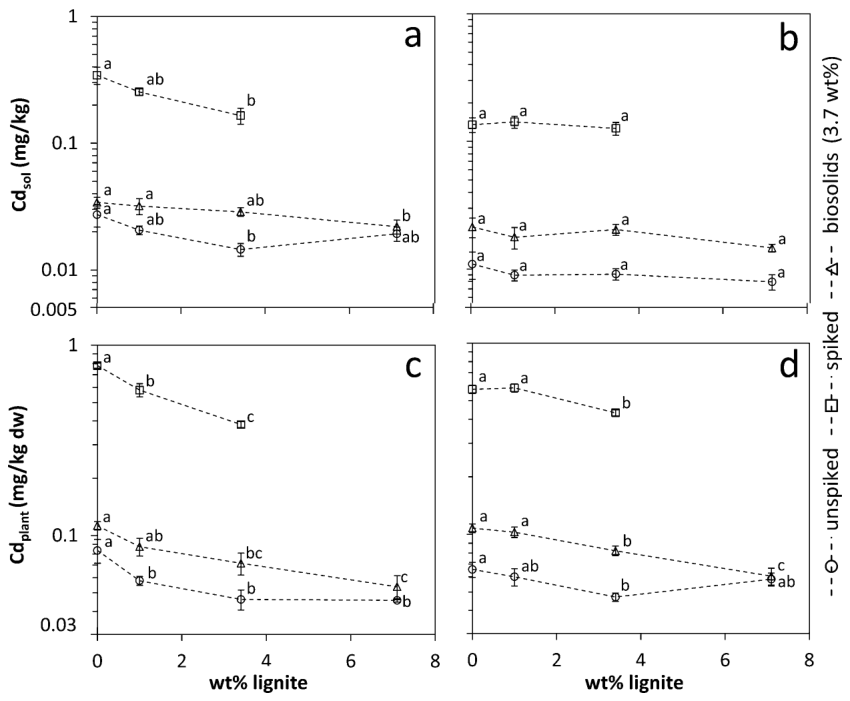
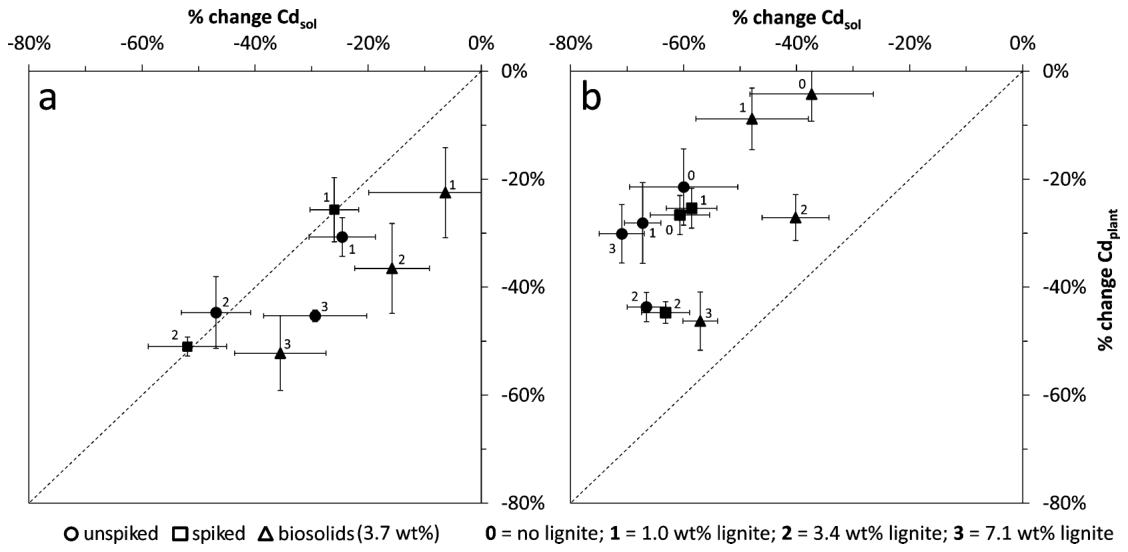
Effect of Lignite Addition on Plant Uptake of Cd. Figures 3 and 4 show that lignite addition reduced Ca(NO3)2− extractable Cd concentrations and accumulation in ryegrass by up to 52% in the treatments without lime addition (Figure 3a, Figure 4a). In the treatments with lime addition (Figure 3b, Figure 4b), 3.4 wt % lignite addition did not reduce the Ca(NO3)2−extractable concentration of Cd but still reduced plant uptake. Although significant, this reduction was less than without liming (Figure 3c, Figure 4a). That the effect of lignite on plant uptake was less at higher pH values is consistent with the findings from batch experiments. When lignite was added to the soils, the pH decreased by up to 0.1 units without liming and by 0.6 pH units with liming. As the pH decrease was more pronounced in the limed treatments, we expect a stronger negative effect on Cd adsorption. This may be responsible for the differences in efficiency of lignite addition in reducing Cd solubility and plant uptake between unlimed and limed soil.
褐煤添加对植物Cd吸收的影响。由图3和图4可见,在不施石灰的处理中,褐煤添加使Ca(NO3)2可提取态Cd浓度及黑麦草Cd累积量降低达52%(图3a,图4a)。在施石灰的处理中(图3b,图4b),添加3.4 wt %褐煤未降低Ca(NO3)2可提取态Cd浓度,但仍降低了植物吸收。该降低虽然显著,但幅度小于不施石灰的情况(图3c,图4a)。褐煤对植物吸收的影响在较高pH下较小,这与批量试验的结果一致。向土壤中添加褐煤后,不施石灰时pH最多下降0.1个单位,施石灰时下降0.6个pH单位。由于施石灰处理中pH下降更为明显,预计其对Cd吸附的负面影响更强。这可能是褐煤添加在降低Cd溶解度及植物吸收方面的效率在不施石灰与施石灰土壤之间存在差异的原因。
Potentially, lignite could be blended with a sufficient amount of lime to buffer the pH drop. Several authors recommended reducing soil acidity by liming as a suitable measure to reduce Cd plant uptake.6,39 Calcium may compete with Cd for exchange sites on root surfaces, further reducing uptake. Therefore, the application of a combination of lignite and lime is expected to be more effective in reducing Cd plant uptake than lignite alone. In this study, liming did not enhance the ability of lignite to reduce plant Cd-uptake (Figure 4 a and b). The lack of effect of liming on Cd plant uptake under certain conditions was described by several authors.40−42 Loganathan et al.40 stated that the large amount of Ca added via lime might compete with Cd for sorption to soil if the pH is not sufficiently increased by the lime application to specifically sorb and immobilize Cd.40 This would imply that outer sphere complexation is an important Cd sorption mechanism in the soil/lignite mixtures as Ca is known to bind generally via ion exchange mechanism and is not expected to compete in inner sphere sorption. The importance of outer and inner sphere sorption in soil at biologically relevant concentrations (<5 mg/ kg) is debated. Experimental evidence is scarce as most of the studies investigating sorption mechanisms to soil used high concentrations not found in pasturelands. At a low Cd loading the effect of pH on Cd sorption is much lower and Cd tends to bind increasingly as inner sphere complexes.40 Harter and Naidu42 suggested this lack of pH effect in high affinity soils at low Cd loading might explain the absence of effect of liming on plant uptake.42 Neither Ca competition nor lack of pH effect on Cd sorption in high affinity soils explains the lack of liming effect on plant uptake in this study as the solubility of Cd was significantly reduced. Other possible reasons are that lime increases root growth (not measured) by supplying Ca and ameliorating soil acidity; lime decreases Zn availability, thereby reducing Zn competition with Cd for plant uptake; and Ca from lime increases root cell permeability, thereby facilitating root Cd uptake.41 Due to plant and/or microbial activity the pH in the rhizosphere between the treatments with and without lime addition may be more similar than the pH values observed in the bulk soil.43−46 Local buffering of the pH in the rhizosphere by biological activity might explain the lack of effect of lime addition on Cd plant uptake. Whether and how L. perenne and/or microorganisms changed the rhizosphere pH value in our experiment cannot be deduced from the results.
理论上,可将褐煤与足量石灰混合以缓冲pH下降。多位学者推荐通过施石灰降低土壤酸度,作为减少植物Cd吸收的适宜措施。6,39钙可能与Cd竞争根表面的交换位点,从而进一步降低吸收。因此,联合施用褐煤和石灰预计比单独施用褐煤更能有效降低植物Cd吸收。但在本研究中,施石灰并未增强褐煤降低植物Cd吸收的能力(图4 a和b)。多位学者曾报道在某些条件下施石灰对植物Cd吸收无影响。40−42Loganathan等40指出,若施石灰未能使pH充分升高以专性吸附并固定Cd,则经石灰添加的大量Ca可能与Cd竞争土壤吸附位点。40这意味着外圈络合是土壤/褐煤混合物中Cd吸附的重要机制,因为已知Ca一般通过离子交换机制结合,预计不会参与内圈吸附竞争。在具有生物学意义的浓度(<5 mg/ kg)下,外圈与内圈吸附在土壤中的相对重要性尚存争议。由于大多数研究土壤吸附机制的工作采用了牧场中不存在的高浓度,相关实验证据十分有限。在低Cd负载下,pH对Cd吸附的影响要小得多,Cd趋于更多地以内圈络合物形式结合。40Harter和Naidu42认为,低Cd负载下高亲和力土壤中pH效应的缺失可能解释了施石灰对植物吸收无影响的现象。42然而,由于本研究中Cd溶解度已显著降低,Ca竞争及高亲和力土壤中pH对Cd吸附无影响均不能解释本研究中施石灰对植物吸收无影响的现象。其他可能的原因包括:石灰通过提供Ca和改善土壤酸度促进根系生长(未测定);石灰降低Zn有效性,从而减少Zn与Cd在植物吸收上的竞争;以及石灰中的Ca增加根细胞通透性,从而促进根系对Cd的吸收。41由于植物和/或微生物活动,施石灰与不施石灰处理之间根际pH的差异可能小于在土体中观测到的pH差异。43−46生物活动对根际pH的局部缓冲可能解释了施石灰对植物Cd吸收无影响的现象。至于本试验中L. perenne和/或微生物是否以及如何改变根际pH,无法从结果中推断。
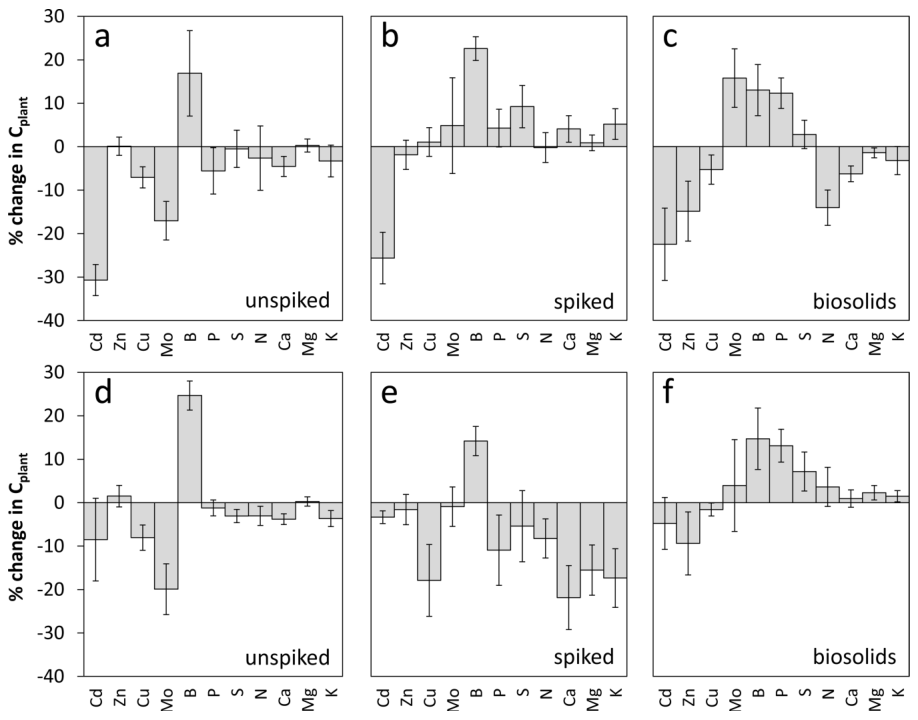
Effect of Lignite on the Concentrations of Other Elements in Pasture. Figure 5 shows that plant concentrations of Ca, Cu, and Mo were significantly reduced for 1 wt % lignite addition, except in the unlimed spiked treatment, where there is a marginal increase (Figure 5 A2) and in the limed biosolids treatment (Figure 5 B3), where plant Ca was unchanged. Plant Zn uptake was significantly reduced in the biosolids treatments that had elevated Zn concentrations. Plant B concentrations significantly increased with increasing lignite addition. In the unlimed soil, the reduction in Cd concentration was greater than the reduction in plant concentration of other elements measured.
褐煤对牧草中其他元素浓度的影响。由图5可见,添加1 wt %褐煤显著降低了植物中Ca、Cu和Mo的浓度,但不施石灰的加标处理例外,其中这些元素略有增加(图5 A2);施石灰的生物固体处理中(图5 B3),植物Ca浓度亦未改变。在Zn浓度较高的生物固体处理中,植物Zn吸收显著降低。植物B浓度随褐煤添加量增加而显著升高。在不施石灰的土壤中,Cd浓度的降低幅度大于所测其他元素植物浓度的降低幅度。
Table S2 and Table S3 show the influence of lignite addition on soil pH and soluble concentrations of nutrients. Assuming that the bioavailability of Cd, Zn, and Cu is a function of their solubility in a 0.05 M Ca(NO3)2 extractant, this observation is surprising as Zn and especially Cu are often cited to show higher affinity to organic matter than Cd.47 However, Cu and Zn also form complexes with dissolved organic matter, some of which may be bioavailable.34 This may further indicate the importance of S groups in complexation of Cd by lignite at biologically relevant concentrations. In contrast to sorption on carboxylic groups, Cd is usually more competitive than Zn in binding to reduced sulfur groups.48 Martinez et al.48 found that表S2和表S3显示了褐煤添加对土壤pH及养分可溶性浓度的影响。假定Cd、Zn和Cu的生物有效性是其在0.05 M Ca(NO3)2浸提剂中溶解度的函数,则这一观察结果出人意料,因为通常认为Zn尤其是Cu对有机质的亲和力高于Cd。47然而,Cu和Zn也会与溶解性有机质形成络合物,其中部分可能具有生物有效性。34这可能进一步表明在具有生物学意义的浓度下S基团在褐煤络合Cd中的重要性。与在羧基上的吸附不同,在与还原态硫基团结合时,Cd的竞争力通常强于Zn。48Martinez等48发现,
peat had a higher affinity for Cd than for Zn and concluded that this might indicate high importance of sulfur groups in the binding of Cd in peat.48
泥炭对Cd的亲和力高于Zn,并据此认为这可能表明硫基团在泥炭结合Cd中具有重要作用。48
Effect on the Lignite on Pasture Growth. Lignite additions of 1.0 and 3.4 wt % had no significant effect on biomass, while the highest addition of lignite (7.1 wt %) decreased pasture biomass, where it was applied, by 10−20% in most treatments (Table S4). In contrast, other authors showed significant increase in plant biomass when lignite was applied.10,12 In these studies, soil was highly contaminated with heavy metals. Lignite addition might have eased phytotoxic effects by rendering metals at toxic levels unavailable to the plant which in turn might have caused the increase in biomass. The decrease in biomass observed in this study might be caused by the sorption of limiting plant nutrients, such as Cu, which were significantly reduced in some treatments (Tables S4 and S5). The decrease in biomass was most pronounced for the treatments fertilized with biosolids. Therefore lignite might have locked up plant nutrients that were released from the biosolids. Alternatively, the biomass reduction may have come from incipient B toxicity as this element was significantly increased in all lignite treatments (Table S5).
褐煤对牧草生长的影响。添加1.0和3.4 wt %褐煤对生物量无显著影响,而最高添加量(7.1 wt %)在大多数处理中使牧草生物量降低10−20%(表S4)。与此相反,其他学者报道施用褐煤可显著增加植物生物量。10,12在这些研究中,土壤受到重金属的严重污染,褐煤添加可能通过使达到毒性水平的金属对植物不可利用而减轻植物毒性效应,进而导致生物量增加。本研究中观察到的生物量下降可能是由于褐煤吸附了Cu等限制性植物养分,这些养分在部分处理中显著降低(表S4和S5)。生物量下降在施用生物固体的处理中最为明显,因此褐煤可能固定了生物固体所释放的植物养分。另外,生物量降低也可能源于初期的B毒害,因为该元素在所有褐煤处理中均显著增加(表S5)。
Potential for Lignite to Mitigate Plant Cd-Uptake in Pasturelands. The addition of 1 wt % (dry matter) lignite to the top 120 mm of the soil profile, where most Cd occurs,49 may be an effective and relative selective amendment for in situ fixation of fertilizer-borne Cd in soil without adversely affecting plant growth. This represents a rate of 23.2 tonnes (fresh weight) per hectare, assuming a soil density of 1.2 g/cm3. However, the effectiveness of the lignite depends on the soil type and lignite amendment might be ineffective in rendering Cd less bioavailable in some soils. Future work should investigate the effect of lignite on the fluxes of Cd and other elements in the soil-plant system over a longer period of time. While lignite has been shown to be relatively persistent in soil,10 it is unclear how its ability to bind Cd or other elements would change.
褐煤缓解牧场植物Cd吸收的潜力。在大部分Cd所在的土壤剖面表层120 mm49中添加1 wt %(干物质)褐煤,可能是原位固定土壤中肥料源Cd的一种有效且相对选择性的改良措施,且不会对植物生长产生不利影响。假定土壤容重为1.2 g/cm3,这相当于每公顷23.2吨(鲜重)的施用量。然而,褐煤的效果取决于土壤类型,在某些土壤中褐煤改良可能无法有效降低Cd的生物有效性。今后的研究应在更长时间尺度上考察褐煤对土壤-植物系统中Cd及其他元素通量的影响。尽管已证明褐煤在土壤中相对持久10,但其结合Cd或其他元素的能力将如何变化尚不清楚。
4ASSOCIATED CONTENT相关内容
*S Supporting Information*S 支持信息
Table S1 lists the treatments of BE1. Figure S1 shows pH as a function of acid/base addition as observed in BE1. Table S2 and Table S3 show the influence of lignite addition on soil pH and soluble concentrations of nutrients and Table S4 and Table S5 the influence of lignite addition on biomass and the concentrations of nutrients in L. perenne (pot experiment). Figure S2 shows the difference in element concentration in L. perenne for the treatments with 3.4 wt % lignite addition relative to the corresponding treatment without lignite addition analogous to Figure 5. This material is available free of charge via the Internet at http://pubs.acs.org.表S1列出了BE1的处理。图S1显示了BE1中pH随酸/碱添加量的变化。表S2和表S3显示了褐煤添加对土壤pH及养分可溶性浓度的影响,表S4和表S5显示了褐煤添加对L. perenne生物量及养分浓度的影响(盆栽试验)。图S2显示了添加3.4 wt %褐煤的处理相对于相应不添加褐煤处理的L. perenne元素浓度差异,与图5类似。上述材料可通过互联网http://pubs.acs.org免费获取。
5AUTHOR INFORMATION作者信息
Corresponding Author通讯作者
*E-mail: brett.robinson@lincoln.ac.nz.
Notes注
The authors declare no competing financial interest.
作者声明无竞争性经济利益。
6ACKNOWLEDGMENTS致谢
We gratefully acknowledge funding for this work from Solid Energy New Zealand Ltd and the staff of Solid Energy’s New
感谢Solid Energy New Zealand Ltd对本研究的资助,并感谢Solid Energy公司New
Vale Mine for providing the sample. We would like to thank Dharini Paramashivam for measuring cation exchange capacity of lignite.
Vale矿工作人员提供样品。感谢Dharini Paramashivam测定褐煤的阳离子交换量。
7REFERENCES参考文献
(1) Kabata-Pendias, A.; Mukherjee, A. B. Trace elements from soil to human; Springer: Berlin, 2007.
(2) Cadmium Working Group Cadmium and New Zealand Agriculture and Horticulture: A Strategy for Long Term Risk Management; Technical Paper No. 2011/02; Ministry of Agriculture and Forestry Wellington: 2011.
(3) Hooda, P. S. Trace elements in soils; Wiley: Chichester, 2010.
(4) Kabata-Pendias, A.; Pendias, H. Trace elements in soils and plants; CRC Press: Boca Raton, 2001.
(5) Taylor, M.; Gibb, R.; Willoughby, J.; Hewitt, A.; Arnold, G. Soil maps of cadmium in New Zealand; Landcare Research Contract Report; Ministry of Agriculture and Forestry: Wellington, 2007.
(6) Loganathan, P.; Hedley, M. J.; Grace, N. D.; Lee, J.; Cronin, S. J.; Bolan, N. S.; Zanders, J. M. Fertiliser contaminants in New Zealand grazed pasture with special reference to cadmium and fluorine: A review. Aust. J. Soil Res. 2003, 41 (3), 501−532.
(7) Lee, J.; Rounce, J. R.; Mackay, A. D.; Grace, N. D. Accumulation of cadmium with time in Romney sheep grazing ryegrass white clover pasture: Effect of cadmium from pasture and soil intake. Aust. J. Agric. Res. 1996, 47 (6), 877−894.
(8) Guo, G. L.; Zhou, Q. X.; Ma, L. Q. Availability and assessment of fixing additives for the in situ remediation of heavy metal contaminated soils: A review. Environ. Monit. Assess. 2006, 116 (1− 3), 513−528.
(9) Bolan, N. S.; Adriano, D. C.; Duraisamy, P.; Mani, A. Immobilization and phytoavailability of cadmium in variable charge soils. III. Effect of biosolid compost addition. Plant Soil 2003, 256 (1), 231−241.
(10) Pusz, A. Influence of brown coal on limit of phytotoxicity of soils contaminated with heavy metals. J. Hazard. Mater. 2007, 149 (3), 590−597.
(11) Kwiatkowska, J.; Provenzano, M. R.; Senesi, N. Long term effects of a brown coal-based amendment on the properties of soil humic acids. Geoderma 2008, 148 (2), 200−205.
(12) Ciecko, Z.; Wyszkowski, M.; Krajewski, W.; Zabielska, J. Effect of organic matter and liming on the reduction of cadmium uptake from soil by triticale and spring oilseed rape. Sci. Total Environ. 2001, 281 (1−3), 37−45.
(13) Skłodowski, P.; Maciejewska, A.; Kwiatkowska, J. The effect of organic matter from brown coal on bioavailability of heavy metals in contaminated soils. In Viable Methods of Soil and Water Pollution Monitoring, Protection and Remediation; Twardowska, I., Allen, H. E., Haggblom, M. M., Stefaniak, S., Eds.; Springer: Dordrecht, 2006; Vol. 69, pp 299−307.
(14) Beesley, L.; Marmiroli, M. The immobilisation and retention of soluble arsenic, cadmium and zinc by biochar. Environ. Pollut. 2011, 159 (2), 474−480.
(15) Park, J. H.; Choppala, G. K.; Bolan, N. S.; Chung, J. W.; Chuasavathi, T. Biochar reduces the bioavailability and phytotoxicity of heavy metals. Plant Soil 2011, 348 (1−2), 439−451.
(16) World Energy Council 2010 Survey of Energy Resources; World Energy Council: London, 2010.
(17) Pentari, D.; Perdikatsis, V.; Katsimicha, D.; Kanaki, A. Sorption properties of low calorific value Greek lignites: Removal of lead, cadmium, zinc and copper ions from aqueous solutions. J. Hazard. Mater. 2009, 168 (2−3), 1017−1021.
(18) Pehlivan, E.; Arslan, G. Removal of metal ions using lignite in aqueous solution - Low cost biosorbents. Fuel Process. Technol. 2007, 88 (1), 99−106.
(19) William, H. C. The chemical forms of sulfur in coal: A review. Fuel 1994, 73 (4), 475−484.
Environmental Science & Technology
(20) Havelcova, M.; Mizera, J.; Sykorova, I.; Pekar, M. Sorption of metal ions on lignite and the derived humic substances. J. Hazard. Mater. 2009, 161 (1), 559−564.
(21) Karabulut, S.; Karabakan, A.; Denizli, A.; Yurum, Y. Cadmium (II) and mercury (II) removal from aquatic solutions with low-rank Turkish coal. Sep. Sci. Technol. 2001, 36 (16), 3657−3671.
(22) Burns, C. A.; Boily, J. F.; Crawford, R. J.; Harding, I. H. Cd(II) binding by particulate low-rank coals in aqueous media: sorption characteristics and NICA-Donnan models. J. Colloid Interface Sci. 2004, 278 (2), 291−298.
(23) Jochova, M.; Puncochar, M.; Horacek, J.; Stamberg, K.; Vopalka, D. Removal of heavy metals from water by lignite-based sorbents. Fuel 2004, 83 (9), 1197−1203.
(24) Pehlivan, E.; Arslan, G. Comparison of adsorption capacity of young brown coals and humic acids prepared from different coal mines in Anatolia. J. Hazard. Mater. 2006, 138 (2), 401−408.
(25) Pehlivan, E.; Richardson, A.; Zuman, P. Electrochemical investigation of binding of heavy metal ions to Turkish lignites. Electroanalysis 2004, 16 (16), 1292−1298.
(26) Janos, P.; Sypecka, J.; Mlckovska, P.; Kuran, P.; Pilarova, V. Removal of metal ions from aqueous solutions by sorption onto untreated low-rank coal (oxihumolite). Sep. Purif. Technol. 2007, 53 (3), 322−329.
(27) Lao, C. X.; Zeledon, Z.; Gamisans, X.; Sole, M. Sorption of Cd(II) and Pb(II) from aqueous solutions by a low-rank coal (leonardite). Sep. Purif. Technol. 2005, 45 (2), 79−85.
(28) Alloway, B. J.; Steinnes, E. Anthropogenic Additions of Cadmium to Soils. In Cadmium in soils and plants; McLaughlin, M. J., Singh, B. R., Eds.; Kluwer Academic Publishers: Dordrecht, 1999; pp 97−123.
(29) Houba, V.; Uittenbogaard, J.; Pellen, P.; Brader, A. Wageningen evaulating programmes for analytical laboratories; Department of Environmental Sciences, Wageningen Agricultural University: Wageningen, 1998.
(30) Blakemore, L. C.; Searle, P. L.; Daly, B. K. Methods for chemical analysis of soils; scientific report 80; New Zealand Soil Bureau, Department of Scientific and Industrial Research: Lower Hutt, NZ, 1987.
(40) Loganathan, P.; Vigneswaran, S.; Kandasamy, J.; Naidu, R. Cadmium sorption and desorption in soils: A review. Crit. Rev. Environ. Sci. Technol. 2012, 42 (5), 489−533.
(41) Loganathan, P.; Hedley, M. J.; Grace, N. D.; Whitacre, D. M. Pasture Soils Contaminated with Fertilizer-Derived Cadmium and Fluorine: Livestock Effects. In Reviews of Environmental Contamination and Toxicology; Whitacre, D. M., Ed.; Springer: New York, 2008; Vol. 192, pp 29−66.
(42) Harter, R. D.; Naidu, R. An assessment of environmental and solution parameter impact on trace-metal sorption by soils. Soil Sci. Soc. Am. J. 2001, 65 (3), 597−612.
(43) Blossfeld, S.; Perriguey, J.; Sterckeman, T.; Morel, J. L.; Losch, R. Rhizosphere pH dynamics in trace-metal-contaminated soils, monitored with planar pH optodes. Plant Soil 2010, 330 (1−2), 173−184.
(44) Gahoonia, T. S.; Claassen, N.; Jungk, A. Mobilization of phosphate in different soils by ryegrass supplied with ammonium or nitrate. Plant Soil 1992, 140 (2), 241−248.
(45) Pinel, F.; Leclerc-Cessac, E.; Staunton, S. Relative contributions of soil chemistry, plant physiology and rhizosphere induced changes in speciation on Ni accumulation in plant shoots. Plant Soil 2003, 255 (2), 619−629.
(46) Logan, K. A. B.; Thomas, R. J. Interactions between N supply and N uptake by perennial ryegrass, (15)N recovery and soil pH for four acid Scottish soils. Grass Forage Sci. 1999, 54 (1), 42−51.
(47) Scheffer, F.; Schachtschabel, P.; Blume, H.-P.; Thiele-Bruhn, S. Lehrbuch der Bodenkunde; Spektrum Akademischer Verlag: Heidelberg, 2010.
(48) Martinez, C. E.; McBride, M. B.; Kandianis, M. T.; Duxbury, J. M.; Yoon, S. J.; Bleam, W. F. Zinc-sulfur and cadmium-sulfur association in metalliferous peats evidence from spectroscopy, distribution coefficients, and phytoavailability. Environ. Sci. Technol. 2002, 36 (17), 3683−3689.
(49) Loganathan, P.; Hedley, M. J.; Gregg, P. E. H.; Currie, L. D. Effect of phosphate fertiliser type on the accumulation and plant availability of cadmium in grassland soils. Nutr. Cycling Agroecosyst. 1997, 46 (3), 169−178.
(50) Landcare Research New Zealand Fundamental Soil Layer. www. landcareresearch.co.nz (accessed June 11, 2012).
(31) FAL; RAC; FAW Schweizerische Referenzmethoden der Eidgenossischen Landwirtschaftlichen Forschungsanstalten; Agroscope FAL Reckenholz: Zurich, 1996.
(32) Degryse, F.; Smolders, E.; Parker, D. R. Partitioning of metals (Cd, Co, Cu, Ni, Pb, Zn) in soils: concepts, methodologies, prediction and applications - a review. Eur. J. Soil Sci. 2009, 60 (4), 590−612.
(33) Karlsson, T.; Elgh-Dalgren, K.; Björn, E.; Skyllberg, U. Complexation of cadmium to sulfur and oxygen functional groups in an organic soil. Geochim. Cosmochim. Acta 2007, 71 (3), 604−614.
(34) Bolan, N.; Adriano, D.; Mani, S.; Khan, A. Adsorption, complexation, and phytoavailability of copper as influenced by organic manure. Environ. Toxicol. Chem. 2003, 22 (2), 450−456.
(35) Antoniadis, V.; Alloway, B. J. The role of dissolved organic carbon in the mobility of Cd, Ni and Zn in sewage sludge-amended soils. Environ. Pollut. 2002, 117 (3), 515−521.
(36) Evangelou, M. W. H.; Daghan, H.; Schaeffer, A. The influence of humic acids on the phytoextraction of cadmium from soil. Chemosphere 2004, 57 (3), 207−213.
(37) Bolan, N. S.; Adriano, D. C.; Kunhikrishnan, A.; James, T.; McDowell, R.; Senesi, N. Dissolved organic matter: biogeochemistry, dynamics, and environmental significance in soils. In Advances in Agronomy, Vol 110; Sparks, D. L., Ed.; 2011; Vol. 110, pp 1−75.
(38) Anitha, K.; Bolan, N. S.; Muller, K.; Laurenson, S.; Ravi, N.; Kim, W. The influence of wastewater irrigation on the transformation and bioavailability of heavy metal(loid)s in soil. Adv. Agron. 2012, 115, 215−297.
(39) McLaughlin, M. J.; Tiller, K. G.; Naidu, R.; Stevens, D. P. Review: The behaviour and environmental impact of contaminants in fertilizers. Aust. J. Soil Res. 1996, 34 (1), 1−54.